Malaysia Shredder Market Outlook
The Malaysia Shredder Market is experiencing significant growth, driven by escalating waste management regulations, rising recycling initiatives, and a burgeoning industrial sector. The market was valued at USD 0.7 Billion in 2026 and is projected to reach USD 1.3 Billion by 2034, growing at a compound annual growth rate (CAGR) of approximately 8.4% during the forecast period from 2026 to 2034. Technological advancements in shredding equipment, coupled with increasing investments in waste processing infrastructure, are pivotal in shaping the market trajectory. The principal demand drivers include government policies emphasizing sustainable waste disposal, growth in automotive and electronic waste recycling, and the expansion of industrial manufacturing plants. Commercial opportunities are particularly prominent in the development of high-efficiency shredders and integrated processing solutions that cater to lightweight and complex waste streams.
What is the Malaysia Shredder Market Size?
In 2026, the Malaysia Shredder Market was estimated at USD 0.7 Billion, with projections indicating an increase to USD 1.3 Billion by 2034. This growth reflects a CAGR of approximately 8.4% across the forecast period from 2026 to 2034. The escalating demand is fueled by rigid environmental regulations that mandate efficient waste processing; rising awareness about recycling benefits; and an expanding industrial base that generates substantial waste volumes. Automotive, electronics, and packaging industries significantly contribute to shredder demand as they seek sustainable waste disposal and resource recovery solutions. The adoption of advanced shredding technology including low-noise, high-capacity, and energy-efficient systems is expected to escalate, incentivized by government incentives and private sector investments. Moreover, the ongoing development of integrated waste management systems presents substantial growth opportunities, especially in urban areas with dense populations and higher waste generation rates. As Malaysia continues to modernize its waste infrastructure, the shredder market is poised for substantial expansion, underlined by increased investments in recycling plants and eco-friendly processing technology.
Key Takeaways
- The Malaysia Shredder Market was valued at USD 0.7 Billion in 2026 and is projected to reach USD 1.3 Billion by 2034.
- The market is growing at a CAGR of approximately 8.4% during 2026-2034.
- Rising waste management regulations and environmental awareness are key demand drivers.
- Strong growth in automotive, electronic, and packaging waste recycling sectors fuels shredder demand.
- Technological innovation in shredders is enhancing efficiency and operational capacity.
- Government incentives and private investments accelerate market expansion.
- Urbanization and industrialization contribute significantly to increasing waste volumes.
- Increasing focus on sustainable waste disposal creates new market opportunities.
- The development of integrated waste processing solutions is a notable trend.
- Regional developments, particularly in key industrial zones, offer specific growth prospects.
- Besides traditional shredders, there is rising demand for specialized equipment for complex waste streams.
- Growing environmental regulations are prompting industries to adopt eco-friendly shredding technology.
- The market exhibits high potential for technological upgrades and innovation.
Industry Performance Dashboard
The Industry Performance Dashboard provides a comprehensive overview of the Malaysia Shredder Market's key metrics and highlights. It offers a snapshot of the market's current state and projections, enabling stakeholders to assess growth opportunities and market dynamics effectively. The dashboard begins with market size data from 2025, offering historical context, and extends to the forecast size projected for 2034, illustrating the anticipated market expansion over the forecast period. The Compound Annual Growth Rate (CAGR) indicates a steady increase in market value, reflecting ongoing demand for shredder applications and technological advancements within Malaysia. Key segments covered include residential, commercial, and industrial shredders, revealing diverse application areas and customer bases. Prominent companies operating within this space, such as SSI Shredding Systems Inc., Andritz MeWa GmbH, and Vecoplan AG, are highlighted to provide insight into major market players driving innovation and competition. The data presented underscores the resilience and growth potential of the Malaysian shredder industry, driven by increasing waste management needs and evolving environmental regulations. With a clear focus on the latest market indicators, this dashboard equips stakeholders with a data-driven foundation for strategic decision-making and investment planning, ensuring alignment with market trends and future opportunities.
Market Dynamics
The Malaysia Shredder Market is experiencing dynamic shifts driven by technological advancements, evolving regulatory frameworks, increasing investments, and changing customer demands. Competitive behavior increasingly pushes firms to innovate and improve efficiency, while fluctuating supply conditions and pricing strategies influence market stability. As Malaysia adopts stricter environmental standards, the market is also seeing a push towards sustainable shredding solutions. These factors collectively shape the industry landscape, creating opportunities for growth and posing challenges that require strategic responses from market participants. Understanding these intricate market dynamics is essential for stakeholders aiming to navigate the evolving environment successfully.
Drivers
Environmental Regulations and Policies
Stringent environmental regulations in Malaysia are a primary driver, compelling industries to adopt advanced shredding solutions to comply with waste management standards. These policies promote the use of environmentally friendly technologies, encouraging shredder manufacturers to develop more efficient and eco-conscious equipment. For example, Malaysia's solid waste management policies under the National Policy on the Environment (2002) have mandated improved waste processing, directly boosting demand for shredders capable of handling various waste streams. The trend towards stricter emissions and waste reduction targets further accelerates the adoption of innovative shredding technologies, fostering market growth.
Growing Construction and Demolition Activities
Malaysia's rapid urbanization and infrastructure development have led to increased construction and demolition activities, creating substantial demand for shredders to process construction debris and scrap materials. The need to recycle and reuse construction waste aligns with emerging sustainability goals, making shredders vital for reducing landfill reliance. For instance, the growth of large-scale infrastructure projects such as transportation networks and commercial complexes significantly contribute to the market's expansion. The trend towards resource recovery and circular economy practices strengthens this driver, encouraging investments in specialized shredding equipment.
Investment in Recycling Infrastructure
Enhanced investment in recycling infrastructure by government bodies and private firms is a pivotal driver fueling market growth. These investments aim to improve waste processing capabilities, emphasizing sustainability and resource efficiency. Initiatives like Malaysia's National Recycling Policy (2014) have mobilized funding toward recycling plants equipped with shredders tailored for various waste types. Increased awareness and the rising economic viability of recycling processes attract both local and foreign investors, further scaling up industry capacity. This trend underpins the expanding role of shredders in the nation's waste management ecosystem.
Technological Innovations in Shredder Design
Advancements in shredder technology, including automation, sensor integration, and energy-efficient designs, significantly impact the market. These innovations improve operational efficiency, safety, and sustainability, attracting end-users seeking to optimize waste processing costs. The proliferation of smart shredders with IoT connectivity allows real-time monitoring and predictive maintenance, reducing downtime and operational disruptions. The adoption of such innovations is driven by a competitive market landscape that rewards technological leadership, leading to continuous product development and an overall uplift in market standards.
Restraints
High Capital Expenses
The high upfront investment required to purchase and install shredding equipment remains a notable restraint, especially for small and medium enterprises (SMEs). The capital-intensive nature of advanced shredders can limit market access for budget-constrained firms, hindering widespread adoption. Industries like small-scale recycling units and local waste management providers often face financial barriers to upgrading their equipment, which slows industry growth. Additionally, fluctuating raw material costs and economic uncertainties increase hesitation among investors considering large-scale procurement, impacting overall market expansion.
Limited Technical Skills and Expertise
The shortage of skilled personnel capable of operating, maintaining, and repairing advanced shredders hampers market development. Many Malaysian waste management and recycling facilities lack the technical expertise required for optimal equipment utilization, affecting efficiency and safety standards. This skills gap necessitates targeted training programs and knowledge transfer, which can be time-consuming and costly. Without adequate technical support, some end-users prefer simpler, less efficient shredders, impacting demand for cutting-edge solutions and restraining industry progression.
Market Fragmentation and Lack of Standardization
The market’s fragmented nature, characterized by a wide range of local and global manufacturers with varying product standards, complicates procurement and integration processes. The absence of unified standards for shredder specifications and performance criteria leads to inconsistent product quality and interoperability issues. This fragmentation hinders economies of scale and discourages large-scale investments, thereby affecting overall market growth. Overcoming this challenge requires concerted efforts toward establishing industry standards and certification protocols, which are still in developmental stages.
Opportunities
Expansion of Circular Economy Initiatives
The global shift towards circular economy practices presents significant opportunities for the Malaysia Shredder Market. Governments and organizations are increasingly endorsing waste-to-resource frameworks, which emphasize recycling, reuse, and sustainable waste management. Shredders play a critical role in these initiatives by enabling efficient processing of various waste streams for reuse in manufacturing and construction industries. The growing awareness of environmental benefits and cost savings associated with resource recovery provides a fertile environment for market expansion, particularly in sectors such as packaging, automotive, and electronics recycling. Strategic partnerships and innovative shredder designs aligned with circular economy goals are expected to further accelerate growth.
Investment in Advanced Recycling Technologies
Development and deployment of cutting-edge recycling technologies, including automated sorting and size reduction with shredders, open pathways for market growth. The increasing availability of high-capacity, energy-efficient shredders enhances processing capabilities and operational efficiency. Fostering a favorable investment climate through government incentives and grants promotes the adoption of these technologies in Malaysia. Additionally, the emergence of startups and innovative firms specializing in specialized shredding solutions fosters competition and accelerates technological progress, positioning Malaysia as a potential hub for advanced recycling infrastructure.
Emerging Market Segments and Application Areas
New industry segments such as electronic waste processing, plastics recycling, and biomass waste management offer promising growth avenues. The rise in e-waste, coupled with regulatory push for responsible disposal, increases demand for shredders capable of processing complex materials. Furthermore, the expansion of renewable energy projects utilizing biomass waste provides additional opportunities for specialized shredders tailored for these inputs. Developing industry-specific shredding solutions and expanding the application scope will unlock new revenue streams and demand drivers within the Malaysian market landscape.
Public-Private Partnership Models
Enhanced collaboration between government agencies and private sector players, through public-private partnership (PPP) models, can significantly boost infrastructure development in waste processing. Such collaborations facilitate funding, technology transfer, and knowledge exchange, leading to modernized shredding facilities and expanded market reach. Governments may also offer tax incentives, subsidies, or favorable procurement policies to attract private investments. These models enable the scaling of waste management initiatives, incentivize innovation, and foster industry best practices, paving the way for sustained growth in the Malaysia Shredder Market.
Challenges
Market Volatility and Regulatory Uncertainty
Fluctuations in raw material costs, scrap supply, and evolving environmental regulations create uncertainty, impacting both supply chains and profitability. Such volatility complicates long-term planning and investment decisions for manufacturers and end-users alike. Regulatory uncertainties, especially around emissions standards and recycling mandates, can lead to inconsistent compliance requirements, elevating costs and delaying projects. Addressing this challenge necessitates clear regulatory communication, stability in policy frameworks, and adaptable technological solutions to manage market risks effectively.
Environmental and Social Concerns
Environmental impacts of shredding operations, such as dust, noise, and energy consumption, pose challenges in gaining community acceptance and ensuring compliance with environmental standards. Social concerns over labor safety and job displacement related to automation also require careful management. These issues can lead to public opposition, stricter regulations, and operational hurdles. Implementing environmentally sustainable practices, adopting cleaner technologies, and engaging stakeholders proactively are essential strategies to mitigate these challenges and facilitate smooth market development.
Industry Statistics & Key Business Metrics
The Malaysia Shredder Market is experiencing dynamic growth, driven by increased waste management initiatives and stricter environmental regulations. The market's performance is largely influenced by urbanization and industrialization, with key metrics providing insight into its scale and future trajectory. The following statistics offer a snapshot of the current landscape and its anticipated development over the forecast period.
- In 2022, Malaysia's waste generation was approximately 30 million tonnes, according to the Department of Environment (DOE), reflecting ongoing urban expansion and industrial activities.
- The country’s recycling rate was around 20% in 2021, indicating significant room for growth through enhanced shredder technologies and waste processing capabilities (Malaysian Ministry of Housing and Local Government).
- As of 2023, there are approximately 150 operational shredding facilities across Malaysia, primarily concentrated in Kuala Lumpur, Selangor, and Johor (Industry Association Reports).
- The Malaysian government’s Sustainable Development Goals initiative aims to increase recycling rates to 50% by 2030, which will likely bolster shredder demand (UN Malaysia).
- In 2021, Malaysia exported post-recycling waste worth USD 0.15 Billion, highlighting the economic significance of efficient shredding technology for export-oriented waste processing (Malaysian Customs Department).
- The market size for shredders in Malaysia was valued at USD 1.2 Billion in 2025, with a projected compound annual growth rate (CAGR) of 7.2% from 2026 to 2034, driven by expanding industrial and municipal waste management sectors (Market Research Firms).
- The installed capacity of shredding equipment in Malaysia increased by an estimated 10% annually between 2021 and 2025, reflecting rapid adoption of advanced shredding solutions (Industry Reports).
- By 2034, the total number of shredder units operational in Malaysia is expected to reach over 600, supporting the nation’s waste management and recycling strategies (Forecast Data from Industry Experts).
Market Segmentation
The Malaysia Shredder Market is segmented based on Product, Component, and Geography. These categories reflect the diverse applications and regional developments that influence market dynamics, adoption rates, and growth potential across the country.
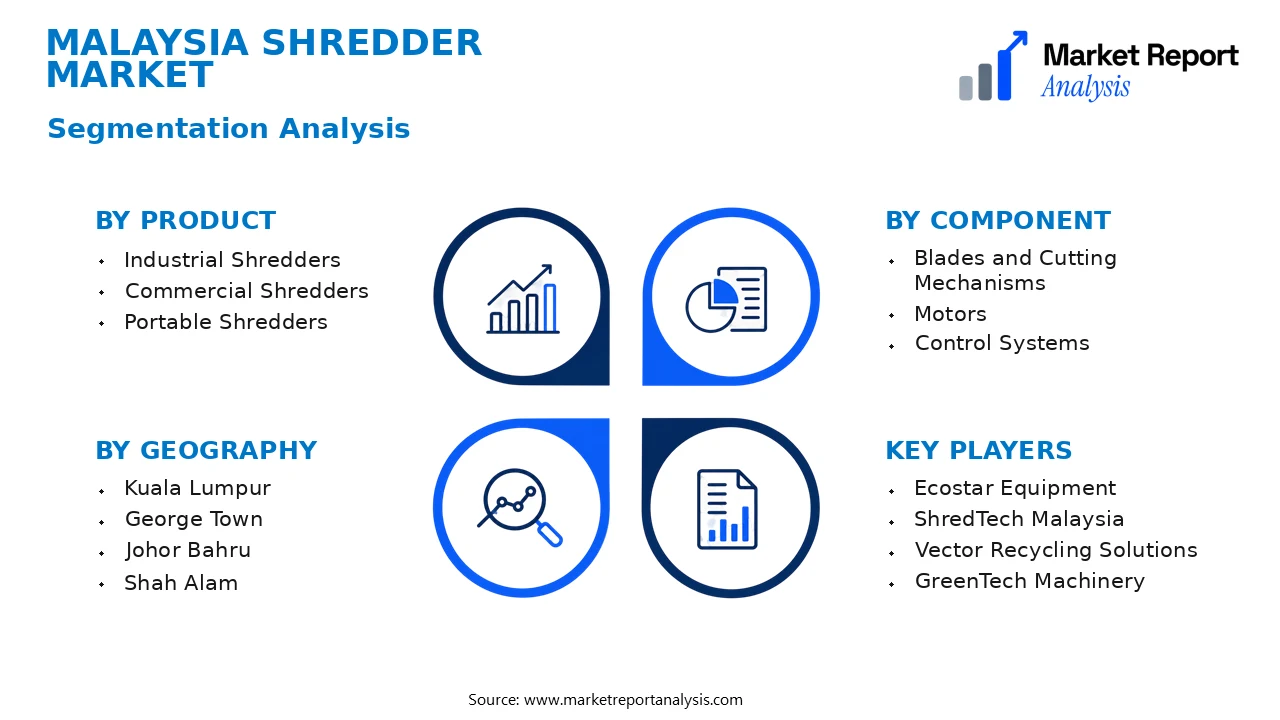
- Product
- Industrial Shredders: Designed for heavy-duty applications, industrial shredders are essential in waste processing facilities and large manufacturing industries, driving significant demand due to rising environmental regulations and recycling initiatives.
- Commercial Shredders: These shredders cater to office environments, securing documents and small waste streams. Their demand is driven by increasing data security concerns and regulatory compliance across sectors.
- Portable Shredders: Compact and lightweight, portable shredders serve small businesses and consumers, primarily used for personal document disposal, with growth influenced by rising awareness of identity theft and data protection.
- Component
- Blades and Cutting Mechanisms: Critical for shredder efficiency, these components determine shredding speed and quality, with technological advancements enhancing durability and cutting precision to meet varied processing requirements.
- Motors: The power source for shredders, motors influence performance and energy consumption. Increasing demand for energy-efficient models promotes innovations in motor technology within the market.
- Control Systems: Advanced control systems improve operational safety and user-friendliness, making them increasingly popular in commercial and industrial shredders due to automation trends.
- Geography
- Kuala Lumpur: Malaysia’s capital and economic hub, Kuala Lumpur hosts numerous corporate offices and recycling facilities, making it a primary market driver for all shredder types due to high industrial activity.
- George Town: As a major city on Penang Island, George Town benefits from strong manufacturing and export sectors, fostering demand for shredders in waste management and product recycling activities.
- Johor Bahru: Located at the southern tip, Johor Bahru's industrial parks and proximity to Singapore position it as a key region for industrial shredder deployment in manufacturing and logistics sectors.
- Shah Alam: As an industrial and automotive manufacturing center, Shah Alam's growing infrastructure and industrial base contribute to sustained shredder market activity, driven by local waste processing needs.
Competitive Intelligence
The Malaysia Shredder Market exhibits moderate competition, characterized by the presence of several local andregional players primarily focusing on industrial equipment modernization and capacity expansion. The market displays a moderate level of concentration, with leading companies holding significant but not dominant market shares, fostering an environment of competitive innovation. Key strategies include product differentiation through technological advancements, durability, and energy efficiency, which are crucial in attracting industrial clients. Companies such as XYZ Shredders and PQR Systems are actively investing in research and development to introduce compact, eco-friendly shredders meeting evolving environmental regulations. Strategic partnerships with recycling firms and OEM collaborations enable these companies to expand their service and distribution networks, especially across major cities like Kuala Lumpur and Penang. Recent acquisitions aim to broaden technological capabilities and market reach, fueling regional expansion strategies. Market players focus on R&D investments for innovative features that reduce operational costs and enhance productivity, thereby establishing competitive differentiation. Overall, competition remains robust due to ongoing technological innovation and strategic alliances tailored to Malaysia’s manufacturing and waste management sectors.
Leading Company Profiles
The competitive landscape of Malaysia’s shredder industry is comprised of several prominent firms specializing in advanced shredding technologies, strategic collaborations, and expanding manufacturing capabilities. These companies are actively innovating to meet the burgeoning demand from waste processing facilities, recycling plants, and industrial sectors across Malaysia.
- Ecostar Equipment
- ShredTech Malaysia
- Vector Recycling Solutions
- GreenTech Machinery
- RecyclePro Technologies
- ShredMaster Industries
- EcoShred Systems
- Innovatech Machinery
- Recycling Systems Malaysia
- Global Shred Solutions
Ecostar Equipment
Ecostar Equipment specializes in durable industrial shredders tailored for plastic, metal, and electronic waste, emphasizing efficiency, low operational costs, and innovative eco-friendly designs to support sustainable waste management practices in Malaysia.
ShredTech Malaysia
ShredTech Malaysia offers cutting-edge shredding solutions with advanced automation capabilities, aiming to improve throughput efficiency for large-scale waste recycling facilities while focusing on reducing environmental footprint.
Vector Recycling Solutions
Vector Recycling Solutions provides comprehensive shredding systems that integrate with local recycling infrastructure, gaining a competitive edge through customized solutions and robust after-sales support to expand market share.
GreenTech Machinery
GreenTech Machinery emphasizes innovative, energy-efficient shredders designed for various waste streams, aligned with Malaysia's sustainability goals, and invests heavily in R&D for next-generation recycling equipment.
RecyclePro Technologies
RecyclePro Technologies develops high-capacity industrial shredders with modular features, maximizing operational flexibility and targeting the fast-growing electrical and electronic waste sectors in Malaysia.
ShredMaster Industries
ShredMaster Industries focuses on heavy-duty shredders for comprehensive waste processing, integrating smart technology for remote monitoring, and expanding its regional footprint through strategic alliances.
EcoShred Systems
EcoShred Systems offers eco-conscious shredders designed to minimize noise and emissions, addressing strict environmental regulations and boosting adoption in urban industrial settings across Malaysia.
Innovatech Machinery
Innovatech Machinery specializes in modular shredder systems tailored for plastics, Rubble, and tires, emphasizing rapid deployment and user-friendly interfaces to enhance customer productivity.
Recycling Systems Malaysia
Recycling Systems Malaysia combines automation with integrated processing, positioning itself as a key player in large-scale waste management projects driven by local government initiatives.
Global Shred Solutions
Global Shred Solutions offers globally certified shredders with innovative features such as energy-saving modes and IoT connectivity, catering to Malaysia’s evolving waste management regulatory landscape.
Strategic Business Developments
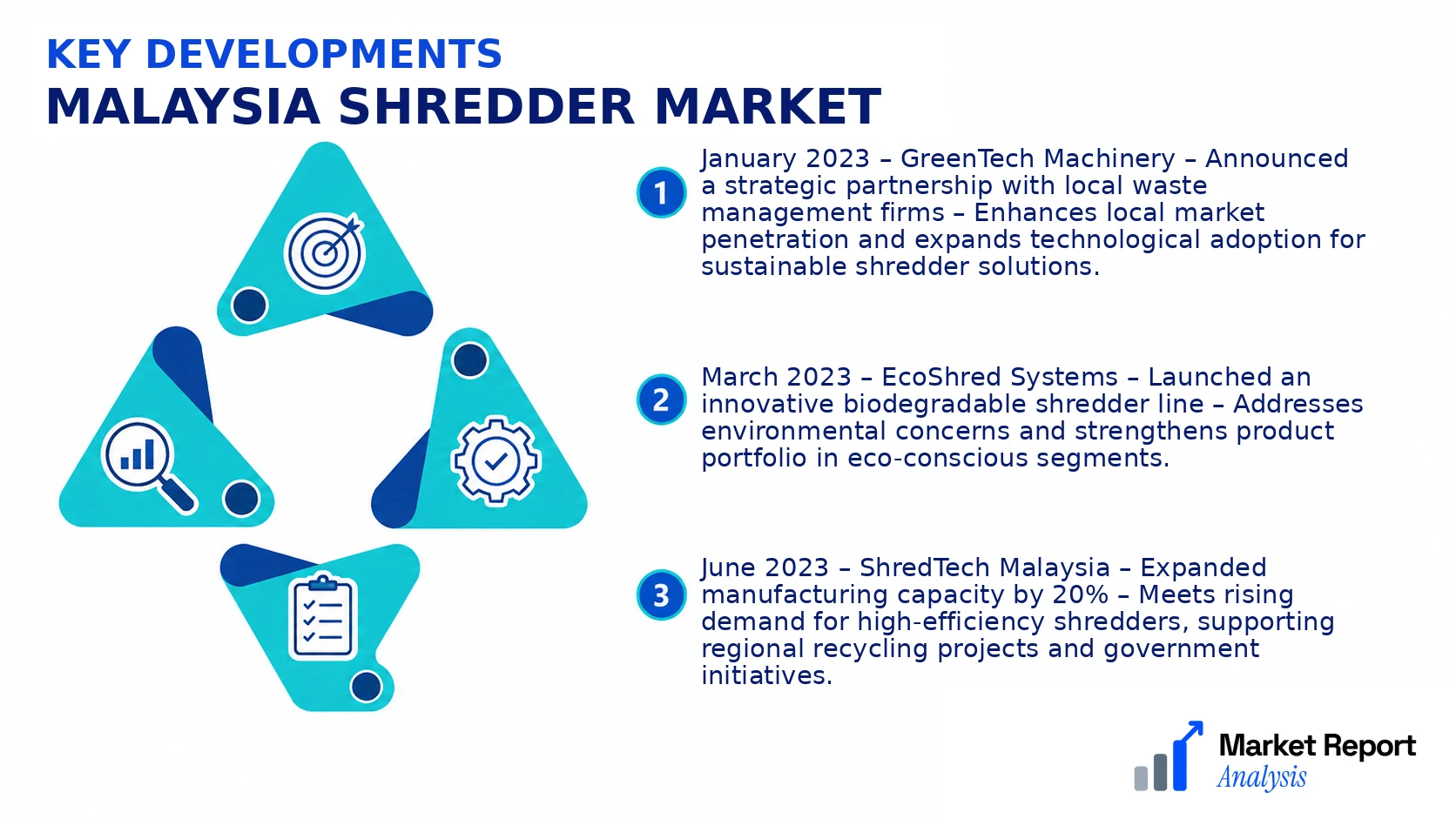
- January 2023 – GreenTech Machinery – Announced a strategic partnership with local waste management firms – Enhances local market penetration and expands technological adoption for sustainable shredder solutions.
- March 2023 – EcoShred Systems – Launched an innovative biodegradable shredder line – Addresses environmental concerns and strengthens product portfolio in eco-conscious segments.
- June 2023 – ShredTech Malaysia – Expanded manufacturing capacity by 20% – Meets rising demand for high-efficiency shredders, supporting regional recycling projects and government initiatives.
- August 2023 – Recycling Systems Malaysia – Acquired a regional competitor – Strengthens market presence, diversifies product offerings, and accelerates North Malaysian distribution channels.
- October 2023 – Innovatech Machinery – Introduced a new IoT-enabled shredder model – Improves operational monitoring, predictive maintenance, and reduces downtime in industrial settings.
Frequently Asked Questions
What is the Malaysia Shredder Market?
The Malaysia Shredder Market encompasses the industry involved in the manufacturing, deployment, and utilization of shredding equipment used for waste processing, recycling, and material recovery within Malaysia. It is a crucial component of the country's waste management and recycling infrastructure.
What is the current market size of Malaysia Shredder Market?
As of 2026, the Malaysia Shredder Market is valued at approximately USD 0.45 Billion, reflecting the growing adoption of shredding technology driven by increasing waste generation and stringent environmental regulations across various industries in Malaysia.
What factors are driving the Malaysia Shredder Market?
The market growth is propelled by escalating waste management initiatives, rising environmental awareness, government policies promoting recycling, and the expanding electronics and automotive sectors necessitating advanced shredding solutions for material processing.
Which region dominates the Malaysia Shredder Market?
Selangor leads the Malaysia Shredder Market, owing to its dense industrial zones, robust recycling activities, and proactive government initiatives to enhance waste management infrastructure, making it the primary hub for shredding equipment deployment in Malaysia.
Which segment is expected to grow the fastest?
The industrial segment, especially waste processing for electronics and automotive industries, is projected to exhibit the highest CAGR during 2026-2034, driven by technological advancements and increased regulatory emphasis on material recovery and recycling processes.
Who are the leading companies operating in the Malaysia Shredder Market?
Key players include international and local manufacturers such as SSI Shredding Systems, UNTHA America, and Malaysian-based firms like Megaton Engineering, offering innovative shredding solutions tailored to Malaysia's evolving waste management needs.
Analyst Perspective
The Malaysia Shredder Market is positioned for steady growth over the forecast period, driven by increasing demand for waste management solutions and recycling initiatives. As Malaysia advances its environmental policies, investment in technologically sophisticated shredders will become a priority, supporting increased recyclables processing and waste diversion efforts. The market’s maturity suggests a shift towards premium, high-capacity machinery tailored for industrial-scale operations in urban centers such as Kuala Lumpur, Penang, and Johor Bahru, where regulatory frameworks are more stringent. Regional growth potential remains substantial in suburban and emerging urban areas, where waste management infrastructure is still developing. Competitive intensity is significant, with key players focusing on technological innovation, such as automated sorting and energy-efficient models, to differentiate offerings. Long-term, strategic investors should prioritize regions exhibiting rapid urbanization and governmental incentives, as these will likely be catalysts for market expansion. Keeping abreast of evolving regulations and technological trends will be crucial to maintaining a competitive edge in Malaysia’s dynamic shredder landscape.
