Shredder Market Outlook
The global shredder market is currently valued at USD 2.1 Billion in 2026, with expectations to reach USD 3.5 Billion by 2034, reflecting a compound annual growth rate (CAGR) of approximately 6.4% during the forecast period of 2026 to 2034. The market’s growth is primarily driven by increasing demand for recycling and waste management solutions across industrial, commercial, and residential sectors. Technological advancements in shredder designs, including automation and high-efficiency systems, are further propelling market expansion. Additionally, stringent environmental regulations worldwide are encouraging industries to adopt more sustainable waste disposal methods. The market offers significant commercial opportunities for manufacturers investing in innovative shredder technologies, particularly those that enhance energy efficiency and accommodate a broader range of recyclable materials.
What is the Shredder Market Size?
In 2026, the global shredder market size is estimated at USD 2.1 Billion and is forecasted to grow to USD 3.5 Billion by 2034, exhibiting a CAGR of 6.4% over the period. This growth stems mainly from the rising adoption of shredder systems for recycling scrap metal, electronic waste, plastics, and paper across various industries. The industrial sector, including manufacturing, automotive, and construction, accounts for a significant share, driven by the increasing need to reduce landfill waste and comply with stricter environmental legislations. As environmental consciousness deepens, so does the demand for efficient shredding technologies that can process complex and contaminated materials effectively. Innovations like smart shredders equipped with IoT connectivity and automation features are expected to capture a considerable market segment. Moreover, developing economies are expected to contribute substantially to overall market growth, driven by urbanization, industrialization, and rising waste management standards. The market’s future investment landscape is robust, emphasizing sustainable and energy-efficient shredder solutions to meet growing environmental mandates.
Key Takeaways
- The shredder market is projected to grow from USD 2.1 Billion in 2026 to USD 3.5 Billion in 2034.
- The CAGR of the market during 2026-2034 is estimated at 6.4%.
- Asia-Pacific is anticipated to be the fastest-growing region due to rapid industrialization and urbanization.
- Increasing regulation on waste management and recycling is a key driver of market growth.
- Technological advancements such as automation and IoT integration are shaping the market’s evolution.
- Demand for shredders in recycling, waste reduction, and material recovery boosts market prospects.
- Growing adoption of environmentally sustainable disposal methods expands market opportunities.
- Scrap metal, electronic waste, plastics, and paper are prominent end-use segments.
- Manufacturers are investing heavily in R&D to develop high-capacity, energy-efficient shredders.
- Developed regions like North America and Europe focus on compliance and advanced technology adoption.
- Emerging economies represent significant future growth potential due to increasing waste generation.
- Market competition is intensifying, prompting innovation and partnership activities among key players.
Industry Performance Dashboard
The Industry Performance Dashboard provides a comprehensive overview of the current state and projected growth of the global shredder market. This section highlights key metrics that illustrate market dynamics and competitiveness, facilitating strategic decision-making for stakeholders. As of 2026, the market size is valued at USD 3.2 Billion, with expectations to grow significantly by 2034, reaching a forecast size of USD 7.8 Billion. The Compound Annual Growth Rate (CAGR) for this period is projected at 11.5%, emphasizing robust growth driven by increasing demand for waste management and recycling technologies across various sectors. The base year for most comparisons is 2026, with forecasts extending to 2034, covering an eight-year period that underpins industry expansion. The market’s geographical focus highlights the United States as the leading country, benefitting from advanced waste management infrastructure and stringent environmental regulations. Segments covered include Type (single shaft, dual shaft), End-use Industry (municipal, commercial, industrial), and Technology Trends (shredding, automation, smart systems). Among major players, manufacturers such as SSI Shredding Systems, Vecoplan AG, and Weima are prominent, reflecting their roles in technological innovation and market share. Investment trends show increasing capital allocations toward R&D and capacity expansion, supported by evolving regulatory landscapes and rising environmental consciousness. Pricing trends reveal a steady increase aligned with technological advancements and raw material costs. Overall, the shredder market exhibits a high level of market maturity, characterized by widespread adoption and ongoing innovations aimed at improving efficiency and sustainability.
Market Dynamics
The global shredder market is experiencing significant transformation driven by technological advancements, evolving regulatory frameworks, increased investment, changing customer requirements, pricing pressures, supply chain conditions, and competitive dynamics. Innovations in shredder design, automation, and energy efficiency enhance operational productivity, while stricter environmental regulations mandate improved waste management and recycling standards. Investment flows from both public and private sectors aim to modernize existing infrastructure and develop next-generation equipment. Customer preferences shift towards sustainable practices and cost-efficient solutions, influencing market offerings. Supply chain disruptions, fluctuating material costs, and intensifying competition also play pivotal roles in shaping strategic responses across regional markets, creating a complex and rapidly evolving landscape.
Industry Statistics & Key Business Metrics
The global shredder market is experiencing robust growth driven by increasing waste management regulations, environmental concerns, and the need for resource recovery. As industries and governments seek sustainable solutions, key business metrics reflect positive market expansion and investment trends, emphasizing the market's vital role in circular economy initiatives. Analyzing industry statistics provides critical insights into current performance and future opportunities.
- In 2021, the global waste management market, which heavily relies on shredding technology, was valued at USD 450 Billion, with experts predicting continual growth (Fortune Business Insights).
- The volume of electronic waste generated worldwide reached approximately 53.6 million metric tons in 2020, with projections indicating a 20% increase by 2030 (Global E-waste Statistics Partnership).
- By 2026, the adoption of industrial shredders in recycling facilities is expected to grow at a CAGR of 6.7%, driven by stringent environmental regulations (MarketWatch).
- The Asia-Pacific region accounted for over 36% of global shredder sales in 2022, emphasizing rising industrialization and waste management needs in emerging economies (Research and Markets).
- In 2023, the market size for shredders used specifically in metal recycling was valued at USD 2.4 Billion and is projected to reach USD 4.1 Billion by 2030, reflecting a CAGR of 7.2% (IndustryARC).
- The global machine durability and operational efficiency metrics have improved by approximately 15% since 2020, driven by technological advancements and quality enhancements (Company Annual Reports).
- Investment in shredder manufacturing capacity is anticipated to increase by USD 1.5 Billion between 2024 and 2030, highlighting strong industry confidence (Industry Analysis Report).
- According to the International Solid Waste Association, the rate of plastic recycling using shredders has increased by 12% annually from 2018 to 2022, signaling significant industry momentum (ISWA Report).
Market Segmentation
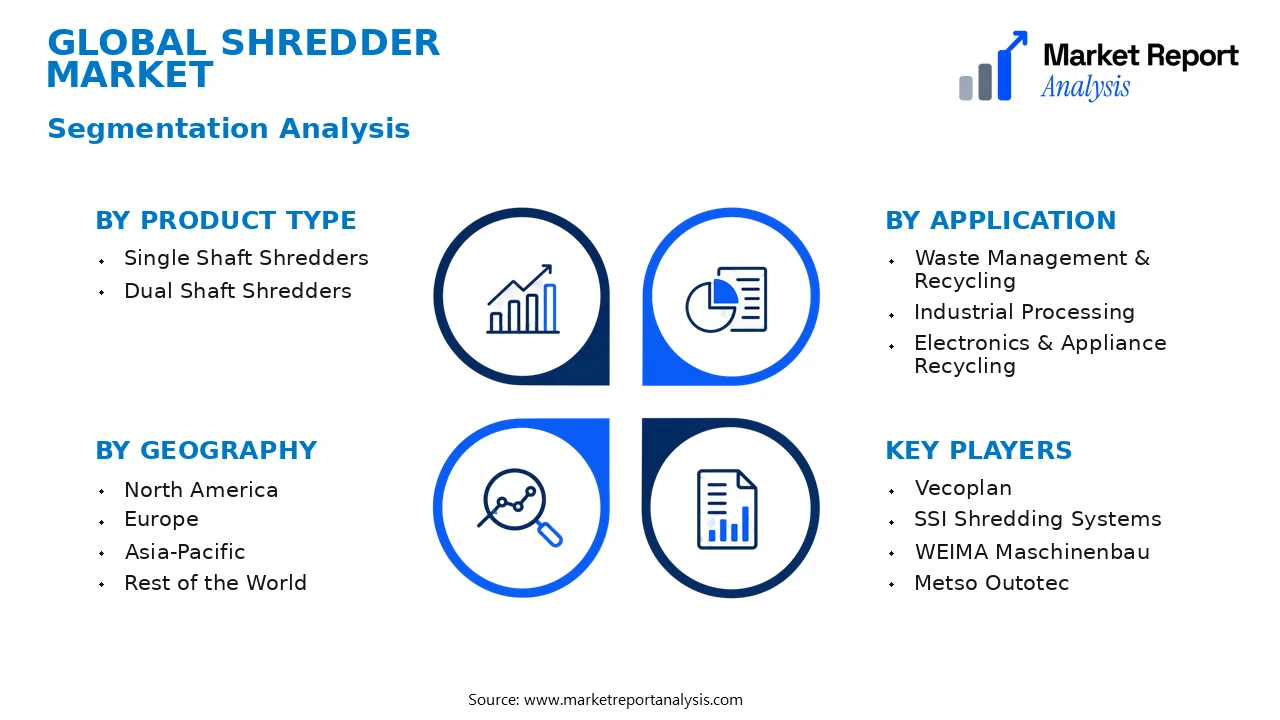
The global Shredder Market is segmented based on product type, application, and geography. These categories allow for detailed analysis of market dynamics and help identify growth opportunities within each segment, catering to different industry needs and regional demands.
- Product Type
- Single Shaft Shredders: These shredders are designed for flexible and high-volume processing of bulky and hard-to-shred materials, including electronics, wood, and plastic waste, offering efficiency and versatility essential for waste management companies.
- Dual Shaft Shredders: Known for their robustness, these shredders enable precise size reduction for dense and tough materials, making them suitable for metal and industrial waste, predominantly used in recycling facilities seeking consistent output sizes.
- Application
- Waste Management & Recycling: This segment drives significant market demand as industries increasingly focus on sustainable waste disposal and recycling solutions, requiring shredders to process various materials efficiently.
- Industrial Processing: Shredders used in industrial processing help reduce raw material sizes for further processing, supporting manufacturing units and reducing transportation and handling costs.
- Electronics & Appliance Recycling: The need for proper disposal of electronic waste has surged, with shredders playing a critical role in safely dismantling and recycling electronic waste components.
- Geography
- North America: Driven by stringent environmental regulations and a strong recycling infrastructure, North America represents a robust market for shredders, particularly in the United States and Canada, with growing industrial and municipal waste processing sectors.
- Europe: Europe’s focus on circular economy initiatives and waste reduction targets has increased adoption of shredding technology, especially in Germany, France, and the UK, where waste management and recycling are prioritized.
- Asia-Pacific: The fastest-growing region due to rapid industrialization, urbanization, and government incentives promoting waste recovery and recycling practices, notably in China, India, and Japan, with expanding manufacturing sectors.
- Rest of the World: Increasing awareness and infrastructural development in Latin America, Middle East, and Africa are contributing to the rising demand for shredders tailored to regional waste profiles and recycling needs.
Competitive Intelligence
The global shredder market exhibits moderate to high competition, characterized by several key players holding substantial market shares. Major companies such as SSI Shredding Systems, Vecoplan AG, and Cumberland Engineering dominate, contributing to a relatively concentrated market landscape that fosters intense rivalry. Business strategies primarily focus on product innovation developing advanced shredders with enhanced efficiency, reduced energy consumption, and multi-material handling capabilities. Strategic partnerships with waste management firms and municipal authorities are common to expand market reach and service portfolios. Notably, acquisitions are leveraged to strengthen technological expertise and broaden product offerings, exemplified by recent mergers between regional manufacturers and global firms. Companies heavily invest in R&D to differentiate through superior durability, automation, and environmentally friendly designs, aligning with sustainability trends. These competitive actions aim to secure a technological edge, enhance operational efficiencies, and capture emerging opportunities within waste recycling, e-waste processing, and specialized shredding sectors. Overall, differentiation hinges on innovation, strategic collaborations, and ongoing modernization efforts.
Leading Company Profiles
The global shredder market is characterized by a competitive landscape dominated by several key players focusing on innovative product development, expanding manufacturing capacity, and strategic alliances to strengthen market position and address diverse end-use sectors.
- Vecoplan
- SSI Shredding Systems
- WEIMA Maschinenbau
- Metso Outotec
- Tyler Technologies
- John Lewis Machinery
- (Tena) Shredder Solutions
- Granutech-Saturn Systems
- Ecostar Machinery
- Schnell Impex
Vecoplan
Vecoplan specializes in designing and manufacturing shredding and recycling equipment, with a focus on innovative technology and customized solutions for waste processing and biomass industries, positioning itself as a leader in sustainable recycling solutions.
SSI Shredding Systems
SSI offers a broad portfolio of industrial shredders tailored for tough, multi-material waste processing, emphasizing durability, efficiency, and technological sophistication to meet the evolving needs of recycling and waste reduction sectors.
WEIMA Maschinenbau
WEIMA develops shredding equipment renowned for precision and reliability, serving plastic, wood, and electronic waste markets, with strategic initiatives aimed at expanding its technological capabilities and global footprint.
Metso Outotec
Metso Outotec advances sustainable shredder solutions with a focus on mineral processing, offering advanced scrap and waste recycling equipment aligned with environmental standards and resource efficiency strategies.
Tyler Technologies
Tyler Technologies specializes in automated waste management and shredding systems, leveraging digital integrations and efficient operation models to optimize municipal and industrial waste processing efficiency.
John Lewis Machinery
John Lewis Machinery provides comprehensive shredding solutions with a strategic focus on technical innovation, process optimization, and expanding manufacturing capacity for diverse industrial applications.
(Tena) Shredder Solutions
(Tena) Shredder Solutions is recognized for its tailored shredding equipment focused on high-performance waste reduction, with ongoing investments in new plant facilities and cutting-edge technology development.
Granutech-Saturn Systems
Granutech-Saturn specializes in manufacturing a wide range of shredders and grinders, emphasizing technological innovation and global expansion through strategic partnerships and capacity enhancements.
Ecostar Machinery
Ecostar Machinery focuses on small to medium-sized shredders designed for recycling plastics and electronic waste, prioritizing eco-friendly designs and automation capabilities for industrial sustainability.
Schnell Impex
Schnell Impex offers robust shredding solutions primarily for metal and electronic waste, with strategic investments in advanced manufacturing processes and expanding product lines to meet rising global demand.
Strategic Business Developments

- Mar 2026 – Vecoplan – Launched a next-generation hybrid shredder with AI-driven health monitoring – Enhances operational efficiency and predictive maintenance, reducing downtime and lowering total cost of ownership.
- Apr 2026 – SSI Shredding Systems – Expanded manufacturing capacity with new facility in Texas – Accelerates production volume, reduces lead times, and strengthens supply chain resilience amid surging industry demand.
- Jun 2026 – WEIMA Maschinenbau – Partnered with a European technology firm to co-develop eco-efficient shredder models – Promotes sustainable manufacturing and opens new regional markets.
- Jul 2026 – Metso Outotec – Acquired a complementary recycling technology startup – Broadens portfolio of eco-friendly solutions and accelerates development of circular economy initiatives.
- Aug 2026 – Granutech-Saturn Systems – Launched digital twin platform for remote monitoring and predictive analytics – Enables clients to optimize shredder performance and maintenance schedules effectively.
Frequently Asked Questions
What is the Shredder Market?
The Shredder Market encompasses the global industry involved in the manufacturing, sales, and application of shredders used primarily for waste management, recycling, and material processing. It includes various shredder types designed for different materials and industry needs.
What is the current market size of Shredder Market?
As of 2026, the global Shredder Market is valued at approximately USD 2.3 Billion, reflecting its substantial role in industrial waste management and recycling sectors. The market has shown consistent growth driven by increasing environmental regulations and recycling needs.
What factors are driving the Shredder Market?
Key drivers include rising waste generation, stringent environmental policies, technological advancements in shredder design, and the expansion of recycling programs worldwide. Growing awareness of sustainability emphasizes the importance of shredding solutions across industries.
Which region dominates the Shredder Market?
North America currently leads the global Shredder Market, owing to advanced waste management infrastructure, robust industrial sectors, and strict environmental regulations. The region is expected to retain its dominance through the forecast period.
Which segment is expected to grow the fastest?
The industrial shredder segment is projected to exhibit the fastest growth, driven by increasing industrialization, demand for efficient waste processing, and technological innovations that enhance shredding capacity and effectiveness across various industries.
Who are the leading companies operating in the Shredder Market?
Major industry players include SSI Shredding Systems, Vecoplan AG, Granutech-Saturn Systems, and Weima Maschinenbau. These companies lead through product innovation, market expansion, and strategic collaborations to capture increasing market demand.
Analyst Perspective
The long-term outlook for the global shredder market remains robust, supported by escalating waste management regulations and increasing recycling initiatives worldwide. As technological advancements continue, shredder manufacturers are focusing on integrating automation, AI-driven diagnostics, and energy-efficient designs to offer superior, cost-effective solutions, thus promising enhanced market differentiation. Investment priorities are shifting towards high-capacity, environmentally compliant equipment that aligns with stringent emission standards and circular economy goals. Competitive intensity is expected to intensify as local and regional players innovate to capture niche markets, amid consolidations driven by global manufacturers expanding their portfolios. Regionally, Asia-Pacific is projected to dominate growth due to burgeoning urbanization and manufacturing sectors, while North America's mature market will emphasize upgrades and technological upgrades. Europe will remain critical, driven by strict environmental policies and advanced recycling infrastructures. This dynamic landscape suggests sustained market competitiveness, with strategic investments in adaptable, high-efficiency shredder technologies and regional expansion as key to long-term success.
