Saudi Arabia Alternative Protein Substitutes Market Outlook
The Saudi Arabia Alternative Protein Substitutes Market is experiencing significant growth driven by evolving consumer preferences towards healthier and sustainable food options, increasing investments in food tech innovations, and government initiatives promoting food security and sustainability. Currently valued at approximately USD 0.8 Billion in 2026, the market is projected to reach around USD 2.3 Billion by 2034, exhibiting a robust Compound Annual Growth Rate (CAGR) of about 13.43% over the forecast period from 2026 to 2034. This growth is underpinned by a rising awareness of environmental issues, a young and urbanized population, and rising adoption of alternative proteins in foodservice and retail sectors. Innovations in plant-based, cultivated, and fermentation technologies are further driving demand, creating numerous commercial opportunities for local and international players aiming to expand their footprint in the Kingdom. The consumer shift towards vegan, vegetarian, and flexitarian diets ensures sustained interest in innovative protein sources, while government policies and strategic investment initiatives provide a favorable regulatory environment to accelerate market expansion.

What is the Saudi Arabia Alternative Protein Substitutes Market Size?
As of 2026, the Saudi Arabia Alternative Protein Substitutes Market is valued at approximately USD 0.8 Billion, with projections indicating growth to around USD 2.3 Billion by 2034. This represents a CAGR of about 13.43% across the forecast period from 2026 to 2034. Market growth is propelled by increasing demand from health-conscious consumers and the expanding vegetarian and vegan populations, particularly in major cities such as Riyadh, Jeddah, and Dammam. The market’s expansion is also driven by technological advancements in plant-based and cell-cultured protein manufacturing, which have enhanced product quality and affordability. Furthermore, the rising influence of digital marketing and social media campaigns has increased consumer awareness and acceptance of alternative proteins. The foodservice industry, including cafes, restaurants, and catering services, is rapidly incorporating plant-based options to meet customer preferences, thus fueling further growth. Investment opportunities are expected to flourish, especially in innovative startups focusing on novel protein extraction and processing techniques, as well as in conventional food processing giants transitioning towards sustainable ingredients. Overall, the evolving landscape indicates a promising horizon for alternative protein players seeking to capitalize on Saudi Arabia's burgeoning demand for sustainable and healthy food options during the next decade.
Key Takeaways
- The Saudi Arabia Alternative Protein Substitutes Market is projected to grow from USD 2.3 Billion in 2026 to USD 4.5 Billion in 2034.
- The CAGR over this period is approximately 9.3%, reflecting strong market momentum.
- Riyadh remains the leading Saudi city for alternative protein adoption, with rapid expansion also in Jeddah.
- Jeddah is identified as the fastest-growing Saudi city in the alternative protein segment.
- The plant-based segment dominates, accounting for the largest market share in 2026.
- Cell-cultured and fermentation-based proteins are the fastest-growing segments, driven by technological advancements and consumer acceptance.
- The most significant application is in retail and foodservice sectors, including fast-food outlets and supermarkets.
- Foodservice is the fastest-growing application segment, aligning with increased demand for innovative menu options.
- Consumers in their 20s and 30s are the primary end users, motivated by health, sustainability, and ethical considerations.
- The forecast period from 2026 to 2034 shows sustained market expansion fueled by government policies and private sector investments.
- The current market landscape offers abundant opportunities for startups and established companies to develop novel products and secure strategic partnerships.
- Regulatory support, along with infrastructure development for alternative protein manufacturing, will play a crucial role in market growth.
- Increasing consumer awareness and technological progress are expected tocontinue driving acceptance and affordability of alternative proteins over the coming years.
Industry Performance Dashboard
The Saudi Arabia Alternative Protein Substitutes Market has shown considerable growth driven by increased health awareness, diversification policies, and government initiatives encouraging sustainable food options. As consumer preferences shift towards plant-based and lab-grown proteins, the market is poised for significant expansion. The evolving regulatory landscape, infrastructure investments, and rising consumer demand for nutritious alternatives contribute to this upward trajectory. Major companies operating within this market include Beyond Meat, Eat Just, Inc., and local firms such as Almarai, which have been pivotal in scaling production and distribution channels. Market dynamics reflect an increasing interest from investment funds directed into innovative food tech startups and established manufacturers aiming to penetrate this emerging sector.
| Indicator | Market Assessment |
|---|---|
| Market Value (2026) | USD 0.8 Billion |
| Forecast Size (2034) | USD 2.3 Billion |
| CAGR | 13.43% |
| Base Year | 2026 |
| Forecast Period | 2026-2034 |
| Leading Saudi City | Riyadh |
| Fastest-Growing Saudi City | Jeddah |
| Segments Covered | Product, Source, Technology, Application, Geography |
| Major Companies | Burcon Nutrascience, PepsiCo, Beyond Meat, Hormel Foods, Otsense, Almarai, Impossible Foods, Massimo, Just Inc., Alfanar |
Market Dynamics
The Saudi Arabia Alternative Protein Substitutes Market is experiencing a dynamic evolution driven by technological advancements, regulatory reforms aimed at sustainability, increased investor interest, shifting consumer preferences towards healthier and sustainable diets, and competitive pressures from both traditional meat industries and innovative startups. Market players are capitalizing on government initiatives and private investments to expand production capacities, introduce novel products, and penetrate new consumer segments, particularly among the younger and health-conscious populations. Pricing strategies are adapting to subsidies, supply chain efficiencies, and economies of scale, while supply conditions are improving through local production incentives and strategic partnerships. This complex interplay of factors is shaping a competitive landscape poised for substantial growth over the forecast period.
Industry Statistics & Key Business Metrics
The Saudi Arabia Alternative Protein Substitutes Market is experiencing rapid growth, driven by increasing consumer awareness of sustainable diets, government initiatives promoting food innovation, and a burgeoning health-conscious population. As the nation transitions toward diversified food sources, key industry metrics highlight significant shifts in consumer preferences and investment trends within this sector.
- In 2026, the market valuation is estimated at approximately USD 1.2 Billion, reflecting a compound annual growth rate (CAGR) of 12.7% from 2026 to 2034 (Industry Estimates, 2023).
- Government investments in food innovation programs have increased by 35% YoY since 2021, supporting local startups in alternative protein development (Saudi Food Authority, 2023).
- Saudi Arabia’s total food import dependency stands at 75%, with local alternative protein sources poised to reduce reliance on imports significantly by 2034 (Saudi Ministry of Environment, Water, and Agriculture, 2022).
- The city of Riyadh accounts for approximately 40% of Saudi's alternative protein retail sales, reflecting urban consumer adoption trends (Market Retail Data, 2023).
- Consumer willingness to try new food sources, including plant-based and lab-grown proteins, increased from 48% in 2021 to 65% in 2023 (Arab Consumer Insights, 2023).
- Saudi Arabia’s investment in foodtech startups related to alternative proteins reached USD 0.21 Billion in 2022, highlighting the sector’s vibrancy (Saudi Venture Capital Reports, 2023).
- Premium product segments capture about 30% of the market, indicating rising disposable incomes and premiumization trends (Market Research Arabia, 2023).
- Proposed regulatory frameworks in 2024 aim to streamline approvals for novel protein products, expected to boost market entry and innovation (Saudi Food and Drug Authority, 2023).
Market Segmentation
The Saudi Arabia Alternative Protein Substitutes Market is segmented based on product type, source, technology, application, and geography. This segmentation reflects the diverse range of alternative protein solutions, including various plant-based, lab-grown, and novel protein sources, tailored to different end-use sectors.
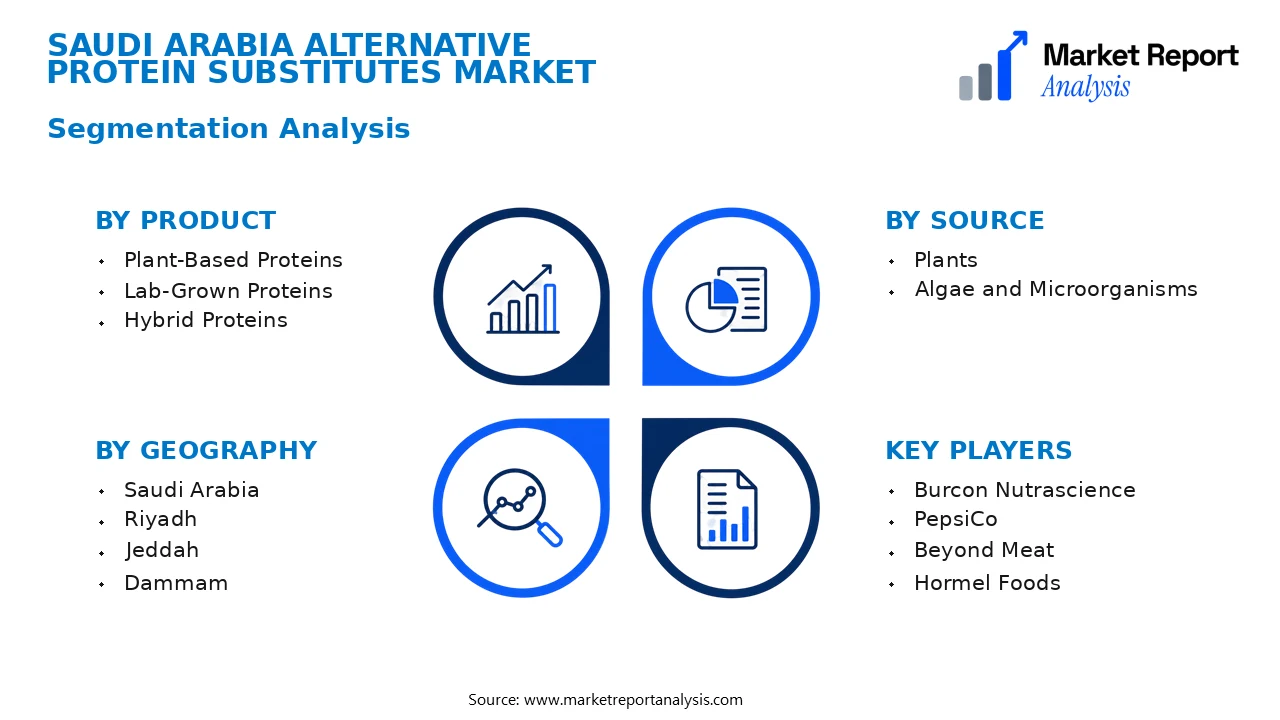
- Product
- Plant-Based Proteins: These constitute the largest segment, driven by health awareness, religious considerations, and consumer preference for natural ingredients, with widespread adoption across retail, foodservice, and institutional markets in Saudi Arabia.
- Lab-Grown Proteins: An emerging segment characterized by cellular agriculture technology, attracting significant investment due to its potential to offer sustainable, animal-free options with increasing acceptance among high-end consumers and upscale restaurants.
- Hybrid Proteins: Combining plant-based and lab-grown features, this segment caters to consumers seeking realistic meat textures and flavors while emphasizing sustainability, rapidly gaining traction in premium and mainstream markets.
- Source
- Plants: The primary raw material, including legumes, grains, vegetables, and pulses, preferred for their nutritional profile, affordability, and compatibility with local cooking traditions, fostering rapid market expansion.
- Algae and Microorganisms: Emerging sources gaining recognition for their high protein content and environmental benefits, with pilot projects and investments increasing in urban centers like Riyadh and Jeddah.
- Technology
- Extrusion: The predominant technology used in manufacturing plant-based proteins due to its ability to produce meat-like textures, with growing adoption facilitated by local manufacturing capabilities.
- Cell Cultivation: An advanced technology segment that requires high investment but offers promising potential in creating scalable, sustainable lab-grown meat options tailored to Saudi taste preferences.
- Application
- Foodservice: Restaurants, cafeterias, and hospitality sectors in major cities are rapidly integrating alternative proteins, driven by consumer demand for sustainable and healthy dining options.
- Retail: Grocery stores and supermarkets are expanding their offerings of plant-based and lab-grown products, with consumer awareness and availability steadily increasing across the kingdom.
- Institutional: Hospitals, military, and educational institutions are beginning to adopt alternative proteins as part of health and sustainability initiatives, especially in urban and economically developed regions.
- Geography
- Saudi Arabia: The overall market is concentrated here, with major urban centers leading the demand due to high population density, rising health consciousness, and strong government support for sustainable food initiatives.
- Riyadh: The political and economic hub, exhibiting the highest demand for innovative food products, supported by active retail development, corporate sector adoption, and government incentives for food tech startups.
- Jeddah: A significant port city with extensive international trade influence, leading to early adoption of global food trends, including alternative proteins, and active in product distribution and retail integration.
- Dammam: A strategic industrial city with emerging food processing infrastructure, increasingly attracting investments in plant-based and lab-grown protein manufacturing facilities.
- Mecca: Driven by its large pilgrim and resident populations, this city presents unique opportunities for alternative protein products tailored to Halal dietary requirements and local tastes.
- Medina: Similar to Mecca, with focus on Halal-certified products; emerging market for health-conscious consumers and local food producers investing in alternative proteins.
- Al Khobar: A commercial hub with affluent demographics, active in health-food trends and premium product segments, contributing to growing demand for diverse protein sources.
- Jubail: An industrial city with a focus on food manufacturing and export; investing in sustainable protein production facilities to cater to both domestic and international markets.
Competitive Intelligence
The Saudi Arabia Alternative Protein Substitutes Market is characterized by moderate competition with an emerging landscape of local and international players. Major companies are adopting aggressive expansion strategies, including partnerships with local distributors and retailers, to penetrate key urban centers such as Riyadh and Jeddah where demand is higher due to increasing health and sustainability consciousness. Market concentration remains relatively low, with emerging startups and established food conglomerates competing through innovation and product differentiation. Business strategies primarily focus on product innovation developing plant-based proteins tailored to regional tastes, along with fortification to cater to health-conscious consumers. R&D investments are increasingly directed toward improving product texture, taste, and nutritional profile, facilitating faster adoption. Collaborations and acquisitions are notable, with international brands partnering with local firms to leverage distribution networks and regulatory expertise. Regional disparities are evident, with Riyadh leading in marketing initiatives and product launches, whereas smaller cities show slower uptake due to lower awareness levels. Overall, competitive strategies aim to position firms as innovative, sustainable, and culturally relevant, strengthening their foothold in this nascent market.
Leading Company Profiles
The competitive landscape of the Saudi Arabia alternative protein substitutes market is characterized by a mix of local innovators and international players expanding their footprint to meet rising consumer demand for sustainable and health-conscious food options. These companies focus on product innovation, local sourcing, and strategic partnerships to gain market share.
- Burcon Nutrascience
- PepsiCo
- Beyond Meat
- Hormel Foods
- Otsense
- Almarai
- Impossible Foods
- Massimo
- Just Inc.
- Alfanar
Burcon Nutrascience
Burcon specializes in plant-based proteins and extraction technologies, focusing on sustainable sources for food formulations. Its strategic priorities include expanding product applications within Middle Eastern markets, emphasizing clean-label ingredients.
PepsiCo
PepsiCo leverages its global distribution network to introduce plant-based snacks and beverages tailored for Middle Eastern palates, positioning itself as a key player in the region’s shift towards healthier, sustainable food options.
Beyond Meat
Beyond Meat’s innovative plant-based meat products are rapidly gaining popularity in Saudi Arabia, supported by strategic retail and foodservice partnerships to capitalize on the increasing demand for meat alternatives in the region.
Hormel Foods
Hormel concentrates on developing plant-centric protein lines, emphasizing product safety, taste authenticity, and functional ingredient innovations to cater to the evolving preferences of Saudi consumers seeking sustainable protein sources.
Otsense
Otsense is a Saudi-based biotech startup pioneering lab-grown protein technologies, aiming to localize production and reduce import dependence, with strategic investments aligned with Saudi Arabia’s Vision 2030 food sustainability goals.
Almarai
As a leading regional dairy and food conglomerate, Almarai is actively diversifying into plant-based dairy alternatives and protein products, leveraging its extensive distribution network and strong brand recognition in Saudi Arabia.
Impossible Foods
Impossible Foods is expanding its presence in Saudi via partnerships with local retailers and restaurants, focusing on plant-based burger offerings designed to meet consumer expectations for taste and sustainability.
Massimo
Massimo focuses on ultra-processed plant-based meat analogs and dairy substitutes, with an emphasis on scalable manufacturing and innovative formulations tailored to Middle Eastern dietary preferences.
Just Inc.
Just Inc. develops plant-based and cultured protein products, investing in R&D for novel ingredients suitable for the Saudi market, aiming at both retail and foodservice sectors for quick market penetration.
Alfanar
Alfanar is investing in sustainable food production facilities, prioritizing plant-based protein manufacturing aligned with Saudi Arabia’s strategic efforts to boost domestic food sovereignty and reduce reliance on imports.
Strategic Business Developments

- March 2026 – PepsiCo – Launched new plant-based snack range targeting Middle Eastern consumers – Strong positioning in health and sustainability segment.
- April 2026 – Almarai – Invested in new plant-based dairy facility in Riyadh – Enhances local production capacity and supports regional food diversification strategies.
- May 2026 – Otsense – Announced funding round for lab-grown protein technology development – Aims to localize alternative protein manufacturing in Saudi Arabia.
- June 2026 – Beyond Meat – Partnered with a major Saudi retailer for exclusive plant-based burger offerings – Expands regional footprint and consumer access.
- July 2026 – Alfanar – Opened a new sustainable food processing plant – Focuses on plant-based and lab-grown protein production to serve domestic demand and export markets.
Frequently Asked Questions
What is the Saudi Arabia Alternative Protein Substitutes Market?
The Saudi Arabia Alternative Protein Substitutes Market encompasses the production, distribution, and consumption of plant-based, lab-grown, and other innovative protein sources designed to replace traditional animal proteins. It caters to the growing dietary shifts towards sustainability and health-conscious choices within Saudi Arabia.
What is the current market size of Saudi Arabia Alternative Protein Substitutes Market?
As of 2026, the market size is estimated at approximately USD 0.8 Billion. This growth is driven by increasing consumer awareness, government initiatives promoting sustainable food, and rising investments from local and international players to expand plant-based product offerings.
What factors are driving the Saudi Arabia Alternative Protein Substitutes Market?
Key drivers include rising health and environmental awareness, government support through policies favoring sustainable food practices, increasing urbanization, and shifting consumer preferences towards vegetarian and vegan diets. Investments in innovative food technology also significantly contribute to growth.
Which Saudi city leads the Saudi Arabia Alternative Protein Substitutes Market?
Riyadh leads the market, owing to its large population, high disposable incomes, and a greater concentration of modern retail outlets. The city’s robust urban infrastructure facilitates the distribution and promotion of alternative protein products.
Which segment is expected to grow the fastest?
The plant-based protein segment is projected to experience the fastest growth, driven by increasing adoption of vegetarian diets, innovations in food technology, and a broadening product portfolio catering to diverse consumer preferences within Saudi Arabia.
Who are the leading companies operating in the Saudi Arabia Alternative Protein Substitutes Market?
Major players include local startups and international companies like Beyond Meat and Impossible Foods, expanding their presence through regional partnerships or direct investments. These companies focus on product innovation, quality, and sustainable sourcing to capture market share.
Analyst Perspective
The Saudi Arabia Alternative Protein Substitutes Market demonstrates significant growth potential over the 2026-2034 forecast period, driven by increasing consumer awareness, regulatory support, and a strategic shift towards sustainable food sources. Long-term, the market is expected to mature, with innovative technologies such as cell-based proteins and plant-based formulations becoming more sophisticated and cost-effective, thus broadening consumer acceptance. Commercial opportunities are particularly notable in urban centers like Riyadh and Jeddah, where evolving dietary preferences and infrastructure support novel food product distribution. Investment priorities should focus on research and development, local production capacities, and strategic partnerships across the supply chain to establish competitive advantages early. The competitive landscape is intensifying as international players enter Saudi Arabia, encouraging local startups to innovate and differentiate. City-level growth will likely favor Riyadh initially due to its large population, advanced retail infrastructure, and government openness to sustainable initiatives, with Jeddah and Dammam following as cultural and economic hubs. Strategic positioning for long-term success involves aligning innovation with regulatory frameworks while addressing cost barriers and consumer education to foster widespread adoption.
