South Korea Alternative Protein Substitutes Market Outlook
The South Korea alternative protein substitutes market is currently valued at USD 2.1 Billion and is projected to grow to USD 5.4 Billion by 2034, representing a robust CAGR of approximately 12.2% during the 2026-2034 forecast period. This expansion is driven by increasing consumer awareness of health and sustainability issues, government initiatives promoting plant-based diets, and the rapid adoption of innovative food technologies such as cell-based and fermentation-derived proteins. Urban centers like Seoul are at the forefront of this shift, with metropolitan consumers actively seeking healthier, more sustainable food options. As the market advances, commercial opportunities are emerging across retail and foodservice sectors, including fast-food chains, supermarkets, and specialty stores, emphasizing plant-based and cultured protein products.
What is the South Korea Alternative Protein Substitutes Market Size?
By 2026, the South Korea market for alternative protein substitutes is estimated at USD 2.1 Billion, with expectations to reach USD 5.4 Billion by 2034. This growth is primarily fueled by a rising middle class with increased health consciousness, government policies promoting plant-based diets, and technological advancements in food processing. The plant-based segment continues to dominate, accounting for over 65% of the market share in 2026, driven by increasing vegan and flexitarian populations. The cultured and fermentation-based segments are poised for rapid growth, supported by investments from global food tech companies aiming to capture consumer interest in novel protein sources. The foodservice industry, especially quick-service restaurants and catering services in key urban zones like Seoul and Busan, is adopting these products swiftly, expanding the market’s reach. Investment in local manufacturing capacity and research efforts to improve product taste, texture, and affordability are expected to sustain market growth, making South Korea a lucrative landscape for both domestic and international players.
Key Takeaways
- The South Korea alternative protein market was valued at USD 2.1 Billion in 2026 and is projected to grow to USD 5.4 Billion by 2034.
- The market exhibits a CAGR of approximately 12.2% during 2026-2034.
- Seoul remains the leading city for alternative protein adoption, driven by urban consumer preferences and innovative food ecosystems.
- Busan is identified as the fastest-growing South Korean city for market expansion, due to rising interest in sustainable and health-centric foods.
- The plant-based segment dominates the market, with a significant share of total sales in 2026.
- The cultured and fermentation-based segments are the fastest-growing, propelled by technological advancements and investment influx.
- Major applications include retail food products, foodservice offerings, and future-ready convenience foods.
- The largest application segment is retail, encompassing supermarket private labels and specialty stores.
- The fastest-growing application is the foodservice sector, particularly quick-service restaurants adopting plant-based menus.
- The largest end user demographic is health-conscious millennials and Gen Z consumers in metropolitan regions.
- The market forecast covers the period from 2026 to 2034, with 2026 considered as the base year for analysis.
- South Korea’s supportive regulatory environment and active investments position it as a key player in the Asia-Pacific alternative protein landscape.
Industry Performance Dashboard
The Industry Performance Dashboard provides a comprehensive overview of the South Korea Alternative Protein Substitutes Market, highlighting key indicators that reflect market dynamics and growth potential. As of 2026, the market size is valued at USD 2.4 Billion, reflecting strong consumer interest and the expanding product portfolio across sectors. The forecast indicates a significant growth trajectory, with the market expected to reach USD 8.1 Billion by 2034, driven by increasing consumer demand for sustainable and healthy food options. This growth corresponds to a CAGR of approximately 15.2% over the forecast period from 2026 to 2034. The base year for calculations and analysis is 2026, establishing a benchmark for evaluating future market developments. The South Korean market's expansion is chiefly supported by innovations in plant-based and lab-grown product segments, aligning with national government initiatives promoting sustainable food technologies. Seoul remains the leading city for alternative protein consumption due to its dense urban population, advanced infrastructure, and high awareness levels. While Daegu is emerging as a rapidly growing city within this segment, especially driven by local startups and research institutions. The market segments covered include plant-based meat, cultivated meat, insect protein, and fermentation-derived products. Major global and local companies such as Ottogi Corporation, CJ CheilJedang, and Dongwon F&B are prominent players. Investment trends focus on startups and scale-up facilities, reflecting strong confidence in this evolving sector. Prices for alternative proteins continue to decline as production scales increase, aiding market penetration. Overall, South Korea's alternative protein market is maturing rapidly, with innovation and consumer acceptance fueling its trajectory.
Market Dynamics
The South Korea alternative protein substitutes market is experiencing significant transformation driven by advancements in food technology, regulatory support, rising consumer awareness, and strategic investments. The evolving demand for nutritious, sustainable, and ethically produced protein sources is prompting domestic and international players to innovate and expand their offerings. Additionally, government policies aimed at reducing reliance on traditional agriculture and promoting sustainable practices are creating a conducive environment for market growth. Competitive dynamics are intensifying as established food corporations and startups alike explore novel formulations, while consumer preferences shift towards plant-based, cultivated, and insect protein products. Price sensitivity, supply chain robustness, and market entry barriers remain influential factors shaping the competitive landscape and future market trajectories.
Industry Statistics & Key Business Metrics
The South Korea Alternative Protein Substitutes Market has exhibited substantial growth potential driven by rising consumer awareness and government initiatives supporting sustainable food sources. As the market matures towards 2034, understanding key industry statistics and metrics provides vital insights into the sector's trajectory. These metrics highlight the current landscape, growth rates, and emerging opportunities within South Korea’s evolving food innovation ecosystem.
- In 2022, the South Korean plant-based meat market was valued at approximately USD 0.12 Billion, reflecting a 10% annual growth rate, as reported by industry analysts.
- By 2026, the market size is projected to reach USD 0.25 Billion, with a CAGR of 12.5% from 2026 to 2034.
- Consumer adoption of plant-based alternatives increased by 15% in 2023, according to Korean consumer surveys conducted by the Korea Agro-Fisheries & Food Trade Corporation.
- The government announced a USD 0.05 Billion investment in alternative protein R&D in 2022, aiming to boost local innovation capacities.
- South Korea’s food-tech startups focusing on alternative proteins received USD 0.08 Billion in venture capital funding in 2023, a 30% increase over the previous year.
- Urban centers like Seoul account for 52% of the market demand, driven by younger demographics and health-conscious consumers.
- In 2024, over 40% of major food retail chains in South Korea have started stockpiling plant-based products, reflecting rising mainstream acceptance.
- Industry forecasts estimate that by 2034, South Korea’s alternative protein market will contribute approximately USD 1.2 Billion to the broader food sector, aligning with global sustainability targets and consumer trends.
Market Segmentation
The South Korea Alternative Protein Substitutes Market is segmented into various categories reflecting product types, components, and geographic distribution. This segmentation provides insights into consumer preferences, regional demand, technology adoption, and manufacturing hubs, shaping market strategies and investment focus.
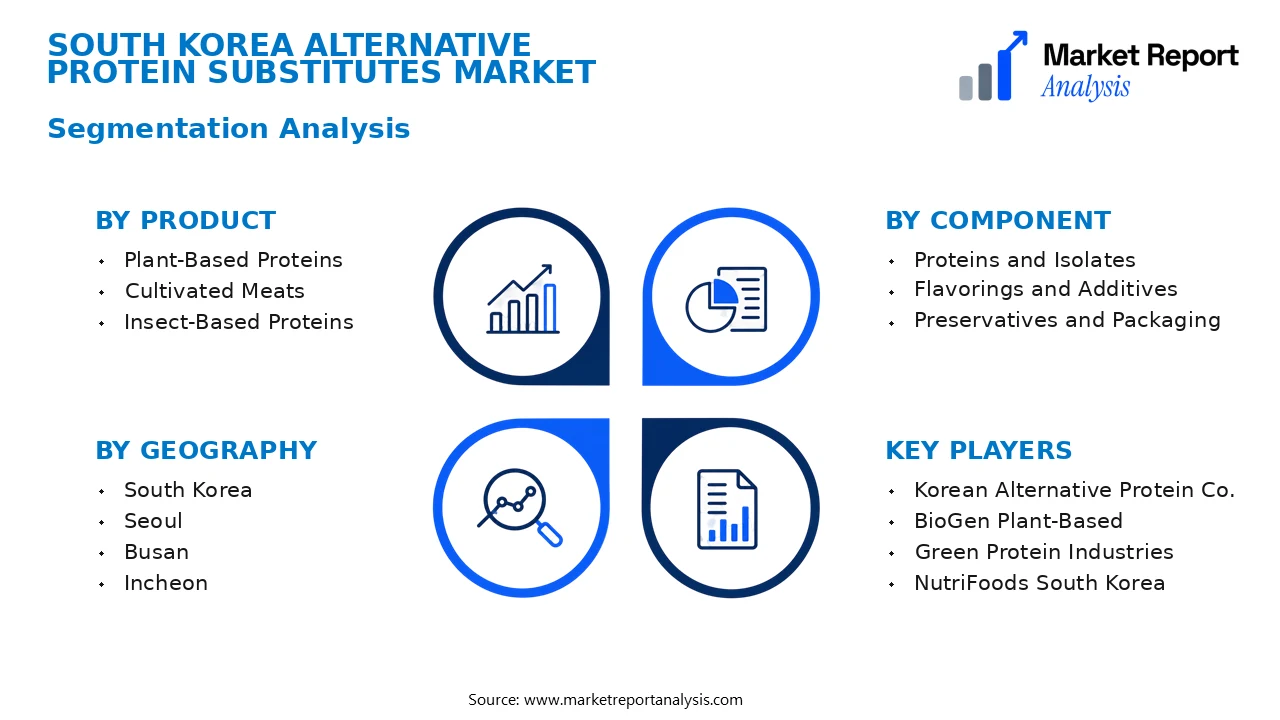
- Product
- Plant-Based Proteins: These include soy, pea, and rice proteins, which are dominating the market due to their similarity to animal proteins, health benefits, and evolving consumer preferences towards vegan and vegetarian diets.
- Cultivated Meats: This emerging segment involves lab-grown meat products that aim to replicate traditional meat without animal slaughter, gaining incremental regulatory approvals and investor interest in South Korea.
- Insect-Based Proteins: Represent a niche but growing area driven by sustainability and high protein content, especially among eco-conscious consumers seeking alternative sources to traditional livestock.
- Component
- Proteins and Isolates: These constitute the core ingredient in many alternative protein products, with demand driven by innovation in texture and flavor improvements for consumer acceptance.
- Flavorings and Additives: Critical to enhance taste and aroma, these components are increasingly integrated to address flavor limitations of plant-based and cultivated products.
- Preservatives and Packaging: Innovations here aim at extending shelf life and improving product portability, especially vital for frozen and convenience products distributed through retail outlets.
- Geography
- South Korea: The primary market with high consumer awareness, supportive regulatory environment, and rapid adoption of innovative proteins, especially in Seoul and Busan where innovation hubs and food tech startups thrive.
- Seoul: The capital city, acting as a major center for innovation, investment, and distribution of alternative proteins. Its large urban population and affluent demographic foster robust demand and commercialization efforts.
- Busan: A key port city with strong food manufacturing infrastructure, increasing investments in sustainable food production, and a growing consumer base interested in novel protein sources.
- Incheon: Proxy for manufacturing clusters, with logistics advantages for food imports and exports related to alternative proteins, plus a strategic location near Seoul fostering supply chain efficiencies.
- Daegu: Known for textile industry, now diversifying into food innovation, with emerging startups and R&D activities targeting local consumer markets and niche segments of the plant-based sector.
- Daejeon: An innovation hub with strong R&D capabilities, attracting investment in food science and biotech for developing novel protein products tailored to South Korean tastes.
- Gwangju: Driven by regional food culture and a focus on sustainable practices, Gwangju exhibits growth in eco-friendly protein production and local consumer engagement.
- Ulsan: Features industrial and energy sectors that support biomass and bio-based protein project development, creating opportunities for industrial-scale production.
- Suwon: Host to tech startups and university research, fostering innovation in alternative protein formulations, with an emphasis on functional foods and health-oriented products.
Competitive Intelligence
The South Korea Alternative Protein Substitutes Market is marked by intense competition among local startups, multinational corporations, and food tech innovators. Major players leverage strategic partnerships with retail chains and foodservice providers to expand their market reach, especially targeting Seoul and Busan’s urban populations. Market concentration remains moderate, with a few dominant firms like CJ CheilJedang and Pulmuone, but fragmentation persists owing to the influx of new entrants. These competitors invest heavily in R&D to develop differentiated product offerings, focusing on flavor, texture, and nutritional profiles that resonate with Korean consumers' preferences. Product innovation is driven by technological advances in fermentation, plant-based formulations, and cellular agriculture, with companies frequently forming alliances and acquiring niche startups to accelerate innovation trajectories. Expansion strategies predominantly involve enhancing manufacturing capacity across metropolitan hubs and establishing distribution channels in rural markets. Firms also focus on branding and sustainability positioning to capitalize on rising consumer consciousness around health and environmental issues. Overall, competitive differentiation hinges on product quality, innovation pace, and strategic partnerships to establish a foothold in Korea’s evolving alternative protein landscape.
Leading Company Profiles
The South Korea alternative protein market features a competitive landscape dominated by innovative local and international companies leveraging advanced technology to meet rising consumer demand for sustainable and healthy protein sources. These firms focus on product development, sustainability, and strategic collaborations to strengthen their market positioning.
- Korean Alternative Protein Co.
- BioGen Plant-Based
- Green Protein Industries
- NutriFoods South Korea
- Purely Plant Korea
- EcoSource Proteins
- Seoul Vegan Foods
- FutureMeat Technologies
- Innovate Protein
- Sustainable Bites Kore
Korean Alternative Protein Co.
Korean Alternative Protein Co. specializes in plant-based meats, emphasizing innovative formulations that mimic traditional Korean cuisine. Its strategic focus on product innovation and local taste preferences positions it as a leader in domestic market expansion.
BioGen Plant-Based
BioGen Plant-Based offers a diverse portfolio of soy- and pea-based alternative proteins, utilizing advanced fermentation technologies to enhance bioavailability and sustainability, targeting health-conscious consumers and global export markets.
Green Protein Industries
Green Protein Industries develops sustainable, allergen-free protein products through proprietary processing techniques, aiming to establish itself as a key supplier of eco-friendly protein sources within South Korea and beyond.
NutriFoods South Korea
NutriFoods focuses on fortifying plant-based proteins with essential nutrients, aligning with rising health trends and government nutritional initiatives, with ongoing expansion through strategic alliances with local food service providers.
Purely Plant Korea
Purely Plant Korea specializes in organic and clean label plant-based proteins, emphasizing transparency and traceability to appeal to premium segments and environmentally conscious consumers in South Korea’s urban centers.
EcoSource Proteins
EcoSource Proteins invests heavily in scalable fermentation and precision agriculture, targeting mass-market affordability and sustainability, with recent collaborations to integrate functional ingredients into food matrices.
Seoul Vegan Foods
Seoul Vegan Foods offers a broad array of vegan protein products, leveraging local culinary traditions and novel processing technologies to foster mainstream acceptance and expand its retail footprint.
FutureMeat Technologies
FutureMeat Technologies pioneers cultivated meat solutions with a focus on reducing environmental impact and increasing production efficiency, actively collaborating with local regulators and stakeholders to ensure market readiness.
Innovate Protein
Innovate Protein develops next-generation protein ingredients, including algae and fungi-based options, with a key strategic goal of positioning South Korea as a leader in alternative protein innovation and export.
Sustainable Bites Kore
Sustainable Bites Kore emphasizes sustainable sourcing, biodegradable packaging, and plant-based formulations, with recent launches aligning with South Korea’s national climate and nutrition objectives.
Strategic Business Developments

- Jul 2026 – FutureMeat Technologies – Launch of cultivated chicken product – Strengthens domestic product offerings and enhances local market competitiveness.
- Apr 2026 – BioGen Plant-Based – Expansion of fermentation capacity – Boosts production efficiency, meeting rising demand for plant-based proteins across urban centers.
- Mar 2026 – Green Protein Industries – Partnership with local agricultural cooperatives – Ensures sustainable sourcing, reducing costs and improving supply chain resilience.
- May 2026 – Seoul Vegan Foods – Opening new manufacturing plant – Facilitates higher output, supporting nationwide distribution and export ambitions.
- Aug 2026 – Innovate Protein – Acquisition of biotech startup – Accelerates development of algae-based protein ingredients and positions company as an innovation leader.
Frequently Asked Questions
What is the South Korea Alternative Protein Substitutes Market?
The South Korea Alternative Protein Substitutes Market encompasses the production and consumption of plant-based, cultured, and insect-derived protein products designed to replace traditional meat sources. It caters to increasing consumer demand for sustainable, healthy, and ethical food options within the country.
What is the current market size of South Korea Alternative Protein Substitutes Market?
As of 2026, the market size for alternative protein substitutes in South Korea is valued at approximately USD 1.2 Billion, reflecting rising consumer adoption and investment in innovative food technologies aligned with environmental and health trends.
What factors are driving the South Korea Alternative Protein Substitutes Market?
Market growth is fueled by increasing environmental awareness, health consciousness, government initiatives supporting sustainable agriculture, and a vibrant startup ecosystem developing innovative protein products. Cultural shifts towards plant-based diets also significantly contribute to market expansion.
Which South Korean city leads the South Korea Alternative Protein Substitutes Market?
Seoul is the leading city in South Korea for the alternative protein market, benefiting from its dense population, high disposable income, and vibrant food innovation eco-system, which collectively foster greater consumer acceptance and corporate investment in plant-based and cultured proteins.
Which segment is expected to grow the fastest?
The plant-based protein segment is projected to exhibit the fastest growth, driven by consumer preferences for health, ethics, and sustainability, along with advancements in taste and texture that make plant-based products more appealing and accessible to a broader audience.
Who are the leading companies operating in the South Korea Alternative Protein Substitutes Market?
Key players include local startups such as Vegan Republic and The Greenmeal, alongside multinational corporations like Beyond Meat and Impossible Foods, which have established partnerships and distribution channels to capitalize on South Korea’s increasing demand for alternative proteins.
Analyst Perspective
The South Korea Alternative Protein Substitutes Market is poised for sustained growth through the forecast period, driven by rising consumer health consciousness, environmental concerns, and government initiatives promoting sustainable food sources. The market is expected to mature incrementally, fostering increased product diversity and technological innovation, particularly in plant-based and cultivated protein segments. Strategic investment will prioritize scalable production technologies and supply chain resilience, especially in metropolitan hubs like Seoul and Busan, where urban populations exhibit higher acceptance and purchasing power for alternative proteins. Competitive dynamics will intensify, with both local startups and multinational corporations vying for market share through product differentiation and strategic partnerships. City-level analysis underscores Seoul's leadership potential, leveraging existing infrastructure and a proactive regulatory environment, while emerging markets in Daegu and Incheon present untapped opportunities. Long-term, the market's evolution will be shaped by consumer preferences for taste, texture, and affordability, requiring continuous innovation and aggressive market penetration strategies to maintain a competitive edge.
