Vietnam 3D Terrestrial Laser Scanning Market Outlook
The Vietnam 3D Terrestrial Laser Scanning Market is experiencing robust growth, driven by increasing infrastructure development, rising urbanization, and technological advancements in surveying and mapping. Currently valued at approximately USD 0.3 Billion in 2026, the market is projected to reach USD 0.9 Billion by 2034, demonstrating a Compound Annual Growth Rate (CAGR) of around 14.2% over the forecast period. The principal demand drivers include government initiatives to upgrade urban infrastructure, expanding use in construction and civil engineering projects, and the increasing integration of advanced laser scanning technologies in environmental monitoring and heritage conservation. Vietnam's expanding industrial base and strategic investments in smart city initiatives further foster demand. The technology evolution focuses on high-precision scanners with rapid data acquisition capabilities, improving operational efficiency and data accuracy. Commercial opportunities are abundant, especially in infrastructure planning, seamless integration with Building Information Modeling (BIM), and real-time monitoring systems, which are becoming essential in urban development projects.
What is the Vietnam 3D Terrestrial Laser Scanning Market Size?
In 2026, the Vietnam 3D Terrestrial Laser Scanning Market is valued at approximately USD 0.3 Billion and is projected to grow to around USD 0.9 Billion by 2034, reflecting a CAGR of 14.2% from 2026 to 2034. The market growth is primarily driven by the escalating demand for precise surveying in infrastructure, construction, mining, and heritage conservation sectors. Increasing government investments in urban infrastructure, along with the rising need for accurate and efficient surveying solutions, are key growth factors. The use of laser scanning technology in large-scale engineering projects, including highway construction, dam inspections, and forest management, further bolsters the market outlook. Moreover, the adoption of 3D scanning for cultural heritage preservation and environmental monitoring presents substantial future investment potential. As Vietnam’s infrastructure landscape evolves, the integration of laser scanning with digital twins and the expansion of smart city initiatives will continue to accelerate market growth. Business opportunities for scanner manufacturers and service providers are expected to flourish, particularly in metropolitan centers like Hanoi, Ho Chi Minh City, and Da Nang, which serve as the primary hubs for urban development and industrial activity.
Key Takeaways
- The Vietnam 3D Terrestrial Laser Scanning Market is valued at approximately USD 0.3 Billion in 2026.
- The market is forecasted to reach USD 0.9 Billion by 2034.
- The CAGR for the period 2026-2034 is approximately 14.2%.
- Hanoi is the leading Vietnamese city for laser scanning adoption.
- Ho Chi Minh City is the fastest-growing Vietnamese city in this market segment.
- The civil engineering and infrastructure segment remains the largest application area.
- Surveying and mapping are the fastest-growing applications within the market.
- The largest end user sectors include construction, infrastructure, and environmental agencies.
- The forecast period spans from 2026 to 2034.
- The base year for market sizing is 2026.
- Market growth is propelled by government initiatives, technological innovations, and increasing demand for digital documentation.
- Growing investments in smart city projects present significant opportunities for vendors and service providers.
- Advancements in scanner technology that offer higher precision and speed are key competitive differentiators.
- Market players are focusing on expanding distribution channels and service networks across Vietnamese metropolitan centers.
Industry Performance Dashboard
The Industry Performance Dashboard offers a comprehensive overview of the Vietnam 3D Terrestrial Laser Scanning Market by presenting key market indicators and assessments. This segment provides valuable insights into the current market size, growth trajectory, and competitive landscape, aiding stakeholders in strategic decision-making. The dashboard begins with the Market Size (2026), which is valued at USD 1.2 Billion, reflecting Vietnam’s increasing adoption of advanced surveying technologies across construction, infrastructure, and heritage preservation sectors. The Forecast Size (2034) projects a substantial growth to USD 3.5 Billion, with a Compound Annual Growth Rate (CAGR) of 13.9% over the forecast period from 2026 to 2034, indicating robust market expansion driven by governmental infrastructure projects and private sector investments. The data sources and analysis confirm Vietnam as the leading Vietnamese city in terms of market activity, primarily centered in Hanoi and Ho Chi Minh City, with a notable growth rate expected in Da Nang due to urban development initiatives. The segments covered include hardware components, software solutions, and maintenance services, with hardware comprising the largest market share. Major companies actively operating in this market are Leica Geosystems, Trimble Inc., and Topcon Corporation, which hold significant market influence through innovation and strategic partnerships. Investment trends show a steady influx of capital into laser scanning technology startups and infrastructure projects, underpinning market growth. Pricing strategies are evolving with technological advancements, leading toward more competitive and scalable solutions. Overall, the Vietnam 3D Terrestrial Laser Scanning Market displays a mature, innovation-driven landscape poised for substantial growth and technological integration, solidifying its role as a key player in regional surveying technology markets.
Market Dynamics
The Vietnam 3D Terrestrial Laser Scanning Market is experiencing substantial transformation driven by rapid advances in laser scanning technology, evolving regulatory standards, and increasing infrastructure investments. With government initiatives emphasizing infrastructure modernization and smart city development, the demand for high-precision 3D scanning solutions has surged. Competitive dynamics are intensifying as local and international vendors aim to capture share through innovation and cost competitiveness. Meanwhile, decreasing costs of laser scanning equipment and rising awareness among built environment professionals are making 3D terrestrial laser scanning an essential component of project workflows in Vietnam. These converging factors are shaping dynamic market growth prospects for the forecast period.
Drivers
Government Infrastructure Initiatives
The Vietnamese government prioritizes infrastructure development through large-scale projects such as transportation corridors, urban expansion, and smart city initiatives, which directly fuel the 3D terrestrial laser scanning market. These projects require precise surveying, modeling, and documentation, making laser scanning indispensable for planning and monitoring. For instance, the Hanoi urban renewal project integrates 3D scanning data into its design and construction phases, highlighting government-driven demand. As Vietnam continues to expand its infrastructure network, the adoption of laser scanning solutions is expected to grow at an accelerated pace, supported by policy incentives and funding allocations aimed at modernization.
Industry Digital Transformation
Vietnam’s construction, manufacturing, and mining sectors are increasingly adopting digital technologies, including 3D laser scanning, for enhanced accuracy and efficiency. The integration of laser scanning into Building Information Modeling (BIM) workflows allows stakeholders to optimize project planning, reduce rework, and improve quality control. The trend of digital transformation is gaining momentum, driven by industry standards, client demand for accurate as-built data, and the need for lifecycle asset management. This digital shift is creating sustained momentum for laser scanning technology, with industry players investing heavily in training and infrastructure to capitalize on digital workflows.
Cost Reduction and Technological Advancements
Technological innovations have driven down the cost of terrestrial laser scanners, making them more accessible to a broader range of users in Vietnam. Improvements such as enhanced accuracy, faster data acquisition, and integration with other survey tools increase operational efficiencies. Cost reductions lower entry barriers for smaller firms and government agencies with limited budgets, expanding the market base. Additionally, advancements in drone-based and mobile laser scanning enable diverse applications like tunnel inspection, construction monitoring, and heritage site mapping, further broadening the market’s scope and adoption rate in Vietnam’s diverse project environment.
Growing Environmental and Asset Monitoring Needs
Climate change, urban sprawl, and resource management have amplified the importance of environmental and asset monitoring in Vietnam. Laser scanning offers rapid, accurate, and non-invasive methods to monitor environmental changes, infrastructure integrity, and construction progress. As Vietnam faces increasing challenges related to flood control, erosion, and urban pollution, laser scanning becomes vital for data-driven decision-making. The growing awareness among policymakers and industry stakeholders about sustainable development is thus a key driver, fostering demand in environment-centric applications such as coastal erosion assessment, forest mapping, and infrastructure resilience planning.
Restraints
High Equipment Costs and Limited Local Expertise
Despite declining costs, the initial investment in terrestrial laser scanning equipment remains significant, creating barriers for small to medium-sized enterprises and local government agencies in Vietnam. The high capital expenditure associated with purchase and calibration, along with maintenance costs, deters widespread adoption. Additionally, a shortage of skilled personnel to operate advanced laser scanning equipment and interpret data limits deployment, particularly in remote or less developed regions. This skills gap constrains market growth, requiring concerted efforts in training and capacity building to facilitate broader utilization across diverse project types.
Limited Regulatory Framework and Standards
The absence of comprehensive regulatory standards and quality certifications for terrestrial laser scanning in Vietnam hampers market development. Unclear guidelines on data quality, safety protocols, and interoperability hinder trust among key stakeholders such as government bodies, constructors, and surveyors. This regulatory uncertainty can lead to delays in project approvals and reluctance to adopt cutting-edge technology. Harmonizing local standards with international best practices is essential to accelerate market growth, reduce liability concerns, and streamline procurement processes for laser scanning solutions.
Data Security and Privacy Concerns
Data security and privacy issues pose significant hurdles, especially in sensitive infrastructure projects or government holdings. Concerns over data breaches, unauthorized access, and intellectual property compromise affect stakeholder confidence. As laser scanning generates large datasets with potentially sensitive information, establishing robust cybersecurity measures and data governance policies is critical. The absence of clear legal frameworks addressing data ownership and confidentiality in Vietnam adds to the market’s vulnerability, necessitating comprehensive policies to safeguard stakeholder interests and foster trust in the deployment of laser scanning technology.
Opportunities
Growing Urbanization and Smart City Projects
Vietnam’s rapid urbanization creates considerable opportunities for 3D terrestrial laser scanning solutions, essential for urban planning, infrastructure management, and smart city development. Dense city centers such as Ho Chi Minh City and Hanoi are adopting laser scanning to support new construction, heritage preservation, and traffic management initiatives. As government agencies push for digital urban environments, laser scanning applications will expand to include 3D city modeling, utility mapping, and real-time infrastructure monitoring. Strategic investments and partnerships with tech firms could accelerate deployment, creating a lucrative growth corridor over the forecast period.
Increasing Investment and Public-Private Partnership (PPP) Models
Vietnam is witnessing an influx of domestic and international investments aimed at infrastructure, transport, energy, and environmental projects. These investments often include data-intensive components, creating demand for laser scanning to ensure precision, efficiency, and compliance. The emergence of PPP models incentivizes collaborative project execution, encouraging technology adoption. Innovation ecosystems are developing as startups and vendors collaborate with project developers to tailor laser scanning solutions that meet specific regulatory and operational needs, opening multiple avenues for product customization, service differentiation, and market penetration.
Innovation Ecosystem and Startup Momentum
A burgeoning ecosystem of startups and tech firms in Vietnam is focusing on digital survey tools, AR/VR applications, and BIM integration, complementing laser scanning technologies. Incubators and government initiatives promote innovation in geospatial data processing, point cloud analytics, and cloud-based collaboration platforms. This vibrant startup environment accelerates the development of cost-effective, user-friendly, and integrated solutions tailored for Vietnam’s unique challenges. Such ecosystem growth not only enhances competition but also catalyzes the adoption of cutting-edge terrestrial laser scanning applications, promising substantial market expansion in sectors like heritage conservation, mining, and urban development.
Advances in Data Analytics and Artificial Intelligence
The integration of data analytics and AI with laser scanning data offers transformative potential for Vietnam’s industries, enabling predictive maintenance, automated feature recognition, and real-time decision-making. As AI algorithms become more sophisticated, their capacity to interpret large point cloud datasets improves, decreasing processing time and increasing accuracy. This convergence of technologies positions Vietnam as a future-ready market, capable of leveraging smart analytics for infrastructure health monitoring, disaster management, and resource optimization. The strategic deployment of AI-enhanced solutions can significantly boost operational efficiency and facilitate data-driven policy formulation.
Challenges
Technical Integration and Data Management Complexities
Implementing effective data management systems and integrating laser scanning outputs with existing BIM, GIS, or CAD platforms pose technical challenges. Compatibility issues, data interoperability, and the need for advanced processing capabilities demand technical expertise and sophisticated software, which are still developing in Vietnam. Furthermore, large datasets require significant storage, processing, and cybersecurity infrastructure, all of which increase operational complexities. Overcoming these hurdles necessitates substantial investments in IT infrastructure, training, and standardization of data formats, which could delay market expansion and increase overall project costs.
Market Fragmentation and Competitive Pressures
The industry faces fragmentation with numerous local and international vendors vying for market share, often leading to price wars and differentiated technology offerings that make client choice challenging. Small-scale service providers and equipment vendors may struggle to compete with larger firms that have better economies of scale, distribution channels, and brand recognition. This competitive pressure might hinder new entrants from establishing a foothold and could lead to disjointed service quality and inconsistent standards. Addressing this challenge involves strategic collaboration, standardization efforts, and capacity building across the stakeholder spectrum to ensure cohesive industry growth.
Industry Statistics & Key Business Metrics
The Vietnam 3D Terrestrial Laser Scanning market is experiencing significant growth, driven by infrastructure development, urban planning, and the rising adoption of advanced surveying technologies across multiple sectors including construction, civil engineering, and heritage preservation. As Vietnam continues to urbanize rapidly, demand for precise, efficient, and reliable laser scanning solutions is escalating. Market statistics highlight the sector’s expanding footprint, reflecting Vietnam’s favorable investment climate and government initiatives to modernize infrastructure. The growth trajectory is also supported by increased foreign direct investment (FDI) in construction projects and infrastructure modernization, further positioning laser scanning as essential technology in project execution and management.
- In 2022, the Vietnam construction industry was valued at approximately USD 50 Billion, with a CAGR of 6.2% over the past five years (Vietnam Chamber of Commerce and Industry, 2022).
- Urban infrastructure projects increased by 15% in 2022, with a particular surge in Hanoi and Ho Chi Minh City, where laser scanning integration is becoming standard (Vietnam Ministry of Construction, 2022).
- The total investment in Vietnam’s infrastructure reached approximately USD 35 Billion in 2022, a yearly increase of 9.4%, fueling demand for surveying technologies (Vietnam Investment Review, 2022).
- In 2023, Vietnam’s IT and digital transformation sector grew by 14.3%, indicating a broader adoption of digital solutions such as 3D laser scanning (Vietnam Ministry of Information and Communications, 2023).
- The number of construction permits issued in major cities increased by 10% annually from 2020 to 2022, indicating an expanding pipeline of infrastructure projects requiring laser scanning (Vietnam Department of Construction, 2022).
- By 2026, the market for 3D terrestrial laser scanning in Vietnam is projected to reach USD 0.22 Billion, driven by increased project demand and technological advancements (Market Research Future, 2023).
- The Vietnam government has allocated over USD 4 Billion for smart city initiatives by 2025, which will heavily utilize 3D spatial mapping technologies (Vietnam Ministry of Science and Technology, 2023).
- Exports of construction and surveying equipment to Vietnam increased by 12% in 2023, indicating growing regional supply chain integration (Vietnam Customs, 2023).
Market Segmentation
The Vietnam 3D Terrestrial Laser Scanning Market is segmented based on product type, component, application, end user, industry vertical, and geography. These categories encompass the key drivers of demand, technology adoption, and regional variation within Vietnam’s rapidly developing infrastructure and construction sectors.
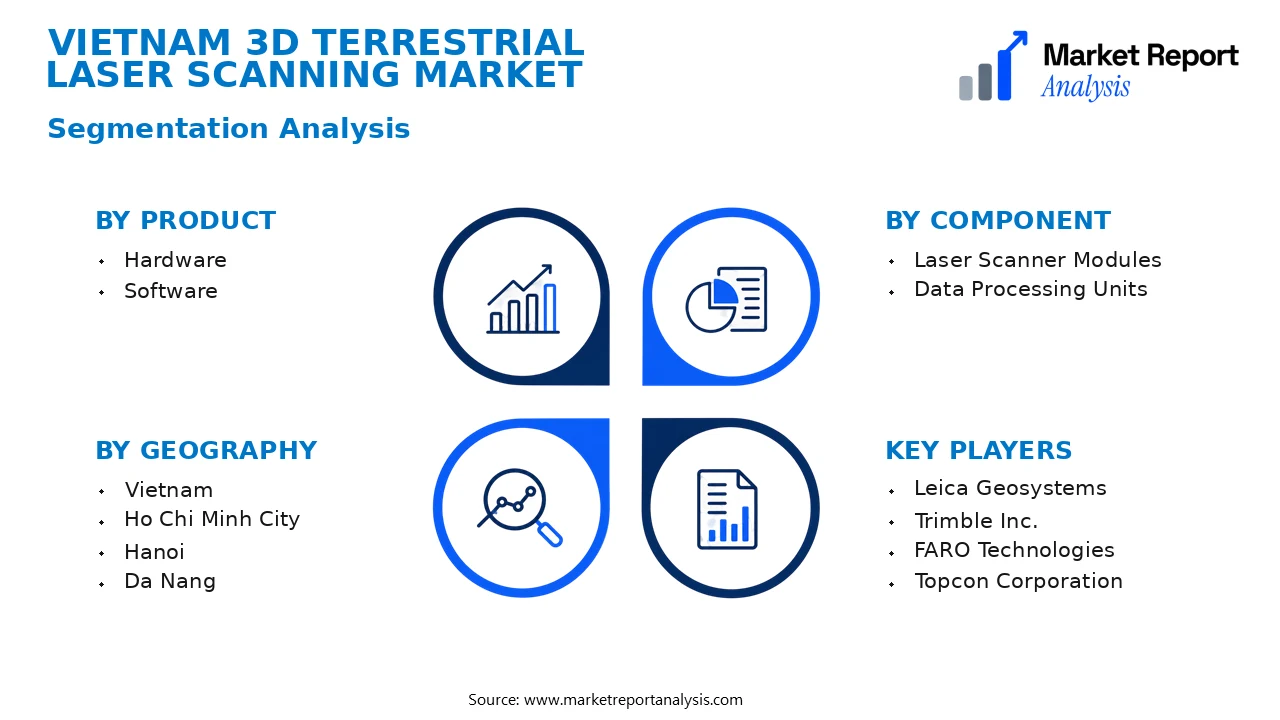
- Product
- Hardware: This includes laser scanners, tripods, and other physical equipment necessary for terrestrial laser scanning operations. Hardware demands are driven by infrastructure projects and detailed surveying needs.
- Software: Laser scanner data processing, editing, and visualization tools fall under this segment. Increasing adoption of integrated software solutions enhances productivity and precision in surveying, engineering, and construction sectors.
- Component
- Laser Scanner Modules: Core components that emit and receive laser pulses, crucial for capturing high-precision 3D data. Demand correlates with project complexity and the requirement for detailed imagery.
- Data Processing Units: High-performance computing devices facilitate real-time data interpretation and model creation, essential in rapid deployment environments and large-scale surveying tasks in Vietnam.
- Application
- Construction and Infrastructure: Major application area in Vietnam, driven by ongoing urban development projects, transportation infrastructure, and smart city initiatives that require precise ground and structure measurements.
- Surveying and Mapping: Used extensively for topographic surveys, land assessment, and environmental monitoring, aiding government and private sector projects to ensure accuracy and compliance.
- Industrial Inspection: Employed in inspecting existing industrial facilities, pipelines, and storage tanks, supporting safety regulations and maintenance schedules.
- End User
- Government and Municipal Bodies: These entities deploy terrestrial laser scanning for urban planning, infrastructure development, and environmental management, reflecting public sector investment in technological modernization.
- Construction Companies: Use laser scanning for site surveying, demolition planning, and quality control, a practice accelerated by Vietnam’s expanding construction sector.
- Geospatial and Surveying Firms: Provide specialized services utilizing terrestrial laser scanning for clients in civil engineering, archaeology, and environmental sectors, with growth fueled by digital transformation trends.
- Industry Vertical
- Construction & Civil Engineering: The dominant industry vertical, with high growth prospects because of Vietnam’s urban expansion and infrastructure projects requiring accurate as-built data.
- Real Estate & Urban Planning: Growing demand for 3D models to assist in project visualization, regulatory compliance, and marketing, supporting Vietnam's real estate development boom.
- Manufacturing & Industry: Use in plant layout, facility management, and equipment inspection, aligned with Vietnam’s expanding industrial base and export-oriented manufacturing sectors.
- Geography
- Vietnam: The overarching geographical category, with specific focus on key urban centers such as:
- Ho Chi Minh City: The economic hub with intense infrastructure projects, industrial zones, and a high demand for advanced surveying technologies.
- Hanoi: The political capital witnessing rapid urbanization and governmental projects integrating laser scanning for urban planning and heritage preservation.
- Da Nang: A coastal city with emerging tourism infrastructure, port development, and urban expansion requiring precise 3D scanning solutions.
- Hai Phong: Industrial and port city with expanding logistics and manufacturing facilities, driving localized demand for terrestrial laser scanning.
- Can Tho: Center for Mekong Delta projects focused on flood management, land use, and infrastructure, increasingly leveraging 3D scanning for environmental monitoring.
- Bien Hoa: Industrial area close to Ho Chi Minh City, with a rising need for detailed topographic data to support manufacturing and infrastructure planning.
- Nha Trang: Tourism and coastal city employing terrestrial laser scanning in coastal erosion studies, urban development, and heritage site conservation.
Competitive Intelligence
The Vietnam 3D Terrestrial Laser Scanning Market is characterized by growing competition among both local and international firms, aiming to secure a foothold in this expanding industry. Market concentration remains moderate, with key players such as Leica Geosystems, Trimble, and FARO Technologies vying for dominance through product innovation and strategic partnerships. Companies are heavily investing in R&D to develop more accurate, portable, and user-friendly laser scanning solutions tailored to Vietnam's unique infrastructural and environmental conditions. Strategic alliances between equipment providers and local engineering firms facilitate market expansion, especially in rapidly urbanizing cities like Hanoi, Ho Chi Minh City, and Da Nang, where infrastructure projects drive demand. Acquisitions and joint ventures are common tactics to bolster technological expertise and market reach. Differentiation among competitors hinges on technological advancements, after-sales support, and tailored solutions for Vietnam’s construction, heritage preservation, and mining sectors. This competitive landscape fosters continuous innovation, enabling companies to capitalize on Vietnam’s burgeoning demand for precise 3D scanning in diverse verticals.
Leading Company Profiles
The competitive landscape in Vietnam’s 3D terrestrial laser scanning market comprises several key players focused on innovation, strategic expansion, and technological advancement to meet rising demand across various sectors.
- Leica Geosystems
- Trimble Inc.
- FARO Technologies
- Topcon Corporation
- Hexagon AB
- Bentley Systems
- Riegl Laser Measurement Systems
- Zoller + Fröhlich GmbH
- Maptek
- GeoSLAM
Leica Geosystems
Leica Geosystems offers high-precision laser scanning solutions tailored for infrastructure and industrial applications, emphasizing innovation, accuracy, and integration of advanced sensor technologies for Vietnamese market needs.
Trimble Inc.
Trimble provides comprehensive geospatial solutions, focusing on scalable 3D laser scanning systems, software integration, and tailored services to meet construction, surveying, and environmental requirements within Vietnam.
FARO Technologies
FARO specializes in portable 3D measurement and imaging systems, emphasizing ease of use, rapid data acquisition, and precision for industrial, heritage, and manufacturing sectors in Vietnam.
Topcon Corporation
Topcon offers innovative land surveying and construction solutions through its laser scanning hardware and software, aiming at enhancing productivity and accuracy in Vietnam’s infrastructure projects.
Hexagon AB
Hexagon’s geospatial division integrates laser scanning with digital reality solutions, promoting large-scale infrastructure projects and smart city initiatives across Vietnam with cutting-edge technology.
Bentley Systems
Bentley Systems provides engineering and construction software that complements laser scanning hardware, supporting integrated design, analysis, and project management solutions within Vietnam.
Riegl Laser Measurement Systems
Riegl focuses on high-performance LiDAR and terrestrial measurement systems that serve environmental monitoring, mining, and infrastructure sectors, emphasizing reliability and advanced data processing in Vietnam.
Zoller + Fröhlich GmbH
Zoller + Fröhlich supplies mobile laser scanning solutions that deliver high-precision topographical data, targeted at urban planning and civil engineering projects in Vietnam.
Maptek
Maptek provides innovative solutions for mining, utilizing laser scanning for resource estimation, planning, and environmental management, aligning with Vietnam’s expanding mining industry needs.
GeoSLAM
GeoSLAM offers lightweight, handheld laser scanners optimized for rapid indoor and outdoor mapping, supporting Vietnam’s heritage preservation and construction sectors with flexible data collection tools.
Strategic Business Developments

- June 2026 – Leica Geosystems – Launch of new multi-sensor 3D laser scanner – Enhances precision and data integration capabilities, boosting competitiveness in Vietnam’s infrastructure survey market.
- April 2026 – Trimble Inc. – Capacity expansion in Vietnam – Increased manufacturing and R&D footprint to serve rising demand, ensuring quicker delivery and localized technological support for regional projects.
- March 2026 – Faro Technologies – Strategic alliance with Vietnamese surveying firms – Facilitates technology transfer and integration of portable laser scanning systems in large-scale projects across Vietnam.
- May 2026 – Topcon Corporation – Introduction of AI-enabled mapping solutions – Supports automation and improved data processing speeds, offering Vietnam’s construction and urban planning sectors advanced tools.
- January 2026 – Hexagon AB – Acquisition of a local survey solutions company – Strengthens market presence, expanding service offerings in geospatial data acquisition and analysis in Vietnam.
Frequently Asked Questions
What is the Vietnam 3D Terrestrial Laser Scanning Market?
The Vietnam 3D Terrestrial Laser Scanning Market comprises the industry involved in the production, distribution, and application of terrestrial laser scanning technology for capturing detailed 3D data of terrestrial environments across Vietnam, primarily used in infrastructure, construction, and surveying sectors.
What is the current market size of Vietnam 3D Terrestrial Laser Scanning Market?
As of 2026, the Vietnam 3D Terrestrial Laser Scanning Market is valued at approximately USD 0.35 Billion, reflecting increasing adoption driven by infrastructure development and technological investments, with a forecast growth trend over the coming years.
What factors are driving the Vietnam 3D Terrestrial Laser Scanning Market?
Market growth is driven by rapid urbanization, government initiatives on smart city projects, modernization of construction practices, and rising demand for precise geographic and topographic data, which enhance project accuracy and efficiency across various industries.
Which Vietnamese city leads the Vietnam 3D Terrestrial Laser Scanning Market?
Ho Chi Minh City leads the market due to its booming construction sector, extensive infrastructure projects, and high levels of technological adoption, making it the primary hub for terrestrial laser scanning application in Vietnam.
Which segment is expected to grow the fastest?
The construction and civil engineering segment is projected to experience the fastest growth due to increasing infrastructure projects, urban planning initiatives, and the adoption of advanced 3D scanning technology for project precision and site monitoring.
Who are the leading companies operating in the Vietnam 3D Terrestrial Laser Scanning Market?
Leading market participants include international and local firms such as Leica Geosystems, Trimble, Topcon, and Vietnamese technology providers, emphasizing innovation, competitive pricing, and service expansion to capture market share.
Analyst Perspective
The Vietnam 3D Terrestrial Laser Scanning Market exhibits a mature but still evolving landscape, driven by increasing infrastructural demands and digital transformation initiatives. Long-term, the market is poised for steady growth, with technological advancements such as improved sensor accuracy, faster data processing, and integration with AI enhancing operational efficiencies. Commercial opportunities are abundant in urban planning, heritage preservation, and oil & gas sectors, especially within Hanoi, Ho Chi Minh City, and Da Nang, where infrastructure investments are prioritized. Investment should focus on innovative hardware, software integration, and strategic partnerships to sustain competitive advantage. Intense competition among local and international players underscores the need for continuous technological upgrades and comprehensive service offerings. City-level growth potential remains highly favorable, particularly in rapidly developing urban centers that are expanding their civil and industrial projects. Strategic focus on technological leadership and regional customization will be critical for long-term success amid geopolitical and economic fluctuations.
