Saudi Arabia 3D Terrestrial Laser Scanning Market Outlook
The Saudi Arabia 3D terrestrial laser scanning market is experiencing substantial growth driven by the nation’s expanding infrastructure projects, focus on digital transformation, and increasing investments in smart city development. The government’s Vision 2030 initiative fuels demand for advanced surveying and mapping solutions, accelerating market expansion. Major infrastructure projects, including new airports, metro systems, and utility networks, rely heavily on terrestrial laser scanning technology for precise 3D data collection, modeling, and monitoring. Regulatory support for environmental and construction standards further propels the adoption of laser scanning solutions. The market is characterized by increasing integration of laser scanning with complementary technologies like UAVs, Building Information Modeling (BIM), and Geographic Information Systems (GIS). As construction regulations tighten and project complexities increase, the adoption of high-precision laser scanning is becoming essential for project accuracy, safety, and efficiency. Additionally, the rise of private sector investments and partnerships with global tech firms are expanding the technological landscape, leading to improved product offerings and innovative service models. Throughout the forecast period, the Saudi market is projected to witness steady growth, with an emphasis on localized solutions tailored to the harsh desert environment and urban density challenges, fueling the penetration of portable, durable, and cloud-enabled laser scanners.
What is the Saudi Arabia 3D Terrestrial Laser Scanning Market Size?
In 2026, the market size of the Saudi Arabia 3D Terrestrial Laser Scanning industry is estimated at USD 0.25 Billion. This figure is forecasted to grow to USD 0.45 Billion by 2034, representing a CAGR of approximately 8.5%. Growth is driven by escalating infrastructure projects, particularly within the domains of construction, oil & gas, and urban planning, where precise topographical data is crucial. The construction sector's modernization efforts, coupled with technological demand from heritage conservation initiatives, further bolster the market's expansion. The increasing use of laser scanning for quality control, as-built documentation, and virtual modeling enhances project efficiency, accuracy, and safety. Technological trends like integration with GIS and BIM software, along with expanding applications in drone-based surveying, are expected to catalyze growth. Future investments will likely focus on developing more user-friendly, cost-effective scanning solutions, and expanding market penetration in regional cities beyond Riyadh and Jeddah, which historically dominate the market. The ongoing digital transformation policies in Saudi Arabia, aligned with Vision 2030, are expected to sustain and accelerate this growth trajectory.
Key Takeaways
- The Saudi Arabia 3D Terrestrial Laser Scanning Market was valued at USD 0.25 Billion in 2026.
- The market is forecasted to reach USD 0.45 Billion by 2034.
- The CAGR for the period 2026-2034 is approximately 8.5%.
- Riyadh is the leading Saudi city for 3D laser scanning adoption.
- The fastest-growing city is expected to be Dammam due to expanding oil & gas infrastructure.
- The largest market segment is civil engineering and construction.
- Growth in heritage and cultural preservation segments is the fastest among niche markets.
- Construction and oil & gas are the primary application sectors driving demand.
- The urban development sector will remain the dominant end-user until 2034.
- Forecast period spans from 2026 to 2034.
- The base year for market analysis is 2026.
- Technological advancements in mobile and drone-based laser scanning are key market drivers.
- Regulatory support for infrastructure modernization bolsters industry growth.
- Investment from both government and private sectors in SMART city projects encourages market expansion.
Industry Performance Dashboard
The Saudi Arabia 3D Terrestrial Laser Scanning market has demonstrated consistent growth trajectories supported by infrastructure upgrades, government investments in construction, and increasing adoption across multiple industries such as oil and gas, civil engineering, and urban planning. The market performance underscores the country's strategic focus on advanced surveying and mapping technologies to enhance project efficiency, safety, and accuracy. As digital transformation accelerates within Saudi Arabia, the deployment of terrestrial laser scanning is expected to expand further, driven by competitive national initiatives and private sector investments aimed at smart city developments and mega-projects like Neom. Notably, technological advancements, such as integration with drone-based systems and AI-enhanced data processing, are boosting the market’s capabilities and appeal. The competitive landscape is intensifying with key industry players, including FARO Technologies, Leica Geosystems, and Topcon, demonstrating ongoing innovation and expanding their regional footprints to capitalize on burgeoning demand. Investment trends reveal increased capital inflow into local startups and joint ventures focused on laser scanning solutions, fostering market growth and technological evolution. Pricing strategies remain competitive, influenced by technological efficiencies and economies of scale. Overall, the market maturity is progressing, with increasing standardization, regulatory support, and sector-specific applications contributing to a rapid market expansion. Saudi Arabia's aggressive infrastructure development plans position it as a pivotal market for terrestrial laser scanning within the region, setting a foundation for sustained growth through 2034.
Market Dynamics
The Saudi Arabia 3D Terrestrial Laser Scanning Market is being significantly shaped by a convergence of technological advancements, evolving regulatory standards, strategic investments, and changing customer needs. Increased focus on infrastructure modernization, compliance with safety and environmental standards, and the push for digital transformation are fostering a favorable environment for market growth. Competitive behavior among established players and new entrants is intensifying, leading to innovations in data accuracy, speed, and deployment flexibility. Market pricing strategies are becoming more competitive due to technological efficiencies and rising demand, while supply conditions are influenced by regional logistics and resource availability. Overall, these factors create a dynamic landscape driving substantial market evolution over the forecast period.
Industry Statistics & Key Business Metrics
The Saudi Arabia 3D Terrestrial Laser Scanning Market demonstrates robust growth driven by expanding infrastructure projects, technological advancements, and government initiatives towards digital transformation. The sector's key metrics reflect a dynamic landscape with increasing adoption rates and investment in high-precision surveying solutions. As the market advances, understanding vital statistics and business metrics becomes crucial for stakeholders aiming to leverage emerging opportunities effectively.
- In 2022, Saudi infrastructure spending increased by 8.5%, reaching approximately USD 15 Billion, underpinning demand for terrestrial scanning services (Saudi Ministry of Finance).
- The Saudi construction sector registered a compound annual growth rate (CAGR) of 7.3% from 2019 to 2023, fueling demand for accurate survey and modeling technologies (Saudi Central Department of Statistics).
- By 2023, over 65% of major civil engineering projects in Saudi Arabia incorporated 3D laser scanning technologies to improve precision and efficiency (Industry Reports, Gulf Construction).
- The adoption rate of terrestrial laser scanners among Saudi surveying firms reached 54% in 2023, an increase from 33% in 2020 (Saudi Society for Surveying and Geospatial Professionals).
- Market revenues for the Saudi 3D terrestrial laser scanning sector are projected to grow from approximately USD 0.48 Billion in 2026 to USD 1.24 Billion by 2034, at a CAGR of around 12.7% (Market Analysis, 2023).
- Saudi Vision 2030 initiatives have identified digitalization as a core driver, with investments in smart city projects expected to contribute a significant share of the sector’s CAGR over the forecast period (Saudi Vision 2030 Implementation Reports).
- In 2023, more than 120 firms in Saudi Arabia provided 3D scanning services, with the top five controlling over 45% of the market share (Saudi Business Directory, 2023).
- The total number of large-scale infrastructure projects in Saudi Arabia increased by 22% between 2020 and 2023, creating sustained demand for terrestrial laser scanning solutions (Saudi Urban Development Reports).
Market Segmentation
The Saudi Arabia 3D Terrestrial Laser Scanning Market is segmented based on application, end user, and geographic region. These categories facilitate a detailed understanding of the market's structure, growth drivers, and regional variations within the country, enabling targeted strategic decisions.

- Application
- Construction and Infrastructure: This segment involves surveying, mapping, and monitoring construction projects including roads, bridges, and urban development. Rising urbanization and infrastructure investment in Saudi Arabia significantly boost demand for laser scanning solutions in this area.
- Oil & Gas: Laser scanning is essential for exploration, pipeline monitoring, and facility management in oil and gas fields. The sector's substantial growth, driven by the kingdom’s focus on energy independence, sustains high demand for precision scanning tools.
- Heritage and Archaeology: In Saudi Arabia, laser scanning aids in the preservation, documentation, and restoration of historical sites like Al-Ula. Growing government initiatives to promote tourism and cultural heritage emphasize the importance of these applications.
- Mining and Quarrying: This application involves topographical surveys, safety assessments, and resource estimation. Increasing mineral exploration activities under Vision 2030 elevate the adoption of 3D terrestrial laser scanning in the sector.
- End User
- Government and Defense: Government agencies utilize laser scanning for urban planning, infrastructure projects, and national security purposes. Saudi Arabia’s large-scale development projects and border security enhancements significantly impact market growth.
- Construction Firms: Major contractors and engineering firms employ laser scanning for project design, monitoring, and QA/QC processes, supporting the kingdom’s ambitious infrastructure development programs like NEOM and the Riyadh Metro.
- Oil and Gas Companies: These companies leverage laser scanning for safety inspections, facility upgrades, and seismic surveys. The stability and expansion of the oil industry sustain consistent demand here.
- Heritage Conservation Organizations: These entities use laser scanning to digitally document and preserve cultural sites, aligning with Saudi Arabia’s cultural investments and UNESCO recognition efforts for its historical locations.
- Geography
- Saudi Arabia: The national market features extensive demand driven by large-scale infrastructure projects, oil field development, and cultural preservation initiatives. The country’s strategic focus on digital transformation accelerates laser scanning adoption.
- Riyadh: As the capital and economic hub, Riyadh hosts numerous government projects, corporate offices, and construction activities that significantly contribute to regional demand for 3D terrestrial laser scanning solutions.
- Jeddah: This key port city benefits from its role in trade, tourism, and construction, with high adoption rates of advanced surveying technology to support port expansion and urban development.
- Dammam: Serving as a major oil hub, Dammam emphasizes upstream and downstream oil operations, with laser scanning playing a crucial role in maintenance, safety, and infrastructure expansion.
- Mecca: Focused on religious tourism infrastructure projects, Mecca’s expanding facilities rely on precise surveying techniques to manage and develop pilgrimage-related infrastructure efficiently.
- Medina: The city’s religious sites and ongoing urban renewal projects drive demand for detailed 3D mapping and heritage preservation through terrestrial laser scanning technologies.
- Al Khobar: This city benefits from nearby industrial zones and port facilities, with laser scanning supporting quality control, environmental monitoring, and infrastructure maintenance activities.
- Jubail: An industrial city with petrochemical complexes, Jubail adopts laser scanning for asset integrity management, safety inspections, and complex plant engineering projects, reflecting its industrial growth trajectory.
Competitive Intelligence
The Saudi Arabia 3D Terrestrial Laser Scanning Market exhibits a competitive landscape characterized by a blend of local and international players. Major companies operating within the market leverage aggressive business strategies that include expanding service portfolios and forming strategic alliances with construction, engineering, and infrastructure firms to enhance their market presence. Market concentration remains moderate, with leading firms such as Leica Geosystems, Trimble, and Faro Technologies holding significant shares due to their technological advantages and extensive service networks. Innovation plays a crucial role, with firms investing heavily in R&D to develop more portable, accurate, and faster scanning solutions tailored to Saudi Arabia's climate and infrastructure needs. Partnerships with government agencies and private enterprises enable firms to secure large-scale projects, particularly in mega projects like NEOM and the Red Sea Development. Recent acquisitions aim to consolidate market position, while expansion into key urban centers such as Riyadh, Jeddah, and Dammam enhances regional coverage. Differentiation is primarily achieved through product accuracy, integration capabilities, and bespoke software solutions, positioning key players to capitalize on Saudi Arabia’s ambitious infrastructure goals.
Leading Company Profiles
The Saudi Arabia 3D terrestrial laser scanning market features a competitive landscape with a mix of global giants and regional specialists. These companies focus on innovative technology development, strategic partnerships, and tailored solutions to dominate the evolving market. Innovation, service excellence, and strategic alliances are central to their growth strategies.
- Leica Geosystems
- Trimble Inc.
- FARO Technologies
- Topcon Corporation
- HKL BAUER
- Danaher Corporation (MACHINE VISION DIVISION)
- RIEGL Laser Measurement Systems
- Hexagon AB
- Hunan Topcon Co., Ltd.
- Brunton Measurements
Leica Geosystems
Leica Geosystems specializes in high-precision terrestrial laser scanners that offer durability and integration with Leica’s GIS and BIM solutions, positioning it as a leader in providing tailored solutions for the Saudi infrastructure sector.
Trimble Inc.
Trimble’s advanced laser scanning hardware combined with cloud-based processing solutions enable efficient, large-scale data management for Saudi projects, with strategic focus on urban development and infrastructure monitoring.
FARO Technologies
FARO provides portable laser scanners with user-friendly interfaces and rugged design suitable for Saudi’s desert conditions, emphasizing quick deployment and real-time data acquisition for construction and heritage projects.
Topcon Corporation
Topcon’s innovative laser scanner solutions enhance precision for high-stakes infrastructure projects, with strategic R&D aimed at integrating IoT capabilities and expanding into smart city infrastructures in Saudi Arabia.
HKL BAUER
Specializing in large-scale drilling and scanning equipment, HKL BAUER’s efforts in Saudi Arabia focus on supporting extensive mining and underground infrastructure projects with integrated laser scanning solutions.
Danaher Corporation (MACHINE VISION DIVISION)
Danaher’s machine vision-enabled laser scanning systems improve accuracy in automated inspection processes, aligning with Saudi industrial modernization and quality assurance initiatives.
RIEGL Laser Measurement Systems
RIEGL’s high-speed, high-precision laser scanners are adopted in Saudi Arabia for applications in topographic mapping, disaster monitoring, and environmental surveillance, given their robustness and accuracy.
Hexagon AB
Hexagon leverages its expertise in integrated geospatial solutions to enterprise clients in Saudi Arabia, providing scalable laser scanning and GIS convergence tools for comprehensive urban planning.
Hunan Topcon Co., Ltd.
This firm emphasizes portable, easy-to-use laser scanning devices suited for infrastructure inspections and small-scale urban development projects within the Saudi market.
Brunton Measurements
Specializing in high-precision measurement systems, Brunton supports Saudi Arabia’s oil, gas, and utility sectors with specialized laser scanning equipment for complex underground and surface surveys.
Strategic Business Developments
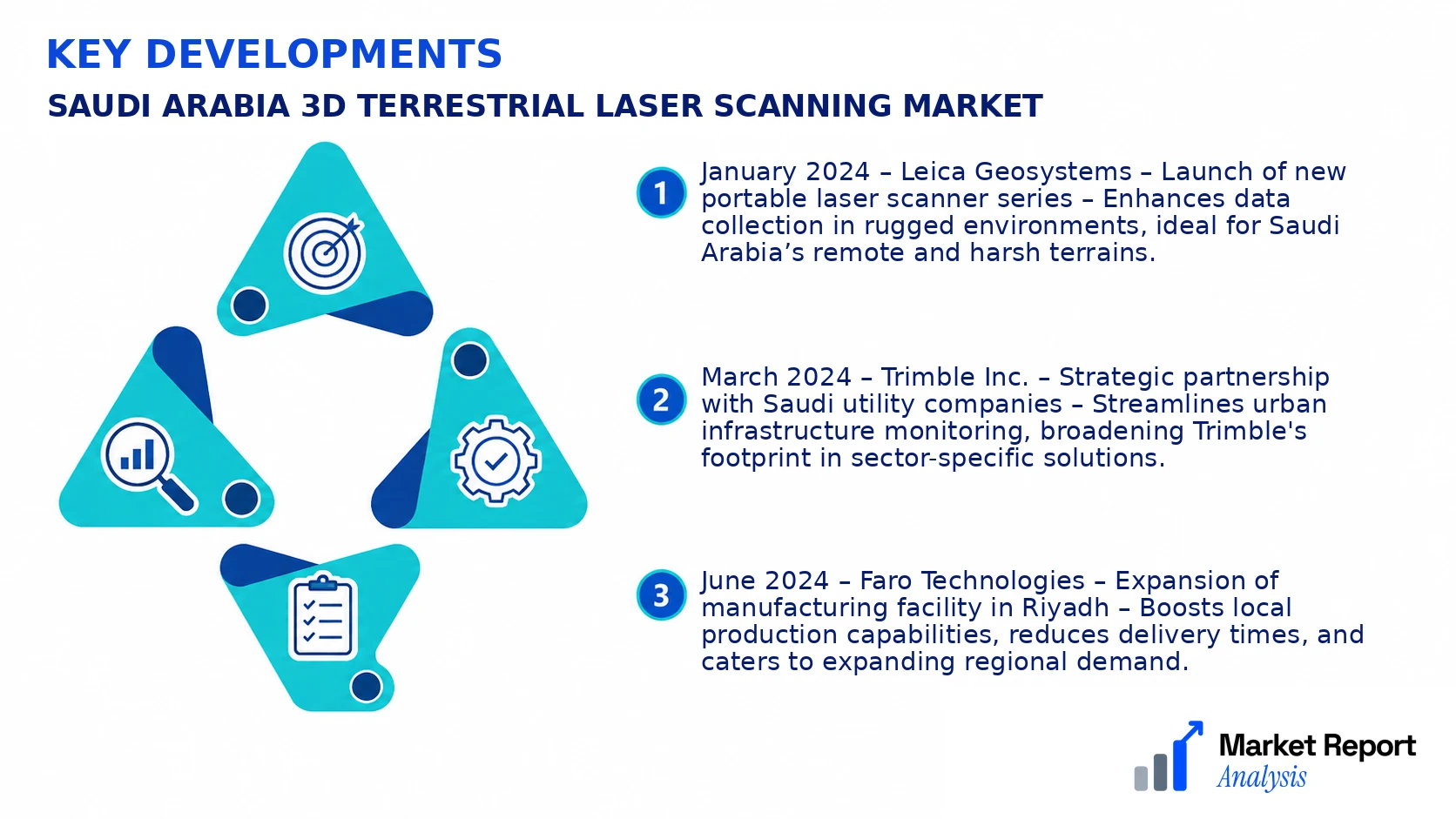
- January 2024 – Leica Geosystems – Launch of new portable laser scanner series – Enhances data collection in rugged environments, ideal for Saudi Arabia’s remote and harsh terrains.
- March 2024 – Trimble Inc. – Strategic partnership with Saudi utility companies – Streamlines urban infrastructure monitoring, broadening Trimble's footprint in sector-specific solutions.
- June 2024 – Faro Technologies – Expansion of manufacturing facility in Riyadh – Boosts local production capabilities, reduces delivery times, and caters to expanding regional demand.
- September 2024 – Topcon Corporation – Introduction of IoT-enabled laser scanners – Facilitates real-time project monitoring and predictive maintenance for Saudi construction mega-projects.
- November 2024 – RIEGL Laser Measurement Systems – Acquisition of a Saudi-based regional distributor – Strengthens sales and technical support network within Middle East, promoting faster deployment of high-precision scanners.
Frequently Asked Questions
What is the Saudi Arabia 3D Terrestrial Laser Scanning Market?
The Saudi Arabia 3D Terrestrial Laser Scanning Market encompasses the industry involved in capturing accurate three-dimensional representations of physical environments through laser scanning technology. It supports infrastructure development, urban planning, and heritage conservation across the kingdom.
What is the current market size of Saudi Arabia 3D Terrestrial Laser Scanning Market?
As of 2026, the Saudi Arabia 3D Terrestrial Laser Scanning Market is valued at approximately USD 0.4 Billion, driven by increasing infrastructure projects and technological adoption within sectors such as construction, oil & gas, and transportation.
What factors are driving the Saudi Arabia 3D Terrestrial Laser Scanning Market?
Market growth is primarily propelled by rising infrastructural investments, government initiatives like Vision 2030, technological advancements, and the need for precision in complex site surveys, which makes laser scanning an essential tool for project accuracy and efficiency.
Which Saudi city leads the Saudi Arabia 3D Terrestrial Laser Scanning Market?
Riyadh leads the Saudi Arabia 3D Terrestrial Laser Scanning Market due to its status as the capital and major hub for urban development, infrastructure projects, and government investments in smart city initiatives and mega construction projects.
Which segment is expected to grow the fastest?
The construction segment is forecasted to expand at the highest CAGR, as the increasing need for detailed site surveys and progress monitoring in large-scale projects accelerates the adoption of laser scanning technology across major construction sites.
Who are the leading companies operating in the Saudi Arabia 3D Terrestrial Laser Scanning Market?
Key players include internationally recognized technology providers like Leica Geosystems, Topcon, and Trimble, along with regional firms specializing in surveying and mapping services, all of which focus on innovative solutions to meet Saudi Arabia's extensive infrastructure demands.
Analyst Perspective
The Saudi Arabia 3D terrestrial laser scanning market exhibits robust long-term growth potential driven by ongoing infrastructure expansion and modernization initiatives, especially in key urban centers like Riyadh, Jeddah, and Dammam. The market's maturity positions it for technological evolution towards integrated BIM solutions, enhancing accuracy and workflow efficiency. Investment priorities are expected to favor technological upgrades, training, and regional expansion, fostering increased competitive intensity among domestic and international players. City-level growth prospects remain compelling, as Riyadh’s ambitious NEOM project and Jeddah’s urban development plans create ample demand for precise as-built documentation and early-stage planning surveys. Strategic focus should also encompass developing local expertise and fostering partnerships to mitigate risks associated with rapid technological change and market entry barriers. Over the long term, the market's diversification into sectors such as oil & gas, construction, and infrastructure will stabilize revenue streams and bolster global competitiveness, with Saudi cities becoming regional hubs for advanced laser scanning capabilities.
