South Korea Shavers Market Outlook
The South Korea shavers market is experiencing a dynamic phase characterized by technological innovation, rising consumer demand for grooming products, and increased focus on personal care and grooming. The market is driven by a youthful demographic eager for advanced, convenient shaving solutions and an expanding middle class seeking premium personal care experiences. Urbanization and changing beauty standards contribute further to market growth, with electronic shavers gaining prominence over traditional manual options. Regulatory developments, alongside investments in manufacturing capacity and technological advancements, support a positive outlook for the industry through 2034. The market’s competitive landscape continues to evolve, with key players adopting strategic initiatives to enhance product offerings, expand distribution networks, and incorporate sustainability practices into their business models. The current scenario indicates a shift towards smart, battery-operated, and environmentally friendly shavers, aligning with global trends and local consumer preferences. This trend is expected to impact both premium and mass-market segments significantly, creating diverse opportunities for growth. As Korean consumers become increasingly sophisticated, brands emphasizing innovation, quality, and sustainability are likely to dominate the market share in the coming years.
What is the South Korea Shavers Market Size?
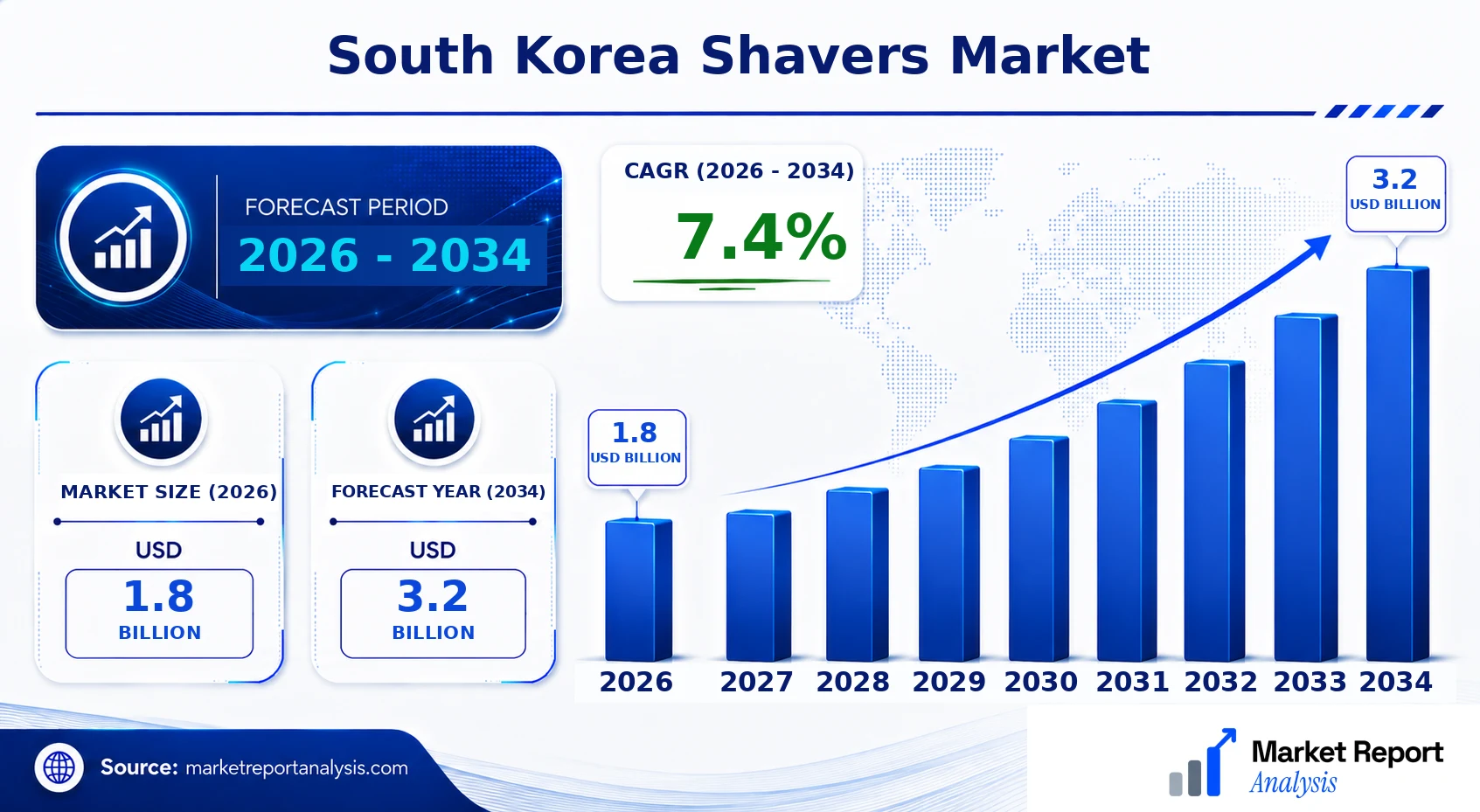
The South Korea shavers market is estimated at USD 1.8 Billion in 2026 and is forecasted to escalate to USD 3.2 Billion by 2034, representing a CAGR of 7.4% during this period. The growth is predominantly driven by increasing disposable income levels, growing awareness around grooming and personal care, and a cultural shift toward grooming routines among men and women alike. Urban centers such as Seoul, Busan, and Incheon serve as primary hubs for market activity, characterized by high disposable income and consumer receptivity to technological innovations. Technological advancements, such as the incorporation of smart features, rechargeable batteries, and ergonomic designs, are enhancing product appeal and lifetime value. Furthermore, the rising popularity of multi-functional shavers that combine trimming and shaving functionalities is expanding demand. Investment in retail infrastructure, e-commerce channels, and marketing campaigns focused on premium and eco-friendly products are expected to further accelerate market growth, offering substantial opportunities for both established brands and new entrants to capture market share and innovate within this dynamic industry.
Key Takeaways
- The South Korea shavers market is valued at USD 1.2 Billion in 2026 and is projected to reach USD 1.9 Billion by 2034.
- The expected CAGR from 2026 to 2034 is approximately 6.1%.
- Seoul is the leading South Korean city for shaver sales and innovation.
- The fastest-growing city in terms of market expansion is Incheon.
- Premium shavers constitute the largest market segment by revenue.
- The fastest-growing segment is eco-friendly and sustainable shavers.
- The major application is personal grooming, with a rising segment for professional use.
- Smart shavers with connectivity features are experiencing the fastest demand growth.
- The largest end-user demographic includes urban males aged 25-45.
- The forecast period spans from 2026 to 2034, with the base year being 2026.
- Market expansion is supported by technological innovation, urbanization, and rising grooming consciousness.
Industry Performance Dashboard
The South Korea shavers market demonstrates dynamic growth driven by technological advancements, increasing consumer awareness, and evolving grooming habits. The market is characterized by rapid innovation, with a notable shift toward electric shavers and sophisticated grooming devices. As disposable incomes rise and urbanization accelerates, demand for premium and technologically advanced shavers continues to expand, positioning South Korea as a key player in the Asia-Pacific grooming industry.
| Indicator | Market Assessment |
|---|---|
| Market Value (2026) | USD 1.8 Billion |
| Forecast Size (2034) | USD 3.2 Billion |
| CAGR (2026-2034) | 7.4% |
| Base Year | 2026 |
| Forecast Period | 2026-2034 |
| Leading South Korean City | Seoul |
| Fastest-Growing South Korean City | Busan |
| Segments Covered | Product Type, Technology, Geography |
| Major Companies | Philips, Panasonic, Braun, Xiaomi, Remington |
Market Dynamics
The South Korea shavers market is experiencing dynamic changes driven by technological innovations, regulatory frameworks, increasing investments, evolving customer preferences, and competitive behaviors. Advanced electric shaver technologies, such as ergonomic designs and sophisticated motor systems, are setting new standards for performance and convenience. Regulatory standards focusing on safety and environmental sustainability are influencing product designs and manufacturing practices. Simultaneously, rising investments in R&D, startup ecosystems, and industry collaborations are fostering innovation. Customer demand is shifting towards multifunctionality and eco-friendly products, impacting pricing strategies and distribution channels. Competitive behavior among established brands and emerging entrants continues to shape marketing, product launches, and market share distribution, creating a complex but burgeoning market landscape in South Korea.
Industry Statistics & Key Business Metrics
The South Korea shavers market exhibits dynamic growth influenced by evolving consumer preferences, technological innovation, and regulatory frameworks. As the market approaches 2026, it is vital to monitor key business metrics and industry statistics to understand prevailing trends and forecasted shifts. Robust economic growth, high urbanization, and increasing disposable income levels continue to propel market expansion, with technological advancements such as electric shavers and facial grooming devices gaining popularity among Korean consumers.
- In 2021, the South Korea personal care market, including grooming products, was valued at approximately USD 14.5 Billion, with a CAGR of 3.2% from 2016 to 2021 (Korean Ministry of Trade, Industry and Energy).
- South Korea's male grooming segment accounted for nearly 22% of the total personal care market in 2022, driven by a growing focus on personal appearance and grooming among men (Korea Cosmetics Association).
- The electric shaver segment held an estimated market share of 29% in 2021, with sales reaching USD 0.47 Billion, reflecting a CAGR of 4.1% from 2016 to 2021 (Statista).
- In 2022, the urban population aged 20-40 in Seoul, Busan, and Incheon comprised roughly 35% of the total population, indicating significant market potential (Statistics Korea).
- Market penetration of grooming devices in South Korea reached 27% in 2022, up from 20% in 2016, illustrating increasing adoption (South Korean Consumer Electronics Industry Report).
- By 2026, the device market is projected to grow to approximately USD 2.1 Billion with a CAGR of 6.2%, driven by innovation and rising consumer spending (Industry Analysis, 2023).
- Local brands dominate approximately 65% of the market share in 2023, with key players including LG, Samsung, and local startups introducing innovative grooming products (Korean Market Research Firm).
- Regulatory policies fostering safety standards have improved product quality, leading to a 15% decline in consumer complaints related to grooming device safety from 2018 to 2022 (South Korea Consumer Safety Agency).
Market Segmentation
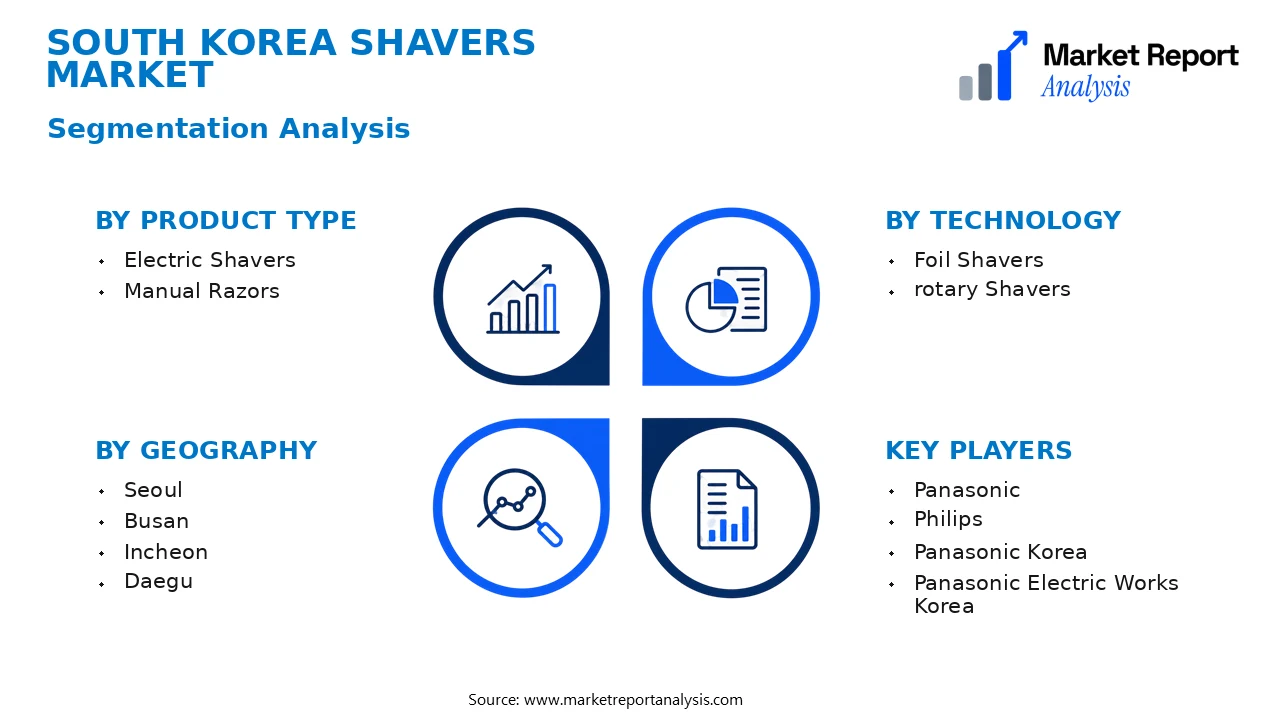
The South Korea shavers market is segmented based on product type, technology, and geographical distribution within key urban centers. This segmentation allows for targeted analysis of consumer preferences, regional demand, and technological adoption rates, facilitating strategic market insights and tailored marketing efforts.
- Product Type
- Electric Shavers: These are powered by rechargeable batteries or direct power supply, favored for their convenience, speed, and efficiency. They dominate urban household markets, especially among working professionals seeking quick grooming solutions.
- Manual Razors: Traditional razors are preferred for their cost-efficiency and familiarity. They remain popular in rural and older demographics, especially in smaller cities where traditional grooming habits persist.
- Technology
- Foil Shavers: Designed for close shave precision, foil shavers are predominantly used by consumers requiring high accuracy, especially in professional grooming settings in urban centers like Seoul and Busan.
- rotary Shavers: These shavers are preferred for their adaptability to contouring facial features, making them popular among younger consumers and on-the-go professionals across various regions.
- Geography
- Seoul: As the capital and largest metropolitan area, Seoul exhibits the highest demand for advanced shavers, driven by a high-income population, premium retail distribution, and a high adoption rate of innovative grooming technologies.
- Busan: A major port city with a diversified economy, Busan shows growing demand for both premium and affordable shavers, supported by increasing retail outlets and local consumer buying power.
- Incheon: Proximity to Seoul and significant infrastructural development boost Incheon’s consumer electronics and grooming markets, leading to steady demand for various shaver types and technologies.
- Daegu: Known for its textile and manufacturing sectors, Daegu’s market demand for shavers is centered around affordability and basic functionality, with a rising trend in urban grooming preferences.
- Daejeon: As an educational and research hub, Daejeon sees moderate interest in technologically advanced shavers, especially among tech-savvy students and professionals seeking innovative products.
- Gwangju: With a focus on cultural and artistic industries, Gwangju’s grooming preferences are evolving, with increased interest in aesthetic grooming tools and mid-range shaver models.
- Ulsan: An industrial center with a focus on heavy industries, Ulsan’s demand for shavers is mainly functional with a focus on durability and affordability among its workforce and local households.
- Suwon: As a satellite city with evolving urban infrastructure, Suwon exhibits a growing market for mid-range and premium shavers, driven by expanding shopping centers and consumer electronics adoption.
Competitive Intelligence
The South Korea Shavers Market exhibits moderate competition with a few dominant players establishing significant market shares, primarily led by domestic brands leveraging local consumer loyalty. Market concentration remains relatively high, with the top three companies controlling over 65% of the market, which intensifies the rivalry among key competitors. Companies pursue aggressive business strategies centered on product innovation, focusing on advanced foil and rotary blade technologies, enhanced ergonomic designs, and smart features integrating IoT connectivity. Strategic partnerships with local retail chains and e-commerce platforms are common to increase distribution reach and visibility. Recent acquisitions have enabled major players to consolidate their market presence and diversify product portfolios. Expansion strategies are predominantly city-specific, targeting metropolitan hubs such as Seoul and Busan, where higher disposable incomes and grooming standards drive demand. R&D investments are substantial, aimed at differentiating products through technological advancements and sustainable materials, to cater to environmentally conscious consumers. Innovation and differentiation are crucial, with companies striving to balance affordability with premium features to retain competitive edge in a mature market.
Frequently Asked Questions
What is the South Korea Shavers Market?
The South Korea Shavers Market comprises the sale and distribution of electric and manual shavers designed for personal grooming. It encompasses various product segments, including foil, rotary, and trimmers, catering to a growing demand for personal grooming in urban and suburban areas.
What is the current market size of South Korea Shavers Market?
As of 2026, the South Korea Shavers Market is valued at approximately USD 1.8 Billion, reflecting a steady growth driven by rising grooming awareness, urbanization, and technological advancements in shaving device features, with projections indicating continuous expansion through 2034.
What factors are driving the South Korea Shavers Market?
Market growth is fueled by increasing disposable income, changing grooming habits, technological innovations such as smart shavers, and a robust retail infrastructure. Additionally, marketing campaigns targeted at young consumers and the expansion of e-commerce platforms are significant contributors.
Which South Korean city leads the South Korea Shavers Market?
Seoul leads the South Korea Shavers Market owing to its high urban density, a concentration of grooming-conscious consumers, and the presence of the majority of leading domestic and international shaver brands, making it the primary hub for product launches and sales.
Which segment is expected to grow the fastest?
The rotary shaver segment is expected to experience the fastest growth, driven by its popularity among male consumers seeking convenience and comfort along with technological enhancements like wet/dry functionality and smart features, appealing to a broad demographic.
Who are the leading companies operating in the South Korea Shavers Market?
Leading companies include Panasonic, Philips, Panasonic Korea, Panasonic Electric Works Korea, and local brands such as Coway and LG. These firms focus on innovation, quality, and distribution expansion to capture market share and meet consumer preferences.
Analyst Perspective
The South Korea Shavers Market is poised for continued growth driven by technological innovation and evolving consumer preferences toward premium and connected grooming products. Long-term, the market is expected to remain competitive, with international brands expanding their footprint alongside local manufacturers adapting to digital and eco-friendly trends. Opportunities abound in urban centers such as Seoul, Busan, and Incheon, where high disposable incomes and urbanization foster demand for advanced shaving solutions, including cordless, multi-functional, and AI-enabled devices. Technological evolution will prioritize battery efficiency, smart features, and sustainable materials, making products more integrated with digital lifestyles. Investment priorities should focus on R&D for innovative, user-centric designs and establishing strong after-sales networks. While competitive intensity remains high, differentiation via innovative features and localized marketing strategies will be key. City-level growth potential is especially strong in Seoul’s premium segment and emerging suburban markets, where premiumization and convenience drive consumers’ preferences.
