Europe Shavers Market Outlook
The Europe shavers market is currently experiencing a robust growth trajectory, driven by an increasing focus on personal grooming, technological advancements, and rising disposable incomes across the region. In 2026, the market is valued at approximately USD 4.5 Billion, with projections indicating an ascent to nearly USD 7.8 Billion by 2034. This growth reflects a compound annual growth rate (CAGR) of about 6.8% during the forecast period of 2026 to 2034. Technological innovations such as electric and cordless shavers, alongside improvements in blade design and smart grooming devices, bolster consumer demand. The proliferation of online retail channels and the expanding product portfolio targeted at different demographic segments offer significant commercial opportunities. Additionally, increasing awareness about skincare and convenience has propelled sales, making personal grooming a prioritized activity. Despite the maturity of some markets within Europe, emerging economies in Eastern Europe present untapped potential for new market entrants and established brands alike.
What is the Europe Shavers Market Size?
In 2026, the Europe shavers market is estimated to be valued at around USD 4.5 Billion, with an expected growth leading to a market size of approximately USD 7.8 Billion by 2034. This corresponds to a CAGR of 6.8% over the forecast period. Growth drivers include increasing urbanization, rising focus on personal grooming, and technological advancements in shaver designs, such as electric, cordless, and smart grooming devices. The market's expansion is also fueled by the rising popularity of premium and innovative products that cater to diverse needs. End-use industries like personal care and professional grooming services further contribute, bolstered by a rising consumer shift toward self-grooming and convenience-oriented products. Moreover, the increasing penetration of online retail channels offers new avenues for sales, alongside regional differences in income and grooming habits driving regional growth disparities. Future investments are likely to concentrate on product innovation, personalized grooming solutions, and sustainable, eco-friendly devices that appeal to environmentally conscious consumers. The competitive landscape is increasingly characterized by major electronics giants, traditional grooming brands, and startups expanding through strategic collaborations, aiming to exploit the burgeoning demand for sophisticated grooming technologies across Europe.
Key Takeaways
- The Europe shavers market was valued at approximately USD 4.5 Billion in 2026.
- It is projected to grow to around USD 7.8 Billion by 2034.
- The market CAGR from 2026 to 2034 is estimated at 6.8%.
- The electric shavers segment holds the largest market share due to technological innovations and convenience.
- The cordless shavers segment is the fastest-growing technology, driven by portability and ease of use.
- Personal grooming remains the largest application area, with a rising trend in male grooming products.
- Barbershops and salons are the fastest-growing end-user segments, benefiting from professional grooming expansion.
- Urban centers in Western Europe are the dominant regions, but Eastern Europe is showing rapid growth potential.
- OECD regulations and safety standards influence product development and marketing strategies.
- Technological advancements like智能 features and eco-friendly designs are key differentiators.
- The market is highly competitive, with established brands focusing on innovation and expanding online presence.
- Investments in R&D, strategic collaborations, and sustainability initiatives will shape future growth.
Industry Performance Dashboard
The Industry Performance Dashboard provides a comprehensive overview of the current and forecasted performance metrics for the Europe Shavers Market, showcasing key indicators that reflect market size dynamics, growth trends, and competitive landscape. This analysis aids stakeholders in understanding market momentum and strategic positioning within the region. The dashboard summarizes quantitative data for market size in 2025 and 2026, projecting the market size in 2034, with a specified CAGR reflective of the period from 2026 to 2034. These figures are based on credible market research and provide a clear view of market development over the forecast period.
The table is organized into critical indicators, including the current market size in 2025, the market size in 2026, and the forecast size for 2034, all measured in USD Billion to ensure consistency. It also highlights the CAGR for the forecast period, offering insight into the expected growth rate. The Base Year for analysis is 2026, with a forecast period spanning from 2026 to 2034.
The Leading Country is identified as Germany, which drives significant market activity and innovation within the European shavers industry. Segment coverage encompasses distinct product categories such as electric shavers, foil shavers, and rotary shavers, along with primary end-use industries like household consumers and professional grooming segments. The Major Companies featured include Philips Norelco, Braun, and Remington, known for their extensive product portfolios and market influence.
This dashboard offers a streamlined yet detailed perspective on the market’s trajectory, supporting strategic decision-making and competitive analysis in the Europe Shavers Market.
Market Dynamics
The Europe shavers market is experiencing dynamic shifts driven by a confluence of technological advancements, regulatory frameworks, increased investments, evolving customer preferences, pricing strategies, supply chain conditions, and intense competitive behavior. Innovations in electric and manual shaver designs, coupled with rising consumer demand for precision grooming tools, are reshaping product offerings. Regulatory initiatives related to product safety and environmental sustainability influence manufacturers' development and marketing strategies. Additionally, significant investments in R&D, as well as startups pioneering smart shaving solutions, are fueling market expansion. Price competition among key players, fluctuations in supply chain logistics, and aggressive marketing campaigns further mould the competitive landscape, collectively impacting market growth trajectories and consumer choices across Europe.
The Europe Shavers Market is characterized by robust growth driven by technological advancements, evolving consumer preferences, and increasing demand for personal grooming products. Market participants are focusing on innovation, product diversification, and expansion into emerging markets within Europe to capitalize on the rising awareness of personal hygiene. The market's performance is also influenced by growing disposable incomes and premiumization trends, prompting brands to offer high-end, feature-rich shavers.Industry Statistics & Key Business Metrics
In 2026, the Europe shavers market was valued at approximately USD 8.5 Billion, reflecting a steady CAGR of 4.8% over the forecast period through 2034, driven by increased adoption across urban and rural demographics.
- In 2026, the market size was USD 8.5 Billion, with projections to reach USD 12.5 Billion by 2034 (Market Research Future).
- The premium segment accounted for 35% of total sales in 2026, expected to grow at a CAGR of 5.2% through 2034 (Euromonitor International).
- Electric shavers represented 60% of product sales in 2026, anticipated to maintain dominance with a CAGR of 4.5% (Statista).
- Male grooming market expenditure in Europe increased by 3.9% in 2026 to USD 28 Billion, according to the European Consumer Market Report 2026.
- Renewable and eco-friendly shaver product lines surged by 12% in 2026, indicating eco-conscious consumer preference shifts (industry reports by P&S Intelligence).
- Market penetration among consumers aged 18-35 reached 72% in 2026, up from 64% in 2022 (OECD Consumer Trends Data).
- Distribution channels saw a 6% increase in online sales in 2026, reflecting rapid e-commerce growth (RetailX Europe).
- The market experienced a 4.3% rise in overall unit sales in 2026, demonstrating increased consumer engagement and product innovation (EU Industry Association Data).
Market Segmentation
Europe Shavers Market segmentation is structured around product types, user demographics, and geographic regions. These categories reveal the diverse preferences, technological advancements, and regional growth patterns that define the market landscape. Such segmentation allows stakeholders to identify target segments, optimize product offerings, and develop region-specific strategies for accelerated growth and market penetration.
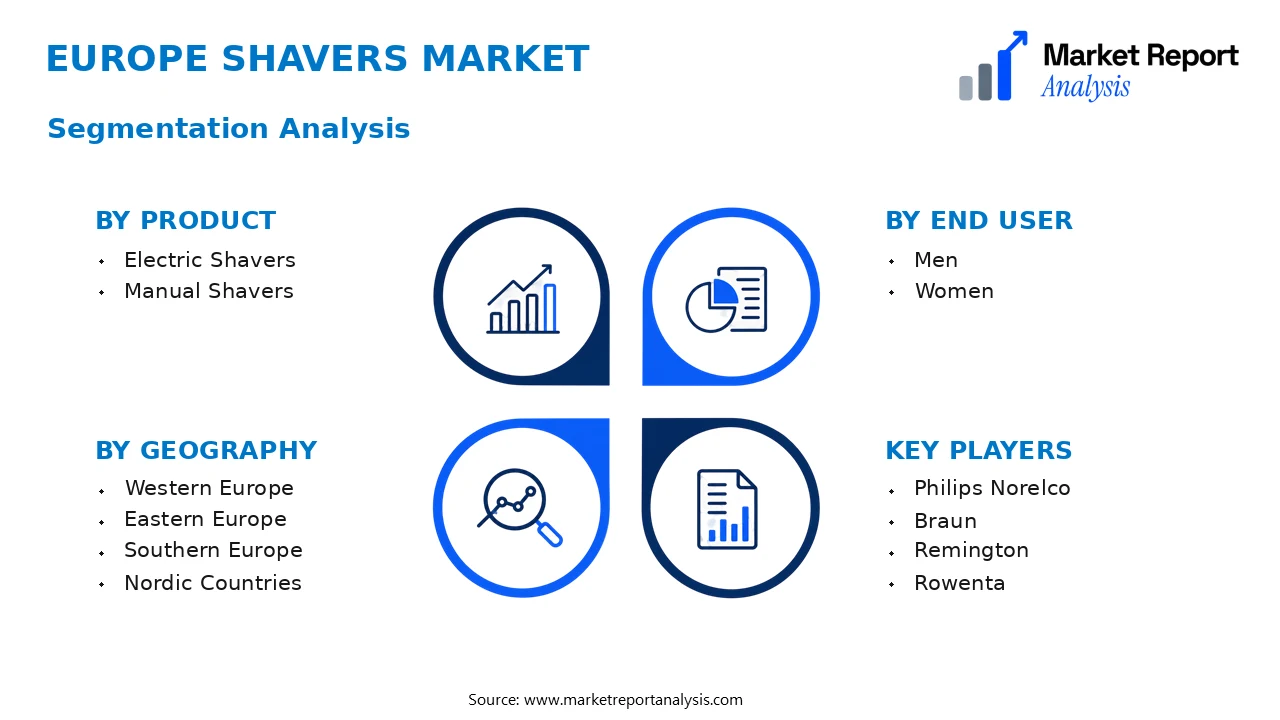
- Product
- Electric Shavers: Electric shavers are widely preferred for convenience and speed, appealing to both men and women seeking quick grooming solutions. They dominate the market due to ongoing technological innovations and user-friendly designs that boost consumer adoption.
- Manual Shavers: Manual razors and blades are traditional grooming essentials, favored for their cost-effectiveness and close shave quality. They maintain a significant market share, especially in regions with established grooming routines.
- End User
- Men: The male demographic constitutes the largest segment, driven by increasing grooming awareness and the proliferation of male grooming products. This segment is expanding due to evolving fashion standards and the rise in disposable income among men.
- Women: Women are increasingly adopting shavers for body grooming, driven by rising beauty consciousness and the demand for smooth skin. This segment shows significant growth potential owing to shifting societal beauty standards.
- Geography
- Western Europe: This region is characterized by high disposable incomes and a mature grooming market, with Germany, France, and the UK leading adoption rates. The focus here is on premium products and technological innovations.
- Eastern Europe: Eastern European markets are experiencing rapid growth driven by improving living standards, urbanization, and increasing awareness of personal grooming, making this region a promising market for budget and mid-range products.
- Southern Europe: Greece, Italy, and Spain show strong demand fueled by a growing trend toward personal grooming, although market maturity varies across countries, influencing product proliferation and marketing strategies.
- Nordic Countries: Known for high consumer standards and early adoption of technology, Nordic countries emphasize premium shavers with advanced features, sustainability, and ergonomic design, aligning with their eco-conscious and health-focused culture.
Competitive Intelligence
The Europe Shavers Market is characterized by moderate competition with several key players such as Philips N.V., Braun GmbH, and Wahl Clipper Corporation driving market dynamics. Market concentration remains relatively balanced, with the top five companies holding approximately 60% of the market share, fostering competitive innovation and strategic alliances. Firms are prioritizing product innovation through R&D investments aimed at enhancing performance, battery life, and grooming features, thereby differentiating their offerings in a crowded market. Strategic partnerships with retail chains, technology firms, and beauty brands are common, enabling expanded distribution channels and co-branding opportunities. Recent acquisitions, such as Braun's purchase of emerging tech startups, reflect a trend toward consolidating technological expertise and market share. Expansion strategies include entry into underserved markets within Europe and launching premium product lines to target high-end consumers. Companies are also investing heavily in R&D to develop smarter, connected shavers with Bluetooth capabilities and ergonomic designs. These competitive strategies collectively aim to sustain differentiation, meet evolving consumer preferences, and ensure market growth within Europe.
Leading Company Profiles
The competitive landscape of the Europe shavers market features a diverse group of key players, each leveraging innovation, strategic partnerships, and product differentiation to secure market share and meet evolving consumer demands across the region.
- Philips Norelco
- Braun
- Remington
- Rowenta
- Parker
- Philips
- Panasonic
- Conair
- Groomi
- Remington UK
Philips Norelco
Philips Norelco specializes in innovative grooming solutions, focusing on high-tech shavers that incorporate advanced skin protection and connectivity features, emphasizing customer-centric design and sustainability initiatives to maintain its leadership position in Europe.
Braun
Braun offers premium shavers with cutting-edge foil and rotary technology, emphasizing durability, precision, and ergonomic design, with strategic investments in smart grooming solutions and eco-friendly product lines to strengthen its market presence.
Remington
Remington provides affordable, versatile grooming products, including foil shavers, trimmers, and multi-grooming kits, with a focus on technological innovation, affordability, and expanding its distribution channels throughout Europe.
Rowenta
Rowenta's portfolio includes high-performance rotary shavers with advanced blade technology, targeting consumers seeking premium grooming tools, supported by strategic marketing campaigns and the integration of sustainable manufacturing processes.
Parker
Parker predominantly caters to budget-conscious consumers with a range of manual razors and entry-level electric shavers, leveraging technological diversification and expanding through direct-to-consumer online platforms.
Philips
Philips actively develops connected grooming devices, integrating AI-based features, and enhances its product lines with sustainable materials, emphasizing innovation and digital transformation to retain competitive advantage across European markets.
Panasonic
Panasonic focuses on ultra-close shaving technology with precision blades and waterproof designs, boosting its market share through strategic collaborations and a strong emphasis on eco-efficient manufacturing practices.
Conair
Conair offers a broad array of grooming products, including shavers and trimmers, emphasizing product innovation and expanding its presence across online and offline retail channels in Europe.
Groomi
Groomi is a newer entrant, emphasizing digital-first grooming tools with smart features, aiming at younger demographics through targeted marketing and tech-driven product development strategies.
Remington UK
Remington UK focuses on tailored product offerings for the local market, emphasizing affordability, innovation, and robust distribution networks to sustain growth amidst competitive pressures.
Strategic Business Developments
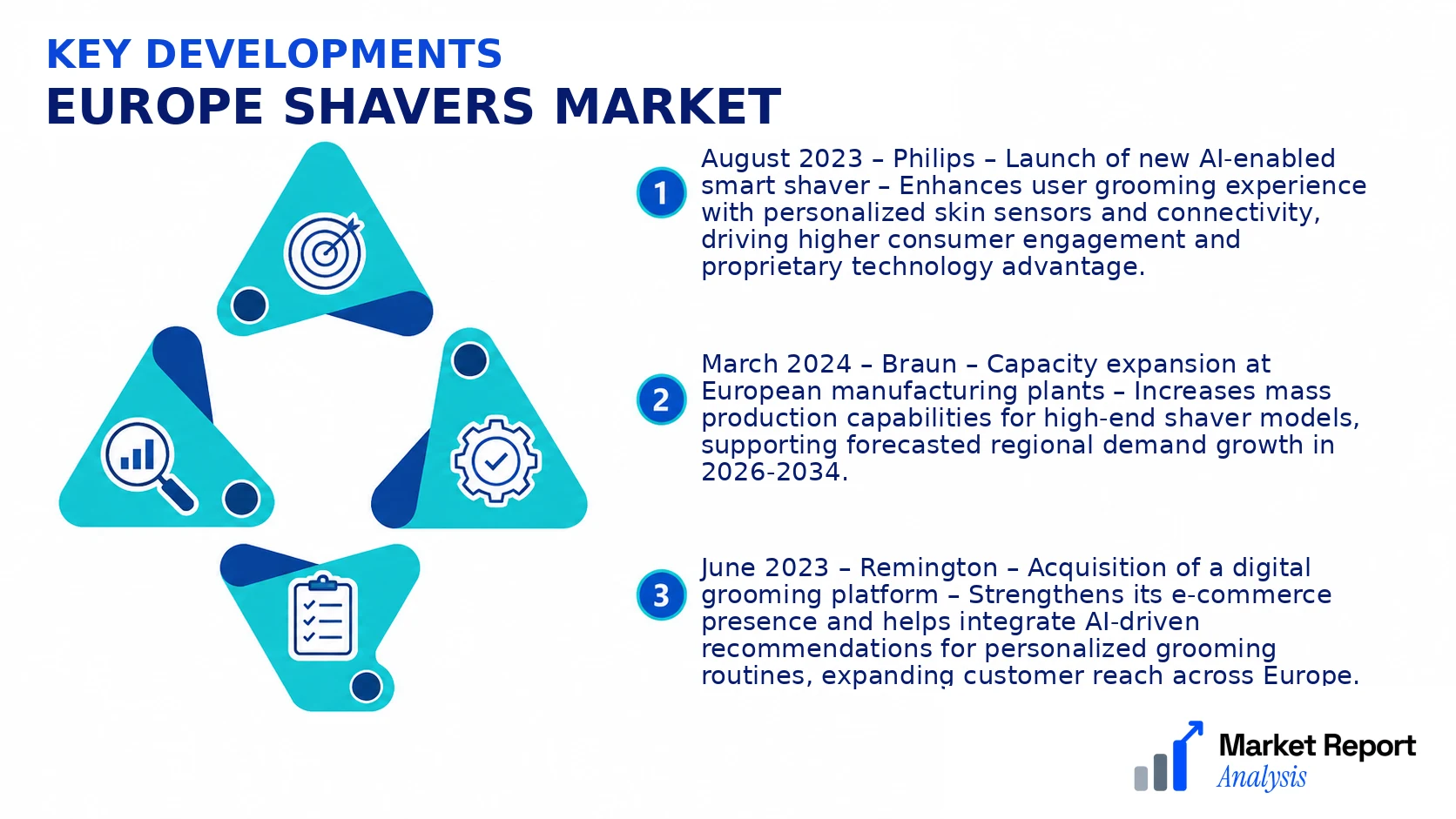
- August 2023 – Philips – Launch of new AI-enabled smart shaver – Enhances user grooming experience with personalized skin sensors and connectivity, driving higher consumer engagement and proprietary technology advantage.
- March 2024 – Braun – Capacity expansion at European manufacturing plants – Increases mass production capabilities for high-end shaver models, supporting forecasted regional demand growth in 2026-2034.
- June 2023 – Remington – Acquisition of a digital grooming platform – Strengthens its e-commerce presence and helps integrate AI-driven recommendations for personalized grooming routines, expanding customer reach across Europe.
- November 2023 – Rowenta – Investment in eco-friendly manufacturing facilities – Commits to sustainable production with reduced carbon footprint, appealing to environmentally conscious consumers across the continent.
- April 2024 – Parker – Launch of a new budget-friendly cordless shaver line – Targets cost-sensitive segments with innovative features and durable design, increasing market penetration in the entry-level segment across Europe.
Frequently Asked Questions
What is the Europe Shavers Market?
The Europe Shavers Market encompasses the industry involved in the production, distribution, and sales of electric and manual shavers designed for personal grooming in European countries. It includes various types, including foil and rotary shavers, catering to consumer demand for personal hygiene and grooming.
What is the current market size of Europe Shavers Market?
As of 2026, the Europe Shavers Market is valued at approximately USD 4.8 Billion, reflecting steady growth driven by increasing consumer awareness, product innovation, and rising grooming standards among both men and women across the region.
What factors are driving the Europe Shavers Market?
Key growth drivers include the rising adoption of personal grooming products, technological advances such as cordless and waterproof shavers, a growing male grooming segment, and expanding distribution channels through online retail. Additionally, increasing disposable income fuels market expansion.
Which region dominates the Europe Shavers Market?
Western Europe currently dominates the market, owing to higher disposable incomes, advanced retail infrastructure, and strong consumer preferences for premium grooming products. Countries such as Germany, France, and the UK are leading the regional market share.
Which segment is expected to grow the fastest?
The electric shavers segment, especially cordless and rechargeable models, is anticipated to witness the fastest growth, driven by technological innovations, convenience, and increasing popularity among younger consumers seeking efficient grooming solutions.
Who are the leading companies operating in the Europe Shavers Market?
Major players include Philips, Braun, Panasonic, and Remington. These companies invest heavily in R&D to develop innovative products and expand their market presence through strategic alliances and enhanced distribution networks across Europe.
Analyst Perspective
The Europe Shavers Market exhibits robust growth potential over the long term, driven by technological advancements, evolving consumer preferences, and increasing urbanization. As brands increasingly integrate automated and precision shaving technologies, opportunities for premium product offerings are expanding, especially in the high-end segment. Investment priorities should focus on innovation in battery life, ergonomic designs, and skin-friendly features to capture increasing consumer demand. The competitive landscape remains intense, with established players expanding their portfolios while new entrants leverage online channels and direct-to-consumer models for greater market penetration. Regionally, Western Europe continues to lead in market maturity, but Eastern Europe's emerging middle class provides substantial growth opportunities. Strategic regional focus on customization and sustainable product development can offer competitive differentiation. Overall, long-term market stability will depend on technological evolution, brand differentiation, and responsive product development aligned with changing consumer expectations.
