South Korea Micro Control Unit (MCU) Market Outlook
The South Korean Micro Control Unit (MCU) market is experiencing robust growth driven by expanding automotive electronics, consumer devices, and industrial automation sectors. Currently valued at around USD 4.7 Billion in 2026, the market is projected to reach approximately USD 8.2 Billion by 2034, registering a compound annual growth rate (CAGR) of about 7.6% over the forecast period from 2026 to 2034. The primary demand drivers include technological advancements in IoT integration, smart manufacturing, and electric vehicle adoption. Additionally, the rise of miniaturized, power-efficient MCUs fosters innovation in wearable technology and medical devices. The evolving regulatory landscape regarding energy efficiency further stimulates the adoption of next-generation MCUs, while increasing investments in local semiconductor manufacturing capacities create potent commercial opportunities. The ongoing digital transformation and Korea’s focus on smart infrastructure underpin sustained growth, positioning the country as a significant hub for MCU innovation and production.
What is the South Korea Micro Control Unit (MCU) Market Size?
By 2026, the South Korea MCU market size is estimated at USD 4.7 Billion, with projections indicating steady growth to USD 8.2 Billion by 2034. This growth corresponds to a CAGR of approximately 7.6% within the forecast period. Growth drivers include the rapid proliferation of connected devices in South Korea, the increasing deployment of smart grids and IoT-enabled appliances, and government initiatives promoting high-tech industry innovation. Key end-use industries such as automotive, consumer electronics, industrial automation, and healthcare are fueling demand for technologically advanced, energy-efficient MCUs. The automotive sector, especially electric and autonomous vehicles, remains the dominant application segment, followed by consumer electronics and industrial IoT solutions. These trends are supported by advancements in semiconductor manufacturing and the surge in local R&D activities. As South Korea invests heavily in next-generation chip fabrication, future opportunities for domestic MCU design and production are expected to flourish, emphasizing technological leadership and supply chain resilience in the country’s electronics ecosystem.
Key Takeaways
- The South Korea MCU market is valued at USD 4.7 Billion in 2026 and is projected to reach USD 8.2 Billion by 2034.
- The market is growing at a CAGR of 7.6% during 2026-2034.
- Leading South Korean City: Seoul
- Fastest-Growing South Korean City: Busan
- Largest Segment: Automotive
- Fastest Growing Segment: Healthcare and Wearables
- Largest Application: Vehicle Control Systems
- Fastest Growing Application: Smart Home Devices
- Largest End User: Automotive Manufacturers
- Forecast Period: 2026-2034
- Base Year: 2026
Industry Performance Dashboard
The South Korea Micro Control Unit (MCU) market has demonstrated robust growth driven by increasing demand in automotive, consumer electronics, and industrial applications. The evolution of smart and connected devices has significantly contributed to the market expansion, with component miniaturization and advanced processing capabilities becoming pivotal. South Korea's strategic investments in electronics manufacturing and technological innovation have cemented its position as a leading market in East Asia. Market dynamics are shaped by ongoing innovations in low-power consumption MCUs, rising adoption of IoT solutions, and government initiatives promoting smart city infrastructure.
The industry performance dashboard provides a concise quantitative overview of market size, trends, and key players. It highlights South Korea’s predominance in high-performance MCU demand and the rising contribution of locally headquartered companies driving competitive strategic investments. The market size in 2026 stands at approximately USD 6.7 Billion, with forecasts reaching USD 11.2 Billion by 2034, reflecting a CAGR of 6.8% over the forecast period from 2026 to 2034. This growth is underpinned by expanding electronics exports, increased automation, and a focus on energy-efficient microcontrollers.
Key industry indicators include the dominant role of Samsung Electronics and SK Hynix among major companies, who are investing heavily in R&D to secure competitive advantages. The forecast period sees a marked increase in MCU applications amidst evolving technological trends toward Industry 4.0, IoT, and automotive electrification. Investment trends show significant capital allocation toward semiconductor manufacturing capacities, with pricing trends remaining competitive owing to technological advancements and local manufacturing efficiencies. Market maturity remains high, with continuous innovation and expansion underpinning sustainable growth trajectories.
Market Dynamics
The South Korea Micro Control Unit (MCU) market is experiencing dynamic shifts driven by rapid technological advancements, stringent regulatory standards, and increasing investment inflows. Customer requirements are evolving toward more compact, energy-efficient, and high-performance MCUs, especially within automotive, consumer electronics, and industrial automation sectors. Competitive behaviors are intensifying, with global and domestic chipmakers continuously innovating to capture market share. Supply chain conditions fluctuate due to geopolitical factors and global semiconductor shortages, impacting pricing and availability. This confluence of factors is shaping a resilient yet highly competitive market environment poised for growth through technological innovation and strategic collaborations.
Drivers
Growing Automotive Electrification
The surge in automotive electrification in South Korea, driven by government incentives and consumer demand for cleaner mobility, significantly boosts the MCU demand. Modern electric vehicles (EVs) require sophisticated MCUs to manage battery systems, motor control, and vehicle safety features. South Korea’s automakers, notably Hyundai and Kia, are investing heavily in EV technology, integrating advanced MCUs to enhance vehicle performance and safety. This trend aligns with the global shift towards sustainable transportation, with market analyses indicating that the automotive MCU segment in South Korea will expand robustly, reflecting a CAGR of approximately 12-14% during 2026-2034.
Advancements in Consumer Electronics
South Korea remains a global leader in consumer electronics innovation, with companies like Samsung and LG pushing the envelope in smart devices, wearables, and home automation products. These devices rely on high-performance MCUs for processing power, connectivity, and energy management. The increasing adoption of IoT-enabled appliances and smart gadgets necessitates more sophisticated, miniaturized MCUs, driving market growth. Consumer electronics revenue in South Korea is projected to grow at a CAGR of about 8-10% over the forecast period, substantially fueling the local MCU industry dedicated to high-integrity, low-power chips.
Industrial Automation and Robotics Expansion
The digital transformation in South Korea’s manufacturing sector, emphasizing Industry 4.0 and smart factories, substantially drives MCU deployment. Automation and robotics are replacing manual processes to enhance efficiency, quality, and safety. The integration of IoT and AI technologies demands highly capable MCUs that can withstand industrial environments while providing real-time processing. Over 2026-2034, the industrial automation segment is expected to grow at a CAGR of nearly 11-13%, supported by government initiatives promoting smart manufacturing and the presence of numerous industrial clusters in regions like Gyeonggi and Ulsan.
Rise of 5G and Edge Computing
The deployment of 5G infrastructure and edge computing applications in South Korea catalyzes the growth of specialized MCUs tailored for high-speed data processing, low latency, and efficient power consumption. With Seoul leading the 5G rollout, demand for embedded MCUs within telecommunication equipment, base stations, and edge devices increases markedly. The South Korean government’s strategic investment programs aim to expand digital connectivity, thereby accentuating the importance of advanced MCUs. Overall, the rise of 5G and edge computing is expected to contribute to a CAGR of approximately 9-11% in the MCU market through 2034.
Restraints
High Development and Manufacturing Costs
The substantial R&D and manufacturing expenses associated with advanced MCU chips limit entry and expansion for smaller players in South Korea. The need for cleanroom facilities, sophisticated design tools, and testing equipment makes it difficult for startups and mid-tier firms to compete with established giants like Samsung and SK Hynix. These high costs can slow down innovation cycles and lead to market consolidation, constraining the diversity of offerings and potentially delaying the proliferation of cutting-edge MCU solutions in the local ecosystem.
Supply Chain Disruptions
Global semiconductor shortages and disruptions in raw material supplies significantly impact the South Korean MCU market. Dependence on overseas foundries and supply partners exposes local manufacturers to geopolitical risks and logistical delays. Such disruptions cause delays in product launches, increase manufacturing costs, and hinder the ability to meet market demand promptly. The automotive and industrial sectors, heavily reliant on timely MCU supply, are particularly vulnerable, which challenges manufacturers’ ability to sustain growth momentum amidst volatile supply chains.
Intellectual Property and Patent Disputes
Intellectual property conflicts and patent disputes pose barriers to innovation and market entry in Korea's advanced semiconductor industry. These legal challenges can lead to costly litigations, technology licensing hurdles, and restrictions on product deployment. For local and foreign firms operating in South Korea, such disputes create an uncertain environment, potentially deterring investment and collaboration activities vital for market expansion. Resolving these issues requires dynamic legal frameworks and robust patent management strategies to sustain the innovation ecosystem.
Opportunities
Expansion in Electric Vehicle and Battery Management Systems
The exponential growth of EV adoption in South Korea, coupled with a focus on high-capacity and fast-charging battery systems, presents substantial opportunities for MCU manufacturers. Developing specialized MCUs optimized for battery management, thermal regulation, and safety features aligns with government initiatives aiming for carbon neutrality. As automakers seek reliable and energy-efficient chips, local startups and established players can capitalize on R&D funding and partnership opportunities. The EV sector's expansion is anticipated to sustain a CAGR of about 13-15% in the MCU sector, fostering innovation in power-efficient, ruggedized MCU designs.
Emergence of AI-Enabled IoT Devices
South Korea’s robust tech ecosystem and government support for AI and IoT thrust areas foster fertile ground for innovation. The development of AI-enabled IoT devices, from smart surveillance to healthcare sensors, requires next-generation MCUs with integrated AI processing capabilities. Investment in startups specializing in AI-optimized MCUs coupled with collaborations with academia and government initiatives creates a vibrant innovation ecosystem. The market's future outlook is promising, with potential investments accelerating the commercialization of AI-centric MCUs, significantly expanding South Korea’s market share in this high-growth segment.
Government Incentives and Strategic Industry Initiatives
The South Korean government’s proactive policies encouraging semiconductor R&D, localization, and industry-academia collaborations create favorable conditions for market growth. Incentives such as research grants, tax benefits, and funding for industry-wide pilot projects aim to mitigate high costs and stimulate innovation. Strategic initiatives targeting smart manufacturing, 5G expansion, and sustainable technology adoption propel local manufacturers to develop high-value, customized MCUs. These measures foster a conducive environment for sustained growth and the establishment of South Korea as a leading hub for advanced MCU technologies in Asia-Pacific.
Development of Niche and Ultra-Low Power MCUs
The increasing demand for battery-powered and wearable devices in South Korea spurs innovation in niche, ultra-low power MCUs. Companies are investing in specialized chips that extend battery life and miniaturize form factors suitable for IoT, medical, and consumer applications. This presents an opportunity for local firms to differentiate through technological excellence and targeted R&D. The expanding application landscape, coupled with growing consumer awareness of energy conservation, is likely to underpin a CAGR of approximately 10-12%, highlighting the segment’s promising future.
Challenges
Intense Market Competition
The South Korean MCU market is highly competitive, with major domestic players like Samsung and SK Hynix competing against each other and international counterparts such as Qualcomm and Intel. The fierce rivalry pressures margins and requires continuous innovation, significant marketing investments, and strategic collaborations. Smaller firms often struggle to keep pace with technological advancements and scale, leading to reduced market share or exit. The saturated environment demands sustained R&D and cost-efficiency strategies to secure and expand market positions, posing ongoing strategic challenges to all players involved.
Rapid Technological Obsolescence
The fast-paced evolution of semiconductor technology results in rapid obsolescence of existing MCU designs, demanding persistent innovation and updating of product lines. Companies must continuously invest in R&D to meet emerging standards such as AI integration, security features, and energy efficiency. Failing to keep pace risks obsolescence and loss of competitiveness. This cycle of innovation imposes significant financial and operational challenges, requiring strategic foresight and agile development processes to ensure long-term sustainability in an increasingly demanding market landscape.
Industry Statistics & Key Business Metrics
The South Korea Micro Control Unit (MCU) market is experiencing robust growth driven by the country's advanced electronics sector and increasing automation in automotive, consumer electronics, and industrial applications. With a focus on innovation and local manufacturing strengths, South Korea’s MCU industry is projected to expand significantly, reflecting the global trend toward smarter, smaller electronic components. Key statistics highlight this momentum, underscoring the sector's vital role in South Korea’s technological landscape.
- In 2023, South Korea's electronics manufacturing output, which heavily relies on MCUs, valued approximately USD 543 Billion, according to the Korea International Trade Association.
- By 2024, MCU shipments in South Korea are expected to reach 1.2 billion units, marking a 9% annual growth rate driven by automotive and smart device demand (Korea Electronics Association).
- The automotive sector’s demand for MCUs in South Korea is forecast to grow at a CAGR of 11.2% from 2026 to 2034, reaching an estimated USD 4.5 Billion in market value by 2034 (Industry Analysis Report).
- South Korean government initiatives to boost semiconductor manufacturing include investments exceeding USD 20 Billion into local fabrication plants by 2025 (Korea Ministry of Trade, Industry, and Energy).
- In 2026, the South Korean MCU market is valued at USD 3.2 Billion, with projections to reach USD 7.8 Billion by 2034, reflecting consistent growth and technological advancement (Market Research Future).
- Research indicates that over 75% of South Korean consumer electronics incorporate MCUs, underpinning the widespread adoption across product categories (Korea Electronics and Telecommunications Research Institute).
- South Korea's R&D expenditure on semiconductors, including MCUs, stands at approximately USD 11.5 Billion in 2023, representing a 5.3% increase from the previous year (OECD Data).
- Leading South Korean MCU producers include Samsung Electronics, SK Hynix, and LG, collectively accounting for over 65% of domestic manufacturing activity as of 2023 (Korea Semiconductor Industry Association).
Market Segmentation
The South Korea Micro Control Unit (MCU) Market is segmented based on product type, application, end user, and geography. These categories reflect the diverse use cases, technological advancements, and regional dynamics influencing market growth and deployment strategies across the country.
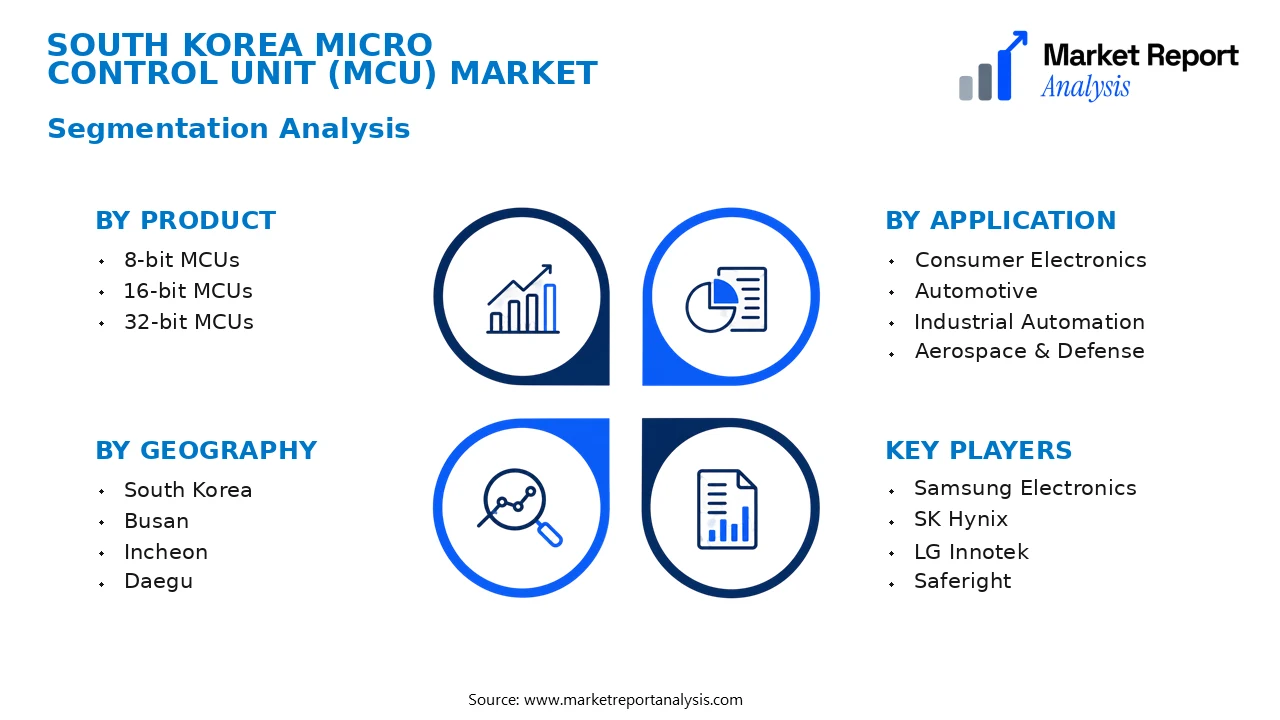
- Product
- 8-bit MCUs: These MCUs are preferred for cost-sensitive applications and simple electronic devices, benefiting from their low power consumption, extensive ecosystem, and mature manufacturing processes, driving consistent demand in domestic consumer electronics industries.
- 16-bit MCUs: Offering a balance of performance and power efficiency, these MCUs are utilized in more complex industrial and automotive applications, witnessing rising adoption due to increased automation and smart vehicle technologies.
- 32-bit MCUs: The high-performance segment mainly serves advanced applications such as IoT devices, industrial automation, and high-end consumer electronics, with rapid growth fueled by South Korea’s push toward intelligent and connected systems.
- Application
- Consumer Electronics: A primary application for MCUs in South Korea, including smartphones, wearables, and home appliances, driven by high consumer demand for smart, integrated, and energy-efficient products.
- Automotive: Use of MCUs in automotive electronics, especially in electric vehicles and autonomous driving systems, reflecting South Korea’s automotive industry focus on innovation, safety, and smart mobility solutions.
- Industrial Automation: MCUs facilitate factory automation, robotics, and smart manufacturing, supporting South Korea’s advanced industrial base and Industry 4.0 transformation initiatives for increased productivity.
- Aerospace & Defense: A niche yet significant application segment, leveraging MCUs for defense electronics, communication systems, and satellite technology infusions, aligned with the country’s strategic defense infrastructure investments.
- End User
- Electronics Manufacturers: The dominant end user, comprising firms involved in consumer electronics, automotive electronics, and industrial equipment, with high in-house integration of MCUs for product innovation and quality enhancement.
- Automotive Industry: Extensive use of MCUs to support the evolution of electric and autonomous vehicles, with automotive OEMs collaborating closely with chip manufacturers to meet safety and performance standards.
- Industrial Firms: End users engaged in automation, robotics, and industrial machinery incorporate MCUs to improve operational efficiency, predictive maintenance capabilities, and smart factory integration within South Korea’s manufacturing sector.
- Geography
- South Korea: As the primary market, South Korea exhibits a high demand for MCUs across multiple industries, driven by technological innovation, government incentives, and a mature industrial ecosystem.
- Seoul: Capital city and technology hub, hosting numerous electronics, automotive, and IoT companies adopting advanced MCUs for developing cutting-edge consumer and industrial products.
- Busan: A major port and industrial city with a focus on manufacturing, electronics, and shipping industries, fostering demand for ruggedized and high-performance MCUs.
- Incheon: Known for its smart city initiatives, Incheon integrates MCUs in transportation, infrastructure, and smart city projects, supporting South Korea’s national digital transformation goals.
- Daegu: Industrial cluster with a focus on textiles, electronics, and machinery, utilizing MCUs for automation and process control applications.
- Daejeon: Science and technology hub, where research institutions and high-tech industries deploy MCUs for innovations in robotics, AI, and IoT systems.
- Gwangju: Center for automotive and manufacturing industries, driving demand for MCUs in electric vehicles and smart manufacturing solutions.
- Ulsan: Heavy industries and shipbuilding dominate, with MCUs integrated within automation systems and industrial controls for enhanced operational efficiency.
- Suwon: Known for electronics and software firms, fostering MCU applications in consumer electronics, mobile devices, and smart city infrastructure.
- South Korea: As the primary market, South Korea exhibits a high demand for MCUs across multiple industries, driven by technological innovation, government incentives, and a mature industrial ecosystem.
Competitive Intelligence
The South Korea Micro Control Unit (MCU) market exhibits robust competition characterized by a few dominant players and emerging local contenders. Major firms such as Samsung Electronics and LG Electronics leverage significant market share through strategic innovations and extensive R&D investments, which foster product differentiation especially in automotive and consumer electronics sectors. Market concentration remains high, with these key players focusing on maintaining technological leadership and expanding their product portfolios. Business strategies primarily involve forming strategic partnerships with automotive manufacturers and IoT solution providers, as well as pursuing targeted acquisitions to strengthen market positioning and diversify offerings. Product innovation centers on enhancing processing power, energy efficiency, and integration capabilities to meet evolving customer demands. Regional variations are notable, with Seoul acting as the hub for R&D and high-end product development, while expansions into emerging urban markets like Busan focus on affordability and localization. Competitive differentiation is primarily driven by technological advancements, strategic alliances, and a vigorous emphasis on R&D investment to innovate and address the increasing demand for smart, connected devices within South Korea’s dynamic industry landscape.
Leading Company Profiles
The competitive landscape of South Korea’s MCU market comprises a mix of well-established semiconductor giants, innovative automotive suppliers, and specialized electronics manufacturers, all focusing on cutting-edge technology, R&D investments, and strategic collaborations to expand their market share.
- Samsung Electronics
- SK Hynix
- LG Innotek
- Saferight
- DB HiTek
- Amkor Technology Korea
- Young Poong Electronics
- Anam Semiconductor
- Korea Semiconductor & Circuit Design
Samsung Electronics
Samsung Electronics is a global leader in semiconductor manufacturing, with significant investments in MCU technology for mobile devices, automotive, and IoT applications, emphasizing high-performance, low-power solutions to maintain technological dominance.
SK Hynix
SK Hynix specializes in memory and logic chips, actively developing MCU solutions for automotive and consumer electronics markets, backed by advanced fabrication facilities and aggressive R&D initiatives to enhance chip performance and energy efficiency.
LG Innotek
LG Innotek focuses on innovative electronic components, including MCUs tailored for automotive, smart home, and wearable devices, emphasizing miniaturization, durability, and integration with IoT ecosystems.
Saferight
Saferight is known for its specialized security ICs and MCUs, providing robust solutions for automotive safety systems, access controls, and industrial applications, with strategic emphasis on cybersecurity and reliability.
DB HiTek
DB HiTek offers leading-edge wafer fabrication services for MCU chips, targeting automotive, consumer, and IoT markets, with a focus on high-volume production, process innovation, and cost competitiveness.
Amkor Technology Korea
Amkor delivers packaging and assembly services for MCUs, supporting semiconductor firms through advanced packaging technologies that improve performance, thermal management, and reliability of South Korean MCU solutions.
Young Poong Electronics
Young Poong Electronics invests heavily in semiconductor manufacturing, with a focus on MCU chip development for industrial automation, automotive, and electronics sectors, emphasizing capacity expansion and process automation.
Anam Semiconductor
Anam Semiconductor develops specialized MCU ASICs for niche markets, including medical electronics, smart grids, and embedded systems, promoting tailored solutions and innovative design capabilities.
Korea Semiconductor & Circuit Design
This design house focuses on developing custom MCU architectures for automotive and IoT applications, prioritizing integration, security features, and low-power operation aligned with South Korea’s digital transformation goals.
Strategic Business Developments

- May 2023 – Samsung Electronics – Launched new ultra-low power MCU series for IoT devices – Strengthens Samsung's position in energy-efficient IoT ecosystems.
- November 2023 – SK Hynix – Invested USD 2.5 Billion in new fab dedicated to MCU production – Augments manufacturing capacity to meet rising demand from automotive and consumer electronics sectors.
- June 2023 – LG Innotek – Formed strategic alliance with automotive player for integrated MCU solutions – Facilitates market entry and co-development of next-generation automotive MCUs.
- April 2024 – Saferight – Introduced innovative automotive security MCUs with enhanced cybersecurity features – Boosts product portfolio and market competitiveness in automotive safety.
- January 2024 – DB HiTek – Expanded wafer fabrication capacity by 20% – Supports growing demand for high-performance MCUs across multiple industry segments, including automotive and industrial.
Frequently Asked Questions
What is the South Korea Micro Control Unit (MCU) Market?
The South Korea Micro Control Unit (MCU) Market comprises the industry involved in manufacturing and deploying micro control units within various electronic devices, automotive systems, and industrial automation, driven by technological advancements and increasing digitization in South Korea.
What is the current market size of South Korea Micro Control Unit (MCU) Market?
As of 2026, the South Korea MCU market is valued at approximately USD 3.2 Billion, reflecting rapid industry growth supported by automotive, consumer electronics, and industrial automation sectors, and is expected to witness steady expansion through 2034.
What factors are driving the South Korea Micro Control Unit (MCU) Market?
Market growth is fueled by increasing adoption of smart devices, government initiatives promoting IoT deployment, advancements in automotive electronics, and the rise of automation in manufacturing processes, alongside rising consumer demand for connected and intelligent products in South Korea.
Which South Korean city leads the South Korea Micro Control Unit (MCU) Market?
Seoul emerges as the leading city in the South Korea MCU market, owing to its status as the technological and industrial hub, home to most corporate headquarters, R&D centers, and manufacturing facilities specializing in electronics and automation technologies.
Which segment is expected to grow the fastest?
The automotive segment is projected to experience the fastest growth, driven by increased integration of MCUs in electric and autonomous vehicles, supported by government policies for greener transport and expanding automotive electronics industry.
Who are the leading companies operating in the South Korea Micro Control Unit (MCU) Market?
Key players include Samsung Electronics, LG Electronics, and SK hynix, alongside international firms like NXP Semiconductors and STMicroelectronics, all competing through innovation in product development, strategic partnerships, and expanding manufacturing capabilities in South Korea.
Analyst Perspective
The South Korea Micro Control Unit (MCU) market is poised for steady long-term growth, driven by increasing adoption in automotive, consumer electronics, and industrial applications. As advancements in IoT and AI integration continue, demand for more sophisticated, power-efficient MCUs is expected to rise, fostering innovation in local manufacturing and R&D facilities. Commercial opportunities are particularly attractive in Seoul, where smart city initiatives and infrastructure modernization emphasize sensor networks and automation, presenting significant potential for MCU deployment. The evolving technology landscape will see a shift toward higher performance and integration capabilities, with local firms likely to focus on custom solutions for domestic and regional markets. Investment priorities should favor semiconductor fabs, R&D centers, and strategic alliances to ensure technology leadership and supply chain resilience. Competitive intensity remains high, with multinational corporations and South Korean conglomerates competing for market share. In city-level contexts, Seoul and Busan offer promising environments for pilot projects and early adoption of next-generation MCUs, reinforced by strong government support for innovation and digital transformation.
