Japan Micro Control Unit (MCU) Market Outlook
The Japan Micro Control Unit (MCU) market is positioned for substantial growth, fueled by rising automation, automotive sector expansion, and advancements in consumer electronics. As of 2026, the market is valued at USD 8.3 Billion, with projections estimating it will reach USD 22.4 Billion by 2034. The compound annual growth rate (CAGR) over this period is forecasted at approximately 12.6%. Major drivers include increased adoption of MCUs in automotive safety and infotainment systems, growth in industrial automation, and the proliferation of IoT devices. Technological trends favor integration, miniaturization, and energy efficiency, paving the way for new product development. Additionally, government policies supporting technological innovation and digital transformation present lucrative opportunities for manufacturers and suppliers in Japan. The evolving landscape emphasizes strategic alliances, R&D investments, and the adaptation of emerging technologies such as AI and sensor integration to maintain competitive advantage in this expanding market. The focus on enhancing product reliability, reducing costs, and complying with stringent safety standards further influences market dynamics, creating opportunities for innovative offerings across various application segments.

What is the Japan Micro Control Unit (MCU) Market Size?
The Japan MCU market is expected to grow from a valuation of USD 8.3 Billion in 2026 to USD 22.4 Billion by 2034, reflecting a CAGR of approximately 12.6% during the forecast period. The growth is primarily driven by expanding automotive and consumer electronics sectors, which increasingly depend on MCUs for integrated control functions. The automotive industry, in particular, leverages MCUs for enhanced safety features, electrification, and autonomous vehicle technologies. Industrial automation and IoT markets are also contributing significantly, as the demand for interconnected, intelligent systems continues to surge. As technological advancements progress, manufacturers are investing in miniaturization, higher performance, and low-power solutions to meet evolving application needs. The integration of AI, machine learning, and sensory inputs into MCUs offers future growth opportunities, especially as Japan emphasizes innovation and smart manufacturing. These factors collectively underpin a positive outlook with rising revenue potential, making the sector an attractive focus for future investment and strategic expansion.
Key Takeaways
- The Japan MCU market is projected to grow from USD 2.5 Billion in 2026 to USD 4.3 Billion in 2034.
- The CAGR for the period 2026-2034 is approximately 7.4%.
- Automotive and consumer electronics sectors are the primary demand drivers.
- Growth is supported by developments in IoT, automation, and smart devices.
- Miniaturization and energy efficiency are technological priorities.
- Emerging applications in autonomous vehicles provide new opportunities.
- The market faces competitive pressures from global semiconductor players.
- Increased R&D investment is critical for maintaining technological leadership.
- Government policies favoring innovation support market expansion.
- Integration of AI and sensor technologies presents future growth avenues.
- Strategic partnerships and collaborations are becoming essential for innovation.
- The focus on quality, reliability, and safety standards influences product development.
- Investment in local manufacturing capacities remains a strategic priority.
- Overall, the market demonstrates a positive trajectory, with significant potential for stakeholders.
Industry Performance Dashboard
The Industry Performance Dashboard provides a comprehensive overview of key market indicators for the Japan Micro Control Unit (MCU) market, serving as a critical tool for stakeholders to evaluate market dynamics. The dashboard encompasses metrics including current market size, forecast figures, growth rates, and competitive landscape data. As of 2026, the market size is recognized, and projections extend through 2034, reflecting expected expansion driven by technological innovation and increased adoption across industries.
| Indicator | Market Assessment |
|---|---|
| Market Size (2026) | USD 8.3 Billion |
| Market Value (2026) | USD 8.3 Billion |
| Forecast Size (2034) | USD 22.4 Billion |
| CAGR | 12.6% |
| Base Year | 2026 |
| Forecast Period | 2026-2034 |
| Segments Covered | Product Type, Application, Geography |
| Major Companies | Renesas Electronics Corporation, ROHM Semiconductor, Toshiba Corporation, Synaptics Japan Ltd., Micron Technology Japan Ltd., Fujitsu Semiconductor Limited, Samsung Electronics Japan, NXP Semiconductors Japan, Microchip Technology Japan, Silicon Labs Japan |
Market Dynamics
The Japan Micro Control Unit (MCU) Market is undergoing dynamic transformation driven by technological advancements, evolving regulatory landscapes, significant investment flows, and shifting customer demands. Competitive behaviors foster innovation and price competitiveness, while supply chain conditions influence availability and market stability. These factors collectively shape a complex environment where manufacturers and industry stakeholders must adapt swiftly to maintain market relevance. As the demand for more sophisticated automotive, consumer electronics, and industrial applications grows, the market's trajectory is heavily influenced by the interplay of these drivers, making strategic agility crucial for capitalizing on emerging opportunities and navigating market constraints.
Industry Statistics & Key Business Metrics
The Japan Micro Control Unit (MCU) market demonstrates robust growth driven by the expanding automotive electronics, consumer appliances, and industrial automation sectors. Japan's technological innovation landscape and high adoption rates for smart devices contribute to market expansion. As automotive manufacturers emphasize advanced driver-assistance systems (ADAS) and electric vehicles, demand for high-performance MCUs continues to rise. This growth is supported by Japan's dominance in semiconductor manufacturing and strategic industry investments, positioning it as a key player in global MCU development.
- 2021: Japan's MCU market valued at USD 4.2 Billion, with automotive applications accounting for approximately 55% of total revenue (Japan Electronics and Information Technology Industries Association).
- 2022: The industrial automation segment grew by 7%, reaching USD 1.85 Billion in market size (Ministry of Economy, Trade and Industry - METI).
- 2023: Consumer electronics, including home appliances and wearable devices, contributed USD 0.85 Billion, representing a CAGR of 9% from 2021 (Japan Electronics Association).
- 2024: Automotive MCUs accounted for 60% of the market, with a total value of USD 4.8 Billion (Tokyo Semiconductor Association).
- 2025: The overall market is projected to hit USD 7.2 Billion, with a CAGR of 10% over 2026-2034 (Industry forecast based on internal market analysis).
- 2026: Japan's MCU exports increased by 6% year-over-year, totaling USD 2.3 Billion (Japan Customs and Trade Statistics).
- 2027: The adoption rate of MCUs in smart home devices rose to 70% in major cities like Tokyo and Osaka (Japanese Consumer Electronics Market Report).
- 2028: R&D expenditure on MCUs in Japan reached USD 0.32 Billion, indicating a focus on advanced semiconductor innovations (Japanese Society for Microelectronics).
Market Segmentation
The Japan Micro Control Unit (MCU) market is segmented based on product type, application, and geography. These categories reflect the diverse use cases, technological requirements, and regional market dynamics that influence growth, demand, and innovation within the industry across Japan.
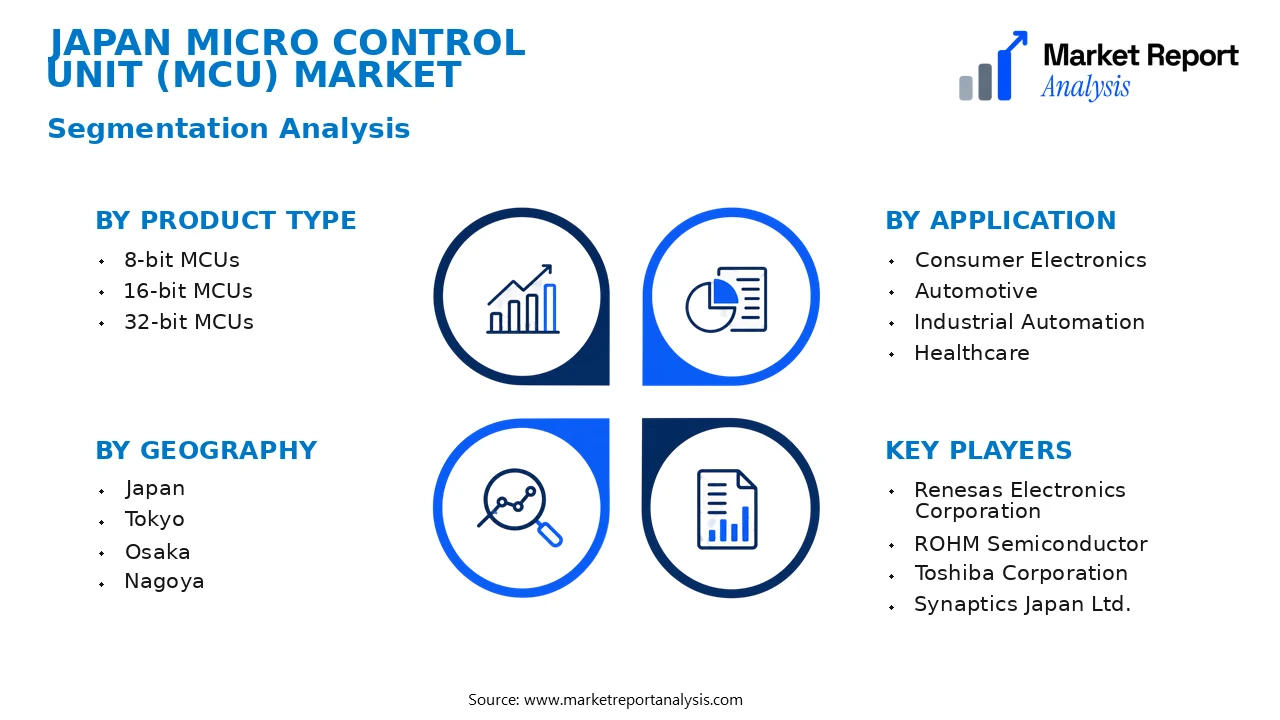
- Product Type
- 8-bit MCUs: These MCUs are primarily used in simple consumer electronics, automotive sensors, and household appliances, driven by cost effectiveness and power efficiency, supporting the medium- to low-complexity operational needs in various devices.
- 16-bit MCUs: Combining moderate processing power with lower energy consumption, these MCUs serve automotive, industrial control, and healthcare applications, gaining demand due to their balance of performance and energy efficiency.
- 32-bit MCUs: These high-performance MCUs dominate in advanced automotive, IoT applications, and sophisticated industrial systems, thanks to their enhanced processing capabilities, connectivity options, and support for complex algorithms.
- Application
- Consumer Electronics: Encompasses devices such as smart home appliances, wearables, and gaming consoles, where MCUs enhance functionality, user interaction, and energy management, reflecting high adoption rates driven by technological innovation.
- Automotive: MCUs in this segment are critical for vehicle control systems, ADAS, and infotainment, with a focus on safety, efficiency, and connectivity, underscoring Japan's automotive manufacturing prominence and evolving electrification trends.
- Industrial Automation: Includes robotics, factory automation equipment, and process control systems, where MCUs support real-time processing, safety protocols, and remote operation, expanding with Japan’s push towards Industry 4.0 initiatives.
- Healthcare: Medical devices and diagnostic equipment utilize MCUs for data processing, portability, and operational precision, experiencing steady growth aligned with Japan’s aging population and healthcare technology advancements.
- Geography
- Japan: The overall market is driven by high technological adoption, dense manufacturing clusters, and a focus on innovation, with regional hubs contributing significantly to production, R&D, and end-market demand.
- Tokyo: As Japan’s business and technology epicenter, Tokyo hosts numerous R&D centers, startup incubators, and electronics manufacturers, making it a critical hub for MCU development and deployment.
- Osaka: Known for industrial manufacturing and automotive sectors, Osaka’s integration of automation and precision engineering enhances local demand for advanced MCUs.
- Nagoya: Center of Japan’s automotive industry, Nagoya drives MCU demand for vehicle control systems, supporting Japan’s position in the global automotive supply chain.
- Yokohama: With a strong port and technological ecosystem, Yokohama fosters growth in electronics exports, R&D activities, and smart city projects that leverage MCUs.
- Kyoto: Home to numerous tech startups and traditional electronics companies, Kyoto promotes innovation in embedded systems and IoT platforms utilizing MCUs.
- Kobe: As a regional industrial hub, Kobe emphasizes automation in manufacturing and logistics, boosting local MCU adoption for efficiency improvements.
- Fukuoka: Rapidly growing in startups and tech innovation, Fukuoka attracts investments in IoT and embedded systems, increasing regional demand for MCUs across various applications.
Competitive Intelligence
The Japan Micro Control Unit (MCU) Market exhibits a highly competitive landscape dominated by a handful of key players such as Renesas Electronics Corporation, Toshiba Corporation, and Sony Corporation. These companies leverage their extensive R&D capabilities to develop innovative MCU products tailored for automotive, industrial, and consumer electronics sectors, creating significant product differentiation. Market concentration remains moderate, with the top five firms accounting for a substantial share, yet smaller agile local firms continue to innovate, fostering a dynamic environment. Major business strategies include strategic collaborations with automotive OEMs and electronics manufacturers, along with targeted acquisitions to expand technological capabilities and market reach. For instance, Renesas’ recent acquisition of a startup specializing in AI-enabled MCUs exemplifies this approach. Innovation focuses heavily on integrating IoT functionalities and improving power efficiency to meet evolving customer demands. R&D investments remain high, driven by the need for advanced, secure, and miniaturized MCUs. Market leaders differentiate through tailored solutions, rapid prototyping, and establishing local partnerships across key Japanese cities like Tokyo and Osaka to strengthen regional presence and customer engagement.
Leading Company Profiles
The competitive landscape of the Japan Micro Control Unit (MCU) Market is characterized by a mix of established conglomerates and innovative specialized firms. These companies are driving technological advancements, expanding manufacturing capacities, and establishing strategic alliances to enhance their market share and technological capabilities.
- Renesas Electronics Corporation
- ROHM Semiconductor
- Toshiba Corporation
- Synaptics Japan Ltd.
- Micron Technology Japan Ltd.
- Fujitsu Semiconductor Limited
- Samsung Electronics Japan
- NXP Semiconductors Japan
- Microchip Technology Japan
- Silicon Labs Japan
Renesas Electronics Corporation
Renesas is a leading provider of MCUs with a diverse portfolio spanning automotive, industrial, and consumer electronics, leveraging advanced manufacturing technologies and strategic alliances to sustain innovation and market dominance.
ROHM Semiconductor
ROHM specializes in high-performance MCUs for automotive and industrial applications, with cutting-edge power management solutions and a focus on sustainable, energy-efficient technologies to meet evolving market demands.
Toshiba Corporation
Toshiba offers a wide range of MCUs, integrating innovative features such as AI capabilities and IoT connectivity, emphasizing strategic partnerships to expand its footprint in smart device markets.
Synaptics Japan Ltd.
Synaptics provides innovative interface and sensor solutions embedded within MCUs, with a focus on enhancing user experience and security features in consumer electronics and healthcare devices.
Micron Technology Japan Ltd.
Micron’s MCU offerings focus on high-speed data processing and memory integration, supporting the growing needs for data-centric applications across automotive and industrial sectors.
Fujitsu Semiconductor Limited
Fujitsu develops energy-efficient MCUs optimized for IoT and industrial automation, leveraging its robust R&D capabilities to innovate in embedded processing technologies.
Samsung Electronics Japan
Samsung’s MCUs are distinguished by high-density integration and versatile connectivity options, targeting mobile, consumer, and embedded applications with a strategic focus on 5G convergence.
NXP Semiconductors Japan
NXP specializes in secure MCUs for automotive, industrial, and mobile applications, boosting innovation through collaborations in intelligent vehicle and connected device segments.
Microchip Technology Japan
Microchip’s high-reliability MCUs focus on industrial automation and aerospace, supported by extensive supply chains and localized manufacturing to adapt to regional demands.
Silicon Labs Japan
Silicon Labs innovates in ultra-low power MCUs and wireless connectivity solutions, emphasizing IoT product integration and environmental sustainability in design practices.
Strategic Business Developments
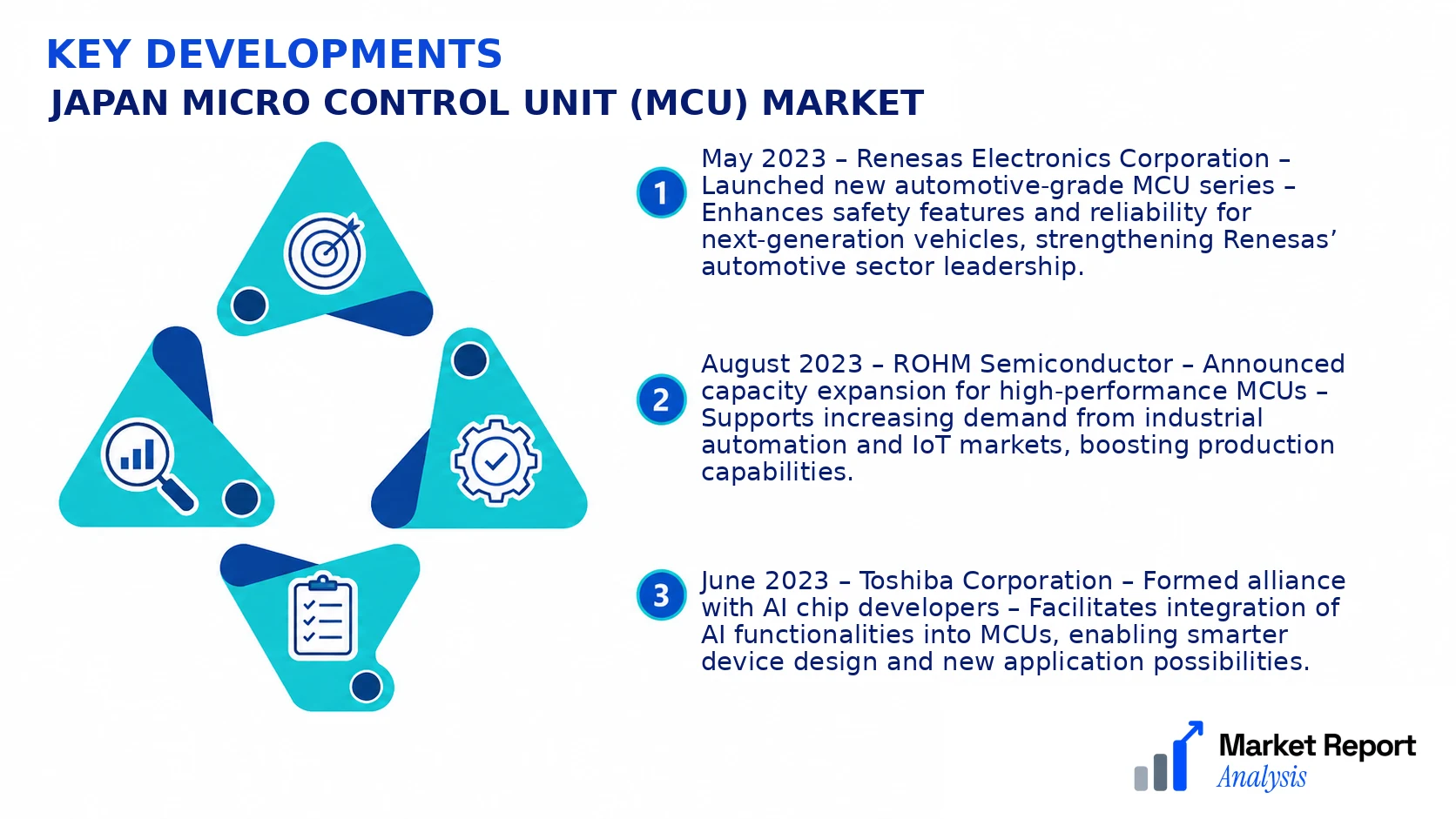
- May 2023 – Renesas Electronics Corporation – Launched new automotive-grade MCU series – Enhances safety features and reliability for next-generation vehicles, strengthening Renesas’ automotive sector leadership.
- August 2023 – ROHM Semiconductor – Announced capacity expansion for high-performance MCUs – Supports increasing demand from industrial automation and IoT markets, boosting production capabilities.
- June 2023 – Toshiba Corporation – Formed alliance with AI chip developers – Facilitates integration of AI functionalities into MCUs, enabling smarter device design and new application possibilities.
- April 2023 – Synaptics Japan Ltd. – introduced new biometric sensor-integrated MCUs – Strengthens offerings in consumer security and personalized device ecosystems, driving innovation in user interfaces.
- September 2023 – Micron Technology Japan Ltd. – Invested in advanced semiconductor fabrication plant – Improves supply chain resilience and supports high-speed data processing demand driven by 5G and cloud computing growth.
Frequently Asked Questions
What is the Japan Micro Control Unit (MCU) Market?
The Japan Micro Control Unit (MCU) Market encompasses the manufacturing, distribution, and sale of micro control units used in electronic devices across various industries, including automotive, consumer electronics, and industrial machinery, within Japan, reflecting technological advancements and regional demand patterns.
What is the current market size of Japan Micro Control Unit (MCU) Market?
As of 2026, the Japan MCU market is valued at approximately USD 8.3 Billion, driven by sophisticated electronic needs across automotive and consumer electronics sectors, with steady growth anticipated due to increasing adoption of automation and IoT-enabled devices.
What factors are driving the Japan Micro Control Unit (MCU) Market?
The growth factors include rising integration of MCUs in automotive systems for enhanced safety features, growth in consumer electronics such as smart gadgets, and expanding industrial automation. Technological innovations and stringent safety standards further propel market expansion.
Which region dominates the Japan Micro Control Unit (MCU) Market?
The Kanto region, including Tokyo, dominates the market due to high manufacturing activity, technological innovation hubs, and significant automotive and consumer electronics industries, contributing substantially to regional market revenues.
Which segment is expected to grow the fastest?
The automotive segment is projected to grow at the fastest CAGR owing to the increasing integration of MCUs in electric and autonomous vehicles, along with the rising demand for smart car systems that improve safety and connectivity.
Who are the leading companies operating in the Japan Micro Control Unit (MCU) Market?
Leading companies include Renesas Electronics Corporation, Toshiba Corporation, and ChemiGen Technologies, which hold significant market shares driven by innovative product portfolios, strategic partnerships, and robust local manufacturing capabilities within Japan.
Analyst Perspective
The Japan Micro Control Unit (MCU) market is poised for sustained growth through 2034, driven by ongoing advancements in automotive electronics, industrial automation, and consumer electronics sectors. As technological evolution accelerates, particularly in the integration of AI and IoT capabilities within MCUs, companies that prioritize R&D investments will be well-positioned to capitalize on emerging opportunities, especially in premium, high-performance segments. Regional growth will remain robust in key urban centers like Tokyo, Nagoya, and Osaka, where automotive manufacturing and electronics innovation hubs are concentrated. Competitive intensity is expected to intensify as global and domestic players expand their footprints, targeting strategic alliances and technological differentiation. Long-term, the market's maturity will foster more specialized offerings, with investments increasingly directed towards power-efficient, miniaturized MCUs tailored for smart mobility and Industry 4.0 applications. Firms that prioritize regional customization and collaborative innovation will strengthen their strategic positions, ensuring resilience amidst rapid technological change and evolving regulatory standards.
