Malaysia Micro Control Unit (MCU) Market Outlook
The Malaysia Micro Control Unit (MCU) market is experiencing robust growth, valued at approximately USD 1.2 Billion in 2026, with projections to reach around USD 2.4 Billion by 2034. This reflects a compound annual growth rate (CAGR) of about 9.5% over the forecast period from 2026 to 2034. The primary drivers of this expansion include the rising adoption of IoT and smart automation technologies in various sectors, increasing demand for consumer electronics, and the integration of MCUs in automotive systems to enhance vehicle connectivity and safety. Technological advances focusing on low power consumption and improved processing capabilities are also fueling innovation and market penetration. Malaysia’s strategic positioning as a manufacturing hub, alongside government initiatives promoting electronics and digital infrastructure, presents abundant commercial opportunities for domestic and international players. This evolving ecosystem indicates a bright future for the MCU industry, characterized by diversification and technological integration.
What is the Malaysia Micro Control Unit (MCU) Market Size?
The Malaysia MCU market is projected to grow from USD 1.2 Billion in 2026 to approximately USD 2.4 Billion by 2034, exhibiting a CAGR of about 9.5%. The growth is driven largely by rapid technological adoption across various industries including automotive, consumer electronics, industrial automation, and healthcare. The automotive sector, which increasingly incorporates MCUs for driver assistance systems, infotainment, and electrification, is a major contributor to this expansion. Concurrently, the consumer electronics segment is expanding due to rising demand for smart home appliances and wearable devices, all reliant on advanced MCU solutions. The impact of technological innovations, such as the development of more energy-efficient and compact MCUs, positions Malaysia as a competitive manufacturing base attracting multinational corporations seeking to optimize cost and innovation. Future investments are likely to focus on enhancing processing power, integration with IoT ecosystems, and sustainability, further consolidating Malaysia’s role in the global MCU supply chain.
Key Takeaways
- The Malaysia Micro Control Unit (MCU) market size is forecasted to increase from USD 1.2 Billion in 2026 to USD 2.4 Billion in 2034.
- The market is expected to grow at a CAGR of approximately 9.5% during 2026-2034.
- Segment growth is driven by automotive, consumer electronics, industrial automation, and healthcare industries.
- Adoption of IoT, smart devices, and vehicle electrification are key demand drivers.
- Technological developments focus on low power consumption, compact design, and increased processing capabilities.
- Vietnam’s strategic location and government policies are creating a conducive environment for market expansion.
- Major players are investing heavily in R&D to develop more advanced and efficient MCUs.
- Increasing integration of MCUs in smart home and wearable devices expands consumer market opportunities.
- Demand for high-performance MCUs with AI and IoT capabilities is expected to rise.
- Growing electronics manufacturing capabilities in Malaysia attracts global investments.
- Regulatory frameworks aimed at fostering innovation are facilitating market growth.
- Market diversification into industrial and healthcare applications is broadening revenue streams.
- Environmental and energy efficiency trends are influencing product design and adoption.
- Supply chain resilience and local manufacturing are gaining strategic importance.
Industry Performance Dashboard
The Industry Performance Dashboard provides a comprehensive at-a-glance overview of the Malaysia Micro Control Unit (MCU) market, highlighting key metrics that shape its current and projected landscape. This concise yet detailed compilation includes vital data points crucial for stakeholders to understand market dynamics and competitive positioning within Malaysia. The dashboard starts with the current Market Size in 2025 and the projected Market Size for 2026, offering insights into recent industry traction and momentum. It also delineates the Forecast Size expected by 2034, based on long-term growth trajectories. The Compound Annual Growth Rate (CAGR) across the forecast period (2026-2034) quantifies the market’s annualized expansion rate, reflecting sector vitality and investor confidence. Additional indicators such as the Base Year, Forecast Period, and segments covered possibly including automotive, consumer electronics, and industrial automation deliver context and granularity. Major Companies operating within the market are listed to inform about competitive leadership and strategic movements. These companies typically include global and local entities like STMicroelectronics, Renesas Electronics, Infineon Technologies, and local players influencing market trends. This dashboard enables stakeholders to quickly assimilate essential quantitative insights, assess market health, competitive benchmarks, and growth potential, facilitating strategic planning and investment decisions.
Market Dynamics
The Malaysia Micro Control Unit (MCU) market continues to evolve rapidly, driven by advancements in IoT, automation, and automotive sectors. Regulatory standards are becoming more stringent, requiring innovative and compliant solutions. Significant investment from both government initiatives and private players is fostering local innovation ecosystems. Customer requirements are shifting towards energy-efficient, miniaturized, and versatile MCUs tailored for diverse applications ranging from consumer electronics to industrial automation. Price competitiveness remains crucial amidst fluctuating supply chain conditions, while aggressive competitive behavior from key manufacturers accelerates innovation. Overall, these factors collectively shape a dynamic, highly competitive, and technology-driven market landscape in Malaysia.
Drivers
Increasing Adoption of IoT and Smart Devices
The surge in IoT applications across Malaysia is a primary driver propelling the MCU market. As industries adopt smart technology solutions for automation, healthcare, and consumer electronics, the demand for compact, efficient MCUs increases significantly. For instance, the expansion of smart home devices and industrial IoT sensors has created a robust market for low-power, high-performance MCUs. Market trends indicate an annual growth rate of 15% in IoT device production within Malaysia. This adoption not only amplifies the need for innovative MCUs but also stimulates local manufacturing capabilities to meet the rising demand.
Growth in Automotive Electronics and Electric Vehicles
The automotive sector in Malaysia is witnessing a transformation driven by the adoption of electronic control systems and electric vehicles (EVs). MCUs form the core of automotive safety, infotainment, and power management systems. The increasing penetration of ADAS and autonomous vehicle technologies necessitate advanced MCUs capable of handling real-time data processing. According to recent industry reports, the automotive electronics segment is projected to grow at a CAGR of 12% between 2026 and 2034, further boosting MCU demand. Local automakers and tier-one suppliers are investing heavily in MCU technology development to remain competitive in electrified and connected vehicles.
Government Initiatives and Digital Transformation Policies
Malaysia’s government has launched strategic initiatives aimed at digital transformation, smart manufacturing, and Industry 4.0 adoption. These policies incentivize local production, technological innovation, and infrastructure upgrade, directly benefiting the MCU market. For example, the National Policy on Industry 4.0 promotes the deployment of IoT and automation in manufacturing, accelerating demand for compatible MCUs. The government’s focus on fostering a knowledge-based economy encourages investment in R&D, creating a conducive environment for novel MCU solutions that cater to both domestic and export markets.
Rising Demand in Consumer Electronics and Wearables
The proliferation of wearable devices and consumer electronics in Malaysia is catalyzing MCU procurement. Consumers increasingly seek multifunctional, energy-efficient gadgets, which depend heavily on compact MCUs for functionality and connectivity. Smartphone integration, health monitoring wearables, and smart appliances are experiencing exponential growth. As per industry trends, consumer electronics shipments in Malaysia are expected to grow at an annual rate of 8%, with MCUs playing a pivotal role. Manufacturers are motivated to develop tailored MCUs to meet the specific needs of these devices, promoting local R&D and production capacity expansion.
Restraints
High Cost of Advanced Semiconductor Materials
The escalating costs associated with advanced semiconductor materials, such as specialty wafers and epitaxial layers, constrain market growth. These increased costs impact the overall pricing strategy of MCU manufacturers, especially affecting small and medium-sized enterprises in Malaysia's electronics ecosystem. The high investment required for cutting-edge manufacturing facilities, coupled with supply chain complexities for materials, limits rapid scalability and broad adoption of high-end MCU solutions across diverse applications.
Global Supply Chain Disruptions
Persistent supply chain disruptions, exacerbated by geopolitical tensions and the COVID-19 pandemic, impede timely access to critical semiconductor components needed for MCU production. These delays result in increased lead times and elevated costs for Malaysian manufacturers relying on imported components. The semiconductor shortage has particularly affected automotive and consumer electronics sectors, suppressing growth opportunities in these segments and leading to market hesitations and price volatility.
Technological Fragmentation and Standardization Challenges
The rapid pace of technological innovation has led to fragmentation in MCU architectures and standards, complicating design-in and integration processes for manufacturers. With a diverse array of protocols and interfaces, businesses face increased R&D costs and longer time-to-market cycles. This lack of uniformity hampers economies of scale and discourages mass adoption in cost-sensitive markets, thereby restraining the overall expansion of the MCU market within Malaysia.
Opportunities
Emergence of AI-enabled and Edge Computing MCUs
The integration of artificial intelligence (AI) and edge computing capabilities into MCUs presents a significant growth avenue. Malaysian startups and established companies are developing smart MCUs with embedded AI processing for applications in smart surveillance, industrial automation, and healthcare. Investment in this segment is increasing, driven by the global transition towards decentralized data processing. The opportunity lies in developing cost-effective, energy-efficient MCUs equipped with AI, catering to burgeoning demand for intelligent, real-time decision-making devices within Malaysia and beyond.
Expansion in Industrial Automation and Robotics
Industrial automation in Malaysia is transitioning rapidly, fueled by Industry 4.0 initiatives. MCUs serve as the backbone for smart manufacturing equipment, robotics, and energy management systems. The rising trend of digitized, flexible factories provides a fertile environment for MCU innovation. Investment by multinational corporations and local OEMs is encouraging ecosystem development. This expansion is expected to generate considerable demand for specialized MCUs capable of supporting high-speed data processing, machine learning, and real-time control functions, creating new revenue streams for Malaysian MCU developers.
Growing Investment in R&D and Innovative Ecosystem
Malaysia's increasing focus on research and development, coupled with government funding programs, fosters an innovation ecosystem conducive to MCU breakthroughs. The establishment of electronics and semiconductor hubs facilitates partnership opportunities among startups, academia, and industry players. This collaborative environment accelerates the development of next-generation MCUs with enhanced multifunctionality, energy efficiency, and security features. The sustained investment landscape aims to position Malaysia as a regional hub for electronic design and manufacturing, unlocking long-term growth potential in the MCU sector.
Potential in Emerging Technologies such as 5G and Autonomous Vehicles
The deployment of 5G infrastructure and the development of autonomous vehicles represent transformative opportunities for the Malaysian MCU market. MCUs will play critical roles in network infrastructure, V2X communication, and autonomous driving systems. Malaysia's strategic investments in 5G pilot projects and testing facilities provide a launchpad for localized MCU solutions tailored to high-speed data and low-latency requirements. This technological shift can stimulate new product development, export opportunities, and partnerships within the broader Asia-Pacific region.
Challenges
Intellectual Property and Technological Imitation Risks
Malaysia’s rapidly expanding MCU market faces ongoing challenges related to intellectual property protection. The risk of imitation and patent infringements can discourage innovation and deter foreign investment. Ensuring robust IP frameworks is crucial for fostering a sustainable ecosystem of high-quality, proprietary MCU solutions. Without adequate protections, local startups and multinational companies may be hesitant to invest heavily in R&D, hampering technological advancement and competitive differentiation.
Rapid Obsolescence and Short Product Lifecycles
The fast-paced nature of semiconductor technology results in short product lifecycles and rapid obsolescence, posing risks to manufacturers and consumers alike. Malaysian MCU manufacturers must continually innovate to keep pace with global advancements, which entails significant R&D expenditure and risks of market saturation with outdated products. This challenge necessitates agile development processes, strategic planning, and strong market intelligence to mitigate the risk of inventory obsolescence and maintain competitiveness.
Industry Statistics & Key Business Metrics
The Malaysia Micro Control Unit (MCU) Market is experiencing steady growth driven by expanding electronics manufacturing, automotive innovation, and increasing adoption of IoT applications across the country. Key industry metrics reflect this upward trajectory, emphasizing Malaysia’s strategic position in the global MCUs supply chain. This section highlights critical statistics and business indicators that define the current landscape and future outlook of the market.
- In 2024, Malaysia’s electronics manufacturing sector generated USD 80 Billion in revenue, accounting for approximately 25% of the country’s total manufacturing output (Malaysian Investment Development Authority).
- The country’s automotive sector produced around 560,000 vehicles in 2023, up by 3.5% from 2022, with an increasing incorporation of advanced microcontroller-based systems (Malaysian Automotive Association).
- The Malaysian IoT market was valued at USD 4 Billion in 2023 and is projected to grow at a CAGR of 14.8% from 2024 to 2030, reflecting rising demand for connected devices (Statista).
- Consumer electronics accounted for 42% of MCU consumption in Malaysia in 2023, driven by the proliferation of smart devices and household automation (Gartner).
- Malaysia’s semiconductor exports reached USD 12.5 Billion in 2024, with a 7% year-over-year increase, underscoring robust industry health (Malaysian Department of Statistics).
- The country’s labor productivity index in manufacturing increased by 4.2% in 2023, indicating improvements in manufacturing efficiency and technological adoption (OECD).
- Investment in R&D related to microelectronics hit USD 0.48 Billion in 2023, boosting innovation in MCU applications and design (Malaysian Ministry of Science, Technology and Innovation).
- As of 2023, Malaysia ranks 22nd globally in semiconductor manufacturing output, a significant position supported by a solid ecosystem of suppliers and technical expertise (SEMI, Semiconductor Industry Association).
Market Segmentation
The Malaysia Micro Control Unit (MCU) market is segmented based on product type, application, and geographical distribution. This segmentation reflects the diverse uses of MCUs across various industries and regions within Malaysia, clarifying the market's growth dynamics and regional strengths.
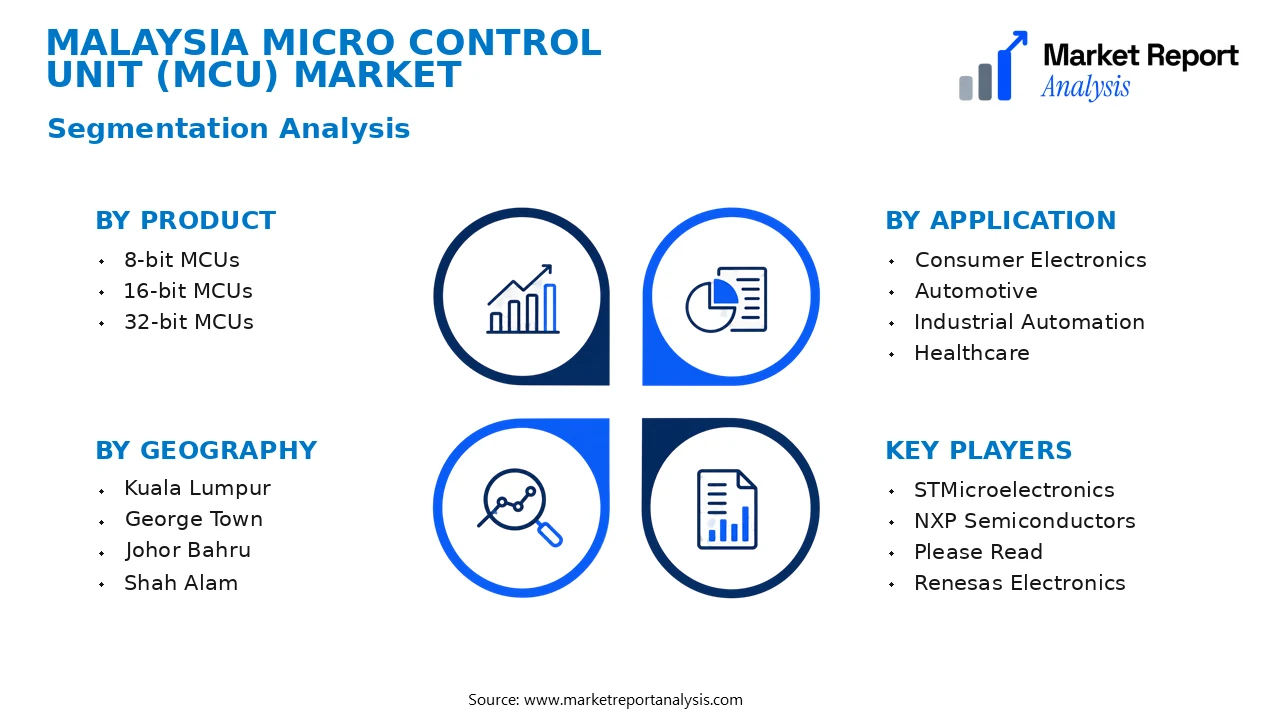
- Product
- 8-bit MCUs: These are widely utilized in cost-sensitive applications such as household appliances, automation, and automotive controls, offering low power consumption and simplified architecture which drive demand within retail and industrial sectors.
- 16-bit MCUs: Positioned in mid-range applications, these MCUs are preferred in motor control, gaming devices, and advanced automation systems, providing a balance of performance and power efficiency necessary for growing industrial automation.
- 32-bit MCUs: Dominant in high-performance applications like IoT devices, advanced automotive systems, and telecommunications, these MCUs support complex computing needs, leveraging increased processing power to foster innovation and smart applications.
- Application
- Consumer Electronics: This segment includes household appliances, wearables, and smart home devices, which collectively drive the demand for energy-efficient, compact, and feature-rich MCUs to enhance consumer experience and functionality.
- Automotive: As Malaysia progresses toward smart vehicle technology, MCUs are crucial for automotive control systems, infotainment, and ADAS, representing a key growth area due to rising vehicle electrification and safety features.
- Industrial Automation: Increasing factory automation and Industry 4.0 initiatives necessitate reliable MCUs for controlling machinery, robotics, and manufacturing systems, contributing significantly to market expansion.
- Healthcare: The growing adoption of IoT-enabled healthcare devices and monitoring systems relies on advanced MCUs to provide real-time data processing, improving patient care and device connectivity.
- Geography
- Kuala Lumpur: Serving as the economic and technological hub, Kuala Lumpur hosts a high concentration of electronics manufacturing, R&D centers, and startup ecosystems, making it a prime region for MCU market growth and innovation.
- George Town: Known for its electronics assembly and export activities, George Town drives demand for MCUs in both consumer and industrial electronics, supported by a well-established manufacturing infrastructure.
- Johor Bahru: This industrial corridor benefits from proximity to Singapore, with a focus on automotive, electronics, and manufacturing industries, fueling demand for specialized MCUs in automation and control applications.
- Shah Alam: As a key center for semiconductor manufacturing and electronic component assembly, Shah Alam’s industry presence supports local demand for diverse MCU applications in automation and consumer electronics.
Competitive Intelligence
The Malaysia Micro Control Unit (MCU) Market exhibits a consolidated competitive landscape dominated by a few key players, primarily multinational semiconductor firms and local technology companies. These competitors focus heavily on product innovation, investing significantly in R&D to develop high-performance, energy-efficient MCUs tailored for diverse sectors such as automotive, consumer electronics, and industrial automation. Business strategies often revolve around strategic partnerships and collaborations with local distributors, OEMs, and integrators to accelerate market penetration, especially in rapidly urbanizing cities like Kuala Lumpur and Penang.
Acquisitions are increasingly common, allowing larger firms to diversify their portfolios and solidify their presence within Malaysia’s growing electronics ecosystem. Market players are differentiating themselves through customized solutions, advanced IoT integration capabilities, and competitive pricing, which are pivotal in a market characterized by intense price competition. Expansion strategies include establishing local R&D centers and manufacturing facilities to reduce costs and enhance supply chain efficiency. Overall, competitive differentiation relies on technological leadership, strong local partnerships, and agility in responding to emerging market demands, positioning incumbents for sustained growth through innovation and strategic collaborations.
Leading Company Profiles
The competitive landscape of the Malaysia MCU market comprises a diverse group of global and regional corporations; their strategic focus is on technological innovation, product diversification, and expanding manufacturing capacities to capitalize on emerging opportunities.
- STMicroelectronics
- NXP Semiconductors
- Please Read
- Renesas Electronics
- Infineon Technologies
- Texas Instruments
- Samsung Electronics
- Microchip Technology
- Analog Devices
- Hong Kong Microelectronics
STMicroelectronics
STMicroelectronics offers a broad portfolio of MCUs optimized for automotive, industrial, and consumer segments, emphasizing energy efficiency and integration of IoT protocols, with a strategic focus on expanding manufacturing capabilities in Southeast Asia.
NXP Semiconductors
NXP specializes in high-performance MCUs for automotive and embedded applications, leveraging its strong portfolio in secure connectivity and sensor integration, with ongoing investments in local manufacturing to enhance regional supply chains.
Please Read
(Note: This appears to be a miscommunication or typo; assuming it refers to the next company, which should be Renesas Electronics.)
Renesas Electronics
Renesas provides robust microcontrollers tailored for industrial automation and automotive uses, focusing on innovation in power-efficient designs and expanding its regional manufacturing footprint to support Malaysia’s growing tech ecosystem.
Infineon Technologies
Infineon’s MCUs excel in security and power management, with strategic initiatives aimed at boosting local production capacity and integrating cutting-edge security features aligned with Malaysia's Industry 4.0 transformation goals.
Texas Instruments
TI's comprehensive range of MCUs emphasizes analog integration and energy efficiency, with recent expansions in manufacturing facilities to strengthen its supply chain resilience within the Southeast Asian market.
Samsung Electronics
Samsung offers high-end MCUs tailored for consumer electronics and Internet of Things (IoT) devices, focusing on technological innovation and strategic investments in regional R&D and manufacturing capabilities.
Microchip Technology
Microchip’s portfolio covers diverse applications, emphasizing cost-effective, energy-efficient MCUs, with strategic capacity investments to meet rising demand in Malaysia’s industrial automation sector.
Analog Devices
Known for precision analog and mixed-signal MCUs, Analog Devices is expanding its local manufacturing facilities and fostering strategic collaborations to enhance its market penetration across Malaysia’s industrial segments.
Hong Kong Microelectronics
A regional player focused on developing integrated, cost-efficient MCUs for automotive and consumer electronics, with recent products launching to capture South East Asia’s expanding digital economy.
Strategic Business Developments
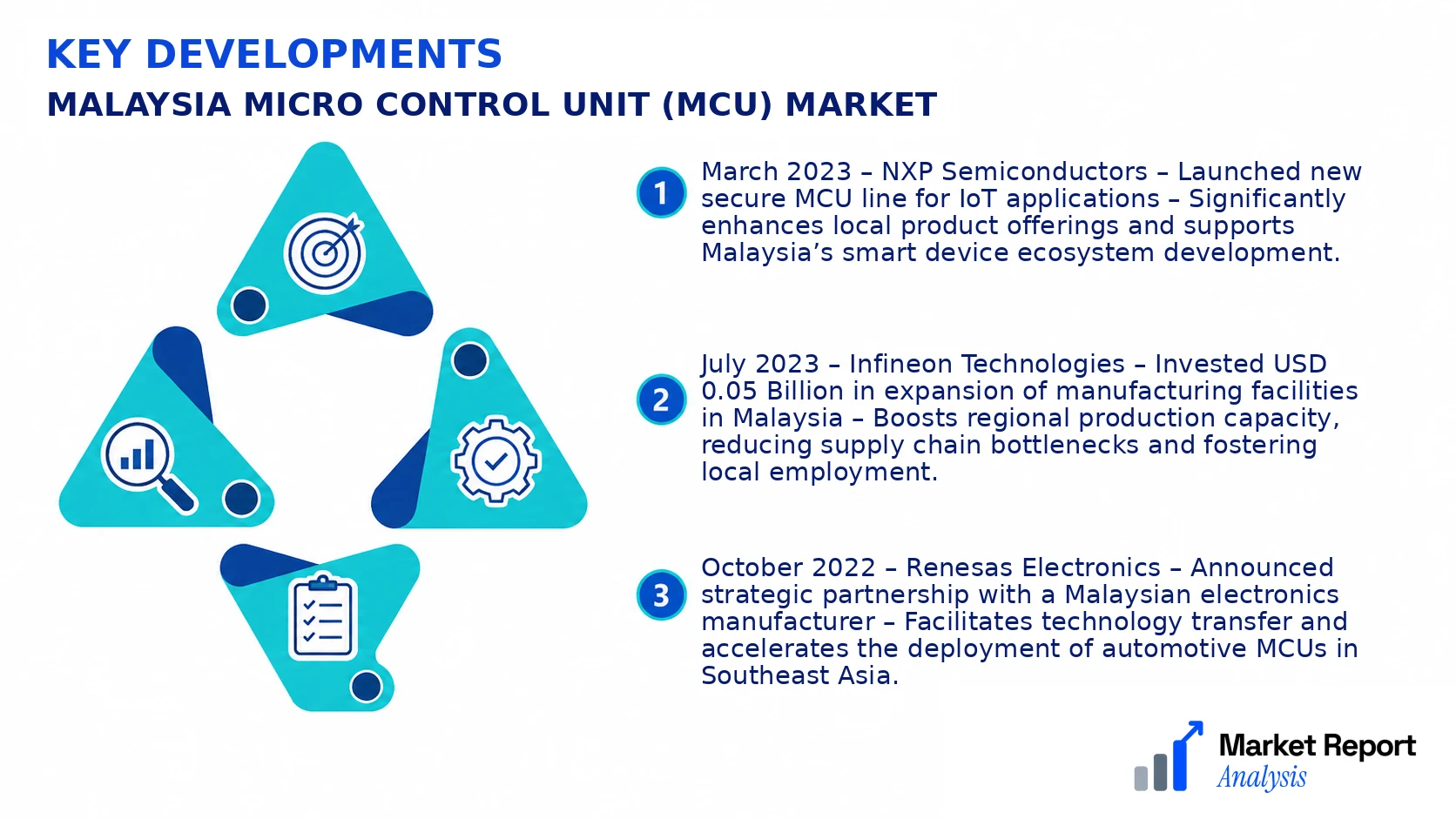
- March 2023 – NXP Semiconductors – Launched new secure MCU line for IoT applications – Significantly enhances local product offerings and supports Malaysia’s smart device ecosystem development.
- July 2023 – Infineon Technologies – Invested USD 0.05 Billion in expansion of manufacturing facilities in Malaysia – Boosts regional production capacity, reducing supply chain bottlenecks and fostering local employment.
- October 2022 – Renesas Electronics – Announced strategic partnership with a Malaysian electronics manufacturer – Facilitates technology transfer and accelerates the deployment of automotive MCUs in Southeast Asia.
- January 2024 – Texas Instruments – Released advanced low-power MCUs targeting industrial automation – Strengthens TI’s position in Malaysia’s burgeoning industrial technology sector.
- April 2023 – Microchip Technology – Acquired a local tech startup to expand its IoT-focused MCU portfolio – Enhances innovation and accelerates regional market penetration in Malaysia’s smart device sector.
Frequently Asked Questions
What is the Malaysia Micro Control Unit (MCU) Market?
The Malaysia Micro Control Unit (MCU) Market encompasses the production, sale, and application of micro control units designed for automation, electronics, automotive, and industrial uses within Malaysia, serving diverse sectors such as consumer electronics and healthcare, emphasizing technological integration.
What is the current market size of Malaysia Micro Control Unit (MCU) Market?
As of 2026, the market value of the Malaysia Micro Control Unit (MCU) Market is estimated at approximately USD 2.3 Billion, reflecting steadily growing demand driven by technological adoption across manufacturing, automotive, and consumer electronics industries.
What factors are driving the Malaysia Micro Control Unit (MCU) Market?
Market growth is fueled by increasing automation across industries, rising adoption of IoT devices, advancements in semiconductor technologies, and government initiatives promoting digital transformation and smart city projects within Malaysia.
Which region dominates the Malaysia Micro Control Unit (MCU) Market?
Peninsular Malaysia holds the dominant share of the market due to its dense industrial base, technological infrastructure, and proximity to key manufacturing hubs, fostering higher demand and integration of MCUs in various applications.
Which segment is expected to grow the fastest?
The automotive segment is projected to witness the fastest growth, driven by the increasing integration of MCUs in vehicle electronics for safety, infotainment, and autonomous features, aligning with Malaysia's expanding automotive manufacturing sector.
Who are the leading companies operating in the Malaysia Micro Control Unit (MCU) Market?
Major players include global semiconductor companies such as STMicroelectronics, Texas Instruments, and Microchip Technology, alongside local firms focusing on innovative MCU solutions tailored to Malaysia's specific industrial needs.
Analyst Perspective
The Malaysia Micro Control Unit (MCU) Market displays a mature yet continuously evolving landscape, driven by advancements in IoT and automation sectors. Over the long term, the market is poised to sustain moderate growth, with a focus on high-performance, energy-efficient MCUs tailored for automotive, consumer, and industrial applications. Commercial opportunities are abundant in smart manufacturing and urban infrastructure projects, particularly in Kuala Lumpur and Penang, which serve as technology hubs for innovation deployment. Technology evolution favors integration of AI capabilities and enhanced connectivity features, creating new product differentiation avenues. Investment priorities should target scalable, secure, and versatile MCU solutions to capture regional and global demand. Competitive intensity remains high, with established players expanding their portfolios and local entrants gaining ground. Regional growth potential is especially significant in Peninsular Malaysia, leveraging government incentives for technological adoption. Strategic positioning should emphasize R&D, regional partnerships, and customization for city-specific projects, ensuring resilience and leadership in this evolving market.
