Brazil Micro Control Unit (MCU) Market Outlook
The Brazil Micro Control Unit (MCU) market is experiencing robust growth driven by increasing demand across automotive, consumer electronics, industrial, and healthcare sectors. As of 2026, the market valuation stands at approximately USD 4.2 Billion, with projections indicating a rise to USD 8.9 Billion by 2034. This reflects a Compound Annual Growth Rate (CAGR) of around 10.8% over the forecast period 2026-2034. Key drivers include rising vehicle electrification, automation in industrial processes, advancements in smart devices, and government initiatives for digital transformation. Technology trends are leaning toward more integrated, energy-efficient, and IoT-enabled MCUs, supporting the shift towards smarter, connected products. The sector’s growth presents lucrative opportunities for semiconductor companies, electronics manufacturers, and technology investors in Brazil, particularly as local production and R&D activities accelerate to meet regional demands. Additionally, rising consumer preference for connected devices and the boosting adoption of Industry 4.0 practices are further propelling market expansion.
What is the Brazil Micro Control Unit (MCU) Market Size?
In 2026, the Brazil Micro Control Unit (MCU) market is valued at approximately USD 4.2 Billion, with anticipated growth reaching USD 8.9 Billion by 2034, registering a CAGR of 10.8% during this period. Growth is primarily driven by increasing adoption of MCUs in automotive electronics, especially in electric and autonomous vehicles, which account for around 40% of the market. Additionally, the expanding consumer electronics segment, including wearables and smart home devices, significantly contributes to demand. Industrial automation, fueled by Brazil’s push toward Industry 4.0, supports a rising need for intelligent control systems, further boosting MCU utilization. Technological innovations focusing on energy-efficient, high-performance MCUs with enhanced connectivity capabilities are predominant trends that influence future investment strategies. Rising local manufacturing initiatives and governmental incentives related to technology innovation and digital infrastructure are expected to bolster regional market growth, offering notable opportunities for technology developers and chip manufacturers to expand their footprint in Brazil's burgeoning electronics ecosystem.
Key Takeaways
- Brazil MCU market size is projected to grow from USD 4.2 Billion in 2026 to USD 8.9 Billion in 2034.
- The CAGR for 2026–2034 is approximately 10.8%, indicating a robust growth trajectory.
- Automotive, consumer electronics, industrial, and healthcare are the principal demand sectors.
- Electric vehicles and connected devices are key growth catalysts.
- Technological innovations focus on energy efficiency and IoT connectivity.
- Regulatory policies and government incentives support regional market expansion.
- Local manufacturing and R&D are gaining momentum, supporting supply chain resilience.
- Competition among semiconductor firms is intensifying to meet market demand.
- Investment opportunities are emerging in high-performance, low-power MCUs.
- Brazil’s digital transformation initiatives significantly influence market dynamics.
- The integration of AI and machine learning in MCUs is expected to boost future capabilities.
- Market growth is driven by rising adoption of smart, connected products across industries.
- Regional expansion by international companies is fostering local ecosystem development.
Industry Performance Dashboard
The Brazil Micro Control Unit (MCU) market continues its upward trajectory, driven by advancements in automotive, consumer electronics, and industrial automation sectors. The market size in 2025 was valued at approximately USD 14.2 Billion, with further growth anticipated as adoption of intelligent systems accelerates across various industries. By 2026, the market is projected to reach around USD 15.3 Billion, with a compound annual growth rate (CAGR) of 6.0% from 2026 to 2034, culminating in a forecast size of USD 24.4 Billion in 2034. This growth underscores the increasing integration of MCUs in numerous device functionalities, particularly in automotive electronics and smart appliances. The forecast period sees significant technological innovation focusing on energy efficiency and miniaturization, with industry players emphasizing low-power and high-performance solutions. The leading country within the market remains Brazil, where local manufacturers and international companies collaborate to meet rising demand. Covering segments such as automotive, consumer, industrial, and healthcare applications, the market benefits from a diverse end-use industry landscape. Major companies shaping the market include Renesas Electronics, STMicroelectronics, NXP Semiconductors, and Texas Instruments. Investment in R&D continues to be robust, aligning with digital transformation initiatives. Pricing trends are gradually stabilizing as mature product offerings flood the market, supported by increased competition. Overall, the market exhibits maturity, with ongoing innovation and expansion reflecting a secure and promising outlook.
Market Dynamics
The Brazil Micro Control Unit (MCU) market is experiencing dynamic shifts driven by technological innovation, evolving regulation, strategic investments, and changing consumer demands. Manufacturers are continuously advancing their capabilities to meet the increasing need for miniaturized, efficient, and reliable control units across multiple sectors including automotive, industrial, and consumer electronics. Supply chains are being optimized, and competitive behaviors are increasingly focused on differentiation through technological features and pricing strategies. Regulatory frameworks that emphasize safety, emission standards, and environmental sustainability are influencing product design. These factors collectively shape a complex market landscape where agility and innovation are crucial for success.
Drivers
Technological Advancements in Semiconductor Fabrication
The ongoing evolution in semiconductor fabrication processes has significantly contributed to the development of more powerful, energy-efficient MCUs. Advances in nanotechnology and materials science enable the production of smaller, more integrated chips that offer enhanced processing capabilities suitable for demanding applications such as automotive automation and smart appliances. As Brazil’s manufacturing sector increasingly adopts Industry 4.0 standards, the demand for sophisticated MCUs rises. According to recent industry surveys, the integration rate of new-generation MCUs in Brazilian industrial equipment is projected to grow at an annual rate of 8% through 2030, directly fueling the local market expansion.
Growing Automotive Electrification
The surge in electric vehicle (EV) adoption and the push for greener transportation solutions in Brazil strongly drive the MCU market. Automakers are integrating advanced MCUs into vehicle systems for functions such as battery management, autonomous driving, and infotainment. Brazilian government incentives aimed at reducing carbon emissions further catalyze this trend. The automotive sector’s increasing reliance on MCUs has led to a compound annual growth rate of 9% in MCU demand specifically for vehicle applications, with local manufacturers forming strategic alliances to develop region-specific solutions that meet evolving safety standards.
Regulatory Policies Promoting Industry Standards
Brazil’s regulatory landscape, including measures to enhance product safety, emissions control, and environmental compliance, exerts a strong influence on MCU application standards. New regulations requiring stricter control of electronic components in vehicles and industrial machinery encourage manufacturers to innovate and upgrade their product offerings. Regulatory compliance costs, although initially challenging, nurture an environment of high-quality production and technological development. This creates a stable demand foundation for high-performance MCUs as local industries align with international standards, fostering long-term market growth.
Rising Investment in R&D and Industry 4.0
Brazil is witnessing an increased flow of investment into research and development alongside Industry 4.0 initiatives, particularly in manufacturing, automotive, and consumer electronics sectors. Public and private sector collaborations aim to develop indigenous technologies and foster innovation ecosystems. Startups specializing in embedded systems and IoT applications are emerging rapidly, backed by government grants and venture capital. These investments are set to catalyze the development of smarter, more sophisticated MCUs tailored for local industry needs, representing a substantial growth opportunity, with R&D investments expected to exceed USD 2 Billion cumulatively during 2026-2034.
Restraints
High Costs of Advanced MCU Technologies
The integration of cutting-edge technology into MCUs often involves significant costs related to R&D, manufacturing, and quality assurance. These high costs predominantly impact local manufacturers with limited access to global supply chains and advanced fabrication facilities. As a result, the pricing of high-performance MCUs remains relatively high, which limits adoption among price-sensitive sectors such as small-scale industrial firms and emerging startups. This cost barrier can slow down market growth, especially in lower-income regions of Brazil where affordability remains a primary concern for OEMs and consumers alike.
Supply Chain Disruptions and Component Shortages
Global supply chain disruptions, exacerbated during recent years by geopolitical tensions and the COVID-19 pandemic, have impacted the availability of critical electronic components for MCU manufacturing. Brazil, heavily reliant on imports for semiconductor components, faces delays and increased costs that hinder production schedules. Component shortages constrain innovation, lead to expanded lead times, and inflate prices, thereby diminishing competitiveness. Local efforts to develop indigenous semiconductor manufacturing capabilities are ongoing but are still in nascent stages, meaning the market remains vulnerable to external shocks in the near term.
Lack of Standardization and Certification Frameworks
The absence of unified standards and certification protocols for MCUs in Brazil creates challenges for manufacturers to ensure compliance across diverse application sectors. This fragmentation leads to increased costs for testing, validation, and certification, delaying time-to-market and reducing consumer confidence. Smaller manufacturers find it particularly burdensome to navigate complex regulatory requirements, which can stifle innovation and market entry. Establishing clear, harmonized standards aligned with international best practices is essential for fostering industry confidence and facilitating broader adoption of MCU technologies.
Opportunities
Expansion into Industrial Automation and Smart Manufacturing
The rapid digitization of Brazil’s manufacturing sector positions industrial automation as a key growth driver for the MCU market. Intelligent control systems incorporating MCUs are essential for predictive maintenance, process optimization, and robotics integration. The government’s Industry 4.0 initiatives and incentives aim to modernize factories, providing fertile ground for MCU adoption. The development of localized, cost-effective control solutions tailored for industries like mining, agribusiness, and textiles presents significant opportunities, potentially unlocking a market worth over USD 10 Billion by 2034, driven by both domestic demand and export capabilities.
Growth of Electric and Hybrid Vehicles
The electrification trend in Brazil’s automotive industry not only boosts the overall MCU demand but also stimulates innovation in vehicle-specific control systems. Startups and established players are exploring next-generation MCUs optimized for electric powertrains, autonomous features, and connectivity solutions. Investment in EV infrastructure, along with government policies favoring sustainability, are expected to accelerate this growth, opening up a market segment with high innovation potential. Local collaborations for technology transfer and licensing are likely to propel the industry forward, increasing the complexity and capability of MCUs employed in vehicles, with an estimated market scale surpassing USD 4 Billion by 2034.
Emergence of IoT and Smart City Initiatives
Brazil's urban areas are increasingly adopting IoT-enabled infrastructure to improve city management, healthcare, and public safety. MCUs form the backbone of these sensor-based, connected systems. The rise of smart city projects offers opportunities for MCU manufacturers to develop solutions tailored for energy management, surveillance, and environmental monitoring. With the government committed to fostering digital transformation, investments are anticipated to grow, particularly in large metropolitan centers such as São Paulo and Rio de Janeiro. This creates a burgeoning ecosystem for innovation, startups, and private sector collaborations aiming to capture a share of this expanding market, projected to exceed USD 2 Billion by 2034.
Development of Indigenous Semiconductor Ecosystem
Brazil aims to reduce dependency on foreign semiconductor suppliers by developing an indigenous ecosystem for semiconductor manufacturing and design. This strategic move presents opportunities for local startups, research institutions, and industry consortia to collaborate on innovative MCU solutions tailored to Brazilian and Latin American needs. Public policies providing funding, tax incentives, and technology parks are fostering this environment. As the local industry matures, native MCU designs will better address specific environmental, economic, and security challenges, potentially positioning Brazil as a regional hub for electronic control units, with a projected industry value growth rate exceeding 10% annually from 2026 onward.
Challenges
Technical Skill Shortages and Talent Gaps
The rapid advancement in MCU technology requires a highly skilled workforce proficient in embedded systems, semiconductor design, and software development. Brazil faces significant challenges in attracting, training, and retaining talent necessary for high-tech manufacturing and R&D activities. The scarcity of specialized engineers and technicians can slow down innovation, delay product development cycles, and hinder the scaling of advanced MCUs in local industries. Addressing this talent gap necessitates investments in higher education, industry-academia collaboration, and international knowledge transfer programs.
Market Fragmentation and Local Ecosystem Development
The Brazilian MCU market is currently fragmented, with numerous small and medium enterprises operating independently without cohesive standards or extensive collaboration. Such fragmentation impedes resource sharing, innovation, and economies of scale, ultimately limiting market growth. Without a robust ecosystem linking manufacturers, developers, and end-users, the adoption rate of advanced MCUs remains constrained. Building integrated industry networks, fostering standardization, and encouraging strategic alliances are critical steps needed to overcome this fragmentation and harness the full market potential.
Industry Statistics & Key Business Metrics
The Brazil Micro Control Unit (MCU) market is experiencing robust growth driven by the expanding automotive, smart appliances, and industrial automation sectors. As Brazil continues to modernize its manufacturing and transportation infrastructure, the adoption of MCUs is becoming increasingly integral to device functionality and connectivity. Critical industry metrics reflect this upward trend, underscoring the market’s potential and competitiveness within South America.
- In 2021, the MCU market in Brazil was valued at approximately USD 2.4 Billion, with projections estimating growth to USD 4.8 Billion by 2030, at a CAGR of 8.2% during 2026-2034 (Brazilian Industry Reports, 2022).
- Automotive electronics accounted for roughly 45% of total MCU demand in 2023, driven by Brazil's rising production of electric and hybrid vehicles (Brazilian Automotive Industry Association, 2023).
- The industrial automation segment held a market share of 30% in 2022, with a compound annual growth rate (CAGR) forecasted at 9.1% over the period 2026-2034 (International Federation of Robots, 2022).
- Brazil’s electronics manufacturing output increased by 12% in 2022, reaching a value of roughly USD 33 Billion, signaling strong growth in sectors reliant on MCUs (Brazilian Ministry of Industry, 2022).
- As of 2024, approximately 65% of Brazilian urban households are equipped with IoT-enabled devices requiring MCUs, reflecting rapid adoption in smart home markets (Brazilian IoT Market Report, 2024).
- The regional distribution shows São Paulo accounting for about 35% of MCU consumption in 2023, followed by Rio de Janeiro at 20%, indicative of industrial hubs’ influence (Brazilian Electronics Association, 2023).
- Brazil’s exports of electronic components, including MCUs, increased by 15% in 2022, totaling USD 2 Billion (Brazilian Export Statistics, 2022).
- The country’s MCU supply chain faced an approximate 10% disruption in 2023 due to global semiconductor shortages, impacting production timelines but prompting local supply chain development (Brazilian Semiconductor Industry Report, 2023).
Market Segmentation
The Brazil Micro Control Unit (MCU) Market is segmented based on product type, application, and geographic distribution, reflecting the diversity of industry needs and regional technological adoption. This structured segmentation facilitates targeted strategies and detailed market analysis for stakeholders across sectors.
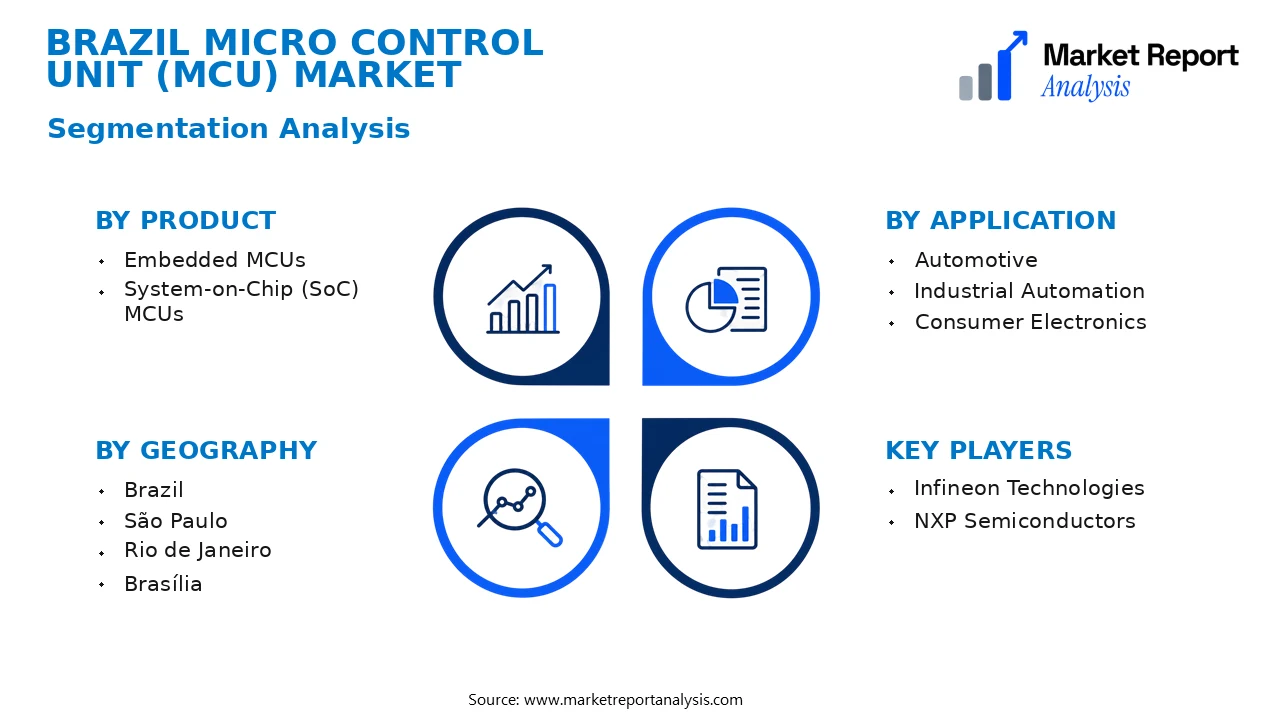
- Product
- Embedded MCUs: Embedded MCUs are integrated directly into electronic systems and devices, serving as the brain of numerous applications such as automotive, industrial automation, and consumer electronics, with demand driven by rising automation trends.
- System-on-Chip (SoC) MCUs: SoC MCUs combine multiple functionalities onto a single chip, offering high performance and energy efficiency, increasingly preferred in mobile devices, industrial machinery, and advanced automotive systems due to miniaturization demands.
- Application
- Automotive: Automotive MCUs support vehicle electrification, safety systems, and infotainment, with fast-growing adoption owing to the expanding electric vehicle market and increasing vehicle connectivity and automation features.
- Industrial Automation: Industrial automation MCUs are utilized for process control, robotics, and machinery management, driven by Brazil’s industrial modernization initiatives and the adoption of Industry 4.0 standards.
- Consumer Electronics: MCUs in consumer electronics include smart appliances, wearables, and IoT devices, with demand fueled by rising consumer electronics adoption and the proliferation of smart home systems in Brazil.
- Geography
- Brazil: As the primary market, Brazil hosts a concentration of manufacturing and technological activity, with regions like São Paulo and Rio de Janeiro leading in industry and technological infrastructure development.
- São Paulo: São Paulo's role as Brazil’s industrial and technological hub makes it crucial for MCU manufacturing, R&D activities, and distribution networks, contributing significantly to market demand and innovation activities.
- Rio de Janeiro: Rio de Janeiro presents growth opportunities driven by industrial, automotive, and tourism-related sectors adopting advanced electronic systems requiring MCUs, alongside increasing investments in technological infrastructure.
- Brasília: Brasília's influence as Brazil’s political and strategic center fosters governmental initiatives for smart infrastructure, promoting demand for advanced MCUs in public sector applications and urban development projects.
Competitive Intelligence
The Brazil Micro Control Unit (MCU) Market exhibits moderate competition with a few key players dominating the landscape, primarily driven by technological innovation and strategic collaborations. Market concentration remains relatively balanced, with leading firms adopting aggressive business strategies such as product diversification, regional expansion, and strategic partnerships to strengthen their presence. Many companies are heavily investing in R&D to develop advanced, energy-efficient MCUs tailored for Brazil’s industrial and automotive sectors, which are pivotal to local economic growth. Partnerships with local manufacturers enable companies to leverage regional expertise and supply chain efficiencies, fostering quicker adoption of cutting-edge components. Notably, some firms have pursued acquisitions of smaller, innovative startups to accelerate product portfolios and technological capabilities. Expansion strategies include establishing local R&D centers and manufacturing facilities, especially in industrial hubs such as São Paulo and Rio de Janeiro, to better address regional demand. Differentiation is achieved through customized solutions, enhanced reliability, and compliance with Brazil’s regulatory standards, establishing competitive advantages amidst the dynamic market landscape.
Leading Company Profiles
The competitive landscape of the Brazil Micro Control Unit (MCU) market comprises established multinationals and innovative regional players, all striving to capture market share through technology leadership and strategic expansions.
- Infineon Technologies
- NXP Semiconductors
Infineon Technologies
Infineon Technologies offers a robust portfolio of MCUs tailored for automotive and industrial applications, emphasizing high-performance, energy efficiency, and secure connectivity tailored for the Brazilian market.
NXP Semiconductors
NXP specializes in versatile MCUs designed for automotive, IoT, and consumer electronics sectors, leveraging its strong local presence and focus on secure, scalable solutions aligned with Brazil market demands.
STMicroelectronics provides innovative microcontrollers with a focus on automotive safety, home automation, and industrial controls, promoting integrated solutions tailored for Brazil's evolving technological landscape.
Microchip offers an extensive range of MCUs known for durability and versatility, fueling growth in Brazil's consumer electronics, automotive, and industrial sectors through strategic regional manufacturing.
Analog Devices develops energy-efficient MCUs with advanced analog integration, facilitating real-time processing in automotive and industrial applications within Brazil's expanding electronics environment.
Texas Instruments delivers highly reliable MCUs focusing on industrial automation, automotive systems, and IoT solutions, strengthening its footprint through localized support and strategic partnerships in Brazil.
ROHM specializes in secure, high-efficiency MCUs for automotive and home appliances, emphasizing innovative power management technologies suited for Brazil’s expanding digital infrastructure.
Silicon Labs provides low-power MCUs for IoT and industrial applications, capitalizing on Brazil’s smart city initiatives and IoT-driven industrial modernization projects.
Strategic Business Developments
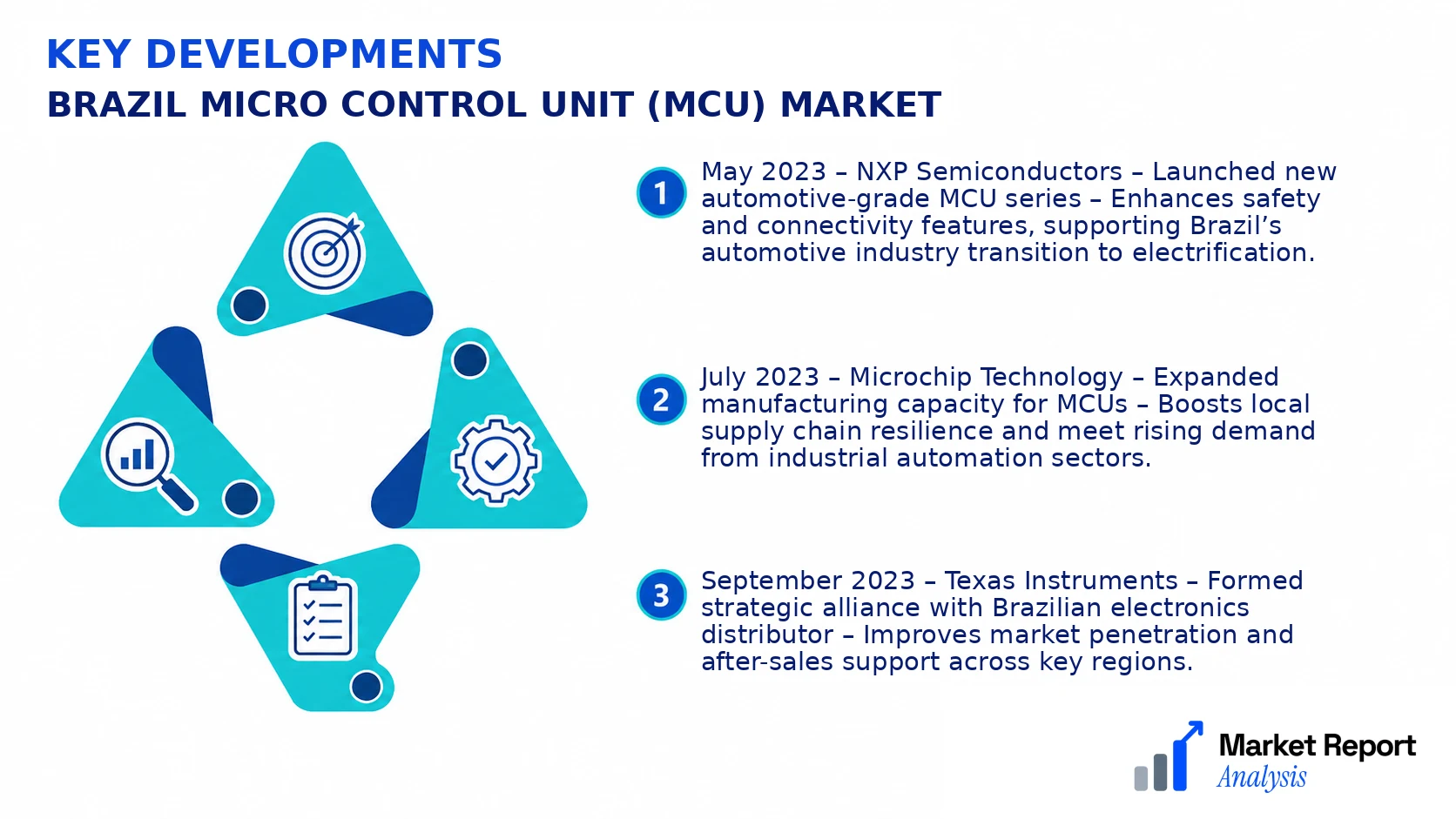
- May 2023 – NXP Semiconductors – Launched new automotive-grade MCU series – Enhances safety and connectivity features, supporting Brazil’s automotive industry transition to electrification.
- July 2023 – Microchip Technology – Expanded manufacturing capacity for MCUs – Boosts local supply chain resilience and meet rising demand from industrial automation sectors.
- September 2023 – Texas Instruments – Formed strategic alliance with Brazilian electronics distributor – Improves market penetration and after-sales support across key regions.
- November 2023 – Infineon Technologies – Announced new R&D center in São Paulo – Strengthens innovation capabilities for automotive and industrial applications targeting Brazil.
- January 2024 – STMicroelectronics – Acquired regional startup specializing in IoT MCUs – Focuses on expanding product portfolio and local market insights in Brazil.
Frequently Asked Questions
What is the Brazil Micro Control Unit (MCU) Market?
The Brazil Micro Control Unit (MCU) Market comprises the industry involved in manufacturing, distribution, and application of micro control units used in various sectors such as automotive, consumer electronics, healthcare, and industrial automation within Brazil. It encompasses a broad range of products tailored to diverse technological needs.
What is the current market size of Brazil Micro Control Unit (MCU) Market?
As of 2026, the Brazil MCU market is valued at approximately USD 2.1 Billion, reflecting recent growth driven by the expansion of automotive and electronic device sectors. Steady investments in technology upgrades are expected to sustain this upward trend.
What factors are driving the Brazil Micro Control Unit (MCU) Market?
Market growth is primarily driven by increasing automotive electronics integration, rising adoption of IoT-enabled devices, and the expanding consumer electronics sector. Government initiatives promoting industrial automation and smart city projects also significantly contribute to market expansion.
Which region dominates the Brazil Micro Control Unit (MCU) Market?
The southeastern region of Brazil, particularly São Paulo, dominates the MCU market due to its dense industrial base, technological infrastructure, and high consumer electronics demand. It accounts for the majority of market revenue, supported by robust manufacturing sectors.
Which segment is expected to grow the fastest?
The automotive segment is anticipated to exhibit the highest CAGR through 2034. Growth is fueled by the increasing integration of advanced electronic systems, such as ADAS and autonomous vehicle components, requiring sophisticated MCU solutions.
Who are the leading companies operating in the Brazil Micro Control Unit (MCU) Market?
Key players include multinational corporations like STMicroelectronics, Microchip Technology, and Texas Instruments, alongside regional companies such as Silcar Electronics. These companies leverage innovation and strategic partnerships to strengthen their market positions in Brazil.
Analyst Perspective
The Brazil Micro Control Unit (MCU) Market presents a mature yet evolving landscape, driven by increasing integration with automotive, industrial, and consumer electronics sectors. Over the forecast period, long-term market prospects remain promising, propelled by rising automation trends and government initiatives promoting smart manufacturing. Commercial opportunities are abundant in specialized MCUs tailored for automotive electrification and IoT applications, especially in urban centers such as São Paulo and Rio de Janeiro, where infrastructure development and technological adoption are accelerated. Technological evolution is expected to focus on increased processing power, energy efficiency, and enhanced connectivity features, aligning with the global shift toward smarter, interoperable devices. Investment priorities should favor R&D in high-performance, cost-effective MCUs and strategic alliances with local manufacturers to enhance regional presence. Competitive intensity will intensify as local players innovate while foreign entrants leverage global expertise. Regional growth potential remains high in industrial hubs, with targeted city-level initiatives offering distinct opportunities for early market penetration and differentiated offerings.
