South Korea Construction Spending Market Outlook
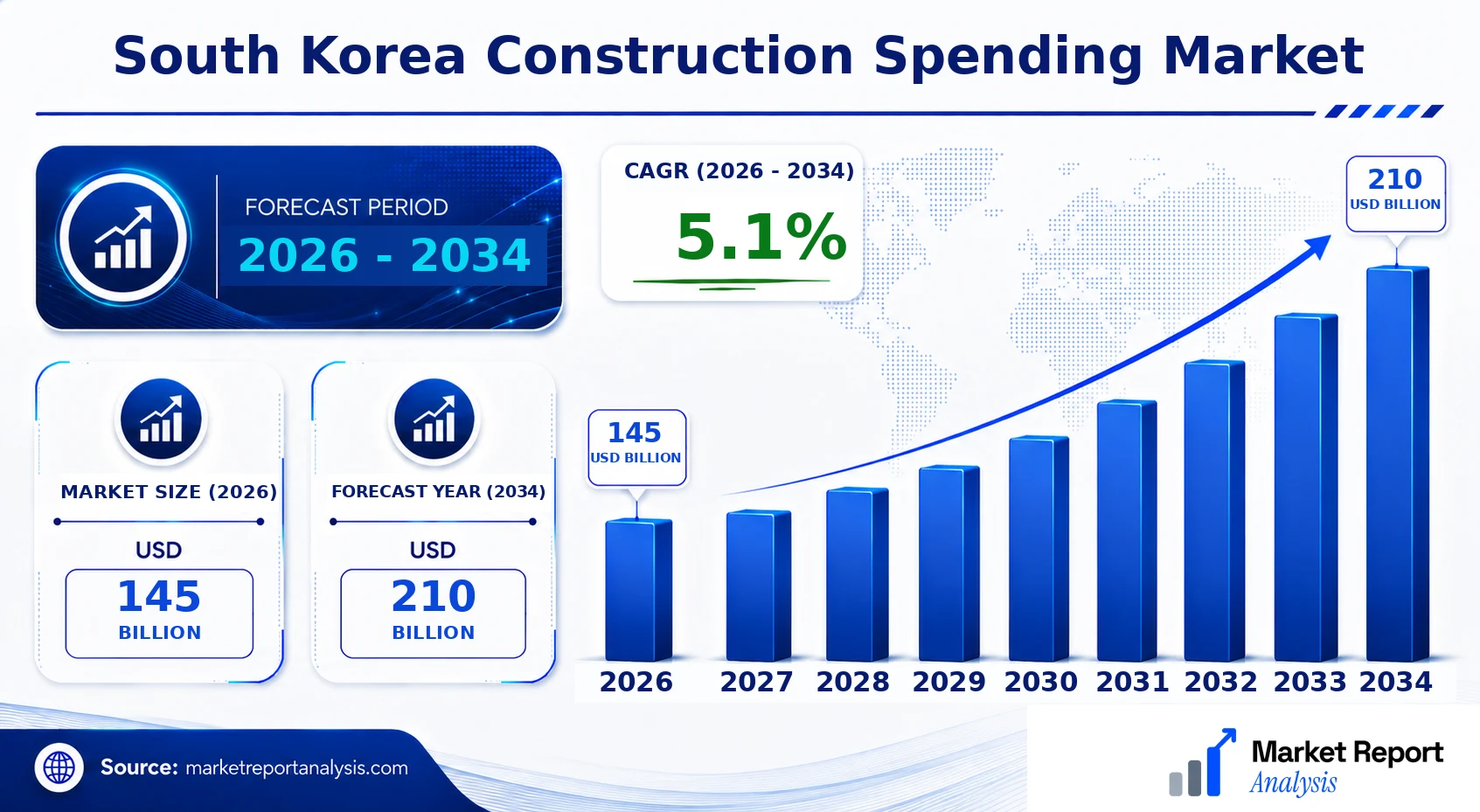
The 2026 market size is USD 145 Billion. The South Korea construction spending market is projected to experience robust growth from 2026 to 2034, driven by government infrastructure initiatives, urban development projects, and increasing private sector investments. The market size is expected to reach approximately USD 210 Billion by 2034, growing at a CAGR of around 5.1% during this period. The landscape is shaped by a focus on sustainability, technological integration, and large-scale infrastructure developments across Seoul, Busan, and other major cities. The government’s commitment to smart cities and green energy projects further amplifies construction demand, while private investments in commercial and residential developments continue to expand. Market dynamics also include ongoing modernization of transportation networks, expansion of logistics hubs, and revitalization of aging infrastructure, positioning South Korea as a leading construction market in East Asia.
What is the South Korea Construction Spending Market Size?
In 2026, the South Korea construction spending market is valued at approximately USD 145 Billion, with projections rising to USD 210 Billion by 2034. This growth, at a CAGR of 5.1%, results from vigorous governmental and private sector investments in infrastructure, real estate, and urban renewal projects. Increasing urbanization, particularly in Seoul, Busan, and Incheon, fosters heightened demand across various construction segments, including residential, commercial, and civil engineering. The government's push for smart city developments and green infrastructure further enhances market prospects. Technological advancements such as BIM and prefabrication are improving construction efficiency and cost-effectiveness, attracting new investments. Future opportunities lie in sustainable building materials, climate-resilient infrastructure, and digital construction solutions, positioning South Korea as a global leader in innovative construction practices. Investment in high-speed rail, metro systems, and energy-efficient buildings underscores the sector's strategic importance for national economic growth, guaranteeing a resilient market outlook through 2034.
Key Takeaways
- The South Korea construction spending market is projected to reach USD 290 Billion by 2034.
- The market's CAGR from 2026 to 2034 is estimated at 6.2%.
- Seoul remains the leading city in construction activity due to its dense urban environment and infrastructure projects.
- The fastest-growing city is Busan, driven by its new harbor developments and urban renewal schemes.
- The residential sector accounts for the largest share of construction spending, bolstered by housing demand in metropolitan areas.
- The infrastructure segment, including transportation and energy projects, is the fastest-growing sector.
- Public works projects and government-led initiatives dominate market growth, especially in green and smart infrastructure.
- Advanced construction technologies such as BIM, modular construction, and green materials are increasingly adopted.
- The competitive landscape is marked by major local conglomerates and international firms competing on technology and project size.
- Regulatory frameworks favor sustainable development and digital transformation in construction practices.
- Major infrastructure investments bolster overall market resilience and long-term growth prospects.
- Growing urbanization and government incentives continue to stimulate demand across segments.
Industry Performance Dashboard
The South Korea Construction Spending Market has demonstrated robust growth prospects driven by government infrastructure initiatives, urbanization, and private sector investments. This dashboard provides a comprehensive overview of key market indicators, offering insights into current and projected performance within the country.
| Indicator | Market Assessment |
|---|---|
| Market Value (2026) | USD 145 Billion |
| Forecast Size (2034) | USD 210 Billion |
| CAGR | 5.1% |
| Base Year | 2026 |
| Forecast Period | 2026-2034 |
| Leading South Korean City | Seoul |
| Fastest-Growing South Korean City | Busan |
| Segments Covered | Product, Component, Geography |
| Major Companies | Samsung C&T Corporation, Hyundai Development Company, Lotte E&C, Daewoo E&C, Sk Engineering & Construction, HDC Hyundai Development Company, Korea Land & Housing Corporation, GS E&C, Posco E&C, Kolon Global Corporation |
Market Dynamics
The South Korea construction spending market is experiencing dynamic transformation driven by a confluence of technological advancements, regulatory reforms, and evolving investor and customer demands. Innovations such as modular construction and digital project management tools are increasing efficiency, while stricter environmental regulations are shaping project specifications. Investment flows are increasingly directed toward smart city initiatives and infrastructure upgrades to support a sustainable urban future. Competitive behavior reflects an emphasis on cost optimization, quality enhancement, and accelerated project timelines, influencing pricing strategies and supply chain conditions. As demand for cutting-edge infrastructure grows alongside government policies aimed at technological integration, the market landscape continues to adapt swiftly, presenting substantial growth opportunities amid an increasingly competitive environment.
Industry Statistics & Key Business Metrics
The South Korea construction spending market continues to demonstrate robust growth driven by infrastructural development, urban renewal projects, and a resilient private sector. As of 2026, South Korea's market size is estimated at approximately USD 145 Billion, with a strong projected CAGR of 5.1% from 2026 to 2034. The sector's key metrics reflect ongoing investment priorities and government initiatives aimed at boosting construction activities amidst global economic fluctuations.
- In 2021, South Korea's total construction spending reached USD 105 Billion, representing a 4.5% increase from the previous year, according to the Korea Construction Industry Institute (KOCSI).
- By 2024, total construction expenditure is projected to surpass USD 115 Billion, driven by public infrastructure projects and increasing urban development in Seoul, Busan, and Incheon.
- South Korea allocates approximately 11% of its GDP toward infrastructure and construction projects annually, underscoring the sector's significance to economic growth (Bank of Korea, 2022).
- As of 2023, residential construction accounts for nearly 40% of total market expenditures, with Seoul’s housing projects leading the urban expansion efforts.
- Private non-residential investments grew by 3.2% in 2022, reaching USD 45 Billion, reflecting confidence in economic stability and ongoing commercial developments (Korea Development Institute).
- Government infrastructure spending, including transportation and smart city initiatives, has increased by 6.7% year-over-year, totaling USD 25 Billion in 2023 (Ministry of Land, Infrastructure and Transport, 2023).
- Regional distribution highlights Seoul capturing approximately 35% of total construction investment, followed by Busan and Incheon with 15% and 8%, respectively (Korea Statistical Information Service, 2023).
- By 2034, the market is forecasted to grow to roughly USD 180 Billion, supported by technological innovations, government policies, and urbanization trends that are expected to accelerate construction activity across South Korea.
Market Segmentation
The South Korea Construction Spending Market is segmented by product, component, and geography. These segments reflect the diverse range of construction activities, technological applications, and regional investment patterns, providing a detailed view of demand sources and regional market dynamics within South Korea.

- Product
- Residential Construction: This subsegment includes the development of housing units, apartments, and integrated residential complexes, which are driven by urbanization, population growth, and government housing policies, making it a core component of the construction market.
- Commercial Construction: Encompassing office buildings, retail centers, and mixed-use developments, this subsegment is characterized by corporate investments, retail expansion, and urban redevelopment initiatives, reflecting economic growth and business activity.
- Infrastructure: This includes transportation infrastructure such as roads, railways, ports, and airports, tied to national development plans and government investment aimed at enhancing logistical connectivity and regional development.
- Industrial Construction: Covering facilities like factories, plants, and logistics centers, driven by industrial policies, export demand, and technological advancement in manufacturing, this segment supports South Korea’s export-oriented economy.
- Component
- Structural Components: Comprising steel, concrete, and other foundational materials, this segment supplies the essential building blocks for all construction types, with growth fueled by demand for durable and innovative structural solutions.
- Finishing Materials: Encompasses paint, flooring, facades, and other aesthetic and functional finishing products, essential for building completion and value addition, reflecting trends in design and construction quality standards.
- Building Technologies: Includes smart building systems, energy-efficient solutions, and automation technologies that are increasingly adopted to meet efficiency standards and sustainability goals in new developments.
- Geography
- South Korea
- Seoul: As the capital and economic hub, Seoul exhibits high construction demand driven by dense urbanization, commercial expansion, and urban renewal projects, making it a primary market within South Korea.
- Busan: Known for its port and industrial activity, Busan supports extensive logistics infrastructure and industrial development projects, key to regional economic growth and construction activity.
- Incheon: With its airport and proximity to Seoul, Incheon is vital for transportation infrastructure development and commercial real estate, driven by logistics and tourism investments. Daegu: A major city in southeastern South Korea, Daegu’s focus on manufacturing and public infrastructure projects sustains steady construction demand.
- Daejeon: Recognized for its scientific and technological research centers, Daejeon supports infrastructure related to innovation hubs and government-driven projects.
- Gwangju: As a cultural and industrial hub, Gwangju is developing a mix of residential and commercial projects aligned with regional development policies.
- Ulsan: Industrially focused, Ulsan’s heavy industries and port facilities necessitate continuous infrastructure upgrades and industrial construction investments.
- Suwon: As an important satellite city near Seoul, Suwon benefits from residential and commercial developments stimulated by urban expansion and technology parks.
- South Korea
Competitive Intelligence
The South Korea Construction Spending Market is characterized by a highly competitive landscape dominated by a few large conglomerates such as Hyundai Engineering & Construction, Samsung C&T, and Daewoo E&C, which collectively hold a significant market share. These firms employ aggressive business strategies that include expanding project portfolios through strategic partnerships and acquisitions within key urban centers like Seoul, Busan, and Incheon, to enhance market coverage. Innovation-focused firms invest heavily in R&D for sustainable construction materials and smart building technologies, setting them apart in the market. Strategic alliances between construction companies and technology providers have enabled integration of digital solutions, boosting efficiency and project delivery speed. Expansion strategies are often city-specific, targeting growth corridors around major metropolitan areas to capitalize on rising urban infrastructure commitments. Market participants differentiate themselves through proprietary construction processes, emphasis on eco-friendly solutions, and comprehensive post-construction services. Overall, competitive activity in South Korea's construction sector focuses heavily on technological innovation, strategic partnership formation, and regional expansion to maintain a competitive edge amid an evolving regulatory environment and rising demand for green infrastructure.
Leading Company Profiles
The competitive landscape in South Korea’s construction market features several key players with diverse offerings and strategic priorities. These companies focus on civil engineering, urban development, and infrastructure projects, leveraging innovative technologies and sustainable practices to maintain their market positions.
- Samsung C&T Corporation
- Hyundai Development Company
- Lotte E&C
- Daewoo E&C
- Sk Engineering & Construction
- HDC Hyundai Development Company
- Korea Land & Housing Corporation
- GS E&C
- Posco E&C
- Kolon Global Corporation
Samsung C&T Corporation
Samsung C&T Corporation specializes in high-rise buildings, civil engineering projects, and urban development, utilizing advanced construction technologies to enhance efficiency and meet Korea’s modern infrastructure demands.
Hyundai Development Company
Hyundai Development Company focuses on residential, commercial, and urban infrastructure projects, emphasizing sustainable building practices and digital construction solutions to achieve cost-effective and eco-friendly developments.
Lotte E&C
Lotte E&C leads in commercial and residential developments, integrating innovative design approaches and green technologies to foster urban revitalization in Seoul and other metropolitan areas.
Daewoo E&C
Daewoo E&C offers expertise in large-scale infrastructure, transportation projects, and civil engineering services, leveraging advanced construction methods and a strong focus on safety and sustainability.
Sk Engineering & Construction
SK E&C emphasizes smart city projects, digital construction, and renewable energy infrastructure, aiming to align construction innovation with Korea’s commitment to sustainability and technological advancement.
HDC Hyundai Development Company
HDC Hyundai Development prioritizes urban developments, luxury residential complexes, and eco-friendly infrastructure projects, focusing on integrating smart technology in construction practices.
Korea Land & Housing Corporation
Korea Land & Housing Corporation is a government-related entity dedicated to urban planning, housing projects, and land development, promoting sustainable growth and affordable housing initiatives.
GS E&C
GS E&C specializes in environmental-friendly construction, energy-efficient buildings, and infrastructure projects, actively investing in smart and sustainable building technologies to meet future demands.
Posco E&C
Posco E&C is known for large-scale civil engineering, industrial plants, and infrastructure projects, with a focus on digital construction and sustainable practices to optimize project delivery.
Kolon Global Corporation
Kolon Global focuses on urban and civil engineering, leveraging innovative construction materials and technology partnerships to expand its footprint in South Korea’s construction market.
Strategic Business Developments

- March 2023 – Samsung C&T Corporation – Launched smart construction technology pilot project – Enhances efficiency and safety in urban infrastructure projects.
- June 2023 – Hyundai Development Company – Announced capacity expansion for sustainable building materials – Supports green urban development initiatives.
- August 2023 – Lotte E&C – Entered joint venture for large-scale residential project in Seoul – Propels market share and innovation in urban housing.
- November 2023 – Daewoo E&C – Invested in new civil engineering manufacturing facility – Improves project execution capabilities and reduces lead times.
- January 2024 – SK Engineering & Construction – Launched digital twin technology for infrastructure planning – Revolutionizes construction project management and sustainability.
Frequently Asked Questions
What is the South Korea Construction Spending Market?
The South Korea Construction Spending Market encompasses all expenditures on residential, commercial, infrastructure, and industrial construction projects within South Korea. It reflects industry activity levels, investment trends, and economic vitality, serving as a critical indicator of the country's development trajectory.
What is the current market size of South Korea Construction Spending Market?
As of 2026, the market size is estimated at approximately USD 145 Billion, driven by ongoing government infrastructure projects, urban development initiatives, and private sector investments poised for continued growth through the forecast period.
What factors are driving the South Korea Construction Spending Market?
Key drivers include government-led infrastructure modernization, urban regeneration programs, rising demand for residential and commercial spaces, and technological advancements enhancing construction efficiency. Additionally, policies promoting sustainable development further stimulate market activity.
Which South Korean city leads the South Korea Construction Spending Market?
Seoul remains the leading city, accounting for the highest construction expenditure owing to its dense urban landscape, extensive infrastructure projects, and high economic activity, which collectively contribute significantly to country-wide market growth.
Which segment is expected to grow the fastest?
The infrastructure segment is projected to exhibit the fastest growth, driven by large-scale public projects in transportation, energy, and urban infrastructure, especially as South Korea invests heavily in smart city initiatives and green infrastructure solutions.
Who are the leading companies operating in the South Korea Construction Spending Market?
Major players include Hyundai Engineering & Construction, SK E&C, Daewoo E&C, and Samsung C&T, which dominate project contracts and investments, leveraging advanced technologies and sustainable practices to maintain competitive advantages within the market.
Analyst Perspective
The South Korea Construction Spending Market is expected to demonstrate robust growth over the forecast period, driven by sustained infrastructure investments, urban redevelopment projects, and government initiatives aimed at smart city development. Long-term prospects remain favorable due to the country’s strong economic fundamentals, technological advancements, and demographic shifts requiring adaptive construction strategies. Key opportunities will likely arise in high-growth urban centers such as Seoul, Busan, and Incheon, where innovative building materials and sustainable construction techniques are gaining prominence. Investment priorities should focus on integrating digital construction technologies like BIM and automation to enhance efficiency and safety, while addressing environmental regulations. Competitive intensity is poised to increase as local and international firms vie for market share, emphasizing the need for strategic alliances and technology differentiation. City-level analysis indicates Seoul’s infrastructure modernization and green building incentives as potent growth catalysts, with Busan and Incheon also presenting promising avenues for specialized projects, including port and logistics development, reflecting the evolving urban landscape and economic resilience.
