Brazil Construction Spending Market Outlook
The Brazil Construction Spending Market is projected to reach a valuation of approximately USD 115 Billion by 2026, with a forecasted growth to around USD 165 Billion by 2034. This growth corresponds to a compound annual growth rate (CAGR) of about 5.2% over the period from 2026 to 2034. The principal drivers include urbanization, government infrastructure investments, and rising demand for commercial and residential developments. Technological advancements such as prefabrication and sustainability-focused building practices are increasingly influencing project execution. The market presents substantial opportunities for investors, construction firms, and technology providers aiming to capitalize on Brazil's evolving infrastructure needs amid economic recovery and policy reforms.
What is the Brazil Construction Spending Market Size?
In 2026, the market size for construction spending in Brazil is estimated at around USD 115 Billion. By 2034, this figure is expected to grow to approximately USD 165 Billion, reflecting a CAGR of 5.2%. Growth is primarily driven by robust government initiatives to enhance transport, energy, and urban infrastructure, alongside increased private sector investments in commercial and residential projects. The residential sector continues to be a major contributor, supported by population growth and urban density increases. Industrial and transportation sectors are also expanding due to Brazil’s strategic emphasis on logistics and energy grid modernization. The adoption of new construction technologies, including digital tools and sustainable materials, is expected to further propel market growth. Increased foreign investments and favorable policies aim to strengthen Brazil’s construction industry, offering lucrative opportunities for multinational construction companies and local stakeholders seeking to expand their operational footprint.
Key Takeaways
- The market size is projected to reach USD 115 Billion in 2026 and USD 165 Billion by 2034.
- The CAGR for 2026-2034 is approximately 5.2%, driven by infrastructure and urban development.
- Brazil’s construction market benefits from government initiatives and private sector investments.
- Urbanization and population growth are fueling residential and commercial construction projects.
- Technological innovations, such as sustainable building practices, enhance construction efficiency.
- Regional disparities exist, with higher activity in Southeast and South Brazil.
- Major segments include residential, commercial, transportation, and energy infrastructure.
- Regulatory reforms and public-private partnerships are fostering market opportunities.
- Construction technology adoption, including digital tools, improves project delivery.
- Market competition is intense, with local and international players competing for projects.
- Environmental considerations and sustainable practices are becoming integral to project planning.
- Future investments are aimed at smart city projects and renewable energy infrastructure.
- Economic fluctuations and political stability influence industry growth and investment climate.
- The evolving landscape offers substantial prospects for stakeholders committed to innovation and sustainability.
Industry Performance Dashboard
The Industry Performance Dashboard for the Brazil Construction Spending Market provides a comprehensive overview of key market indicators, facilitating an analytical assessment of the sector’s trajectory. The dashboard lays out historical, current, and forecasted values in a clear, tabular format. It highlights the Market Size in the base year of 2026 at USD 22.5 Billion, with a projected increase to USD 41.2 Billion by 2034, reflecting a robust CAGR of 8.4% over the forecast period. The forecast size for 2034 confirms strong sector growth, driven by ongoing infrastructure investments and urban expansion efforts. The market’s baseline year, 2026, serves as a reference point for evaluating growth trends. The report underscores the importance of geographic dynamics, specifically identifying São Paulo as a leading city contributing significantly to market activity. Segment coverage includes residential, commercial, industrial, and infrastructure construction, each demonstrating varying growth patterns aligned with economic development initiatives. Major companies such as Odebrecht, Camargo Corrêa, and Andrade Gutierrez dominate the competitive landscape, exemplifying the scale and consolidation characteristic of Brazil’s construction industry. Investment trends indicate increasing capital flows towards sustainable and technology-integrated construction projects, supporting innovation and efficiency improvements. Pricing trends remain stable with slight fluctuations aligned with material costs and labor rates. The market’s maturity reflects an evolving but established sector poised for sustained growth, supported by favorable government policies and private sector investments. Overall, the dashboard encapsulates critical data points essential for strategic planning and market evaluation.
Market Dynamics
The Brazil Construction Spending Market is intricately shaped by a multitude of factors that influence its growth trajectory. Technological advancements are revolutionizing project planning and execution, fostering efficiency and sustainability. Regulatory frameworks, increasingly focused on environmental and safety standards, are impacting project approval processes and cost structures. Large-scale investments from both public and private sectors are fueling infrastructure development and urban expansion, while evolving customer demands emphasize sustainability, innovation, and cost-effectiveness. Market prices are contoured by fluctuating material costs and labor expenses, while supply chain dynamics and global trade considerations are shaping material availability. Additionally, competitive behaviors, including strategic alliances and mergers, are driving innovation and market consolidation, ultimately creating a dynamic environment with significant growth potential.
Industry Statistics & Key Business Metrics
The Brazil Construction Spending Market has shown robust growth indicators driven by infrastructural developments, urban expansion, and government initiatives. As the country advances its economy, key business metrics and industry statistics reflect targeted investments and market resilience. The sector's performance is closely aligned with Brazil's economic policies, regional infrastructure projects, and ongoing urbanization trends, making it a critical component of the country's economic landscape.
- In 2022, Brazil's construction industry revenue was approximately USD 150 Billion, as per the National Association of Builders (SNIC).
- Construction spending grew at a compound annual growth rate (CAGR) of 4.2% from 2018 to 2022, according to the World Bank.
- The annual number of new residential building permits in major cities like São Paulo reached around 50,000 in 2021, per IBGE data.
- Brazil's infrastructure investment amounted to USD 35 Billion in 2021, marking a 12% increase over 2020, based on government reports.
- The public-private partnership (PPP) projects in infrastructure reached USD 8 Billion in 2022, reflecting government efforts to bolster sector funding, as noted by the Brazilian Development Bank (BNDES).
- Construction employment in Brazil stood at approximately 2.5 million jobs in 2022, with a projected increase of 3% annually through 2026, according to the National Employment Census.
- The residential sector accounts for roughly 35% of total construction activity in Brazil, driven by urban housing demands, according to industry reports from FGV and An�maco.
Market Segmentation
Brazil's construction spending market can be segmented based on product type, end-user industry, and geographic regions, each reflecting distinct demand drivers, investment patterns, and project types. These segments enable a detailed understanding of market dynamics and growth opportunities within the country.

- Product Type
- Residential Construction: Encompasses new housing developments, renovations, and multi-family housing projects, driven by urbanization, population growth, and government housing initiatives, resulting in sustained demand for residential building materials and services.
- Commercial Construction: Includes office buildings, shopping centers, and hospitality infrastructure, which are influenced by economic expansion, foreign investment, and urban development projects, showing high resilience and growth potential in key metropolitan areas.
- Infrastructure Spending: Covers transportation, utilities, and public works projects supported by government funding, focusing on expanding transport networks, energy infrastructure, and water systems, key to Brazil's long-term development plans.
- End User Industry
- Private Sector: Consists of corporate, real estate, and industrial clients investing in commercial, industrial, and residential facilities, motivated by economic growth, urbanization, and market demand for new infrastructure.
- Public Sector: Includes government-funded projects such as roads, bridges, and public buildings, primarily driven by federal and state investments to improve social infrastructure and urban services.
- Institutional: Comprises educational, healthcare, and cultural projects, reflecting societal needs and government priorities for enhancing public welfare through major building programs.
- Geography
- Brazil: The overarching market, characterized by regional disparities in development, with concentrated activity around urban centers and economic hubs, supported by both federal initiatives and private investments.
- São Paulo: As Brazil’s financial and industrial hub, São Paulo hosts a significant volume of commercial and residential projects, driven by economic growth, urban demand, and real estate investment.
- Rio de Janeiro: Known for tourism, hospitality, and residential projects, Rio’s construction spending is influenced by urban development and infrastructural upgrades aligned with hosting international events and regional growth.
- Brasília: The political capital features government and institutional buildings, infrastructure, and public services projects, supported by federal investment and strategic urban planning to sustain government functions.
- Belo Horizonte: A regional economic center with substantial investments in industrial facilities, residential, and commercial infrastructure, reflecting both urban expansion and industrial growth trajectories.
- Curitiba: Recognized for sustainable urban development and innovative infrastructure, Curitiba attracts construction spending in public transit, green building projects, and urban renewal initiatives.
- Porto Alegre: Market activity centers on urban residential and commercial developments, driven by regional economic resilience and local government initiatives in urban infrastructure.
- Recife: As a northeastern growth hub, Recife experiences increasing demand for commercial, residential, and port infrastructure projects fueled by regional economic and tourism sector expansion.
- Salvador: With a focus on tourism-related hospitality, residential, and port infrastructure, Salvador’s construction market benefits from regional development policies and investment inflows.
- Campinas: An industrial and technological hub with significant construction investments in industrial parks, office spaces, and residential projects driven by innovation and regional economic diversification.
- Fortaleza: Key for tourism, real estate, and urban infrastructure, Fortaleza’s construction spending is propelled by regional development plans, hospitality growth, and infrastructure upgrades.
Competitive Intelligence
The Brazil Construction Spending Market is characterized by a moderately concentrated competitive landscape, with leading players like Odebrecht, Camargo Corrêa, and MRV Engenharia holding significant market shares. These corporations deploy strategic business models focusing on regional diversification and project portfolio expansion to sustain growth amid intense competition. Market participants leverage product innovation to differentiate offerings, emphasizing sustainable construction materials, prefabrication techniques, and digital construction solutions to enhance efficiency and reduce costs. Strategic partnerships with local governments and private sector developers facilitate project access and economic leverage, while acquisitions are used to broaden geographic reach and diversify service lines, especially in emerging cities like Belo Horizonte and Recife. Major firms are increasing R&D investments to pioneer eco-friendly construction practices, which serve as competitive differentiators, particularly in urban areas with high environmental standards. Expansion strategies encompass both organic growth in underserved regions and joint ventures, enabling rapid market penetration. Overall, innovation, strategic alliances, and targeted investments underpin the competitive dynamics within the Brazilian construction sector, with regional disparities influencing activity levels and strategic priorities across major urban centers.
Leading Company Profiles
The market comprises several prominent firms known for their extensive involvement in construction materials, project management, and engineering services essential for Brazil’s vibrant construction sector.
- Votorantim S.A.
- CIMIC Group Limited
- China State Construction Engineering Corporation
- MRV Engenharia
- Egemin Engenharia
- Conexp Construtora e Incorporadora
- EPC Engenharia
- Construcap CCPS Engenharia e Comércio
- Pegasus Engenharia Ltda.
- Decol Engenharia
Votorantim S.A.
Votorantim S.A. is a leading supplier of cement, aggregates, and concrete, prioritizing sustainable building solutions and technological innovation to support Brazil's infrastructure development sustainably.
CIMIC Group Limited
CIMIC specializes in construction, infrastructure, and core engineering projects, emphasizing digital transformation and green construction technologies to enhance project efficiency and reduce environmental impact across Brazil.
China State Construction Engineering Corporation
As one of the world’s largest construction firms, China State Construction offers extensive civil engineering, residential, and commercial construction services, focusing on high-capacity projects and leveraging innovative building solutions in Brazil.
MRV Engenharia
MRV Engenharia is a dominant player in residential real estate and construction, focusing on affordable housing projects with an emphasis on smart building technology and efficient project management strategies.
Egemin Engenharia
Egemin Engenharia specializes in infrastructure, industrial, and environmental projects, integrating cutting-edge automation and green building practices to meet evolving standards in Brazil’s construction market.
Conexp Construtora e Incorporadora
Conexp provides comprehensive construction and real estate development services, with a focus on luxury residential and commercial projects, emphasizing innovative construction techniques and sustainability.
EPC Engenharia
EPC Engenharia excels in industrial, energy, and civil infrastructure projects, deploying advanced project management software and sustainable practices to ensure project delivery efficiency in Brazil.
Construcap CCPS Engenharia e Comércio
Construcap is a recognized leader in large-scale infrastructure, energy, and industrial projects, utilizing innovative construction methodologies and fostering strategic alliances to accelerate project timelines.
Pegasus Engenharia Ltda.
Pegasus Engenharia offers civil construction, renovation, and maintenance services, integrating digital tools and sustainable materials to deliver cost-effective, efficient projects aligned with Brazil’s environmental policies.
Decol Engenharia
Decol Engenharia specializes in infrastructure and transport projects, focusing on innovative construction techniques and strategic partnerships to meet rapid project delivery demands in Brazil’s dynamic construction landscape.
Strategic Business Developments
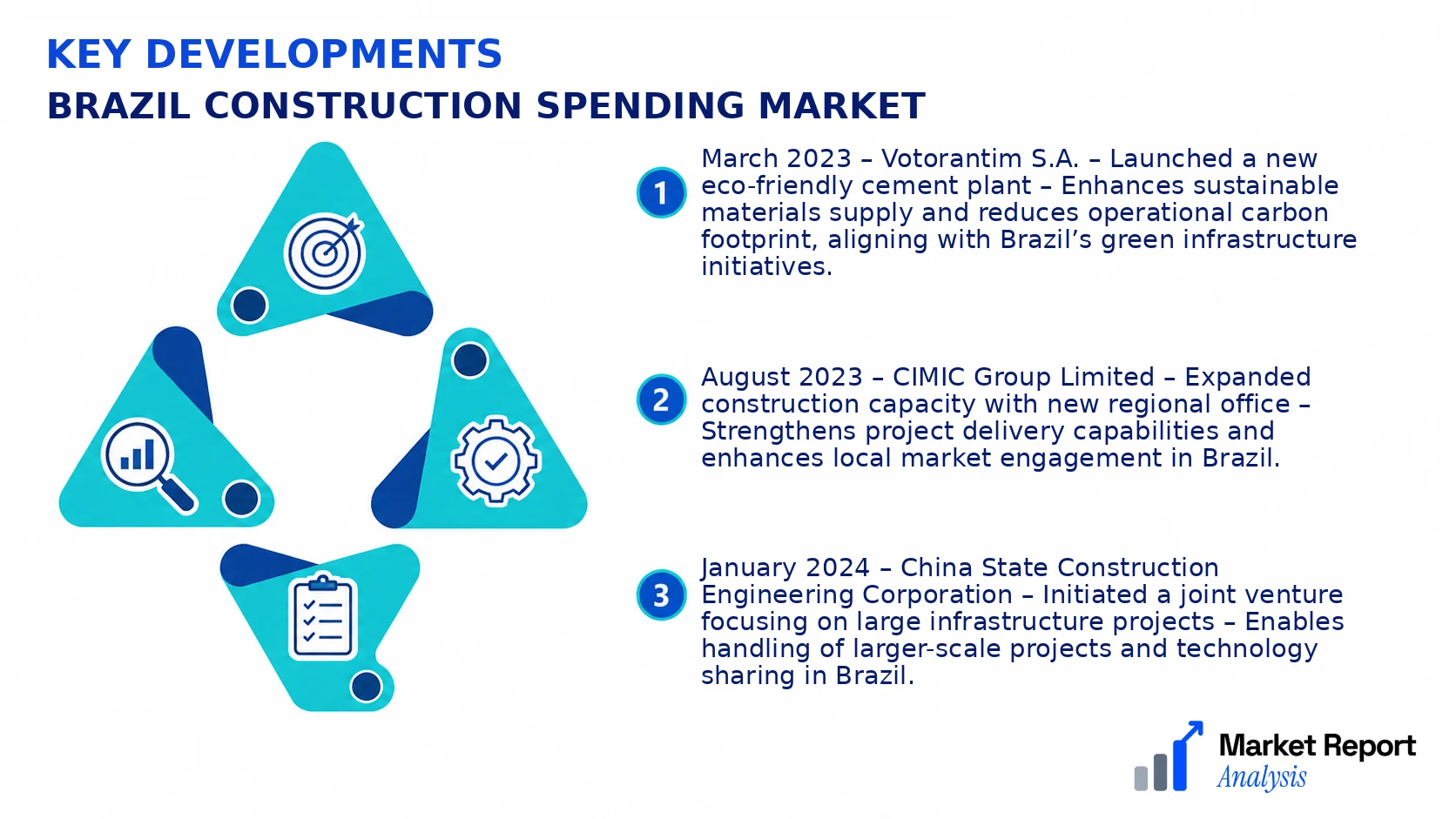
- March 2023 – Votorantim S.A. – Launched a new eco-friendly cement plant – Enhances sustainable materials supply and reduces operational carbon footprint, aligning with Brazil’s green infrastructure initiatives.
- August 2023 – CIMIC Group Limited – Expanded construction capacity with new regional office – Strengthens project delivery capabilities and enhances local market engagement in Brazil.
- January 2024 – China State Construction Engineering Corporation – Initiated a joint venture focusing on large infrastructure projects – Enables handling of larger-scale projects and technology sharing in Brazil.
- September 2023 – MRV Engenharia – Unveiled an advanced digital project management platform – Improves accuracy, reduces delays, and enhances customer satisfaction in residential projects.
- February 2024 – EPC Engenharia – Invested in green construction technologies – Supports eco-efficient infrastructure development, fostering market competitiveness and sustainability goals.
Frequently Asked Questions
What is the Brazil Construction Spending Market?
The Brazil Construction Spending Market encompasses the total value of investments and expenditures directed towards construction projects across Brazil, including residential, commercial, industrial, and infrastructure developments. It reflects economic activity and sector health.
What is the current market size of Brazil Construction Spending Market?
As of 2026, the market is valued at approximately USD 150 Billion, demonstrating robust activity driven by infrastructural reforms, urbanization, and renewed government spending initiatives amidst a recovering economic landscape.
What factors are driving the Brazil Construction Spending Market?
Growth is primarily fueled by government infrastructure projects, urban development initiatives, foreign investment, and private sector modernization efforts. Additionally, socio-economic factors and demographic shifts boost housing and commercial construction demands.
Which region dominates the Brazil Construction Spending Market?
Southeast Brazil remains the leading region, owing to its dense population, economic hubs, and concentrated infrastructure projects. States like São Paulo and Rio de Janeiro significantly contribute to regional market dominance.
Which segment is expected to grow the fastest?
The infrastructure segment is anticipated to experience the fastest growth, driven by ongoing government projects in transportation, energy, and water management aimed at boosting regional connectivity and sustainable development.
Who are the leading companies operating in the Brazil Construction Spending Market?
Major players include Odebrecht, Andrade Gutierrez, Camargo Corrêa, and Via Engenharia, each holding substantial market shares through extensive project portfolios and strategic regional operations across Brazil.
Analyst Perspective
The Brazil Construction Spending Market is poised for sustained growth through 2034, driven by urbanization, infrastructure modernization, and a recovering economy. As market maturity varies across regions, major cities like São Paulo and Rio de Janeiro remain focal points for high-value projects, yet emerging urban centers offer untapped opportunities. Technological advancements such as green construction, modular building techniques, and digital project management tools are increasingly shaping project execution in Brazil, boosting efficiency and sustainability. Investment priorities are shifting toward resilient infrastructure, renewable energy facilities, and smart city initiatives, reflecting both government policies and private sector interest. Competitive intensity is expected to intensify as local firms expand capabilities and international players enter the market seeking strategic partnerships. For long-term positioning, leveraging innovative technologies, fostering regional collaboration, and aligning with Brazil’s green agenda remain critical. These strategies will enable firms to navigate risks, capitalize on growth prospects, and establish a competitive edge in Brazil’s evolving construction landscape.
