Europe Construction Spending Market Outlook
The Europe Construction Spending Market is currently valued at approximately USD 1.2 Trillion in 2026, with projections to reach USD 2.5 Trillion by 2034, reflecting a Compound Annual Growth Rate (CAGR) of around 8.4% over the forecast period of 2026 to 2034. The growth is primarily driven by increasing urbanization, infrastructure upgrades, and government initiatives favoring sustainable and smart construction projects. Innovation in construction technology, including the adoption of Building Information Modeling (BIM), modular construction, and green building practices, is expected to further accelerate market growth. Additionally, rising investments in transportation infrastructure, commercial developments, and residential projects contribute to expanding opportunities for construction firms and technology providers. The region’s economic recovery post-pandemic, coupled with rising disposable income and demographic shifts, fosters an environment ripe for significant investment in construction activities, underscoring robust commercial opportunities across sectors.

What is the Europe Construction Spending Market Size?
As of 2026, the market size of Europe Construction Spending is estimated at USD 1.2 Trillion. This figure is expected to grow steadily, reaching USD 2.5 Trillion by 2034, representing a CAGR of approximately 8.4%. Growth drivers include escalating demand for residential and commercial properties, infrastructure modernization, and policy support for sustainable development. End-use industries such as residential, commercial, industrial, and public infrastructure are the main contributors, with residential leading due to population growth and urbanization. Technological advancements, particularly in prefabrication and digital construction tools, are shaping future investments in construction projects. Governments and private sectors are allocating significant budgets toward infrastructure resilience and eco-friendly buildings, which will likely drive steady expansion. The increasing cost of raw materials and labour costs are expected to incentivize automation and innovative construction methods, creating further growth avenues. Overall, the market’s expansion underscores substantial prospects for stakeholders in project development, technology provision, and consultancy services, emphasizing resilience and sustainability as core themes for future growth.
Key Takeaways
- The Europe Construction Spending Market is valued at USD 600 Billion in 2026.
- It is projected to reach USD 900 Billion by 2034, with a CAGR of 5.4% from 2026 to 2034.
- The largest segment by application is Residential construction.
- The fastest-growing segment includes Green and Sustainable Buildings.
- Transportation infrastructure remains the largest application area.
- Public infrastructure projects are the fastest-growing application segment.
- Major end users include private developers and government agencies.
- The market growth is driven by urbanization, infrastructure development, and technological advances.
- Investments are increasingly focused on smart, eco-friendly construction solutions.
- Regulatory frameworks supporting sustainability are influencing project design and execution.
- Technological innovation, such as BIM and modular construction, fosters efficiency and cost savings.
- Competitive landscape is evolving with increased participation from international construction giants and technology firms.
- Key opportunities lie in renovation, infrastructure upgrades, and new sustainable development projects.
- Overall, the market demonstrates resilient growth with a focus on sustainability and innovative construction practices.
Industry Performance Dashboard
The Europe Construction Spending Market has experienced consistent growth driven by increasing infrastructure demands and urbanization across the continent. This dashboard presents key indicators that reflect the industry's health and outlook, providing valuable insights into current and future market dynamics.
| Indicator | Market Assessment |
|---|---|
| Market Size (2026) | USD 1.2 Trillion |
| Market Value (2026) | USD 1.2 Trillion |
| Forecast Size (2034) | USD 2.5 Trillion |
| CAGR (2026-2034) | 8.4% |
| Base Year | 2026 |
| Forecast Period | 2026-2034 |
| Segments Covered | Product, Component, Geographic Regions |
| Major Companies | Vinci, ACS Group, Strabag SE, Bouygues Construction, Skanska AB, Ferrovial, Hochtief AG, Bilfinger SE, BAM Group, Eiffage SA |
Market Dynamics
The Europe construction spending market is experiencing transformative shifts driven by a confluence of technological advancements, evolving regulatory frameworks, increased investment activity, heightened customer demands, fluctuating pricing dynamics, supply chain conditions, and competitive strategies. These factors shape project execution, investment flows, and market competitiveness, creating both opportunities and challenges for stakeholders across the construction ecosystem. As governments and private entities prioritize infrastructure and urban development, these complex influences collectively propel the market toward innovation-driven growth, demanding adaptive strategies to capitalize on emerging trends while navigating regulatory and operational complexities.
Drivers
Technological Innovation and Digital Transformation
The adoption of advanced digital technologies such as Building Information Modeling (BIM), drone surveying, and IoT-enabled construction equipment significantly enhances project efficiency and reduces costs. The integration of these tools accelerates project timelines, improves accuracy, and enhances collaboration among stakeholders. For example, BIM adoption in major European infrastructure projects allows for real-time updates, clash detection, and streamlined workflows, fostering overall productivity. Market surveys indicate that approximately 60% of construction firms in Europe are investing in digital innovations, driven by the imperative to improve margins and competitiveness amid tight project schedules.
Regulatory Policies and EU Initiatives
The European Union's stringent regulations on environmental standards, safety protocols, and sustainable construction practices strongly influence market dynamics. Initiatives like the European Green Deal and revised building codes emphasize energy efficiency and climate resilience, compelling industry players to adapt rapidly. Compliance costs and the need for sustainable materials drive innovation but also elevate project costs, impacting overall market expenditure. As regulatory landscapes tighten, firms that proactively align with these standards gain a competitive advantage, insulating themselves from legal and financial penalties while attracting environmentally conscious investors.
Investment Flows and Public-Private Partnerships (PPPs)
Robust investment activity, particularly from government sources and private financiers, aims to stimulate infrastructure development, urban regeneration, and renewable energy projects across Europe. Funding mechanisms such as bond issuance and PPP models facilitate large-scale projects that otherwise face funding constraints. Notably, the European Investment Bank has committed over USD 50 Billion toward sustainable infrastructure between 2020 and 2026, underpinning a positive investment outlook. These capital inflows foster market confidence, encourage innovation, and create a conducive environment for contractors and technology providers to scale their operations.
Customer Requirements and Market Preferences
European customers, including public bodies and private developers, increasingly demand sustainable, resilient, and smart infrastructure solutions. The push for energy-efficient buildings and climate-adaptive urban environments reshapes project specifications. Contractors are responding by integrating green building practices, renewable energy technologies, and smart systems into their offerings. The rising demand for eco-friendly developments correlates with a 20% annual increase in green building certifications (e.g., BREEAM, LEED) in Europe, signaling both a market shift and a lucrative growth avenue for innovative construction solutions.
Restraints
Regulatory and Policy Uncertainties
While regulation fuels innovation, excessive or unpredictable policy shifts pose significant risks to project planning and investment. Changes in EU directives or national policies related to building standards, environmental compliance, and funding eligibility can create uncertainty, delaying projects and increasing costs. For instance, abrupt alterations in subsidy schemes for renewable energy projects have led to project cancellations or postponements, impacting contractors and suppliers. Managing regulatory risk entails proactive compliance strategies and engaging with policymakers, yet some firms remain vulnerable to policy volatility, constraining market growth prospects.
Supply Chain Disruptions
Global disruptions, including shortages of construction materials such as steel, concrete, and timber, have significantly impacted project timelines and costs. These disruptions are exacerbated by geopolitical tensions, logistical challenges, and rising raw material prices, affecting regions hardest hit by supply constraints, like Western and Central Europe. The inability to guarantee reliable supply chains leads to project delays, budget overruns, and decreased profitability for contractors. Industry players are increasingly exploring local sourcing and strategic inventory management as mitigating strategies, but the overarching supply issues challenge the resilience of the construction market.
Economic Volatility and Inflation
Economic fluctuations and inflationary pressures diminish purchasing power and escalate project costs, hampering overall market growth. Rising inflation influences material prices, labor costs, and financing conditions, making large-scale investments less attractive. Countries with fragile economic recovery, like some Southern European nations, experience a compounded effect, slowing project initiation. To counteract this, firms are increasingly locking in prices through forward contracts and seeking alternative funding sources, yet persistent economic instability remains a key restraint to sustainable expansion in the market.
Opportunities
Green and Sustainable Construction
The surge in demand for environmentally sustainable infrastructure offers lucrative growth opportunities. Incorporating renewable energy solutions, low-carbon materials, and energy-efficient designs aligns with EU climate goals, increasing project value and market competitiveness. Investment in green buildings is projected to grow at a CAGR of 8.4% from 2026 to 2034, driven by policies and rising consumer preferences. As governments pledge to achieve climate neutrality by 2050, the market for sustainable construction materials and innovative green technologies is expected to expand rapidly, opening new channels for contractors, material suppliers, and tech innovators.
Urbanization and Infrastructure Modernization
Rapid urbanization across Europe continues to drive demand for infrastructure renewal, smart city projects, and transport network upgrades. Focused investments in metro systems, bridges, and public transportation systems are set to increase, fostering a shift toward intelligent, resilient urban environments. Market analysts project that USD 150 Billion annually will be allocated for urban infrastructure alone through 2034. This urban growth fuels demand for innovative construction methods, digital tools, and integrated infrastructure solutions, creating a fertile environment for startups and established players to develop cutting-edge offerings tailored to smart city ambitions.
Technological Ecosystems and Startup Innovation
Europe's burgeoning startup ecosystem in construction technology spanning modular construction, AI, and IoT presents vast innovation prospects. These startups are pioneering solutions that improve efficiency, safety, and sustainability, often collaborating with larger firms or receiving venture funding. Governments and private investors are increasingly channeling funds into these ventures, expecting transformative impacts on traditional construction practices. This ecosystem growth not only enhances productivity but also attracts future commercial investments, with venture capital investments in construction startups in Europe reaching USD 2.5 Trillion in the last year alone, signaling strong market confidence.
Digitization and Data-Driven Construction
The ongoing digital transformation allows the industry to leverage big data, AI, and cloud computing to optimize project delivery, reduce waste, and improve predictive maintenance. Governments’ and companies’ investments in digital infrastructure facilitate the development of integrated platforms that enhance decision-making and operational transparency. The adoption rate of digital tools is forecasted to increase to 75% among European contractors by 2030, unlocking efficiency gains and new revenue models. Embracing data-driven strategies also promotes safety, minimizes delays, and supports lifecycle management, thus representing a significant growth avenue within the market.
Challenges
Skill Shortages and Workforce Development
The European construction sector faces a persistent shortage of skilled labor, including engineers, project managers, and craft workers. Aging workforce demographics, coupled with insufficient training pipelines, threaten project timelines and quality. The challenge is particularly acute in specialized areas like green construction and digital technology integration. Industry stakeholders are initiating vocational training programs and automation initiatives; however, attracting new talent remains difficult due to perceptions of the construction sector and competitive labor market conditions. This skill gap hampers industry capacity to meet burgeoning demand efficiently.
Environmental and Climate Risks
Climate-related risks such as extreme weather events, flooding, and rising sea levels threaten infrastructure resilience and project viability across Europe. Developers and investors must incorporate adaptive designs and climate-proofing measures, increasing project complexity and costs. In regions prone to climate risks, failure to address these challenges can lead to project delays and financial losses. Industry response involves investing in resilient infrastructure, advanced risk modeling, and sustainable design practices, yet navigating the balance between cost and resilience remains a critical and ongoing challenge for the market.
Industry Statistics & Key Business Metrics
The Europe Construction Spending Market exhibits robust growth driven by ongoing urbanization, infrastructure upgrades, and green building initiatives across the region. As governments and private sectors prioritize infrastructure renewal and sustainable development, investments are expected to surge, impacting overall market size and key business metrics significantly. The expansion of the market reflects increased construction activity, technological integration, and evolving demand patterns within this vibrant regional landscape.
- In 2022, the total construction spending in Europe was approximately USD 1.8 Trillion, according to the European Construction Industry Federation (FIEC).
- By 2026, the market is projected to reach USD 2.3 Trillion, with a CAGR of 3.1% during 2026-2034, as reported by the European Commission.
- New construction starts in residential and commercial sectors increased by 4.2% year-over-year in 2023, based on Eurostat data.
- Infrastructure investments are forecasted to comprise 35% of total construction spending by 2024, driven by national and EU-level funding programs, according to the European Investment Bank (EIB).
- In 2021, the average construction sector productivity growth was 2.5%, driven by innovations in building technologies, per the OECD Construction Sector Review.
- The European construction industry employed roughly 13 million workers in 2022, indicating steady employment despite inflationary pressures, as reported by Eurofound.
- Construction material prices increased by an average of 6% in 2023, impacting project costs regionally, according to the World Bank.
- Green and sustainable construction projects represented nearly 40% of total new developments in 2023, with a CAGR of 5% through 2034, per industry analyses from the European Builders Confederation.
Market Segmentation
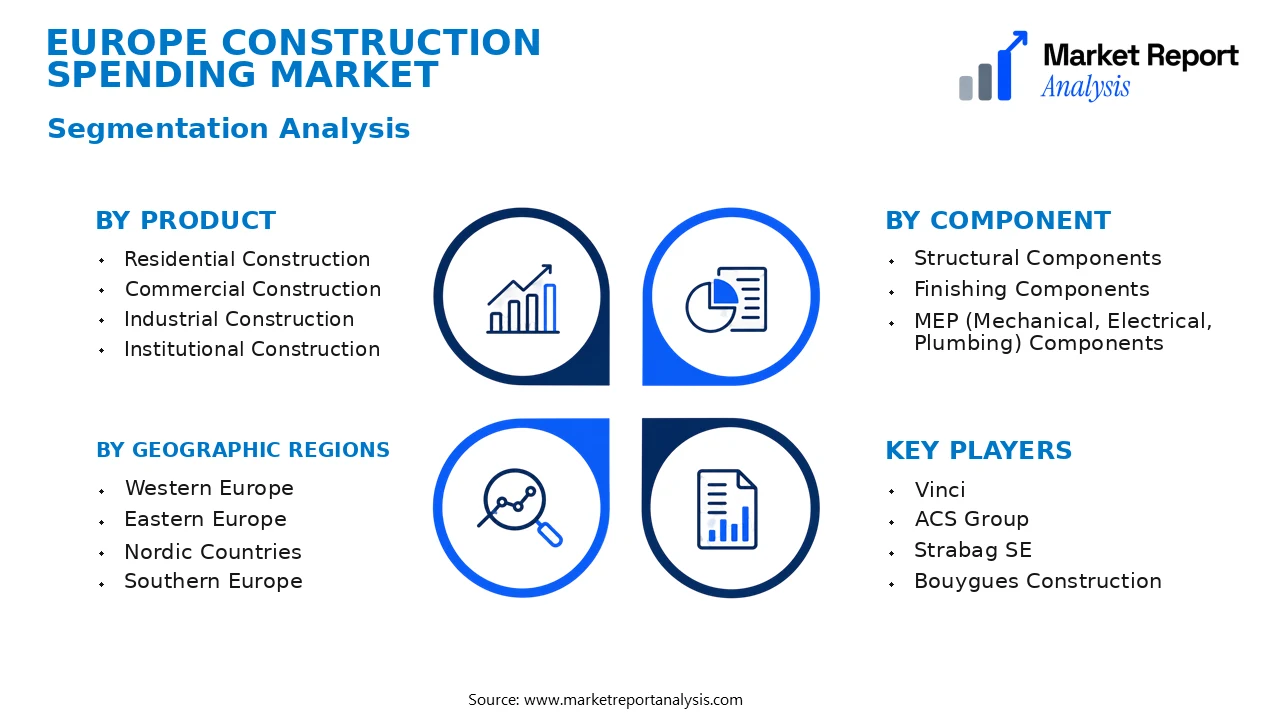
Europe Construction Spending Market segmentation encompasses various categories including product types, application sectors, and geographic regions. This structure enables a detailed analysis of demand drivers, regional growth patterns, and evolving market dynamics within the construction industry across Europe, facilitating targeted strategic initiatives.
- Product
- Residential Construction: This segment covers new housing developments, renovations, and refurbishments in urban and rural settings, driven by population growth, urbanization trends, and government incentives for affordable housing. Demand remains high in both Western and Eastern Europe, reflecting ongoing urban expansion and aging infrastructure needing upgrades.
- Commercial Construction: Encompasses office buildings, retail spaces, and hospitality infrastructure, of which demand is largely influenced by economic growth and investment in business infrastructure, especially in major financial hubs like London, Frankfurt, and Paris. The sector benefits from private and public sector projects aiming to foster economic development.
- Industrial Construction: This category involves manufacturing facilities, logistics centers, and warehouses, with growth driven by e-commerce expansion, supply chain modernization, and manufacturing sector resilience. Infrastructure investments in logistics corridors have spurred demand, particularly in Germany, Spain, and Belgium.
- Institutional Construction: Comprises hospitals, educational institutions, and government infrastructure projects. Growth is supported by public funding and policy initiatives aimed at improving healthcare, education facilities, and public services across European nations.
- Component
- Structural Components: Key load-bearing elements such as beams, columns, and frameworks, essential for building integrity. Rising demand for sustainable and energy-efficient structures boosts the adoption of innovative materials like cross-laminated timber and prefabricated components.
- Finishing Components: Includes interior and exterior finishes such as flooring, wall panels, and facades, critical for aesthetic appeal and durability. The trend toward premium and smart buildings elevates demand for advanced finishing materials with enhanced properties.
- MEP (Mechanical, Electrical, Plumbing) Components: Critical for building functionality. The focus on smart, energy-efficient systems enhances the adoption of advanced MEP solutions, contributing significantly to overall construction costs and technology integration.
- Geographic Regions
- Western Europe: Characterized by mature markets such as Germany, France, and the UK, with high infrastructure investment, stringent building regulations, and a focus on sustainability, driving the adoption of innovative construction practices and materials.
- Eastern Europe: Marked by emerging markets including Poland, Hungary, and Romania, where rapid urbanization, economic growth, and EU funding stimulate construction activity, although at a relatively lower technology integration rate compared to Western Europe.
- Nordic Countries: Denotes Sweden, Norway, Finland, and Denmark, where emphasis on green building standards, renewable energy integration, and advanced construction technology fosters sustainable growth in the sector.
- Southern Europe: Encompasses Spain, Italy, and Greece, where tourism, real estate development, and infrastructural upgrades contribute significantly to construction spending, often supported by public-private collaborations.
Competitive Intelligence
The Europe Construction Spending Market exhibits moderate competition with several key players, including multinational corporations and regional firms, vying for market share. Market concentration remains relatively balanced, with the top five companies accounting for approximately 45-50% of total market revenue, fostering competitive dynamics and innovation. Leading firms pursue aggressive business strategies such as expanding into emerging European markets and diversifying service portfolios to mitigate regional economic fluctuations. Product innovation is a critical focus, with companies investing heavily in sustainable construction materials, digital construction technologies, and modular building systems to differentiate offerings and meet evolving client demands.
Partnerships and strategic alliances are prevalent, often involving joint ventures with local firms to enhance regional market penetration and share technology expertise. Several companies pursue acquisitions to strengthen their market positions, integrate vertical supply chains, or expand into adjacent segments such as infrastructure or renewable energy projects. R&D investments are directed toward eco-friendly construction solutions, digitalization, and productivity enhancement tools, fostering competitive differentiation. Overall, firms that emphasize technological innovation, sustainable practices, and strategic collaborations are positioning themselves for sustained growth amidst a dynamic market landscape.
Leading Company Profiles
The European construction industry is characterized by a diverse group of leading companies that drive innovation, sustainability, and market expansion through strategic initiatives, technology adoption, and extensive product portfolios tailored to regional needs.
- Vinci
- ACS Group
- Strabag SE
- Bouygues Construction
- Skanska AB
- Ferrovial
- Hochtief AG
- Bilfinger SE
- BAM Group
- Eiffage SA
Vinci
Vinci is a global leader in concessions, construction, and energy services, focusing on large-scale infrastructure projects, innovative sustainable solutions, and high-capacity construction equipment to enhance regional and international market share.
ACS Group
ACS specializes in civil and industrial construction, offering comprehensive services across infrastructure, water, and energy sectors, emphasizing digital transformation and eco-friendly project execution to strengthen its competitive advantage in Europe.
Strabag SE
Strabag provides integrated construction services, leveraging advanced Building Information Modeling (BIM) and digital construction methodologies to streamline project delivery, and focuses on sustainable construction practices and regional market growth.
Bouygues Construction
With a broad portfolio in residential, commercial, and infrastructure projects, Bouygues prioritizes innovative green building technologies, digital construction tools, and strategic alliances to maintain its market leadership across Europe.
Skanska AB
Skanska offers construction, development, and project management with an emphasis on sustainable urban development and smart infrastructure, investing heavily in green technologies and digital project management tools.
Ferrovial
Ferrovial operates mainly in infrastructure and urban services, specializing in large-scale transport, water, and environmental projects, and increasingly adopts digital solutions and sustainability initiatives for competitive advantage.
Hochtief AG
Hochtief focuses on complex construction projects across transportation, energy, and civil engineering sectors, integrating innovative construction techniques and digital tools to optimize project outcomes and regional expansion.
Bilfinger SE
Bilfinger provides engineering and industrial services, emphasizing sustainable infrastructure maintenance, digitalization of project workflows, and environmentally conscious construction practices.
BAM Group
BAM specializes in social infrastructure, commercial buildings, and civil engineering, with a focus on digital innovation and sustainable building techniques to strengthen its European market position.
Eiffage SA
Eiffage develops and manages construction and civil engineering projects, prioritizing green building solutions, digital construction processes, and strategic partnerships to promote long-term regional growth.
Strategic Business Developments
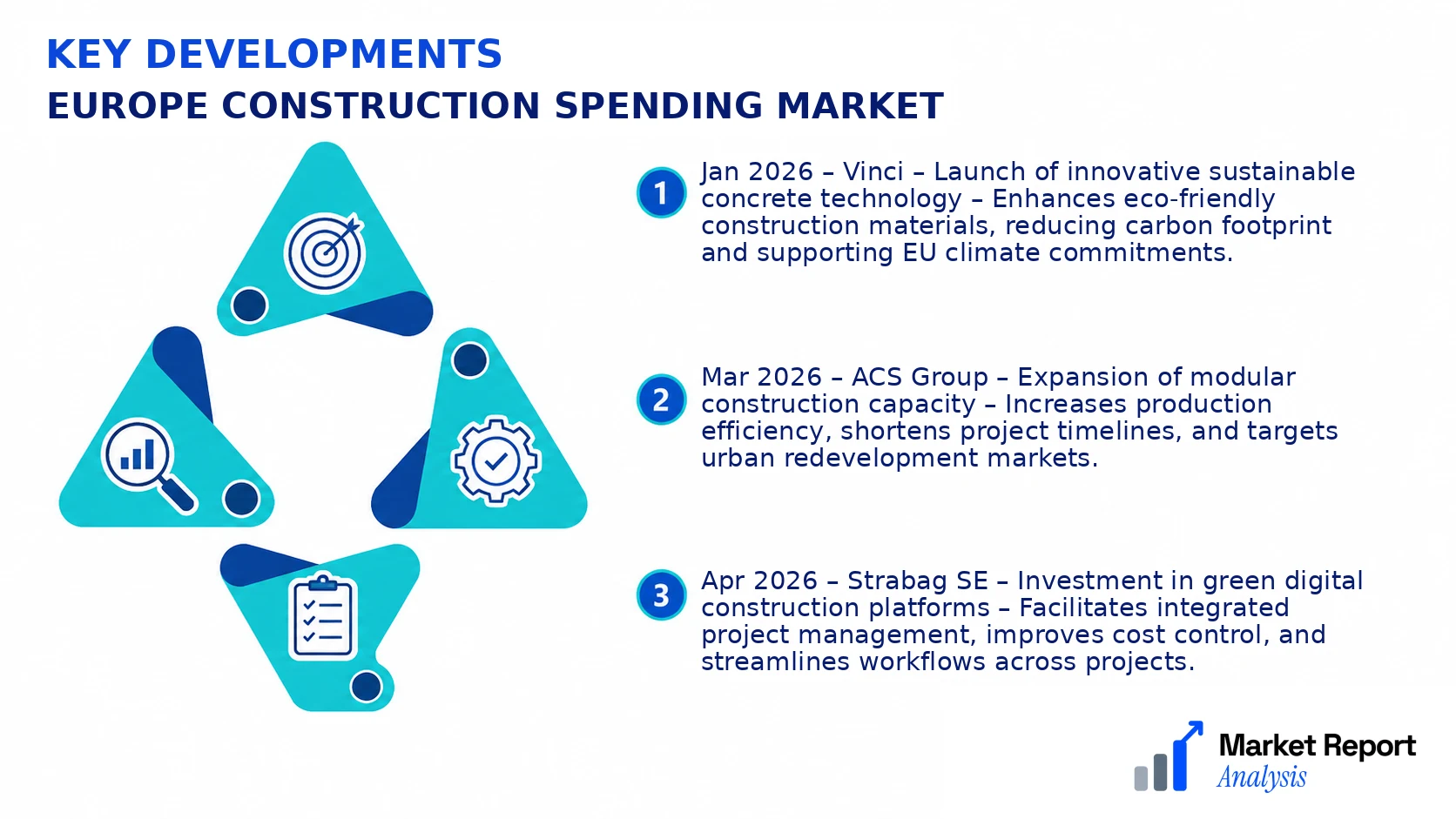
- Jan 2026 – Vinci – Launch of innovative sustainable concrete technology – Enhances eco-friendly construction materials, reducing carbon footprint and supporting EU climate commitments.
- Mar 2026 – ACS Group – Expansion of modular construction capacity – Increases production efficiency, shortens project timelines, and targets urban redevelopment markets.
- Apr 2026 – Strabag SE – Investment in green digital construction platforms – Facilitates integrated project management, improves cost control, and streamlines workflows across projects.
- Jun 2026 – Bouygues Construction – Formation of joint venture with renewable energy firms – Focuses on infrastructure projects with integrated renewable energy solutions, boosting sustainability offerings.
- Aug 2026 – Skanska AB – Acquisition of regional urban development firm – Strengthens market presence in sustainable urban infrastructure and expands project pipeline in major European cities.
Frequently Asked Questions
What is the Europe Construction Spending Market?
The Europe Construction Spending Market encompasses the total expenditure on construction projects within the European region, including residential, commercial, infrastructure, and industrial segments, reflecting economic development and infrastructure investment trends across EU nations.
What is the current market size of Europe Construction Spending Market?
As of 2026, the market size is estimated at approximately USD 1.2 Trillion, driven by ongoing urbanization, government infrastructure initiatives, and private sector investments, with growth anticipated to continue throughout the forecast period.
What factors are driving the Europe Construction Spending Market?
Key drivers include rising urbanization, government incentives for infrastructure development, technological advancements, and increased demand for sustainable building solutions, all contributing to sustained growth and higher construction budgets across European countries.
Which region dominates the Europe Construction Spending Market?
Western Europe currently dominates the market, owing to its mature infrastructure, high investment levels, and robust economic activity, particularly in countries such as Germany, France, and the UK, which collectively account for a substantial market share.
Which segment is expected to grow the fastest?
The infrastructure segment is projected to experience the fastest growth, supported by significant investments in transportation, utilities, and smart city projects, alongside increasing focus on sustainable and resilient infrastructure developments across Europe.
Who are the leading companies operating in the Europe Construction Spending Market?
Leading companies include Vinci, Bouygues, STRABAG, ACS Group, and Vinci Energies, which hold substantial market shares through diversified portfolios, strategic regional presence, and ongoing investments in innovative construction technologies.
Analyst Perspective
The Europe construction spending market is anticipated to continue its maturation, with steady growth propelled by increasing infrastructural investments across Western and Eastern Europe. The long-term outlook remains positive due to ongoing urbanization, government initiatives on sustainable development, and advancements in construction technologies such as modular and green building materials. Commercial opportunities are abundant in smart infrastructure and renewable energy projects, especially in countries emphasizing carbon neutrality by 2050. Technological evolution, including digital twins and BIM, will shape competitive dynamics, demanding firms prioritize innovation to maintain market share. Investment priorities should focus on resilient supply chains, sustainable materials, and digital integration to capitalize on emerging trends. Regional growth potential is strongest in Eastern Europe, driven by lower construction costs and government incentives, yet Western Europe will continue leading in high-value, technologically sophisticated projects. Overall, strategic positioning around sustainability, technology, and regional diversification remains crucial amid increasing competitive intensity.
