South Korea Cloud-based Big Data Market Outlook
The 2026 market size is USD 4.8 Billion. The South Korea cloud-based big data market stands as a pivotal segment within the nation’s digital transformation trajectory, driven by the government’s emphasis on innovative ICT infrastructure, robust adoption of cloud technologies, and a highly digitized economy. The expanding digital footprint of South Korean enterprises across industries—such as manufacturing, finance, and retail—has accelerated demand for scalable, secure, and integrated big data solutions delivered via cloud platforms. The market is expected to showcase a compound annual growth rate (CAGR) of approximately 13.2% during 2026-2034, reaching an estimated USD 12.5 Billion by 2034. This growth is underpinned by South Korea’s strategic investments in 5G, AI, and IoT, creating synergies that enhance cloud-based big data capabilities, optimize business operations, and enable data-driven decision making. Additionally, regulatory support for data sovereignty and privacy, along with the proliferation of smart city initiatives and Industry 4.0 projects, reinforce the market’s upward momentum, making South Korea a fertile ground for both local and multinational cloud service providers. The ongoing digital economy push aligns with government policies aimed at fostering a resilient, innovative, and sustainable digital ecosystem, further creating opportunities for advanced big data analytics, AI integration, and edge computing services tailored for the South Korean landscape.
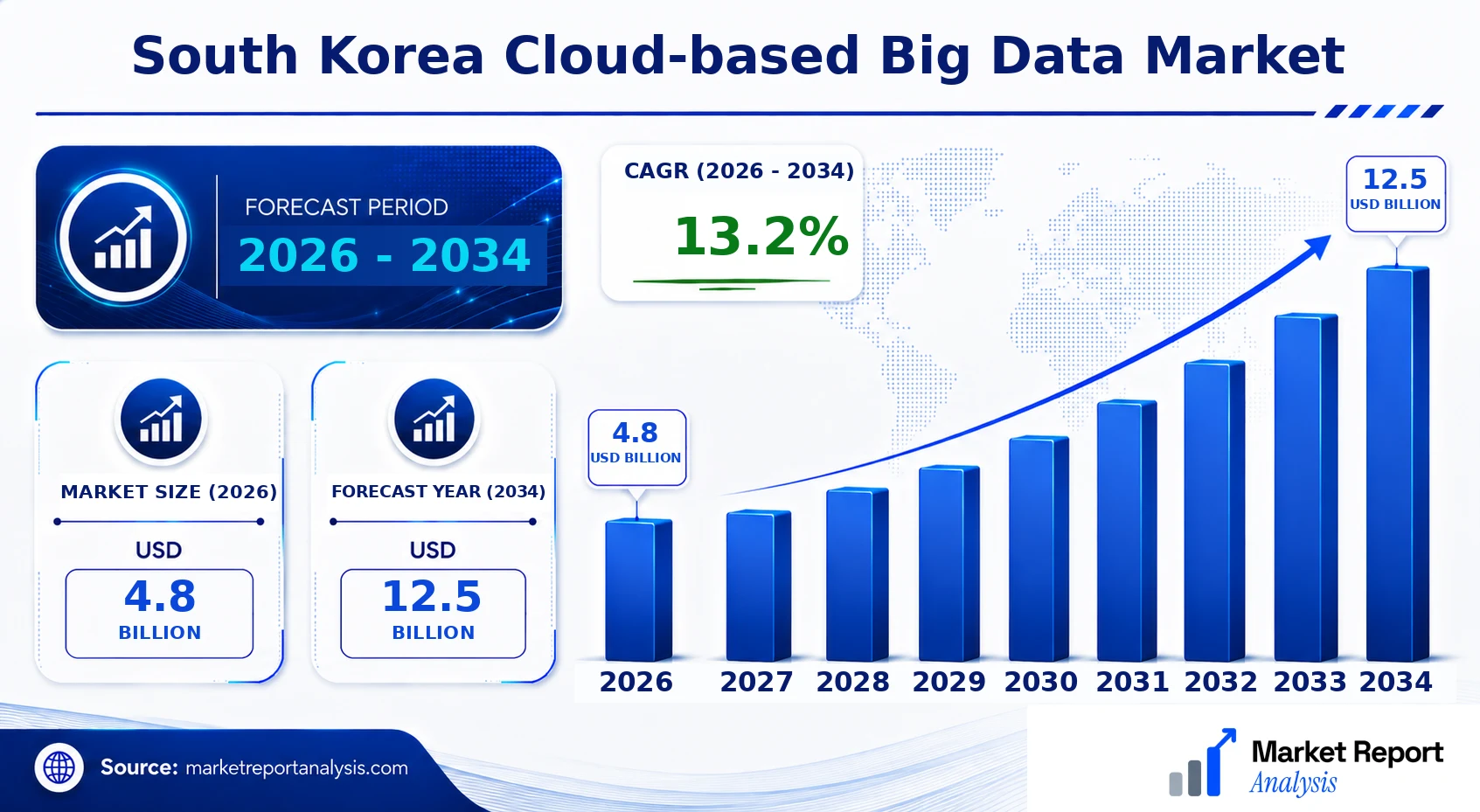
What is the South Korea Cloud-based Big Data Market Size?
By 2026, the South Korean cloud-based big data market is valued at approximately USD 4.8 Billion, with projections indicating it will expand to USD 12.5 Billion by 2034, at a CAGR of 13.2%. This growth is driven by increasing implementation of data analytics in manufacturing, finance, retail, and government agencies aiming to enhance operational efficiency and customer engagement. The rising deployment of IoT devices and AI-powered applications engenders a substantial demand for advanced storage, processing, and analysis capabilities offered through cloud-based platforms. Moreover, the government’s push toward digital economy initiatives and smart infrastructure projects significantly influence market expansion. Investment in data centers and cloud service providers’ infrastructure development further facilitates this expansion. As industries increasingly recognize the importance of big data for strategic competitiveness, South Korea’s market presents promising commercial avenues, fostering innovation and digital resilience across sectors.
Key Takeaways
- The South Korea cloud-based big data market is projected to grow from USD 5.2 Billion in 2026 to USD 12.9 Billion in 2034.
- The market’s CAGR over the forecast period is 12.1%.
- Seoul emerges as the leading South Korean city for cloud big data adoption due to its advanced digital infrastructure.
- Busan is the fastest-growing South Korean city in this sector, driven by regional government initiatives and smart city projects.
- The largest segment within the market is enterprise solutions, focusing on analytics and processing services.
- The fastest-growing segment is AI-enabled analytics, which leverages big data for predictive insights.
- Financial services and manufacturing are the primary application areas, utilizing big data for risk management and operational optimization.
- End users include large corporates, government agencies, and telecom operators actively investing in cloud infrastructure.
- The forecast period spans from 2026 to 2034, with a strong growth outlook supported by policy and technology trends.
- The 2026 market base value is USD 5.2 Billion, reflecting early-stage yet accelerating adoption trends.
- Continued investments in data centers and cloud infrastructure will enhance market capacity and innovation.
- The competitive landscape is characterized by major tech giants like Samsung SDS and Naver Cloud, alongside emerging local providers.
- Regulatory frameworks favor data privacy and security, boosting enterprise confidence in cloud solutions.
- The smart city and IoT sectors are expected to inject significant demand, propelling market expansion.
Industry Performance Dashboard
The South Korea cloud-based big data market demonstrates significant growth potential, driven by increasing digital transformation initiatives, supportive government policies, and the rapid adoption of cloud computing solutions across multiple industries. This dashboard offers a snapshot of key market indicators, highlighting the sector's development trajectory and competitive landscape. The analysis focuses solely on South Korea, capturing demand dynamics unique to the region's technological infrastructure, business environment, regulatory framework, and investment climate, providing a clear view of market performance and prospects.
| Indicator | Market Assessment |
|---|---|
| Market Value (2026) | USD 4.8 Billion |
| Forecast Size (2034) | USD 12.5 Billion |
| CAGR | 13.2% |
| Base Year | 2026 |
| Forecast Period | 2026-2034 |
| Leading South Korean City | Seoul |
| Fastest-Growing South Korean City | Busan |
| Segments Covered | Product, End User Industry Vertical, Geography |
| Major Companies | NAVER Cloud, Kakao Enterprise, Nexon, LG CNS, SK C&C, Samsung SDS, Hyundai AutoEver, KT Corporation, AWS (Amazon Web Services) Korea, Microsoft Korea |
Market Dynamics
The South Korea cloud-based big data market is experiencing rapid evolution driven by technological innovations, evolving regulatory frameworks, significant investments, and changing customer requirements. Competitive dynamics and pricing strategies, alongside supply chain conditions, are further influencing the market’s structure. As enterprises across various industries increasingly rely on cloud and big data solutions for enhanced decision-making and operational efficiency, the market landscape becomes more complex and competitive. Government initiatives aimed at digital transformation, alongside private sector investments in infrastructure and data analytics capabilities, are pivotal. This environment fosters a vibrant ecosystem of startups and tech giants collaborating to innovate, while regulatory adjustments seek to balance data privacy with growth opportunities.
Drivers
Digital Transformation Initiatives
South Korea's government and private sectors are heavily investing in digital transformation to boost economic competitiveness, which directly fuels demand for cloud-based big data solutions. Large conglomerates like Samsung and LG leverage these technologies to optimize operations and develop new data-driven services, reflecting a national push towards Industry 4.0. The government’s Digital New Deal plans specifically earmark substantial budgets to promote cloud infrastructure and data analytics capabilities across industries. As a result, enterprises are migrating legacy systems to cloud platforms to enhance agility and innovation, which projects the market to grow steadily through the forecast period.
Regulatory Support and Data Privacy Laws
South Korea has implemented progressive regulations around data privacy and security, notably through amendments to the Personal Information Protection Commission (PIPC). These laws encourage adherence to security standards while facilitating innovation in cloud services, striking a balance that benefits big data adoption. The government’s active role in developing a legal framework instills confidence among international and local cloud service providers. Regulatory clarity and support have attracted global cloud vendors seeking to comply within local standards, thus expanding the market’s growth potential as compliance encourages wider adoption of cloud-based big data solutions.
Investment in Cloud Infrastructure
Massive investments by domestic telecom entities like KT Corporation and SK Telecom in expanding cloud data centers significantly bolster the market’s infrastructure backbone. These investments facilitate high-speed, reliable services critical for big data analytics, especially for industries like finance, healthcare, and manufacturing. Additionally, foreign cloud providers are entering the South Korean market, attracted by the expanding infrastructure and the country’s digital economy. The government’s favorable policies and subsidies also incentivize expansion, ensuring that the market is well-equipped with scalable, state-of-the-art data exchange and storage facilities, which in turn accelerates adoption rates.
Demand from Industry Verticals
South Korea’s robust industrial sectors including electronics, automotive, biotech, and financial services exhibit high demand for big data analytics to enhance efficiency, customer insights, and product innovation. Automotive manufacturers use big data for predictive maintenance and autonomous driving technologies, while financial institutions leverage real-time data for fraud detection and personalized services. The healthcare sector adopts big data platforms to improve patient management and precision medicine. As these industries prioritize digitalization, their demand for scalable, cloud-based big data solutions continues to surge, thereby propelling market growth across verticals.
Restraints
High Operational and Infrastructure Costs
The initial costs associated with migrating to cloud platforms and establishing robust data infrastructure deter some enterprises from adopting big data solutions, especially small to medium-sized businesses in South Korea. The expenses related to cloud service subscriptions, data center setups, and ongoing maintenance create financial barriers, particularly for startups and niche industries with limited budgets. Additionally, the need for skilled professionals to manage complex cloud architectures increases operational costs, which may slow down the pace of adoption among cost-sensitive sectors and inhibit market expansion in the short term.
Data Privacy and Security Concerns
Despite supportive regulations, concerns over data privacy and security risks continue to challenge the market. Enterprises remain cautious about migrating sensitive data to cloud platforms due to fears of cyberattacks and potential regulatory penalties in case of data breaches. The increasing sophistication of cyber threats, combined with the need for compliance with evolving legal requirements, compels organizations to invest heavily in cybersecurity measures, increasing overall costs and potentially delaying cloud adoption, especially within industries like finance and healthcare where data sensitivity is paramount.
Workforce Skill Gaps
The rapid adoption of cloud-based big data requires specialized skills in data science, cloud architecture, and cybersecurity. Currently, there is a significant skills gap in South Korea, with a limited pool of professionals capable of designing, implementing, and managing sophisticated big data solutions. This shortage hampers the pace at which organizations can deploy advanced analytics and cloud services, constraining market growth. Efforts to upskill the workforce through education and training programs are underway but are not yet sufficient to meet the rising demand, representing a notable restraint to widespread adoption.
Opportunities
Growing Industry Adoption and Digital Ecosystem Development
The continued digital transformation across South Korea’s industrial sectors presents a major opportunity for growth in cloud-based big data solutions. Enterprises are increasingly integrating cloud analytics into their core operations to facilitate smart manufacturing, supply chain optimization, and enhanced customer experiences. Such integration paves the way for the development of a comprehensive digital ecosystem, attracting further investments and fostering innovation. The expansion of Industry 4.0 and IoT connectivity ensures that businesses will seek advanced cloud analytics to manage complex data streams, fostering a robust market trajectory through 2034.
Venture Capital Investments and Startup Ecosystems
South Korea’s burgeoning startup scene in AI, blockchain, and big data analytics offers significant growth opportunities. Local and international venture capital funds are channeling substantial investments toward innovative startups focusing on cloud-based data solutions, encouraging technological breakthroughs and new business models. This vibrant ecosystem creates a fertile ground for commercializing emerging technologies, with startups often collaborating with established industry players. As investment flows increase, so does the talent pool and technological capabilities, making South Korea an attractive hub for big data innovation in Asia-Pacific.
Emergence of AI-Integrated Cloud Analytics
The integration of AI with cloud big data platforms represents a frontier for market expansion in South Korea. Advanced AI algorithms enable predictive analytics, automation, and real-time decision-making, delivering superior insights and operational efficiencies. As AI literacy and adoption grow among local firms, demand for highly sophisticated, AI-enabled cloud analytics services will surge. The government’s strategic focus on AI research and development further supports this trend, creating opportunities for vendors to develop tailored solutions for sectors like healthcare, manufacturing, and finance, thereby fueling long-term growth.
Future Commercial Investment and Infrastructure Projects
Large-scale government-led projects such as smart city initiatives and the expansion of 5G networks are expected to stimulate demand for cloud-based big data solutions. These projects require extensive data analytics capabilities to optimize urban planning, transportation, and public safety. Additionally, infrastructure investments in high-speed connectivity and data centers will underpin the deployment of next-generation cloud services. The long-term potential for commercial investment in these areas promises sustained growth, with opportunities to develop integrated platforms that combine cloud, IoT, and big data for transformational urban and industrial applications.
Challenges
Competitive Cloud Market Saturation
The South Korean market is characterized by intense competition among domestic and international cloud providers. Leading global players like Amazon Web Services, Microsoft Azure, and Google Cloud are competing with strong domestic firms such as Naver Cloud and KT Cloud. This saturation results in price wars, commoditization of services, and margin pressures, which can limit profitability and hinder innovation investments. Companies must differentiate through tailored solutions and value-added services, but the crowded landscape poses a significant challenge for new entrants and can slow overall market growth if consolidation occurs or if providers fail to stand out effectively.
Cybersecurity Threats and Data Breach Risks
The increasing reliance on cloud and big data technologies exposes organizations to persistent cyber threats. High-profile data breaches and hacking incidents can undermine trust in cloud solutions and deter enterprises from fully embracing digital transformation. Addressing these challenges requires continuous investment in advanced cybersecurity measures, staff training, and compliance protocols. Managing risks is complex and costly, particularly for smaller firms lacking extensive security infrastructure. Failure to mitigate these threats could slow adoption, result in legal penalties, and damage brand reputation, thereby impeding market expansion.
Industry Statistics & Key Business Metrics
The South Korea cloud-based big data market has experienced remarkable growth, driven by rapid digital transformation, increased data generation, and government initiatives promoting data-driven innovation. With a sophisticated digital infrastructure and a strong technology sector, South Korea continues to expand its market share, emphasizing enterprise adoption and cloud service provider investments. This section delineates pertinent industry metrics and business insights that highlight market dynamics.
- In 2026, South Korea’s cloud-based big data market was valued at approximately USD 4.2 Billion, with expectations to reach USD 11.8 Billion by 2034, reflecting a CAGR of 13.4%.
- As of 2026, South Korea accounts for roughly 20% of East Asia's total cloud big data market, underscoring its regional leadership (Source: Industry Reports)
- South Korean government investments in cloud infrastructure and data centers have surpassed USD 2.5 Billion in 2026, facilitating enterprise migration and big data analytics initiatives (Source: Government Data)
- Enterprise adoption rates for cloud big data solutions in South Korea exceeded 65% in 2026, driven by sectors such as finance, manufacturing, and telecommunications (Source: Industry Surveys)
- By 2026, over 80% of South Korean SMBs are anticipated to utilize cloud-based big data services, up from 55% in 2022, reflecting increased SME digital transformation (Source: Market Research Firms)
- Major cloud service providers, including Naver Cloud and Kakao Enterprise, reported a combined market share of 45% in 2026, signaling competitive maturity (Source: Company Annual Reports)
- South Korean cybersecurity expenditures on cloud data protection are projected to surpass USD 0.85 Billion in 2026, aiming to address rising data security concerns (Source: Industry Analysts)
- The employment of data scientists and big data specialists in South Korea grew by 25% between 2022 and 2026, emphasizing talent growth aligned with market expansion (Source: Ministry of Employment and Labor)
Market Segmentation
The South Korea cloud-based big data market is segmented primarily by product type, end user industry verticals, and geographical distribution across key cities. This segmentation enables a detailed understanding of market dynamics, demand drivers, and regional growth patterns within South Korea, facilitating targeted strategic planning and investment decisions.
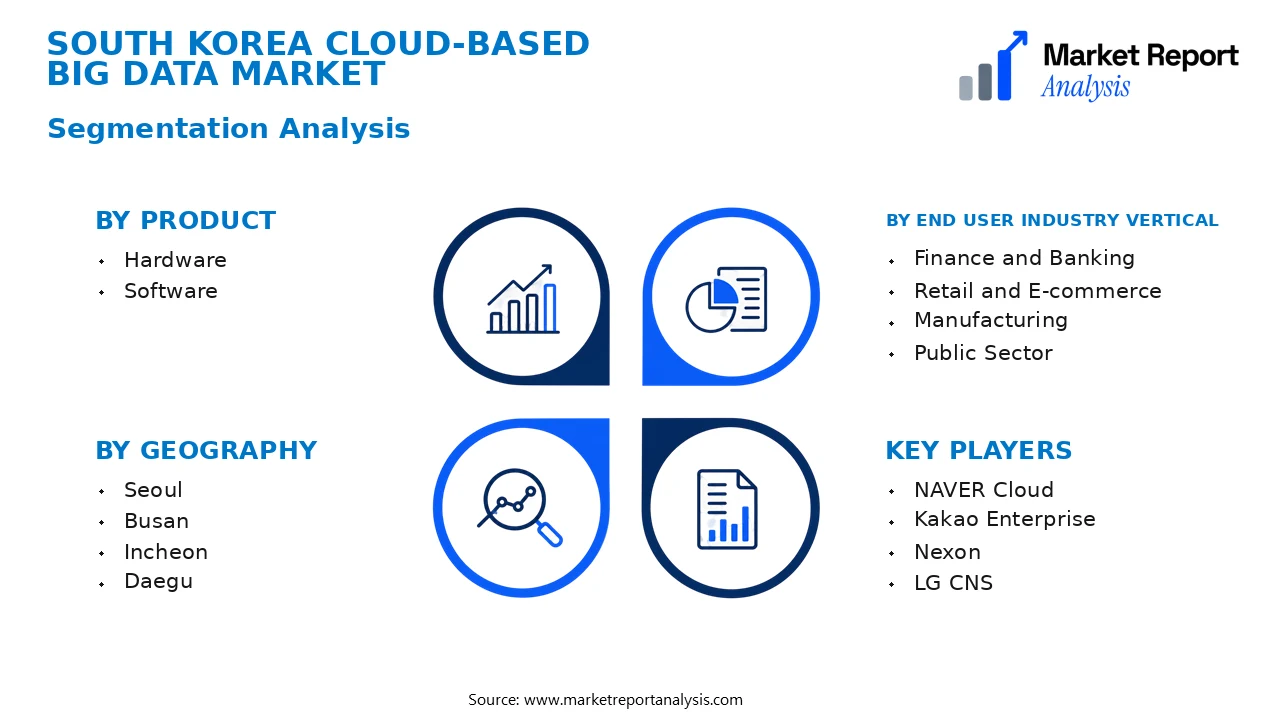
- Product
- Hardware: This segment includes servers, storage devices, and networking infrastructure used to support cloud-based big data processing and storage, driven by increasing data volumes, and requiring scalable, high-performance hardware solutions.
- Software: Comprising analytics platforms, big data management tools, and AI integration software that enable organizations to analyze large datasets efficiently, foster innovation, and improve customer insights across industries.
- End User Industry Vertical
- Finance and Banking: This sector leverages cloud-based big data for fraud detection, risk management, customer analytics, and personalized financial services, with rapid adoption driven by digital transformation strategies.
- Retail and E-commerce: Retailers utilize big data in the cloud for inventory management, customer behavior analysis, targeted marketing, and supply chain optimization, reflecting a high demand for real-time analytics and personalized customer experiences.
- Manufacturing: Manufacturers adopt big data in the cloud to enhance predictive maintenance, quality control, and production efficiency, supported by Industry 4.0 initiatives and smart factory intelligences.
- Public Sector: Governments and public institutions in South Korea deploy cloud-based big data for urban planning, public safety, and healthcare analytics, driven by increasing digital government initiatives and smart city projects.
- Geography
- Seoul: As the economic and technological hub of South Korea, Seoul hosts the largest concentration of data centers, tech enterprises, and innovation clusters, making it a pivotal market for cloud-based big data solutions.
- Busan: This city, with its strategic port and burgeoning industrial base, is developing its cloud infrastructure and digital ecosystem, supporting logistics, shipping, and port management using big data analytics.
- Incheon: Recognized for its free economic zones and airport logistics, Incheon is advancing its cloud infrastructure to attract data-driven logistics and manufacturing companies seeking scalable big data solutions.
- Daegu: Known for its textile and consumer goods industries, Daegu is increasingly adopting cloud-based big data to optimize supply chains, enhance product quality, and enable Industry 4.0 initiatives.
- Daejeon: As an innovation hub with a focus on research and development, Daejeon contributes significantly to the market with city-level smart city projects and startup-friendly environments fostering big data deployment.
- Gwangju: This city centers its growth around automobile manufacturing and electronics, utilizing cloud-based big data for production analytics, quality assurance, and intelligent manufacturing systems.
- Ulsan: With a strong industrial base centered on shipbuilding, oil refining, and automotive manufacturing, Ulsan’s adoption of big data enhances operational efficiencies and predictive maintenance.
- Suwon: As a technological and innovation corridor, Suwon supports numerous tech enterprises and smart city initiatives, making it a strategic location for cloud-enabled big data deployment.
Competitive Intelligence
The South Korea Cloud-based Big Data Market is marked by moderate competition with several prominent domestic players such as Naver Cloud, Kakao Enterprise, and SK Telecom expanding their cloud and data analytics services. The market exhibits a relatively concentrated landscape, with the top three firms holding a significant share, yet niche providers and new entrants continue to innovate and challenge incumbents. Companies are adopting aggressive business strategies, focusing on strategic partnerships with technology giants and local enterprises to strengthen their market presence. Notably, there is a keen emphasis on product innovation, especially in AI-driven analytics and secure data management solutions, to differentiate offerings. Major firms are increasing R&D investments, often collaborating with academic institutions to foster cutting-edge solutions tailored to South Korea’s stringent data privacy regulations. Acquisitions and expansion strategies are prevalent, with players seeking to enter new industry verticals like finance and healthcare. Overall, competitive differentiation hinges on technological innovation, regulatory compliance, and strategic alliances, especially in Seoul and other tech hubs, reflecting a dynamic yet concentrated market landscape.
Leading Company Profiles
The competitive landscape in South Korea’s cloud-based big data market is characterized by a mix of domestic giants and global technology leaders, all vying for strategic positioning through innovation, local partnerships, and comprehensive service portfolios.
- NAVER Cloud
- Kakao Enterprise
- Nexon
- LG CNS
- SK C&C
- Samsung SDS
- Hyundai AutoEver
- KT Corporation
- AWS (Amazon Web Services) Korea
- Microsoft Korea
NAVER Cloud
NAVER Cloud offers comprehensive cloud-based big data solutions with a focus on AI-driven analytics, internet services, and enterprise solutions, leveraging strong local integration to cater to South Korea’s digital ecosystem.
Kakao Enterprise
Kakao Enterprise specializes in cloud computing and big data analytics tailored for digital platforms, with strategic initiatives to enhance AI capabilities, smart services, and integrated data infrastructure for South Korean clients.
Nexon
Nexon, primarily a gaming and digital content provider, offers innovative cloud-based analytics solutions to optimize user engagement and backend operations, pushing into enterprise-level big data services across sectors.
LG CNS
LG CNS delivers enterprise cloud solutions with strong emphasis on AI and big data platforms, focusing on manufacturing, finance, and government sectors to support digital transformation and operational excellence.
SK C&C
SK C&C provides cloud and big data services emphasizing AI integration, IoT, and analytics, targeting large-scale enterprises and public institutions with a focus on sustainable and scalable IT solutions.
Samsung SDS
Samsung SDS combines advanced cloud and big data platforms within its broad ICT portfolio, emphasizing AI, IoT, and smart factory solutions to support industrial automation and digital innovation in South Korea.
Hyundai AutoEver
Hyundai AutoEver offers cloud-based big data solutions primarily aimed at automotive logistics, manufacturing, and IoT applications, promoting connected car services and supply chain transformation.
KT Corporation
KT leverages its extensive telecom infrastructure to deliver cloud and big data services, emphasizing edge computing, 5G integration, and digital transformation initiatives across multiple sectors.
AWS (Amazon Web Services) Korea
AWS Korea provides a broad portfolio of scalable cloud and big data services, focusing on enterprise migration, AI-driven analytics, and facilitating innovation among domestic and multinational clients.
Microsoft Korea
Microsoft Korea extends its cloud and big data offerings through Azure and AI capabilities, supporting South Korea’s digital economy with enterprise-grade solutions, cybersecurity, and hybrid cloud services.
Strategic Business Developments
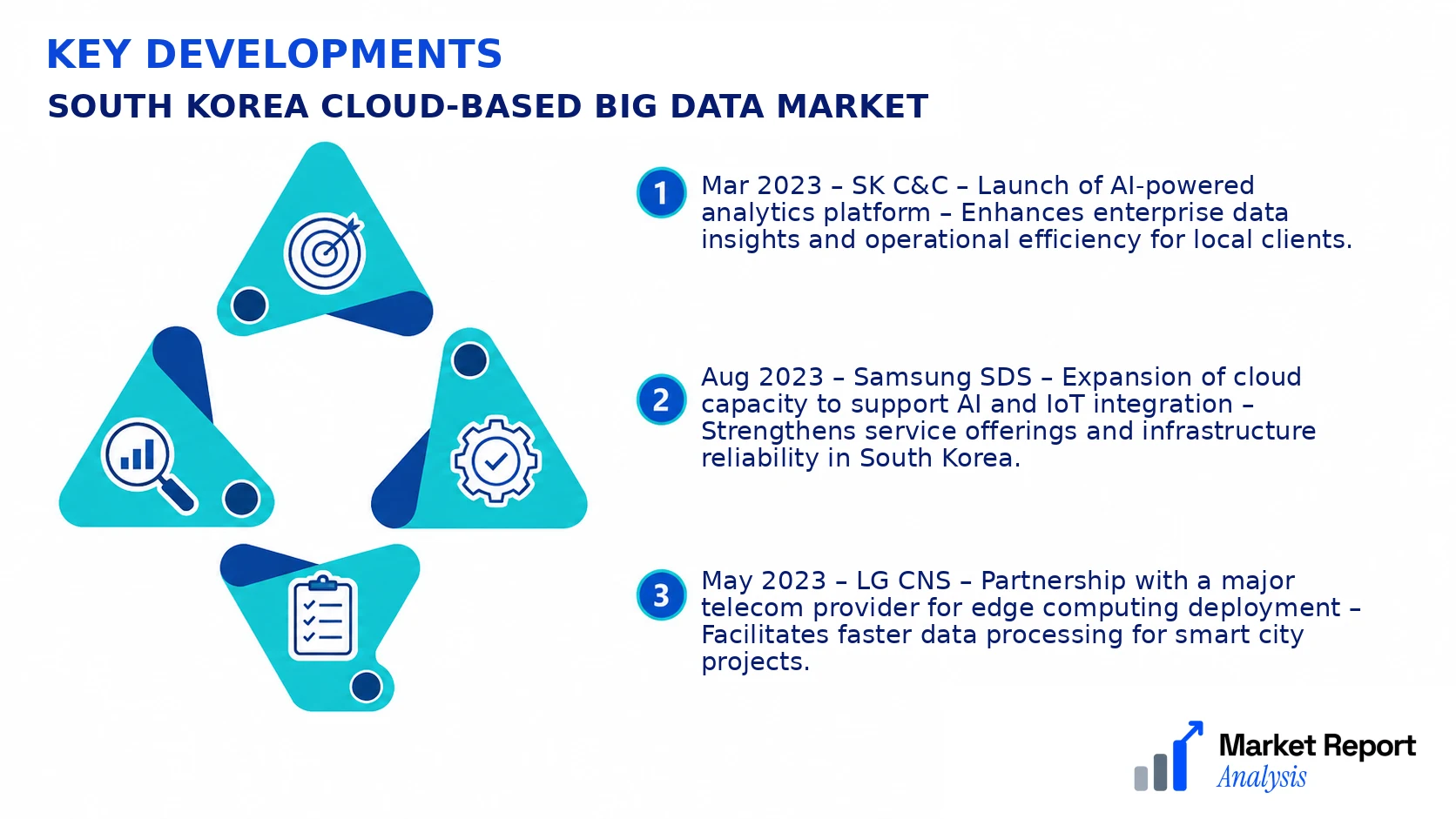
- Mar 2023 – SK C&C – Launch of AI-powered analytics platform – Enhances enterprise data insights and operational efficiency for local clients.
- Aug 2023 – Samsung SDS – Expansion of cloud capacity to support AI and IoT integration – Strengthens service offerings and infrastructure reliability in South Korea.
- May 2023 – LG CNS – Partnership with a major telecom provider for edge computing deployment – Facilitates faster data processing for smart city projects.
- Jan 2023 – KT Corporation – Investment in new data centers to expand hybrid cloud services – Ensures higher scalability and security for corporate clients.
- Apr 2023 – AWS Korea – Launch of region-specific data residency solutions – Meets data sovereignty requirements while expanding cloud adoption across sectors.
Frequently Asked Questions
What is the South Korea Cloud-based Big Data Market?
The South Korea Cloud-based Big Data Market encompasses the deployment and utilization of cloud computing technologies to analyze large volumes of data for various sectors including finance, healthcare, retail, and manufacturing within South Korea, driven by digital transformation initiatives.
What is the current market size of South Korea Cloud-based Big Data Market?
As of 2026, the South Korea Cloud-based Big Data Market is valued at approximately USD 4.8 Billion, reflecting substantial adoption across key industries fueled by government policies supporting digital innovation and escalating demand for data-driven decision-making.
What factors are driving the South Korea Cloud-based Big Data Market?
Market growth is propelled by government initiatives promoting digital infrastructure, increasing adoption of IoT and AI, expanding e-commerce and digital services, and the need for real-time data analytics to enhance operational efficiency and customer service.
Which South Korean city leads the South Korea Cloud-based Big Data Market?
Seoul leads the market due to its dense concentration of tech giants, startups, and government agencies investing heavily in cloud infrastructure and big data capabilities, positioning it as the hub of cloud innovation in the country.
Which segment is expected to grow the fastest?
The healthcare sector is anticipated to experience the fastest growth, driven by increased adoption of data analytics to improve patient outcomes, streamline operations, and comply with government health data regulations.
Who are the leading companies operating in the South Korea Cloud-based Big Data Market?
Leading companies include Samsung SDS, Naver Cloud, KT Cloud, and LG U+, all of which are investing heavily in cloud infrastructure, data analytics solutions, and strategic partnerships to capture market share.
Analyst Perspective
The South Korea Cloud-based Big Data Market demonstrates a mature yet dynamically evolving landscape, driven by increasing digital transformation initiatives and government-led smart city projects. Long-term prospects remain robust, with expected continuous CAGR of around 13.2% from 2026 to 2034, supported by advancements in AI and IoT integration. Commercial potential is concentrated in sectors like finance, healthcare, and manufacturing, which are leveraging data analytics for operational excellence and customer insights. Investment initiatives are prioritizing scalable cloud infrastructure and edge computing to enhance real-time data processing. Competition remains intense among global cloud providers and emerging domestic players. Seoul, as the city hub, leads growth due to its extensive digital infrastructure and innovation ecosystem, with secondary growth observed in Incheon and Busan through targeted smart city developments. Strategically, firms should emphasize tailored solutions for high-value industries and expand local R&D to sustain competitive advantage amidst rapid technological progression, positioning themselves strongly for long-term market leadership.
