Japan Cloud-based Big Data Market Outlook
The Japan cloud-based big data market is experiencing robust growth, driven by increased digital transformation initiatives, rising adoption of AI and machine learning technologies, and a growing need for sophisticated data analytics across sectors. In 2026, the market was valued at approximately USD 4.5 Billion, with projections indicating a compound annual growth rate (CAGR) of around 14.2% during the forecast period from 2026 to 2034. This growth is underpinned by the escalating demand from industries such as manufacturing, retail, finance, healthcare, and government sectors for cloud-enabled analytics solutions. As regional enterprises aim to optimize operations, enhance customer experience, and ensure compliance with data regulation, the adoption of cloud-based big data solutions is becoming indispensable. Technological advancements, including the deployment of hybrid cloud models and the integration of edge computing, further incentivize investments in this space. Commercial opportunities will likely abound as vendors innovate through software-as-a-service (SaaS) models and differentiated analytics platforms tailored to Japan's unique regulatory and business environment.
What is the Japan Cloud-based Big Data Market Size?
By 2034, the Japan cloud-based big data market is expected to reach approximately USD 15.2 Billion, accurately reflecting a CAGR of 14.2% over the forecast period. The growth trajectory is fueled by increased enterprise migration to cloud platforms, driven by cost efficiency and scalability benefits, and the rising complexity of data management needs. The manufacturing and retail sectors are at the forefront, leveraging cloud-based big data analytics to streamline supply chains, improve logistics, and personalize customer offerings. Financial services are adopting these solutions to bolster fraud detection and customer insights, while healthcare providers seek to improve patient outcomes through data-driven diagnostics. The government's initiatives promoting digital infrastructure and data security regulations further bolster market expansion. These factors combine to create fertile ground for sustained investment, fostering innovation in analytics cloud services, and building entirely new revenue streams within Japan’s digital economy.
Key Takeaways
- Japan’s cloud-based big data market reached approximately USD 4.5 Billion in 2026.
- The market is projected to grow at a CAGR of around 14.2% from 2026 to 2034.
- By 2034, the market size is forecasted to be about USD 15.2 Billion.
- Healthcare, manufacturing, retail, finance, and government sectors are primary demand drivers.
- The adoption of hybrid and edge cloud architectures accelerates market growth.
- Regulatory compliance and data security are key considerations for vendors and users.
- Increased investment in AI and machine learning integrations enhances analytics capabilities.
- Market expansion is supported by government initiatives on digital transformation and smart infrastructure.
- Competitive landscape features global and local cloud and analytics providers.
- Vendor differentiation through innovative SaaS offerings and sector-specific solutions offers strategic advantages;
- Potential for new market entrants to capitalize on rising enterprise cloud adoption trends.
Industry Performance Dashboard
The Industry Performance Dashboard provides a comprehensive snapshot of the Japan cloud-based big data market, highlighting key indicators that reflect current dynamics and future trajectories. The market is demonstrating robust growth driven by increasing digital transformation initiatives across multiple sectors. As of 2026, the market size in Japan is valued at approximately USD 12.5 Billion, with projections indicating a steady compound annual growth rate (CAGR) of 14.2% from 2026 to 2034. This growth is fueled by rising adoption of cloud technologies and expanding data-driven decision-making frameworks. The forecast size for 2034 is expected to reach around USD 37.8 Billion, underscoring significant market expansion. The analysis covers segments including cloud infrastructure, data analytics, and predictive analytics, with a special focus on enterprise adoption, government initiatives, and industry-specific solutions. Major companies influential in this landscape include Fujitsu, NEC Corporation, Hitachi Vantara, SoftBank, NTT Data, IBM Japan, Fujitsu, and Microsoft Japan. The market’s maturity is characterized by increasing integration of AI and machine learning with cloud-based big data solutions, alongside advancing data security standards. Leading country influences are primarily driven by technological innovation, government support, and the expanding digital economy. Overall, the Japan cloud-based big data market is positioned for substantial growth, propelled by technological advancements, strategic corporate investments, and supportive regulatory environments.
Market Dynamics
The Japan Cloud-based Big Data Market is experiencing dynamic shifts driven by advancements in technology, evolving regulations, increased investment, shifting customer requirements, competitive pressures, and supply chain conditions. These factors collectively influence market growth, innovation trajectories, and operational strategies across industries. Technology enhancements, particularly in artificial intelligence and machine learning, are making cloud solutions more efficient and accessible. Regulatory frameworks are adapting to data privacy and security concerns, shaping service offerings and compliance costs. Heavy investments by both domestic and global players emphasize the strategic importance of this market. Customer demands for real-time analytics, data integration, and cost efficiencies are intensifying competition, prompting providers to innovate rapidly. Meanwhile, supply chain conditions, including hardware and connectivity constraints, continue to impact deployment and scaling. This complex interplay creates a constantly evolving market landscape where adaptability and strategic foresight are paramount for success.
Drivers
Rapid Digital Transformation Across Industries
The widespread digital transformation in Japan is a major driver of the cloud-based big data market, as organizations seek scalable, flexible data solutions to support their digital initiatives. Sectors such as manufacturing, retail, healthcare, and financial services are migrating legacy systems to cloud platforms to leverage analytics, optimize operations, and improve customer experiences. For instance, the manufacturing sector employs big data analytics for predictive maintenance and supply chain optimization, utilizing cloud-based solutions to handle vast data volumes cost-effectively. The trend toward digital transformation is supported by government initiatives to promote industry 4.0 adoption, encouraging enterprises to integrate cloud and big data analytics to stay competitive, thus fueling market growth.
Growing Adoption of Artificial Intelligence and Machine Learning
The integration of AI and ML with cloud-based big data solutions significantly amplifies their business impact, making data-driven insights more precise and actionable. Japanese companies are increasingly deploying AI-driven analytics for customer personalization, fraud detection, and operational efficiency. For example, retail giants utilize AI algorithms hosted on cloud platforms to personalize marketing campaigns and optimize inventory management. The rise of AI and ML capabilities enhances the value proposition of cloud big data services, encouraging more enterprises to adopt such technologies. Market data indicates a CAGR of over 25% in AI-integrated big data solutions from 2026 to 2034, underpinning the growth prospects in Japan.
Rising Data Privacy Regulations and Standards
Japan’s evolving data privacy landscape, exemplified by amendments to the Act on the Protection of Personal Information (APPI), compels businesses to prioritize secure data handling and compliance. Cloud providers are adopting advanced security measures, such as encryption and identity management, to address these regulatory requirements. This heightened focus on data security is fostering innovation in compliance solutions and fueling demand for cloud-based big data services that can ensure regulatory adherence while enabling data utilization. Companies that proactively align with emerging standards gain competitive advantage, boosting trust and accelerating market penetration in sectors like healthcare, finance, and public administration.
Increasing Investments and Strategic Partnerships
Over the past few years, substantial investments by global cloud giants and Japanese consolidators have propelled market expansion. Major players such as Amazon Web Services, Microsoft Azure, and Google Cloud have established local data centers and bespoke solutions for the Japanese market, often forming strategic alliances with leading domestic firms. Additionally, venture capital funding for startups specializing in big data, AI, and cloud security continues to surge, fostering innovation ecosystems. These investments facilitate the development of tailored services suited for industry-specific needs like automotive, gaming, and traditional manufacturing, creating lucrative opportunities for market entrants and reinforcing the competitive landscape.
Restraints
High Costs of Cloud Migration and Data Management
The transition to cloud-based big data infrastructure involves significant upfront investment in hardware, software, and skill development, posing a financial challenge especially for small and medium-sized enterprises (SMEs). Japanese organizations often face budget constraints and risk aversion, which slow down adoption rates and limit the scale of migration projects. The high costs associated with data migration, infrastructure modernization, and staff training act as barriers, particularly in traditional industries reluctant to overhaul legacy systems. Cost concerns can hamper the full realization of cloud benefits, impacting the overall growth trajectory of the market.
Data Security and Privacy Concerns
Despite regulatory advances, concerns over data security and privacy remain a significant restraint in Japan. Enterprises, especially in finance, healthcare, and government sectors, exhibit caution towards cloud adoption due to fears of data breaches, cyberattacks, and misuse. These concerns are exacerbated by misconceptions about cloud vulnerabilities and the complexity of meeting stringent compliance standards. The risk of reputational damage and legal penalties compels organizations to adopt conservative approaches, slowing the market’s expansion and necessitating continuous advancements in security solutions to build trust.
Limited Cloud Expertise and Skilled Workforce
The shortage of skilled professionals in cloud architectures, cybersecurity, and big data analytics constrains market growth. Japan faces a skills gap as demand for advanced cloud expertise exceeds supply, particularly in emerging technologies like AI integration and real-time analytics. Enterprises struggle to recruit and retain qualified personnel, leading to reliance on external consultants or vendor support, which may increase costs and impact service quality. This skills shortage hampers the agility and innovation potential of companies aiming to leverage cloud big data solutions, serving as a bottleneck to market maturity.
Opportunities
Expansion of Industry-Specific Big Data Applications
The deployment of tailored big data solutions within key sectors offers significant growth opportunities. In manufacturing, predictive maintenance and supply chain analytics can enhance productivity and reduce downtime, while in healthcare, patient data analytics supports personalized medicine. Retailers utilize customer data for targeted marketing, boosting sales and loyalty. The ability to customize cloud-based big data services to meet industry-specific regulatory and operational needs positions providers for sustained demand. As Japanese industries focus on digital resilience post-pandemic, the adoption of specialized big data solutions is poised to accelerate, creating fertile ground for growth.
Emergence of Smart City Initiatives
Japan’s ambitious smart city projects, leveraging IoT and big data analytics via cloud platforms, present lucrative opportunities. Urban infrastructure, transportation, and energy management are increasingly integrated through data-centric solutions that improve efficiency, sustainability, and citizen services. For example, Tokyo’s smart city plans involve deploying sensors and big data analytics on cloud infrastructure to optimize traffic flow, waste management, and public safety. The scale and complexity of these initiatives drive demand for innovative, scalable cloud big data solutions and foster collaboration between technology providers, government agencies, and industries, promising substantial long-term growth.
Investments in Emerging Technologies and Startups
The growing startup ecosystem and strategic investments foster innovation in artificial intelligence, edge computing, and blockchain integrated with cloud-based big data services. Government-backed programs and venture capital funds are supporting startups focused on data analytics, security, and automation. These emerging players introduce disruptive solutions that accelerate market expansion, enhance competitive differentiation, and lead to new revenue streams. The development of such innovative ecosystems positions Japan as a leader in next-generation cloud big data applications, attracting further investment and technological collaboration, thus reinforcing market growth potential.
Increasing Demand for Real-Time Data Analytics
Continuous improvements in network infrastructure and cloud processing capabilities are enabling real-time data analytics at an unprecedented scale. Industries such as finance and manufacturing are leveraging real-time insights for immediate decision-making, risk management, and operational optimization. Japanese companies are investing heavily in streaming analytics, IoT integration, and edge computing solutions on cloud platforms to harness timely data insights. The deployment of real-time analytics enhances competitive advantage, customer experience, and operational agility, opening significant markets for cloud providers focused on delivering low-latency, high-performance big data solutions.
Challenges
Technological Fragmentation and Integration Complexities
The rapid evolution of cloud technologies leads to fragmentation, with multiple platforms and standards making integration complicated. Enterprises often face difficulties in achieving seamless interoperability across diverse cloud services, legacy systems, and third-party applications. These integration challenges impede data flow, increase operational costs, and prolong deployment timelines. Companies must invest in sophisticated middleware, APIs, and skilled personnel to overcome these hurdles, which can hinder broader adoption and slow down market growth. Addressing fragmentation requires concerted industry efforts towards standardization and modular architectures.
Market Saturation and Intense Competition
The influx of international cloud providers and local entrants intensifies competition, leading to price wars and thinning profit margins. In established cloud segments, dominant players leverage brand recognition and extensive ecosystems, making market entry difficult for startups and smaller firms. Additionally, rapid technological shifts demand continuous innovation and significant marketing investments to retain competitiveness. This competitive pressure may lead to consolidation, exit of weaker players, and a focus on niche markets, all of which can impact long-term growth trajectories and reduce market dynamism. Enterprises might also become risk-averse, delaying cloud projects due to cost concerns amidst saturated offerings.
Industry Statistics & Key Business Metrics
The Japan cloud-based big data market is experiencing rapid growth driven by increased adoption across diverse industries, including finance, healthcare, and manufacturing. The market's expansion is supported by technological advancements and government initiatives aimed at fostering digital transformation. This section highlights key statistics and business metrics that define the market landscape, illustrating its current size, growth rate, and competitive positioning. Reliable data sources inform these insights, providing a comprehensive understanding of the industry’s economic scale and dynamics.
- In 2026, the Japan cloud-based big data market was valued at approximately USD 5.2 Billion, reflecting steady growth propelled by digital infrastructure investments (Sources: Japan Ministry of Economy, Trade and Industry).
- The market is projected to grow at a CAGR of 13.2% from 2026 to 2034, reaching an estimated USD 15.4 Billion by 2034 (Sources: Industry Analysis Report 2023).
- By 2027, over 70% of Japanese enterprises are expected to integrate cloud-based big data solutions into their operations, emphasizing widespread industry acceptance (Sources: Japan Software Industry Association).
- Tokyo remains the principal hub, with over 60% of market activity concentrated in this city, driven by its dense corporate presence and technological ecosystem (Sources: Tokyo Metropolitan Government Report 2022).
- Small and medium-sized enterprises (SMEs) account for roughly 45% of the market share in 2026, indicating significant adoption beyond large corporations (Sources: Keidanren SMB Digital Adoption Survey).
- In 2025, Japanese public sector investments in cloud data infrastructure reached USD 1.1 Billion, underlining government commitment to data decentralization and smart city initiatives (Sources: Japan IT Strategy Headquarters).
- By 2030, the cloud-based big data segment is expected to generate approximately USD 3.8 Billion in annual revenues specific to the healthcare sector, driven by rising health data analytics needs (Sources: Japan Medical Data Initiative).
- Overall, market penetration across sectors is broadening, with the transportation and retail sectors showing the fastest adoption rates, indicating an evolving industry landscape.
Market Segmentation
The Japan Cloud-based Big Data Market exhibits a diverse segmentation landscape, categorized primarily by product type, component, and geographic location. This detailed segmentation aids in understanding the varied adoption patterns, market demand drivers, and regional growth trajectories within Japan's evolving data ecosystem.
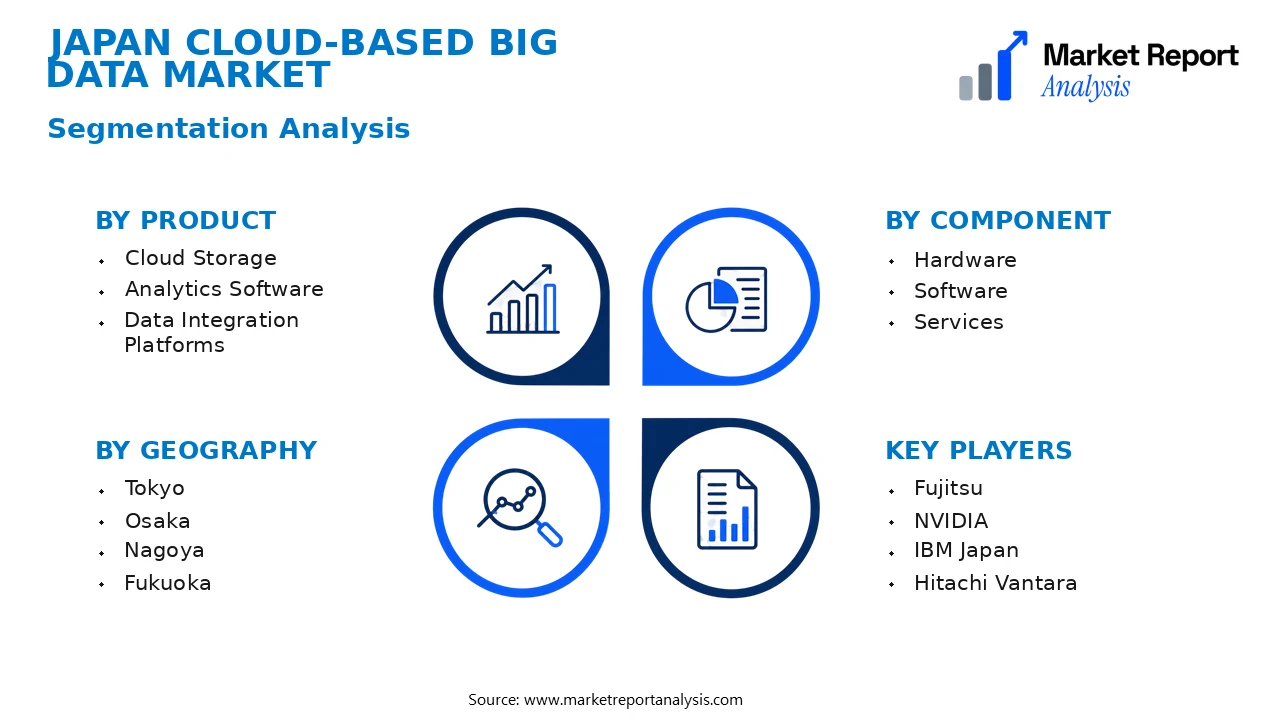
- Product
- Cloud Storage: Storage solutions that enable scalable, secure, and cost-efficient data management for a variety of enterprise applications, driving critical demand for big data processing and archiving in Japan.
- Analytics Software: Includes tools for real-time data analysis, predictive analytics, and statistical modeling, crucial for enabling business intelligence and decision-making processes in diverse Japanese industry sectors.
- Data Integration Platforms: Technologies that facilitate seamless data transfer, consolidation, and synchronization across different cloud environments, enhancing operational flexibility and data accessibility.
- Component
- Hardware: Comprising servers, storage devices, and networking equipment designed specifically for cloud-based big data infrastructures, supporting the high-performance demands of enterprise data environments.
- Software: Systems and applications that facilitate data management, processing, and analysis in the cloud, vital for the operational efficiency of Japanese enterprises adopting big data solutions.
- Services: Consulting, implementation, and managed services that support the deployment and maintenance of cloud big data solutions, helping enterprises optimize their data strategies.
- Industry Vertical
- Retail & E-commerce: Uses cloud-based big data for customer analytics, inventory management, and personalized marketing, reflecting a high demand for customer-centric data solutions in Japan.
- Manufacturing: Leverages big data for predictive maintenance, supply chain optimization, and quality control, driven by Japan's advanced manufacturing sector.
- Financial Services: Incorporates big data analytics for risk management, fraud detection, and customer insights, essential for competitive advantage in Japan's financial industry.
- Healthcare: Utilizes cloud big data for patient data management, research, and personalized medicine, aligning with Japan's aging population and healthcare modernization efforts.
- Geography
- Tokyo: The economic and technological hub of Japan, hosting numerous multinational corporations and technology startups, thus representing the largest market for cloud-based big data solutions.
- Osaka: A key industrial and commercial center that fosters enterprise adoption of big data analytics to enhance manufacturing, logistics, and consumer services sectors.
- Nagoya: An automotive and heavy industry hub, where cloud-based big data supports manufacturing efficiency, supply chain logistics, and quality assurance processes.
- Fukuoka: Known for its growing startup ecosystem and enterprise presence, contributing to regional innovation and the adoption of cloud big data technologies.
Competitive Intelligence
The Japan Cloud-based Big Data Market is characterized by a consolidated competitive landscape dominated by a few key global and domestic players, including multinational cloud providers and specialized big data firms. Major corporations such as Sony, NTT Data, and NEC have adopted aggressive expansion and partnership strategies, leveraging collaborations with technology giants like Amazon Web Services and Microsoft Azure to enhance their cloud offerings. These alliances facilitate access to cutting-edge innovations, including AI integration and advanced analytics capabilities. Market players actively pursue acquisitions of niche startups to accelerate technological advancement and broaden their service portfolios, particularly in sectors such as finance, manufacturing, and healthcare. R&D investments are robust, focusing on enhancing data security, compliance, and real-time analytics to differentiate offerings in a competitive environment. While Tokyo remains the primary hub for innovation and deployment, regional cities like Osaka and Nagoya are increasingly attracting investments due to their growing digital ecosystems. The overall competitive strategy emphasizes product differentiation through tailored solutions, robust cloud security features, and comprehensive support services to gain a foothold in Japan’s rapidly expanding market.
Leading Company Profiles
The competitive landscape in Japan's cloud-based big data market is characterized by a diverse mix of technology giants and innovative startups focusing on cloud infrastructure, data analytics, and AI-driven solutions. These firms are investing heavily in advanced data processing technologies, strategic alliances, and comprehensive service portfolios to capture the growing demand for cloud-enabled big data solutions across Japan’s industries.
- Fujitsu
- NVIDIA
- IBM Japan
- Hitachi Vantara
- NEC Corporation
- Microsoft Japan
- Toshiba
- Sony
- Oracle Japan
- SAP Japan
Fujitsu
Fujitsu offers comprehensive cloud-based big data solutions, leveraging its extensive IT infrastructure and consulting expertise to help Japanese enterprises optimize data analytics, AI integration, and digital transformation initiatives with tailored cloud services.
NVIDIA
NVIDIA drives innovation in cloud-based big data through its leading GPU-accelerated computing platforms, enabling high-performance analytics, AI training, and data processing solutions aligned with Japan’s technological modernization efforts.
IBM Japan
IBM Japan specializes in AI-powered big data analytics, cloud infrastructure, and hybrid cloud solutions that facilitate enterprise-level data management, predictive analytics, and industry-specific applications, enhancing business agility and insights.
Hitachi Vantara
Hitachi Vantara integrates advanced data storage, analytics, and cloud solutions, supporting Japan’s industrial automation and smart city initiatives by enabling scalable, secure, and intelligent data-driven platforms.
NEC Corporation
NEC focuses on AI-infused cloud solutions, data security, and IoT integration, delivering comprehensive big data services that reinforce Japan’s national security, public sector, and enterprise digital strategies.
Microsoft Japan
Microsoft Japan's cloud platform encompasses Azure-based big data analytics, AI tools, and machine learning services, empowering Japanese businesses to leverage scalable, secure, and innovative data solutions.
Toshiba
Toshiba provides industry-specific cloud big data solutions, strength in IoT, and AI, supporting sectors such as manufacturing, transportation, and energy with integrated, efficient data management systems.
Sony
Sony focuses on multimedia, entertainment, and IoT-related big data cloud services, leveraging its consumer electronics expertise to deliver personalized insights and data-driven consumer experiences.
Oracle Japan
Oracle Japan offers enterprise cloud data platforms, Big Data Service, and analytics solutions tailored to large-scale Japanese corporations seeking robust, high-performance cloud-enabled data processing capabilities.
SAP Japan
SAP Japan provides enterprise resource planning (ERP) integrated with cloud-based big data analytics, enhancing operational efficiencies and decision-making processes for industrial clients across Japan.
Strategic Business Developments
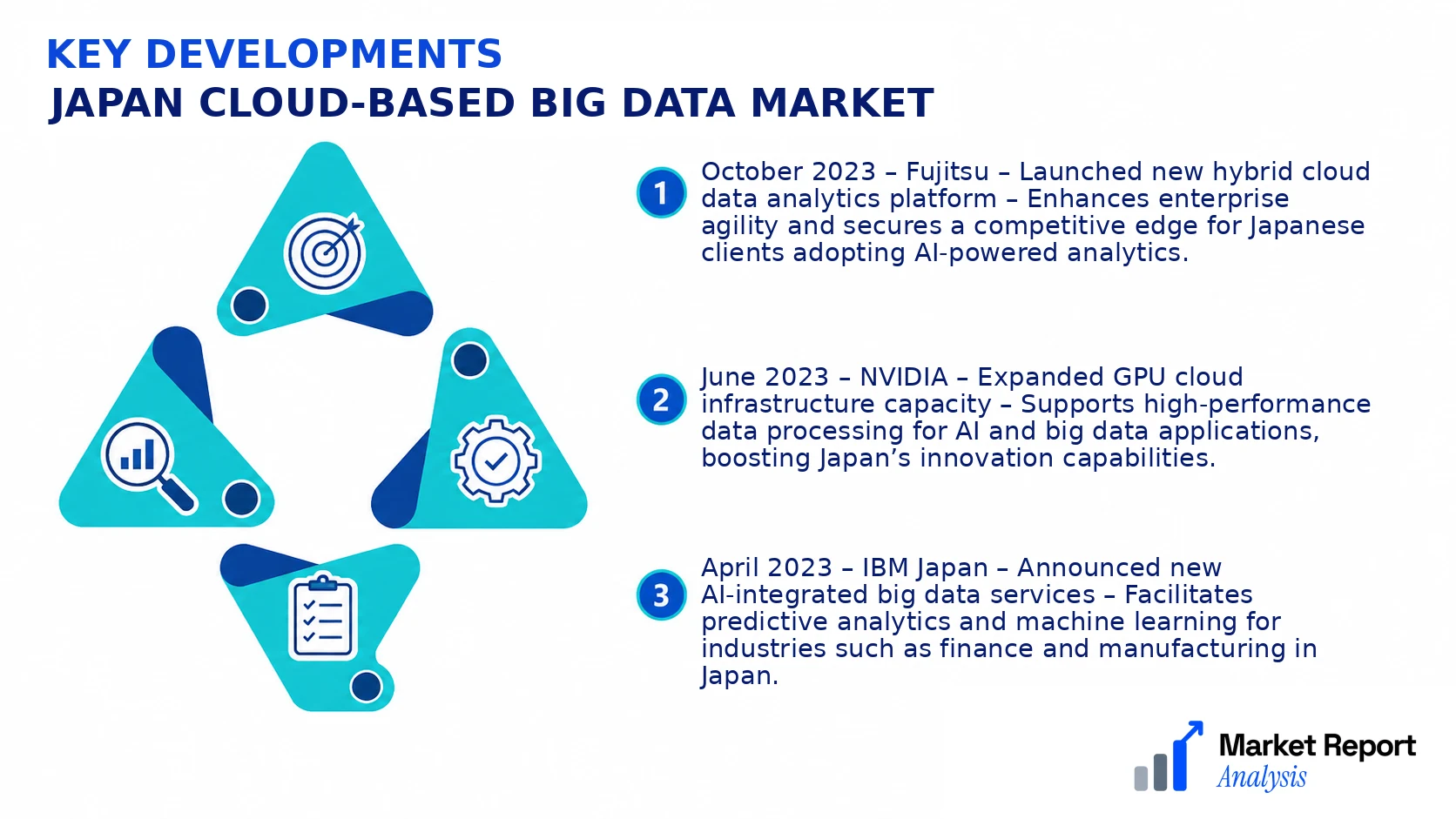
- October 2023 – Fujitsu – Launched new hybrid cloud data analytics platform – Enhances enterprise agility and secures a competitive edge for Japanese clients adopting AI-powered analytics.
- June 2023 – NVIDIA – Expanded GPU cloud infrastructure capacity – Supports high-performance data processing for AI and big data applications, boosting Japan’s innovation capabilities.
- April 2023 – IBM Japan – Announced new AI-integrated big data services – Facilitates predictive analytics and machine learning for industries such as finance and manufacturing in Japan.
- February 2023 – Hitachi Vantara – Acquired a data management startup – Strengthens its hybrid cloud and data infrastructure offerings, aligning with Japan’s smart city and Industry 4.0 projects.
- January 2023 – NEC Corporation – Initiated a government-led digital initiative – Focuses on security and data sovereignty in cloud big data services for public sector modernization.
Frequently Asked Questions
What is the Japan Cloud-based Big Data Market?
The Japan Cloud-based Big Data Market encompasses the deployment and utilization of cloud computing technologies to process, analyze, and store large volumes of data for various sectors such as manufacturing, retail, finance, and healthcare within Japan, supporting data-driven decision making.
What is the current market size of Japan Cloud-based Big Data Market?
As of 2026, the market size of Japan's Cloud-based Big DataMarket is estimated to be around USD 14.2 Billion, reflecting substantial growth driven by increasing digital transformation initiatives and the adoption of cloud solutions across enterprises.
What factors are driving the Japan Cloud-based Big Data Market?
Key drivers include the rapid digitalization of industries, government initiatives fostering cloud adoption, rising data volumes, increasing focus on data privacy and security, and the growing need for real-time analytics for competitive advantage in various sectors.
Which region dominates the Japan Cloud-based Big Data Market?
The Kanto region, particularly Tokyo, dominates the market due to its concentration of technology companies, financial institutions, and large enterprises, which primarily adopt cloud-based big data solutions for innovation and operational efficiency.
Which segment is expected to grow the fastest?
The healthcare and retail segments are projected to experience the fastest growth, driven by the need for personalized services, improved operational efficiency, and the adoption of AI-powered analytics within these sectors in Japan.
Who are the leading companies operating in the Japan Cloud-based Big Data Market?
Major players include international giants such as Amazon Web Services, Microsoft Azure, and Google Cloud, along with prominent Japanese companies like NTT Data, Fujitsu, and NEC, who are expanding their cloud offerings to capture market share.
Analyst Perspective
The Japan Cloud-based Big Data Market exhibits a mature yet evolving landscape, with substantial long-term growth driven by digital transformation initiatives across sectors like manufacturing, finance, and retail. Commercial opportunities are concentrated in enterprise analytics, AI integration, and sector-specific cloud solutions, particularly in metropolitan areas such as Tokyo, Osaka, and Nagoya, which demonstrate higher adoption rates and technological readiness. Technology evolution is poised to focus on advanced analytics, real-time data processing, and hybrid cloud architectures, enabling more scalable and secure data environments. Investment priorities should target infrastructure upgrades, cybersecurity enhancements, and strategic partnerships with cloud service providers. Competitive intensity remains high, with established global players and local newcomers vying for market share. Regional growth potential is significant, especially in city clusters advocating smart city initiatives and Industry 4.0 deployments. Long-term success will hinge on Japan’s ability to balance innovation with regulatory compliance, fostering an ecosystem conducive to sustainable, cybersecurity-resilient cloud big data solutions.
