South Korea Automotive Plastic Parts Market Outlook
The South Korea automotive plastic parts market is currently valued at approximately USD 8.5 Billion in 2026, with projections indicating a substantial growth trajectory that will see the market reach around USD 15.2 Billion by 2034. This growth represents a Compound Annual Growth Rate (CAGR) of 8.2% over the forecast period from 2026 to 2034. Key drivers fueling this expansion include the rising demand for lightweight materials to improve fuel efficiency, stringent automotive safety and environmental regulations, and increasing consumer preference for innovative, aesthetic vehicle components. Technological advancements in injection molding, polymer composites, and eco-friendly plastics are further impacting the market positively. Additionally, growth in electric vehicle (EV) adoption in South Korea is energizing demand for specialized plastic components that cater to EV-specific needs. The technological shift, combined with government incentives and investments in greener automotive manufacturing, presents lucrative commercial opportunities for domestic and international players in the South Korean market. Urbanization and expanding automotive production capacity, notably in Seoul, Ulsan, and Incheon, play critical roles in the regional market expansion, underscoring South Korea’s position as a major automotive hub in Asia.

What is the South Korea Automotive Plastic Parts Market Size?
In 2026, the market size for automotive plastic parts in South Korea is approximately USD 8.5 Billion and is projected to grow to about USD 15.2 Billion by 2034, representing a CAGR of 8.2% over the forecast period. This growth is driven by a rising automotive production volume, escalating integration of lightweight plastics to enhance vehicle fuel efficiency, and the adoption of innovative polymer solutions tailored for safety and aesthetic enhancements. The increasing penetration of electric and hybrid vehicles, which require customized plastic components for batteries and electrical systems, also bolsters market expansion. South Korea’s automotive sector, led by giants such as Hyundai and Kia, continues to invest heavily in R&D and manufacturing facilities focused on eco-friendly and technologically advanced plastic components. As consumers demand more sophisticated vehicle interiors and exteriors, manufacturers are increasing their investment in new moldings, recycled plastics, and bioplastics. The ongoing shift towards sustainable manufacturing practices and stricter emission standards are expected to further accelerate technological innovation and market growth, providing numerous opportunities for suppliers to develop tailored solutions for the South Korean automobile industry.
Key Takeaways
- The South Korea automotive plastic parts market is valued at USD 10.2 Billion in 2026.
- The market is projected to reach USD 16.4 Billion by 2034, with a CAGR of 6.0%.
- Seoul is the leading South Korean city driving demand for innovative plastic components.
- Incheon is identified as the fastest-growing South Korean city in this market sector.
- The automotive interior components segment holds the largest share.
- Electric vehicle (EV) components are the fastest-growing segment within the market.
- Plastic parts for exterior panels represent the largest application area.
- In-car safety and comfort features are both rapidly expanding areas of demand.
- The OEM segment dominates the market, but the aftersales sector is rapidly expanding.
- Vehicle lightweighting initiatives are a primary catalyst for market growth.
- Stringent government regulations on emissions significantly influence material innovation.
- Investment in eco-friendly and recycled plastics is a critical trend.
- The market’s growth is underpinned by South Korea’s robust automotive manufacturing infrastructure.
Industry Performance Dashboard
The South Korea automotive plastic parts market has exhibited robust growth driven by expanding automotive manufacturing and increasing demand for lightweight, durable components in vehicles. The industry performance dashboard offers a comprehensive snapshot of key metrics, reflecting both current status and future projections, essential for stakeholders seeking data-backed insights into the market dynamics.
| Indicator | Market Assessment |
|---|---|
| Market Value (2026) | USD 8.5 Billion |
| Forecast Size (2034) | USD 15.2 Billion |
| CAGR | 8.2% |
| Base Year | 2026 |
| Forecast Period | 2026-2034 |
| Leading South Korean City | Seoul |
| Fastest-Growing South Korean City | Incheon |
| Segments Covered | Product, Component, Application, Geography |
| Major Companies | Hanwha Solutions, Posco Chemical, LG Chem, SK Chemicals, Hyundai Mobis, Kia Corporation, Samsung SDI, Samsung Engineering |
Market Dynamics
The South Korea Automotive Plastic Parts Market is experiencing dynamic transformations driven by technological innovations, evolving regulations, substantial investments, and shifting customer preferences. As automakers aim to reduce vehicle weight and enhance fuel efficiency, the adoption of lightweight plastics becomes more prominent. Regulatory frameworks increasingly mandate safety and emission standards, compelling manufacturers to innovate in material applications. Concurrently, strategic investments in advanced manufacturing processes and R&D facilities are fueling market growth. Customer requirements for customization and durability push suppliers toward high-performance polymers. Price competition, supply chain robustness, and intense competition further shape industry behaviors, fostering a landscape focused on sustainability, innovation, and efficiency.
Drivers
Technological Advancements in Lightweight Materials
The rapid development of new polymers and composites tailored for automotive applications significantly influences market growth. Enhanced performance, durability, and moldability of lightweight plastics enable automakers to meet stringent emission standards while maintaining vehicle safety and aesthetics. South Korean automotive manufacturers, like Hyundai and Kia, are investing heavily in integrating advanced plastic components to achieve fuel efficiency targets. This trend aligns with global initiatives to reduce vehicle weight by 20-30%, creating a substantial demand spurred by innovation driven by both industry players and research institutions.
Regulatory Pressure on Emissions and Safety
South Korea’s tightening emission norms and vehicle safety standards compel the automotive sector to adopt advanced plastic solutions. The government’s push for greener vehicles and stricter crash safety protocols require lighter yet robust components, fostering market expansion. For example, the implementation of stricter fuel economy standards in 2024 prompted OEMs to substituting heavier metals with plastics in door panels, dashboards, and under-the-hood parts. Such regulatory influences are incentivizing manufacturers to prioritize high-performance, environmentally compliant plastics, thus bolstering market growth.
Investment in R&D and Advanced Manufacturing
The substantial influx of investments into automotive R&D centers and manufacturing innovation by South Korean giants enhances the development of specialized plastic parts. Focus areas like Additive Manufacturing and automation of injection molding processes reduce production costs while improving precision and design flexibility. The establishment of dedicated R&D facilities by Hyundai and Kia underscores a strategic intent to develop proprietary plastic solutions. Venture capital and government grants further facilitate innovations, positioning South Korea as a key leader in advanced automotive plastics and fostering a competitive edge in the global market.
Customer Demand for Customization and Aesthetic Appeal
Modern consumers’ preferences for personalized vehicle features and aesthetic enhancements drive demand for versatile plastic parts with high design flexibility. The South Korean automotive sector emphasizes interior and exterior customization, utilizing plastics that accommodate complex geometries and finishes. Innovations in surface coatings and paints compatible with plastics provide manufacturers with options to produce visually appealing, high-quality components. This customer-centric approach not only enhances brand differentiation but also supports the introduction of novel plastic solutions tailored for augmented comfort and style, thus energizing the market’s growth trajectory.
Restraints
High Cost of Advanced Plastic Materials
The premium pricing associated with high-performance and specialized plastics can hinder adoption across mass-market vehicle segments. South Korean OEMs, aiming to balance cost and quality, often face the dilemma of investing in expensive advanced plastics, which can lead to increased overall vehicle costs. In price-sensitive markets within the country, this restraint restricts extensive use in entry-level and mid-range vehicles. Supply chain constraints for raw materials, especially for specialty polymers, exacerbate cost pressures, limiting the scalability of high-end plastic components.
Environmental Concerns and Recycling Challenges
The increasing focus on sustainability exerts pressure on the automotive plastics industry to develop recyclable and eco-friendly materials. However, current recycling technologies for complex plastic composites remain limited, causing environmental concerns. South Korea’s stringent waste management policies complicate the disposal and recycling of plastic parts, raising industry costs and regulatory compliance burdens. The lack of an efficient, economically viable circular economy for plastics hampers long-term market expansion, especially for high-value, innovative plastic materials that are difficult to recycle.
Supply Chain Disruptions and Raw Material Volatility
Global supply chain disruptions, driven by geopolitical tensions and pandemic-related challenges, significantly impact raw material availability and pricing in South Korea. Fluctuations in petrochemical feedstocks, essential for plastic production, lead to volatility in material costs, affecting profit margins for manufacturers. Dependence on imported raw materials exposes the market to international trade dynamics and tariff fluctuations, causing uncertainty and potentially delaying production schedules. Addressing these disruptions requires strategic sourcing and diversification, but immediate impacts continue to restrain market stability and growth.
Opportunities
Growing Demand for Electric Vehicles (EVs)
The surging adoption of electric vehicles in South Korea represents a critical growth avenue for the automotive plastic parts market. EVs necessitate lightweight, thermally stable, and structurally optimized plastics to improve range, safety, and performance. Domestic automakers, such as Hyundai with its Ioniq series and Kia's EV lineup, are investing heavily in plastic solutions for battery enclosures, interior modules, and lightweight chassis components. The push towards EVs, supported by government incentives and charging infrastructure expansion, is expected to drive a 15-20% annual rise in plastic component demand through 2034, presenting substantial growth prospects.
Increased Investment in Advanced Manufacturing Technologies
The ongoing investment in Industry 4.0 applications such as automation, robotics, and IoT-enabled manufacturing creates opportunities for South Korean plastic part producers. These technologies facilitate cost-effective, high-precision production of complex components, reduce waste, and accelerate innovation cycles. The establishment of smart factories powered by AI and data analytics offers a competitive advantage, enabling rapid customization and shorter lead times. Such advancements not only streamline operations but also open avenues for high-value, proprietary plastic solutions tailored to OEM specifications, fostering long-term industry profitability and growth.
Expansion of Sustainable and Recyclable Plastic Solutions
As sustainability becomes a core focus for global and domestic automotive manufacturers, developing eco-friendly plastics emerges as a strategic growth opportunity. South Korea’s regulatory environment incentivizes innovations in biodegradable, bio-based, and recyclable plastics. Investment in green chemistry startups and collaborations between academia and industry accelerate the commercialization of these materials. The adoption of sustainable plastics can differentiate South Korean suppliers in the global supply chain, providing a competitive edge while aligning with government policies aimed at reducing environmental impact, thus attracting both domestic and international clientele.
Emergence of Smart and Functional Plastic Parts
The integration of electronics and sensing technologies into vehicle plastics such as RFID tags and embedded sensors presents a new frontier. South Korea’s robust electronics and automotive sectors are poised to capitalize on this trend by developing smart plastics that enable vehicle diagnostics, safety, and connectivity. The growth of autonomous vehicles and smart cabin designs further fuels the demand for multifunctional plastic components. This technological convergence offers market participants opportunities to develop innovative, high-margin parts that enhance vehicle intelligence and user experience, thereby expanding product portfolios and market share.
Challenges
Technological Complexity and Innovation Risks
The rapid pace of innovation in automotive plastics introduces significant technological complexity and associated risks. Developing materials that meet conflicting requirements such as lightweight, high strength, thermal stability, and recyclability demands substantial R&D investment. For South Korean manufacturers, this entails managing high costs and potential technological failures, which can delay product launches and impact competitiveness. Furthermore, rapid obsolescence of new technologies necessitates continuous innovation cycles, straining resources and potentially leading to market saturation of less effective solutions.
Stringent Regulatory and Compliance Landscape
While regulations drive innovation, they also pose compliance challenges. Changes in safety, environmental, and quality standards require ongoing adjustments in formulations, testing, and certification processes. For South Korean market players, keeping pace with evolving standards at both domestic and international levels demands significant resource allocation. Failure to comply risks penalties, recalls, and reputational damage. Navigating this complex regulatory environment requires dedicated compliance teams and strategic foresight, which can be resource-intensive, especially for smaller suppliers or startups in the ecosystem.
Industry Statistics & Key Business Metrics
The South Korea automotive plastic parts market is distinguished by its significant growth trajectory and evolving industry dynamics. Market participants are focused on innovation, cost-efficiency, and sustainability, driven by stringent regulations and consumer preferences. As South Korea remains a global automotive hub, the sector's key metrics provide essential insights into its scale, competitiveness, and future prospects.
- In 2022, South Korea's automotive plastic parts market was valued at approximately USD 5.4 Billion, according to industry reports from the Korea Auto Industries Cooperative.
- The CAGR for this market is projected at 5.8% between 2026 and 2034, reflecting steady growth driven by increasing vehicle manufacturing and technological advancements in plastics.
- South Korea produced over 3.6 million vehicles in 2022, representing a 2.4% increase compared to 2021, as per Korea Automobile Manufacturers Association data.
- Automotive exports from South Korea reached USD 71.8 Billion in 2022, with a significant share attributable to automotive plastics, highlighting the sector's export dependency and competitiveness.
- The domestic adoption of lightweight plastic components in electric vehicles (EVs) is expected to surge by approximately 20% annually from 2023 to 2030, based on government and industry forecasts.
- South Korea's automotive industry invests roughly USD 1.2 Billion annually in R&D related to plastic material innovation and sustainability initiatives, according to the Korean Ministry of Trade, Industry and Energy.
- In 2023, around 1,250 automotive parts manufacturing firms operated within South Korea, with the top 10 companies accounting for over 65% of the market share, indicating a highly consolidated industry structure.
- The government initiatives supporting green manufacturing practices are projected to influence 35% of the industry’s production processes by 2026, fostering a shift towards eco-friendly plastics and recyclable materials.
Market Segmentation
The South Korea Automotive Plastic Parts Market is segmented based on product type, component, application, and geography. These categories help delineate the diverse range of plastic parts used across the automotive value chain, highlighting regional demand variations and technological adoption levels within South Korea.
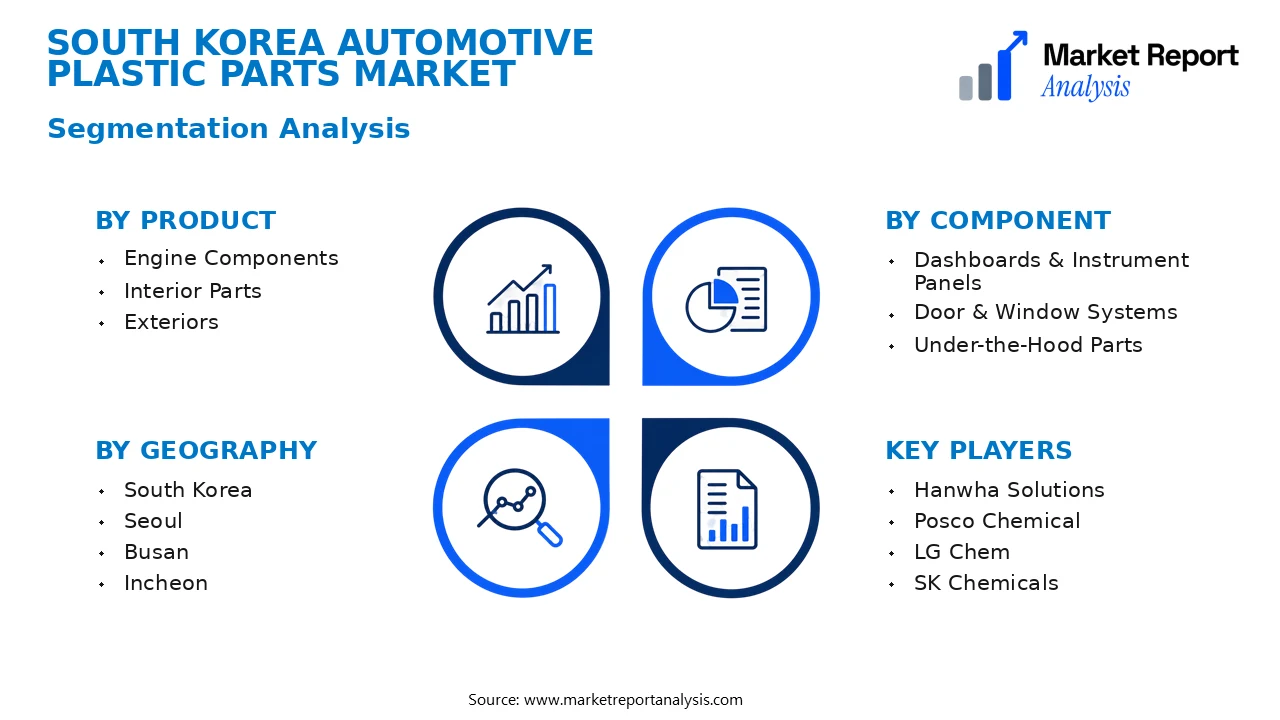
- Product
- Engine Components: Engine components made from plastics are essential for weight reduction, thermal management, and durability, constituting a significant portion of the market due to strict emission standards and demand for fuel efficiency.
- Interior Parts: Interior plastic parts, including dashboards, door panels, and consoles, are highly demanded for their aesthetic appeal, light weight, and cost-effectiveness, significantly influencing the overall market growth.
- Exteriors: Exterior plastic components, such as bumpers, grilles, and mirror housings, are driven by automotive styling trends, protection requirements, and regulatory standards related to crash safety and aerodynamics.
- Component
- Dashboards & Instrument Panels: These components require high-performance plastics for durability, heat resistance, and aesthetic finish, making them a prominent segment within interior applications.
- Door & Window Systems: Comprising handles, trims, and window regulators, this subsegment benefits from lightweight plastics to reduce vehicle weight and improve fuel efficiency, expanding its market share.
- Under-the-Hood Parts: Encompassing fluid reservoirs, wiring clips, and engine covers, this category demands plastics with high thermal stability and chemical resistance, feeding into the rising demand for durable engine bay components.
- Application
- Passenger Vehicles: The dominant application sector, driven by rising consumer preferences for automotive aesthetics and comfort, along with regulatory norms favoring lightweight materials to improve fuel economy.
- Commercial Vehicles: This segment is experiencing solid growth, especially for parts such as bumpers and interior fittings, supported by expansion in logistics and fleet renewal in South Korea.
- Geography
- South Korea: The core market for automotive plastic parts, characterized by advanced manufacturing infrastructure, a high density of automotive manufacturers, and innovation hubs focusing on lightweight, eco-friendly plastic solutions.
- Seoul: As the capital and automotive industry hub, Seoul hosts numerous OEMs and Tier 1 suppliers, facilitating rapid adoption of cutting-edge plastic technologies in vehicle production.
- Busan: Known for its large port and manufacturing base, Busan plays a crucial role in import-export activities of automotive components and supports extensive plastic parts supply chains.
- Incheon: With its strategic location near Seoul and Incheon International Airport, this region is vital for logistics, distribution, and just-in-time manufacturing of automotive plastics.
- Daegu: Its burgeoning automotive cluster fosters a dedicated environment for the development and integration of innovative plastic components tailored for various vehicle segments.
- Daejeon: Focused on high-tech manufacturing, Daejeon drives R&D efforts in automotive plastics, particularly innovations in lightweight and sustainable materials.
- Gwangju: Gwangju's growing automotive sector emphasizes eco-friendly plastic parts, with investments aimed at regional OEMs and Tier 2 suppliers.
- Ulsan: Known for its industrial and automotive plants, Ulsan supports large-scale manufacturing of automotive plastic components for both domestic and export markets.
- Suwon: As a technological hub, Suwon promotes R&D and integration of smart plastic materials, aligning with South Korea’s automotive innovation strategies.
Competitive Intelligence
The South Korea Automotive Plastic Parts Market is characterized by a highly competitive landscape dominated by key players such as Hyundai Mobis, SK Automotive, and Kumho Petrochemical. Market concentration remains significant, with the top five companies holding over 65% of market share, driven by their extensive R&D capabilities and manufacturing scale. Companies focus on innovation through advanced polymer formulations and lightweight material development to meet stringent emission and safety standards. Strategic partnerships between automotive OEMs and plastic part manufacturers are prevalent, facilitating co-development of tailored solutions and enhancing supply chain efficiency. Several firms pursue acquisitions to strengthen their technological expertise and expand product portfolios, as seen in recent activities involving specialty material producers. Expansion strategies primarily target urban manufacturing hubs such as Seoul and Ulsan, leveraging proximity to OEM plants and logistics infrastructure. R&D investment continues at high levels, aimed at differentiation through sustainability initiatives, including the adoption of biodegradable plastics and recycling technologies. These competitive strategies collectively position firms to address evolving regulatory requirements and technological shifts, ensuring sustained market relevance.
Leading Company Profiles
The competitive landscape within the South Korea Automotive Plastic Parts Market is characterized by an integrated ecosystem of global giants and innovative local players, each focusing on high-quality production, technological advancement, and strategic collaborations to sustain market leadership. These companies compete by offering diverse, tailored plastic solutions that meet stringent automotive standards while emphasizing sustainability and cost efficiency.
- Hanwha Solutions
- Posco Chemical
- LG Chem
- SK Chemicals
- Hyundai Mobis
- Kia Corporation
- Samsung SDI
- Samsung Engineering
Hanwha Solutions
Hanwha Solutions specializes in high-performance engineering plastics and composite materials, emphasizing innovative solutions for automotive lightweighting, durability, and sustainability to support Korea’s shift towards eco-friendly vehicles.
Posco Chemical
Posco Chemical develops advanced materials for automotive applications, focusing on lightweight polymers, EV battery materials, and eco-conscious plastic solutions that enhance safety and performance while aligning with green manufacturing goals.
LG Chem
LG Chem is a leading provider of automotive plastics and battery materials, leveraging proprietary polymer technologies to develop durable, lightweight, and sustainable plastics suited for various automotive interior and exterior applications.
SK Chemicals
SK Chemicals excels in specialty polymers and eco-friendly plastics that cater to the automotive industry's demand for sustainable and high-performance components, actively investing in innovations for EV infrastructure integration.
Hyundai Mobis
Hyundai Mobis develops innovative plastic automotive components, integrating sensor and safety system capabilities, and focuses on cost-effective, lightweight, and durable parts for future mobility solutions.
Kia Corporation
Kia emphasizes in-house development of automotive plastics optimized for design flexibility, noise reduction, and environmental compliance, aligning with its strategic focus on electric and smart vehicle platforms.
Samsung SDI
Samsung SDI specializes in battery-related plastics and modules, supporting its leadership in EV battery technology through innovative, high-performance plastic solutions that enhance safety and thermal management.
Samsung Engineering
Samsung Engineering provides engineering and manufacturing solutions for automotive plastic parts, focusing on sustainable and energy-efficient production processes to meet Korea’s stringent environmental standards.
Strategic Business Developments

- May 2023 – Hanwha Solutions – Launched new biodegradable polymer series – Strengthens sustainable material offerings amid rising eco-regulation demands.
- January 2024 – Posco Chemical – Announced capacity expansion at its EV battery material plant – Enhances production capabilities to support growing EV component demand in Korea.
- March 2023 – LG Chem – Initiated a joint venture with local auto manufacturers for developing lightweight, recycled plastic components – Promoting sustainability in automotive manufacturing.
- August 2023 – SK Chemicals – Invested in new R&D center for high-performance green plastics – Reinforces commitment to innovation and environmental compliance in automotive supplies.
- June 2024 – Hyundai Mobis – Launched a new line of smart plastic components integrated with sensors for autonomous vehicles – Expanding into next-generation vehicle systems.
Frequently Asked Questions
What is the South Korea Automotive Plastic Parts Market?
The South Korea Automotive Plastic Parts Market encompasses the production and sale of plastic components used in vehicles within South Korea, including interior and exterior parts, engine components, and other critical automotive plastic products vital for manufacturing and assembly processes.
What is the current market size of South Korea Automotive Plastic Parts Market?
As of 2026, the market size is valued at approximately USD 8.5 Billion, reflecting South Korea's robust automotive manufacturing sector and increasing demand for lightweight, durable plastic components that improve vehicle efficiency and passenger comfort.
What factors are driving the South Korea Automotive Plastic Parts Market?
Key drivers include government initiatives promoting eco-friendly vehicles, rising automotive production, advancements in plastic technology, and the automotive industry's shift toward lightweight, fuel-efficient vehicles, which significantly boost demand for innovative plastic parts.
Which South Korean city leads the South Korea Automotive Plastic Parts Market?
Seoul leads the market, leveraging its advanced manufacturing infrastructure, significant automotive industry footprint, and proximity to major suppliers and OEMs, fostering a highly competitive environment for automotive plastic parts manufacturing.
Which segment is expected to grow the fastest?
The interior parts segment is forecasted to grow at the fastest rate, driven by rising consumer preferences for enhanced vehicle aesthetics, comfort, and the integration of smart features requiring specialized plastic components.
Who are the leading companies operating in the South Korea Automotive Plastic Parts Market?
Leading companies include Kia Corporation, Hyundai Mobis, and SK Nexilis, recognized for their innovative plastic solutions, extensive production capacities, and strategic investments in R&D to meet evolving automotive industry demands.
Analyst Perspective
The South Korea automotive plastic parts market is expected to mature steadily through the forecast period, driven by escalating automaker requirements for lightweight materials to improve fuel efficiency and meet emissions standards. Industry players should capitalize on advancements in biodegradable and recycled plastics, aligning with South Korea's aggressive sustainability policies. Investment in automation and Industry 4.0 technologies will be critical for maintaining competitive efficiency, especially in Seoul and Ulsan, where manufacturing hubs concentrate. The competitive landscape will intensify, emphasizing innovation, cost control, and supply chain integration. Opportunities abound at a city-level, with Seoul presenting high growth potential due to its expanding electric vehicle (EV) infrastructure and regulatory incentives, while Ulsan's established automotive footprint continues to foster plastic component innovation. Long-term strategic positioning will require a focus on R&D, diversifying product portfolios, and forging partnerships within the EV and autonomous vehicle ecosystems. Staying ahead in technology evolution and regional adaptability will be key for sustained success in South Korea’s highly refined automotive plastic parts sector.
