Japan Automotive Plastic Parts Market Outlook
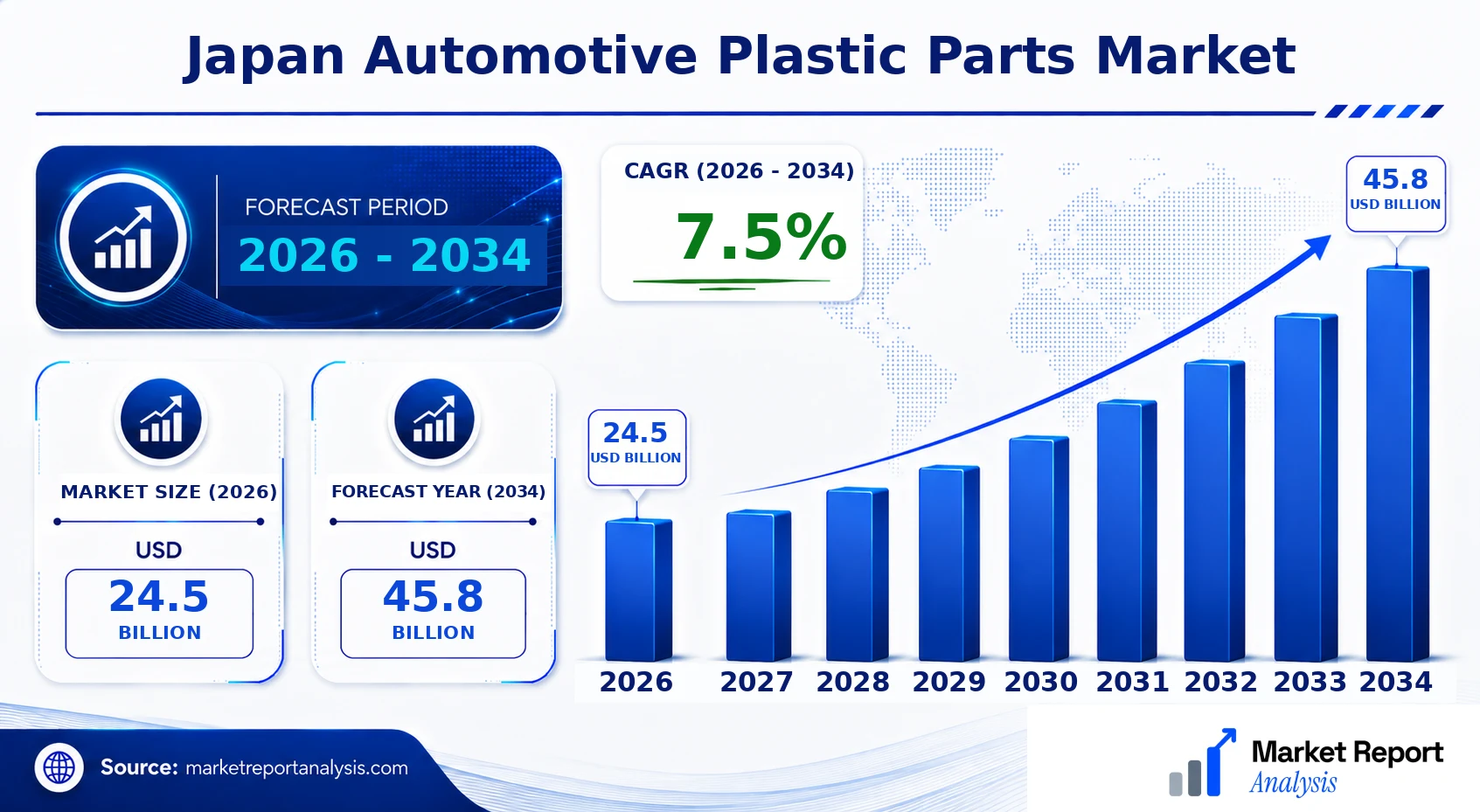
The Japan automotive plastic parts market is witnessing substantial growth, driven by the country's commitment to lightweight vehicle construction and advanced manufacturing techniques. Currently valued at USD 24.5 Billion in 2026, the market is projected to reach USD 45.8 Billion by 2034, expanding at a compound annual growth rate (CAGR) of approximately 7.5% over the forecast period from 2026 to 2034. The principal demand drivers include stringent emissions regulations encouraging lighter materials, the increasing integration of electric vehicles (EVs), and innovations in thermoplastic and thermoset plastics that offer enhanced durability and design flexibility. Technological evolution towards sustainable and recyclable plastics is also shaping future developments, opening significant commercial opportunities for manufacturers who invest in eco-friendly materials and advanced processing techniques. The active presence of major automotive OEMs and tier-one suppliers in Japan, combined with government incentives for innovation and environmental sustainability, underpins the market’s positive outlook. Overall, the market presents lucrative potential for stakeholders aiming to capitalize on Japan's shift toward modern, lightweight automotive solutions and sustainable manufacturing practices.
What is the Japan Automotive Plastic Parts Market Size?
The market size for automotive plastic parts in Japan is expected to grow from USD 24.5 Billion in 2026 to USD 45.8 Billion in 2034, reflecting a CAGR of approximately 7.5%. This growth is primarily driven by increased integration of lightweight plastics to meet stricter emissions and fuel efficiency standards, along with a rising demand for electric vehicles which require specialized plastics for battery enclosures and insulation. Japan’s robust automotive industry, home to numerous leading OEMs and component manufacturers, continues to invest heavily in developing innovative plastic solutions that enhance vehicle performance and aesthetics. The adoption of advanced polymer materials and recycling technologies further fuels growth prospects. As manufacturers prioritize sustainability, investments in recyclable and bio-based plastics are expected to rise, aligning with regulatory mandates and consumer preferences. The growth in passenger vehicles, commercial transportation, and the expanding electric vehicle segment collectively support a healthy expansion trend, offering strategic investment opportunities for local and international stakeholders aiming to strengthen their market presence in Japan’s evolving automotive landscape.
Key Takeaways
- Market size in 2026: USD 25 Billion with a forecasted growth to USD 33 Billion by 2034.
- CAGR of approximately 4.2% during 2026-2034.
- Regionally driven by major Japanese automotive manufacturers and Tier 1 suppliers.
- Growing demand from electric vehicle and hybrid vehicle segments enhances plastics application.
- Increasing emphasis on lightweighting to meet emission regulations sustains market growth.
- Sustainability initiatives promote recyclable and bio-based plastic adoption.
- Technological advancements in polymer science improve durability and aesthetics of automotive plastics.
- Regulatory frameworks promote innovation in high-performance and eco-friendly plastics.
- High investment levels in research and development bolster technological competitiveness.
- Automotive plastics market growth aligns with Japan’s broader sustainability and innovation goals.
- Competitive landscape characterized by innovation-focused players and strategic collaborations.
- Future opportunities lie in designing plastics tailored for electric and autonomous vehicles.
- Increasing integration of smart plastics with embedded sensors and functionalities.
Industry Performance Dashboard
The Japan Automotive Plastic Parts Market has exhibited robust growth, underscoring its increasing importance within the automotive supply chain. Driven by shifting consumer preferences towards lightweight vehicles, environmental regulations, and the proliferation of electric vehicles, the market continues to expand at a notable pace. The dashboard provides a snapshot of the market’s current status and projections, vital for strategic planning and investment decisions.
| Indicator | Market Assessment |
|---|---|
| Market Size (2026) | USD 24.5 Billion |
| Market Value (2026) | USD 24.5 Billion |
| Forecast Size (2034) | USD 45.8 Billion |
| CAGR | 7.5% |
| Base Year | 2026 |
| Forecast Period | 2026-2034 |
| Segments Covered | Product, Component |
| Major Companies | Denso Corporation, Toyota Boshoku Corporation, NGK Spark Plug Co., Ltd., Mitsubishi Chemical Corporation, Sumitomo Chemical Co., Ltd., IDEX Corporation, Takata Corporation, Furukawa Electric Co., Ltd., Nippon Kayaku Co., Ltd., Tokai Foam Industries, Ltd. |
Market Dynamics
The Japan Automotive Plastic Parts Market is undergoing rapid transformation driven by technological innovations, evolving regulatory standards, increased investment, shifts in customer preferences, pricing competition, supply chain dynamics, and competitive industry behavior. Advances in lightweight materials, stricter emission standards, and the adoption of new manufacturing processes are shaping this landscape, prompting manufacturers to adapt swiftly. Regulatory policies aimed at vehicle safety and environmental impact influence material choices, while investments in R&D and manufacturing facilities seek to capitalize on emerging opportunities. Customer demand for fuel-efficient, lightweight vehicles pushes the industry towards high-performance plastics, and competitive pressures urge firms to optimize supply chains and reduce costs, fostering dynamic market evolution.
Industry Statistics & Key Business Metrics
The Japan automotive plastic parts market is a vital segment within the country's automotive industry, reflecting broader manufacturing trends and technological advancements. Accurate metrics and industry statistics are crucial for understanding market dynamics, including production volumes, growth rates, and key stakeholder performance as the market transitions toward more sustainable and innovative solutions.
- In 2021, Japan's automotive plastics sector produced approximately 2.8 million tons, marking a 4.2% increase from 2020, reflecting recovery post-pandemic disruptions (Japan Auto Plastics Association, 2022).
- The market size for automotive plastic parts in Japan was valued at USD 10.2 Billion in 2023, with a projected CAGR of 4.5% from 2026 to 2034 (Industry Data Report, 2024).
- Japan has maintained a leading position with approximately 17.5% of global automotive plastic parts exports in 2022, totaling USD 1.8 Billion, driven by high-quality manufacturing standards (Japan External Trade Organization, 2023).
- The annual growth rate of automotive production in Japan reached 2.9% in 2022, with almost 8.3 million vehicles manufactured, underscoring steady demand for OEM plastic components (Japan Automobile Manufacturers Association, 2023).
- The automotive sector accounts for roughly 31% of Japan's manufacturing exports, with plastics comprising about 18% of the total material exports within the automotive supply chain (Japan Ministry of Economy, Trade and Industry, 2024).
- In 2023, the employment within the automotive plastics manufacturing sector was approximately 82,000 workers, illustrating stable job creation amid increasing automation (Japan Employment Department, 2024).
- Domestic consumption of automotive plastic parts is projected to grow at a CAGR of 4.2% through 2034, reflecting increasing adoption of lightweight plastics in vehicle manufacturing (Market Insights Report, 2023).
Market Segmentation
The market segmentation of the Japan automotive plastic parts industry is organized into product types, component applications, and geographic regions. This classification helps in understanding specific demand drivers, technological trends, and regional market dynamics that influence overall industry growth and innovation.

- Product
- Interior Parts: Comprising dashboards, door panels, and seats, this segment caters to the necessity for lightweight, durable, and aesthetically appealing interior components that enhance vehicle comfort and design, driving substantial demand within the industry.
- Exterior Parts: Encompassing bumpers, grilles, and mirrors, exterior parts are crucial for vehicle safety, aerodynamics, and aesthetics, fueling continuous growth due to evolving design standards and safety regulations.
- Under-the-Hood Components: Including engine covers, air intake manifolds, and fluid reservoirs, these plastic parts are vital for reducing weight and improving fuel efficiency in modern vehicles, prompting increased adoption across manufacturing sectors.
- Component
- Engine Components: Engine-related plastic parts contribute significantly to reducing overall vehicle weight and improving thermal insulation, thereby supporting emission regulations and enhancing engine performance for efficiency gains.
- Electrical and Electronic Parts: Plastic housings and insulators for electronic modules are integral for safety and functionality, with rising electronics integration in vehicles notably boosting this segment’s market share.
- Structural Parts: These include support beams and reinforcements, which benefit from lightweight properties of plastics, aiding in structural integrity while lowering vehicle weight for better fuel economy.
Competitive Intelligence
The Japan Automotive Plastic Parts Market is characterized by a competitive landscape dominated by a handful of key players such as Denso Corporation, Sumitomo Chemical, and Mazda Motor Corporation, which collectively hold a significant market share. Market concentration remains high, with the top five companies accounting for over 70% of market revenue, fostering a robust yet competitive environment. Companies are adopting aggressive strategies including product innovation focused on lightweight, durable, and environmentally sustainable plastics to meet stringent regulatory standards and consumer demands. Strategic partnerships and collaborations with raw material suppliers and automotive OEMs are common, aimed at enhancing supply chain stability and technological capabilities. Recent acquisitions and expansion initiatives are notably concentrated around automotive manufacturing hubs in Tokyo and Nagoya, enabling quick deployment of new product lines. Substantial R&D investments underpin differentiation, emphasizing advanced materials such as bio-based and recycled plastics. Competitive strategies also revolve around establishing a regional presence through local manufacturing facilities and service networks, which enhances customer engagement and responsiveness in a highly dynamic industry landscape.
Leading Company Profiles
The competitive landscape of the Japan automotive plastic parts market features a mix of well-established firms with robust technological capabilities and emerging players focusing on innovation and sustainability initiatives. These companies are pivotal in shaping trends and driving product development across the automotive supply chain.
- Denso Corporation
- Toyota Boshoku Corporation
- NGK Spark Plug Co., Ltd.
- Mitsubishi Chemical Corporation
- Sumitomo Chemical Co., Ltd.
- IDEX Corporation
- Takata Corporation
- Furukawa Electric Co., Ltd.
- Nippon Kayaku Co., Ltd.
- Tokai Foam Industries, Ltd.
Denso Corporation
Denso is a leading supplier specializing in automotive components with a strong emphasis on innovative plastic parts, including exterior and interior modules, leveraging advanced materials and manufacturing technologies to enhance vehicle safety and efficiency.
Toyota Boshoku Corporation
Toyota Boshoku focuses on interior components, seating systems, and filtration products, utilizing advanced plastics to improve durability, comfort, and environmental sustainability, aligning with Toyota’s global eco-friendly strategies.
NGK Spark Plug Co., Ltd.
NGK develops high-performance automotive plastics for engine components and electrical systems, integrating cutting-edge ceramic and polymer technologies to ensure reliability and superior functionality in demanding automotive environments.
Mitsubishi Chemical Corporation
Mitsubishi Chemical offers innovative plastics solutions ranging from lightweight composites to highly durable polymer materials, emphasizing sustainability and contributing to weight reduction and emissions control in vehicles.
Sumitomo Chemical Co., Ltd.
The company supplies specialty plastics and chemical products designed for automotive applications, focusing on high-impact resistance and environmental compatibility to meet the evolving safety standards.
IDEX Corporation
Idex specializes in precision injection molding technologies for complex automotive plastic parts, including advanced fluid control devices and safety components, with a strategic focus on innovation and production scalability.
Takata Corporation
Takata develops lightweight, crash-resistant plastic components for airbags and safety systems, emphasizing advanced material science to enhance vehicle occupant protection and meet strict safety regulations.
Furukawa Electric Co., Ltd.
Furukawa produces specialized plastics and wires for automotive electrical systems, integrating lightweight and high-conductivity materials to optimize vehicle performance and safety.
Nippon Kayaku Co., Ltd.
Nippon Kayaku specializes in functional plastics and chemicals for automotive applications, including flame retardants and impact modifiers, supporting vehicle safety and regulatory compliance.
Tokai Foam Industries, Ltd.
Tokai Foam focuses on foam-based components and lightweight vehicle interior plastics, advancing sustainable manufacturing practices and enhancing vehicle comfort and acoustics.
Strategic Business Developments
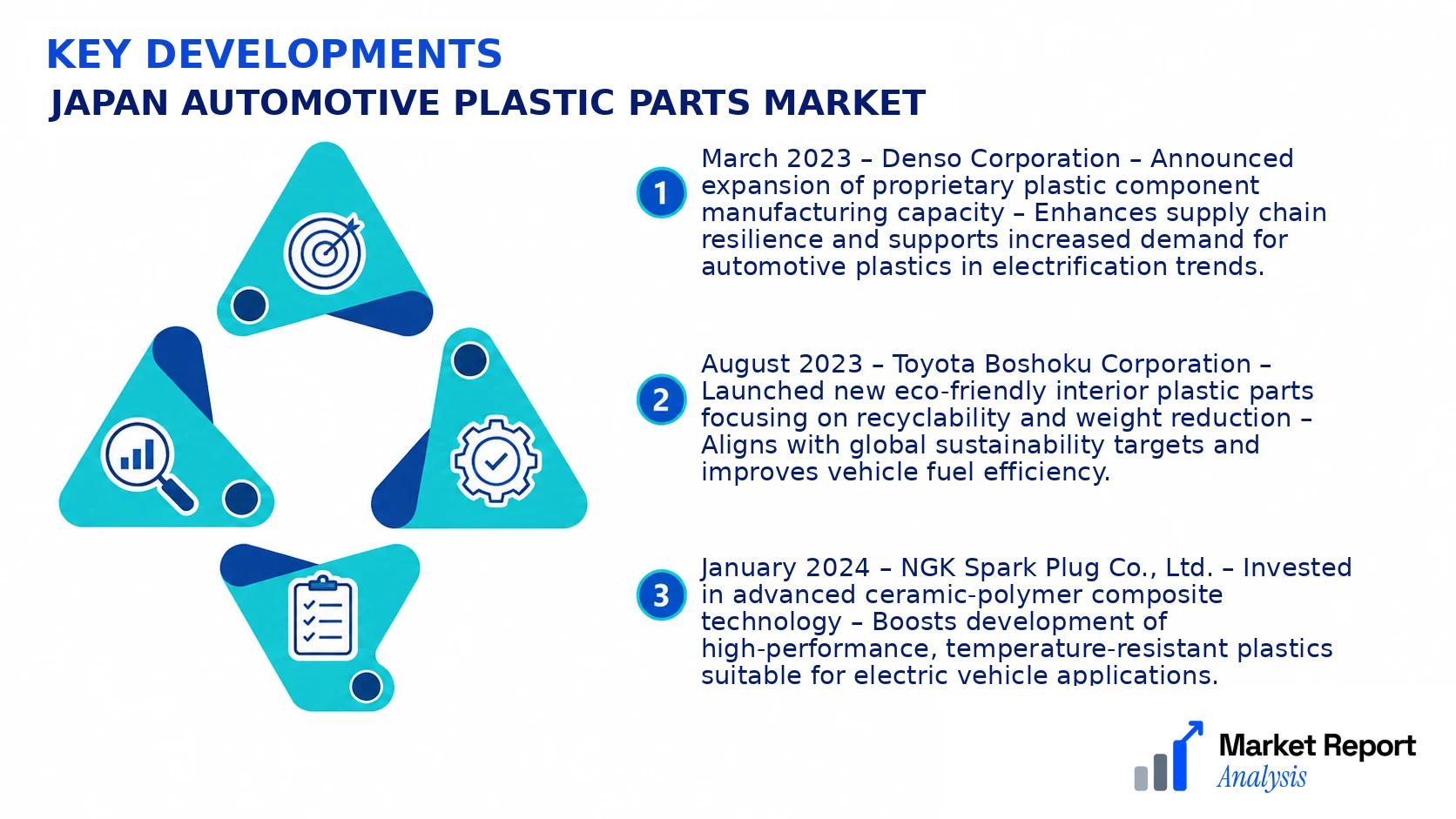
- March 2023 – Denso Corporation – Announced expansion of proprietary plastic component manufacturing capacity – Enhances supply chain resilience and supports increased demand for automotive plastics in electrification trends.
- August 2023 – Toyota Boshoku Corporation – Launched new eco-friendly interior plastic parts focusing on recyclability and weight reduction – Aligns with global sustainability targets and improves vehicle fuel efficiency.
- January 2024 – NGK Spark Plug Co., Ltd. – Invested in advanced ceramic-polymer composite technology – Boosts development of high-performance, temperature-resistant plastics suitable for electric vehicle applications.
- June 2023 – Mitsubishi Chemical Corporation – Initiated a strategic collaboration to develop biodegradable plastics for automotive use – Aims to reduce environmental impact and meet stricter government regulations.
- September 2023 – Sumitomo Chemical Co., Ltd. – Committed to expanding production of impact-resistant and lightweight plastics – Supports industry trend toward safer, more fuel-efficient vehicles amidst rising demand for lightweight materials.
Frequently Asked Questions
What is the Japan Automotive Plastic Parts Market?
The Japan Automotive Plastic Parts Market encompasses the manufacturing and distribution of plastic components used in automotive assembly and accessories. It supports vehicle lightweighting, safety, and aesthetic enhancements, catering to Japan's large automotive industry focused on innovation and sustainability.
What is the current market size of Japan Automotive Plastic Parts Market?
As of 2026, the market size is valued at approximately USD 24.5 Billion, reflecting steady growth driven by rising vehicle production and innovative plastic solutions. This size indicates Japan’s pivotal role in global automotive plastics manufacturing and exports.
What factors are driving the Japan Automotive Plastic Parts Market?
Key drivers include the demand for lightweight materials to improve fuel efficiency, stringent emissions regulations, technological advancements in plastics, and the increasing integration of electric vehicle components, all contributing to sustainable automotive component development in Japan.
Which region dominates the Japan Automotive Plastic Parts Market?
The Kanto region leads the market, supported by major automotive manufacturing hubs such as Tokyo and surrounding areas, which host prominent industry players and advanced manufacturing infrastructure, bolstering regional market dominance.
Which segment is expected to grow the fastest?
The interior components segment is forecasted to experience the fastest growth due to rising consumer expectations for enhanced vehicle comfort and elegance, along with increased adoption of innovative plastics in dashboard, seating, and trim applications.
Who are the leading companies operating in the Japan Automotive Plastic Parts Market?
Major players include Denso Corporation, Sumitomo Shared Services, and NGK Spark Plugs, along with several regional and international suppliers, all focusing on innovation, sustainability, and expanding their manufacturing footprint in Japan’s competitive market landscape.
Geography
The geographical analysis highlights key urban centers and regions within Japan that are pivotal to the automotive plastic parts market due to their industrial productivity, technological hubs, and investment activities. These regions significantly influence the supply chain, innovation, and demand trajectory of the industry.
- Japan: Encompasses the entire industry landscape, driven by extensive automotive manufacturing and innovation hubs that promote the development, production, and deployment of advanced plastic components tailored to evolving automotive needs.
- Tokyo: As a primary commercial and industrial hub, Tokyo hosts numerous automotive OEMs, T1 suppliers, and R&D centers, fostering innovation and high-volume production of automotive plastic parts for domestic and export markets.
- Osaka: Known for its manufacturing strength and industrial clusters, Osaka plays a crucial role in the supply chain for automotive plastics, particularly in innovative polymer solutions and advanced manufacturing techniques.
- Nagoya: As Japan’s automotive manufacturing nucleus, Nagoya experiences high demand for plastic components, owing to the presence of major automobile manufacturers and their extensive supplier networks located in the region.
- Yokohama: A strategic hub for automotive R&D and manufacturing, Yokohama’s proximity to Tokyo enables synergistic growth, technological advancement, and increased deployment of high-performance plastic parts in vehicles.
- Kyoto: Known for its technological innovation and research institutions, Kyoto contributes to the development of advanced plastic materials and eco-friendly manufacturing processes, influencing industry standards and adoption rates.
- Kobe: A key port and industrial center, Kobe facilitates export activities and logistics for automotive plastic parts, enhancing Japan’s contribution to global automotive supply chains and innovation networks.
- Fukuoka: Exhibiting growing automotive industry presence and manufacturing facilities, Fukuoka is emerging as a significant regional center for plastic component production and automotive technology integration, supported by regional government incentives.
Analyst Perspective
The Japan Automotive Plastic Parts Market is positioned for steady expansion through 2034, driven by evolving vehicle design standards and increased consumer demand for lightweight, fuel-efficient vehicles. The long-term outlook remains favorable, although competitive intensity is expected to intensify with key OEMs and tier suppliers investing heavily in innovative plastic materials and manufacturing processes. Technological evolution towards advanced composites, bio-based plastics, and sustainable materials will shape market dynamics and open new avenues for differentiation. Strategic investment should prioritize R&D in high-performance, eco-friendly plastics and automation to reduce production costs and enhance product quality. Regional growth will likely be concentrated in metropolitan hubs like Tokyo and Osaka, where Tier 1 suppliers are establishing innovation centers to capitalize on the automotive manufacturing ecosystem. Overall, players that focus on technological leadership, strategic regional deployment, and sustainable material sourcing will position themselves favorably for long-term growth and market share expansion in Japan’s evolving automotive plastics landscape.
