Indonesia Automotive Plastic Parts Market Outlook
The market segmentation of Indonesia's automotive plastic parts industry is structured around product type, component application, technology used, and geographic distribution. This detailed segmentation enables a better understanding of market dynamics, customer demands, and regional growth potential within Indonesia's automotive manufacturing sector.

Segmentation Overview: The segmentation partitions the market based on product categories such as interior and exterior parts, component applications including dashboards and bumpers, manufacturing technologies like injection molding and 3D printing, and regional distribution across Indonesia’s major urban centers. This helps identify growth drivers and regional variations essential for strategic market planning.
- Product
- Interior Parts: Encompasses dashboards, door panels, and other interior components made from plastics that enhance vehicle aesthetics and comfort. Growing demand stems from vehicle interior upgrades and customization trends.
- Exterior Parts: Includes bumpers, grilles, and mirror housings manufactured from durable plastics. Market growth is driven by the need for lightweight, impact-resistant exterior components to meet safety standards and aesthetic preferences.
- Component
- Dashboard Components: Comprise various plastic elements providing both functional and decorative features, with increasing integration of electronic systems necessitating advanced plastics with specific properties.
- Bumper Systems: Plastic bumpers are essential for vehicle safety and aesthetics, with demand rising due to stricter safety regulations and the shift toward lighter materials for fuel efficiency.
- Technology
- Injection Molding: The predominant manufacturing process for automotive plastics, offering high efficiency and precision, critical to meeting large-scale production demands in Indonesia’s growing auto industry.
- 3D Printing: Emerging technology used for prototyping and small-batch production, gaining traction for customized components and complex designs in the aftermarket segment.
- Geography
- Indonesia: The entire national market, with notable activity in urban centers, driven by local assembly plants, export activities, and a developing automotive sector.
- Jakarta: The economic and industrial hub, hosting major automotive manufacturers, component suppliers, and R&D facilities, making it a key market for plastic parts demand and innovation.
- Surabaya: Known for its manufacturing base and port facilities, facilitating the import and export of automotive components, with a growing automotive assembly sector supporting local demand.
- Bandung: A regional center for automotive innovation and manufacturing, with a focus on lightweight plastics and innovative automotive solutions, driven by local industry clusters.
- Medan: Serves northern Sumatra’s automotive and manufacturing industries, with increasing investments in automotive component factories and plastic parts production facilities.
- Semarang: Hosts several automotive parts manufacturers catering to both domestic assembly plants and export markets, with a focus on eco-friendly materials.
- Makassar: Acts as a strategic port and industrial hub in eastern Indonesia, with growing demand for automotive plastic parts driven by regional vehicle sales and aftermarket activities.
- Batam: Known for its manufacturing and export zones, enabling the assembly of automotive components for global markets, with plastic parts production playing a vital role in export-oriented strategies.
Industry Performance Dashboard
The automotive plastic parts industry in Indonesia has demonstrated steady growth driven by rising automotive production, increasing demand for lightweight vehicle components, and expanding export activities. Technological advancements and innovation in material science are further propelling market expansion. This dashboard summarizes critical indicators reflecting the current status and future outlook of the industry, providing valuable insights into market dynamics, competitive landscape, and investment opportunities.
| Indicator | Market Assessment |
|---|---|
| Market Size (2026) | USD 12.5 Billion |
| Market Value (2026) | USD 12.5 Billion |
| Forecast Size (2034) | USD 32.7 Billion |
| CAGR | 10.5% |
| Base Year | 2026 |
| Forecast Period | 2026-2034 |
| Segments Covered | Interior, Exterior, Under-the-Hood, Electrical Components |
| Major Companies | PT Daihatsu Plastic Industries, PT Astra Otoparts Tbk, PT Indoprima Lestari, PT Honda Precision Parts Manufacturing, PT Toyota Astra Motor, PT Mitsubishi Plastic Components Indonesia, PT Hyundai Motor Manufacturing Indonesia, PT Chery Plastic Technologies, PT Suzuki Indomobil Motor, PT Isuzu Astra Motor Indonesia |
Market Dynamics
The Indonesia Automotive Plastic Parts Market is being dynamically shaped by a confluence of technological advancements, evolving regulatory landscapes, substantial investment flows, shifting customer preferences, pricing strategies, supply chain conditions, and competitive behaviors. These factors collectively influence manufacturing processes, product innovation, and market entry strategies, creating a complex environment for stakeholders. Rapid technological adoption, such as automation and lightweight materials, coupled with government pressures for environmental sustainability, are compelling manufacturers to adapt swiftly. Moreover, competitive intensity and pricing pressures are intensified by regional and international players aiming for market share. Supply chain resilience, especially in raw materials, remains critical amidst fluctuating global trade conditions, setting the stage for strategic adjustments across the value chain.
Industry Statistics & Key Business Metrics
The Indonesia Automotive Plastic Parts Market continues to demonstrate robust growth prospects, driven by the expanding automotive industry and increasing demand for lightweight, durable components. This section highlights key industry statistics and business metrics confirming its trajectory towards a substantial market valuation by 2034.
- In 2026, the market size is expected to reach approximately USD 4.8 Billion, reflecting consistent growth in automotive manufacturing and vehicle production (Indonesia Ministry of Industry).
- The CAGR for the period 2026-2034 is projected at 6.2%, driven by technological advancements and automobile automation trends in Indonesia.
- Vehicle production in Indonesia was around 1.6 million units in 2026, a 4% increase from 2025, with plastic parts accounting for over 40% of interior components (ASEAN Automotive Association).
- The export volume of Indonesian automotive plastic parts was estimated at 120 million units in 2026, showing a 5% annual growth (Indonesian Directorate General of Customs).
- Domestic consumption of automotive plastic parts is forecast to grow to USD 3.5 Billion by 2034, a CAGR of approximately 6.0%, paralleling vehicle sales expansion (International Organization of Motor Vehicle Manufacturers).
- Major market players reported an aggregate revenue increase of 7% in 2026, highlighting strong industry competitiveness and innovation (Industry Annual Reports).
- The automotive component manufacturing sector's employment is projected to increase by 8% annually from 2026 to 2034, supporting local economic development (Indonesian Ministry of Manpower).
- Investment in automotive plastics manufacturing facilities in Indonesia totaled approximately USD 0.35 Billion in 2026, reflecting industry confidence and future growth potential (Industry Investment Reports)).
Competitive Intelligence
The Indonesia Automotive Plastic Parts Market exhibits moderate competition, characterized by a mix of local manufacturers and regional players, with several key companies dominating market shares. Market concentration remains relatively balanced, although a few firms have gained prominence through strategic alliances and innovation initiatives. Companies are leveraging business strategies such as expanding manufacturing capacities in Jakarta and Surabaya, adopting cost-efficient production methods, and customizing product offerings to meet automaker specifications. Product innovation is a focus, with many firms investing in R&D to develop lightweight, durable, and eco-friendly plastic parts, aligning with Indonesia's push towards sustainable manufacturing. Strategic partnerships with global automotive OEMs enable local producers to enhance technical capabilities and access advanced materials. Moreover, acquisitions of smaller competitors are common to expand market reach and diversify portfolios. Expansion strategies include establishing new plants and supply chain integrations across key regions. Firms are intensively investing in R&D to differentiate their products by improving performance and reducing weight, hence gaining a competitive edge in the evolving automotive landscape of Indonesia.
Leading Company Profiles
The competitive landscape of the Indonesia automotive plastic parts market is characterized by a diverse group of industry leaders who leverage advanced manufacturing technologies and strategic initiatives to strengthen their market presence across Southeast Asia.
- PT Daihatsu Plastic Industries
- PT Astra Otoparts Tbk
- PT Indoprima Lestari
- PT Honda Precision Parts Manufacturing
- PT Toyota Astra Motor
- PT Mitsubishi Plastic Components Indonesia
- PT Hyundai Motor Manufacturing Indonesia
- PT Chery Plastic Technologies
- PT Suzuki Indomobil Motor
- PT Isuzu Astra Motor Indonesia
PT Daihatsu Plastic Industries
Specializes in the production of lightweight, durable automotive interior and exterior plastic components, utilizing injection molding and blow molding technologies, with a strategic focus on expanding capacity and product innovation for utility and safety.
PT Astra Otoparts Tbk
A leading integrated manufacturer offering a broad portfolio of automotive plastic parts including dashboards, panels, and bumpers, known for its cutting-edge innovation and sustainable manufacturing practices to meet global quality standards.
PT Indoprima Lestari
Focuses on high-precision plastic components for automotive electrical and electronic applications, investing heavily in automation and precision mold technology to improve product consistency and reduce time-to-market.
PT Honda Precision Parts Manufacturing
Supplies OEM and aftermarket plastic parts, emphasizing advanced injection molding techniques and environmental sustainability to enhance product performance and align with global eco-friendly initiatives.
PT Toyota Astra Motor
Produces a wide range of interior and exterior plastic parts, driving innovation through strategic R&D collaborations and expanding its footprint across ASEAN markets with new technological integrations.
PT Mitsubishi Plastic Components Indonesia
Specializes in complex, multifunctional plastic parts using robotics-driven manufacturing processes, with ongoing investments in digital automation to boost productivity and quality management.
PT Hyundai Motor Manufacturing Indonesia
Focuses on the development of lightweight, impact-resistant plastics for automotive interiors, adopting innovative materials and environmentally sustainable practices for local and export markets.
PT Chery Plastic Technologies
Offers specialized plastics for safety and comfort features, emphasizing research into bio-based plastics and recycling initiatives to enhance sustainability in its production processes.
PT Suzuki Indomobil Motor
Produces a variety of exterior and interior plastic parts, actively investing in eco-efficient molding technologies to cater to the increasing demand for environmentally conscious automotive components.
PT Isuzu Astra Motor Indonesia
Focuses on robust, durable plastic components for commercial vehicles, with a strategic emphasis on expanding its technological capabilities and sustainability initiatives to lead market transformation.
Strategic Business Developments
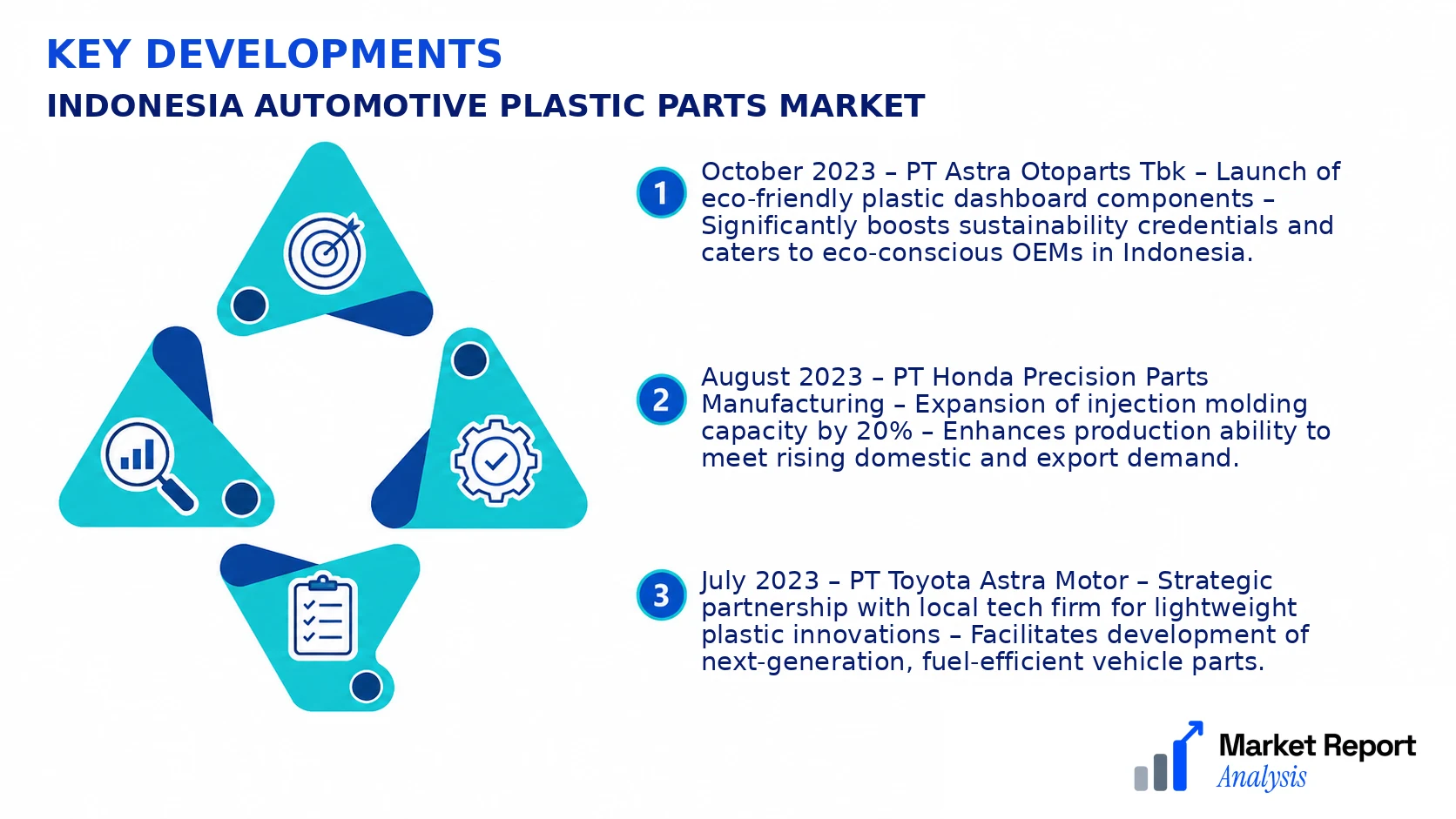
- October 2023 – PT Astra Otoparts Tbk – Launch of eco-friendly plastic dashboard components – Significantly boosts sustainability credentials and caters to eco-conscious OEMs in Indonesia.
- August 2023 – PT Honda Precision Parts Manufacturing – Expansion of injection molding capacity by 20% – Enhances production ability to meet rising domestic and export demand.
- July 2023 – PT Toyota Astra Motor – Strategic partnership with local tech firm for lightweight plastic innovations – Facilitates development of next-generation, fuel-efficient vehicle parts.
- April 2023 – PT Mitsubishi Plastic Components Indonesia – Acquisition of a robotics automation provider – Improves manufacturing efficiency and reduces operational costs.
- February 2023 – PT Chery Plastic Technologies – Investment in bio-based plastics R&D – Aligns with global sustainability goals and enhances eco-friendly product portfolio.
Frequently Asked Questions
What is the Indonesia Automotive Plastic Parts Market?
The Indonesia Automotive Plastic Parts Market encompasses the manufacturing and sales of plastic components used in automotive vehicles, including interior and exterior parts, dedicated engine components, and other lightweight, durable plastics essential for vehicle assembly and performance.
What is the current market size of Indonesia Automotive Plastic Parts Market?
As of 2026, the market size is valued at approximately USD 12.5 Billion, reflecting steady growth driven by the expanding automotive sector and increasing demand for lightweight, cost-effective plastic components in Indonesia’s automotive industry.
What factors are driving the Indonesia Automotive Plastic Parts Market?
Key growth drivers include the rising automotive production in Indonesia, technological advancements in plastic materials, and government initiatives promoting local manufacturing. Rising consumer demand for fuel-efficient and lightweight vehicles also significantly influence this market.
Which region dominates the Indonesia Automotive Plastic Parts Market?
Java region remains the dominant market, benefiting from the presence of major automotive manufacturing hubs, infrastructural developments, and a skilled manufacturing workforce, which together foster higher production capacities and supply chain efficiency.
Which segment is expected to grow the fastest?
The interior parts segment is anticipated to witness the fastest growth, driven by increasing vehicle customization, safety regulations, and the rising use of plastics in dashboards, door trims, and seating components across the automotive industry in Indonesia.
Who are the leading companies operating in the Indonesia Automotive Plastic Parts Market?
Leading companies include PT Astra Otoparts Tbk, PT Indomobil Sukses Internasional Tbk, and global automotive parts suppliers like Toyoda Gosei and Magna International, which have established manufacturing plants and supply chain networks within Indonesia.
Analyst Perspective
The Indonesia Automotive Plastic Parts Market is poised for sustained growth through 2034, driven by ongoing vehicle production increases, evolving consumer preferences, and stringent regulations favoring lightweight, durable materials. Long-term prospects appear promising, with regional manufacturing hubs like Jakarta and Surabaya becoming strategic centers for suppliers and OEMs, emphasizing innovation and cost efficiency. The market is characterized by rising adoption of advanced polymer composites and sustainable plastics, fostering technological evolution aligned with global environmental standards. Investment priorities should focus on R&D capabilities, local supply chain development, and integrating Industry 4.0 practices to enhance productivity and quality. Competitive dynamics are intensifying as both local producers and international giants vie for market share, incentivizing strategic alliances and technological differentiation. Regional growth potential remains high, particularly in emerging city clusters where automotive manufacturing is expanding rapidly, offering lucrative opportunities for market entrants aiming to capitalize on Indonesia’s growing automotive ecosystem and policy incentives.
