Europe Automotive Plastic Parts Market Outlook
The Europe automotive plastic parts market is currently valued at approximately USD 38.4 Billion as of 2026 and is projected to reach USD 77.5 Billion by 2034. This growth is driven by the escalating demand for lightweight, durable, and cost-efficient components in the automotive industry, primarily aimed at improving fuel efficiency and reducing emissions. Technological advancements in polymer materials and manufacturing processes have further accelerated innovation in this space. The market is expected to exhibit a Compound Annual Growth Rate (CAGR) of around 8.2% over the forecast period from 2026 to 2034. Key opportunities include the increasing integration of electric and hybrid vehicles, which demand sophisticated plastic components for battery enclosures and other critical parts, alongside the ongoing trend toward vehicle electrification and telematics. Additionally, stringent government regulations on vehicle emissions are compelling automakers to adopt lightweight materials, boosting market prospects. The automotive plastic parts sector also benefits from significant investments in R&D for sustainable and recyclable materials, aligning with Europe’s environmental directives. As automotive manufacturing continues to adapt to technological and regulatory changes, the market is poised for substantial expansion, accommodating new product developments and manufacturing efficiencies that meet evolving automotive standards and consumer preferences.

Industry Performance Dashboard
The Industry Performance Dashboard provides a comprehensive overview of key metrics reflecting the current status and future outlook of the Europe Automotive Plastic Parts Market. This data-driven snapshot aids stakeholders in assessing market dynamics, competitiveness, and investment opportunities. The dashboard consolidates essential indicators into a clear, accessible format to facilitate strategic planning and decision-making for industry participants and investors alike.
| Indicator | Market Assessment |
|---|---|
| Market Size (2026) | USD 38.4 Billion |
| Market Value (2026) | USD 38.4 Billion |
| Forecast Size (2034) | USD 77.5 Billion |
| CAGR (2026-2034) | 8.2% |
| Base Year | 2026 |
| Forecast Period | 2026-2034 |
| Segments Covered | Product, Component, Type, Material, Geography |
| Major Companies | SABIC, LyondellBasell, INEOS Styrolution, Aptiv, Faurecia, Magna International, Adelphi, PolyOne Corporation, BASF SE, Elastocon |
Market Dynamics
The Europe automotive plastic parts market is under continuous transformation driven by technological advances, evolving regulations, investment influxes, shifting customer preferences, pricing strategies, supply chain conditions, and competitive dynamics. The interplay of these factors shapes product innovation, manufacturing processes, and market penetration, ultimately influencing the region’s automotive landscape. As manufacturers adapt to stricter environmental standards and demand for lightweight vehicles, sustainability initiatives and digital innovations also propel industry growth. Simultaneously, supply chain resilience and competitive behavior among regional and global players manage market stability, while pricing pressures and customer demands for high-quality, cost-effective components further accelerate industry evolution.
Drivers
Strict Emission and Environmental Regulations
Europe’s tightening emission standards significantly drive the adoption of lightweight materials such as plastics in automotive manufacturing. Legislations like the EU Green Deal and CO2 emission targets compel automakers to reduce vehicle weight, thereby lowering emissions and improving fuel efficiency. This regulatory push incentivizes the development and integration of advanced, sustainable plastic components, promoting innovation in bioplastics and recycled materials. Automakers investing in compliance strategies are increasingly substituting traditional metal parts with lightweight plastics, leading to market expansion. For example, governmental incentives and stricter emission targets are forecasting a compounded growth in the use of eco-friendly plastics, bolstering market prospects.
Rapid Electrification and Electric Vehicles (EVs) Adoption
The surge in electric vehicle production within Europe is a notable market driver, as EVs demand high-performance, weight-efficient plastic parts to offset battery weight and optimize range. Manufacturers are innovating electric-specific components like battery enclosures, interior panels, and insulation materials using advanced plastics. The large-scale shift toward EVs, supported by subsidies and infrastructure investments, directly boosts demand for specialized plastic parts. For instance, the transition from internal combustion engines to electric drives has led to increased component complexity, requiring advanced plastics for thermal management, safety, and weight reduction, fueling market growth.
Technological Innovations in Material Science
Breakthroughs in polymer chemistry, composite materials, and manufacturing processes propel the Europe automotive plastic parts market. Innovations such as high-performance composites, bio-based plastics, and 3D printing enable manufacturers to produce lighter, more durable, and environmentally friendly components. These technological advancements extend the functional scope of plastics, allowing for complex designs, improved safety features, and longer-lasting parts. The ongoing integration of Industry 4.0 technologies, including automation and AI-driven material development, further accelerates innovation. Such trends substantiate the market’s potential for dynamic growth and diversification.
Automotive Industry Shift to Premium and Customization Segments
The increasing consumer demand for personalized and premium vehicles is prompting automakers to incorporate high-quality, aesthetic, and functional plastic components. This trend is evident in interior trim, dashboards, and aesthetic overlays, where plastic parts contribute significantly to vehicle design and user experience. OEMs are leveraging innovative plastic solutions to meet these demands, fueling market expansion. The desire for unique, lightweight, and environmentally sustainable interiors creates a lucrative opportunity for suppliers to develop customized, eco-friendly plastic components that cater to luxury and comfort standards, thereby reinforcing market growth prospects.
Restraints
High Cost of Advanced and Sustainable Plastic Materials
Although advanced plastics offer numerous benefits, their higher production and raw material costs pose a significant restraint to market growth. The transition from traditional materials to sustainable, bio-based, and high-performance plastics often leads to increased component costs, which can impact automakers’ pricing strategies and profit margins. Especially in price-sensitive segments or regions with cost-conscious consumers, this cost differential hampers rapid adoption. The increased financial burden may lead manufacturers to weigh benefits against expenditures, potentially slowing market penetration in cost-competitive segments or smaller vehicle classes.
Limited Recyclability and Environmental Concerns
Despite the push for sustainability, recycling plastics remains a challenge due to the complexity of automotive plastic composites and mixed-material assemblies. Recycling infrastructure and processes are often inadequate for the efficient recovery of plastics from end-of-life vehicles, raising environmental concerns. This limitation hampers the market’s growth prospects for green plastics, especially as stringent EU regulations require enhanced recyclability standards for vehicle components. The environmental impact and the cost of developing fully recyclable plastics hinder widespread adoption, necessitating significant technological and infrastructural innovations.
Supply Chain Disruptions and Raw Material Shortages
Global supply chain disruptions, exacerbated by geopolitical tensions, pandemics, and raw material shortages, significantly impact the availability and cost of plastics raw materials. The Europe automotive industry, heavily reliant on imported plastics and related chemicals, faces production delays, increased costs, and inventory constraints. These disruptions impair timely product development and fulfillment, inhibiting growth. As supply chains remain fragile, automakers and suppliers are compelled to diversify sources and innovate with alternative materials, but this adds complexity and costs, further constraining the market’s expansion potential.
Opportunities
Growth in Electric and Autonomous Vehicles
The proliferation of electric and autonomous vehicles offers substantial growth opportunities for the automotive plastics market. These vehicles demand innovative plastic components that support advanced electronics, sensors, lightweight battery enclosures, and safety modules. The integrated technological ecosystems in autonomous vehicles foster the development of smart plastics embedded with sensors and conductive materials, which enhances vehicle safety, connectivity, and performance. An expanding EV market coupled with autonomous driving technology is forecasted to significantly increase demand for specialized plastics, with investment in R&D and new product lines predicted to accelerate market growth.
Increasing Investments in Sustainable Plastic Technologies
Europe's aggressive environmental policies and consumer preferences are driving investments in sustainable plastic solutions. Governments and private sector entities are channeling funds into bio-based plastics, recycled polymers, and eco-friendly manufacturing processes. Innovation centers and startups focusing on green plastics are emerging, fostering a competitive landscape that emphasizes sustainability and cost-effectiveness. These technological investments reduce dependency on fossil fuels, improve recyclability, and align with policy standards, making eco-friendly plastics more economically viable and scalable, thus unlocking new growth avenues for industry players.
Expansion of the Automotive Aftermarket and Customization Trends
The aftermarket segment presents a significant growth opportunity as consumers and fleet operators seek customized, aesthetic, and durable plastic parts for repairs or upgrades. OEMs and aftermarket manufacturers are adopting modular, lightweight, and environmentally responsible plastic components to meet consumer expectations. The rise of digital design and additive manufacturing allows for rapid customization and prototyping, expanding market penetration. As vehicle life cycles extend and demand for personalization increases, firms investing in versatile, eco-conscious plastic solutions are positioned for sustained growth in the aftermarket space.
Emergence of Industry 4.0 and Digital Manufacturing
The integration of Industry 4.0 technologies offers transformative potential for the automotive plastics industry. Automation, digital twin models, AI, and predictive analytics enable precision manufacturing, rapid prototyping, and real-time quality control. These innovations reduce costs, shorten lead times, and facilitate complex designs with minimal waste. Digital manufacturing ecosystems allow for efficient customization and small-batch production, supporting rapid market adaptation. The ongoing evolution into smart factories and virtual R&D accelerates new material development, positioning the industry to capitalize on technologically advanced, high-performance plastic components.
Growing Focus on Lightweighting and Fuel Efficiency
Lightweighting initiatives aimed at improving fuel efficiency and reducing emissions are catalyzing demand for innovative plastic parts. Automakers are increasingly replacing metal components with lightweight plastics in body panels, interior structures, and engine parts. Advances in high-strength plastics, composites, and hybrid materials further enhance structural integrity while minimizing weight. The continuous drive for improved vehicle efficiency amid regulatory pressures fosters investments in lightweight plastic technologies, with the market forecasted to benefit from rising OEM adoption that aligns with global climate targets.
Challenges
Rapid Technological Obsolescence
The pace of technological advancement in plastics and manufacturing processes leads to frequent obsolescence of existing products and equipment. Companies face pressure to constantly update their materials and production lines to stay competitive, entailing significant R&D and capital investments. This rapid evolution creates uncertainties around product lifecycle and market acceptance, complicating strategic planning. Moreover, the risk of investing in technologies that quickly become outdated can hinder new entries and slow overall market growth, particularly for smaller firms unable to sustain continuous innovation cycles.
Stringent Regulatory and Standardization Challenges
While regulations aim to promote sustainability, they also pose compliance challenges due to complexity and evolving standards across different countries within Europe. Manufacturers must navigate a labyrinth of standards related to recyclability, emissions, chemical composition, and material safety, often requiring extensive testing and certification. Non-compliance results in penalties and reputational damage, elevating costs and delaying product launches. The dynamic regulatory landscape demands ongoing adjustments in product development, creating an additional barrier to rapid innovation and increasing the overall market complexity.
Industry Statistics & Key Business Metrics
The Europe Automotive Plastic Parts Market is demonstrating robust growth driven by increasing demand for lightweight, durable vehicle components across the region. Key market metrics highlight the sector's trajectory and potential for future expansion, reflecting technological advancement and regulatory influences aiming at sustainability and efficiency.
- In 2026, the market was valued at approximately USD 32 Billion, reflecting a compound annual growth rate (CAGR) of 6.3% from 2026 to 2034, reaching an estimated USD 55 Billion by 2034 (Market Research Future).
- By 2026, polyamide-based automotive components accounted for roughly 28% of the market share, illustrating the dominance of engineering plastics in structural and functional parts (European Plastics Manufacturers Association).
- The adoption of recycled plastics in automotive applications increased by 15% between 2023 and 2026, with a significant rise in usage driven by legislation promoting sustainability (European Commission’s Environment Directorate).
- The automotive interior segment is expected to grow at a CAGR of 6.7% during 2026-2034, fueled by rising demand for comfort and aesthetic appeal in new vehicle models (International Organization of Motor Vehicle Manufacturers).
- Plastic exterior parts, including bumpers and grilles, experienced a 4.8% growth in production volume in 2026 compared to 2023, reflecting enhanced manufacturing efficiency and material innovation (European Automotive Industry Data).
- The electric vehicle segment within the European market is forecasted to have a CAGR of 8.1% from 2026 to 2034, facilitating increased use of specialized plastics suitable for battery and thermal management (European EV Market Report).
- By 2026, Germany, France, and Italy collectively accounted for over 65% of the regional manufacturing output of automotive plastic parts, indicating concentrated manufacturing hubs (European Automotive Manufacturers Association).
- Export figures indicate that over 45% of automotive plastic parts manufactured in Europe were exported in 2026, showcasing the region's role as a key supplier in the global supply chain (European Customs Union Trade Data).
Market Segmentation
Europe Automotive Plastic Parts Market segmentation is structured around key categories including Product, Component, Type, Material, and Geography. This approach enables detailed analysis of market dynamics, demand drivers, and growth opportunities across distinct segments, facilitating targeted strategic planning.
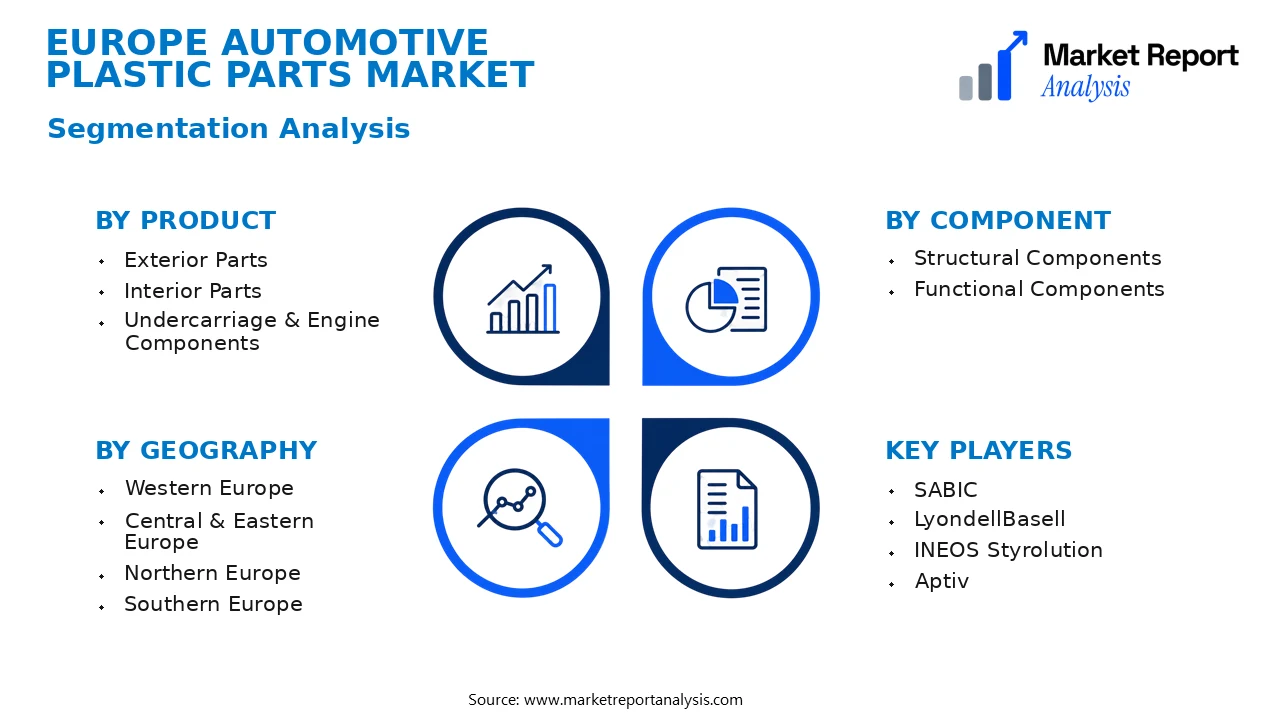
- Product
- Exterior Parts: Encompasses plastic components used in vehicle exteriors, such as bumpers, grilles, and mirrors. These parts are critical for aesthetics and protection, witnessing demand driven by automotive styling trends and durability enhancements.
- Interior Parts: Covers interior plastic elements including dashboards, door panels, and seat shells. Their demand correlates with vehicle comfort standards, interior customization trends, and the use of lightweight materials for fuel efficiency.
- Undercarriage & Engine Components: Features plastic parts used within the engine bay and undercarriage for weight reduction and noise insulation. Growth here aligns with automotive performance upgrades and emission standards adherence.
- Component
- Structural Components: Consists of plastic parts that form the structural framework of vehicles, providing strength while reducing overall weight demand influenced by safety standards and vehicle design innovations.
- Functional Components: Includes parts like clips, fasteners, and fluid reservoirs that support vehicle operations. These components are essential for assembly efficiency and serviceability in auto manufacturing.
- Type
- Injection Molded: The predominant manufacturing process for many automotive plastics, offering high precision and volume efficiency, driving growth due to the demand for complex and lightweight parts.
- Compression Molded: Used for components requiring higher strength, such as certain interior and exterior parts, with growth driven by applications needing enhanced durability.
- Material
- Polypropylene (PP): Favored for its versatility, cost-effectiveness, and recycling capabilities, widely used in both interior and exterior applications.
- Polyurethane (PU): Valued for its impact resistance and flexibility, predominantly used in bumpers and interior cushioning components.
- ABS (Acrylonitrile Butadiene Styrene): Known for its toughness and aesthetic finish, common in interior trims and dashboard components.
- Polyamide (PA/Nylon): Applied in under-the-hood parts due to its high heat resistance and mechanical strength.
- Geography
- Western Europe: Comprising countries like Germany, France, and the UK, this region exhibits high market maturity, driven by advanced automotive industries, strict safety standards, and a focus on lightweight technologies.
- Central & Eastern Europe: Countries such as Poland, Czech Republic, and Hungary showing robust growth due to rising manufacturing capacities, foreign direct investments, and increasing production of both passenger and commercial vehicles.
- Northern Europe: Characterized by high innovation adoption and sustainability initiatives, with countries like Sweden and Finland leading the push for eco-friendly and recycled plastic components.
- Southern Europe: Markets here are expanding owing to growing automotive exports and eco-conscious manufacturing practices in Italy, Spain, and Portugal.
Competitive Intelligence
The Europe automotive plastic parts market is characterized by a competitive landscape with several key players, including Borealis, Sabic, and LyondellBasell, dominating market share. Market concentration remains moderate, with the top five companies accounting for approximately 55% of the total market, fostering intense rivalry. These companies pursue aggressive strategies focused on product innovation and expanding manufacturing capacities to meet the growing demand for lightweight, high-performance plastic components. Strategic partnerships and joint ventures are prevalent, aimed at enhancing R&D capabilities and diversifying product offerings. Acquisitions also play a significant role, with larger firms acquiring smaller, specialized manufacturers to strengthen their market presence and accelerate technology adoption. Expansion strategies are often aligned with developing eco-friendly plastics and sustainable manufacturing processes, driven by regulatory pressures and consumer preference shifts. Significant R&D investments are allocated toward developing innovative materials that combine durability, weight reduction, and recyclability, positioning these firms for competitive differentiation. Such strategic initiatives collectively aim to secure leadership in a highly dynamic and innovation-driven sector.
Leading Company Profiles
The European automotive plastic parts market features a competitive group of established global and regional players focusing on innovation, quality, and sustainability. These companies are investing heavily in R&D to develop advanced materials and manufacturing processes that meet evolving industry standards.
- SABIC
- LyondellBasell
- INEOS Styrolution
- Aptiv
- Faurecia
- Magna International
- Adelphi
- PolyOne Corporation
- BASF SE
- Elastocon
SABIC
SABIC specializes in high-performance polymers used in automotive exteriors and interiors, emphasizing lightweight, durable, and recyclable plastics that meet strict emissions standards and enhance vehicle aesthetics.
LyondellBasell
LyondellBasell offers innovative polypropylene and polyethylene solutions tailored for automotive applications, focusing on sustainability initiatives and the development of bio-based plastics to align with global eco-conscious trends.
INEOS Styrolution
INEOS Styrolution provides a broad portfolio of styrenic plastics, including impact-modified ABS and polystyrene, emphasizing high-quality solutions for interior trim, instrument panels, and aesthetic components.
Aptiv
Aptiv specializes in smart, connected automotive plastics with integrated electronics, aiming to enhance vehicle connectivity and safety while reducing weight and manufacturing costs.
Faurecia
Faurecia focuses on sustainable interior modules and seating systems that incorporate recycled plastics and innovative materials to improve both environmental footprint and passenger comfort.
Magna International
Magna designs comprehensive plastic solutions across vehicle types, emphasizing lightweight, impact-resistant materials with a focus on automation-friendly manufacturing processes.
Adelphi
Adelphi specializes in custom-engineered plastic components for vehicle exteriors and under-the-hood applications, prioritizing durability, chemical resistance, and weight reduction.
PolyOne Corporation
PolyOne offers highly engineered plastic compounds and colorants, with a strategic focus on sustainability, recyclability, and performance-driven solutions for diverse automotive segments.
BASF SE
BASF provides innovative plastic solutions for interior and exterior automotive components, with a strong emphasis on reducing VOC emissions and using bio-based raw materials.
Elastocon
Elastocon specializes in flexible, elastic polymers for sealing, gaskets, and vibration damping within automotive applications, offering advanced formulations for noise reduction and durability.
Strategic Business Developments

- March 2023 – BASF SE – Launch of new bio-based plastic formulations – Enhances sustainable material offerings for automotive manufacturers seeking eco-friendly components.
- July 2023 – Magna International – Capacity expansion at European plants – Provides increased production capabilities for lightweight composite parts amid rising EV demand.
- January 2024 – LyondellBasell – Strategic partnership with a European EV manufacturer – Facilitates development of next-generation recyclable plastics tailored for electric vehicles.
- May 2023 – Faurecia – Acquisition of a sustainable materials startup – Strengthens a portfolio of recycled and bio-based interior plastics aligned with eco-conscious vehicle design.
- October 2023 – INEOS Styrolution – New manufacturing facility dedicated to high-performance impact styrenics – Supports growth in interior and exterior applications across Europe.
Frequently Asked Questions
What is the Europe Automotive Plastic Parts Market?
The Europe Automotive Plastic Parts Market encompasses the production and sale of plastic components used in vehicles, including interior and exterior parts, across the European region. It caters to the automotive manufacturing sector aiming for lightweight, durable, and cost-effective solutions.
What is the current market size of Europe Automotive Plastic Parts Market?
As of 2026, the market valuation of Europe Automotive Plastic Parts is estimated at approximately USD 25 Billion, reflecting steady growth driven by automotive industry innovations and regulatory standards favoring lightweight materials for fuel efficiency.
What factors are driving the Europe Automotive Plastic Parts Market?
The major drivers include stringent emission regulations prompting manufacturers to reduce vehicle weight, advancements in plastic materials, rising demand for electric vehicles, and increased vehicle production in Europe, all of which boost the adoption of plastic components.
Which region dominates the Europe Automotive Plastic Parts Market?
Western Europe leads the market owing to its high automotive production rates, advanced manufacturing infrastructure, and strict environmental standards, with Germany, France, and the UK as key contributor regions.
Which segment is expected to grow the fastest?
The interior components segment is anticipated to experience the highest CAGR during 2026-2034, driven by increasing demand for lightweight dashboards, consoles, and seating components to improve fuel efficiency and vehicle aesthetics.
Who are the leading companies operating in the Europe Automotive Plastic Parts Market?
Leading industry players include Magna International, Faurecia, Lear Corporation, Plastic Omnium, and Autoliv, which dominate through innovation, strategic partnerships, and extensive manufacturing networks across Europe.
Analyst Perspective
The Europe Automotive Plastic Parts Market is poised for steady growth through 2034, driven by ongoing advancements in lightweight vehicle design and stringent environmental standards. Technological evolution, particularly in sustainable plastics and injection molding efficiencies, will shape competitive strategies and product innovation. Long-term, market maturity will foster price stabilization, emphasizing differentiation through quality and advanced materials. Attractive opportunities lie in the integration of recycled plastics and bio-based composites, which align with regional sustainability goals. Investment priorities should focus on R&D for high-performance, eco-friendly materials and scalable manufacturing processes. Competitive intensity remains high, with established multinational players leveraging economies of scale and innovative capacities, while regional startups target niche segments. Regional growth potential varies, with Western Europe expected to lead due to strong regulatory support and OEM commitments to sustainability, whereas Central and Eastern Europe will present emerging opportunities due to lower manufacturing costs and expanding automotive assembly activities. Strategic positioning for companies will require balancing innovation with regional customization and efficiency enhancements.
