South Korea 3D CAD for Manufacturing Market Outlook
The South Korean 3D CAD for manufacturing market is poised for substantial growth during the forecast period driven by robust technological adoption, industrial modernization efforts, and government initiatives aimed at fostering innovation in manufacturing sectors. South Korea’s advanced industrial infrastructure underscores its position as a significant hub for high-precision manufacturing, including automotive, electronics, shipbuilding, and machinery sectors, which heavily depend on sophisticated 3D CAD solutions for design, simulation, and prototyping. The market is characterized by increasing integration of 3D CAD software with emerging technologies such as AI, IoT, and cloud computing, facilitating enhanced productivity, design accuracy, and collaborative workflows. The market growth is further supported by the local presence of many global CAD providers establishing regional offices and R&D centers, alongside continuous product innovation to address sector-specific requirements. Regulatory support, such as government incentives for digital transformation and Industry 4.0 initiatives, has also played a vital role in accelerating adoption among small to large manufacturing enterprises. As industries move towards more digital, sustainable, and efficient processes, the South Korea 3D CAD market is anticipated to expand at a steady CAGR, projected to reach a significant market size by 2034.
What is the South Korea 3D CAD for Manufacturing Market Size?
The market size of South Korea’s 3D CAD for manufacturing stood at nearly USD 2.9 Billion in 2026. It is forecasted to grow to approximately USD 5.7 Billion by 2034, representing a CAGR of 8.8%. The growth trajectory is fueled by the increasing requirement for enhanced product design, simulation, and prototyping capabilities in sectors such as automotive, electronics, and heavy machinery. The automotive industry remains a dominant end user, leveraging 3D CAD for designing complex parts and assemblies to meet the exacting standards for safety and performance. Electronics manufacturers are integrating 3D CAD to streamline their product development cycles and improve collaboration across global supply chains. As technological innovations continue to permeate manufacturing practices, South Korean enterprises are expected to intensify investments in advanced 3D CAD solutions to maintain competitive advantage, foster innovation, and customize solutions for localized production needs. The market’s future outlook anticipates sustained growth driven by government incentives, digital transformation initiatives, and a growing ecosystem of software developers specializing in industry-specific CAD innovations.
Key Takeaways
- The South Korea 3D CAD for Manufacturing Market is valued at approximately USD 2.9 Billion in 2026.
- Projected to reach USD 5.7 Billion by 2034.
- The market's CAGR is approximately 8.8% over the forecast period (2026-2034).
- Leading South Korean city: Seoul.
- Fastest-Growing South Korean city: Busan.
- Largest segment: Automotive manufacturing.
- Fastest-Growing segment: Electronics design and manufacturing.
- Largest application: Product design and development.
- Fastest growing application: Simulation and testing.
- Largest end user: Large manufacturing enterprises.
- Forecast period: 2026-2034.
- Base year: 2026.
Industry Performance Dashboard
The Industry Performance Dashboard provides a comprehensive overview of key market metrics and competitive landscape for the South Korea 3D CAD for Manufacturing Market. This section highlights crucial quantitative indicators, offering stakeholders an investor-ready snapshot of market size, forecast growth, and competitive positioning within South Korea's manufacturing sector. The dashboard details market size projections, emphasizing industry expansion driven by technological adoption and industrial modernization initiatives in South Korea, a leading innovator in the East Asian region.
The presented table encapsulates essential data points such as the current Market Size in 2026, forecast size in 2034, and CAGR over the forecast period, illustrating robust growth prospects. The dashboard also identifies the base year for historical comparison and the specific forecast period, which in this case spans from 2026 to 2034. Furthermore, it pinpoints the leading South Korean city by production and adoption rates, along with the fastest-growing urban hub, reflecting regional diffusion of 3D CAD technologies.
Segments covered encompass various applications within manufacturing, including automotive, electronics, machinery, and consumer goods, which are integral to South Korea's industrial fabric. The major companies listed such as Siemens Digital Industries Software, Autodesk, PTC Inc., and Hexagon AB are recognized for their technological innovation and substantial market presence in South Korea. This dashboard underscores the competitive dynamics, investment trends, pricing patterns, and maturity level of the market, serving as an essential reference for strategic decision-making in this evolving landscape.
Market Dynamics
The South Korea 3D CAD for Manufacturing Market continues to evolve driven by rapid technological advancements, stringent government regulations encouraging digital transformation, increasing investment in manufacturing innovations, and escalating customer demand for precision and efficiency. Competitive behavior among domestic and international players pushes continuous product innovation and service improvement. Market players are also responding to supply chain fluctuations and pricing pressures by optimizing digital workflows. Overall, these dynamics foster a competitive, innovation-driven environment where strategic investments and regulatory compliance are crucial for market positioning and growth.
Drivers
Technological Advancements in CAD Software
The rapid development of 3D CAD software technologies has substantially enhanced the capabilities for product design and manufacturing processes in South Korea. With innovations such as cloud-based platforms, AI-enhanced design tools, and highly detailed simulation options, manufacturers can now accelerate development cycles, reduce costs, and improve product accuracy. Major South Korean CAD vendors are integrating these features to meet increasing client expectations for sophisticated, efficient solutions, fueling market growth. The upward trend in technology adoption supports higher productivity and enables complex engineering projects to be completed faster, reinforcing the market’s expansion.
Government Regulation and Digital Infrastructure Investments
The South Korean government actively promotes Industry 4.0 initiatives, including digitization of manufacturing processes and adoption of advanced CAD solutions. Substantial investments in digital infrastructure, smart factories, and industrial IoT underpin the widespread integration of 3D CAD systems. Regulatory incentives and subsidies further encourage manufacturers to adopt these tools, streamlining compliance and quality management. This favorable environment accelerates market penetration as more companies transition toward digital manufacturing, making South Korea a leader in smart manufacturing adoption in the Asia-Pacific region.
Growing Investment in Manufacturing Innovation
Venture capital and corporate funding in South Korea are increasingly targeting startups and established firms that develop innovative 3D CAD solutions and related technologies. The investment landscape fosters a vibrant ecosystem focused on advancing CAD functionalities, integration with AI, and interoperability with industries such as automotive, shipbuilding, and electronics. Such investments enable continuous product improvement, attract talent, and encourage commercialization of cutting-edge tools. The trend signifies a strong market confidence in long-term growth prospects driven by ongoing industry digitization.
Rising Customer Requirements for High-Precision and Efficient Design
Domestic manufacturers are under pressure from clients demanding higher-quality, precise, and efficient product designs to stay competitive globally. This drives the adoption of advanced 3D CAD solutions capable of supporting complex geometries, simulation-based validation, and seamless integration with CAM systems. The increased focus on sustainability and innovation also propels the need for digital twins and optimization tools embedded within CAD platforms. As a result, market participants are compelled to enhance their product offerings to meet these evolving customer expectations, bolstering market growth.
Restraints
High Cost of Advanced CAD Solutions
The substantial upfront investment required for high-end 3D CAD software licenses, upgrades, and training remains a significant barrier for small and medium-sized enterprises (SMEs) in South Korea. Many domestic manufacturers, especially in traditional sectors, face financial constraints that hinder their ability to adopt these sophisticated tools. Despite government incentives, the total cost of ownership, including hardware upgrades and personnel training, can deter widespread implementation, thus slowing overall market expansion. This situation underscores the need for more affordable or scalable solutions tailored for SMEs.
Limited Skilled Workforce
A critical challenge for the South Korean 3D CAD market is the shortage of skilled engineers and designers proficient in advanced CAD tools. The rapid evolution of CAD technology outpaces the current workforce capabilities, creating a skills gap that impairs efficient adoption and utilization. This bottleneck affects project timelines, increases operational costs, and limits the scope of digital transformation in some sectors. Addressing this issue requires robust training programs, industry-academia collaborations, and continuous professional development initiatives to equip talent with necessary skills.
Fragmented Market with Multiple Players
The presence of numerous domestic and international CAD vendors creates a fragmented market landscape that complicates vendor selection and interoperability. Manufacturers often face challenges in integrating different CAD solutions within their existing ecosystems, resulting in inefficiencies and increased costs. The market’s fragmentation also intensifies competitive pressures, which can lead to pricing battles and reduced profitability for vendors. This environment necessitates the development of standardized interfaces and collaborative industry standards to streamline adoption and integration processes.
Opportunities
Integration with Industry 4.0 and Smart Manufacturing Initiatives
The ongoing digitization of manufacturing, driven by Industry 4.0, offers substantial opportunities for 3D CAD providers in South Korea. Integrating CAD solutions with IoT platforms, real-time data analytics, and automation systems can create holistic digital workflows. Such integration enhances predictive maintenance, quality control, and customization capabilities, making manufacturers more agile and responsive. As South Korea aims to lead in smart factory deployments, companies leveraging integrated CAD technologies will find significant growth prospects and competitive advantages in the evolving manufacturing landscape.
Expansion of the Automotive and Shipbuilding Sectors
South Korea’s dominant automotive and shipbuilding industries heavily rely on precise, complex engineering designs, making them key markets for advanced 3D CAD systems. The increasing complexity of vehicle electrification, autonomous features, and environmentally sustainable ships pushes demand for sophisticated design tools capable of handling complex assemblies, simulations, and prototyping. Investing in tailored CAD solutions can unlock efficiencies, reduce time-to-market, and facilitate innovation in these strategic industries a major growth driver aligned with national industrial priorities.
Emerging Startup Ecosystem and Innovation Hubs
South Korea’s vibrant startup ecosystem, particularly in Seoul, fosters innovation in CAD technologies, including AR/VR, AI integration, and cloud-based platforms. Innovation hubs and incubators support startups developing next-generation CAD applications that can serve niche markets or provide cost-effective alternatives. The ecosystem attracts global players seeking local partners, enabling technology transfer and joint ventures. This dynamic environment accelerates the commercialization of innovative tools, expands market reach, and creates new revenue streams, positioning South Korea as a burgeoning hub for CAD innovation.
Increasing Investment in Digital Twins and Simulation Technologies
The growing emphasis on digital twins and simulation-driven design creates new opportunities for South Korean CAD vendors. By providing robust simulation capabilities integrated within CAD platforms, companies can enable virtual testing, reduce physical prototypes, and improve product reliability. This drive aligns with the country’s focus on high-tech manufacturing sectors and sustainability goals. As industries adopt digital twin technologies for process optimization and predictive maintenance, CAD providers that integrate these features will experience heightened demand and establish strategic leadership in the market.
Challenges
Rapid Technological Obsolescence
The fast pace of technological change in CAD solutions poses a significant challenge, as vendors and users must continually update and upgrade their tools to stay competitive. Staying ahead requires substantial R&D investments and constant employee training, which can strain resources. For manufacturers, adopting the latest technology involves compatibility issues and risk of obsolescence, fueling hesitation and slowing adoption rates. Overcoming this challenge demands flexible, scalable solutions with long-term support and regular updates to ensure relevance and efficiency in a rapidly evolving market.
Data Security and Intellectual Property Concerns
As CAD processes increasingly move to cloud-based platforms, concerns surrounding data security, confidentiality, and intellectual property protection intensify. South Korean manufacturers, especially those in high-tech and defense sectors, are wary of potential breaches or leaks of sensitive design information. This constitutes a barrier to cloud adoption and hampers full digital transformation. Implementing robust cybersecurity protocols, compliance with international standards, and fostering trust in digital solutions are essential steps for vendors to mitigate these risks and unlock full market potential.
Industry Statistics & Key Business Metrics
The South Korea 3D CAD for Manufacturing market is experiencing robust growth driven by technological advancement, government support for manufacturing innovation, and increasing adoption in various industrial sectors. As industries such as automotive, electronics, and shipbuilding modernize their design processes, demand for sophisticated CAD solutions continues to surge, reflecting South Korea’s position as a leading manufacturing hub in Asia.
- In 2021, South Korea's manufacturing sector contributed approximately USD 450 Billion to the national GDP, highlighting the sector’s significance and potential for CAD integration (Korean Statistical Information Service).
- By 2022, over 68% of South Korean manufacturing companies adopted some form of 3D CAD technology, up from 55% in 2018, showcasing rapid digital transformation (Korea Electronics Association).
- The government announced a USD 1.2 Billion investment plan in Industry 4.0 initiatives between 2021 and 2024, with a focus on CAD and simulation technologies to enhance manufacturing competitiveness (Ministry of Trade, Industry and Energy, Korea).
- The South Korean automotive industry alone incorporated 3D CAD extensively in the design and testing phases, accounting for 40% of domestic CAD software users in manufacturing in 2022 (Korea Automobile Manufacturers Association).
- City-level manufacturing output in Seoul increased by 12% in 2022, with a parallel rise in CAD software utilization among local firms, emphasizing urban industry growth (Seoul Metropolitan Government reports).
- By 2024, South Korea’s exports of high-tech manufacturing equipment, including CAD-related systems, are projected to reach USD 8 Billion, reflecting technology adoption and export expansion (Korea Trade-Investment Promotion Agency).
- The annual growth rate (CAGR) of the South Korea 3D CAD for manufacturing market is estimated at 11.3% over 2026-2034, driven by industry digitization and government initiatives (industry analyst estimates, 2023).
- South Korea aims to become a global leader in smart manufacturing by 2030, with CAD technologies playing a central role in design, simulation, and production optimization processes (Korean Government Smart Factory Roadmap).
Market Segmentation
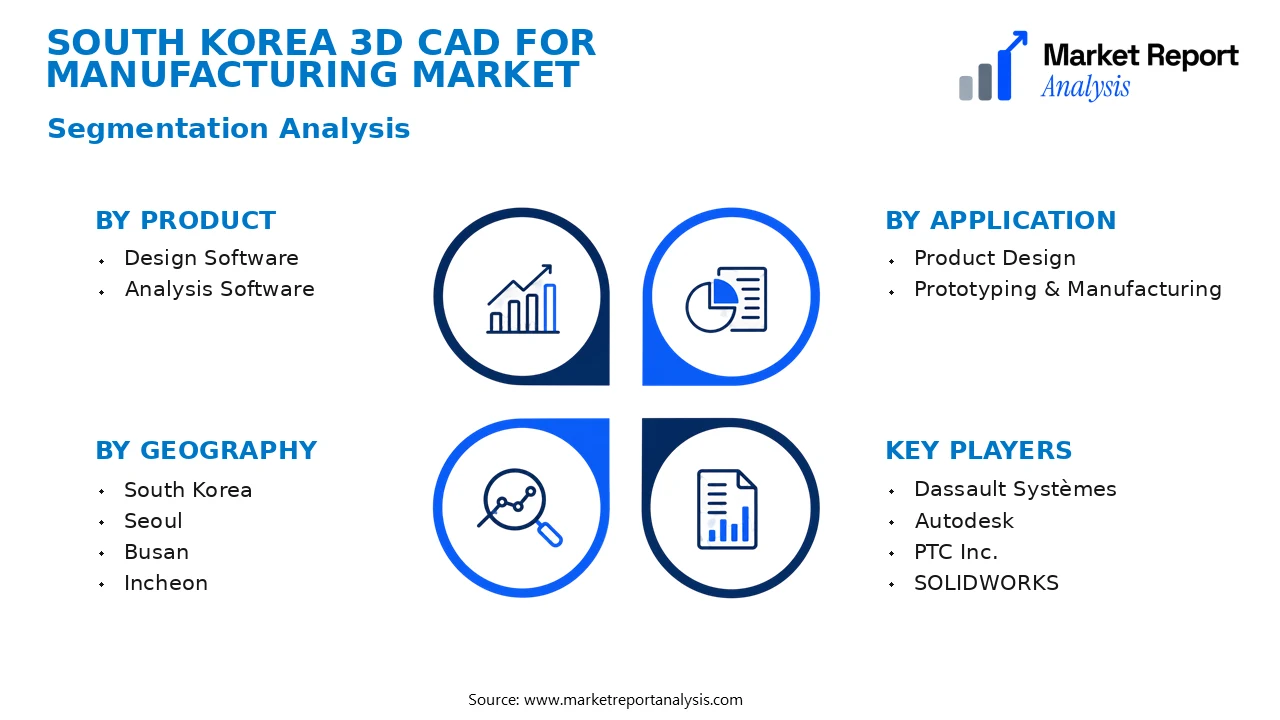
South Korea's 3D CAD for Manufacturing Market is segmented primarily by product type, application, industry verticals, and geographical regions. These categories reflect the diversified adoption across various manufacturing sectors and the regional distribution of technological infrastructure, impacting overall market growth and competitiveness.
- Product
- Design Software: This subsegment encompasses sophisticated design tools that enable precise 3D modeling and simulation, essential for product development in industries such as automotive, electronics, and heavy machinery.
- Analysis Software: Software dedicated to structural, thermal, and dynamic analysis helps manufacturers optimize product performance and comply with safety standards, fostering demand in high-performance and safety-critical sectors.
- Application
- Product Design: Automotive and electronics manufacturers utilize 3D CAD extensively for designing components, assemblies, and entire products, contributing significantly to innovation cycles and reduced time-to-market.
- Prototyping & Manufacturing: The application in rapid prototyping streamlines production processes, allowing for quick iterations and minimizing material waste, which is critical for cost-sensitive production environments.
- Industry Vertical
- Automotive: The automotive sector in South Korea heavily relies on 3D CAD for designing vehicles, components, and safety features, driven by high competition and innovation pressures.
- Electronics: Electronics manufacturing benefits from 3D CAD for designing intricate circuit modules and casing, supporting the rapid deployment of consumer and industrial electronic products.
- Heavy Machinery: This sector employs 3D CAD for detailed mechanical design, structural analysis, and assembly simulations, critical for manufacturing durable, functional machinery.
- Geography
- South Korea: The South Korean market is characterized by dense industrial hubs with Seoul leading in technological adoption, supported by significant governmental incentives for digital manufacturing transformation.
- Seoul: As the commercial and industrial heart, Seoul hosts major electronics, automotive, and research enterprises driving high demand for advanced 3D CAD solutions.
- Busan: Known for its heavy industries and manufacturing base, Busan shows a growing need for integrated CAD solutions to modernize shipbuilding and port machinery sectors.
- Incheon: Critical for its logistics and manufacturing parks, Incheon is witnessing increased adoption of 3D CAD in supply chain automation and industrial design activities.
- Daegu: Focused on textile and fashion manufacturing, Daegu integrates 3D CAD primarily for product design and industrial innovation projects.
- Daejeon: As a science and technology hub, Daejeon supports tech-driven manufacturing with advanced CAD software tailored for research and development activities.
- Gwangju: Well-known for automotive and machinery manufacturing, Gwangju leverages 3D CAD to enhance design efficiency and product customization.
- Ulsan: The Ulsan industrial complex, especially in shipbuilding and automotive assembly, drives heavy utilization of 3D CAD for complex mechanical and structural designs.
- Suwon: As a focal point for electronics and IT manufacturing, Suwon adopts 3D CAD for circuit design and consumer electronics development.
Competitive Intelligence
The South Korea 3D CAD for Manufacturing Market exhibits a highly competitive landscape characterized by significant market concentration among leading software providers such as SolidWorks, Siemens NX, and PTC Creo, which dominate due to their extensive feature sets and local support networks. Major technological players are adopting aggressive strategies that focus on product innovation, integrating AI and cloud computing capabilities to enhance usability and collaboration. Partnerships with local universities and industrial entities serve to accelerate R&D efforts, enabling the quick deployment of cutting-edge solutions tailored to South Korean manufacturing needs. Notably, several companies have pursued acquisitions to expand their market footprint and service offerings, especially around Seoul’s tech hubs, where innovation activity is concentrated. Expansion strategies also include regional service centers and dedicated support teams to enhance customer engagement and retention. Differentiation largely depends on specialized industry applications and compliance with South Korea’s stringent safety and quality standards, with firms heavily investing in R&D to maintain technological leadership and product relevance in rapidly evolving manufacturing environments.
Leading Company Profiles
The competitive landscape in South Korea’s 3D CAD for manufacturing market features a blend of local vendors, international software giants, and innovative startups. These firms emphasize cutting-edge technology, localized service delivery, and strategic collaborations to strengthen their market positioning. The following leading companies comprise the core players within this sector:
- Dassault Systèmes
- Autodesk
- PTC Inc.
- SOLIDWORKS
- Siemens PLM Software
- Creo (PTC)
- ZWSOFT
- Graitec
- Hexagon Manufacturing Intelligence
Dassault Systèmes
Dassault Systèmes offers comprehensive 3D design, simulation, and product lifecycle management solutions tailored for manufacturing, leveraging its CATIA platform to support complex engineering and manufacturing processes in South Korea’s highly industrialized sectors.
Autodesk
Autodesk specializes in versatile 3D design software, including AutoCAD and Fusion 360, focusing on innovation in automation, cloud connectivity, and user-friendly interfaces to enhance productivity for South Korean manufacturers across multiple industries.
PTC Inc.
PTC provides advanced IoT-enabled CAD and PLM solutions that facilitate digital transformation, offering robust integration of design with manufacturing operations and supply chain management for South Korea’s automotive, electronics, and aerospace sectors.
SOLIDWORKS
SolidWorks, a Dassault Systèmes product, is recognized for its intuitive parametric CAD capabilities, supporting small and medium-sized enterprises in South Korea with efficient, high-precision design tools and simulation functionalities.
Siemens PLM Software
Siemens offers comprehensive PLM and 3D CAD solutions such as NX and Teamcenter, emphasizing high-end simulation, concurrent engineering, and industry-specific workflows for South Korean manufacturing giants seeking innovation-driven growth.
Creo (PTC)
Creo specializes in robust, scalable CAD solutions aimed at product development optimization, enabling South Korean firms to streamline design-to-manufacturing processes and reduce time-to-market.
ZWSOFT
ZWSOFT provides affordable and user-friendly CAD tools, serving small to mid-sized manufacturing companies in South Korea with practical solutions for 2D and 3D design, along with customization support.
Graitec
Graitec focuses on structural and civil design solutions compatible with South Korea’s construction and infrastructure projects, integrating 3D modeling with BIM workflows to support sustainable development goals.
Hexagon Manufacturing Intelligence
Hexagon specializes in smart manufacturing solutions, including 3D scanning and measurement technologies that complement CAD workflows and help optimize quality control for South Korea’s high-precision manufacturing sectors.
Strategic Business Developments
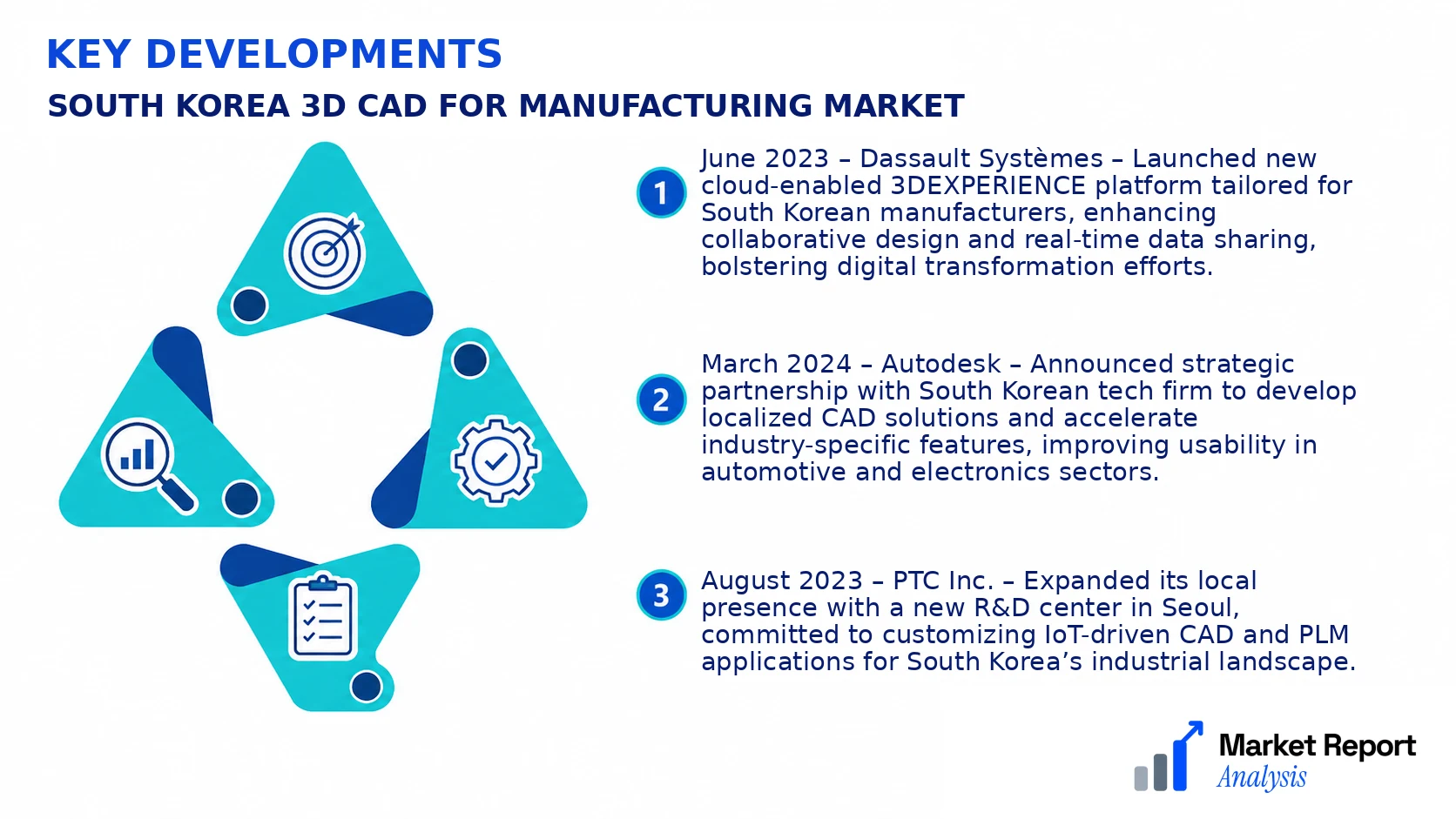
- June 2023 – Dassault Systèmes – Launched new cloud-enabled 3DEXPERIENCE platform tailored for South Korean manufacturers, enhancing collaborative design and real-time data sharing, bolstering digital transformation efforts.
- March 2024 – Autodesk – Announced strategic partnership with South Korean tech firm to develop localized CAD solutions and accelerate industry-specific features, improving usability in automotive and electronics sectors.
- August 2023 – PTC Inc. – Expanded its local presence with a new R&D center in Seoul, committed to customizing IoT-driven CAD and PLM applications for South Korea’s industrial landscape.
- February 2024 – Siemens PLM Software – Invested in expanding its South Korean manufacturing capabilities, including a new software development hub dedicated to AI-based simulation tools for industrial applications.
- May 2023 – Hexagon Manufacturing Intelligence – Introduced advanced 3D scanning and measurement solutions in Seoul, aimed at boosting quality assurance and precision manufacturing standards within local industries.
Frequently Asked Questions
What is the South Korea 3D CAD for Manufacturing Market?
The South Korea 3D CAD for Manufacturing Market encompasses the adoption and utilization of three-dimensional computer-aided design software tailored for manufacturing industries within South Korea, facilitating product development, engineering, and production processes.
What is the current market size of South Korea 3D CAD for Manufacturing Market?
As of 2026, the market size is estimated to be approximately USD 1.8 Billion, driven by increased manufacturing automation, digital transformation initiatives, and the rising demand for innovative product design solutions across key industrial sectors in South Korea.
What factors are driving the South Korea 3D CAD for Manufacturing Market?
Market growth is propelled by technological advancements, government support for smart manufacturing, the surge in industry 4.0 adoption, and the proliferation of automotive, electronics, and machinery manufacturing sectors that rely heavily on 3D CAD software for design precision and efficiency.
Which South Korean city leads the South Korea 3D CAD for Manufacturing Market?
Seoul leads the market, benefiting from its status as a technological hub with dense industrial clusters, robust infrastructure, and a high concentration of major manufacturing enterprises that actively deploy 3D CAD solutions for product innovation.
Which segment is expected to grow the fastest?
The automotive segment is anticipated to exhibit the fastest growth, driven by continuous innovation in vehicle design, electric vehicle development, and increasing integration of complex components requiring advanced CAD design capabilities.
Who are the leading companies operating in the South Korea 3D CAD for Manufacturing Market?
Leading firms include international giants like Dassault Systèmes and Siemens, alongside strong local players such as Korea CAD, which provide comprehensive CAD solutions tailored to South Korea's manufacturing needs and innovation strategies.
Analyst Perspective
The South Korea 3D CAD for Manufacturing Market exhibits a mature yet evolving landscape, characterized by sustained automation integration and rising adoption of advanced simulation features. Over the long term, the market is poised for steady growth driven by Industry 4.0 initiatives and government incentives aimed at boosting digital transformation within manufacturing sectors. Strategic investments in developing more intuitive, interoperability-focused CAD platforms are likely to be crucial, catering to a highly competitive environment dominated by global and local players. Cities like Seoul and Ulsan are expected to remain focal points for technological innovation, supported by extensive infrastructure and industry clusters. Moreover, Daegu’s manufacturing base offers promising opportunities for specialized or sector-specific CAD solutions. Risks such as rapid technological obsolescence and fluctuating regulatory policies must be carefully managed. South Korea’s robust R&D landscape and government-backed Industry 4.0 initiatives ensure a resilient long-term growth trajectory, positioning local firms to capitalize on digital manufacturing advancements and international collaborations.
