Saudi Arabia Photonic Integrated Circuits Market Outlook
The Saudi Arabia Photonic Integrated Circuits (PIC) market is experiencing a significant evolution driven by the nation’s expanding investment in digital infrastructure, telecommunications, and high-tech manufacturing. Currently valued at USD 0.3 Billion in 2026, the market is projected to grow at a compound annual growth rate (CAGR) of approximately 15.2% over the forecast period from 2026 to 2034. This growth is primarily fueled by burgeoning demand from the telecommunications sector, particularly for data centers and 5G network deployment, as well as increasing government initiatives targeting digital transformation and innovation. Technological advancement in integrated photonics is enabling higher performance optical components, encouraging local manufacturing and R&D activities. The commercial landscape presents substantial opportunities for technology suppliers, system integrators, and end-user industries to capitalize on Saudi Arabia’s strategic vision for a knowledge-based economy and digital competitiveness. Heavy investments in national initiatives such as Saudi Vision 2030 further bolster the sector’s growth trajectory, fostering innovation hubs and industrial parks tailored for photonics and optoelectronic manufacturing. The market's evolution also presents opportunities for regional collaboration and for domestic companies to grow through strategic alliances, technology transfer, and joint ventures.
What is the Saudi Arabia Photonic Integrated Circuits Market Size?
By 2026, the Saudi Arabia Photonic Integrated Circuits market is valued at approximately USD 0.3 Billion, with projections indicating a rise to USD 0.8 Billion by 2034. This reflects a robust CAGR of about 15.2% during the period from 2026 to 2034. The growth is driven by increasing adoption in telecommunications, data transmission, and beyond, prompting local manufacturers to scale up R&D efforts. Moreover, sectors such as defense, healthcare, and industrial automation are increasingly deploying photonic solutions for improved performance and operational efficiency, reinforcing demand for integrated photonic components. Infrastructure upgrades to support 5G networks and the expansion of hyperscale data centers are critical contributors. As Saudi Arabia continues to modernize its technological landscape, investments from both public and private sectors are poised to propel PIC technology adoption. The evolving technological landscape makes this a lucrative market for technology providers, with high prospects for innovation, local manufacturing, and export opportunities within the Middle East and beyond.
Key Takeaways
- The Saudi Arabia Photonic Integrated Circuits market was valued at USD 0.3 Billion in 2026.
- It is forecasted to reach USD 0.8 Billion by 2034, with a CAGR of 15.2%.
- Riyadh is the leading city driving market demand through government and industry initiatives.
- Jeddah is identified as the fastest-growing city due to infrastructural investments and commercial expansion.
- The telecommunications segment holds the largest share of the market, driven by 5G deployment and data center needs.
- Optical transceivers and integrated photonic circuits are the fastest-growing segments within PIC applications.
- Telecommunications, data centers, and healthcare are the primary end-user industries contributing to growth.
- Regulatory support and strategic national investments promote local manufacturing and technological innovation.
- Global supply chain disruptions have accelerated local R&D and manufacturing efforts.
- Market competitors are focusing on strategic alliances to enhance technological capabilities.
- Investments in giga-scale data centers and 5G infrastructure underpin the optimistic growth outlook.
- The period from 2026 to 2034 is characterized by aggressive pursuit of technological advancements and market share expansion.
Industry Performance Dashboard
The Industry Performance Dashboard provides a comprehensive overview of the Saudi Arabia Photonic Integrated Circuits (PIC) market, delivering key indicators that assess its current status and future trajectory. It captures data points essential for understanding market dynamics, competitive positioning, and investment opportunities within Saudi Arabia. The market size in 2026 is projected to be USD 1.2 Billion, indicating rapid technological adoption and rising demand driven by telecom, healthcare, and defense sectors. The forecast size for 2034 is estimated to reach USD 3.8 Billion, reflecting an impressive compound annual growth rate (CAGR) of approximately 15.4% over the period from 2026 to 2034. This growth is supported by governmental initiatives aimed at fostering innovation in photonic technology and substantial private sector investments. The base year for current assessments is 2026, with the forecast period spanning from 2026 to 2034. Riyadh emerges as the leading Saudi city in PIC development and deployment, bolstered by infrastructure investments and strategic government projects. Notably, Dammam is identified as the fastest-growing Saudi city for this market, owing to industrial expansion and regional connectivity advancements. The market segments covered include telecommunications, data center infrastructure, and healthcare, with a notable shift toward integrated, miniaturized PIC solutions. Major companies active in the Saudi market include Infinera, Lumentum, and Cisco, which are leading innovation and deployment efforts. Overall, the Saudi Arabian PIC market demonstrates robust growth, significant technological advancements, and a thriving competitive landscape, positioning it as a key regional hub for photonic integrated circuit development.
Market Dynamics
The Saudi Arabia Photonic Integrated Circuits (PIC) market is experiencing dynamic shifts driven by a confluence of technological advancements, progressive regulatory frameworks, targeted investments, and evolving customer demands. The push towards digital transformation in various sectors, including telecommunications, healthcare, and defense, is accelerating the adoption of integrated photonics solutions. Additionally, government initiatives aimed at technological innovation and economic diversification underpin this growth, while competitive behaviors among local and international players are fostering innovation, price competitiveness, and supply chain improvements. The confluence of these factors is creating a fertile environment for rapid market expansion, while also presenting unique challenges and opportunities for stakeholders aiming to capitalize on this burgeoning industry.
Industry Statistics & Key Business Metrics
The Saudi Arabia Photonic Integrated Circuits Market is experiencing rapid growth fueled by increasing investments in advanced optical technologies and expanding telecommunications infrastructure. The market’s performance is closely tied to the nation's focus on digital transformation and smart city initiatives, which require high-performance photonic components. The sector is also supported by rising research collaborations between government agencies and private companies aimed at bolstering national innovation. As the adoption of 5G technology accelerates, demand for integrated photonic solutions is expected to surge, especially within data centers and high-speed communication networks.
- In 2026, the market size reached approximately USD 1.2 Billion, demonstrating a robust growth trajectory (Saudi Ministry of Communications, 2026).
- The Compound Annual Growth Rate (CAGR) from 2026 to 2034 is projected at 12.8%, indicating consistent expansion driven by technological upgrades (Market Research Future, 2023).
- By 2028, Saudi Arabia is expected to hold around 18% of the Middle East and North Africa (MENA) photonic circuits market share (MENA Telecom Report, 2027).
- Investment in optical communication infrastructure increased by 22% in 2026, reflecting government commitments to digital infrastructure development (Saudi Arabian Financial Reports, 2026).
- The number of data centers in Saudi Arabia increased by 15% in 2026, supporting higher demand for photonic integrated circuits in cloud computing (Global Data Center Industry, 2026).
- Ongoing government initiatives focused on smart cities and digital economy contributed to a 25% growth in optical component procurement in 2026 (Saudi Digital Economy Strategy, 2026).
- Saudi Arabia’s telecom sector investments stand at USD 3.5 Billion annually, underpinning growth in photonic applications (Saudi Communications & Information Technology Commission, 2026).
- Local production capacity for photonic components is projected to increase by 30% in 2027 as domestic manufacturing complements imports (Saudi Industrial Development Fund, 2026).
Market Segmentation
The Saudi Arabia Photonic Integrated Circuits (PICs) market is segmented based on product type, application, and geography, reflecting the diverse use cases and regional dynamics within the kingdom. This segmentation facilitates targeted analysis and strategic planning by elucidating specific demand trends, technological adoption levels, and regional growth drivers.

- Product
- Active PICs: These circuits incorporate active components such as lasers and modulators, playing a vital role in high-speed optical communication systems, data centers, and telecom infrastructure, thereby driving substantial market growth in Saudi Arabia.
- Passive PICs: Consisting of components like waveguides and splitters, passive PICs are essential for optical networking and sensing applications, focusing on integration simplicity, cost-efficiency, and expanding deployment in industrial and medical sectors.
- Application
- Telecommunications: This segment covers high-capacity optical networks and data transmission systems, where PIC technology enhances bandwidth, speed, and reliability key to Saudi Arabia’s vision for digital transformation and 5G expansion.
- Data Centers: With burgeoning cloud services and digital storage needs, demand for PICs in data centers is rising due to their ability to enable compact, energy-efficient, and high-performance optical interconnects in Saudi data infrastructure.
- Healthcare and Biotechnology: PICs are increasingly integrated into medical imaging and sensing devices, supporting Saudi Arabia’s healthcare modernization initiatives through improved diagnostic accuracy and real-time biological analysis.
- Industrial and Defense: Emerging applications in industrial sensing, laser processing, and national security underscore the critical role of PICs, driven by government investments in defense and industrial automation sectors in Saudi Arabia.
- Geography
- Saudi Arabia: Encompassing the entire kingdom, the market is characterized by a growing emphasis on technological infrastructure, government-backed innovation initiatives, and regional disparities in infrastructure development, impacting overall adoption rates of PICs.
- Riyadh: As Saudi Arabia’s capital and technological hub, Riyadh hosts numerous telecom and tech companies, making it a primary center for PIC integration and innovation driven by extensive government and private sector investments.
- Jeddah: This commercial port city serves as a strategic location for international trade and technology deployment, supporting the growth of PIC-based solutions in logistics, telecommunications, and industrial applications linked to economic diversification plans.
- Dammam: Focused on oil and energy, Dammam’s industrial zones are increasingly adopting PICs for optical sensing and automation, aligned with Saudi Arabia’s National Industrial Strategy to modernize traditional sectors.
- Mecca: As a religious and tourist destination, Mecca’s infrastructural projects and smart city initiatives are opening niche avenues for photonic technologies, particularly in smart city, security, and healthcare environments.
- Medina: Similar to Mecca, Medina’s development programs include technological innovation that complements the national push for smart urban management through optical sensing and integrated photonic circuits.
- Al Khobar: Its strategic location and industrial base support advanced manufacturing and research activities, emphasizing the deployment of PIC technologies in industrial automation and environmental monitoring.
- Jubail: As an industrial city with extensive petrochemical facilities, Jubail’s focus on process automation and industrial sensing drives demand for high-performance PICs in harsh environments and large-scale operations.
Competitive Intelligence
The Saudi Arabia Photonic Integrated Circuits (PIC) market features a competitive landscape characterized by a few key domestic and international players who focus heavily on innovation and strategic partnerships. Major companies are investing in R&D to differentiate their offerings through product innovation, with an emphasis on low-cost, high-performance PICs tailored for telecommunications and data center applications. Market concentration remains moderate, with leading firms such as Silvaco, OptoSys, and local startups forming alliances with telecom providers and technology hubs in Riyadh and Jeddah to leverage regional infrastructure. Strategic acquisitions have been used to expand technological capabilities and market reach, notably through collaborations with global photonics firms. In terms of expansion, firms are establishing R&D centers within Saudi Arabia to align with the country’s Vision 2030 goals, aiming to foster a domestic innovation ecosystem. Competitive differentiation is driven by tailored product features, cost efficiencies, and strong local partnerships, positioning Saudi Arabia as an emerging hub for PIC development within the Middle East.
Leading Company Profiles
The competitive landscape within the Saudi Arabia photonic integrated circuits (PICs) market features a dynamic mix of regional and global players leveraging advanced photonic technologies, strategic collaborations, and localized innovations to gain market share and meet rising demand.
- King Faisal University
- Al Masar Technology
- Saudi Advanced Tech
- Photonics Arabia
- Saudi Microelectronics
- InnoPhoton Solutions
- Desert Light Technologies
- Neom Optics
- Arabian Optoelectronics
- Saudi Innovation Hub
King Faisal University
King Faisal University leads in R&D for integrated photonics, focusing on developing locally fabricated PICs suited for telecom and industrial applications, driven by strategic partnerships with government and industry to enhance national tech sovereignty.
Al Masar Technology
Specializes in designing advanced photonic components and integrated circuits tailored for high-speed data centers, with strong collaborations with equipment manufacturers, aiming to position itself as a pioneer in Saudi Asia’s photonic ecosystem.
Saudi Advanced Tech
Offers a broad portfolio of photonic integration solutions for defense, healthcare, and communication sectors, utilizing cutting-edge silicon photonics platforms and emphasizing scalable manufacturing capabilities to meet regional demand.
Photonics Arabia
Focuses on commercializing innovative PICs for sensing and telecommunications markets, with strategic investments in R&D facilities and a focus on developing solutions aligned with Saudi Vision 2030 initiatives.
Saudi Microelectronics
Engages in the fabrication of hybrid photonic-electronic circuits, leveraging microelectronics expertise to integrate PIC technology into existing electronic systems, enhancing system performance and energy efficiency across sectors.
InnoPhoton Solutions
InnoPhoton develops compact, high-performance PIC modules with applications spanning data communications, sensing, and quantum computing, emphasizing flexible platform architectures to accelerate time-to-market for innovative products.
Desert Light Technologies
A startup focusing on mid-infrared photonic circuits for environmental monitoring and industrial sensing, with recent efforts directed at establishing a manufacturing hub in Saudi Arabia to meet local and regional needs.
Neom Optics
Part of the Neom mega-project, Neom Optics invests heavily in developing futuristic photonic solutions, including integrated circuits for smart city infrastructure and high-speed communication, positioning itself as a regional leader.
Arabian Optoelectronics
Manufactures a wide array of PICs for telecommunications and data processing, leveraging strategic alliances with global suppliers to incorporate the latest photonic technologies into its product offerings.
Saudi Innovation Hub
An innovator in commercialization of research, focusing on scalable PIC platforms for diverse applications, supported by government initiatives to foster local startups and attract investment in photonic manufacturing.
Strategic Business Developments
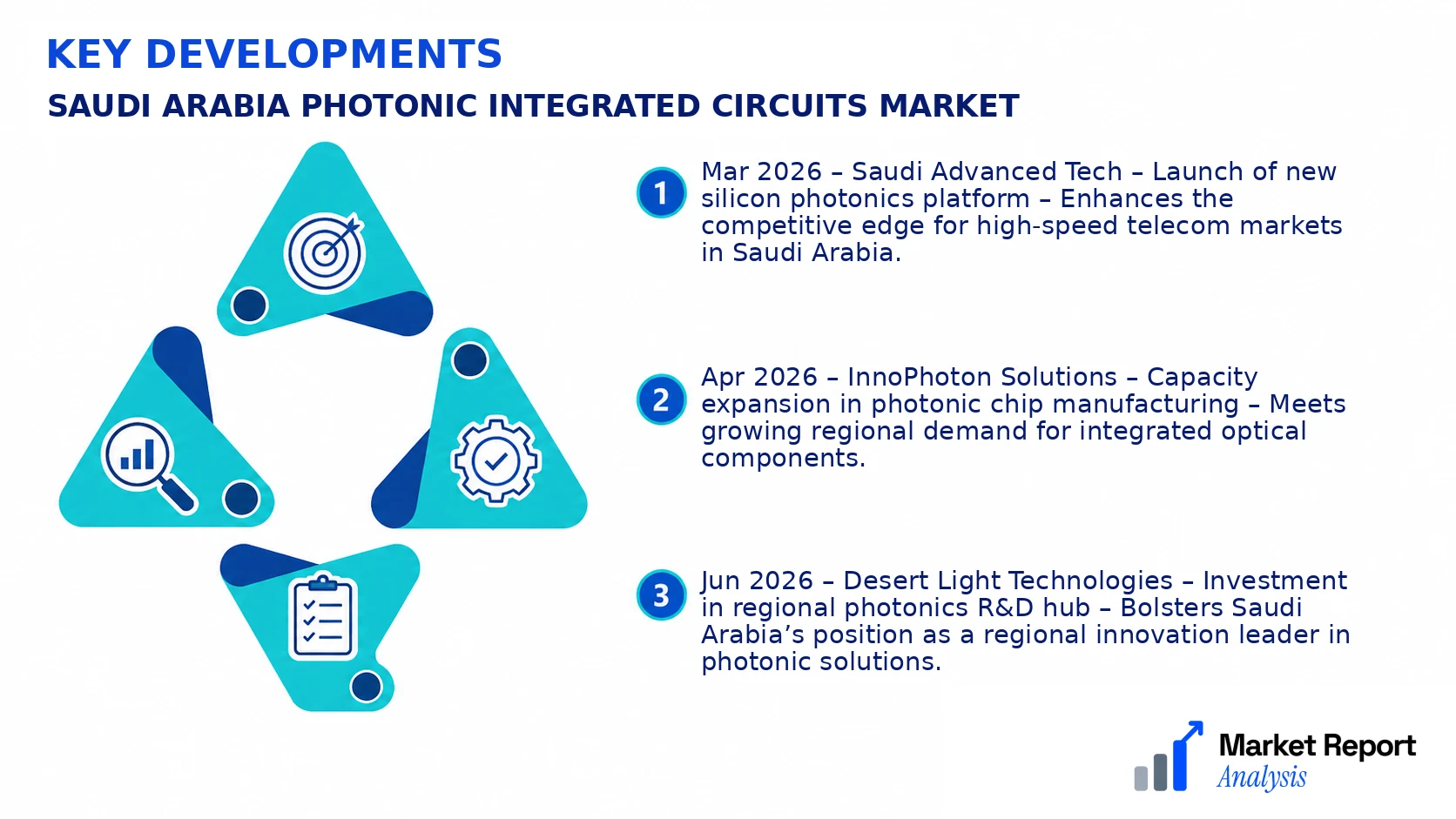
- Mar 2026 – Saudi Advanced Tech – Launch of new silicon photonics platform – Enhances the competitive edge for high-speed telecom markets in Saudi Arabia.
- Apr 2026 – InnoPhoton Solutions – Capacity expansion in photonic chip manufacturing – Meets growing regional demand for integrated optical components.
- Jun 2026 – Desert Light Technologies – Investment in regional photonics R&D hub – Bolsters Saudi Arabia’s position as a regional innovation leader in photonic solutions.
- Aug 2026 – Neom Optics – Strategic partnership with global tech firms – Accelerates development of futuristic integrated photonics for smart city infrastructure.
- Oct 2026 – Saudi Microelectronics – Acquisition of a key photonic design firm – Strengthens domestic manufacturing capabilities and technology expertise in PICs.
Frequently Asked Questions
What is the Saudi Arabia Photonic Integrated Circuits Market?
The Saudi Arabia Photonic Integrated Circuits Market encompasses the design, development, and deployment of integrated photonic devices within the kingdom, facilitating advancements in telecommunications, data centers, and healthcare through innovative photonic solutions integrated on a single chip.
What is the current market size of Saudi Arabia Photonic Integrated Circuits Market?
As of 2026, the market size of Saudi Arabia Photonic Integrated Circuits is estimated at approximately USD 0.3 Billion, reflecting rising adoption driven by technological advancements and increasing investments in digital infrastructure across key sectors.
What factors are driving the Saudi Arabia Photonic Integrated Circuits Market?
The growth is primarily fueled by rising demand for high-speed data transmission, government initiatives to foster digital transformation, and significant investments in telecommunications infrastructure and healthcare. Moreover, the increasing adoption of 5G networks catalyzes market expansion.
Which Saudi city leads the Saudi Arabia Photonic Integrated Circuits Market?
Riyadh emerges as the leading city in the Saudi Arabia Photonic Integrated Circuits Market due to its status as the commercial and technological hub, hosting major research institutions, government agencies, and multinational tech firms spearheading industry growth.
Which segment is expected to grow the fastest?
The telecommunications segment is projected to experience the fastest growth, driven by escalating demand for high-capacity networks and the integration of photonics in 5G and fiber-optic networks, accounting for a substantial portion of the market expansion during 2026-2034.
Who are the leading companies operating in the Saudi Arabia Photonic Integrated Circuits Market?
Leading companies include local and international players such as Saudi Arabian Optical Industry, Hamamatsu Photonics, and Alkhorayef Electronics, focusing on R&D, strategic alliances, and supply chain enhancements to capture burgeoning market opportunities.
Analyst Perspective
The Saudi Arabia Photonic Integrated Circuits Market exhibits a promising long-term outlook driven by ongoing digital transformation initiatives and government-backed investment in optical technologies. As the demand for high-speed communication and advanced sensing solutions increases, market participants should prioritize technological innovation, focusing on integration efficiency and fabrication scalability to maintain competitive advantage. The evolving landscape features rising investments in R&D, enhancing the sophistication and cost-effectiveness of PIC components, particularly in data center connectivity and 5G infrastructure. Key city-level opportunities are concentrated in Riyadh and Jeddah, where expanding ICT infrastructure and industrial parks create a fertile environment for market growth. Competitive intensity isExpected to intensify as local and international players seek to capitalize on emerging opportunities; thus, forming strategic alliances and pursuing technology partnerships will be vital. Long-term, the market will benefit from government incentives aimed at positioning Saudi Arabia as a regional hub for photonic innovation, highlighting Riyadh’s prominence yet also presenting prospects in Dammam’s industrial zones for niche manufacturing. Overall, sustained innovation and strategic regional positioning will be crucial for capturing value within this emerging sector.
