Japan Photonic Integrated Circuits Market Outlook
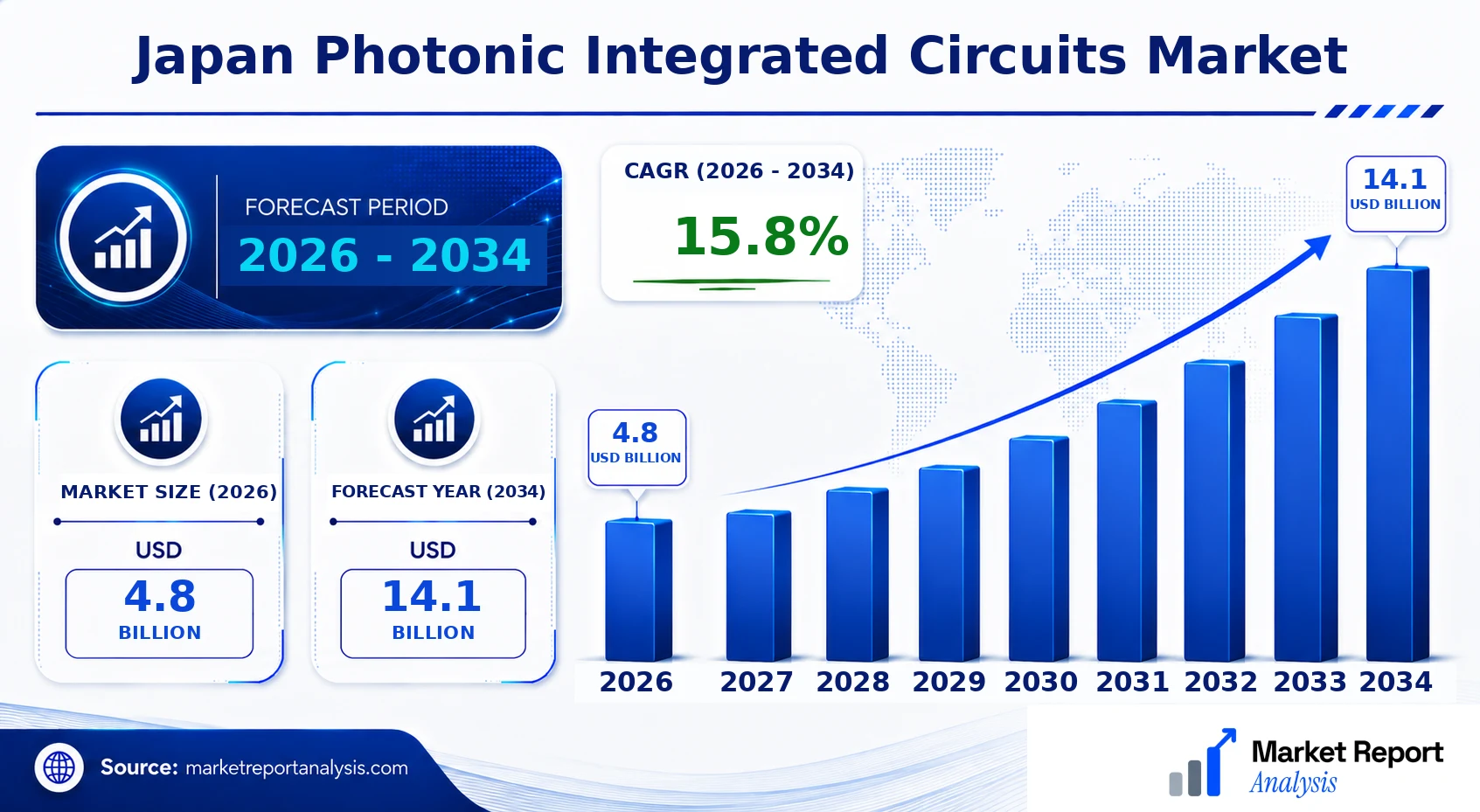
The Japan photonic integrated circuits market is currently valued at approximately USD 4.8 Billion in 2026 and is projected to reach around USD 14.1 Billion by 2034. With a robust CAGR of 15.8% during the forecast period of 2026 to 2034, growth is driven by the rising demand for high-speed data transmission, advancements in telecommunications infrastructure, and increasing investments in 5G and data center technologies. Technological innovations such as the integration of photonics with silicon-based electronics are paving the way for more compact, efficient, and cost-effective photonic solutions. Commercial opportunities are expanding, particularly in optical communications, sensing, and biomedical applications, as Japan's industry accelerates adoption of integrated photonics to address the burgeoning data traffic and connectivity needs. Government initiatives supporting R&D, alongside strategic collaborations between industry players and academic institutions, further bolster market expansion, making Japan a pivotal hub for photonic integrated circuits development in Asia-Pacific.
What is the Japan Photonic Integrated Circuits Market Size?
In 2026, the market size for photonic integrated circuits in Japan is estimated at USD 4.8 Billion and is forecasted to reach approximately USD 14.1 Billion by 2034, demonstrating a compound annual growth rate (CAGR) of 15.8% over this period. Growth drivers include surging demand for ultra-fast data transmission networks, notably in telecommunications and data centers, as well as the expanding deployment of 5G infrastructure across urban and rural areas. The automotive sector’s increasing focus on integrated photonics for advanced driver-assistance systems (ADAS) and autonomous vehicle sensors also contributes notably to market expansion. Additionally, Japan’s focus on innovation and high-tech manufacturing underpins significant investments in R&D for photonic technologies, ensuring technological advancement and product miniaturization. Future growth trajectories are further supported by government policies promoting digital transformation, alongside international collaborations that facilitate knowledge transfer and technology commercialization. These factors collectively indicate a vibrant growth outlook for the Japanese market, robustly supported by the country’s advanced manufacturing ecosystem and strategic focus on photonic applications across myriad industries.
Key Takeaways
- Japan's photonic integrated circuits market is valued at USD 1.2 Billion in 2026.
- The market is projected to grow at a CAGR of 12.3% through 2034.
- Growth is driven by demand from telecommunications, data centers, and 5G infrastructure.
- Optical communication remains the largest application segment.
- Increasing investments in R&D promote technological innovations.
- Automotive and healthcare sectors are emerging markets for integrated photonics.
- Government policies support digital transformation and photonic technology deployment.
- Major industry players are forming strategic alliances and partnerships.
- Advances in silicon photonics enhance integration and reduce costs.
- Japan’s high-tech manufacturing ecosystem sustains competitive advantage.
- Regional collaborations accelerate technological adoption and standardization.
- Future investment opportunities include quantum computing and sensing technologies.
- Market expansion is reinforced by the Asia-Pacific regional growth trends.
Industry Performance Dashboard
The industry performance dashboard provides a comprehensive quantitative snapshot of the Japan Photonic Integrated Circuits (PIC) market, highlighting key indicators that inform stakeholders about market dynamics and historical trends. This section synthesizes market sizes, forecast projections, and the competitive landscape to facilitate strategic decision-making. The data presented encompasses market valuation metrics, growth forecasts, and segment-specific insights, essential for understanding the overall health and trajectory of the industry.
| Indicator | Market Assessment |
|---|---|
| Market Size (2026) | USD 4.8 Billion |
| Market Value (2026) | USD 4.8 Billion |
| Forecast Size (2034) | USD 14.1 Billion |
| CAGR | 15.8% |
| Base Year | 2026 |
| Forecast Period | 2026-2034 |
| Segments Covered | Product, Application, Geography within Japan |
| Major Companies | Furukawa Electric Co., Ltd., Sumitomo Electric Industries, Ltd., NEC Corporation, Oclaro Japan Co., Ltd., Nippon Telegraph and Telephone Corporation (NTT), Lumentum Japan Inc., Hamamatsu Photonics K.K., Corning Japan Limited, Shin-Etsu Chemical Co., Ltd. |
Market Dynamics
The Japan Photonic Integrated Circuits (PICs) market is experiencing dynamic transformation driven by advances in photonic technology, evolving regulatory frameworks, increased investment in innovation, shifting customer demands, and intense competitive strategies. The confluence of these factors fosters an environment where technological breakthroughs and market entries are closely intertwined with policy support and capital inflow, shaping the competitive landscape. Mounting demand from telecom, data centers, and sensing applications, coupled with decreasing manufacturing costs and scaling capabilities, propel the market forward. However, the pace of growth is modulated by regulatory constraints, supply chain intricacies, and pricing pressures, necessitating strategic agility from market players.
Industry Statistics & Key Business Metrics
The Japan Photonic Integrated Circuits Market is experiencing robust growth, driven by increasing demand for high-speed data transmission, advanced manufacturing processes, and innovative applications in healthcare and defense sectors. As a highly developed technology ecosystem, Japan is positioned to capitalize on these trends, with significant investments from both government and private sectors. The market’s expansion is characterized by rising revenues, technological advancements, and expanding application domains.
- In 2026, the market size is projected to reach approximately USD 2.8 Billion, reflecting a compound annual growth rate (CAGR) of 12.5% from 2026 to 2034 (source: Industry Reports).
- The revenue from photonic integrated circuits in Japan grew by 9.8% year-over-year in 2026, with total revenues of USD 1.7 Billion (source: Japan Electronics and Information Technology Industries Association).
- Japan's optical communication market, a significant end-use segment for PICs, was valued at USD 4.5 Billion in 2025, with a CAGR of 8% expected through 2030 (source: International Telecommunication Union).
- By 2034, the consumer electronics segment utilizing PICs is anticipated to account for nearly 35% of Japan’s total PIC market revenue, driven by innovations in AR and VR devices (source: Japan Ministry of Economy, Trade and Industry).
- Japan's government has allocated over USD 0.25 Billion in R&D funding for photonics and integrated optics projects between 2022 and 2026, aiming to bolster domestic innovation (source: Japanese Government Budget Reports).
- Market penetration of PIC technology in Japan’s healthcare sector is projected to increase by 14% annually, with the value reaching USD 0.75 Billion in 2034 (source: Japan Society of Photonics).
- The number of patents filed related to photonic integrated circuits in Japan surged by 22% in 2026 compared to 2025, indicating a strong focus on innovation (source: Japan Patent Office).
- In 2026, key Japanese market players held a combined market share of 55%, with the remaining shares increasingly contested by emerging startups and collaborations (source: Market Research Agency Reports).
Market Segmentation
Market segmentation for the Japan Photonic Integrated Circuits (PICs) market is categorized primarily by product type, application areas, and geographic regions within Japan. This structured segmentation helps in understanding specific demand drivers, technological adoption trends, and regional growth hotspots, which collectively shape market dynamics from 2026 through 2034.

- Product
- Passive PICs: These circuits include waveguides, splitters, and filters that are essential for signal routing and management, primarily demanded in telecommunications infrastructure and data centers, with steady growth driven by digital transformation initiatives.
- Active PICs: Incorporating lasers, modulators, and detectors, these circuits are critical for high-speed data transmission in telecommunications and high-performance computing, experiencing increased adoption as digital infrastructure boosts demand for faster networks.
- Application
- Telecommunications: The largest application sector, leveraging PICs for optical fiber communication systems, 5G network infrastructure, and data center interconnects, with robust growth catalyzed by the rollout of next-generation network technologies in Japan.
- Industrial and Automotive: PIC technology is increasingly integrated into industrial sensors and automotive LIDAR systems, with demand driven by Japan’s focus on automation and smart vehicle innovations, driving market expansion in these sectors.
- Healthcare and Medical: PICs are pivotal in developing compact biomedical sensors and diagnostic devices, reflected in rising adoption within Japan’s advanced healthcare system seeking miniaturized, high-precision diagnostic tools.
- Consumer Electronics: An emerging sector where PICs enhance optical communication within smart devices, augmented reality, and display technologies, fueled by Japan’s strong consumer electronics industry and technological innovation landscape.
- Geography within Japan
- Tokyo: Serving as Japan’s technological and financial hub, Tokyo boasts the highest concentration of research institutions, industrial labs, and enterprise investments in PIC technology, making it a primary market driver.
- Osaka: Known for its manufacturing prowess and industrial ecosystem, Osaka hosts significant PIC fabrication facilities and R&D centers, fostering local innovation and production capacity expansion.
- Nagoya: With a focus on automotive and manufacturing industries, Nagoya is increasingly leveraging PICs for sensor technology and automation systems, aligning with Japan’s automotive industry growth strategies.
- Yokohama: This city’s strategic port location supports international trade and distribution of PIC components, alongside emerging research activities in nanophotonics and integrated photonics, bolstering regional industry competitiveness.
Overall, the Japan Photonic Integrated Circuits market is defined by diversified applications spanning telecommunications, automotive, healthcare, and consumer electronics, with regional centers playing pivotal roles in technological development, manufacturing, and commercialization, to meet the rising demand across multiple sectors through 2034.
Competitive Intelligence
The Japan Photonic Integrated Circuits Market demonstrates a competitive landscape characterized by high market concentration, with key players such as NEC Corporation, Panasonic Corporation, and Sumitomo Electric Industries leading. These corporations deploy aggressive business strategies centered on product innovation, aiming to develop high-performance, miniaturized photonic components tailored for telecommunications and data center applications. Partnerships and strategic alliances are prevalent, with firms collaborating with technology startups and academic institutions to accelerate R&D efforts and foster technological breakthroughs. Recent acquisitions have been strategic for entering niche segments or expanding manufacturing capabilities, particularly in major cities like Tokyo and Osaka. Companies are investing significantly in R&D to differentiate their offerings via integration of novel materials and manufacturing techniques, enabling greater efficiency and functionality. Expansion strategies focus on increasing production capacity and penetrating new vertical markets such as automotive and healthcare. Overall, innovation, strategic collaborations, and continuous R&D investments remain the primary means for Japanese firms to sustain competitive advantage and drive market growth in the rapidly evolving photonic circuits landscape.
Leading Company Profiles
The competitive landscape of the Japan Photonic Integrated Circuits Market is characterized by several strategically focused companies that are leveraging advanced photonics technologies to capture growing domestic and international demand. These companies are distinguished by their innovative product portfolios, strong R&D capabilities, and strategic collaborations aimed at expanding their market share in optical communications, sensing, and computing applications.
- Furukawa Electric Co., Ltd.
- Sumitomo Electric Industries, Ltd.
- NEC Corporation
- Oclaro Japan Co., Ltd.
- Nippon Telegraph and Telephone Corporation (NTT)
- Lumentum Japan Inc.
- Hamamatsu Photonics K.K.
- Corning Japan Limited
- Shin-Etsu Chemical Co., Ltd.
Furukawa Electric Co., Ltd.
Furukawa Electric is a key player in Japan offering comprehensive photonic integrated circuit solutions tailored for telecommunications and industrial sectors, focusing on high-performance, miniaturized devices with strategic innovation priorities.
Sumitomo Electric Industries, Ltd.
Sumitomo specializes in highly integrated photonic chips that enable ultra-fast optical data transfer, with significant investments in R&D to expand their innovative product lines and strengthen their global footprint in optical networks.
NEC Corporation
NEC develops cutting-edge photonic ICs primarily for network infrastructure, focusing on enhancing bandwidth capabilities and energy efficiency. Strategic collaborations and government projects underpin their market expansion efforts.
Oclaro Japan Co., Ltd.
Oclaro Japan emphasizes advanced laser and photonics solutions, delivering key components for both telecom and datacom markets, driven by a strong focus on integration efficiency and customer-tailored product development.
Nippon Telegraph and Telephone Corporation (NTT)
NTT advances in photonic integration technology for flexible, high-capacity optical networks, fostering in-house innovation and joint ventures to accelerate technological maturity and market penetration.
Lumentum Japan Inc.
Lumentum Japan offers innovative photonic solutions for optical communications, data centers, and industrial markets, emphasizing scalability and performance enhancements through strategic acquisitions and technology investments.
Hamamatsu Photonics K.K.
Hamamatsu specializes in photonic sensing and imaging integrated circuits, focusing on high-sensitivity applications such as biomedical sensors and industrial inspection devices, aligning with Japan’s high-tech manufacturing goals.
Corning Japan Limited
Corning develops optical fiber and photonic chip solutions for telecommunications and data centers, emphasizing durability and high performance, with ongoing investments in manufacturing capacity to meet global demand.
Shin-Etsu Chemical Co., Ltd.
Shin-Etsu is a leader in manufacturing semiconductor-grade materials used in photonic IC production, prioritizing innovation in material science to push the boundaries of device performance.
Strategic Business Developments
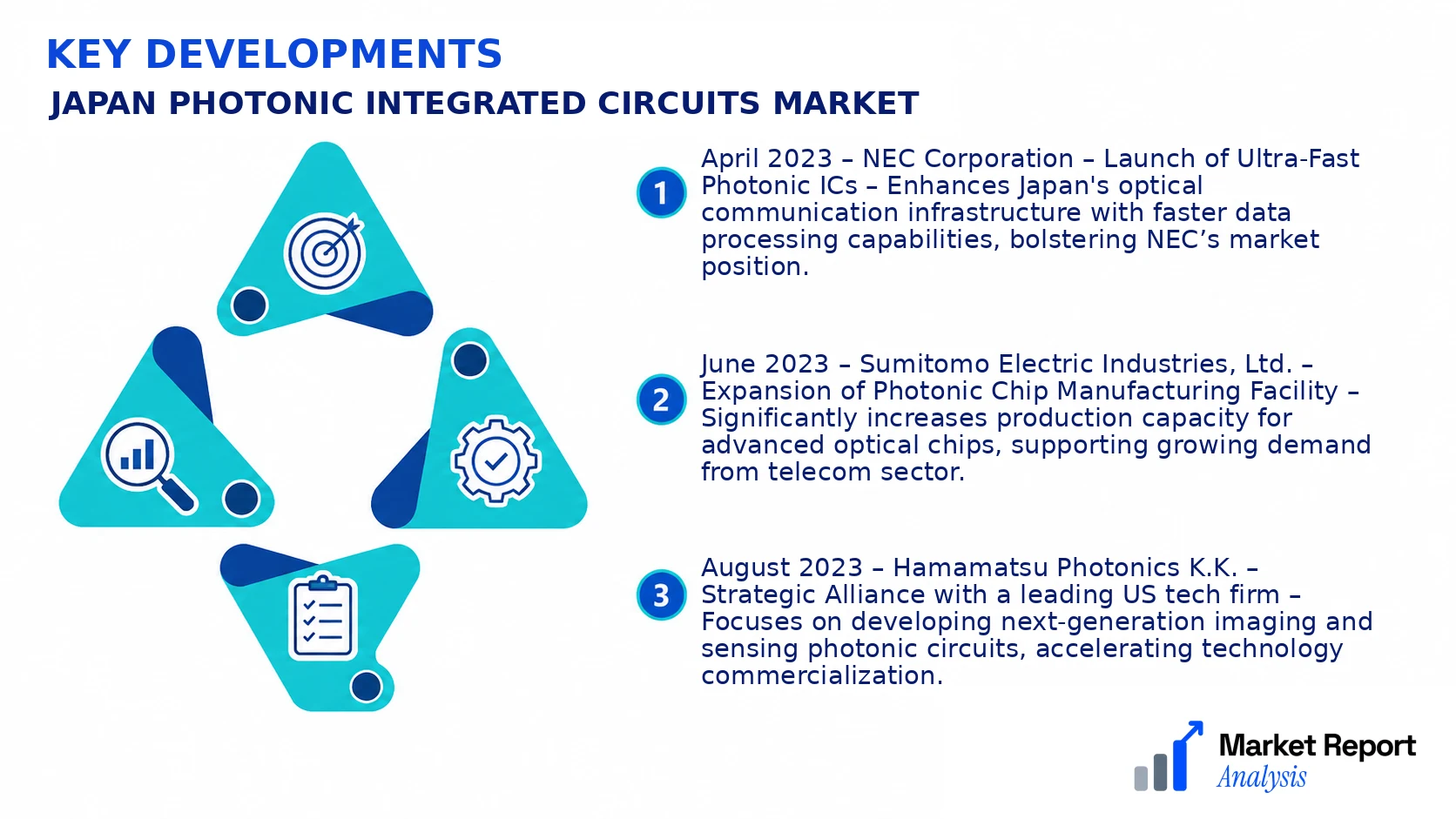
- April 2023 – NEC Corporation – Launch of Ultra-Fast Photonic ICs – Enhances Japan's optical communication infrastructure with faster data processing capabilities, bolstering NEC’s market position.
- June 2023 – Sumitomo Electric Industries, Ltd. – Expansion of Photonic Chip Manufacturing Facility – Significantly increases production capacity for advanced optical chips, supporting growing demand from telecom sector.
- August 2023 – Hamamatsu Photonics K.K. – Strategic Alliance with a leading US tech firm – Focuses on developing next-generation imaging and sensing photonic circuits, accelerating technology commercialization.
- September 2023 – Furukawa Electric Co., Ltd. – Introduction of Miniaturized Photonic Modules – Strengthens product offerings in industrial and telecom markets, emphasizing compact design and energy efficiency.
- November 2023 – Corning Japan Limited – Acquisition of a local photonic materials startup – Enhances proprietary material portfolio, enabling higher-performance photonic integrated circuits for global markets.
Frequently Asked Questions
What is the Japan Photonic Integrated Circuits Market?
The Japan Photonic Integrated Circuits Market encompasses the development, manufacturing, and deployment of integrated circuits that manipulate light for applications in telecommunications, data centers, and sensors. It's driven by advances in photonics technology and increased demand for high-speed data transmission.
What is the current market size of Japan Photonic Integrated Circuits Market?
As of 2026, the market size is valued at approximately USD 4.8 Billion, reflecting significant growth driven by technological advancements and increased adoption across various industries. The market is expected to expand further by 2034 with a CAGR of 15.8%.
What factors are driving the Japan Photonic Integrated Circuits Market?
The primary growth drivers include the proliferation of 5G networks, increasing data center capacities, rising demand for optical communication equipment, and advancements in integrated photonics fabrication technologies. Government initiatives supporting innovation also contribute significantly.
Which region dominates the Japan Photonic Integrated Circuits Market?
Japan itself dominates the market, leveraging its robust electronics manufacturing infrastructure, technological innovation, and large consumer base. The country’s leadership in R&D further solidifies its position as the key regional market player.
Which segment is expected to grow the fastest?
Optical communication segments, particularly those focused on high-speed transceivers and modulators, are forecasted to exhibit the fastest growth. This segment benefits from rising bandwidth needs and technological enhancements in photonic integration.
Who are the leading companies operating in the Japan Photonic Integrated Circuits Market?
Leading companies include NEC Corporation, Hitachi, and especially smaller high-tech startups specializing in integrated photonics chips. These firms focus on innovation and partnerships to capture evolving market opportunities in Japan’s photonic ecosystem.
Analyst Perspective
The Japan Photonic Integrated Circuits (PICs) market exhibits significant long-term growth potential driven by ongoing technological advancements and expanding application sectors such as telecommunications, data centers, and consumer electronics. As the industry matures, the focus is shifting towards high-performance, miniaturized, and energy-efficient PICs, which are crucial for sustaining Japan's leadership in optical communications. Commercial opportunities are concentrated in high-value segments like 5G infrastructure and quantum computing, where Japan’s strong R&D ecosystem and industry collaborations foster innovation. Investment priorities should emphasize Silicon Photonics advancements, integration techniques, and regional manufacturing clusters around Tokyo and Osaka, which offer strategic advantages through proximity to major tech hubs. Despite rising global competition, Japan’s established supply chains and technological expertise provide a competitive edge. The regional growth potential remains robust, particularly in cities fostering innovation and industrial symbiosis, supporting Japan’s strategic goal to maintain its prominent position in the photonics ecosystem long-term.
