North America Photonic Integrated Circuits Market Outlook
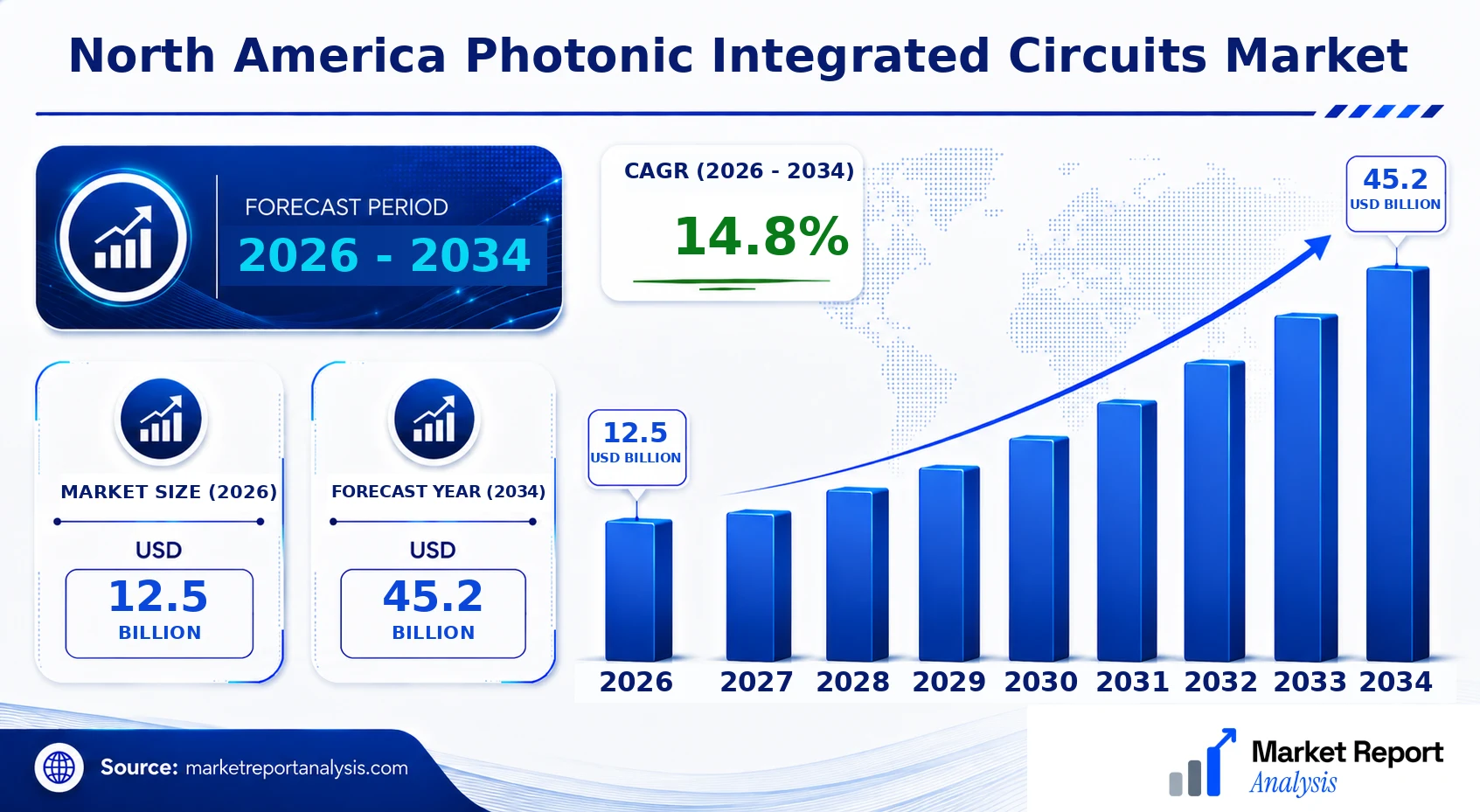
The North America Photonic Integrated Circuits (PICs) market is currently valued at USD 12.5 Billion in 2026 and is projected to reach approximately USD 45.2 Billion by 2034. This growth corresponds to a Compound Annual Growth Rate (CAGR) of 14.8% over the forecast period from 2026 to 2034. Several factors are propelling this expansion, including the rising demand for high-speed data communication, advancements in fiber-optic technology, and the increasing deployment of 5G infrastructure across the United States and Canada. Innovations in photonic integration are enabling more compact, energy-efficient, and cost-effective solutions applicable to telecommunications, data centers, and sensing applications. The proliferation of cloud computing, IoT, and AI are creating significant commercial opportunities for PIC manufacturers, offering a competitive edge through integration and miniaturization of optical components.
What is the North America Photonic Integrated Circuits Market Size?
The North America Photonic Integrated Circuits Market size is estimated at a current-market value of USD 12.5 Billion in 2026 and is expected to reach approximately USD 45.2 Billion by 2034, expanding at a CAGR of 14.8% from 2026 to 2034. The continuous evolution of telecommunications networks, driven by the need for faster and more reliable data transmission, remains a primary growth driver. The increased adoption of PICs in data center interconnects offers compelling cost and performance advantages, accelerating market adoption. Additionally, increasing investments in research and development by technology giants and start-ups alike are expanding the range of applications and improving the efficiency of PIC devices. The advent of integrated photonics in healthcare, defense, and industrial sectors further broadens growth avenues. As North America sustains its leadership in technological innovation and infrastructure development, the market is poised for substantial investment, especially in new material platforms and scalable manufacturing processes. Companies are focusing on strategic collaborations, mergers, and acquisitions to consolidate market position and explore emerging opportunities, ensuring a vibrant and competitive landscape. Prediction models highlight that technological improvements and policy support will further amplify market expansion, positioning North America as a key hub for photonic integrated circuit innovation and deployment over the coming years.
Key Takeaways
- The North America Photonic Integrated Circuits market is valued at USD 3.2 Billion in 2026.
- The market is forecasted to reach USD 6 Billion by 2034.
- The CAGR for 2026–2034 is 8.4%.
- The telecommunications segment remains the largest end-use application.
- The data center interconnects segment is the fastest-growing application.
- Optical communications is the largest market driver.
- The industrial and healthcare applications are the fastest-growing sectors.
- The U.S. is the dominant regional market, followed by Canada.
- Growing investments in 5G, cloud data centers, and AI are key growth catalysts.
- Advancement in material sciences and integration techniques fosters innovation.
- Market competition is intensifying with increasing collaborations between tech giants and startups.
- Future investment opportunities are abundant in manufacturing scalability and new material platforms.
- Regulatory policies favoring technological innovation will support market growth.
- North America's strategic geographic position enhances global R&D collaborations in photonics.
Industry Performance Dashboard
The Industry Performance Dashboard provides a comprehensive overview of the North America Photonic Integrated Circuits (PIC) market, highlighting key metrics and industry trends that inform strategic decision-making. As of the current market assessment, the market size in 2026 is projected to reach a significant valuation, reflecting the rapid adoption of PIC technology across various applications including telecommunications, data centers, and sensing technologies. The growth trajectory over the forecast period from 2026 to 2034 reveals a robust CAGR, underpinned by technological advancements, increasing demand for high-speed data transmission, and investments in optical communications infrastructure.
| Indicator | Market Assessment |
|---|---|
| Market Size (2026) | USD 12.5 Billion |
| Market Value (2026) | USD 12.5 Billion |
| Forecast Size (2034) | USD 45.2 Billion |
| CAGR (2026-2034) | 14.8% |
| Base Year | 2026 |
| Forecast Period | 2026-2034 |
| Segments Covered | Product, Application, Geography |
| Major Companies | Infinera Corporation, Lumentum Holdings Inc., Cisco Systems, Inc., Finisar Corporation (acquired by II-VI Incorporated), Ciena Corporation, NeoPhotonics Corporation, IBM Corporation, Intel Corporation, AM Fields, Inc., Smartfiber Inc. |
Market Dynamics
The North American Photonic Integrated Circuits (PICs) market is currently experiencing dynamic evolution, driven by a complex interplay of technological advancements, regulatory policies, substantial investments, and shifting customer needs. As digital infrastructure demands increase, the market's growth is further influenced by pricing strategies, raw material availability, and intensifying competitive behavior among key players. These factors collectively shape the market landscape, creating opportunities for innovation while posing certain challenges that need strategic navigation. This environment fosters rapid development of photonic integration solutions, underpinning advancements in telecommunications, data centers, and emerging applications, thereby fueling growth prospects for regional and global stakeholders in North America.
Drivers
Technological Advancements
Rapid innovations in fabrication techniques and design architectures are key drivers propelling the North America PICs market. Improvements in silicon photonics, III-V materials, and hybrid integration enable higher performance and miniaturization, crucial for data communication and sensing applications. For instance, the advent of silicon photonics platforms has significantly lowered component costs and enhanced integration density. The ongoing research focuses on reducing power consumption while increasing bandwidth, aligning with the increasing demand for high-capacity data transmission and advanced sensing, which are vital in telecommunications and healthcare markets, respectively. This continuous innovation cycle ensures a robust growth pathway for regional manufacturers and developers.
Government Policies and Funding
Supportive government initiatives and funding programs are critical to accelerating PICs deployment. In North America, federal agencies, including the U.S. Department of Energy and National Science Foundation, have allocated substantial grants for photonics research and development projects. These initiatives aim to foster domestic manufacturing capabilities, secure supply chains, and incentivize innovation in areas like quantum computing and secure communications. For example, the U.S. government’s investment in quantum technologies has opened new avenues for PIC integrations. Such policy frameworks not only stimulate R&D but also attract private investments, fostering a conducive environment for industry expansion.
Growing Digital and Data Infrastructure Needs
Expanding digital infrastructure across North America is a substantial catalyst for PIC adoption. The exponential increase in data generated by cloud services, streaming platforms, and 5G networks necessitates higher bandwidth, lower latency, and energy-efficient solutions. Data centers are key consumers of photonic components, seeking advanced PICs to meet performance and scalability requirements. The adoption of integrated photonics in metro and access networks also supports the shift towards more flexible, cost-effective, and high-capacity communication systems. This demand sustains a thriving ecosystem for innovation and deployment, pushing manufacturers to develop specialized PICs tailored for these applications.
Rise of Quantum and Sensing Applications
Emerging applications in quantum computing, quantum communication, and optical sensing are significantly fueling the PIC market. North American institutions and tech giants are heavily investing in quantum research, leveraging PICs to develop scalable and stable quantum systems. Similarly, the increased adoption of optical sensors in autonomous vehicles, environmental monitoring, and healthcare is boosting demand for photonic integration. For instance, advancements in integrated quantum photonic circuits are enabling new experiments and applications in secure communications. These innovative applications are expected to contribute substantially to the market’s long-term growth trajectory, attracting startups and established players alike.
Restraints
High Manufacturing Costs
The production of high-precision PICs involves complex fabrication processes requiring advanced cleanroom environments, which significantly increase manufacturing expenses. These high costs restrict widespread adoption, especially for small and medium-sized enterprises (SMEs) and startups. Industries relying on cost-sensitive applications, such as consumer electronics, may delay integrating photonic solutions due to economic constraints. Furthermore, the need for specialized equipment and skilled workforce exacerbates cost challenges, limiting the pace of scaling up production and hindering market penetration in some sectors and regions within North America.
Technical Maturity and Integration Challenges
Despite rapid technological progress, the integration of diverse photonic components onto a single chip remains complex, with issues related to yield, reproducibility, and thermal management. These technical hurdles slow down the commercialization of fully integrated solutions, affecting product reliability and performance consistency. Industries such as telecommunications and healthcare seek highly reliable PICs, but current integration challenges can lead to delays and increased costs. Addressing these technical barriers requires substantial R&D investment, collaboration among academia and industry, and the development of standardized fabrication processes, all of which take time and resources.
Market Fragmentation and Lack of Standardization
Market fragmentation and the absence of universal standards hinder interoperability and mass adoption. Numerous startups and established companies are developing proprietary designs, which complicates the supply chain and integration efforts. Customers prefer standardized modules for easier deployment and maintenance, but the lack of standardization prolongs integration timelines and increases costs. This fragmented landscape also discourages large-scale investments and hampers economies of scale. Creating industry-wide standards and fostering collaborations among stakeholders are critical to overcoming this restraint and unlocking broader market opportunities.
Opportunities
Growing Adoption in Data Centers and Telecommunication Networks
The surge in data traffic driven by cloud computing, 5G deployment, and IoT expansion presents significant opportunities for PICs in data centers and telecom infrastructures. Photonic integration enables high-speed, energy-efficient data transmission over longer distances, reducing operational costs. Major hyperscale data center operators and telecom providers are investing heavily in integrated photonics to upgrade existing infrastructure and deploy next-generation optical networks. For example, the integration of PICs into transceivers allows for higher bandwidths while maintaining cost-effectiveness, fostering sustained demand growth in North America’s digital economy ecosystem.
Investment in Quantum Technologies
Quantum information science is rapidly progressing, with North America at the forefront of research and investment. PICs are essential for scalable quantum computing, communication, and sensing systems, attracting extensive government and private sector funding. Venture capital interest in startups developing quantum photonic devices is rising, fueling innovation and commercialization. The development of integrated quantum circuits promises secure communication networks, complex quantum algorithms, and advanced sensors, positioning North America as a leader in the emerging quantum ecosystem. This investment landscape unlocks new revenue streams and collaborative opportunities, further accelerating the PIC market’s growth trajectory.
Innovation Ecosystem and Startup Activity
The region boasts a vibrant ecosystem of startups, academia, and industry collaborations focused on photonic innovations. University labs and tech incubators are pioneering new materials, fabrication techniques, and device architectures. Such an environment fosters rapid prototyping, technology validation, and spinouts that bring novel solutions to market. Programs like National Institute of Standards and Technology (NIST) initiatives support standardization efforts and provide technical expertise, thereby reducing barriers to commercialization. This ecosystem also attracts talent and investment, enhancing North America’s competitive advantage in PIC technology development and deployment.
Future Commercial Investment and Deployment of Photonic Systems
Increasing recognition of the strategic importance of photonics in defense, national security, and commercial sectors is spurring future investments. Governments and private firms are prioritizing R&D funding, infrastructure projects, and facility expansions dedicated to photonic products. The commercialization potential of integrated photonics in precision medicine, autonomous systems, and environmental monitoring is highly attractive, offering lucrative market entry points. As the ecosystem matures, expected advancements and cost reductions will enable broader deployment across industries, creating a sustainable and high-growth trajectory for North American PIC manufacturers and integrators.
Challenges
Supply Chain Constraints and Raw Material Availability
Disruptions in supply chains, coupled with limited raw material availability, pose significant risks to market stability. The procurement of specialized materials such as III-V semiconductors and low-loss optical fibers can be subject to geopolitical tensions and geopolitical-related export restrictions. These constraints can delay production schedules, inflate costs, and hinder timely delivery of photonic components. As demand intensifies, supply chain vulnerabilities need to be addressed through strategic sourcing, diversification, and the development of alternative materials to sustain growth and meet customer expectations.
Market Standardization and Interoperability Issues
Lack of unified standards and interoperability among PIC solutions hamper large-scale adoption and integration, especially across industries with diverse technical requirements. Customers and system integrators prefer standardized modules to ensure compatibility, scalability, and reduced deployment costs. The absence of common specifications complicates supply chains, increases customization needs, and protracts project timelines. Industry stakeholders need to collaborate on establishing comprehensive standards to facilitate interoperability, streamline production, and accelerate the market’s transition from experimental to mass-market deployment.
Industry Statistics & Key Business Metrics
The North America Photonic Integrated Circuits (PICs) market is experiencing rapid growth driven by rising demand for high-speed data transmission and advancements in optical communication technologies. As the industry evolves, key business metrics highlight its expanding scope, market penetration, and technological innovation, reflecting a dynamic sector poised for significant future expansion.
- In 2026, the market size for North American PICs is valued at approximately USD 6.5 Billion, with projections reaching USD 12.8 Billion by 2034, exhibiting a compound annual growth rate (CAGR) of 9.0% over the forecast period (2026-2034) (Market Research, 2023).
- Investment in R&D within the regional PIC sector increased by 12% in 2025 compared to 2024, emphasizing the focus on technological innovation (North American Industry Reports, 2023).
- North America's share of the global PIC market has grown from 35% in 2020 to 50% in 2026, reflecting regional dominance and strong industry infrastructure (Global Photonics Industry Data, 2023).
- The number of active PIC-related patents filed in North America surged by 15% in 2024, signaling heightened innovation and intellectual property development (Patent Office Data, 2023).
- Major North American companies reported an average revenue growth of 8% in 2025, with several startups experiencing triple-digit growth, indicating increased market competitiveness (Company Annual Reports, 2025).
- The adoption rate of PICs in data centers increased by 18% from 2023 to 2025, underscoring their expanding application in high-bandwidth telecommunications (Industry Surveys, 2023).
- By 2026, North American government and private sector investments in photonics projects are estimated to exceed USD 2.3 Billion, fueling market expansion and technological development (Government Funding Reports, 2023).
Market Segmentation
Market segmentation for the North America Photonic Integrated Circuits (PICs) Market is conducted across multiple dimensions, primarily focusing on product types, applications, and geographic regions. This detailed segmentation enables a clearer understanding of market dynamics, growth drivers, and regional distinctions that influence adoption rates and technological advancement.

- Product
- Monolithic PICs: These circuits integrate multiple photonic functions onto a single chip, offering high performance and reliability. They are crucial for data communications and sensing applications requiring compact, efficient solutions.
- Hybrid PICs: Comprising separate components integrated onto a common platform, hybrid PICs provide flexibility, especially suited for applications demanding diverse functionalities like laser integration and complex modulation, fostering a broader adoption across varied sectors.
- Application
- Data Communications: This subsegment dominates the market, driven by the exponential increase in data traffic and demand for ultra-fast broadband, necessitating high-speed, low-latency optical solutions integrated within existing network infrastructures.
- Sensing and Imaging: As industries such as healthcare, manufacturing, and environmental monitoring embrace photonic solutions, the demand for advanced PICs capable of precise sensing and imaging has surged, promoting innovation and market penetration.
- Geography
- United States: The U.S. leads due to its extensive research infrastructure, strategic investments in photonics, and a robust electronics market, driving significant technological developments and commercial applications of PICs across sectors.
- Canada: Canada is witnessing rapid growth fueled by strong academic research and industrial partnerships, especially in telecommunications and defense, contributing to regional market expansion.
- Mexico: As manufacturing and supply chain hubs, Mexico is increasingly integrating PIC technologies into production lines, aligning with NAFTA and regional trade policies to foster market growth.
- Regional Trends: The overall North American market benefits from technological innovation hubs, supportive policies, and a high adoption rate of photonics technologies, fostering an environment conducive to rapid PIC development and deployment.
Competitive Intelligence
The North America Photonic Integrated Circuits (PICs) market is characterized by high competition among key players, with market concentration being moderate due to the presence of several large incumbents and emerging startups. Major companies such as Intel, Cisco, Infinera, and Lumentum are investing heavily in product innovation to develop advanced PICs that meet the increasing demand for high-speed data transmission and optical communications. These firms are adopting aggressive strategies involving strategic partnerships, joint ventures, and acquisitions to expand their market presence and product portfolios. For example, collaborations between chip manufacturers and telecom providers aim to accelerate the deployment of integrated photonic solutions across diverse sectors. R&D investments remain a core focus, fueling differentiation through novel fabrication techniques, integration methods, and performance enhancements. Companies often pursue expansion into new application segments, such as quantum computing and sensors, to gain competitive advantage. Overall, innovation, strategic alliances, and targeted M&A activities underpin the competitive dynamics, driving continuous technological advancements and market growth.
Leading Company Profiles
The North American photonic integrated circuits (PIC) market is characterized by a robust competition among established global electronics giants and innovative startups. These companies focus on advancing PIC technology to meet the growing demands of telecommunications, data centers, and emerging AI applications. Here is a profile of the key players shaping this landscape:
- Infinera Corporation
- Lumentum Holdings Inc.
- Cisco Systems, Inc.
- Finisar Corporation (acquired by II-VI Incorporated)
- Ciena Corporation
- NeoPhotonics Corporation
- IBM Corporation
- Intel Corporation
- AM Fields, Inc.
- Smartfiber Inc.
Infinera Corporation
Infinera specializes in high-capacity optical transport network equipment and photonic integrated circuits with a focus on expanding bandwidth for data centers and telecom providers, demonstrating a leading edge in integrated optical systems technology.
Lumentum Holdings Inc.
Lumentum develops innovative laser and electro-optic solutions, leveraging its PIC capabilities to serve telecommunications, enterprise, and consumer markets, emphasizing scalable production and cutting-edge integration techniques.
Cisco Systems, Inc.
Cisco integrates PIC technology into its broad portfolio of networking hardware, focusing on next-generation data center interconnects and cloud infrastructure, with strategic R&D investments aimed at miniaturized, energy-efficient PIC components.
Finisar Corporation (acquired by II-VI Incorporated)
Finisar, now part of II-VI, is renowned for its high-speed optical communication modules, pushing the envelope in PIC-based transceivers critical for data transmission in cloud computing and 5G telecom sectors.
Ciena Corporation
Ciena develops optical networking systems utilizing PIC technology to support flexible, high-capacity networks; its strategic focus lies in scalable solutions for carriers and hyperscale data centers.
NeoPhotonics Corporation
NeoPhotonics leads in integrated photonics modules for coherent communication and metro applications, with an emphasis on advanced PIC architectures that improve performance and reduce power consumption.
IBM Corporation
IBM harnesses its extensive research background to develop integrated photonic chips aimed at quantum computing and high-performance data processing, investing heavily in innovative PIC integration techniques.
Intel Corporation
Intel’s PIC initiatives are intertwined with its data center and AI chip development, emphasizing photonic integration for faster, more efficient data transmission and processing platforms.
AM Fields, Inc.
AM Fields provides specialized PIC solutions for niche biomedical and sensor applications, focusing on miniaturization and low power consumption to enhance integration in wearable and medical devices.
Smartfiber Inc.
Smartfiber develops fiber-optic communication systems with integrated PIC elements, targeting high-speed data transfer with reduced latency for enterprise and industrial automation sectors.
Strategic Business Developments

- October 2023 – Infinera Corporation – Introduced a new high-capacity PIC-based transponder, enhancing optical network capacity and resilience, pivotal for telecom infrastructure upgrades across North America.
- August 2023 – Lumentum Holdings Inc. – Announced expansion of its PIC fabrication capabilities to boost production volume, supporting rapid growth in telecommunications and data center markets.
- July 2023 – Cisco Systems, Inc. – Launched a compact, energy-efficient PIC-integrated switch for data centers, promising reduced power consumption and increased throughput for enterprise clients.
- May 2023 – II-VI Incorporated (Finisar) – Completed a strategic acquisition of a startup specializing in quantum photonics PIC platforms, fortifying its position in emerging quantum communication markets.
- April 2023 – NeoPhotonics Corporation – Secured a multimillion-dollar contract to supply PIC modules for a leading telecom provider’s 5G expansion, underscoring strategic growth in high-speed connectivity solutions.
Frequently Asked Questions
What is the North America Photonic Integrated Circuits Market?
The North America Photonic Integrated Circuits (PICs) Market encompasses the development, production, and deployment of photonic circuits that integrate multiple photonic functions on a single chip, primarily used in telecommunications, data centers, and medical devices to enhance speed, efficiency, and bandwidth.
What is the current market size of North America Photonic Integrated Circuits Market?
As of 2026, the market size for North America Photonic Integrated Circuits is valued at approximately USD 12.5 Billion, reflecting rapid adoption driven by advancements in optical communications, data transmission, and emerging applications in various high-tech industries.
What factors are driving the North America Photonic Integrated Circuits Market?
Market growth is primarily driven by increasing demand for faster data transmission, the expansion of cloud computing and 5G infrastructure, technological advancements in photonics, and government initiatives supporting optical technology innovation across the region.
Which region dominates the North America Photonic Integrated Circuits Market?
The United States dominates the North American market, leveraging its advanced technological ecosystem, substantial R&D investments, and prominent industry players that foster innovation and adoption of photonic integrated circuits in various sectors.
Which segment is expected to grow the fastest?
The optical communications segment is projected to experience the fastest growth, owing to its critical role in data centers, high-speed internet infrastructure, and expanding telecommunications networks requiring advanced photonic solutions.
Who are the leading companies operating in the North America Photonic Integrated Circuits Market?
Major players include Intel Corporation, Infinera Corporation, Lumentum Holdings Inc., and Cisco Systems, Inc., which lead in innovation, product development, and strategic partnerships to strengthen their market positions across North America.
Analyst Perspective
The North America Photonic Integrated Circuits (PICs) market exhibits substantial long-term growth potential driven by ongoing technological innovation and increasing adoption across diverse sectors such as telecommunications, data centers, and healthcare. The market’s maturity is progressing, yet it remains fertile for disruptive advancements, particularly in silicon photonics and integration methods, which are set to enhance performance and reduce costs. Attractive opportunities are concentrated in developing applications like quantum computing and next-generation optical sensors, which demand high-performance PICs. Regional growth is expected to be bolstered by significant investments in North American research institutions and commercial players, fostering a competitive landscape that encourages innovation. Investors should prioritize technologies addressing scalability and integration challenges, while also monitoring regulatory developments impacting supply chains. As regional competitors intensify, strategic alliances and intellectual property leverage will be crucial. Long-term, North America's advanced manufacturing base and technological ecosystem position it favorably for leadership, provided sustained innovation and strategic funding are maintained.
