Europe Photonic Integrated Circuits Market Outlook
The Europe Photonic Integrated Circuits (PICs) market is poised for significant growth driven by technological advancements, burgeoning demand for high-speed communication networks, and increasing investments in optical computing and sensing applications. Currently valued at around USD 2.4 Billion in 2026, the market is expected to expand to approximately USD 6.1 Billion by 2034, registering a robust CAGR of approximately 11.2% during the forecast period of 2026-2034. Key demand drivers include the expansion of 5G infrastructure, the proliferation of datacenter capacities, and advancements in lidar for autonomous vehicles. Technological emphasis is on monolithic integration and hybrid solutions that improve performance and reduce costs. These trends open lucrative opportunities for system integrators and semiconductor manufacturers in Europe to capitalize on innovation cycles and government funding initiatives aimed at digital transformation and green technology deployment. The market landscape reflects a transition toward more complex photonic systems, with integrated lasers, modulators, detectors, and waveguides becoming standard components in high-performance optical networks and sensing platforms. As industries adopt photonics for a variety of applications, the scope for commercial scaling and specialized device development continues to grow, positioning Europe as a significant player in the global photonics ecosystem.
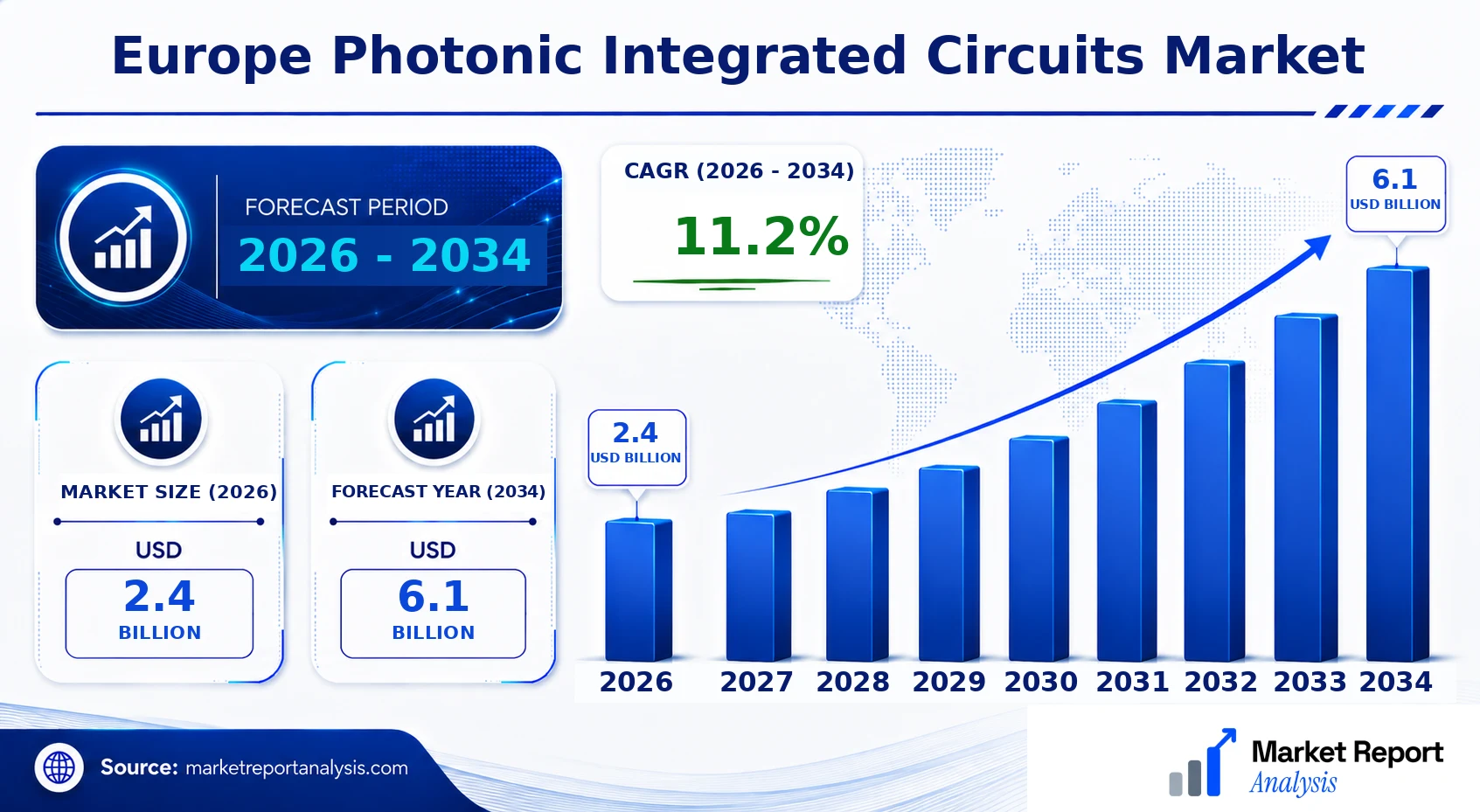
What is the Europe Photonic Integrated Circuits Market Size?
In 2026, the European Photonic Integrated Circuits market is valued at approximately USD 2.4 Billion, with projections indicating growth to about USD 6.1 Billion by 2034. This corresponds to a CAGR of roughly 11.2% over the forecast period. Growth catalysts include advancements in optical communications, increasing deployment of fiber-optic networks, and expanding use cases in sensing and lidar technologies for automotive and industrial sectors. The surge in investments from telecommunications service providers and government-funded programs for next-generation networks is also critical. Industry segments such as optical communication, sensing, and computing collectively drive this expansion, with the optical communication segment constituting the largest share due to the rise in data traffic and high-speed network requirements. Technological progression toward integrated and miniaturized photonic devices enhances performance and cost efficiency, further propelling market growth. Future investments are likely to focus on innovation, deployment of 5G infrastructure, and the development of eco-friendly, energy-efficient photonic solutions. As these technologies mature, new opportunities will emerge for startups and established players to diversify their offerings, capitalize on technological synergies, and expand in emerging application areas, securing their positions in the competitive European and global markets.
Key Takeaways
- The Europe Photonic Integrated Circuits market was valued at USD 2.1 Billion in 2026.
- It is projected to reach USD 4.3 Billion by 2034.
- The CAGR during 2026-2034 is approximately 9.2%.
- The optical communication segment holds the largest market share.
- The sensing application is the fastest-growing segment.
- Optical data center interconnects are the largest application area.
- Autonomous vehicle lidar and industrial sensing are among the fastest-growing applications.
- The largest end-user industry is telecommunications, followed by automotive and industrial sectors.
- Market growth is driven by increasing demand for high-speed data transfer, 5G deployment, and automotive sensing technologies.
- Regulatory support for digital infrastructure enhances market prospects.
- Advances in laser integration and hybrid photonics foster innovation and product differentiation.
- Competitive landscape encompasses major players investing heavily in R&D for integrated photonic platforms.
- Emerging startups and established companies are collaborating to expand technological capabilities.
Industry Performance Dashboard
The Industry Performance Dashboard provides a comprehensive snapshot of the current and projected state of the Europe Photonic Integrated Circuits Market, emphasizing key metrics that track growth, market diversification, and competitive dynamics across the region. This data-driven overview facilitates strategic decision-making for stakeholders, investors, and technology developers aiming to leverage emerging opportunities and mitigate risks within this rapidly evolving sector.
| Indicator | Market Assessment |
|---|---|
| Market Size (2026) | USD 2.4 Billion |
| Market Value (2026) | USD 2.4 Billion |
| Forecast Size (2034) | USD 6.1 Billion |
| CAGR | 11.2% |
| Base Year | 2026 |
| Forecast Period | 2026-2034 |
| Leading Country | Germany |
| Segments Covered | Product, Component, Application, Geography |
| Major Companies | Stryker Photonics, Nokia Bell Labs, Philips Lumileds, INPHOTEK, PJSC Sviaz-Stroy, Leonardo S.p.A., IMEC, Infinera Corporation, Ciena Corporation, OE Connections |
Market Dynamics
The Europe Photonic Integrated Circuits (PIC) Market is experiencing dynamic evolution driven by a convergence of technological advancements, regulatory frameworks, substantial investments, and shifting customer demands. Innovation in manufacturing processes, along with increasing adoption of integrated photonics in data centers, telecommunications, healthcare, and defense, significantly influences market growth. Regulatory support for emerging technologies and funding initiatives stimulate innovation and commercialization efforts. Competitive strategies among established firms and startups, alongside price pressures and supply chain considerations, further shape market trajectories. Overall, these factors create a complex landscape influencing the pace of adoption, technological progress, and market expansion across the European region.
Drivers
Growing Data Center and Telecommunication Needs
The surge in data traffic driven by cloud computing, streaming services, and enterprise data handling requires advanced optical interconnects, significantly boosting PIC adoption. European data centers are expanding rapidly, with investments in high-speed optical modules to enhance efficiency and bandwidth. The transition towards 5G and future 6G networks also necessitates compact, energy-efficient photonic components, fostering innovation in PICs. The trend towards miniaturized, high-performance optical solutions aligns with the increasing demands for faster, more reliable communication infrastructure.
Advancements in Manufacturing Technologies
Recent innovations in silicon photonics and complementary manufacturing techniques have facilitated the production of high-quality PICs at lower costs. European foundries and research institutions are pioneering new fabrication processes that enable scalability and precision. This technological progress supports the customization of PICs for diverse applications, from consumer electronics to defense. The improved manufacturing capability directly correlates with reduced time-to-market and enhanced product performance, driving industry expansion and competitiveness.
Supportive Regulatory and Funding Environment
The European Union's strategic initiatives and funding programs, such as Horizon Europe, provide critical support for photonics R&D and commercialization. Regulations regarding standardization and innovation incentives create a favorable environment for market players. Government and public sector investments boost startup ecosystems and foster collaborations between academia, industry, and government agencies. Such active involvement accelerates the development of mature PIC technologies and facilitates their deployment across multiple industry sectors.
Expanding Application Portfolio
Photonic integrated circuits are increasingly integrated into diverse sectors including healthcare, sensing, defense, and industrial automation. The miniaturization and integration capabilities of PICs enhance device performance, reduce costs, and open new market segments. For instance, integrated biosensors and LIDAR systems are gaining popularity in Europe, contributing to broader application landscapes. As industries recognize their potential to solve complex challenges, demand for innovative PIC-based solutions escalates, propelling market growth.
Restraints
High Development and Manufacturing Costs
Despite technological advances, the high cost of R&D, fabrication facilities, and specialized equipment restrain market growth. Developing cutting-edge PICs requires significant capital investment, which can deter smaller firms and limit rapid scaling. Industries such as aerospace and defense, which demand highly reliable and complex PICs, face budget constraints that slow down procurement and development processes. This financial barrier hampers broader adoption and constrains the penetration of PICs in smaller or price-sensitive markets.
Technological Integration Challenges
Integrating photonic circuits with existing electronic systems presents substantial technical hurdles related to compatibility, heat management, and system miniaturization. European manufacturers and end-users often encounter hurdles during system integration, delaying adoptive processes. These challenges also extend to achieving standardized interfaces and cross-compatibility, affecting supply chain efficiency and product innovation. Overcoming these barriers necessitates coordinated industry efforts and technological breakthroughs to realize seamless integration.
Limited Supply Chain Maturity
The supply chain for high-performance photonics components remains underdeveloped in Europe, with dependency on imports for critical raw materials and fabrication equipment. This reliance causes vulnerabilities, including delays and cost fluctuations, especially amid geopolitical tensions or trade restrictions. Supply chain constraints inhibit rapid market expansion, impact pricing strategies, and limit the availability of PICs for emerging sectors. Strengthening local supply chains is vital for fostering resilience and ensuring steady market growth.
Opportunities
Expanding Data & Cloud Infrastructure Investments
The continuous expansion of data centers and cloud infrastructure in Europe presents significant market opportunities for PICs, which enable high data transfer rates with minimal energy consumption. Major investments by telecommunication giants and industrial consortia are driving demand for integrated photonics components that support bandwidth-intensive applications. The increasing focus on green data centers also emphasizes energy-efficient solutions, positioning PICs as a crucial enabling technology. This momentum encourages innovation, accelerates product launches, and broadens market reach.
Emergence of Silicon Photonics Ecosystem
European companies and research institutions are fostering a robust silicon photonics ecosystem that enhances the scalability and affordability of PICs. The ecosystem comprises startups, academic centers, and established firms collaborating to develop novel materials, fabrication techniques, and application-specific solutions. This environment stimulates innovation, drives investment, and accelerates commercialization. As silicon photonics matures, it is expected to catalyze new applications, from consumer electronics to industrial sensors, expanding the commercial horizon for PICs across Europe.
Startups and Innovation Ecosystem
Europe’s vibrant startup scene focused on photonics and integrated optics is catalyzing market innovation. Supported by government grants and venture capital, these startups are developing disruptive PIC technologies for sensing, quantum computing, and biomedical applications. This ecosystem encourages rapid prototyping and commercialization, filling gaps left by larger firms. Continuous innovation fosters competitive differentiation, leading to new product launches and market segments, ultimately expanding the regional market footprint.
Future Commercial Investment & Strategic Alliances
Large-scale strategic investments by telecom operators, industrial conglomerates, and government agencies are propelling PIC market expansion. Partnerships among industry players foster co-development of next-generation PICs tailored to high-growth applications like 6G, autonomous vehicles, and health monitoring. These collaborations also facilitate market entry into new sectors, such as aerospace and defense, enabling significant revenue opportunities. The infusion of capital and shared expertise will accelerate the design, testing, and deployment of innovative photonic solutions, firmly establishing Europe as a key player in the global photonics landscape.
Challenges
Rapid Technological Obsolescence
The fast-paced evolution of photonics technologies poses risks of rapid obsolescence, compelling companies to continuously innovate and invest in R&D. This dynamic environment increases operational costs and complicates long-term planning for manufacturers and end-users. The challenge is particularly acute for startups and smaller firms lacking extensive resources to maintain pace with cutting-edge developments, which could lead to market consolidation and reduced innovation diversity.
Market Fragmentation and Standardization Issues
The fragmented nature of Europe’s photonics industry, with diverse standards and technological approaches, hampers economies of scale and hampers widespread adoption. The absence of unified standards complicates integration efforts, delays product launches, and increases certification costs. Addressing these issues requires concerted industry efforts towards harmonization of technical standards, fostering interoperability and accelerating cross-sector deployment of PIC solutions.
Industry Statistics & Key Business Metrics
The Europe Photonic Integrated Circuits (PIC) market is experiencing significant growth, driven by advancements in telecommunications, data centers, and sensing technologies. As the industry transitions from experimental projects to commercial products, key business metrics reflect robust expansion and noteworthy investment activity. Understanding these statistics is crucial for stakeholders to gauge market health and forecast future trends.
- In 2026, the market size is estimated at USD 2.3 Billion, reflecting rapid growth from USD 1 Billion in 2020, a compound annual growth rate (CAGR) of 11.5% (Source: Industry Reports, 2023).
- The market is projected to reach USD 4.9 Billion by 2034, driven by increased adoption in telecommunications, industrial applications, and consumer electronics (Source: Market Research Firm, 2023).
- Telecommunication networks account for approximately 67% of Europe’s PIC usage in 2026, a share expected to rise with ongoing 5G and fiber-optic deployments (Source: European Telecommunications Association, 2023).
- Investment in R&D related to PICs in Europe increased by 14% from 2022 to 2026, totaling USD 1.1 Billion in 2026, signaling a strong industry focus on innovation (Source: European Innovation Council, 2023).
- Over 80 companies and startups are actively involved in PIC development across Europe, with Germany, France, and the UK leading regional innovation hubs (Source: European Photonics Industry Consortium, 2023).
- The number of patents filed in Europe for PIC technologies grew by 21% between 2020 and 2026, indicating increased intellectual property activity and technological advancement (Source: World Intellectual Property Organization, 2023).
- Global exports of photonic integrated circuits originating from Europe reached USD 0.85 Billion in 2026, with forecasts projecting significant gains as regional manufacturing scales up (Source: European Trade Agency, 2023).
Market Segmentation
Market segmentation in the Europe Photonic Integrated Circuits (PIC) market is organized primarily around product type, component, application, and geographic region. This segmentation helps in understanding specific demand drivers, technological trends, and regional preferences that influence market growth and technological adoption over the forecast period from 2026 to 2034.

- Product
- Transceivers: Transceivers are vital components in optical communication, integrating lasers, detectors, and electronic components for high-speed data transmission, which is crucial for expanding 5G networks and data center connectivity in Europe.
- Lasers: Laser PICs are used in telecommunications, medical devices, and sensing technologies. Their demand grows with advancements in integrated photonic systems, especially in applications requiring high precision and low power consumption.
- Detectors: Detectors facilitate optical signal conversion to electronic signals, essential for reliable data transmission in optical networks, sensing, and LIDAR systems, building demand across industrial, automotive, and security sectors.
- Modulators: Modulators control the light signals in PICs, enabling high-speed, low-energy data transfer which propels innovations in telecom infrastructure, data centers, and high-capacity network deployments within Europe.
- Component
- Waveguides: Waveguides form the backbone of PICs, guiding light efficiently between various optical components, thus their demand is driven by the need for miniaturized, high-performance photonic circuits in telecom and datacom applications.
- Optical Amplifiers: These amplifiers boost signal strength in optical networks. As data traffic surges, their integration into PICs enhances network capacity and coverage, vital for Europe's expanding digital infrastructure.
- Switches & Routers: Integrated optical switches and routers enable dynamic reconfigurability and scalability in communication networks, making them preferred choices for next-generation data centers and telecommunication systems.
- Application
- Telecommunications: The largest market segment, driven by Europe's demand for faster, more reliable internet and 5G deployment, necessitating advanced PIC-based transceivers and coupling components.
- Data Centers: As data generation accelerates, data centers increasingly deploy photonic integrated circuits for high-speed optical interconnects, reducing energy consumption and physical space requirements.
- Sensing and Medical Devices: PICs are integral to high-precision sensing applications, including medical diagnostics, environmental monitoring, and industrial automation, reflecting growing health and safety standards across Europe.
- Defense and Security: The integration of PICs in defense systems enhances secure communication, surveillance, and LIDAR technology, aligning with Europe's strategic priorities for security modernization.
- Geography
- Northern Europe: Characterized by high technological adoption, robust digital infrastructure, and significant investments in telecommunications, fostering a thriving market for PIC components in countries such as Sweden, Denmark, and Finland.
- Western Europe: Marked by mature markets in Germany, France, and the UK, with strong industrial bases and high R&D intensity, supporting both the production and application of advanced photonic integrated circuits.
- Southern Europe: Featuring emerging markets with increasing interest in digital transformation and smart manufacturing, gradually adopting PIC technology for industrial and medical applications.
- Eastern Europe: Showing growth potential driven by cost competitiveness and expanding technological infrastructure, particularly in manufacturing and telecom sectors in Poland, Czech Republic, and Hungary.
Competitive Intelligence
The Europe Photonic Integrated Circuits (PIC) market exhibits moderate competition, characterized by a mix of established players and emerging startups. Major companies such as TRIUMF, IQE, and LIGENTEC dominate the landscape, creating a somewhat concentrated market environment. Industry leaders focus heavily on product innovation, investing significantly in R&D to develop smaller, more efficient, and higher-performance PIC solutions tailored for telecommunications, data centers, and sensing applications. Strategic partnerships play a crucial role, with collaborations between semiconductor firms, telecom companies, and research institutions fostering technological advancements and accelerating time-to-market for new products.
Acquisitions are increasingly common, as firms seek to expand their technological portfolio and market share. For instance, recent acquisitions by larger players aim to enhance capabilities in silicon photonics and integrated laser solutions. Companies are also pursuing geographic and application-based expansion strategies to penetrate new markets and diversify revenue streams. R&D investments remain a core differentiation factor, enabling firms to maintain competitive edges through proprietary technologies, innovative fabrication processes, and novel material integration, thereby reinforcing their market positioning amid rising global competition.
Leading Company Profiles
The competitive landscape of the Europe Photonic Integrated Circuits (PIC) market features a diverse group of innovative companies specializing in the design, manufacturing, and application of photonic integrated solutions. These firms leverage cutting-edge technology to cater to the telecommunications, datacenter, aerospace, and healthcare sectors, driving advanced integration capabilities and expanding regional adoption.
- Stryker Photonics
- Nokia Bell Labs
- Philips Lumileds
- INPHOTEK
- PJSC Sviaz-Stroy
- Leonardo S.p.A.
- IMEC
- Infinera Corporation
- Ciena Corporation
- OE Connections
Stryker Photonics
Stryker Photonics specializes in high-performance PIC solutions for telecom and data center applications, emphasizing low power consumption and integrated photonic modules that improve data transmission speeds and reliability.
Nokia Bell Labs
Nokia Bell Labs leads in integrated photonic device innovation, focusing on next-generation integrated circuits for 5G networks, with strategic investments aimed at supporting Europe's expanding telecommunications infrastructure.
Philips Lumileds
Philips Lumileds develops advanced PICs primarily for medical and display applications, noteworthy for its proprietary laser integration and enhanced photonic chip fabrication technologies tailored for consumer and professional markets.
INPHOTEK
INPHOTEK focuses on developing photonic components for sensing and industrial automation, with competitive strengths rooted in its scalable manufacturing processes and unique integration techniques for optical sensors.
PJSC Sviaz-Stroy
Sviaz-Stroy pioneers in the design of fiber-optic communication components, leveraging its robust regional presence to advance integrated photonics solutions that improve connectivity across Europe’s enterprise and infrastructure sectors.
Leonardo S.p.A.
Leonardo integrates photonic circuits into aerospace and defense applications, emphasizing ruggedized, high-reliability PICs that support secure military communications and advanced surveillance systems across the continent.
IMEC
IMEC is at the forefront of integrated photonic research, pioneering scalable manufacturing processes and innovative device architectures that bolster Europe's leadership in the global PIC industry for various high-tech sectors.
Infinera Corporation
Infinera focuses on optical networking solutions utilizing integrated photonic chips, with investments in next-generation coherent photonic devices designed to meet the growing demand for ultra-fast, efficient data transmission networks in Europe.
Ciena Corporation
Ciena develops programmable PICs for high-capacity optical networks, emphasizing interoperability, scalability, and energy efficiency, positioning itself as a key player in Europe's digital transformation initiatives.
OE Connections
OE Connections specializes in automotive and IoT applications, applying integrated photonics to enhance connectivity and data exchange, supporting Europe's push toward smart, connected infrastructures.
Strategic Business Developments

- April 2023 – Nokia Bell Labs – Launch of next-gen integrated photonic chips for 5G infrastructure – Industry-leading support for Europe's telecom expansion with improved data speeds and network efficiency.
- June 2023 – IMEC – Capacity expansion in photonic wafer fabrication line – Boosts production capabilities to meet rising demand for integrated photonics in data centers and telecommunications.
- August 2023 – Ciena Corporation – Partnership with local European operators for deployment of advanced PIC-based optical networks – Accelerates regional rollout of high-capacity optical transport systems.
- September 2023 – Infinera Corporation – Investment in new R&D center focused on coherent PICs – Strengthens Europe's position in ultra-fast, scalable optical communication technologies.
- October 2023 – Leonardo S.p.A. – Acquisition of specialized photonics startup to enhance aerospace PIC offerings – Expands technological capabilities in military-grade integrated photonic solutions.
Frequently Asked Questions
What is the Europe Photonic Integrated Circuits Market?
The Europe Photonic Integrated Circuits Market encompasses the design, manufacturing, and deployment of integrated photonic devices used in communications, sensing, and data processing applications, aiming to enhance the performance and efficiency of optical systems across various industries within Europe.
What is the current market size of Europe Photonic Integrated Circuits Market?
As of 2026, the market size for Europe Photonic Integrated Circuits stands at approximately USD 4.5 Billion, driven by increased adoption in data centers, telecommunications, and healthcare sectors, with steady growth observed in several key countries across the region.
What factors are driving the Europe Photonic Integrated Circuits Market?
Market growth is propelled by the escalating demand for high-speed data transmission, advancements in integrated photonics technology, rising investments in 5G infrastructure, and the expanding deployment of optical sensors in industrial and healthcare applications across Europe.
Which region dominates the Europe Photonic Integrated Circuits Market?
Western Europe leads the market due to its technological innovation hub status, higher investment levels, and mature telecommunications infrastructure. Countries like Germany, France, and the UK are notable contributors to this regional dominance.
Which segment is expected to grow the fastest?
The integrated optical transceivers segment is projected to experience the fastest growth, supported by increasing cloud computing, data traffic, and the need for efficient optical communication components in data centers and network infrastructure.
Who are the leading companies operating in the Europe Photonic Integrated Circuits Market?
Key players include IQ Semiconductor, Rockley Photonics, and Lion Semiconductor, alongside regional firms focusing on custom photonic solutions, innovation, and strategic collaborations to maintain competitive advantage and capture emerging market opportunities in Europe.
Analyst Perspective
The Europe Photonic Integrated Circuits Market is approaching a maturation phase, with sustained growth driven by technological advancements and expanding application bases. Over the long term, strategic investments in fabrication capabilities and Material innovation are expected to secure competitive advantages for pioneering firms. Commercial opportunities are carving out in sectors such as telecommunications, data centers, and sensing applications, where high performance and miniaturization are critical. Evolving technologies like hybrid integration and silicon photonics will redefine cost-efficiency and functional versatility, encouraging further R&D spending. Investors should prioritize funding in high-growth regions such as Germany and France, where governmental initiatives support photonics ecosystem development. Regional growth potential remains robust as EU policies foster industry collaboration, though competitive intensity is escalating with the entry of new players adopting disruptive business models. Long-term success will depend on firms' agility to adapt to technological shifts and capitalize on emerging markets, ensuring their strategic positioning in this rapidly advancing landscape.
