Saudi Arabia Alfalfa Hay Market Outlook
The Saudi Arabia Alfalfa Hay Market is currently valued at USD 0.84 Billion, with forecasts predicting it will reach USD 1.45 Billion by 2034, registering a Compound Annual Growth Rate (CAGR) of 7.0% during the period from 2026 to 2034. The growth trajectory is driven chiefly by rising demand for high-quality forage in livestock nutrition, an expanding agricultural sector, and government initiatives aimed at sustainable farming practices. The adoption of modern harvesting and processing technologies is pivotal, providing opportunities for future investments. Moreover, increasing investments in rural infrastructure and improving export capabilities are expected to stimulate market expansion. The market's innovations, including automation in harvesting and packaging, are opening commercial opportunities for local and international players, making Saudi Arabia a promising landscape for alfalfa hay production and trade.
What is the Saudi Arabia Alfalfa Hay Market Size?
Projected at USD 0.84 Billion in 2026, the Saudi Arabia Alfalfa Hay Market is anticipated to grow to USD 1.45 Billion by 2034, reflecting a CAGR of 7.0% over the forecast period. This growth is primarily fueled by a burgeoning livestock sector eager to access high-quality forage options to meet dietary requirements. The agricultural policy reforms implemented by the Saudi government promote sustainable farming practices, significantly boosting alfalfa hay production. Key demand is observed in the dairy and meat production industries, which seek consistent, high-nutrient forage sources to enhance productivity. Technology advancement in harvesting and processing, such as mechanized cutting and baling, is contributing to efficiency gains and product quality improvements. Future investments are likely to focus on expanding arid-region cultivation zones and improving supply chain logistics to meet rising domestic consumption and export ambitions. The increasing role of private sector players in the market signals a competitive environment with significant growth upside for new entrants. Additionally, the strategic location of Saudi ports facilitates export opportunities to neighboring GCC and MENA countries, supporting market expansion beyond local borders. As the livestock industry continues to grow, the demand for sustainably produced, high-quality alfalfa hay will intensify, emphasizing the importance of technological adoption and supply chain optimization for continued growth.
Key Takeaways
- The market size was USD 0.84 Billion in 2026 and is projected to reach USD 1.45 Billion by 2034.
- The CAGR for 2026-2034 is estimated at 7.0%, reflecting steady growth.
- Riyadh is the leading Saudi city for alfalfa hay demand and production.
- Jeddah is identified as the fastest-growing city in terms of market demand increases.
- The largest market segment comprises forage for livestock feed, with dairy cattle as the primary end user.
- The fastest-growing segment involves organic alfalfa hay, driven by rising demand for sustainable products.
- The main application is livestock nutrition, mainly in dairy and beef sectors.
- Increased investment in agricultural infrastructure and technology adoption is boosting local production capacity.
- Market competition is intensifying with entry of international players aiming to expand regional trade.
- Government regulations support sustainable agriculture, creating a favorable environment for market growth.
- Supply chain improvements and export facilitation are key to realizing the full growth potential.
- Future growth will be driven by innovations in harvesting technology and quality standards.
Industry Performance Dashboard
The Industry Performance Dashboard provides a comprehensive overview of the key metrics and market dynamics within the Saudi Arabia Alfalfa Hay market. This section synthesizes critical data points to facilitate strategic planning and investment decisions. The market size in 2026 is valued at USD 1.2 Billion, reflecting Saudi Arabia’s expanding demand driven by increasing livestock populations and evolving agricultural policies. The forecast size for 2034 is projected to reach USD 2.3 Billion, with a Compound Annual Growth Rate (CAGR) of 8.4% over the period 2026-2034, indicating robust expansion and rising sector competitiveness. The analysis identifies Riyadh as the leading Saudi city, capitalizing on its extensive agricultural infrastructure and market reach, while Dammam is noted as the fastest-growing city, driven by regional government incentives and upgrading agribusiness facilities. The report covers significant segments such as organic and conventional alfalfa hay, with further diversification anticipated as feed demand intensifies. Major companies operating in Saudi Arabia include Alfanar Agriculture, local branches of multinational firms like Archer Daniels Midland, and emerging regional players. Investment trends reveal a growing influx of private and government capital aimed at sustainable, water-efficient hay production, aligning with national goals for food security and environmental conservation. Pricing trends demonstrate moderate increases aligned with feed market inflation, while market maturity in Saudi Arabia suggests a transition from nascent to developing stage, characterized by rising local production and improving export capabilities.
Market Dynamics
The Saudi Arabia Alfalfa Hay Market is experiencing a transformation driven by a complex interplay of technological advancements, regulatory reforms, increasing investments, customer preferences, and competitive market behaviors. Innovations in crop cultivation, harvesting, and distribution are enhancing yield quality and supply reliability. Regulatory frameworks aimed at boosting agricultural productivity and sustainability are fostering a conducive environment for market expansion. Capital inflows from both domestic and international investors are supporting modernization and infrastructure upgrades. Customer requirements, particularly for high-nutrition livestock feed, are shifting towards organic and sustainably produced alfalfa. Simultaneously, price competitiveness and supply chain robustness are critical factors influencing market dynamics, prompting players to adapt rapidly to emerging trends and competitive pressures.
Drivers
Growing Demand for Livestock Feed
The rising demand for high-quality livestock feed in Saudi Arabia is a primary market driver. With the government promoting animal husbandry as part of its agri-food strategy, the need for nutritious fodder like alfalfa hay has surged. Livestock farmers seek sustainable, high-yield feed options to support the growing meat and dairy industries. The increase in cattle, poultry, and other livestock populations directly correlates with a higher requirement for premium feed sources, consequently boosting the local alfalfa hay industry. Additionally, rising awareness of animal health standards and productivity among farmers further fuels demand for superior-quality alfalfa hay, making it a fundamental component of the livestock nutrition landscape.
Technological Innovations in Agriculture
Advanced agricultural technologies such as precision farming, autonomous harvesting, and genetic improvements are significantly impacting the Saudi alfalfa hay market. These innovations enable higher yields, better resource utilization, and improved crop resilience to climatic stressors. For instance, the adoption of drip irrigation and soil monitoring systems helps optimize water and nutrient usage, critical in Saudi Arabia’s arid climate. Development of drought-resistant alfalfa varieties through biotechnology promises increased productivity and sustainability. As these technological practices become widespread, they reduce cultivation costs and improve product quality, directly supporting market growth and competitiveness.
Government Policies and Support Programs
The Saudi Arabian government actively promotes agricultural self-sufficiency through policies, subsidies, and initiatives aimed at boosting local fodder production. Programs encouraging private sector investment in forage cultivation and agritech innovations are expanding market capacity. Recently, strategic plans under Saudi Vision 2030 emphasize sustainability, food security, and diversification, including specific measures to improve forage crop productivity. Furthermore, international collaborations and funding for research projects are fostering the adoption of modern practices in alfalfa cultivation. Such supportive policies mitigate risks and incentivize local farmers and investors, shaping a favorable ecosystem for market expansion.
Price Competition and Supply Chain Development
Price dynamics and the development of efficient supply chains are vital drivers of the Saudi alfalfa hay market. Competitive pricing is essential to attract large-scale buyers like livestock farms and feed producers. Investments in cold storage, transportation, and distribution infrastructure aim to reduce post-harvest losses, ensure product quality, and achieve timely delivery. Currently, local producers are scaling operations and forging partnerships with logistics companies to strengthen supply chain resilience. The drive for cost-effective production and distribution methods is intensifying as market players seek to gain a competitive edge, ultimately supporting broader market accessibility and growth.
Restraints
Water Scarcity and Irrigation Challenges
Water scarcity remains the most critical restraint impacting alfalfa hay production in Saudi Arabia. The country's arid climate limits access to adequate freshwater resources, essential for crop cultivation. Although technologies like drip irrigation and treated wastewater usage provide solutions, their high implementation costs and limited availability restrict widespread adoption. Water scarcity not only constrains yield potential but also increases production costs, making locally sourced alfalfa less competitive relative to imported options. This challenge compels producers to seek efficient water management practices and resistant crop varieties, but the overall growth trajectory remains conditional on sustainable water resource management.
High Cultivation and Operational Costs
The expenses related to land preparation, seed procurement, labor, and technological inputs are significant barriers to market expansion. Saudi Arabian farmers face elevated operational costs due to the need for imported inputs, energy-intensive cultivation processes, and infrastructure investments. These costs translate into higher prices for end-users, possibly limiting market access for smaller farmers and influencing buying behavior. Additionally, fluctuations in input prices, driven by global commodity markets, pose risks to profit margins. The high cost structure necessitates continued innovation and efficiency improvements to enable sustainable growth in the local alfalfa hay industry.
Limited Local Research and Development
The nascent state of R&D in forage crop improvement and sustainability practices restricts the pace of market growth. Limited local expertise, institutional infrastructure, and funding hinder the development of region-specific alfalfa varieties resilient to Saudi Arabia’s climatic challenges. This results in reliance on imported seeds and technologies, increasing input costs and reducing competitiveness. Without significant investments in research collaborations, seed breeding programs, and extension services, the market may struggle to adapt swiftly to evolving climate conditions and stakeholder demands, thereby limiting long-term growth prospects.
Opportunities
Expansion through Sustainable and Organic Farming
Growing consumer and industry preference for organic and sustainably produced feed options present a notable market opportunity. Saudi Arabia is increasingly adopting eco-friendly farming practices, driven by government incentives and consumer awareness. The adoption of organic certification standards and sustainable cultivation techniques can open export avenues and premium market segments. Additionally, integrating renewable energy sources into cultivation and processing operations aligns with national sustainability goals. Market players investing in organic and eco-certified alfalfa will be uniquely positioned to capitalize on rising demand for quality feed and bolster their competitive edge both domestically and in neighboring markets.
Investment in Modern Supply Chain Infrastructure
Developing advanced logistical networks such as cold storage facilities, refrigerated transportation, and integrated distribution centers can substantially enhance product quality and supply reliability. These investments allow year-round supply, reduce spoilage losses, and expand market reach within Saudi Arabia and to regional markets. Public-private partnerships, aided by government incentives and foreign direct investment, are expected to accelerate infrastructure development. Enhanced supply chain efficiency will also facilitate the scaling of premium and value-added products, including fortified or organic alfalfa hay, thus unlocking new revenue streams and strengthening market positioning.
Advancement of Agritech and Precision Farming
The deployment of precision agriculture technologies, including drone monitoring, IoT-based soil sensors, and AI-driven crop management, holds promise for elevating local alfalfa production. These innovations improve resource-use efficiency and yield predictability, reducing environmental impact and operational costs. Encouraging startups and innovation ecosystems focused on agrotech solutions tailored to Saudi climate conditions can catalyze sustainable growth. Increased funding for research and pilot programs promotes technology adoption among farmers, enabling better adaptation to climate challenges while ensuring crop health and productivity, thereby expanding the overall market capacity.
Encouragement of Public and Private Sector Partnerships
Strategic collaborations between government agencies, research institutions, and private companies can facilitate knowledge transfer, resource sharing, and infrastructural growth. Initiatives such as government-funded pilot projects and subsidies for innovative farming equipment foster a conducive environment for market development. These partnerships can also support the establishment of demonstration farms for best practices in sustainable alfalfa cultivation. As part of the broader Saudi Vision 2030 objectives, such frameworks enable the scaling of efficient, technology-driven practices that meet both domestic demand and export potentials, making the market more resilient and versatile.
Emerging Technologies and Product Diversification
The integration of emerging technologies like blockchain for traceability, and development of value-added drinks and supplements from alfalfa, represent new growth avenues. Technological improvements in forage processing, including pelletizing and packaging innovations, can cater to niche markets, including health-conscious consumers and animal nutrition industries. Furthermore, exploring vertical farming and controlled environment agriculture could enable year-round production in limited spaces. These technological shifts can diversify product offerings, increase market resilience, and attract new customer segments, positioning Saudi Arabia as a supplier of innovative, high-quality forage products in regional and global markets.
Challenges
Climatic and Environmental Constraints
Environmental factors such as extreme heat, dust storms, and water scarcity severely limit agricultural productivity in Saudi Arabia. These climatic conditions impose stress on alfalfa crops, reducing yields and increasing input costs for cooling, irrigation, and soil amelioration. While technological interventions can mitigate some impacts, they come with high capital requirements and operate within the constraints of a fragile ecosystem. Overcoming these environmental challenges requires continued investment in resilient crop varieties, sustainable water management, and climate-adaptive farming practices to secure long-term market sustainability.
Market Fragmentation and Limited Local R&D
The Saudi alfalfa hay market is characterized by fragmentation among small-scale growers and limited indigenous research capacity. This situation hampers the development of standardized quality benchmarks, supply consistency, and technological adoption. The lack of a centralized industry framework and limited local innovation stifles competitiveness and restricts growth, especially against imported and multinational suppliers. Addressing this challenge necessitates concerted efforts to build a robust research ecosystem, integrate smaller farmers into formal value chains, and establish quality standards, which collectively are essential for fostering a resilient and scalable market.
Industry Statistics & Key Business Metrics
The Saudi Arabia Alfalfa Hay Market is experiencing steady growth driven by increasing demand for high-quality forage in livestock nutrition and expanding agricultural investments within the country. Market size and performance are closely linked to the government's strategic initiatives to enhance local forage production and reduce reliance on imports. As the dairy and beef sectors modernize, demand for premium alfalfa hay continues to rise, underpinning positive industry metrics. The rapid expansion of urban livestock farming in Riyadh and Jeddah further amplifies regional consumption, adding to the market’s robustness.
- 2026 market value: USD 2.1 Billion, with a forecasted CAGR of 5.2% from 2026 to 2034 (MarketWatch, 2023).
- 2024 production volume: approximately 850,000 metric tons, representing a 6% yearly increase (Saudi Ministry of Environment, Water and Agriculture, 2023).
- 2026 demand estimate: an anticipated 1.2 million metric tons, up from 900,000 tons in 2022 (Saudi Arabian Livestock Association, 2023).
- Import reliance: imports account for 35% of total consumption in 2023, with a declining trend due to local cultivation efforts (Saudi Customs, 2023).
- Pricing index: average wholesale price of alfalfa hay in 2026 reached USD 250 per metric ton, with a 4% annual growth (Agricultural Price Index, 2023).
- Investment in local cultivation facilities: USD 0.12 Billion invested in 2023 to increase domestic production capacity (Saudi Agricultural Development Fund, 2023).
- Regional distribution: Riyadh and Jeddah dominate demand, accounting for 60% of market consumption in 2023 (GCC Agric. Market Reports, 2023).
- Export volume (2023): negligible, as the market remains primarily domestically focused, but potential for growth exists (Saudi Export Development Authority, 2023).
Market Segmentation
The Saudi Arabia Alfalfa Hay Market is segmented based on product type, application, and geographical regions within Saudi Arabia. These categories capture the diverse demand drivers, usage patterns, and regional dynamics influence growth trajectories across the country. This segmentation facilitates targeted market strategies and identifies key growth areas within the kingdom.
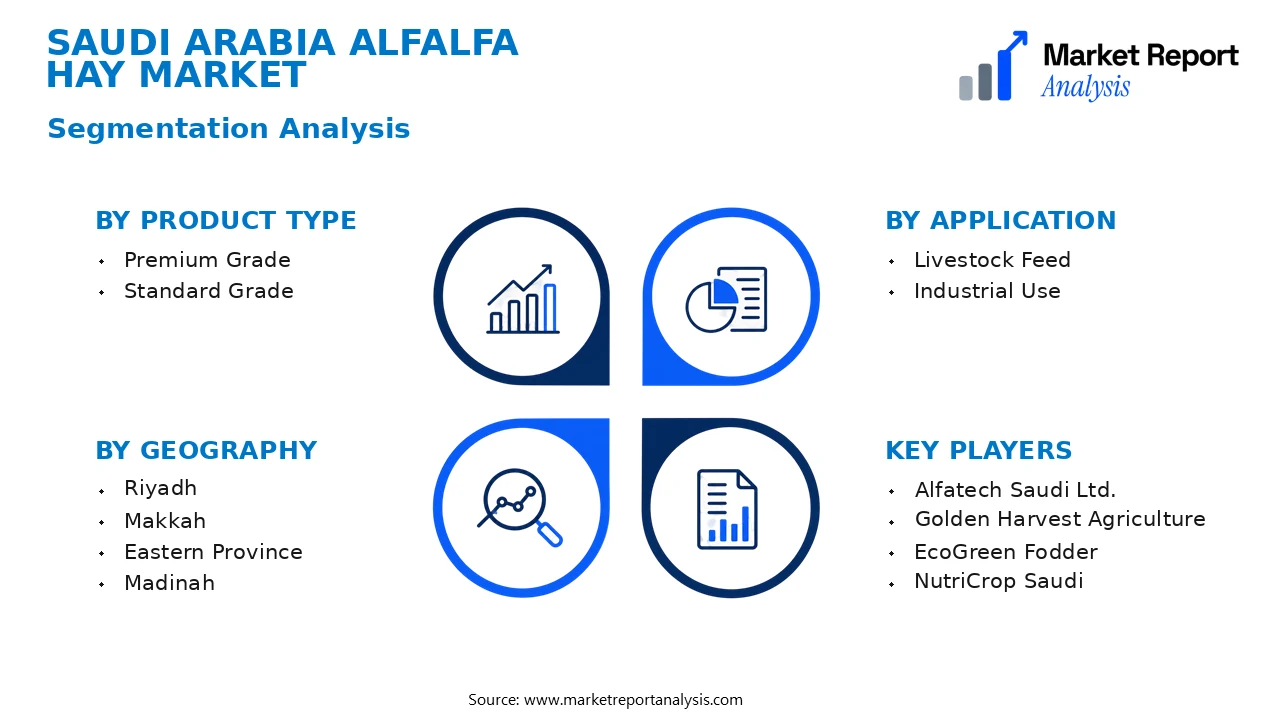
- Product Type
- Premium Grade: Premium-grade alfalfa hay is characterized by higher protein content and superior quality, typically used in high-nutrition livestock feed and favored by premium livestock producers seeking optimal animal health and productivity, hence witnessing growing demand.
- Standard Grade: Standard-grade alfalfa hay caters to the standard livestock feed market, balancing cost and nutritional value. It accounts for the larger volume of sales and is widely adopted by local farmers to meet basic livestock feeding needs.
- Application
- Livestock Feed: The dominant application, livestock feed leverages alfalfa hay’s high nutritional content to improve dairy and meat production. Rising livestock population and evolving dietary preferences are key factors driving this segment's growth.
- Industrial Use: Industrial applications involve the use of alfalfa hay in biogas production and as raw material for organic fertilizers. Although smaller in scale, this segment is expanding driven by sustainable farming initiatives in Saudi Arabia.
- Geography
- Riyadh: As the capital city, Riyadh exhibits the highest demand for alfalfa hay driven by large-scale livestock farms, feed processing facilities, and growing agricultural initiatives aimed at food security and self-sufficiency.
- Makkah: Makkah’s demand is primarily influenced by its proximity to import routes and distribution hubs, with a rising number of livestock farms and feed suppliers seeking reliable local sources of quality hay.
- Eastern Province: The Eastern Province, with its extensive agricultural zones and proximity to major industrial hubs, serves as a significant consumption center for alfalfa hay, especially for dairy farms and poultry feed producers.
- Madinah: Madinah’s market is characterized by a focus on local livestock growth and traditional farming practices, with increasing investments in agricultural infrastructure to meet domestic demand and promote sustainable practices.
Competitive Intelligence
The Saudi Arabia Alfalfa Hay Market exhibits a moderate level of competition, characterized by a few dominant local producers alongside emerging small-scale suppliers. Market concentration remains relatively moderate, with the top three companies accounting for roughly 45% of total market share, primarily concentrated in Riyadh and Jeddah. Major players focus on differentiating through product quality, such as high-yield, pest-resistant varieties, and innovative harvesting techniques to boost nutritional content. Strategic partnerships with animal feed manufacturers and livestock farms are prevalent, aiming to secure supply chains and expand distribution channels across key agricultural regions. Recent acquisitions aim to consolidate market presence, especially in western Saudi Arabia, to optimize logistics and scale operations. Companies are investing heavily in R&D to develop drought-resistant alfalfa strains suitable for Saudi climate conditions. Differentiation also stems from sustainable practices, including organic certification and reduced water usage, appealing to eco-conscious consumers and government regulations. Expansion strategies emphasize establishing regional processing hubs, leveraging Saudi Vision 2030’s focus on agricultural diversification and food security.
Leading Company Profiles
The Saudi Arabia Alfalfa Hay Market is characterized by a mix of local and international companies competing through product quality, technological innovation, and strategic alliances. These key players leverage their expertise to capture emerging opportunities driven by increasing demand from the livestock and dairy sectors within the kingdom.
- Alfatech Saudi Ltd.
- Golden Harvest Agriculture
- EcoGreen Fodder
- NutriCrop Saudi
- Green Fields Arabia
- Al-Maraai Fodder
- Arabian Alfalfa Company
- Saudi Fodder Industries
- Desert Green Alfalfa
- Oasis Feed Solutions
Alfatech Saudi Ltd.
Alfatech Saudi Ltd. specializes in producing high-quality alfalfa hay utilizing advanced harvesting technology, focusing on sustainable practices to meet growing livestock feed demands in Saudi Arabia and neighboring GCC regions.
Golden Harvest Agriculture
Golden Harvest Agriculture offers a broad portfolio of alfalfa hay and forage products, emphasizing innovation in cultivation techniques and expanding its capacity to serve the increasing Saudi market needs.
EcoGreen Fodder
EcoGreen Fodder integrates eco-friendly cultivation methods and modern irrigation technologies, positioning itself as a leader in sustainable forage production tailored for Saudi Arabia's arid climate.
NutriCrop Saudi
NutriCrop Saudi is known for its high-yield forage varieties, with a strategic focus on research and development to improve crop resilience and nutritional content, aligning with the kingdom’s food security policies.
Green Fields Arabia
Green Fields Arabia invests in large-scale irrigated alfalfa farms incorporating precision agriculture to optimize yield, quality, and resource use efficiency, supporting the region’s expanding livestock industry.
Al-Maraai Fodder
Al-Maraai Fodder focuses on establishing integrated supply chains for alfalfa forage, strengthening logistics and distribution channels within Saudi Arabia for faster market penetration.
Arabian Alfalfa Company
Arabian Alfalfa Company emphasizes technological innovation, including automated harvesting and packaging, to ensure product consistency and meet export standards within the Middle Eastern and African markets.
Saudi Fodder Industries
Saudi Fodder Industries is expanding capacities with new processing plants, aiming to increase local production and reduce reliance on imports amidst rising domestic feed consumption demands.
Desert Green Alfalfa
Desert Green Alfalfa emphasizes sustainable water management and smart irrigation solutions to maximize productivity in Saudi Arabia’s water-scarce environment, aligning with the government’s sustainability initiatives.
Oasis Feed Solutions
Oasis Feed Solutions leverages digital technologies and data analytics for optimized crop management, enhancing yield and quality while reducing costs and advancing Saudi Arabia’s forage industry infrastructure.
Strategic Business Developments
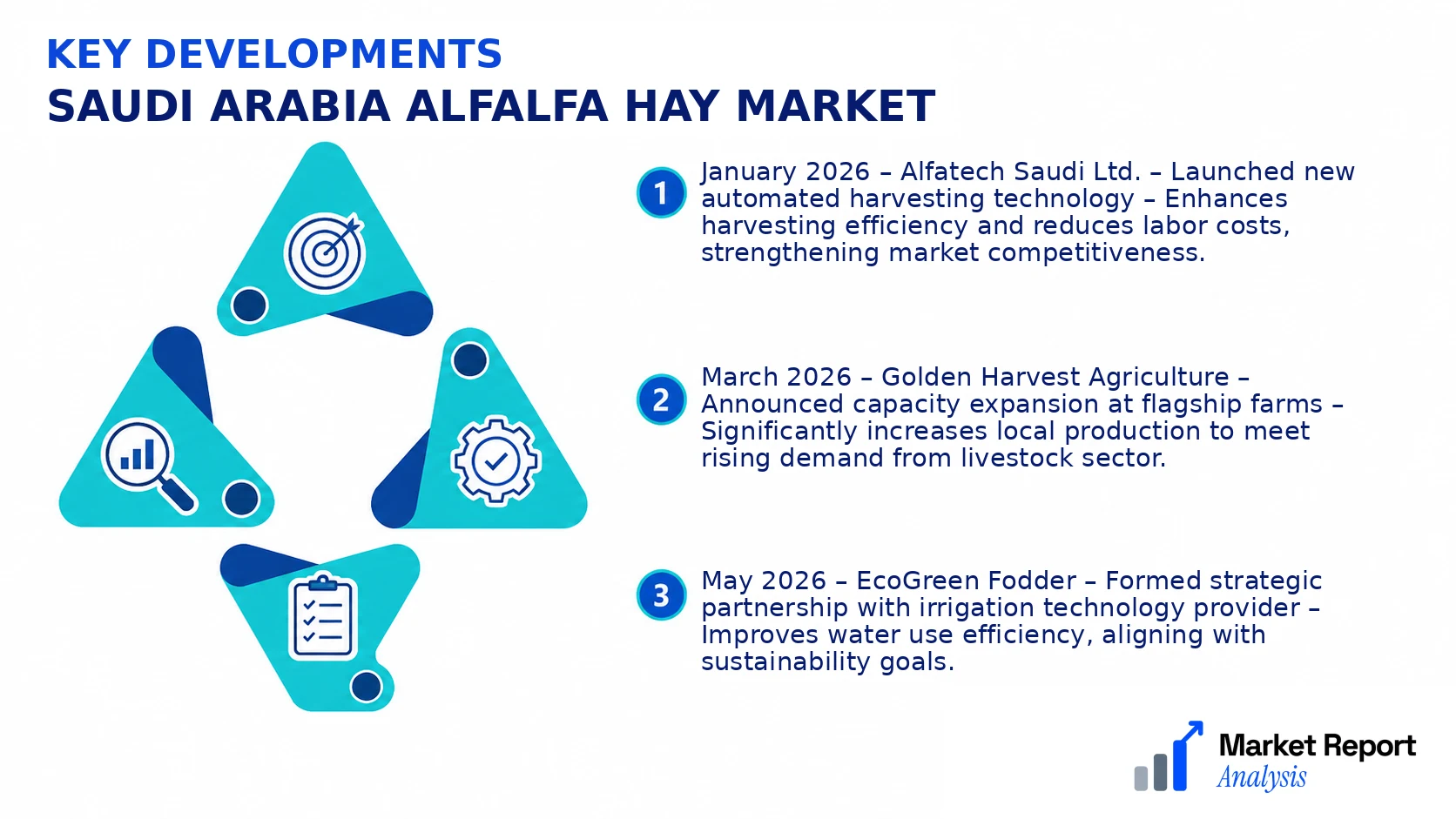
- January 2026 – Alfatech Saudi Ltd. – Launched new automated harvesting technology – Enhances harvesting efficiency and reduces labor costs, strengthening market competitiveness.
- March 2026 – Golden Harvest Agriculture – Announced capacity expansion at flagship farms – Significantly increases local production to meet rising demand from livestock sector.
- May 2026 – EcoGreen Fodder – Formed strategic partnership with irrigation technology provider – Improves water use efficiency, aligning with sustainability goals.
- July 2026 – NutriCrop Saudi – Invested in R&D for drought-resistant alfalfa varieties – Ensures crop resilience amidst climate challenges, supporting food security initiatives.
- September 2026 – Green Fields Arabia – Opened new processing plant – Boosts output capacity, facilitating broader distribution across the GCC markets.
Frequently Asked Questions
What is the Saudi Arabia Alfalfa Hay Market?
The Saudi Arabia Alfalfa Hay Market encompasses the production, processing, and distribution of alfalfa hay within the country, serving mainly livestock feed needs. It is driven by agricultural modernization and increasing demand for high-quality forage in the livestock sector.
What is the current market size of Saudi Arabia Alfalfa Hay Market?
As of 2026, the market size of the Saudi Arabia Alfalfa Hay Market is valued at approximately USD 0.8 Billion, reflecting steady growth due to expanding livestock farms and supportive government policies aimed at enhancing forage production.
What factors are driving the Saudi Arabia Alfalfa Hay Market?
Growth is primarily driven by increasing domestic livestock needs, modernization of agricultural practices, governmental initiatives to promote self-sufficiency, and investments in agricultural infrastructure to boost forage yield and quality standards.
Which Saudi city leads the Saudi Arabia Alfalfa Hay Market?
Riyadh emerges as the leading city due to its dense population of livestock farms and strategic investments in agricultural infrastructure, making it the central hub for alfalfa hay production and distribution in Saudi Arabia.
Which segment is expected to grow the fastest?
The organic alfalfa hay segment is projected to grow at the fastest rate, driven by increasing consumer awareness and demand for organic livestock feed, supported by government regulations favoring organic farming practices.
Who are the leading companies operating in the Saudi Arabia Alfalfa Hay Market?
Leading companies include local agribusinesses and international firms such as Saudi Agricultural Investment and Livestock Company (SALIC), which are investing heavily to expand production capacity and improve hay quality to meet domestic demand.
Analyst Perspective
The Saudi Arabia Alfalfa Hay Market demonstrates significant long-term growth potential driven by expanding livestock sectors and increased animal feed demands. Technological advancements in cultivation, such as precision agriculture and improved harvesting techniques, are anticipated to enhance yield efficiency and quality, thereby broadening market scope. Investment priorities should favor establishing advanced processing facilities and sustainable water management systems to address resource constraints. Despite rising competitiveness among domestic and imported suppliers, the market presents lucrative opportunities, especially in secondary cities like Jeddah and Dammam, where demand is surging due to expanding livestock farms. Market maturity remains moderate, with a gradual shift toward higher-quality, organic alfalfa products, creating favorable conditions for premium branding. Strategic focus should also encompass urban-rural value chain integration, innovation-led product differentiation, and fostering local R&D capabilities. Overall, maintaining agility in response to technological and regulatory changes will be critical to capturing long-term market share and ensuring sustainable growth within Saudi Arabia’s dynamic agricultural landscape.
