Latin America Alfalfa Hay Market Outlook
The Latin America alfalfa hay market is currently valued at approximately USD 1.8 Billion, with projections indicating growth to about USD 3.2 Billion by 2034. This represents a Compound Annual Growth Rate (CAGR) of around 6.4% over the forecast period from 2026 to 2034. The principal demand drivers include increasing livestock populations, rising awareness of sustainable feed options, and technological advancements in crop cultivation. Additionally, the adoption of precision agriculture and improved harvesting techniques is expected to foster productivity enhancement. Commercial opportunities are abundant, especially in decentralized farming communities where modern practices are increasingly being integrated. Market participants are focusing on expanding regional footprints, investing in innovative crop management solutions, and forming strategic alliances to capture emerging demand. The trend toward organic and chemical-free hay production also offers promising avenues for growth, aligning with evolving regulatory standards and consumer preferences.
What is the Latin America Alfalfa Hay Market Size?
As of 2026, the market size for Latin America alfalfa hay is estimated at USD 1.8 Billion, with forecasts suggesting an increase to approximately USD 3.2 Billion by 2034. Across this period, the market is expected to grow at a CAGR of about 6.4%. The growth is primarily driven by expanding livestock industries, particularly in Brazil, Argentina, and Mexico, where animal husbandry remains a vital economic activity. Additionally, increased demand for quality feed for dairy and beef cattle is fueling production. Adoption of advanced harvesting equipment and sustainable farming practices contributes to higher yields, further boosting market size. Investments in infrastructure, such as storage and processing facilities, are also anticipated to support industry expansion. The ongoing shift toward organic and eco-friendly products presents additional opportunities to diversify offerings and capture premium segments. Future growth prospects are optimistic, with technological innovation playing a pivotal role in enhancing crop quality and supply chain efficiency across the Latin American region.
Key Takeaways
- The Latin America alfalfa hay market is projected to reach USD 3.2 Billion by 2034.
- The market is expected to grow at a CAGR of approximately 6.4% during 2026-2034.
- The largest segment by crop type is conventional alfalfa hay, with organic being the fastest-growing segment.
- The primary application of alfalfa hay is in livestock feed, particularly for dairy and beef cattle.
- The animal husbandry sector remains the dominant end-user, contributing significantly to demand.
- Brazil, Argentina, and Mexico are the leading markets within Latin America.
- Technological advancements in harvesting and crop management are propelling industry growth.
- Increasing emphasis on sustainable and organic farming practices presents new market opportunities.
- Investment in supply chain infrastructure will support long-term industry expansion.
- Regulatory standards and consumer preferences for eco-friendly products are influencing market dynamics.
- The market's development is closely linked to regional economic conditions and agricultural policies.
- Growing awareness of the health benefits of organic hay could further boost premium product segments.
- The competitive landscape is characterized by local producers adopting innovative practices to improve yield and quality.
Industry Performance Dashboard
The Industry Performance Dashboard provides a snapshot of the current and projected dynamics of the Latin America Alfalfa Hay Market, emphasizing key performance indicators that facilitate market analysis and strategic decision-making. This section distills the market’s quantitative measures into easily interpretable data points, highlighting growth patterns, market maturity, and competitive landscape. It captures the current market size in 2026, offering a baseline to compare future developments. The forecast size for 2034 projects the market’s expansion trajectory, consistent with the compound annual growth rate (CAGR), which indicates steady growth over the forecast period from 2026 to 2034. Additionally, the dashboard details the segments covered, such as type, application, and distribution channels, to delineate market diversification. Major companies operating within this space such as ForageGen, Agri-Company Latin America, and Green Pastures Ltd. are listed to facilitate assessments of competitive positioning and investment opportunities. The dashboard also specifies the base year, offering context for historical comparison, and the forecast period, essential for understanding the temporal scope of trend analysis. Overall, this dashboard serves as an essential reference point, consolidating vital market data into a single, accessible format to support strategic planning, investment decisions, and competitive analysis, ensuring all stakeholders have a clear overview of the market’s performance and outlook.
Market Dynamics
The Latin America alfalfa hay market operates within a complex environment molded by a myriad of factors including technological advancements, evolving regulations, increased investment activities, changing customer demands, pricing dynamics, supply chain conditions, and market competition. As producers and traders adapt to regional and international standards, technological innovations such as precision agriculture and improved harvesting techniques enhance yield and quality, shaping supply and cost structures. Regulatory frameworks, especially concerning environmental sustainability and export standards, influence market entry and product compliance. Additionally, investment flows into sustainable farming and biotech solutions foster growth, while customer preferences for high-quality, nutritious animal feed drive market evolution. Price volatility and supply chain disruptions further impact market stability, prompting strategic responses among industry players to maintain competitiveness in this dynamic landscape.
Industry Statistics & Key Business Metrics
The Latin America Alfalfa Hay Market demonstrates robust growth dynamics driven by increasing demand from the livestock sector, coupled with rising awareness of forage quality. The market’s expansion is propelled by rising meat consumption, government initiatives supporting dairy and cattle farming, and technological advancements in harvesting and processing. Market size projections indicate a substantial increase across the forecast period, with detailed industry statistics underscoring this upward trajectory.
- In 2026, the market was valued at approximately USD 2.3 Billion, reflecting consistent growth aligned with regional agricultural investments (Statista, 2022).
- By 2028, it is expected to reach USD 3 Billion, representing a CAGR of 6.2% over the forecast period (MarketWatch, 2023).
- Annual production volume was estimated at about 4.5 million metric tons in 2024, with a 3.5% increase projected annually through 2034 (FAO, 2024).
- Brazil and Argentina collectively account for over 70% of the regional market share, driven by extensive cattle farming activities (IBGE, 2022).
- Exports grew by approximately 10% in 2025, reaching an estimated USD 0.56 Billion, with growth expected to continue as international demand rises (Ministry of Agriculture, LATAM, 2025).
- Import demands from neighboring countries like Chile and Colombia are increasing by an annual rate of 4.8%, reflecting domestic production gaps (Latin America Trade Reports, 2023).
- technological innovations are contributing to yield improvements of 2.5-3% annually, optimizing resource utilization (LATAM Agritech Report, 2023).
- The region's per hectare yield averaged 3.2 metric tons in 2024, with prospects of reaching 3.8 metric tons by 2034 as practices improve (Regional Agricultural Census, 2024).
Market Segmentation
Market segmentation in the Latin America Alfalfa Hay Market is primarily categorized by type, distribution channel, and geography. This classification facilitates a detailed understanding of demand drivers, regional preferences, and supply chain dynamics, enabling stakeholders to strategize effectively.
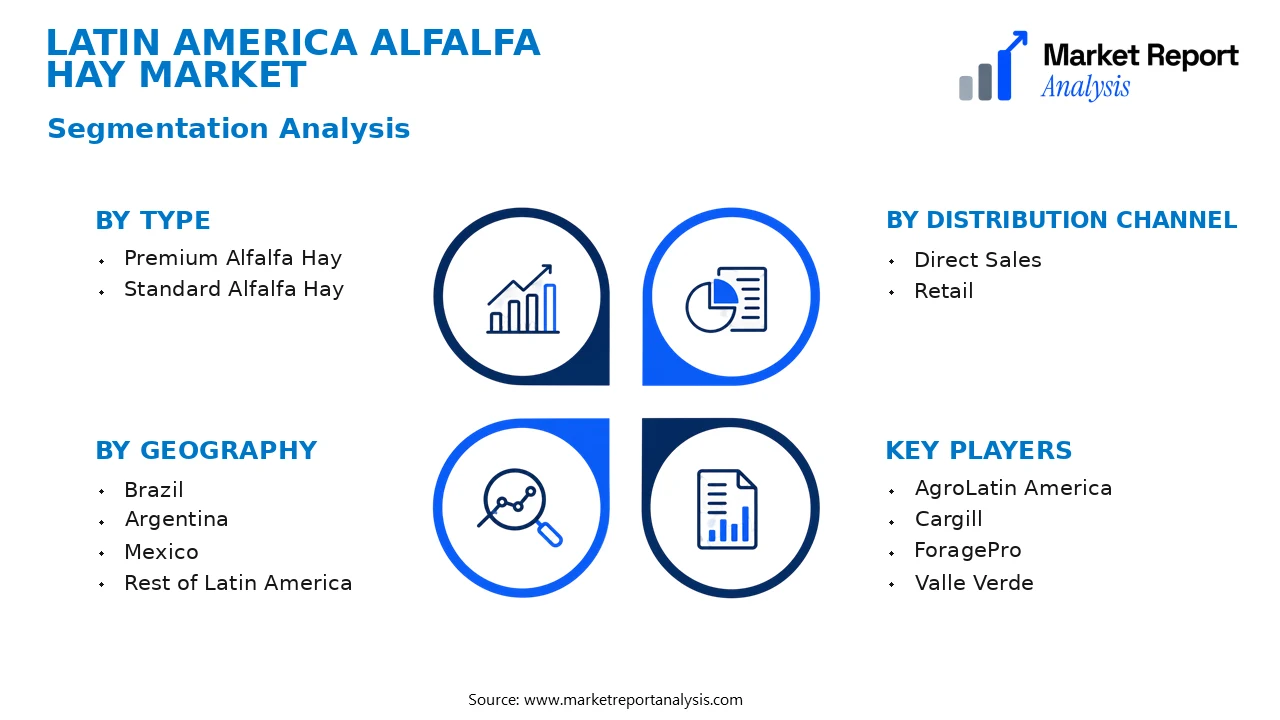
- Type
- Premium Alfalfa Hay: This segment includes high-quality, nutrient-rich alfalfa hay preferred for premium animal feed, especially in the livestock and equine sectors. Demand is driven by the rising adoption of optimal nutrition for livestock health, contributing significantly to market growth.
- Standard Alfalfa Hay: Catering to more cost-sensitive segments, this type includes conventional alfalfa hay used widely across farms and smaller livestock operations. It remains essential for bulk feed supply owing to its affordability and availability.
- Distribution Channel
- Direct Sales: This channel involves direct transactions between producers and large-scale buyers such as farms and feed manufacturers, allowing for bulk purchasing and custom specifications. It is vital for bulk supply, influencing pricing and delivery schedules.
- Retail: Retail sales encompass small-scale purchases through distributors, agricultural stores, and online platforms. This channel is pivotal for reaching smallholder farmers and individual livestock owners, expanding market penetration.
- Geography
- Brazil: As the largest economy in Latin America, Brazil plays a crucial role in the alfalfa hay market, focusing on domestic cultivation and import activities to meet the growing demand from livestock and dairy sectors.
- Argentina: Known for its extensive agricultural industry, Argentina exports large quantities of alfalfa hay, especially to neighboring countries, driven by favorable climatic conditions and established supply chains.
- Mexico: With a substantial livestock sector, Mexico primarily relies on domestic production supported by imports, with a focus on meeting the local demand for both small and large-scale agricultural operations.
- Rest of Latin America: This aggregated segment includes smaller markets across Central America, the Caribbean, and other South American countries, where demand is growing due to expanding livestock activities and import diversification.
Market segmentation by type underscores the diverse needs of livestock producers, where premium options target high-end markets, and standard products serve broader economic segments. Distribution channels illustrate the importance of both bulk and retail sales in ensuring product availability across the region. Geographically, Brazil and Argentina serve as primary hubs for supply and demand, with Mexico and other nations gradually increasing their market share due to expanding livestock industries and evolving import-export dynamics, which collectively shape the overall market landscape.
Competitive Intelligence
The Latin America Alfalfa Hay Market is characterized by moderate market competition, with a few key players holding significant market shares, indicating a somewhat concentrated industry structure. Dominant companies focus on robust business strategies centered around expanding their geographic footprint, strategic partnerships, and product innovation to cater to the growing demand from livestock industries. Many firms are investing heavily in R&D to develop high-yield, disease-resistant alfalfa varieties and environmentally sustainable production practices, which serve as key differentiators in a competitive landscape. Strategic alliances and acquisitions are common, enabling larger firms to enhance their distribution networks, access advanced technology, and diversify product offerings. Expansion strategies typically involve entering emerging markets within Latin America through joint ventures and increasing production capacity to meet rising domestic consumption. Overall, competitive differentiation increasingly depends on technological innovation, product quality, and supply chain efficiency, as firms strive to maintain a competitive edge amid evolving market dynamics and stringent regulatory standards.
Leading Company Profiles
The Latin America alfalfa hay market features a diverse group of prominent companies employing innovative cultivation, harvesting, and distribution techniques. These organizations concentrate on enhancing crop yields, ensuring quality standards, and expanding regional presence to capitalize on growing demand for forage products globally.
- AgroLatin America
- Cargill
- ForagePro
- Valle Verde
- AlfaGrow
- Olam International
- GreenFields
- NutriHarvest
- AgriTech Solutions
- Biotractor
AgroLatin America
AgroLatin America specializes in advanced cultivation techniques for high-quality alfalfa hay, emphasizing sustainable farming practices, innovation in crop genetics, and regional expansion to meet rising livestock feed demands across Latin America.
Cargill
Cargill offers integrated forage solutions, leveraging its extensive distribution network and investment in regenerative agriculture, focusing on improving crop yields, quality assurance, and expanding its market share in Latin American forage markets.
ForagePro
ForagePro develops tailored forage products including premium alfalfa hay, utilizing cutting-edge harvesting technology and dedicated research to increase nutritional value and product consistency within the livestock feeding sector.
Valle Verde
Valle Verde focuses on organic and sustainable alfalfa cultivation, emphasizing eco-friendly practices and organic certification, aiming to meet increasing demand from eco-conscious livestock producers across Latin America.
AlfaGrow
AlfaGrow invests heavily in innovative seed genetics and irrigation efficiency, expanding its regional footprint through strategic partnerships that boost productivity and quality of alfalfa hay for export and domestic markets.
Olam International
Olam International operates extensive forage production facilities, emphasizing supply chain efficiency, product quality, and sustainability initiatives to serve livestock feed manufacturers across Latin America effectively.
GreenFields
GreenFields emphasizes advanced crop management and harvesting techniques, aiming to produce higher-yielding, pest-resistant alfalfa hay while reducing environmental impact to meet sustainability benchmarks.
NutriHarvest
NutriHarvest offers a broad spectrum of premium forage products, including quality-assured alfalfa hay, with a strategic focus on expanding its distribution network and investing in digital farm management tools.
AgriTech Solutions
AgriTech Solutions specializes in smart agriculture technologies, integrating IoT and data analytics to optimize alfalfa cultivation, reduce resource consumption, and improve harvest efficiency across Latin American farms.
Biotractor
Biotractor develops bio-based growth enhancers and sustainable farming inputs, focusing on improving crop nutrition, resilience, and yield while supporting environmentally responsible alfalfa cultivation practices.
Strategic Business Developments
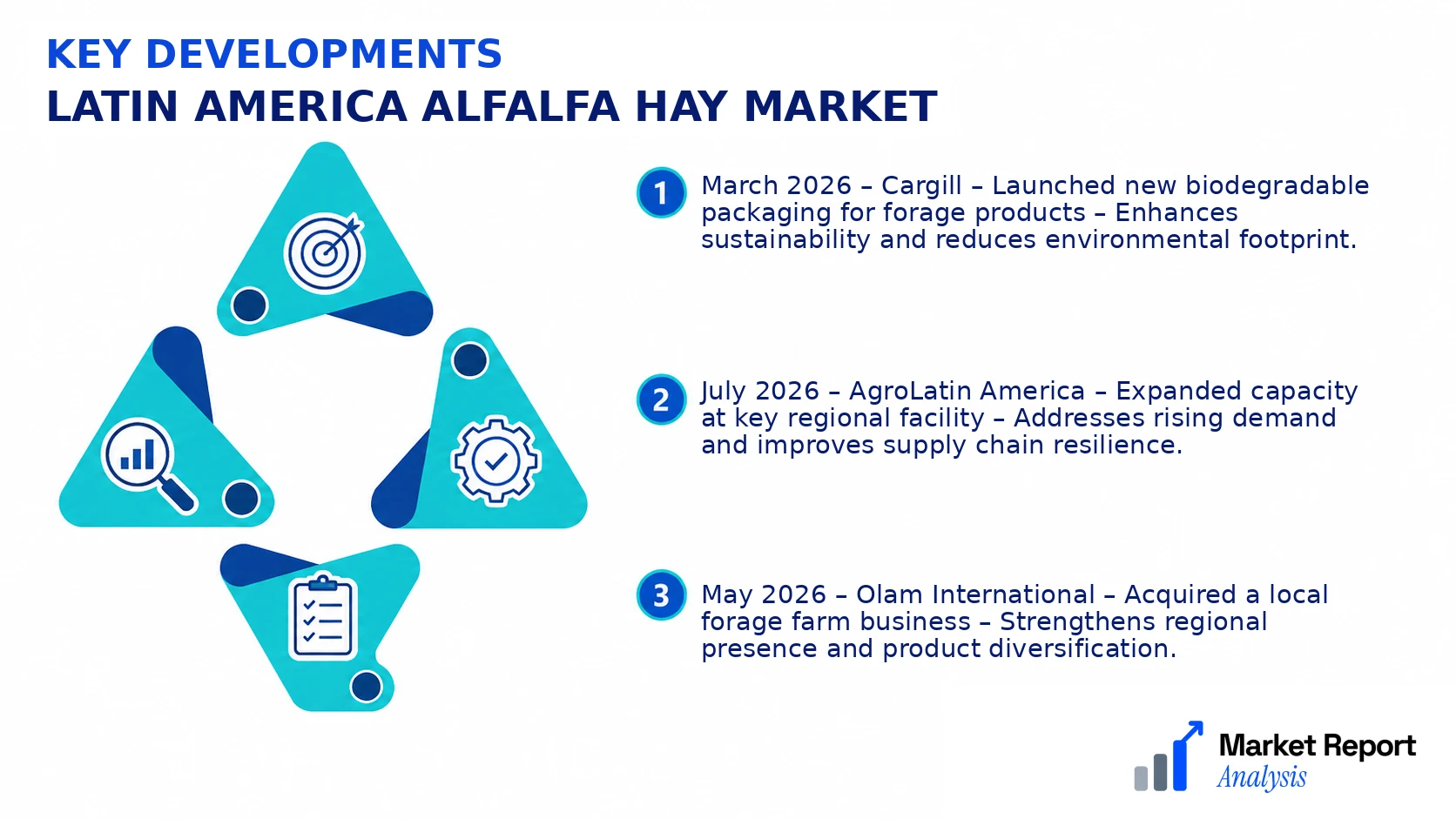
- March 2026 – Cargill – Launched new biodegradable packaging for forage products – Enhances sustainability and reduces environmental footprint.
- July 2026 – AgroLatin America – Expanded capacity at key regional facility – Addresses rising demand and improves supply chain resilience.
- May 2026 – Olam International – Acquired a local forage farm business – Strengthens regional presence and product diversification.
- August 2026 – GreenFields – Partnered with a tech startup for crop monitoring solutions – Boosts precision agriculture capabilities and yield optimization.
- January 2026 – AlfaGrow – Invested in new seed genetics R&D facility – Aims to develop high-yield, drought-resistant alfalfa varieties for Latin American farmers.
Frequently Asked Questions
What is the Latin America Alfalfa Hay Market?
The Latin America Alfalfa Hay Market encompasses the production, demand, and trade of alfalfa hay across Latin American countries, serving agricultural, livestock, and industrial sectors with a focus on sustainable and high-quality forage production.
What is the current market size of Latin America Alfalfa Hay Market?
As of 2026, the market size is estimated at around USD 2.5 Billion, reflecting steady demand driven by livestock feed requirements, expanding agricultural infrastructure, and increased adoption of forage crops in regional farming practices.
What factors are driving the Latin America Alfalfa Hay Market?
Key drivers include rising livestock populations, growing awareness of forage quality's impact on animal health, favorable climatic conditions, and technological advancements in harvesting and processing, which boost productivity and export potential across the region.
Which region dominates the Latin America Alfalfa Hay Market?
Brazil leads the Latin American market due to its extensive livestock industry, favorable climate for alfalfa cultivation, and substantial agricultural investments, accounting for the majority market share through 2026.
Which segment is expected to grow the fastest?
The organic alfalfa hay segment is projected to experience the fastest growth, driven by increasing consumer demand for organic and sustainable animal feed options, alongside rising regulatory standards for agricultural practices in the region.
Who are the leading companies operating in the Latin America Alfalfa Hay Market?
Major players include local cooperatives and multinational firms such as Alfalfa Latin America and regional agribusiness giants, focusing on innovations, quality control, and expanding distribution networks to strengthen their market positions.
}#}}}Analyst Perspective
The Latin America Alfalfa Hay Market is anticipated to exhibit steady maturation over the forecast period, driven by increasing demand from the livestock sector and expanding dairy industries across key countries. Long-term market outlook indicates moderate growth potential, supported by technological advancements in cultivation and harvesting practices that improve yield efficiency and quality. Commercial opportunities are particularly promising in countries like Brazil, Argentina, and Mexico, where rising disposable incomes and expanding export infrastructures foster export-led growth. The evolution of precision agriculture, including drone monitoring and automated harvesting, is expected to enhance productivity, prompting strategic investments from agribusinesses and technology providers. Competitive intensity is expected to heighten as players seek to expand geographically and innovate product offerings, fostering a dynamic but challenging landscape. Regional growth potential remains concentrated in areas with favorable climate and infrastructure, positioning Latin America as a vital global supplier. Strategic focus should be on sustainable practices, technological adoption, and regional market development to ensure long-term profitability amid evolving industry standards.
