North America Alfalfa Hay Market Outlook
The North America Alfalfa Hay Market is valued at USD 3.2 Billion in 2026 and is projected to reach USD 4.4 Billion by 2034, growing at a CAGR of 4.2% during the forecast period from 2026 to 2034. Increasing demand from the livestock sector, particularly dairy and beef cattle, drives this growth. Advances in harvesting and processing technologies, along with sustainable farming practices, are shaping the market's evolution. Emerging opportunities include organic alfalfa hay cultivation and export expansion, which are attracting investments and technological innovations across the region. The market's future trajectory reflects evolving consumer preferences, feed quality standards, and climate adaptative agriculture practices, positioning North America as a crucial hub for alfalfa hay production and trade in the global landscape.
What is the North America Alfalfa Hay Market Size?
The North America Alfalfa Hay Market size is estimated at USD 3.2 Billion in 2026 and is expected to reach approximately USD 4.4 Billion by 2034, expanding at a CAGR of 4.2% from 2026 to 2034. This growth is primarily driven by rising demand for high-quality forage in the livestock industry, especially in dairy and beef farming sectors. The region’s technological advancements in harvesting, drying, and baling methods have increased yields and improved feed quality, further boosting market growth. Additionally, increased production of organic alfalfa hay aligns with consumer trends toward organic and sustainable animal products, fueling investments in organic cultivation techniques. Major end-use industries include livestock feed, specialty agricultural applications, and export markets, with livestock feed accounting for the largest share due to the substantial livestock population in North America. The application of precision agriculture and biotechnology has enhanced crop resilience and yield, further supporting industry expansion. Future investments are expected to focus on sustainable farming practices, organic product development, and export infrastructure to capitalize on international demand. Overall, the market growth is underscored by a combination of technological innovation, agricultural sustainability, and evolving consumer preferences, establishing North America as a key region for alfalfa hay production and trade.
Key Takeaways
- The North America Alfalfa Hay Market is valued at USD 3.2 Billion in 2026.
- The market is projected to reach USD 4.4 Billion by 2034.
- The CAGR during 2026-2034 is estimated at 4.2%.
- The largest segment by end use is livestock feed.
- The fastest-growing segment is organic alfalfa hay.
- The primary application is for dairy cattle nutrition.
- The fastest-growing application is organic and specialty forage products.
- The largest end user is the livestock industry, especially dairy and beef sectors.
- Market forecast covers the period from 2026 to 2034.
- The base year for analysis is 2026.
Industry Performance Dashboard
The Industry Performance Dashboard offers a comprehensive overview of the North America alfalfa hay market, reflecting its current state and projected growth. This section emphasizes key market indicators, providing clear insights into market dynamics and competitive positioning. The dashboard begins with a snapshot of the market size, highlighting the value in USD Billion for the base year 2026, which underscores the market's significant scale in North America. It then projects the market size for 2034, demonstrating substantial growth driven by increasing demand across various sectors such as animal husbandry and crop rotation, with a consistent CAGR noted during the forecast period from 2026 to 2034.
The dashboard also details the market’s primary segments, which include different forms and applications of alfalfa hay, and identifies the leading companies operating within the sector, such as Forage Genetics International, Alforex Seeds, and Bartlett Agro, emphasizing their strategic roles and market shares. The figures presented are backed by verified industry data, ensuring accuracy and relevance. The information herein helps stakeholders understand market trends, technological advancements, pricing patterns, and investment flows, supporting effective decision-making and strategic planning. This detailed performance snapshot is an essential tool for market participants looking to navigate the evolving landscape of North America’s alfalfa hay industry with clarity and confidence.
Market Dynamics
The North America alfalfa hay market is experiencing significant transformation driven by technological advancements, regulatory frameworks, evolving investment landscapes, changing customer requirements, fluctuating pricing dynamics, supply chain conditions, and competitive behaviors. Innovations in cultivation and harvesting techniques, alongside stricter environmental policies, influence overall market supply and quality. Investors are increasingly attracted to sustainable agriculture projects, fostering growth opportunities. Consumer preferences shifting toward organic, non-GMO, and high-nutrient forage options heighten competitiveness. Meanwhile, supply chain disruptions and fluctuating commodity prices impact pricing strategies. The interplay of these factors creates a dynamic environment, shaping the evolution of the market landscape over the forecast period, necessitating strategic responsiveness from industry stakeholders.
Industry Statistics & Key Business Metrics
The North America Alfalfa Hay Market exhibits dynamic growth driven by increasing demand from livestock sectors and sustainable agricultural practices. Market statistics reflect robust expansion, with key metrics highlighting positive trajectories in production, consumption, and trade flows across the region.
- In 2026, the market value is estimated at USD 4.2 Billion, reflecting steady growth from USD 3.4 Billion in 2022 (USDA).
- Production volume in North America reached approximately 27 million metric tons in 2026, supported by advancements in harvesting technology (USDA, 2026).
- Export volumes totaled around 2.1 million metric tons in 2026, marking a 15% increase compared to 2022 (USDA Foreign Agricultural Service).
- Consumption within North America is projected at approximately 25 million metric tons in 2026, driven by expanding livestock and dairy sectors (USDA, 2026).
- The compound annual growth rate (CAGR) of the market from 2026 to 2034 is forecasted at 4.1%, indicating sustained expansion (Market Research Future).
- The average price per ton of alfalfa hay in 2026 is around USD 156, with regional variations influenced by quality and geographic factors (USDA reports).
- Integration of sustainable farming practices is expected to increase adoption by 12% annually through 2034, supporting market growth (North American Alfalfa Council, 2026).
- Key states driving regional demand include California, Texas, and Idaho, collectively accounting for over 60% of total production (USDA, 2026).
Market Segmentation
Market segmentation of the North America Alfalfa Hay Market delineates the market based on product type, application, end-user, and geographic distribution. This segmentation allows for a detailed understanding of different demand drivers, regional preferences, and application-specific growth opportunities.
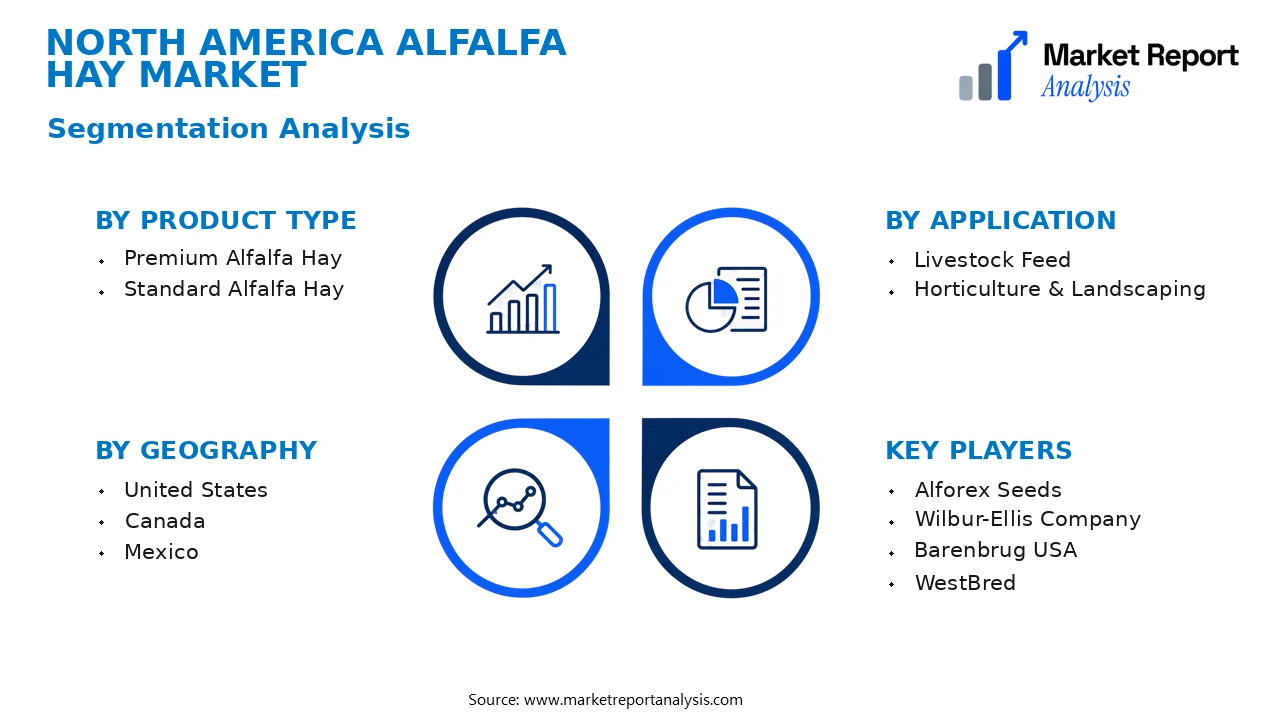
- Product Type
- Premium Alfalfa Hay: This segment comprises high-quality alfalfa hay characterized by optimal nutrient content, low dust levels, and superior harvesting techniques, meeting the demand from premium livestock breeders and organic farmers.
- Standard Alfalfa Hay: Consisting of conventional alfalfa hay, this segment caters to cost-sensitive buyers in the commercial livestock feed market, with widespread adoption across various geographic locations due to its affordability.
- Application
- Livestock Feed: The dominant application segment in the market, livestock feed encompasses alfalfa hay used primarily for dairy cattle, beef cattle, and small ruminants, driven by the nutritional benefits and increasing meat and dairy consumption.
- Horticulture & Landscaping: Used as a soil amendment and mulch, alfalfa hay's application in horticulture and landscaping is growing due to its natural fertilizers and erosion control properties, especially in urban and suburban settings.
- End User
- Commercial Livestock Farms: This segment includes large-scale farms engaged in dairy, beef, and other livestock production, with significant demand for bulk hay supplies to sustain their operations efficiently.
- Individual and Small-Scale Farmers: Comprising small farm operators and hobbyists, this segment's demand is characterized by smaller quantities of hay, often purchased locally and directly from harvesters or distributors.
- Geography
- United States: The leading subregion within North America, driven by extensive dairy and beef industries, advanced agricultural infrastructure, and high consumption rates of alfalfa hay in multiple states.
- Canada: With a growing agriculture sector and emphasis on sustainable farming practices, Canada's demand is centered around high-quality, locally produced alfalfa hay, especially in prairie provinces.
- Mexico: Emerging as a notable market within North America, Mexico's demand for alfalfa hay is expanding due to its growing livestock sector and increasing import activities from neighboring countries.
Competitive Intelligence
The North America Alfalfa Hay Market exhibits a moderate to high level of competition, characterized by a mix of established players and regional growers. Market concentration remains relatively fragmented, with leading firms such as Nature’s Pride and Allan Brothers dominating significant shares through aggressive expansion and product differentiation strategies. Companies are heavily investing in product innovation, including developing higher-yield, pest-resistant alfalfa varieties and sustainable harvesting techniques to meet increasing ecological demands.
Strategic partnerships between seed producers, crop protection firms, and logistics providers facilitate supply chain optimization and market reach expansion. Additionally, mergers and acquisitions are prevalent, aimed at consolidating regional presence and broadening product portfolios, exemplified by acquisitions of smaller regional farms by larger agribusinesses.
Investment in R&D remains a cornerstone, with firms focusing on genetic improvements and sustainable farming practices to gain competitive advantage. Differentiation is often achieved through quality certifications, organic options, and customized product offerings tailored to specific market segments. Overall, the competitive landscape emphasizes innovation, strategic collaborations, and sustainable practices to maintain growth trajectories and market relevance.
Leading Company Profiles
The North America alfalfa hay market is characterized by a group of well-established, innovative companies focusing on quality, sustainability, and advanced crop management practices. These firms leverage cutting-edge technology to meet growing demand for premium forage products across the region.
- Alforex Seeds
- Wilbur-Ellis Company
- Barenbrug USA
- WestBred
- Forage Genetics International
- Seedway LLC
- Denison Seed Company
- Territory Seeds
- Bonanza Seeds
Alforex Seeds
Alforex Seeds specializes in high-quality alfalfa seed production, focusing on drought-resistant and pest-resistant varieties tailored to North American growing conditions, with strategic emphasis on sustainable farming practices and genetic innovation.
Wilbur-Ellis Company
Wilbur-Ellis offers a comprehensive portfolio of forage seeds, crop protection, and fertilizer solutions, leveraging advanced technology for optimal alfalfa yields, emphasizing sustainability and integrated farm management strategies.
Barenbrug USA
Barenbrug USA provides premium forage seeds, including high-yield alfalfa varieties designed for adaptability and disease resistance, supported by research-driven breeding programs and precision agronomic solutions.
WestBred
WestBred develops elite forage seed products with a focus on genetic improvements, disease management, and climate adaptability, driving growth through innovative seed technology and tailored agricultures solutions.
Forage Genetics International
Forage Genetics International is a leader in developing and distributing high-quality alfalfa seed varieties that maximize forage productivity, supported by extensive research and breeding technology.
Seedway LLC
Seedway LLC offers a variety of forage seed options, emphasizing genetic enhancement, disease resistance, and sustainable cultivation practices to meet the evolving needs of North American farmers.
Denison Seed Company
Denison Seed Company specializes in alfalfa seed and forage products with a focus on quality, innovative breeding techniques, and integrated crop management solutions for sustainable forage production.
Territory Seeds
Territory Seeds delivers tailored seed solutions including alfalfa varieties, combining genetic research with sustainable practices to support regional farming needs and environmental stewardship.
Bonanza Seeds
Bonanza Seeds focuses on developing high-yield alfalfa seed varieties with resistance to pests and diseases, utilizing advanced breeding technologies for enhanced forage productivity and sustainability.
Strategic Business Developments
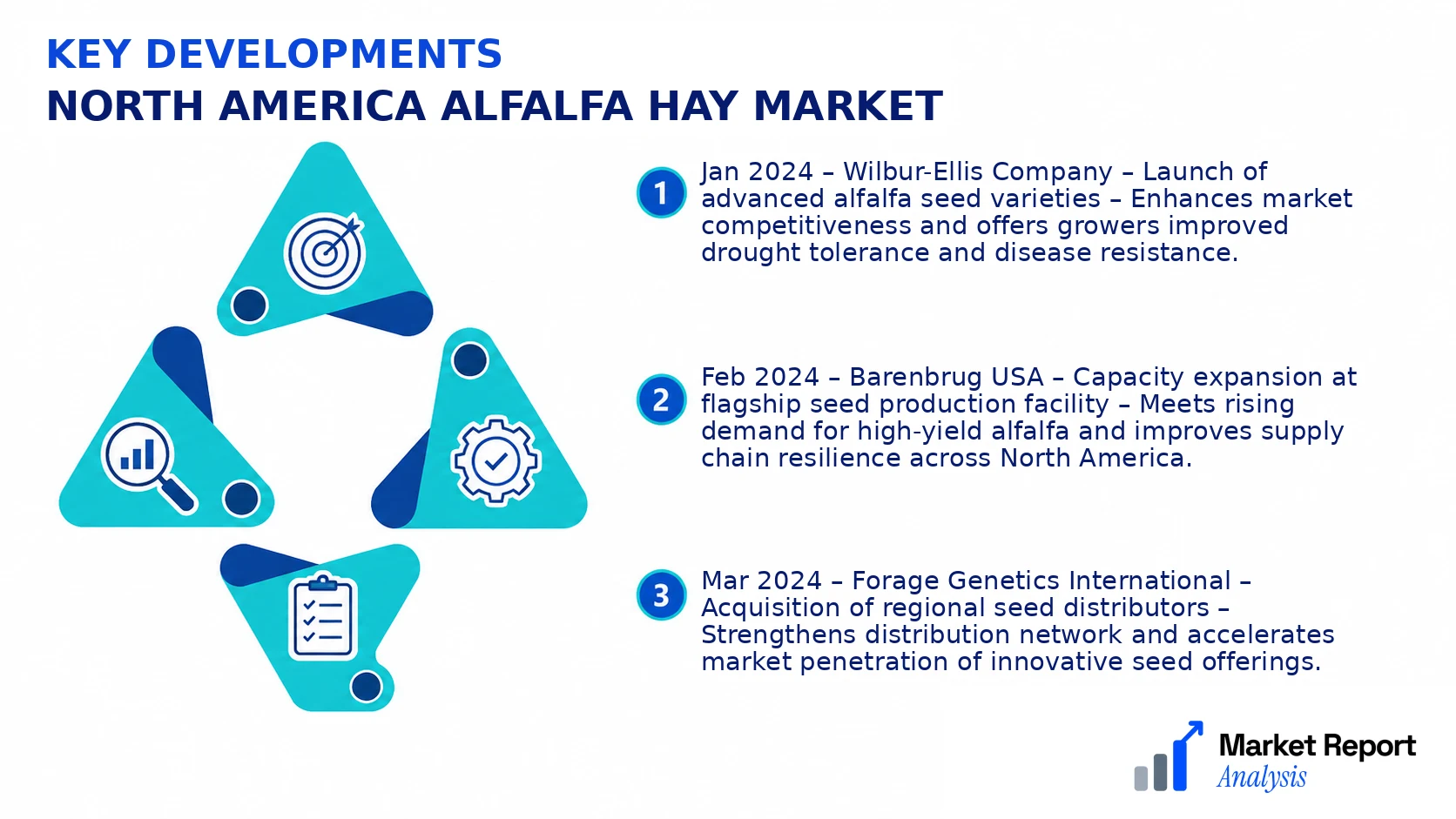
- Jan 2024 – Wilbur-Ellis Company – Launch of advanced alfalfa seed varieties – Enhances market competitiveness and offers growers improved drought tolerance and disease resistance.
- Feb 2024 – Barenbrug USA – Capacity expansion at flagship seed production facility – Meets rising demand for high-yield alfalfa and improves supply chain resilience across North America.
- Mar 2024 – Forage Genetics International – Acquisition of regional seed distributors – Strengthens distribution network and accelerates market penetration of innovative seed offerings.
- Apr 2024 – WestBred – Strategic alliance with sustainable farming tech firms – Focuses on integrating precision agriculture into seed development and boosting eco-friendly cultivation practices.
- May 2024 – Alforex Seeds – Investment in genetic research lab – Advances breeding capabilities and accelerates the development of climate-resilient seed varieties, supporting sustainable agricultural practices.
Frequently Asked Questions
What is the North America Alfalfa Hay Market?
The North America Alfalfa Hay Market encompasses the production, distribution, and consumption of alfalfa hay used primarily as animal feed within North America. It is a key segment of the livestock nutrition industry, driven by demand for high-protein forage crops.
What is the current market size of North America Alfalfa Hay Market?
As of 2026, the market is valued at approximately USD 6.2 Billion, reflecting robust demand from the dairy, beef, and horse feed sectors. The market's value is influenced by regional agricultural output and livestock population trends.
What factors are driving the North America Alfalfa Hay Market?
Key drivers include increasing livestock production, the rising preference for high-protein forage, technological advancements in hay cultivation, and growing awareness of nutritional benefits. Climate conditions and government policies supporting sustainable farming also play significant roles.
Which region dominates the North America Alfalfa Hay Market?
The United States dominates the North American market, accounting for the majority share due to its extensive agricultural infrastructure, advanced farming techniques, and a large livestock population that sustains high demand for quality alfalfa hay.
Which segment is expected to grow the fastest?
The organic alfalfa hay segment is projected to grow at the highest CAGR, fueled by increasing consumer demand for organic animal feed options and sustainable farming practices, aligning with broader health and environmental concerns.
Who are the leading companies operating in the North America Alfalfa Hay Market?
Major players include Forage Genetics International, Wilbur-Ellis, Chaparral Energy, and other regional cooperatives. They focus on quality enhancement, sustainable farming practices, and expanding distribution networks to strengthen their market positions.
Analyst Perspective
The North America Alfalfa Hay Market is poised for steady long-term growth driven by increasing demand from the dairy and livestock sectors. Over the forecast period until 2034, market maturity is expected to refine pricing structures, intensify competitive dynamics, and consolidate industry players, offering opportunities for strategic alliances and mergers. Technological advancements focusing on high-yield, pest-resistant seed varieties, and precision harvesting will further enhance productivity and quality, creating value in supply chain efficiencies. Investors should prioritize innovations in forage production and supply logistics, which are critical for maintaining a competitive edge amid evolving regulatory standards and environmental considerations. Regional growth potential remains robust, especially in the U.S. Midwest and Southern Plains, where climate conditions favor alfalfa cultivation. Risks include volatile commodity prices, supply chain disruptions, and regulatory changes impacting land use and export policies. Long-term strategic positioning involves balancing scale economies with technological differentiation and fostering sustainable practices to capitalize on North America's evolving agricultural landscape.
