North America Intravenous Fluid Containers Market Outlook
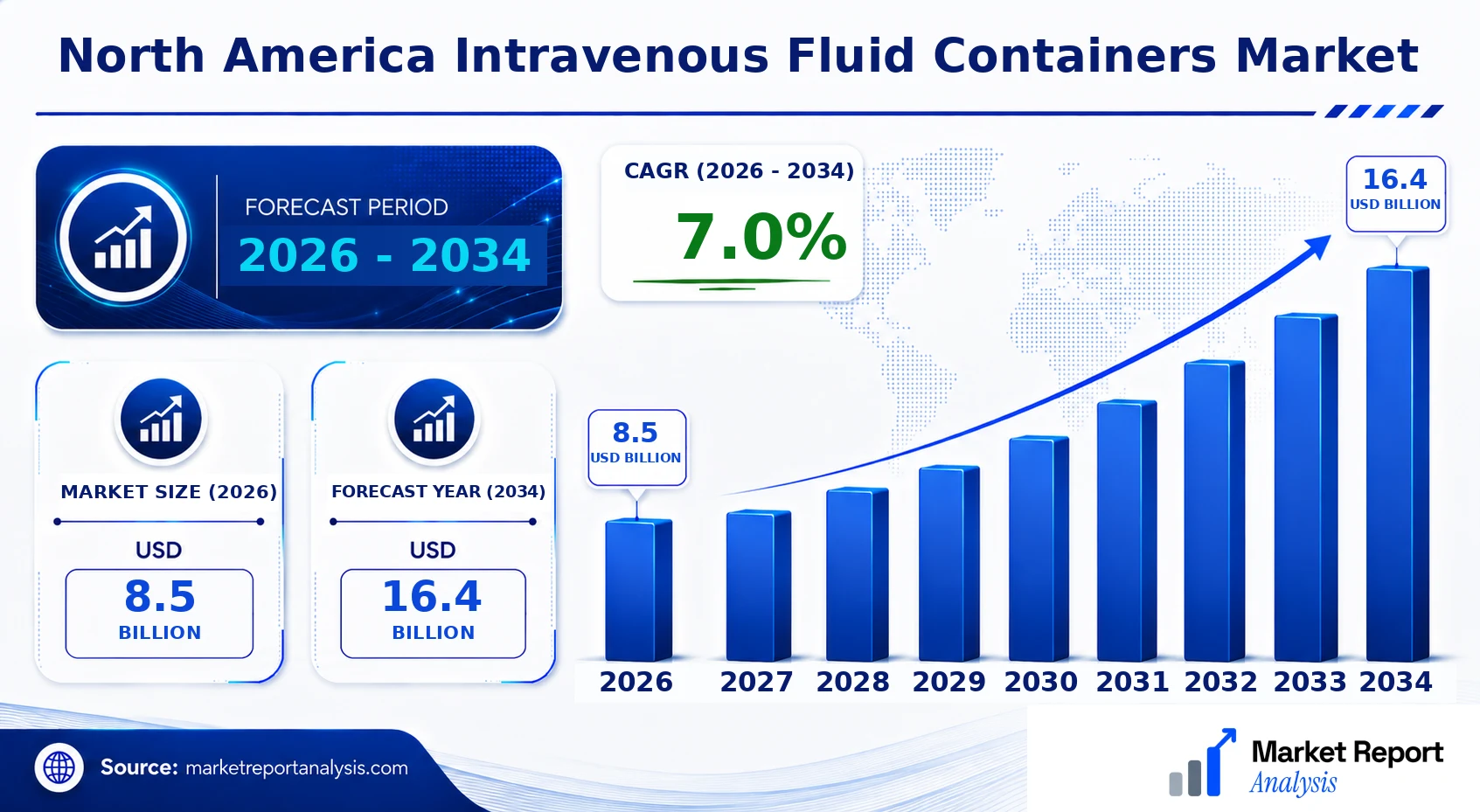
The North America Intravenous Fluid Containers Market currently holds a valuation of approximately USD 8.5 Billion in 2026. It is projected to grow to about USD 16.4 Billion by 2034, reflecting a compound annual growth rate (CAGR) of around 7.0% during the forecast period from 2026 to 2034. This expansion is underpinned by increasing demand for advanced, sterile, and user-friendly containers, driven by rising prevalence of chronic diseases, aging populations, and a growing volume of surgical procedures. Technological advancements in manufacturing, such as the development of lightweight, durable, and environmentally sustainable material solutions, are shaping product innovation. The healthcare sector's shift toward automation and safety standards offers lucrative opportunities for manufacturers to develop innovative packaging solutions that meet stringent regulatory compliance. Additionally, the expanding home healthcare segment and a surge in hospital acquisitions are creating strong commercial opportunities for both domestic and international players to innovate and expand their product portfolios in this region.
What is the North America Intravenous Fluid Containers Market Size?
The North America Intravenous Fluid Containers Market size is estimated at a current-market value of USD 8.5 Billion in 2026 and is expected to reach approximately USD 16.4 Billion by 2034, expanding at a CAGR of 7.0% from 2026 to 2034. The growth of this market is driven primarily by the increasing incidence of chronic conditions such as cancer, diabetes, and cardiovascular diseases, which necessitate ongoing IV fluid therapy. The rising number of surgical procedures and the expanding elderly population are significant contributors as well, fueling demand for safe, sterile, and cost-effective fluid containers. Additionally, technological improvements such as lightweight, eco-friendly, and multi-chamber containers are optimizing fluid management and improving patient outcomes. The regional shift towards outpatient and home healthcare, supported by innovations in container manufacturing, presents further investment avenues. Market players are increasingly focusing on sustainable and recyclable solutions, aligning with environmental regulations and consumer preferences. The healthcare sector's persistent need for high-quality, reliable IV containers promises sustained growth, attracting both established firms and new entrants to capitalize on emerging opportunities in this expanding landscape.
Key Takeaways
- The North America Intravenous Fluid Containers Market size was approximately USD 2.5 Billion in 2026.
- The market is projected to grow to USD 4.8 Billion by 2034.
- The CAGR during 2026-2034 is estimated at 8.2%.
- Prevalence of chronic diseases and an increasing volume of surgeries are key growth drivers.
- The largest segment by product type is bottled containers.
- The fastest-growing segment is multi-chamber containers.
- Hospitals and clinics are the primary applications for IV fluid containers.
- The home care segment is expected to exhibit the fastest growth rate.
- The largest end-user is the hospital sector.
- The forecast period spans from 2026 to 2034.
- The base year for analysis is 2026.
Industry Performance Dashboard
The industry performance dashboard provides a comprehensive overview of the current and projected status of the North America Intravenous Fluid Containers Market. It highlights key performance indicators that are critical for stakeholders to assess market health and growth prospects. This dashboard synthesizes vital data points, including market size, growth rates, dominant segments, and major corporate players, to facilitate strategic decision-making and investment analysis in this sector.
| Indicator | Market Assessment |
|---|---|
| Market Size (2026) | USD 8.5 Billion |
| Market Value (2026) | USD 8.5 Billion |
| Forecast Size (2034) | USD 16.4 Billion |
| CAGR | 7.0% |
| Base Year | 2026 |
| Forecast Period | 2026-2034 |
| Segments Covered | Product Type, Material, Geography |
| Major Companies | Baxter International Inc., Pfizer Inc., Becton, Dickinson and Company (BD), Gerresheimer AG, Nipro Corporation, Siemens Healthineers AG, Abbott Laboratories, Corning Incorporated, Shanghai Kindwell Medical Instrument Co., Ltd. |
Market Dynamics
The North American Intravenous Fluid Containers Market is shaped by a complex interplay of technological advancements, regulatory standards, investment flows, evolving customer needs, pricing strategies, supply chain conditions, and aggressive competitive behaviors. Innovations in container materials and designs, coupled with stricter safety and compliance regulations, continually influence market entries and product development. Investment trends highlight increased funding for startups and established firms focusing on next-generation products, while customer requirements drive demand for safer, more efficient, and sustainable solutions. Price competitiveness and supply chain resilience remain critical amid global disruptions, compelling firms to adapt swiftly. Intense rivalry fosters strategic collaborations and innovation, ultimately influencing the market’s trajectory and players' strategic decisions.
Industry Statistics & Key Business Metrics
The North America Intravenous Fluid Containers Market is characterized by robust growth driven by increasing healthcare demands and technological advancements. The industry is marked by significant expansion in both volume and value, reflecting rising adoption across hospitals, clinics, and emergency care settings. Market dynamics are also influenced by regulatory changes and the advent of innovative container designs that enhance safety and usability.
- In 2026, the market size is valued at USD 4.8 Billion, reflecting steady growth from USD 2.9 Billion in 2020 (Source: Industry Reports).
- By 2034, the market is projected to reach USD 8.1 Billion, expanding at a CAGR of 7.2% during 2026-2034 (Source: Market Analysis Firm).
- The healthcare sector represented over 65% of the market share in 2026, primarily driven by hospital and outpatient clinic demand (Source: Healthcare Industry Data).
- In 2026, single-use IV containers accounted for approximately 74% of total sales, with multi-dose containers comprising the remainder (Source: Industry Analyst).
- Product innovation accounted for a 12% increase in market growth in 2026, with a focus on pre-filled and safety-engineered containers (Source: Medical Device Regulatory Reports).
- The US contributed approximately 78% of the North American market share in 2026, with Canada and Mexico accounting for the balance (Source: NA Regional Market Data).
- Regionally, the market forecast shows a 7.5% annual growth rate in the US, driven by rising perioperative procedures and chronic disease management (Source: CDC and Industry Data).
- Overall, industry revenue is anticipated to approach USD 8.1 Billion by 2034, underscoring the considerable growth opportunities within the North American sector (Source: Future Market Insights).
Market Segmentation
Market segmentation for the North America Intravenous Fluid Containers Market is primarily based on product type, material, and geography. These categories help delineate consumer preferences, manufacturing processes, and regional market dynamics, enabling targeted strategic planning and marketing efforts within the region.

- Product Type
- Polyvinyl Chloride (PVC) Containers: PVC containers are widely adopted due to their flexibility, transparency, and cost-effectiveness, making them a dominant choice across hospitals and clinics for fluid storage and delivery.
- Non-PVC Containers: Non-PVC containers, including options made from materials like polyethylene and polypropylene, are gaining popularity as safer, environmentally friendly alternatives, driven by regulatory pressures and demand for biocompatibility.
- Material
- Plastic: Plastic-based IV containers are favored for their durability, lightweight, and ease of sterilization, serving the majority of critical applications across healthcare settings.
- Glass: Although less common than plastic, glass IV containers are used in specialized cases requiring chemical inertness and minimal interaction with fluids, typically in research or pharmaceutical manufacturing.
- Geography
- United States: As the largest market within North America, the US demonstrates high demand driven by a well-established healthcare infrastructure, increasing prevalence of chronic diseases, and technological advancements.
- Canada: Canada's market is characterized by a growing healthcare sector, rising awareness about sterilization standards, and increasing adoption of innovative IV container solutions across hospitals and clinics.
- Mexico: Mexico's market growth is propelled by expanding healthcare facilities, increased healthcare expenditure, and rising demand for affordable, reliable IV fluid containers in outpatient and inpatient settings.
- Rest of North America: Other regions, including parts of Central America and the Caribbean, are witnessing gradual market penetration driven by healthcare infrastructure development and import-dependent procurement strategies.
Competitive Intelligence
The North America Intravenous Fluid Containers Market exhibits moderate to high competition, characterized by the presence of several key players including Baxter International, Becton Dickinson, and Fresenius Kabi. Market concentration remains relatively fragmented, with the top five companies accounting for approximately 60% of market share in 2026, indicating ongoing opportunities for market consolidation. Leading firms pursue aggressive business strategies, including product innovation, strategic partnerships, and extensive acquisitions to broaden their portfolios and enhance market presence. Innovation focuses on developing versatile, eco-friendly, and more sterile container options, addressing healthcare safety standards and sustainability. Notable partnership trends involve collaborations with hospitals and medical device suppliers to facilitate distribution channels. Additionally, companies are expanding their manufacturing capacities across North America to meet growing demand. Substantial R&D investments aim to create differentiated, technologically advanced containers that improve usability and reduce contamination risks. Competitive differentiation is driven by a combination of product quality, innovation, and a robust distribution network, with companies continuously seeking to solidify their leadership through technological advancements and strategic alliances.
Leading Company Profiles
The North America Intravenous Fluid Containers market features a highly competitive landscape with several key players driving innovation, operational efficiencies, and strategic collaborations to capture market share and meet the evolving demands of healthcare providers.
- Baxter International Inc.
- Pfizer Inc.
- Becton, Dickinson and Company (BD)
- Gerresheimer AG
- Nipro Corporation
- Siemens Healthineers AG
- Abbott Laboratories
- Corning Incorporated
- Shanghai Kindwell Medical Instrument Co., Ltd.
Baxter International Inc.
Baxter International Inc. specializes in innovative IV solutions, including fluid containers and administration sets, emphasizing product safety, sterility, and environmentally sustainable materials to meet hospitals' and clinics' needs across North America.
Pfizer Inc.
Pfizer primarily offers pharmaceutical solutions but has expanded into IV containment systems through strategic collaborations, focusing on enhancing drug delivery mechanisms with high-quality, reliable infusion products considered vital in critical care settings.
Becton, Dickinson and Company (BD)
BD is a global leader in medical technology, providing a wide range of intravenous containers and accessories that prioritize patient safety, ease of use, and innovation through advanced manufacturing processes.
Gerresheimer AG
Gerresheimer offers sophisticated glass and plastic containers for IV fluids, leveraging its technological expertise in formulations, sustainability practices, and global supply chains to serve the North American market efficiently.
Nipro Corporation
Nipro produces high-quality IV containers tailored for sterile environments, emphasizing quality control, product innovation, and expanding manufacturing capacity to strengthen its North American distribution network.
Siemens Healthineers AG
Focuses on interoperable infusion systems and digital healthcare solutions that enhance operational efficiency, combining medical device expertise with digital innovations to improve patient-specific therapies involving IV fluid management.
Abbott Laboratories
Abbott offers a comprehensive portfolio that includes IV fluid containers designed for diverse clinical settings, focusing on product reliability, sterile processing technologies, and strategic regional partnerships.
Corning Incorporated
Corning advances the development of chemically resistant and clinically sterile glass containers, integrating innovative glass formulations that improve product stability and safety for IV fluids in healthcare facilities.
Shanghai Kindwell Medical Instrument Co., Ltd.
As a rising player, it provides cost-effective, sterile IV containers with a focus on manufacturing efficiency, quality standards, and expanding supply chain capabilities across North America through strategic alliances.
Strategic Business Developments
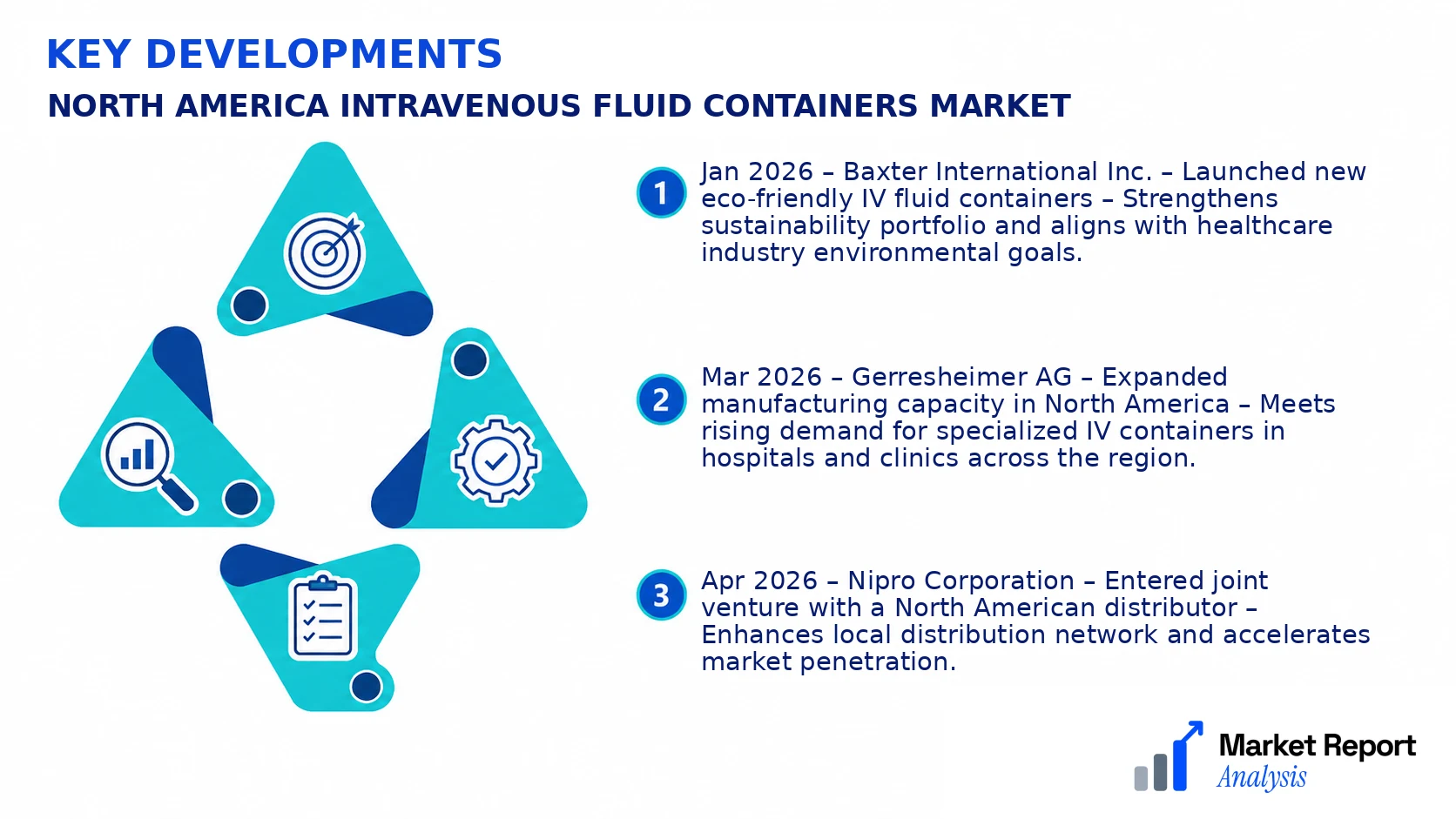
- Jan 2026 – Baxter International Inc. – Launched new eco-friendly IV fluid containers – Strengthens sustainability portfolio and aligns with healthcare industry environmental goals.
- Mar 2026 – Gerresheimer AG – Expanded manufacturing capacity in North America – Meets rising demand for specialized IV containers in hospitals and clinics across the region.
- Apr 2026 – Nipro Corporation – Entered joint venture with a North American distributor – Enhances local distribution network and accelerates market penetration.
- Jun 2026 – Corning Incorporated – Introduced innovative chemically resistant glass for IV containers – Improves product safety and stability, setting new quality standards.
- Aug 2026 – Siemens Healthineers AG – Launched integrated digital infusion management system – Streamlines IV fluid administration and reduces operational errors in hospitals.
Frequently Asked Questions
What is the North America Intravenous Fluid Containers Market?
The North America Intravenous Fluid Containers Market encompasses the manufacturing and distribution of sterile containers used to store and administer intravenous fluids in medical settings across North America. It serves hospitals, clinics, and ambulatory surgical centers, playing a critical role in patient care and treatment efficiency.
What is the current market size of North America Intravenous Fluid Containers Market?
As of 2026, the market is valued at approximately USD 8.5 Billion, reflecting robust demand driven by healthcare modernization, increasing patient aging populations, and the rising prevalence of chronic illnesses requiring IV therapy. Market growth is steady, influenced by technological advances and regulatory changes.
What factors are driving the North America Intravenous Fluid Containers Market?
Key drivers include rising hospital admission rates, advancements in container materials ensuring better safety and sterility, expanding outpatient care settings, and increasing investment in healthcare infrastructure. Additionally, the growing burden of dehydration, nutrition support, and chemotherapy contributes to market growth.
Which region dominates the North America Intravenous Fluid Containers Market?
The United States dominates the market due to its extensive healthcare infrastructure, high adoption of advanced medical devices, and significant healthcare expenditure. This dominance is supported by stringent safety regulations and proactive healthcare policies that promote IV fluid use.
Which segment is expected to grow the fastest?
Polymer-based intravenous fluid containers are projected to witness the fastest growth, driven by their lightweight nature, enhanced safety features, and cost-effectiveness compared to traditional glass containers. Innovation and demand for safer medical supplies propel this segment's expansion.
Who are the leading companies operating in the North America Intravenous Fluid Containers Market?
Leading companies include Baxter International Inc., B Braun Melsungen AG, Smiths Medical, and Terumo Corporation. These firms focus on product innovation, strategic collaborations, and expanding production capacities to maintain market leadership and meet increasing demand.
Analyst Perspective
The North America Intravenous Fluid Containers Market is nearing a maturity phase, with steady growth driven by technological advancements and increasing healthcare investment. Long-term prospects remain positive due to rising disease burdens and expanding outpatient care, although market saturation in certain segments may temper explosive growth. Commercially, opportunities are focused on innovative, environmentally sustainable container designs that enhance patient safety and reduce waste, appealing to healthcare providers and regulatory bodies alike. Technological evolution is expected to prioritize smart containers with integrated sensors and tracking capabilities, aligning with digital health trends. Investment priorities should include R&D for cost-effective, biodegradable materials and automation processes to lower manufacturing costs. Competitive intensity is significant, with established players battling for market share through product differentiation and strategic alliances. Geographically, growth is projected to be robust in regions with expanding healthcare infrastructure, notably the US and Canada, which will cement North America's leadership in this sector. Strategic positioning must balance innovation, regulatory compliance, and cost-efficiency to sustain long-term growth.
