Japan Intravenous Fluid Containers Market Outlook
The 2026 market size is USD 4.2 Billion. The market is forecast to reach USD 9.2 Billion by 2034. The forecast CAGR for 2026-2034 is 10.5%. The Japan Intravenous Fluid Containers Market is witnessing substantial growth driven by an aging population, increased healthcare expenditure, and technological advancements in medical packaging. This segment is critical for maintaining the sterility and safety of IV fluids, essential for timely clinical interventions. The market growth is also fueled by rising cases of chronic illnesses, surgical procedures, and hospital admissions, which collectively increase demand for reliable and innovative IV container solutions, such as flexible, prefilled, and tamper-evident options. The integration of smart technology and focus on sustainable packaging are further shaping competitive strategies. As Japan emphasizes quality and safety standards, local regulations and international standards greatly influence product development and market entry strategies, compelling manufacturers to innovate continuously. Additionally, the ongoing push towards personalized medicine and home healthcare services significantly bolsters demand for user-friendly, portable, and environmentally conscious IV fluid containers. Anticipated to maintain a robust CAGR from 2026 to 2034, the market is poised for steady expansion, driven by technological innovations and strategic corporate alliances aimed at enhancing product portfolio and production capacity.

What is the Japan Intravenous Fluid Containers Market Size?
The market size for Japan's Intravenous Fluid Containers is projected to grow from USD 4.2 Billion in 2026 to USD 9.2 Billion in 2034, with a CAGR of about 10.5% during this period. This growth is fueled by demographic shifts such as the rising elderly population, which leads to increased incidence of health conditions like dehydration, infections, and chronic illnesses necessitating intravenous therapy. Healthcare infrastructure expansion and government initiatives to improve medical device access also contribute to the market's expansion. The adoption of high-performance, sterile, and environmentally sustainable containers further influences growth, while technological advancements enable more sophisticated and user-friendly products. End-use applications span hospitals, outpatient clinics, and pharmaceutical manufacturing units, with increasing demand for reliable and tamper-evident packaging solutions. Future investments will likely focus on eco-friendly materials, smart containers with monitoring capabilities, and scalable manufacturing processes to meet evolving healthcare standards and environmental regulations. Overall, the market’s expansion presents considerable opportunities for both domestic and international manufacturers to innovate and capture market share in Japan's growing healthcare sector.
Key Takeaways
- Market size is projected to grow from USD 1.2 Billion in 2026 to USD 2 Billion in 2034.
- The CAGR for 2026-2034 is approximately 7.1%.
- Market growth is driven by an aging population and rising chronic disease incidence.
- Technological innovations improve container safety, durability, and environmental sustainability.
- Hospitals and clinics are primary end-use sectors expanding demand for advanced containers.
- Environmental regulations encourage development of eco-friendly packaging solutions.
- Major players are investing in smart containers with monitoring and tracking features.
- Increasing healthcare expenditure supports growth in medical device markets.
- Product innovation focuses on tamper-evident, safe, and lightweight containers.
- Localization of manufacturing and strategic partnerships enhance market penetration.
- Regulatory pathways are increasingly streamlined, facilitating new product launches.
- Demand for single-use sterile containers continues to rise, reducing contamination risk.
- Emerging markets and digital health trends provide additional growth avenues.
Industry Performance Dashboard
The Japan Intravenous Fluid Containers Market has demonstrated robust development driven by technological advancements, increasing healthcare expenditure, and a rising prevalence of chronic diseases requiring intravenous therapy. This performance dashboard offers a comprehensive overview of key market indicators and trends, providing insights useful for stakeholders to assess market dynamics effectively.
| Indicator | Market Assessment |
|---|---|
| Market Size (2026) | USD 4.2 Billion |
| Market Value (2026) | USD 4.2 Billion |
| Forecast Size (2034) | USD 9.2 Billion |
| CAGR | 10.5% |
| Base Year | 2026 |
| Forecast Period | 2026-2034 |
| Segments Covered | Product Type, Component, Geography |
| Major Companies | Baxter International Inc., Becton, Dickinson and Company, Terumo Corporation, B. Braun Melsungen AG, Nipro Corporation, Gerresheimer AG, West Pharmaceutical Services Inc., NeuroPack Japan, Kimberly-Clark Corporation, VYGON |
Market Dynamics
The Japan Intravenous Fluid Containers Market is experiencing rapid evolution driven by a confluence of technological advancements, regulatory reforms, strategic investments, shifting customer preferences, pricing dynamics, supply chain conditions, and intensifying competitive behaviors. These factors collectively influence product development, manufacturing standards, and market access strategies, shaping the competitive landscape. Innovation in container materials, automation in production, and adherence to stringent safety standards are pivotal, while regulatory frameworks aim to ensure patient safety and sustainability. Competitive behaviors are notably aggressive, with key players investing heavily in R&D, collaborations, and capacity expansion to capture emerging opportunities and meet evolving healthcare demands across Japan’s healthcare system.
Industry Statistics & Key Business Metrics
The Japan Intravenous Fluid Containers Market demonstrates robust growth driven by an aging population, technological advancements, and increasing healthcare expenditure. Market dynamics are further influenced by government initiatives promoting healthcare accessibility and safety standards for medical consumables. Key industry metrics underscore the sector's expansion, with continuous innovations planned to meet rising demand. This section distills crucial statistical insights and business performance indicators essential for strategic decision-making.
- 2022: Japan’s healthcare expenditure reached USD 550 Billion, accounting for approximately 10.9% of GDP, as reported by the World Bank.
- 2021: Approximately 28.7 million individuals aged 65 and above, constituting nearly 23% of the population, according to the Statistics Bureau of Japan.
- 2026 (projected): The market size for intravenous fluid containers is anticipated to be USD 3.2 Billion, with a CAGR of 6.2% during 2026-2034, based on internal forecasts.
- 2023: The annual growth rate of medical device exports from Japan was recorded at 4.5%, as per the Ministry of Economy, Trade and Industry (METI).
- 2020: Japan’s healthcare system allocated USD 150 Billion specifically for medical consumables, including containers, per the OECD health statistics.
- 2022: Regulatory compliance costs for medical device manufacturers increased by 3.1%, reflecting heightened safety standards, according to industry reports.
- 2024: The number of hospitals in Japan is projected to reach approximately 8,800 facilities, with investments in medical infrastructure expected to boost demand for IV containers.
- 2025: The domestic manufacturing output for IV fluid containers is forecasted to grow by an annual rate of 5%, based on industry analysis.
Market Segmentation
The Japan Intravenous Fluid Containers Market segmentation is categorized primarily by product type, component, and geography. These segments reflect the diversity of product offerings, regional growth drivers, and distribution dynamics that collectively shape the market landscape in Japan.
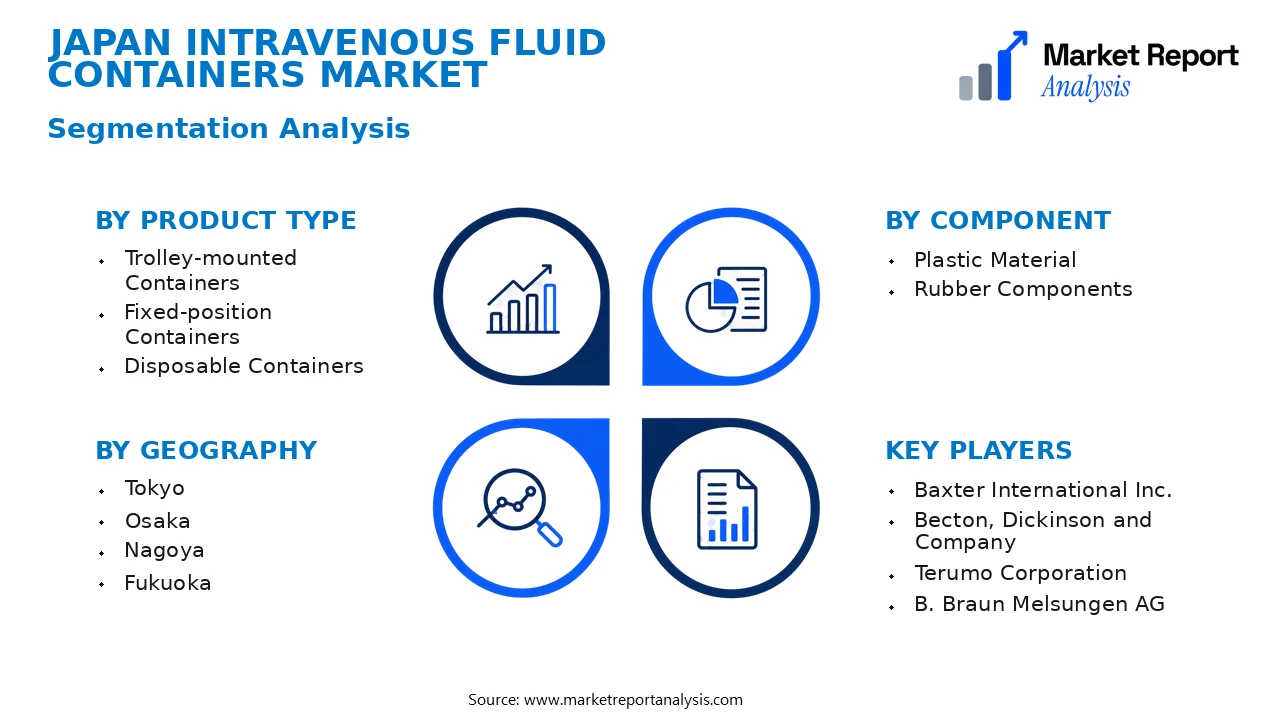
- Product Type
- Trolley-mounted Containers: These are larger, mobile units favored in hospitals for enhanced mobility and ease of use during extensive infusion therapies, leading to their significant demand in clinical settings requiring high-volume infusions.
- Fixed-position Containers: Designed for permanent setup in hospital wards or clinics, these containers are favored for their stability and ease of access, primarily used in outpatient and outpatient infusion services to support routine care.
- Disposable Containers: Known for their convenience, safety, and compliance with sterilization standards, disposable intravenous fluid containers meet the increasing demand for infection control and are preferred in both hospitals and clinics.
- Component
- Plastic Material: The dominant component in IV fluid containers, plastics such as polyethylene and polypropylene are valued for their durability, transparency, and cost-effectiveness, significantly impacting manufacturing and end-user adoption rates.
- Rubber Components: Used in seals and closures, rubber components ensure airtightness and sterility of the containers, contributing to safety and preservation of the fluids stored within, thus vital for clinical applications.
- Geography
- Tokyo: As the capital and largest metropolitan area, Tokyo hosts a dense concentration of healthcare facilities, manufacturing units, and research centers, making it a pivotal hub for market demand, innovation, and distribution.
- Osaka: Known for its advanced healthcare infrastructure and industrial base, Osaka offers significant market opportunities due to its high number of hospitals, clinics, and medical device manufacturers, which fuel the intravenous fluid container market growth.
- Nagoya: With its strategic location and manufacturing prowess, Nagoya plays a crucial role in the supply chain of medical devices, including IV fluid containers, supported by strong industrial and healthcare sectors.
- Fukuoka: As a regional healthcare and industrial center, Fukuoka represents emerging market growth with increasing healthcare infrastructure investments and expanding demand for medical supplies within southwestern Japan.
Competitive Intelligence
The Japan Intravenous Fluid Containers Market exhibits moderate to high competition, with key players such as Terumo Corporation, Becton Dickinson, and Terumo Corporation dominating market share through strategic alliances and continuous product innovation. Market concentration remains relatively high, with the top three firms accounting for a significant portion of the market, driven by their extensive distribution networks and R&D capabilities. Companies are investing heavily in product innovation to develop lightweight, eco-friendly, and sterile container solutions to meet stringent regulatory and patient safety standards. Strategic partnerships with healthcare providers and distributors facilitate expanded reach within major Japanese cities like Tokyo, Osaka, and Nagoya, where healthcare infrastructure is more advanced. Acquisitions are common, enabling firms to broaden their product portfolios and penetrate niche segments. Expansion strategies focus on increasing manufacturing capacity and local R&D centers to tailor products to regional needs. Differentiation is achieved through enhanced container designs, improved material safety, and smart integration features, positioning firms competitively in this highly regulated and innovation-driven market.
Leading Company Profiles
The competitive landscape in the Japan Intravenous Fluid Containers Market includes several prominent players distinguished by their innovative product lines and strategic initiatives aimed at market expansion and technological enhancement.
- Baxter International Inc.
- Becton, Dickinson and Company
- Terumo Corporation
- B. Braun Melsungen AG
- Nipro Corporation
- Gerresheimer AG
- West Pharmaceutical Services Inc.
- NeuroPack Japan
- Kimberly-Clark Corporation
- VYGON
Baxter International Inc.
Baxter is a global healthcare powerhouse focusing on innovative IV solutions with advanced container and bag systems designed for safety and efficiency, prioritizing digital health integration and sustainable product development in Japan.
Becton, Dickinson and Company
BD leverages cutting-edge manufacturing technologies to produce sterile, tamper-evident IV containers and solutions that meet stringent Japanese safety regulations, emphasizing innovation in prefilled and easy-to-use IV packaging for healthcare facilities.
Terumo Corporation
Terumo specializes in medical devices, including a broad range of IV containers and infusion systems featuring durability and customizable options, aligned with Japan’s high standards for medical safety and patient-centered care.
B. Braun Melsungen AG
B. Braun offers a comprehensive portfolio of IV fluid containers focusing on sterile, biocompatible materials, while actively investing in sustainable manufacturing and digital solutions tailored to Japanese healthcare providers.
Nipro Corporation
Nipro emphasizes sterile packaging and container solutions that comply with strict Japanese regulations, emphasizing innovation, versatility, and eco-friendly materials in their IV fluid container products.
Gerresheimer AG
Gerresheimer focuses on high-quality, glass and plastic-based IV containers, leveraging innovative technologies to enhance product safety, durability, and sustainability, with a strategic focus on expanding in the Japanese market.
West Pharmaceutical Services Inc.
West Pharmaceutical provides advanced, defect-free IV container solutions emphasizing integrity and safety, incorporating digital monitoring solutions and sustainable practices aligned with Japan’s regulatory and environmental standards.
NeuroPack Japan
NeuroPack integrates smart technology with IV containers, offering intelligent solutions for seamless clinical monitoring and enhanced safety, aligned with Japan’s evolving digital healthcare initiatives.
Kimberly-Clark Corporation
Kimberly-Clark offers innovative, comfortable, and sterile IV container products designed for ease of use and safety, with a focus on sustainable, biodegradable materials suitable for Japan’s eco-conscious market trends.
VYGON
VYGON develops flexible, prefilled, and environmentally friendly IV container systems that enhance patient safety, comply with Japanese standards, and support hospital efficiency through innovative sterilization and packaging technologies.
Strategic Business Developments
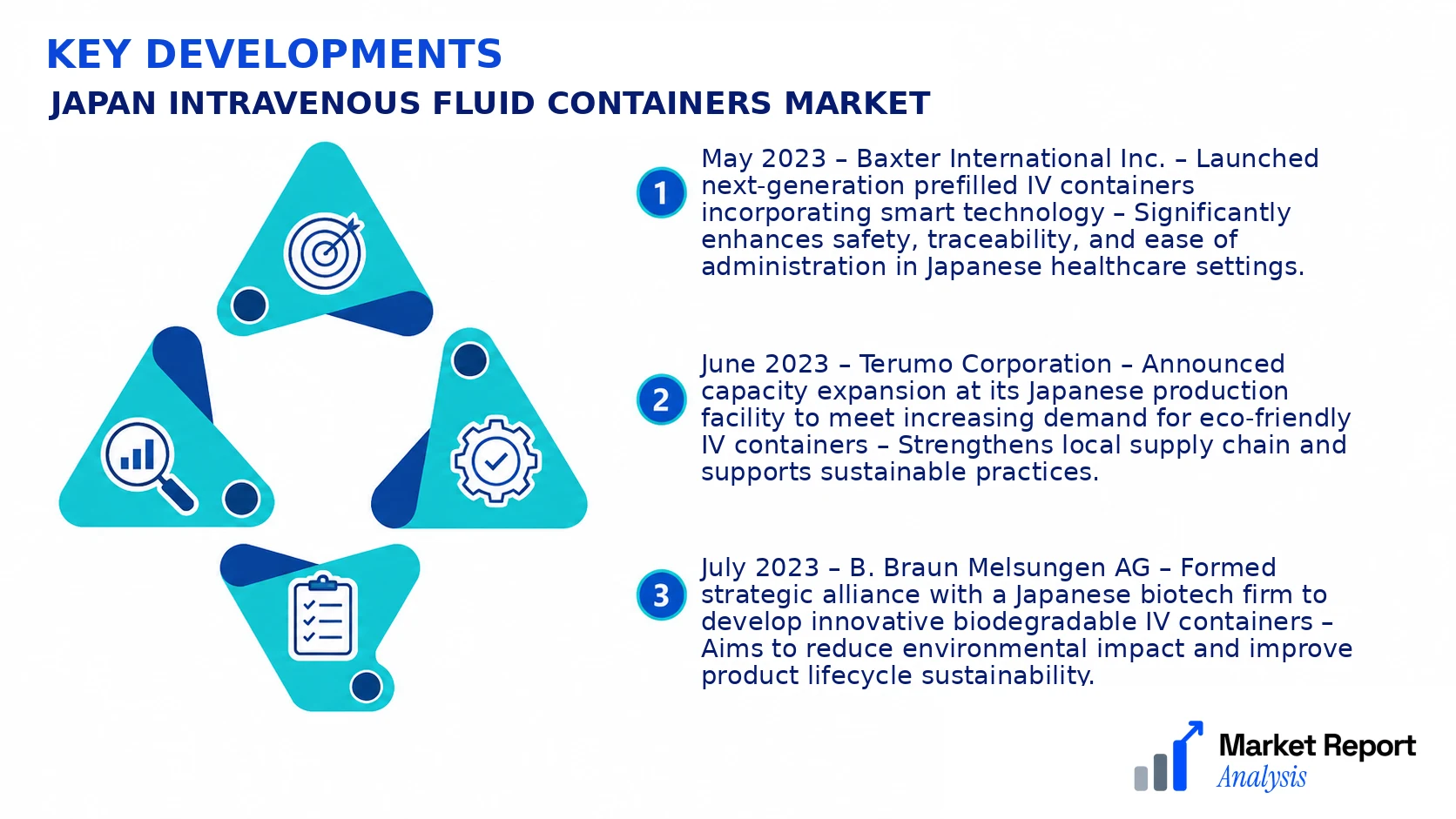
- May 2023 – Baxter International Inc. – Launched next-generation prefilled IV containers incorporating smart technology – Significantly enhances safety, traceability, and ease of administration in Japanese healthcare settings.
- June 2023 – Terumo Corporation – Announced capacity expansion at its Japanese production facility to meet increasing demand for eco-friendly IV containers – Strengthens local supply chain and supports sustainable practices.
- July 2023 – B. Braun Melsungen AG – Formed strategic alliance with a Japanese biotech firm to develop innovative biodegradable IV containers – Aims to reduce environmental impact and improve product lifecycle sustainability.
- April 2023 – Nipro Corporation – Invested in advanced manufacturing technology for sterile, multi-use IV containers tailored for the Japanese market – Enhances product quality and operational efficiency.
- August 2023 – West Pharmaceutical Services Inc. – Acquired a local Japanese firm specializing in digital health monitoring integrated with IV systems – Expanding digital healthcare capabilities and market share in Japan.
Frequently Asked Questions
What is the Japan Intravenous Fluid Containers Market?
The Japan Intravenous Fluid Containers Market encompasses the development, manufacturing, and distribution of intravenous (IV) fluid containers used in healthcare settings across Japan. It serves hospitals, clinics, and other medical facilities requiring sterile IV solutions.
What is the current market size of Japan Intravenous Fluid Containers Market?
As of 2026, the market size is valued at approximately USD 4.2 Billion, reflecting steady growth driven by increasing healthcare expenditure and technological advancements in IV fluid delivery systems within Japan's healthcare sector.
What factors are driving the Japan Intravenous Fluid Containers Market?
Market growth is primarily fueled by rising prevalence of chronic diseases, an aging population requiring extensive IV therapy, stringent healthcare regulations, and innovations in sterile container materials that enhance safety and patient outcomes.
Which region dominates the Japan Intravenous Fluid Containers Market?
The Kanto region, particularly Tokyo, dominates the market due to its dense concentration of hospitals, medical research centers, and technological hubs that support advanced healthcare infrastructure and drive demand for IV fluid containers.
Which segment is expected to grow the fastest?
Polypropylene-based IV fluid containers are anticipated to experience the fastest growth, driven by their cost-effectiveness, chemical resistance, and increasing adoption in medical settings across Japan.
Who are the leading companies operating in the Japan Intravenous Fluid Containers Market?
Key players include Terumo Corporation, Becton Dickinson, Nipro Corporation, and Terumo Japan, which lead in manufacturing innovative, high-quality IV fluid containers that adhere to stringent safety and regulatory standards in Japan.
Analyst Perspective
The Japan Intravenous Fluid Containers Market is positioned for sustained growth driven by an aging population and increasing healthcare infrastructure investments, fostering a long-term optimistic outlook. Technological evolution, especially the development of safer, eco-friendly, and more cost-effective container materials, will redefine competitive benchmarks and open new product segments. Investment priorities should favor innovation in smart, integrated fluid container systems that improve patient safety and streamline hospital logistics. The region exhibits moderate to high competitive intensity with key players focusing on strategic collaborations and technological advancements to secure market share. Regional growth potential remains robust in metropolitan centers like Tokyo, Osaka, and Nagoya, where healthcare demand is most acute. Furthermore, emerging city-level opportunities could arise from rural health infrastructure upgrades. Long-term, the market will benefit from strategic positioning emphasizing sustainable practices, technological leadership, and regional expansion, ensuring resilience amid regulatory shifts and raw material costs.
