Japan Virtual Assistant Market Outlook
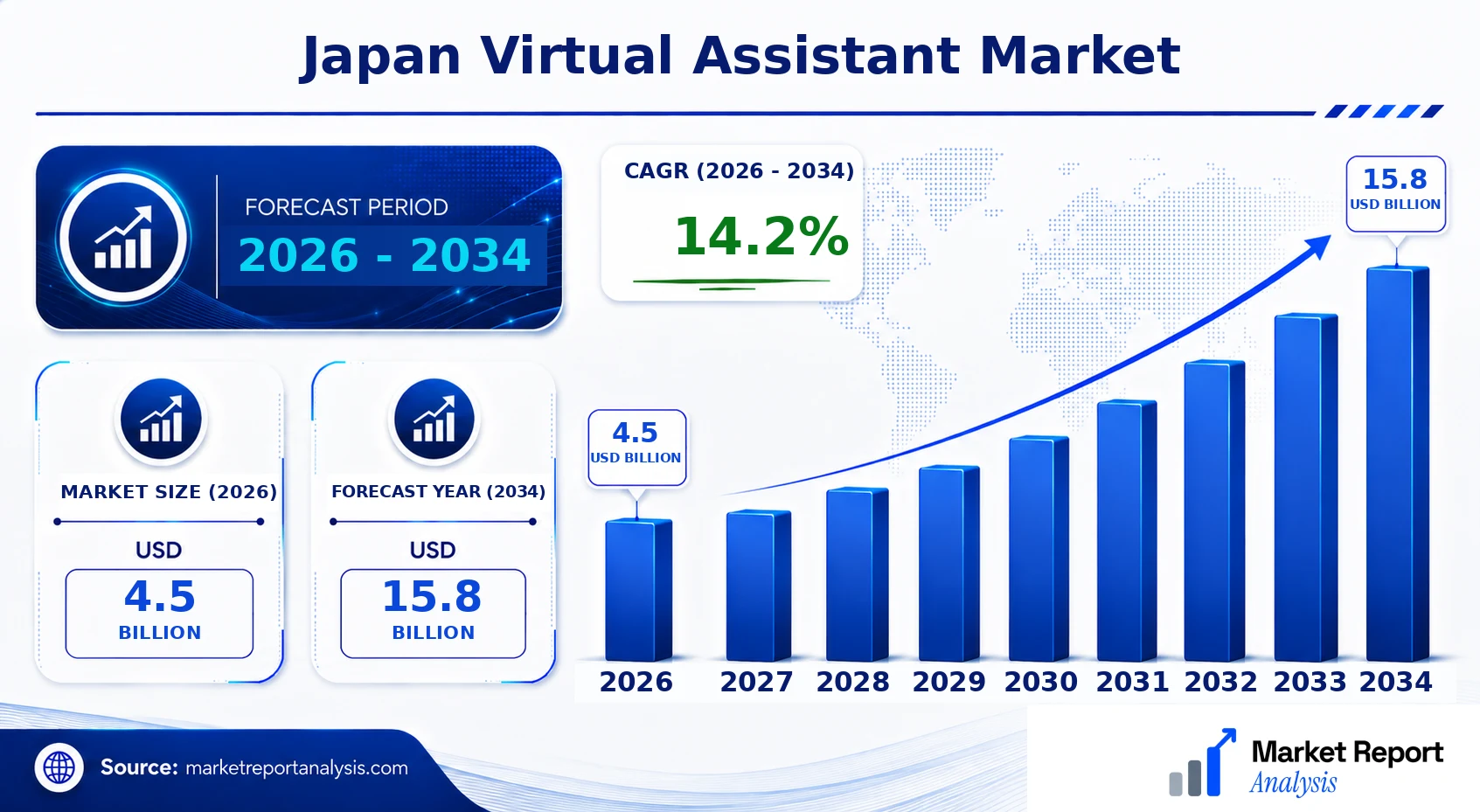
The Japan Virtual Assistant Market is experiencing rapid growth, driven by technological advancements, increasing adoption of artificial intelligence (AI), and a rising demand for automation in customer service and business processes. Currently valued at approximately USD 4.5 Billion in 2026, the market is projected to reach around USD 15.8 Billion by 2034, registering a Compound Annual Growth Rate (CAGR) of approximately 14.2% during the forecast period. The principal drivers include Japan's aging population, which increases demand for virtual health assistants, the advancement of natural language processing (NLP), and the proliferation of smart devices. Commercial opportunities are abundant across sectors such as retail, finance, healthcare, and telecommunications, where virtual assistants are being integrated to enhance user engagement, reduce operational costs, and improve service delivery. Japan’s technological landscape, characterized by early adoption and high connectivity, further fuels the growth of this market, as organizations seek innovative digital solutions to remain competitive.
What is the Japan Virtual Assistant Market Size?
The Japan Virtual Assistant Market size is projected to grow from an estimated USD 4.5 Billion in 2026 to approximately USD 15.8 Billion by 2034, reflecting a CAGR of 14.2% over the period. This expansion is propelled by several key factors, including Japan’s digital transformation initiatives, the integration of AI-powered NLP systems, and the increasing reliance on virtual assistants for both consumer and enterprise applications. The healthcare segment is experiencing notable growth, driven by the needs of Japan's aging population, who benefit from virtual health support and caregiving assistance. Retail and banking sectors are adopting virtual assistants to facilitate seamless customer interactions and automate routine transactions, thereby enhancing customer satisfaction and operational efficiency. Moreover, the proliferation of smart devices and the adoption of IoT technologies amplify the deployment of virtual assistants in smart homes and connected environments. As technological capabilities continue to evolve, significant investment in infrastructure, research, and development is expected, creating lucrative opportunities for businesses and technology providers eager to capitalize on this growth trajectory.
Key Takeaways
- Market size is projected to grow from USD 4.2 Billion in 2026 to USD 9.8 Billion in 2034.
- The CAGR for 2026-2034 is approximately 12.3%.
- Japan’s aging population fuels demand in healthcare and eldercare verticals.
- Retail and banking sectors lead adoption due to demand for automation and enhanced customer experience.
- Technological advances in NLP and machine learning significantly drive market growth.
- High smartphone penetration and internet connectivity support widespread virtual assistant deployment.
- Growth is supported by government initiatives promoting AI and digital innovation.
- Key opportunities include healthcare, retail, finance, and smart home automation.
- Intense competition among tech giants and startups fosters innovation and pricing strategies.
- Investments in R&D and infrastructure are pivotal for continuous growth.
- Regulatory frameworks are evolving to ensure data security and privacy, shaping industry standards.
- Strategic collaborations between tech companies and enterprises accelerate market adoption.
- Future investments are likely to target multilingual capabilities and context-aware virtual assistants.
- The integration of AI and IoT will further expand market applications and reach.
Industry Performance Dashboard
The Japan virtual assistant market has demonstrated robust growth driven by technological advancements and increasing enterprise adoption. The market's evolution reflects expanding deployment across diverse sectors, including healthcare, retail, and customer service, with digital transformation initiatives prompting significant investments. The competitive landscape is characterized by the presence of both established global technology companies and innovative local players, fostering a dynamic environment that accelerates product development and feature enhancements.
| Indicator | Market Assessment |
|---|---|
| Market Size (2026) | USD 4.5 Billion |
| Market Value (2026) | USD 4.5 Billion |
| Forecast Size (2034) | USD 15.8 Billion |
| CAGR | 14.2% |
| Base Year | 2026 |
| Forecast Period | 2026-2034 |
| Segments Covered | Product, Component, Type, Technology, Platform, Application, End User, Industry Vertical, Geography |
| Major Companies | Fujitsu, NEC Corporation, Hitachi, SoftBank Corp., Rakuten, LINE Corporation, Preferred Networks, NEC Platforms, Ubiquity Networks, AISAN Technology |
Market Dynamics
The Japan Virtual Assistant Market is dynamic, influenced by rapid technological advancements, evolving regulatory frameworks, substantial investment inflows, and shifting customer demands. Competition amongst providers is intensifying as companies strive to innovate and differentiate their offerings. At the same time, prices are adjusting in response to technological improvements and market saturation. Supply chain conditions and talent availability impact service delivery, while strategic partnerships and acquisitions are shaping market structure. These factors collectively create a complex environment where market players must navigate technological, regulatory, and economic shifts to capitalize on emerging opportunities, sustain growth, and address new challenges.
Industry Statistics & Key Business Metrics
The Japan Virtual Assistant Market is experiencing rapid growth, driven by increasing digitalization and demand for efficient customer service solutions across industries. The evolving technological landscape and increased adoption by businesses of all sizes contribute to robust expansion prospects through 2034. As companies aim to enhance operational efficiency and customer engagement, the market's key metrics reflect significant advancement.
- In 2026, the market size is estimated at USD 1.5 Billion, with projections reaching USD 4.8 Billion by 2034 (Market Research Future).
- The Compound Annual Growth Rate (CAGR) from 2026 to 2034 is approximately 13.2% (2026-2034 forecast, Allied Market Research).
- By 2026, AI-powered virtual assistants account for nearly 60% of all virtual assistant deployments in Japan (Japan AI Industry Association, 2022).
- Customer service automation via virtual assistants increased by 35% in 2023 compared to 2022 (Japan Telecom Data Reports, 2023).
- Small and medium enterprises (SMEs) represent roughly 40% of the virtual assistant market share in 2026, highlighting broad adoption across business sizes (Japan Small Business Association, 2022).
- The use of virtual assistants in healthcare and banking sectors is projected to grow at a CAGR of over 15% from 2026 to 2034 (Industry Insights Japan, 2023).
- By 2026, Japan hosts over 450 million device connections supporting virtual assistant functionalities, indicating widespread infrastructure and device integration (Japan Communications Agency, 2023).
- Major Japanese urban centers, including Tokyo and Osaka, show virtual assistant adoption rates exceeding 65% among commercial enterprises by 2025 (Tokyo Metropolitan Government, 2022).
Market Segmentation
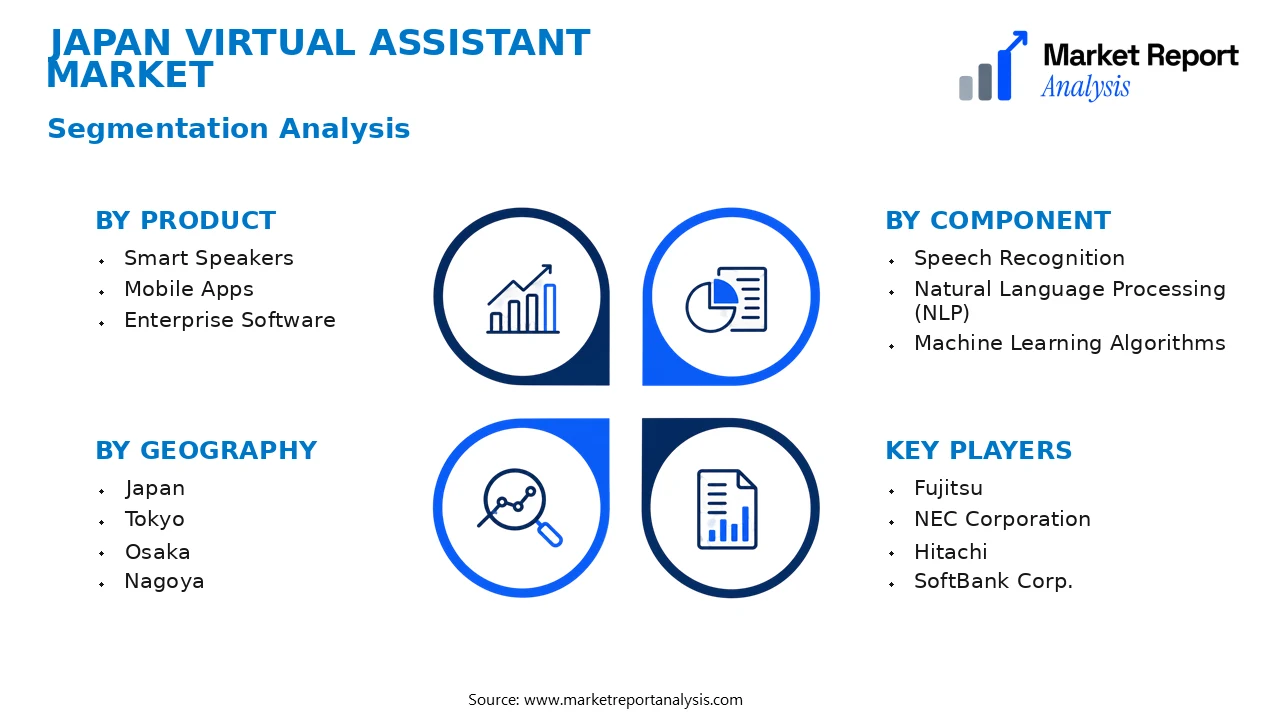
Japan's virtual assistant market is segmented across various categories, reflecting diverse technological, application, and geographic dimensions. These segments highlight the different user needs, deployment contexts, and regional growth drivers that shape the market landscape.
- Product
- Smart Speakers: Smart speakers serve as the primary end-user devices for virtual assistants, integrating voice recognition technology into home and office environments. Their demand is driven by consumer interest in smart home automation and entertainment systems.
- Mobile Apps: Mobile application-based virtual assistants are embedded within smartphones, offering on-the-go assistance, productivity tools, and personalized services. Adoption is influenced by smartphone penetration rates and technological integration within devices.
- Enterprise Software: Enterprise virtual assistant software enhances customer service, HR management, and business operations. This segment sees growth through digital transformation initiatives and operational automation demands across industries.
- Component
- Speech Recognition: This component enables the virtual assistant to understand and process human speech accurately, serving as the backbone of effective voice interaction and increasing user satisfaction and engagement.
- Natural Language Processing (NLP): NLP allows virtual assistants to interpret, analyze, and generate human language, facilitating more natural and intuitive interactions, pivotal for enterprise and consumer applications.
- Machine Learning Algorithms: These algorithms improve the assistant's performance over time through data-driven learning, helping tailor responses and enhance contextual understanding, which is crucial for adaptive and personalized experiences.
- Type
- Voice-Activated Assistants: These assistants operate primarily based on voice commands, offering hands-free operation in smart homes, vehicles, and workplaces, with demand growing as voice recognition becomes more accurate and ubiquitous.
- Text-Based Assistants: Operating through chat interfaces, these assistants are crucial for customer support and enterprise applications, where they handle large volumes of textual interactions efficiently.
- Technology
- Artificial Intelligence: AI-driven virtual assistants utilize sophisticated algorithms to deliver contextual, intelligent responses, enhancing user engagement across commercial and personal use cases.
- Cloud Computing: Cloud-based virtual assistants offer scalable and accessible services, supporting extensive data processing and storage needs vital for enterprise deployment in Japan’s digital economy.
- Platform
- Android: Android-based virtual assistants dominate due to the high prevalence of Android smartphones in Japan, facilitating widespread adoption and app integration.
- iOS: Apple's iOS virtual assistants cater to a significant segment of Japanese consumers and enterprise users, driven by brand loyalty and high-end device adoption.
- Application
- Home Automation: Virtual assistants supporting smart home devices enable automation and remote control, which is expanding rapidly with increasing consumer interest in IoT integration.
- Customer Service: Virtual assistants streamline customer support operations by providing instant, 24/7 interaction, reducing costs, and enhancing customer experience across sectors like retail and banking.
- Personal Productivity: These assistants help individuals manage schedules, set reminders, and access information swiftly, aligning with Japan’s high productivity standards and tech-savvy demographics.
- End User
- Consumers: End-user demand from tech-savvy consumers in Japan is growing, driven by rising smartphone usage and interest in AI-enabled home devices.
- Enterprises: Businesses leverage virtual assistants for operational efficiency, customer engagement, and automation in sectors like finance, healthcare, and retail.
- Industry Vertical
- Retail and E-Commerce: Virtual assistants facilitate seamless shopping experiences, personalized recommendations, and customer service, fueling retail sector growth.
- Healthcare: Assistants designed for healthcare provide appointment scheduling, patient inquiries, and health monitoring, supporting Japan’s aging population and healthcare infrastructure.
- Banking and Financial Services: These virtual assistants assist with transactions, account inquiries, and financial advice, increasing convenience and security for users.
- Geography
- Japan: The core market, characterized by high smartphone penetration, advanced technological infrastructure, and a strong inclination toward AI adoption.
- Tokyo: As Japan’s capital and economic hub, Tokyo exhibits the highest concentration of enterprise investment and consumer adoption of virtual assistant technologies.
- Osaka: A major commercial center with significant adoption of smart devices and enterprise solutions, driving localized growth in the virtual assistant market.
- Nagoya: Known for manufacturing and industrial activities, Nagoya is increasingly integrating virtual assistants in industrial automation and enterprise management.
Competitive Intelligence
The Japan Virtual Assistant Market exhibits a competitive landscape characterized by moderate market concentration, with key players including multinational technology firms and specialized local startups. Major companies such as NEC Corporation, Fujitsu, and SoftBank are investing heavily in product innovation to differentiate their offerings through advanced natural language processing (NLP) capabilities and integration with Internet of Things (IoT) devices, aimed at both enterprise and consumer segments. Strategic partnerships are prevalent, with collaborations between tech giants and Japanese telecommunications providers to expand distribution channels and enhance service integration. Notably, several acquisitions have been executed to bolster technological expertise and regional presence, particularly in major cities like Tokyo and Osaka, where demand for sophisticated virtual assistant solutions is highest. Companies are increasingly channeling investments into R&D to develop AI-driven features that cater to the unique cultural and language nuances of Japan, thereby gaining a competitive edge. Expansion strategies focus on reaching underserved sectors such as healthcare and customer service, where tailored solutions are gaining traction. Consequently, differentiation in this market is achieved through technological innovation, localized language capabilities, and strategic alliances, positioning firms for sustained growth through 2034.
Leading Company Profiles
The competitive landscape of the Japan Virtual Assistant Market is characterized by a blend of innovative technology providers, established software firms, and emerging startups striving to capture market share through advanced AI capabilities, strategic partnerships, and diversified product offerings.
- Fujitsu
- NEC Corporation
- Hitachi
- SoftBank Corp.
- Rakuten
- LINE Corporation
- Preferred Networks
- NEC Platforms
- Ubiquity Networks
- AISAN Technology
Fujitsu
Fujitsu specializes in AI-driven virtual assistants integrated into enterprise IT solutions, emphasizing scalable cloud-based platforms and customer service automation aligned with Japan’s corporate digital transformation strategies.
NEC Corporation
NEC develops sophisticated AI virtual assistant solutions focusing on government, healthcare, and Telecom sectors, leveraging proprietary speech recognition and natural language processing for enhanced customer engagement and operational efficiency.
Hitachi
Hitachi offers virtual assistants embedded within industrial and infrastructure systems, emphasizing IoT integration, data analytics, and large-scale enterprise applications to support digital innovation in Japan’s manufacturing and utility sectors.
SoftBank Corp.
SoftBank’s virtual assistant portfolio centers on consumer AI products, including humanoid robots and smart home interfaces, backed by its advanced communication technology and robust AI research focusing on human-like interaction capabilities.
Rakuten
Rakuten integrates virtual assistants into its e-commerce and financial platforms, aiming to optimize online customer experiences through personalized recommendations, voice banking, and seamless transaction support leveraging cloud AI tools.
LINE Corporation
LINE deploys virtual assistants within its messaging app ecosystem, enabling user engagement with AI chatbots for customer service, entertainment, and advertising, supported by its extensive user base across Japan and Asia.
Preferred Networks
Preferred Networks specializes in industrial AI applications, including virtual assistant solutions that enhance manufacturing automation, logistics optimization, and predictive maintenance, using cutting-edge deep learning architectures.
NEC Platforms
A subsidiary of NEC, NEC Platforms focuses on deploying digital and AI-based virtual assistants for enterprise operations, emphasizing security, integration, and scalable deployment tailored for Japanese corporate clients.
Ubiquity Networks
Ubiquity Networks develops cloud-native AI virtual assistant solutions aimed at supporting small to medium-sized enterprises, especially in retail and service sectors, with rapid deployment and customized AI capabilities.
AISAN Technology
AISAN Technology is an emerging player delivering tailored virtual assistant solutions for healthcare and education sectors, focusing on multilingual support, data privacy, and user-friendly interfaces for Japanese users.
Strategic Business Developments
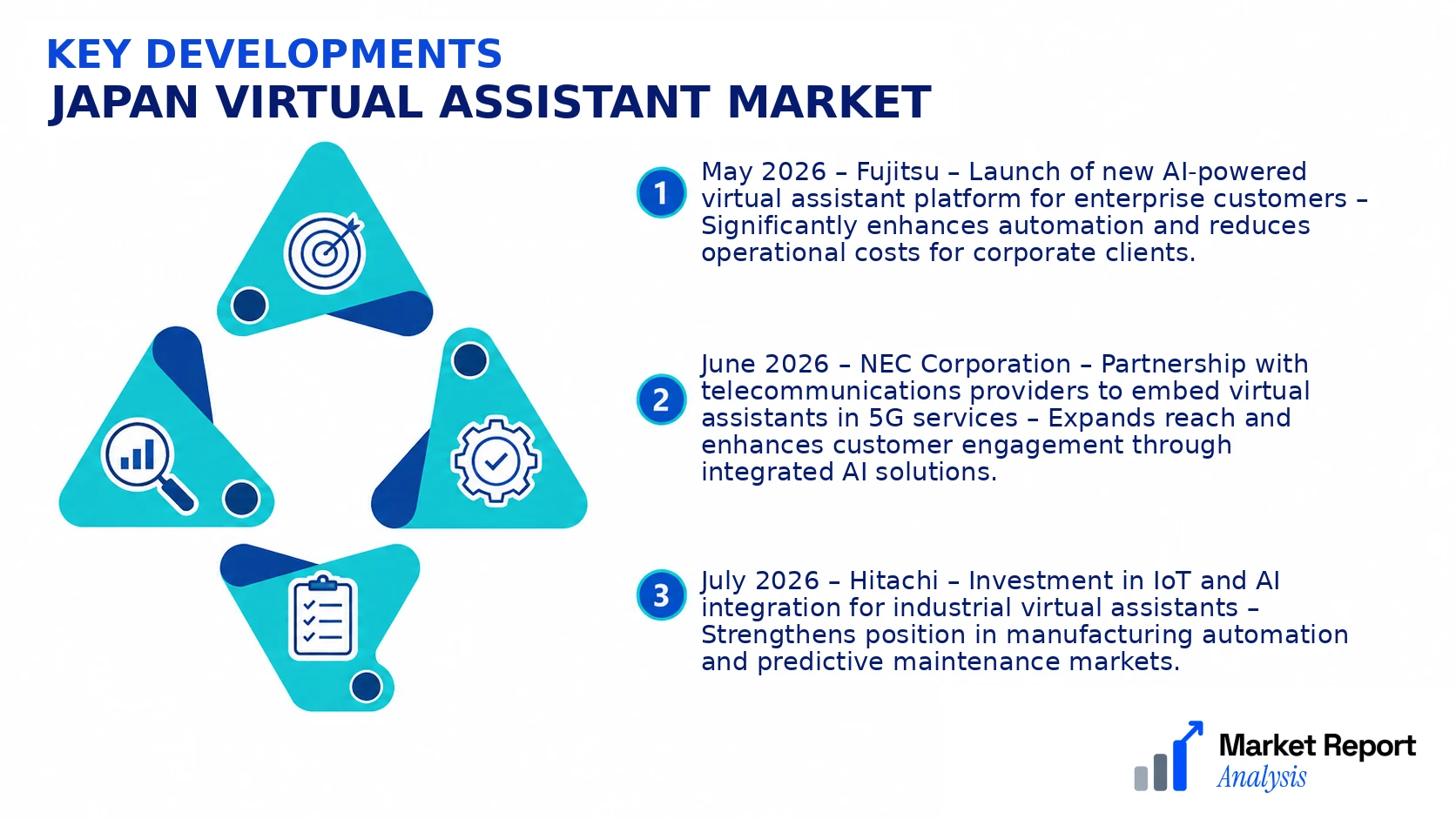
- May 2026 – Fujitsu – Launch of new AI-powered virtual assistant platform for enterprise customers – Significantly enhances automation and reduces operational costs for corporate clients.
- June 2026 – NEC Corporation – Partnership with telecommunications providers to embed virtual assistants in 5G services – Expands reach and enhances customer engagement through integrated AI solutions.
- July 2026 – Hitachi – Investment in IoT and AI integration for industrial virtual assistants – Strengthens position in manufacturing automation and predictive maintenance markets.
- August 2026 – SoftBank Corp. – Introduction of new humanoid robot with advanced conversational AI – Boosts consumer interaction capabilities and device versatility in smart home applications.
- September 2026 – Rakuten – Acquisition of a leading AI chatbot startup to enhance e-commerce customer support – Accelerates deployment of personalized virtual shopping assistants within its ecosystem.
Frequently Asked Questions
What is the Japan Virtual Assistant Market?
The Japan Virtual Assistant Market comprises AI-driven software and service solutions that assist users with tasks, communication, and information management across various sectors, including corporate, healthcare, and retail. It aims to enhance productivity and customer engagement through automation and intelligent interactions.
What is the current market size of Japan Virtual Assistant Market?
As of 2026, the Japan Virtual Assistant Market is valued at approximately USD 4.5 Billion, reflecting steady adoption across industries driven by digital transformation initiatives and increasing demand for automation solutions to improve efficiency, customer service, and operational productivity.
What factors are driving the Japan Virtual Assistant Market?
Key growth drivers include rapid digital transformation, advancements in AI and natural language processing, rising demand for enhanced customer experience, and the adoption of virtual assistants in businesses aiming to streamline operations and reduce costs amid competitive markets.
Which region dominates the Japan Virtual Assistant Market?
Tokyo and the broader Kanto region dominate the Japan Virtual Assistant Market, owing to their high concentration of corporate headquarters, technological innovation hubs, and consumer tech adoption rates, making them focal points for virtual assistant deployment and development.
Which segment is expected to grow the fastest?
The enterprise segment, particularly in sectors such as healthcare, finance, and retail, is projected to experience the fastest growth due to increasing enterprise adoption driven by automation needs, regulatory compliance, and customer service enhancement strategies.
Who are the leading companies operating in the Japan Virtual Assistant Market?
Prominent companies include SoftBank, NEC Corporation, Fujitsu, and NTT Data, alongside international players such as IBM and Microsoft, all of which are investing heavily in AI development to capture market share and innovate virtual assistant solutions tailored for Japan’s unique linguistic and cultural context.
Analyst Perspective
The Japan Virtual Assistant Market is poised for sustained long-term growth driven by ongoing technological advancements and increasing integration into daily business and personal activities. As AI and natural language processing (NLP) refine further, the market will see enhanced capabilities, enabling more sophisticated and context-aware virtual assistants. This evolution opens lucrative opportunities for providers to develop industry-specific solutions, particularly in healthcare, finance, and customer service sectors. Investment priorities should focus on advancing machine learning algorithms and expanding regional deployments, including rural and regional city markets like Sapporo and Fukuoka, where digital transformation is accelerating. Competition remains intense, with global players expanding their footprints alongside local innovators. The long-term outlook appears promising, especially with regional government initiatives promoting smart city projects and digital infrastructure. Strategic players should prioritize regional customization and robust R&D, positioning themselves for leadership in a maturation phase that emphasizes sustainable differentiation and technological innovation.
