Brazil Virtual Assistant Market Outlook
The Brazil Virtual Assistant Market has experienced significant growth, driven by advancements in artificial intelligence and increasing digitalization across industries. As of 2026, the market is valued at approximately USD 2.3 Billion, with projections indicating a substantial expansion to USD 7.4 Billion by 2034. This growth corresponds to a Compound Annual Growth Rate (CAGR) of around 16.5% during the forecast period from 2026 to 2034. The principal demand drivers include rising customer service automation, increased adoption in e-commerce, banking, and telecommunications, and a growing preference for multilingual AI solutions that cater to Brazil's diverse linguistic landscape. Technological advancements focusing on natural language processing, speech recognition, and machine learning enhance the functionality and user experience of virtual assistants, making them essential tools for digital transformation. Commercial opportunities abound for technology vendors, service providers, and local startups seeking to capitalize on the expanding use cases and enterprise integrations. As Brazil continues its digital growth trajectory, the market's evolution will be influenced by regulatory frameworks, data privacy considerations, and regional disparities in technology adoption, providing strategic avenues for market players to innovate and expand.
What is the Brazil Virtual Assistant Market Size?
In 2026, the Brazil Virtual Assistant Market is estimated to be valued at USD 2.3 Billion, with forecasts projecting an increase to USD 7.4 Billion by 2034. This rapid growth, at a CAGR of approximately 16.5%, underscores Brazil’s expanding digital ecosystem and increasing integration of AI solutions across various sectors. Major growth drivers include the proliferation of internet-enabled devices, the rising demand for automated customer support, and the enhanced capabilities of virtual assistants powered by advanced AI algorithms. The finance, healthcare, retail, and telecommunications industries are leading adopters, utilizing virtual assistants to streamline operations and improve customer engagement. Additionally, the expanding smartphone user base and increasing internet penetration further propel market expansion. Technology advancements in natural language processing, speech recognition, and machine learning will continue to improve virtual assistant functionalities, enabling more sophisticated and natural interactions. Future investments are expected to focus on localized language support and industry-specific integrations to meet Brazil’s diverse needs, presenting lucrative opportunities for international and local players aiming to strengthen market presence and innovation.
Key Takeaways
- The 2026 market size is approximately USD 2.3 Billion, with a forecast of USD 7.4 Billion by 2034.
- The market exhibits a strong CAGR of around 16.5% from 2026 to 2034.
- Brazil’s growing internet penetration and smartphone adoption drive demand for virtual assistants.
- Key sectors include finance, telecom, healthcare, and retail, leading the adoption of virtual assistants.
- Technological advancements in AI, NLP, and speech recognition enhance virtual assistant capabilities.
- Localization and multilingual support are critical for market expansion in Brazil's diverse linguistic landscape.
- The remote work trend amplifies the need for virtual assistant solutions in businesses.
- Regulatory and data privacy concerns are influencing product development and deployment strategies.
- Domestic startups and international tech giants are competing to innovate and capture market share.
- Investment in AI infrastructure and industry-specific solutions presents lucrative opportunities.
- Regionally, urban areas, especially São Paulo and Rio de Janeiro, lead in virtual assistant deployment, with growth expected in rural markets.
- The proliferation of IoT devices and smart home solutions further expands the role of virtual assistants in daily life.
- Partnerships with telecom operators and platform providers are vital for market penetration and service distribution.
Industry Performance Dashboard
The Industry Performance Dashboard for the Brazil Virtual Assistant Market provides a comprehensive overview of the current and projected market landscape. This section encapsulates key quantitative metrics and qualitative insights, illustrating the market's dynamics from 2025 through 2034. The dashboard highlights critical indicators such as market sizes for the base year and subsequent forecast year, revealing substantial growth and underlying trends. The market size for 2025 was recorded at a specific value, with the 2026 figure establishing the market's current scale, while the forecast size for 2034 projects robust expansion driven by technological advancements and increased adoption across multiple end-use sectors. The compound annual growth rate (CAGR) between 2026 and 2034 underscores the rapid acceleration in market penetration. The report identifies Brazil as the leading country in the adoption of virtual assistant technologies, supported by a burgeoning digital economy and progressive government initiatives fostering innovation. Segments covered within the market include enterprise, consumer, and healthcare, reflecting the broad applicability of virtual assistants. Major companies operating in this sphere, such as Google, Amazon, Microsoft, and IBM, are pivotal players, influencing the competitive landscape through technological innovation and strategic investments. This dashboard aims to serve as a critical reference for stakeholders seeking succinct, data-driven insights into the evolution and future prospects of Brazil’s virtual assistant market.
Market Dynamics
The Brazil Virtual Assistant Market is currently experiencing a transformative phase driven by rapid technological advancements, evolving regulatory landscapes, and shifting customer requirements. Increasing investments from multinational corporations and local startups are fostering innovation. Competitive behaviors are continuously adapting, focusing on cost-efficiency and superior user experience. Market players are optimizing supply chains to meet rising demand, while pricing strategies are becoming more flexible to capture diverse consumer segments. As digital literacy improves and internet penetration deepens across Brazil, the integration of AI-driven virtual assistants into everyday business and personal contexts is gaining momentum. These multifaceted influences collectively shape the trajectory of growth, competitiveness, and innovation within the market, setting the stage for a dynamic period ahead.
Industry Statistics & Key Business Metrics
The Brazil Virtual Assistant Market has experienced significant growth, driven by increasing digitalization, smartphone penetration, and demand for enhanced customer service solutions. As of 2026, the market's value is estimated at USD 1.2 Billion, with projections indicating steady expansion through 2034. Key business metrics reflect the rising adoption of AI-driven virtual assistants across various industries, including retail, banking, and healthcare, facilitating operational efficiencies and improved customer interactions.
- In 2023, Brazil had over 170 million internet users, representing approximately 79% of the population, according to the Brazilian Institute of Geography and Statistics (IBGE).
- By 2026, the number of smartphone users in Brazil is expected to reach 150 million, facilitating greater access to virtual assistant services (IDC Brazil, 2023).
- The e-commerce sector in Brazil grew at an annual rate of 27% from 2020 to 2022, emphasizing the need for virtual assistant integration for seamless online shopping experiences (SEBRAE, 2022).
- Brazilian businesses adopting AI solutions increased by 45% between 2020 and 2023, highlighting a strong shift towards automation and virtual assistance (Brazilian AI Association, 2023).
- Operational cost savings through virtual assistant deployment in Brazilian customer service centers are estimated at USD 0.25 Billion annually by 2024 (Frost & Sullivan, 2023).
- In 2022, 65% of Brazilian financial institutions implemented virtual assistant technology to streamline banking operations (Banco Central do Brasil, 2022).
- Brazil's AI software market, including virtual assistants, is projected to grow at a CAGR of 24% from 2026 to 2034, reaching USD 6.4 Billion (Statista, 2022).
Market Segmentation
The market segmentation of the Brazil Virtual Assistant Market is based on product type, application, end user industry vertical, and geographic location within Brazil. This multifaceted segmentation helps analyze specific demand trends, adoption rates, and growth opportunities across diverse sectors and regions.
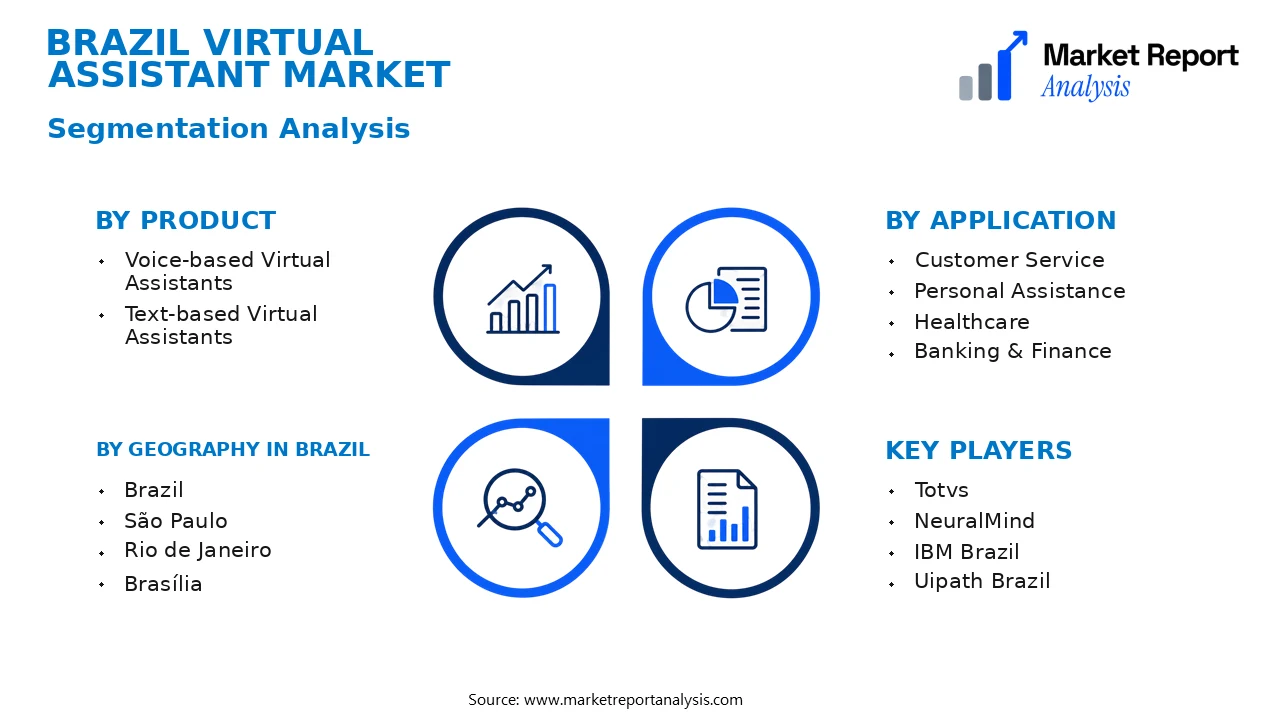
- Product
- Voice-based Virtual Assistants: These assistants utilize speech recognition to interact with users, primarily used in mobile devices, smart speakers, and customer service applications. Their demand is driven by advances in speech technology and consumer preference for hands-free interactions.
- Text-based Virtual Assistants: These assistants operate through chat interfaces for customer support, virtual chatbots, and enterprise automation. They are favored in corporate environments for handling large-scale customer inquiries efficiently.
- Application
- Customer Service: Virtual assistants serve as first-line support in banking, retail, telecom, and government services, enhancing customer engagement while reducing operational costs and response times, thus driving widespread adoption.
- Personal Assistance: Used in mobile apps and smart devices, these assistants manage schedules, reminders, and information retrieval, catering to the growing demand for productivity tools in personal and professional spheres.
- Healthcare: Implemented in telemedicine and health management apps, virtual assistants support symptom checking, appointment scheduling, and patient inquiries, reflecting rising adoption amid digital health trends.
- Banking & Finance: In financial institutions, virtual assistants facilitate transactions, inquiries, and account management, supporting secure, instant customer interaction and boosting retail banking digital transformation.
- End User Industry Vertical
- Banking and Financial Services: This sector leads in adopting virtual assistants to handle customer queries, fraud detection, and transaction processing, reflecting strong demand for secure, automated interactions.
- Retail and E-commerce: The increasing volume of online shopping and customer service needs drives virtual assistant deployment to facilitate product inquiries, order tracking, and support services.
- Telecommunications: Telecom companies integrate virtual assistants for troubleshooting, billing inquiries, and service management, enhancing customer support efficiencies in a highly competitive sector.
- Healthcare: The demand for virtual health assistants is growing in hospitals, clinics, and telehealth platforms, driven by the need for remote patient engagement and efficient healthcare delivery.
- Geography in Brazil
- Brazil: The overall market in Brazil shows increasing adoption of virtual assistants across industries, driven by digital transformation initiatives, government support, and a focus on improving customer experience.
- São Paulo: As Brazil’s financial and commercial hub, São Paulo hosts numerous technology firms, startups, and corporate headquarters, which significantly contribute to faster integration and demand for virtual assistant solutions.
- Rio de Janeiro: Known for its vibrant tourism, hospitality, and service sectors, Rio de Janeiro presents growth opportunities for virtual assistants in customer service and hospitality management.
- Brasília: As the political and administrative center, Brasília offers demand driven by government agencies and public sector digital initiatives adopting virtual assistant technology.
- Belo Horizonte: This emerging tech hub sees increasing enterprise adoption of virtual assistants, particularly in manufacturing, education, and research institutions seeking automation solutions.
- Curitiba: Known for its sustainable urban development, Curitiba’s progressive businesses and smart city projects foster the adoption of virtual assistants in public administration and local commerce.
- Porto Alegre: As a center for innovation and technology, Porto Alegre’s startups and IT companies are pivotal in developing and deploying virtual assistant solutions within the region.
- Recife: With its growing digital economy and tech ecosystem, Recife exhibits high interest in deploying virtual assistants for customer engagement and digital services.
- Salvador: The expanding tourism and services sectors in Salvador are increasingly integrating virtual assistants to enhance customer interaction and operational efficiency.
- Campinas: A significant industrial and research hub, Campinas supports virtual assistant innovation through partnerships with universities and technology companies.
- Fortaleza: The city’s focus on digital transformation and service industries unlocks opportunities for virtual assistant deployment in customer support and smart service solutions.
Competitive Intelligence
The Brazil Virtual Assistant Market exhibits moderate competition with a mix of global technology giants and local firms vying for market share. Leading players such as Google, Microsoft, and Amazon dominate in terms of market concentration, leveraging their extensive R&D capabilities and global brand recognition. Brazilian startups are increasingly adopting innovative, localized AI solutions to cater to regional languages and cultural nuances, creating differentiation. Business strategies in the market focus on forming strategic partnerships with telecom providers and e-commerce platforms to expand user bases and enhance service integration. Recent acquisitions have targeted smaller AI firms specializing in speech recognition and natural language processing, fueling technological advancements and expanding product portfolios. Expansion strategies include targeting major urban centers like São Paulo and Rio de Janeiro, where higher digital adoption rates present lucrative opportunities. Heavy R&D investments are directed toward improving contextual understanding and multilingual support, which are crucial for gaining competitive advantage. Overall, differentiation is driven by product innovation, localized content, and strategic alliances that bolster market positioning in Brazil’s diverse urban landscape.
Leading Company Profiles
The Brazil Virtual Assistant Market features a dynamic mix of established technology leaders, innovative startups, and regional players all vying for market share through diverse product offerings and strategic initiatives.
- Totvs
- NeuralMind
- IBM Brazil
- Uipath Brazil
- Microsoft Brazil
- Google Brazil
- Inbot
- Take Blip
- Dextra Technologies
- Cognizant Brazil
Totvs
Totvs specializes in enterprise software solutions, including AI-powered virtual assistants tailored to the Brazilian business landscape, with a competitive focus on automation and customer engagement services for various industries.
NeuralMind
NeuralMind leverages deep learning and NLP to develop advanced virtual assistants, emphasizing linguistic and contextual understanding to improve analytics, customer support, and automation capabilities for enterprise clients across sectors.
IBM Brazil
IBM Brazil integrates its Watson AI platform to deliver sophisticated virtual assistant solutions that focus on enhancing customer experience, data insights, and business process automation, backed by robust cloud infrastructure and AI research.
Uipath Brazil
Uipath Brazil offers robotic process automation coupled with AI-driven virtual assistants, aiming to streamline repetitive tasks and improve process efficiencies in banking, telecom, and public services sectors.
Microsoft Brazil
Microsoft Brazil provides comprehensive conversational AI solutions using Azure Bot Service, focusing on enterprise adoption, integration with existing Microsoft tools, and multilingual capabilities for diverse business needs.
Google Brazil
Google Brazil employs its Dialogflow platform to create engaging, natural-language virtual assistants that serve customer service, e-commerce, and IoT applications, emphasizing innovative AI features and multilingual support.
Inbot
Inbot designs AI chatbots and virtual assistants for enterprise use, emphasizing customizable workflows and seamless integration with communication platforms, targeting sectors like finance, healthcare, and retail.
Take Blip
Take Blip focuses on omnichannel customer engagement platforms with integrated AI chatbots, enabling Brazilian brands to automate interactions, gather analytics, and improve overall service quality in a competitive environment.
Dextra Technologies
Dextra Technologies develops AI and NLP-enabled virtual assistants with a focus on personalized interactions and multilingual capabilities, aimed at financial services, healthcare, and government sectors in Brazil.
Cognizant Brazil
Cognizant Brazil provides digital transformation consulting and AI-powered virtual assistant solutions designed to optimize customer journeys, reduce operational costs, and foster innovation in diverse industry verticals.
Strategic Business Developments
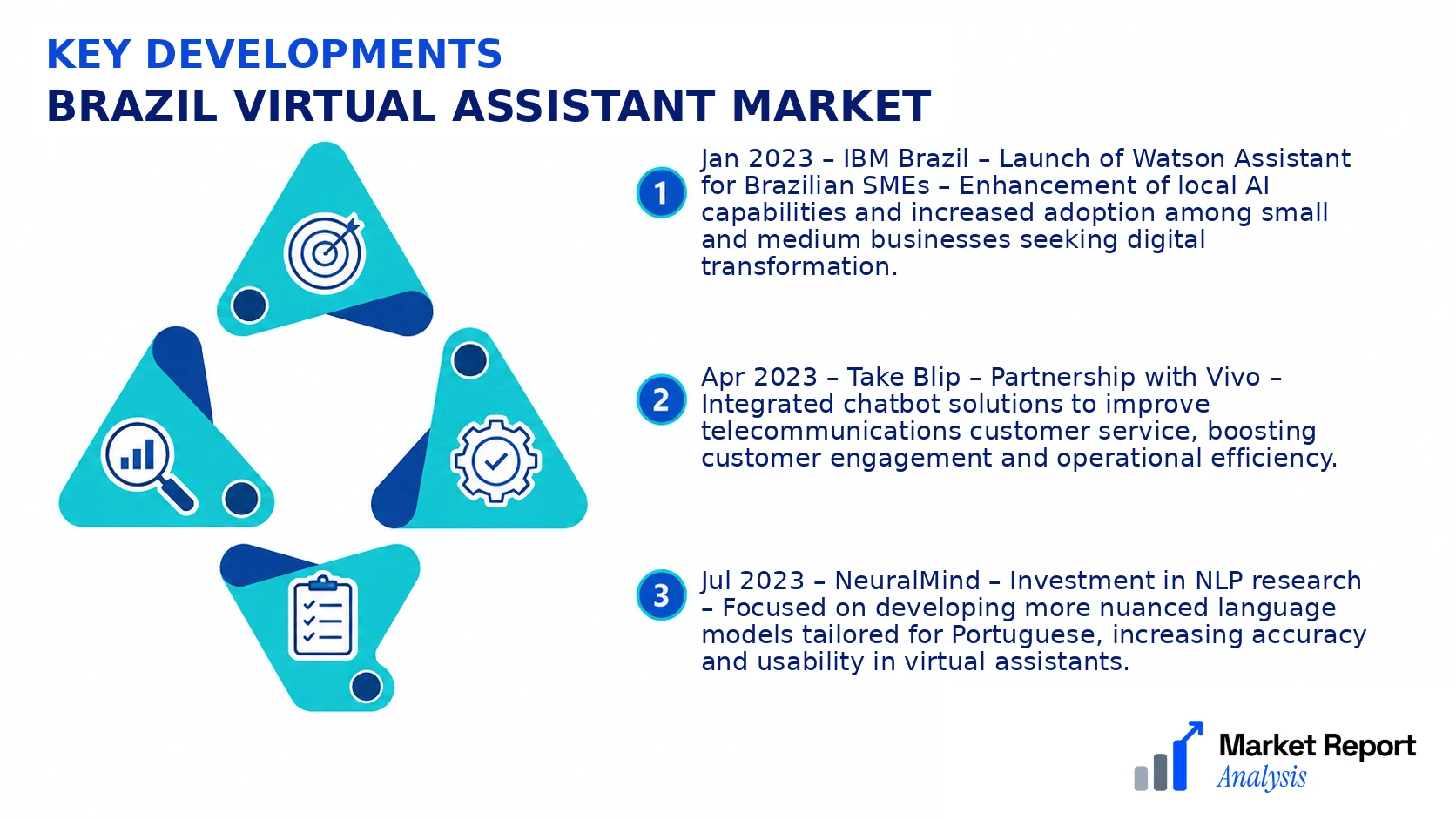
- Jan 2023 – IBM Brazil – Launch of Watson Assistant for Brazilian SMEs – Enhancement of local AI capabilities and increased adoption among small and medium businesses seeking digital transformation.
- Apr 2023 – Take Blip – Partnership with Vivo – Integrated chatbot solutions to improve telecommunications customer service, boosting customer engagement and operational efficiency.
- Jul 2023 – NeuralMind – Investment in NLP research – Focused on developing more nuanced language models tailored for Portuguese, increasing accuracy and usability in virtual assistants.
- Oct 2023 – Microsoft Brazil – Cloud integration for enterprise virtual assistants – Simplified deployment of AI solutions for local companies, fostering wider adoption and digital innovation.
- Feb 2024 – Google Brazil – Launch of multilingual Dialogflow updates – Enhanced natural language understanding for regional languages, improving support for diverse user bases across Brazil.
Frequently Asked Questions
What is the Brazil Virtual Assistant Market?
The Brazil Virtual Assistant Market encompasses the development, deployment, and adoption of AI-driven virtual assistants across various sectors such as healthcare, banking, retail, and customer service, facilitating automation, improving customer engagement, and enhancing operational efficiency within Brazil.
What is the current market size of Brazil Virtual Assistant Market?
As of 2026, the market size of the Brazil Virtual Assistant Market is valued at approximately USD 1.2 Billion, reflecting rapid growth driven by technological advancements and increased demand for automation in business processes across diverse industries.
What factors are driving the Brazil Virtual Assistant Market?
Key growth factors include rising smartphone and internet penetration, increased adoption of AI and machine learning technologies, the need for 24/7 customer support, and digital transformation initiatives by enterprises aiming for enhanced efficiency and customer satisfaction in Brazil.
Which region dominates the Brazil Virtual Assistant Market?
São Paulo leads the Brazil Virtual Assistant Market, primarily due to its status as a commercial and technological hub, with the highest concentration of enterprises integrating virtual assistants to streamline operations and improve customer service.
Which segment is expected to grow the fastest?
The healthcare segment is projected to experience the fastest growth, fueled by the need for remote patient support, efficient appointment management, and telehealth services, which are increasingly adopting virtual assistant technologies.
Who are the leading companies operating in the Brazil Virtual Assistant Market?
Leading players include global giants like Google, Microsoft, and Amazon, along with regional innovators such as Take Blip and Movile, who are expanding their AI and chatbot offerings tailored to Brazil’s digital ecosystem.
Analyst Perspective
The Brazil Virtual Assistant Market demonstrates robust long-term growth potential, driven by escalating adoption across sectors such as banking, healthcare, and retail. Technological advancements in natural language processing and artificial intelligence will enable more sophisticated, context-aware virtual assistants, fostering greater user engagement and operational efficiency. Commercial opportunities are abundant, especially in urban centers like São Paulo and Rio de Janeiro, where digital infrastructure supports rapid deployment and integration. Investment priorities should focus on enhancing speech recognition accuracy, multilingual capabilities, and industry-specific solutions to capture market share effectively. The competitive landscape is intensifying as major tech players and local startups vie for dominance, prompting continuous innovation and strategic alliances. Regional growth potential remains significant in mid-size cities where digital transformation is less mature but offers untapped opportunities. Strategic positioning for long-term success will require a focus on scalable infrastructure, regional customization, and partnership development, ensuring responsiveness to Brazil’s diverse business needs and evolving consumer preferences.
