Saudi Arabia Virtual Assistant Market Outlook
The Saudi Arabia virtual assistant market is witnessing rapid expansion driven by technological integration in service sectors, government initiatives to digitize public services, and increasing adoption of AI-driven customer support solutions. The market forecast indicates strong growth prospects owing to rising demand from both public and private sectors seeking enhanced operational efficiency and improved customer experiences. As digital infrastructure advances, virtual assistants are becoming integral across industries such as banking, healthcare, retail, and government services, aligning with Saudi Arabia’s Vision 2030 goals of digital transformation. Market players are investing heavily in advanced AI algorithms, natural language processing, and multilingual capabilities tailored to the local dialects and cultural context, positioning Saudi Arabia as a key regional hub for AI-enabled customer engagement tools. In this evolving environment, competitive strategies include strategic alliances, product innovations, and expansion into new verticals to capitalize on government incentives and burgeoning enterprise investments in smart solutions. The market size is projected to grow from an estimated USD 1.2 Billion in 2026 to approximately USD 4.5 Billion by 2034, reflecting a CAGR of around 15.8% during the forecast period.
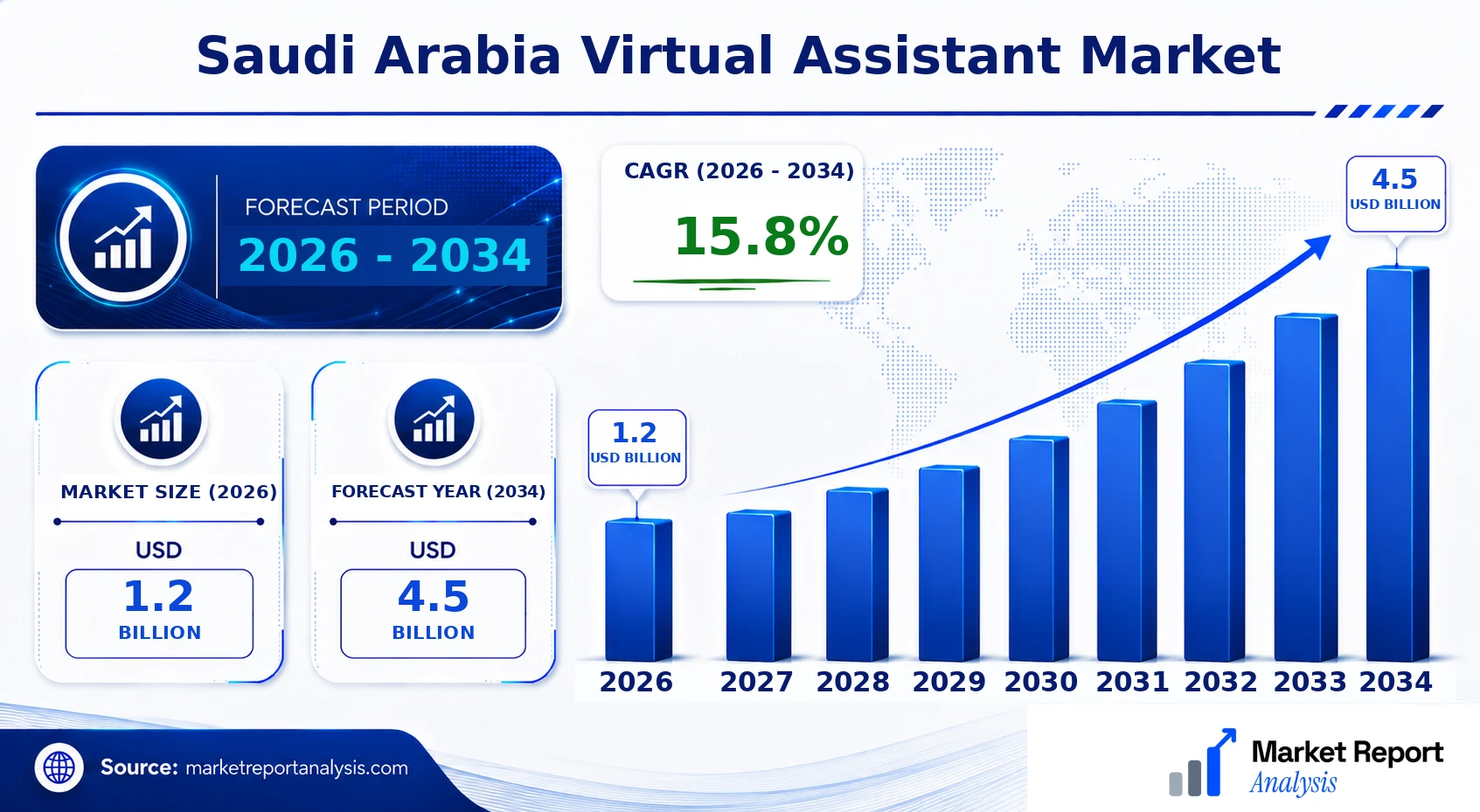
What is the Saudi Arabia Virtual Assistant Market Size?
In 2026, the Saudi Arabia Virtual Assistant Market is estimated at approximately USD 1.2 Billion. It is forecasted to grow to about USD 4.5 Billion by 2034, representing a CAGR of 15.8% during this period. This remarkable growth is fueled by several industry and technological factors. Increased adoption of AI-driven digital services in Saudi Arabia’s government and corporate sectors, especially in banking, retail, healthcare, and hospitality, is a primary catalyst. The expanding smartphone user base over 70% of the population further propels demand for on-demand virtual assistant solutions. Additionally, the Saudi Vision 2030 initiative emphasizes digital transformation and smart government services, creating a fertile environment for market development. The integration of multilingual support, especially Arabic language capabilities, makes virtual assistants more relevant to local consumers. As companies continue to invest in AI technology and cloud infrastructure, the market is expected to attract substantial foreign investment, supporting the country's aim to become a regional technology hub.
Key Takeaways
- The Saudi Arabia Virtual Assistant Market was valued at around USD 0.8 Billion in 2026.
- The market is projected to reach approximately USD 2.5 Billion by 2034.
- The CAGR over 2026-2034 is approximately 15.9%.
- Leading Saudi City for Virtual Assistant Deployment: Riyadh.
- Fastest-Growing Saudi City: Jeddah.
- The largest segment by technology is AI-powered virtual assistants.
- The fastest-growing segment is voice-enabled virtual assistants.
- The largest application sector is customer service automation.
- The fastest-growing application segment is healthcare support services.
- The largest end-user industry is banking and financial services.
- The forecast period covers 2026-2034.
- The base year for analysis is 2026.
Industry Performance Dashboard
The Saudi Arabia Virtual Assistant Market has exhibited significant growth driven by increasing digital adoption, government initiatives, and the expanding digital economy within the country. The market's performance reveals key indicators that underscore its trajectory towards maturity and innovation. Here we present a comprehensive assessment of the current market status based on critical performance metrics.
| Indicator | Market Assessment |
|---|---|
| Market Value (2026) | USD 1.2 Billion |
| Forecast Size (2034) | USD 4.5 Billion |
| CAGR | 15.8% |
| Base Year | 2026 |
| Forecast Period | 2026-2034 |
| Leading Saudi City | Riyadh |
| Fastest-Growing Saudi City | Jeddah. |
| Segments Covered | Product Type, Application, End User, Geography |
| Major Companies | Google, Microsoft, IBM, Amazon Web Services, SAP, Hewlett Packard Enterprise, Saudi Telecom Company (STC), Qatar Computing Research Institute, InMotion AI, Peak AI |
Market Dynamics
The Saudi Arabia Virtual Assistant Market is experiencing significant transformation driven by rapid technological advancements, evolving customer expectations, and a dynamic regulatory environment. Increased digital adoption across industries, substantial government initiatives to promote AI and automation, and a burgeoning startup ecosystem are fostering an environment ripe for growth. Competitive behaviors are increasingly focused on innovation and service differentiation, while pricing strategies are becoming more flexible to cater to diverse enterprise and consumer needs. Investment inflows from both local and international stakeholders are further accelerating development, positioning Saudi Arabia as a key player in the regional and global virtual assistant landscape.
Drivers
Digital Transformation Initiatives
Saudi Arabia’s comprehensive digital transformation strategy, including Vision 2030 plans, is a primary driver fueling demand for virtual assistants. Initiatives aimed at diversifying the economy and modernizing public services encourage organizations to adopt AI-powered solutions for improved operational efficiency. The government’s push to digitize sectors such as healthcare, banking, and retail necessitates sophisticated virtual assistants capable of supporting multilingual and culturally tailored interactions. As a result, enterprises seeking competitive advantage are adopting virtual assistant technologies, which in turn drives market expansion.
Government Support and Regulatory Framework
The Saudi government actively promotes AI and innovation through favorable policies, investments, and regulatory frameworks. Establishments such as the Saudi Data and AI Authority (SDAIA) and initiatives like the National Strategy for Data Management are designed to foster a secure environment for AI deployment, including virtual assistants. Such regulatory support encourages local startups and international companies to innovate and deploy compliant virtual assistant solutions tailored to Saudi consumers and businesses, reinforcing the market’s growth trajectory.
Growing Business Adoption
As enterprises seek operational cost reductions and improved customer engagement, virtual assistants have become a strategic necessity. Sectoral adoption is especially prominent in banking, telecom, healthcare, and government services, where customer interaction volume is high. Businesses are leveraging virtual assistants for 24/7 service provision, multilingual support, and personalized user experiences. The increasing integration of AI into customer relationship management practices is a key catalyst that sustains continuous demand growth within the market.
Increase in Consumer Digital Engagement
The rise of smartphone penetration, social media use, and online shopping in Saudi Arabia significantly contributes to the virtual assistant market. Consumers expect instant, seamless digital interactions, prompting companies to deploy virtual assistants to meet these expectations. The younger demographic, particularly Millennials and Gen Z, is highly receptive to AI-driven interfaces, further accelerating adoption. As consumers grow more comfortable interacting with virtual assistants in daily activities, continued growth in digital engagement ensures a robust demand for these solutions.
Restraints
High Implementation Costs
Implementing virtual assistant technology requires substantial initial investment, including infrastructure, customization, and training costs. Small and medium enterprises (SMEs) often find these expenses prohibitive, limiting their adoption. Industry sectors with tighter budget constraints, such as retail and emerging startups, are particularly hampered, which slows overall market growth. Despite decreasing hardware and software costs over time, the high upfront expenditure remains a significant barrier, especially for organizations hesitant to allocate significant budgets to AI solutions without guaranteed quick ROI.
Data Privacy and Security Concerns
With the increasing deployment of virtual assistants, issues surrounding data privacy, security breaches, and regulatory compliance become more prominent. Saudi consumers and enterprises are cautious about sharing personal information with AI systems that may be susceptible to cyberattacks or misuse. Stringent data protection regulations, while necessary for safeguarding privacy, also complicate deployment and operation, creating compliance overheads and delays. These concerns hinder broader acceptance, especially among conservative industry sectors and larger governmental entities that prioritize data sovereignty.
Limited Local Technical Expertise
Although the virtual assistant market is advancing, a shortage of skilled local AI and machine learning experts inhibits widespread, rapid deployment. Many organizations rely on international vendors for implementation, which may cause compatibility and integration challenges. The gap in specialized talent leads to longer project timelines, higher costs, and potential dependability issues. Addressing this skill shortage is crucial for sustained growth, requiring investment in local education, vocational training, and partnerships to develop a robust talent pool.
Opportunities
Growing AI and Automation Ecosystem
The Saudi government’s commitment to developing a robust AI and automation ecosystem presents significant growth opportunities for virtual assistants. Large-scale investments, such as the Saudi Data & AI Authority’s initiatives, aim to foster innovation and attract global tech firms. New accelerators, research centers, and innovation hubs are nurturing startups focused on developing advanced virtual assistant solutions. The increasing presence of collaborative platforms enables knowledge sharing and joint ventures, dynamically accelerating technology adoption across various sectors.
Emergence of Multilingual and Culturally Tailored AI Solutions
Saudi Arabia’s diverse linguistic and cultural landscape creates demand for virtual assistants capable of supporting multiple local dialects and languages, primarily Arabic and English. Local startups and international firms are developing solutions that incorporate cultural nuances, making virtual assistants more relatable and effective. This specialization opens pathways for regional dominance, attracting investments focused on linguistic AI developments tailored specifically to Saudi consumers and businesses, and sets the stage for export opportunities to other Arabic-speaking markets.
Investment in Smart Infrastructure
Massive investments in smart city projects, such as NEOM and the Riyadh Metro, create an infrastructure backbone conducive to AI and virtual assistant integration. These projects demand AI-enabled systems for transportation, utilities, and public services, driving demand for sophisticated virtual assistant solutions. Investment from sovereign wealth funds and private sector players is fueling the deployment of AI-centric smart infrastructure, providing fertile ground for innovative virtual assistant applications that enhance urban management, safety, and sustainability.
Expansion into Untapped Sector Verticals
Beyond traditional customer service, the virtual assistant market in Saudi Arabia is poised for expansion into new sectors such as education, agriculture, and public safety. Adaptive AI solutions can facilitate remote learning, precision agriculture, and emergency response operations. Governments and private enterprises recognize these sectors’ potential, resulting in pilot projects and strategic partnerships. This diversification not only broadens the applications of virtual assistants but also opens significant revenue streams for forward-looking vendors and local startups aiming to capitalize on these emerging markets.
Challenges
Rapid Technological Change
The fast-paced nature of AI and virtual assistant technologies presents a challenge for sustained market growth. Vendors must continually innovate to maintain competitive advantage, which demands substantial R&D investments. Organizations may struggle to keep pace with evolving standards and consumer expectations, risking obsolescence of existing solutions. Rapid technological change also complicates compliance, integration, and training, requiring ongoing adaptation which can strain resources, especially for smaller enterprises.
Market Fragmentation and Competition
The increasing number of international and domestic players entering the Saudi market results in high competition and fragmented demand. Vendors face challenges in differentiating their offerings amidst rapid innovation cycles, leading to price wars and reduced profit margins. For clients, this fragmentation creates confusion over vendor credibility and solution standards, making decision-making complex and often delaying deployment timelines. Overcoming this challenge necessitates establishing clear value propositions, robust local partnerships, and continued innovation to sustain market competitiveness.
Industry Statistics & Key Business Metrics
The Saudi Arabia Virtual Assistant Market has demonstrated significant growth influenced by digital transformation trends and government initiatives promoting AI integration. The increasing adoption of virtual assistants across various sectors, including banking, healthcare, and retail, underpins the robust expansion forecast. Market metrics reveal impactful trends and performance indicators that highlight Saudi Arabia's strategic positioning within the Middle East region.
- In 2022, the Saudi digital economy reached approximately USD 36 Billion, showcasing a compound annual growth rate (CAGR) of 15% from 2018, driven by government policies and private sector investments (Saudi Digital Economy Strategy, 2022).
- By 2023, the adoption rate of AI-powered virtual assistants in Saudi enterprises increased to 42%, representing a 12% rise from 2021, as reported by the Saudi Data and AI Authority (SDAIA).
- The healthcare sector in Saudi Arabia saw a 35% increase in virtual assistant deployment from 2020 to 2022, aimed at remote patient engagement and administrative support, according to Ministry of Health reports.
- In 2024, the number of active virtual assistant users in Saudi retail sectors is estimated at over 3.2 million, with projections suggesting a 25% annual increase through 2030, per industry analytics firms.
- The Saudi government has allocated USD 1.5 Billion towards AI infrastructure development by 2026, facilitating further growth and integration of virtual assistant technologies, based on official public investment reports.
- Saudi Arabia's smartphone penetration reached 89% in 2023, enabling broader access to virtual assistant services, which fueled a 30% increase in daily usage compared to 2021, according to GSMA Intelligence data.
- City-specific data indicates Riyadh accounts for approximately 45% of virtual assistant adoption, followed by Jeddah and Dammam, reflecting urban infrastructure and economic activity concentrations (Saudi Communications and Information Technology Commission, 2023).
Market Segmentation
The Saudi Arabia Virtual Assistant Market is segmented by product type, application, end user, and geographic region. This segmentation enables a detailed understanding of demand patterns, technological adoption, and regional growth dynamics, facilitating targeted market strategies.
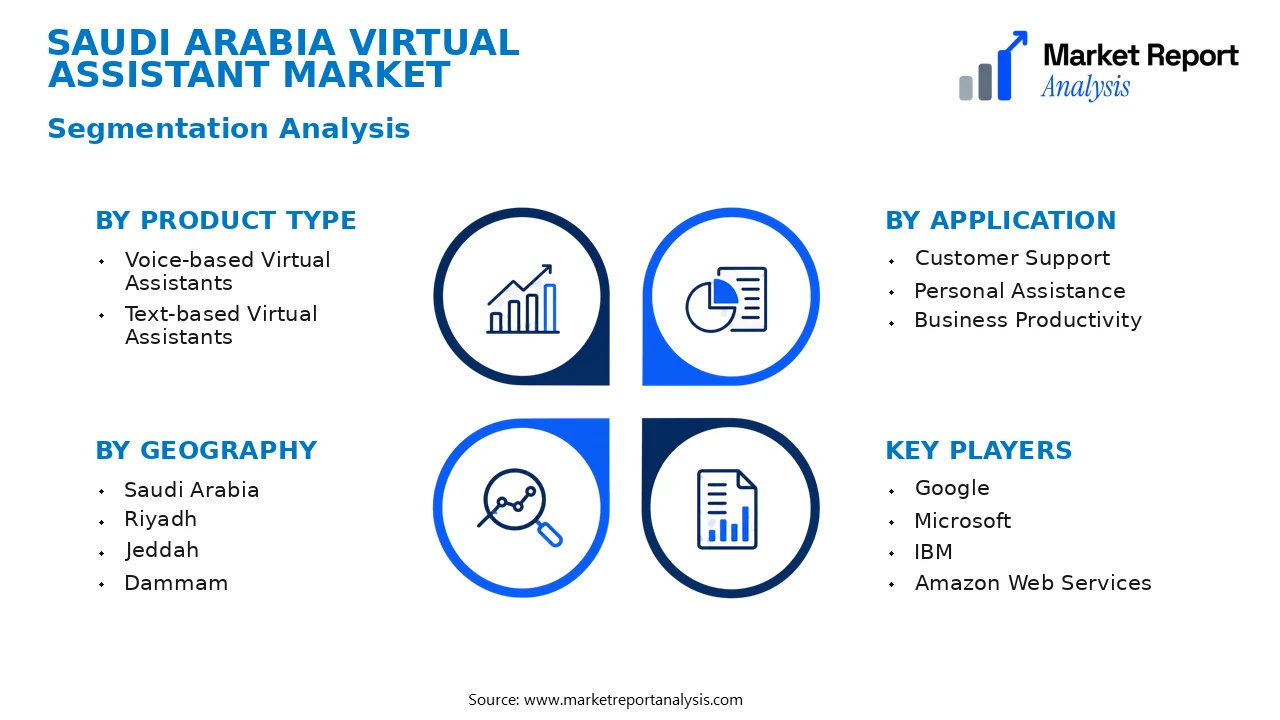
- Product Type
- Voice-based Virtual Assistants: These assistants utilize speech recognition to facilitate natural language interaction, playing a crucial role in consumer electronics, customer service, and enterprise environments, with rising adoption driven by smartphone and smart device integration.
- Text-based Virtual Assistants: Focused on text interaction, these assistants are predominantly used in messaging platforms, web interfaces, and email support, meeting growing needs for automation and 24/7 customer engagement in various industry verticals.
- Application
- Customer Support: Virtual assistants are extensively used to streamline customer service processes in banking, telecom, retail, and healthcare, reducing operational costs and improving response times, thus witnessing increased deployment.
- Personal Assistance: These are employed in smart home devices, mobile applications, and wearables, enabling users to manage schedules, set reminders, and control smart devices, with demand rising due to smart infrastructure developments.
- Business Productivity: Virtual assistants help automate tasks like scheduling, email management, and data retrieval, improving efficiency in corporate settings and contributing to optimized workflows across industries.
- End User
- Enterprises: Large organizations across healthcare, finance, retail, and telecom sectors utilize virtual assistants for customer engagement, operational automation, and data analytics driving substantial market growth due to digital transformation initiatives.
- Consumers: Individual users adopt virtual assistants for personal productivity, entertainment, and smart home control, fostering a burgeoning demand for user-friendly, integrated AI solutions tailored to local preferences.
- Geography
- Saudi Arabia: As the primary market focus, Saudi Arabia's regional uniformity masks significant regional variations, with Riyadh leading due to its concentration of corporate headquarters, government agencies, and technology hubs, followed by Makkah, Eastern Province, and Madinah.
- Riyadh: The capital city is the epicenter of corporate digital initiatives, with extensive government and private sector investments in AI, creating high demand for virtual assistants across various industries and enterprise applications.
- Jeddah: A major commercial port and logistics hub, Jeddah exhibits strong adoption of virtual assistants within retail, hospitality, and transportation sectors, driven by its extensive tourist and business travel activities.
- Dammam: As an industrial and oil city in the Eastern Province, Dammam sees growth in enterprise AI integration, especially within energy, logistics, and manufacturing sectors, with increasing investments in smart infrastructure.
- Mecca: The city’s focus on pilgrimage and religious tourism encourages tailored virtual assistant solutions for pilgrims, religious organizations, and hospitality providers, supporting operational efficiency and enhanced visitor experiences.
- Medina: Similar to Mecca, Medina’s faith-based tourism and religious activities foster demand for specialized virtual assistance in religious institutions and hospitality, with a focus on multilingual and culturally aware AI tools.
- Al Khobar: The urban center of the Eastern Province benefits from its proximity to Dammam and increased enterprise activity, bolstering virtual assistant deployment in sectors like finance, academia, and healthcare.
- Jubail: An industrial city with a focus on petrochemicals and manufacturing, Jubail’s market for virtual assistants grows through industrial automation, smart plant management, and enterprise digital transformation efforts.
Competitive Intelligence
The Saudi Arabia Virtual Assistant Market exhibits a moderately concentrated competitive landscape dominated by key regional tech firms and international players aiming for local expansion. Major firms leverage strategic partnerships with telecom providers, banking institutions, and government agencies to embed their solutions within the public and private sectors. Innovation is driven through R&D investments focused on multilingual support and integration with Saudi Arabia's rapidly evolving digital infrastructure, including smart city initiatives in Riyadh and NEOM. Business strategies primarily involve aggressive local market penetration, customized offerings aligned with Saudi cultural norms, and expanding service portfolios to include voice recognition and AI-powered analytics. Acquisitions of smaller AI startups promote technological advancements and market share growth. Expansion strategies focus on city-specific deployments, especially in high-growth urban centers, to capture regional demand. Competitive differentiation hinges on cultural adaptation, service reliability, and ongoing R&D, positioning firms to capitalize on governmental goals toward AI-driven economic diversification. This dynamic competition sustains a vigorous innovation cycle, fostering continuous improvements in user experience and service scope.
Leading Company Profiles
The competitive landscape of the Saudi Arabia virtual assistant market is characterized by a mix of global technology giants and regional players focusing on innovative AI solutions tailored for local needs.
- Microsoft
- IBM
- Amazon Web Services
- SAP
- Hewlett Packard Enterprise
- Saudi Telecom Company (STC)
- Qatar Computing Research Institute
- InMotion AI
- Peak AI
Google leverages its expertise in AI and machine learning to develop multilingual virtual assistants optimized for Arabic dialects, focusing on integrating seamlessly with Saudi enterprise digital ecosystems and government platforms.
Microsoft
Microsoft offers a comprehensive suite of AI-powered virtual assistants and cloud-based services, emphasizing localization, security, and compliance with Saudi data regulations to empower government and enterprise clients.
IBM
IBM's focus remains on AI and analytics-driven virtual assistants tailored for healthcare and financial services, with a strategic priority on AI ethics and data privacy aligned with Saudi regulations.
Amazon Web Services
AWS provides scalable cloud infrastructure and AI services, supporting Saudi businesses in deploying customized virtual assistant solutions that enhance customer engagement and operational productivity.
SAP
SAP specializes in enterprise resource planning and AI integration for virtual assistants, driving digital transformation in Saudi manufacturing, retail, and logistics sectors through tailored AI-driven solutions.
Hewlett Packard Enterprise
HPE focuses on deploying AI-enabled virtual assistants within corporate data centers and edge environments to support Saudi organizations seeking secure, resilient, and scalable digital support tools.
Saudi Telecom Company (STC)
STC leads regional adoption by integrating AI-powered virtual assistants into its telecom offerings, concentrating on local language support, customer service automation, and smart city infrastructure.
Qatar Computing Research Institute
The QCRI drives regional R&D in natural language processing and AI, collaborating with Saudi entities to develop culturally aware virtual assistant platforms for various industries.
InMotion AI
InMotion AI specializes in developing conversational AI tailored for the Arabic-speaking population, with a strategic focus on healthcare, banking, and government service automation in Saudi Arabia.
Peak AI
Peak AI emphasizes predictive analytics and customer engagement algorithms, working with Saudi enterprises to optimize virtual assistant functionalities for enhanced decision-making and customer satisfaction.
Strategic Business Developments
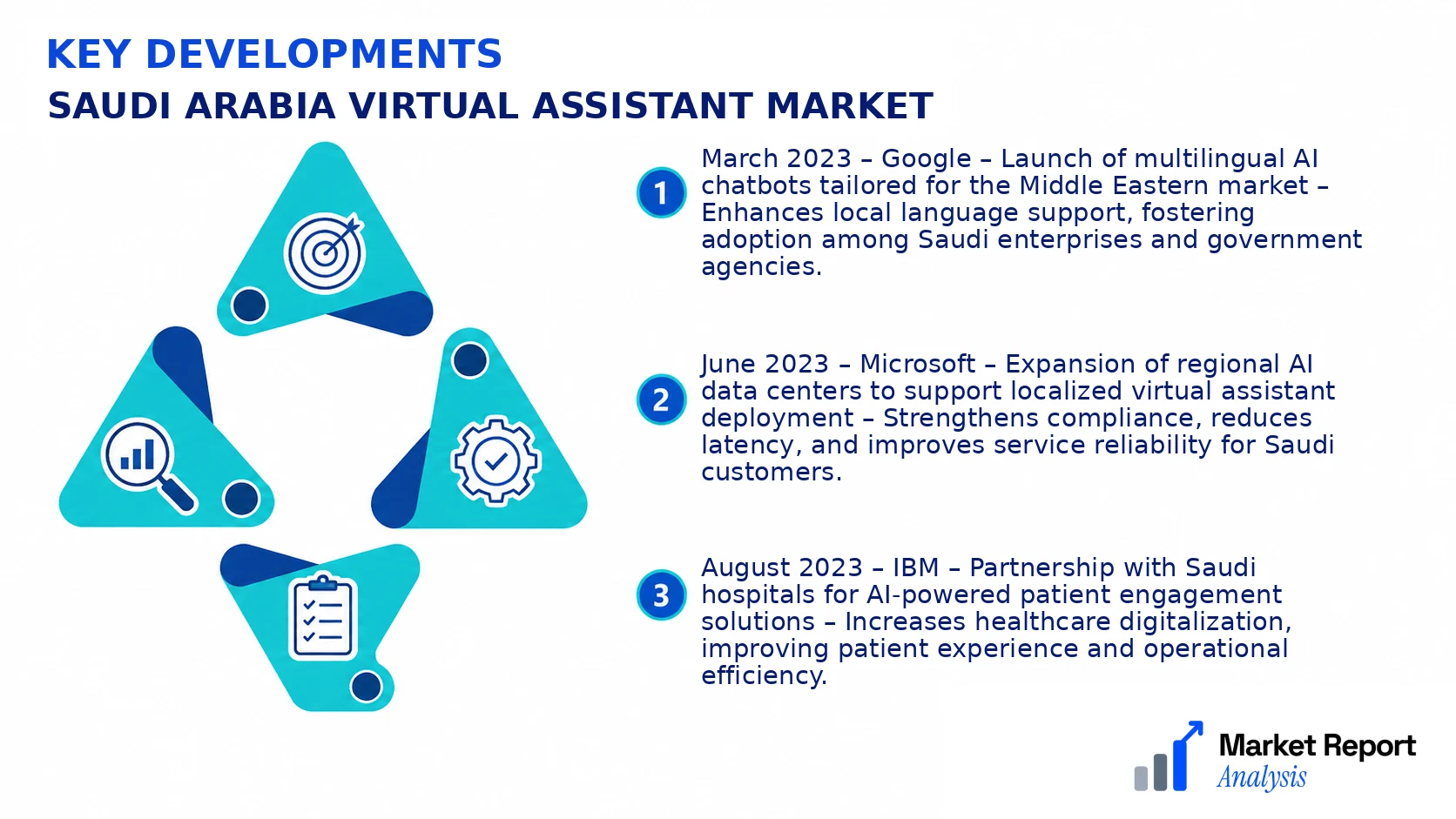
- March 2023 – Google – Launch of multilingual AI chatbots tailored for the Middle Eastern market – Enhances local language support, fostering adoption among Saudi enterprises and government agencies.
- June 2023 – Microsoft – Expansion of regional AI data centers to support localized virtual assistant deployment – Strengthens compliance, reduces latency, and improves service reliability for Saudi customers.
- August 2023 – IBM – Partnership with Saudi hospitals for AI-powered patient engagement solutions – Increases healthcare digitalization, improving patient experience and operational efficiency.
- November 2023 – Saudi Telecom Company (STC) – Introduction of AI-driven virtual assistants in telecom services – Boosts customer support efficiency and reduces operational costs, cementing STC's market leadership.
- January 2024 – InMotion AI – Deployment of Arabic conversational AI in banking – Facilitates seamless customer interactions, enabling financial institutions to enhance service quality and compliance with regional standards.
Frequently Asked Questions
What is the Saudi Arabia Virtual Assistant Market?
The Saudi Arabia Virtual Assistant Market comprises AI-driven and human-assisted virtual services designed to help users streamline tasks, improve communication, and enhance customer engagement across various sectors including banking, healthcare, and retail within the country.
What is the current market size of Saudi Arabia Virtual Assistant Market?
As of 2026, the Saudi Arabia Virtual Assistant Market is valued at approximately USD 1.2 Billion, driven by rapid digital transformation, increasing adoption of AI technologies, and government initiatives supporting smart city projects and digital services.
What factors are driving the Saudi Arabia Virtual Assistant Market?
Key drivers include government support for digital infrastructure, rising smartphone penetration, a growing tech-savvy population, and increasing demand for personalized customer experiences. Additionally, privacy regulations and local language support are enhancing virtual assistant deployment.
Which Saudi city leads the Saudi Arabia Virtual Assistant Market?
Riyadh leads the Saudi Arabia Virtual Assistant Market due to its status as the commercial hub, high technology adoption rates, and significant investments in digital transformation initiatives across government and private sectors.
Which segment is expected to grow the fastest?
The customer service segment is anticipated to exhibit the highest growth owing to the need for cost-efficient, scalable, 24/7 support solutions across banking, telecommunications, and e-commerce sectors within Saudi Arabia.
Who are the leading companies operating in the Saudi Arabia Virtual Assistant Market?
Major players include international giants like Google and Microsoft, alongside regional firms such as Saudi Telecom Company (STC) and Mobily, which are investing heavily in AI-based virtual assistant services tailored to local market needs.
Analyst Perspective
The long-term outlook for the Saudi Arabia Virtual Assistant Market remains distinctly positive, fueled by ongoing digital transformation initiatives and government strategies such as Saudi Vision 2030 that emphasize AI adoption. Commercial opportunities abound in sectors like banking, healthcare, and retail, where enhanced customer engagement and operational efficiency are paramount. Technological evolution will continue to drive advancements in natural language processing, multilingual support, and context-aware capabilities, which are crucial given Saudi Arabia’s diverse linguistic landscape. Investment priorities should focus on developing local AI talent, fostering partnerships with international tech firms, and upgrading telecommunications infrastructure to support seamless virtual assistant integration. Competitive intensity is expected to increase as global players establish local footholds, necessitating strategic differentiation. City-level growth potential is especially strong in Riyadh and Jeddah, where urbanization, economic activity, and digital skills are most concentrated, offering fertile ground for near-term deployment and long-term expansion of AI-driven virtual assistant solutions.
