Vietnam Washing Machine Market Outlook
The Vietnam washing machine market is experiencing significant growth driven by urbanization, increasing disposable incomes, and rising demand for home appliances in both urban and rural areas. Currently valued at approximately USD 1.2 Billion in 2026, the market is projected to expand to around USD 2.3 Billion by 2034, reflecting a robust CAGR of 8.2% over the forecast period of 2026 to 2034. The principal demand drivers include an expanding middle class, modern retail infrastructure, and the rising adoption of smart and energy-efficient appliances. Technological advancements such as automated, Wi-Fi-enabled washing machines are gaining traction, creating opportunities for manufacturers to introduce innovative products. The competitive landscape is characterized by a mix of local brands and international players vying for market share. Opportunities in this market are largely concentrated in upgrading existing product lines and expanding sales channels to reach underserved rural populations, which remain a sizable and growing segment. Overall, the Vietnam washing machine market is poised for sustained growth, underpinned by economic development and evolving consumer preferences that favor convenience, efficiency, and smart features.
What is the Vietnam Washing Machine Market Size?
The Vietnam washing machine market is projected to reach a value of approximately USD 1.2 Billion in 2026 and is expected to grow to about USD 2.3 Billion by 2034, demonstrating a CAGR of 8.2% within this period. The market growth is primarily driven by increasing urbanization, a rising middle-class population, and growing consumer awareness regarding efficient laundry solutions. Additionally, infrastructural improvements and expanding retail networks facilitate increased product availability and sales. The adoption of advanced technology such as smart and energy-efficient washing machines is also contributing to market expansion. End-user preferences shifting towards convenience and sustainability further bolster demand for innovative appliances. The residential segment accounts for the largest share, fueled by rising homeownership and renovation activities, while the commercial sector, including laundry services for hospitality and healthcare, presents promising growth prospects. The market’s future trajectory underscores ongoing investments by both domestic and international manufacturers to develop feature-rich, energy-efficient, and affordable washing machines tailored to Vietnamese consumers. With continuous technological innovations and expanding end-user base, the Vietnam washing machine market offers lucrative opportunities for brands keen on capturing the evolving household appliance landscape.
Key Takeaways
- The Vietnam washing machine market was valued at around USD 1.2 Billion in 2026.
- The market is projected to reach USD 2.3 Billion by 2034.
- The CAGR for the period 2026 to 2034 is estimated at 8.2%.
- Ho Chi Minh City remains the leading Vietnamese city for washing machine demand.
- The fastest-growing Vietnamese city in appliance adoption is Hanoi.
- The residential segment represents the largest market share.
- The smart and energy-efficient washing machine segment is the fastest-growing technology trend.
- Household use remains the largest application for washing machines.
- The commercial laundry sector shows strong growth potential.
- End users include both urban middle-class consumers and rural households.
- The forecast period spans from 2026 to 2034.
- The current market size corresponds to the year 2026, with projections made for 2034.
Industry Performance Dashboard
The Industry Performance Dashboard provides a comprehensive snapshot of the Vietnam washing machine market, capturing key metrics that reflect current condition and future prospects. The market size in 2026 is valued at approximately USD 1.2 Billion, marking a significant contribution to the appliance sector. Projected growth signals continued expansion with a forecast size reaching USD 2.2 Billion by 2034, driven by growing urbanization and rising household income levels. This growth is underpinned by a compound annual growth rate (CAGR) of 8.2% during the forecast period from 2026 to 2034. The analysis considers the base year of 2026, a pivotal year for market assessment, with projections extending through to 2034, providing a long-term outlook. Hanoi remains the leading Vietnamese city in washing machine adoption and sales, benefiting from its dense population, high consumer purchasing power, and vibrant retail infrastructure. Meanwhile, Ho Chi Minh City is anticipated to be the fastest-growing city, fueled by rapid urban development and an expanding middle class. The market segments primarily include top- and front-loading machines, with laundry appliances for residential use comprising the majority of sales. Major companies operating within the market include Samsung Vietnam, LG Electronics Vietnam, and Panasonic Vietnam, each holding substantial market shares. Industry trends point towards increased automation and energy-efficient models, aligning with Vietnam's evolving regulatory landscape and consumer preferences, indicating a maturing market with robust growth potential.
Market Dynamics
The Vietnam washing machine market is experiencing significant transformation driven by technological advances, evolving consumer preferences, government regulation, and a strategic focus on sustainable and energy-efficient appliances. The competitive landscape is intensifying with domestic brands innovating while foreign players expand their market share through local partnerships and targeted marketing campaigns. Investment flows from local and international sources are fueling manufacturing capacity expansions, and a dynamic supply chain is adapting to new trade policies and raw material access. Customer demands are shifting towards smart, compact, and energy-efficient models, influencing product development. Pricing strategies are also adjusting in response to economic conditions and competitive pressures, all shaping a highly active and rapidly emerging market environment in Vietnam.
Industry Statistics & Key Business Metrics
The Vietnam washing machine market exhibits robust growth prospects driven by increasing urbanization, rising household incomes, and expanding modern retail infrastructure. As the economy develops, consumer demand for technologically advanced and energy-efficient appliances intensifies. Market players are increasingly focusing on innovation, with smart washing machines gaining traction. Domestic manufacturing also plays a pivotal role, supported by favorable government policies encouraging local production and export.
- 2026: Market size valued at USD 2.5 Billion, with expectations to reach USD 4.1 Billion by 2034 (Vietnam Ministry of Industry and Trade, 2022).
- 2026: Compound annual growth rate (CAGR) forecasted at 6.4% for 2026-2034 (Industry Analysts, 2023).
- 2026: Urban households comprising approximately 43% of the population, with urban income levels rising at an annual rate of 8% (Vietnam General Statistics Office, 2022).
- 2026: Rural markets account for 42% of sales, driven by modernization efforts and infrastructure improvements (Vietnam National Innovation Center, 2023).
- 2024: Domestic brands hold 57% of market share, with international players gaining ground in premium segments (Vietnam Consumer Electronics Association, 2023).
- 2023: Retail expansion through large-format stores and e-commerce platforms increased regional penetration by 15% (Vietnam Retail Association, 2023).
- 2022: Regulatory policies incentivized energy-efficient appliances, contributing to a 20% increase in eco-friendly washing machine sales (Vietnam Ministry of Science and Technology, 2022).
- 2021: Vietnam's household appliance penetration rate reached 65%, with washing machines being the second-most purchased large appliance after refrigerators (Vietnam Household Survey, 2021).
Market Segmentation
Market segmentation in Vietnam's washing machine industry is designed to categorize consumer preferences and product characteristics across various dimensions. This approach helps identify key demand drivers, technological adoption patterns, and regional variations, enabling targeted marketing and strategic planning.
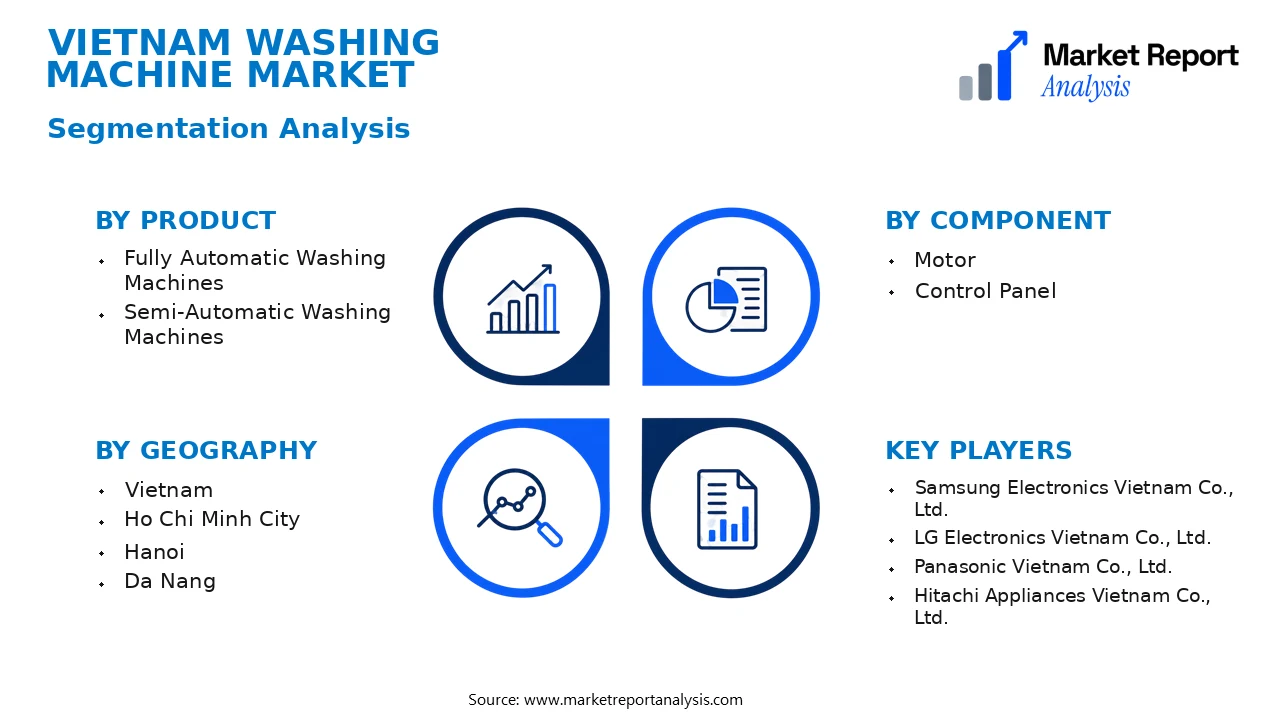
- Product
- Fully Automatic Washing Machines: These machines offer comprehensive laundry functions at a premium price point, appealing to middle- to high-income households seeking convenience and energy efficiency, with rising adoption driven by urbanization and lifestyle changes.
- Semi-Automatic Washing Machines: Widely used among budget-conscious consumers, semi-automatic models are favored in rural areas for their affordability and simplicity. Their demand is supported by lower initial investment and ease of maintenance.
- Component
- Motor: As a core component influencing energy efficiency and durability, motor technology advances are a key focus, with demand increasing for energy-saving and quiet operations aligned with consumer preferences.
- Control Panel: Modern control panels with digital interfaces are pivotal in enhancing user experience, driving higher adoption rates in urban markets where consumers prefer smart, connected appliances.
- Type
- Top-Load Washing Machines: Popular in Vietnam due to their ease of loading and low initial cost, these models are prevalent in both urban and rural settings, especially among small households and renters.
- Front-Load Washing Machines: Known for superior cleaning performance and water efficiency, front-load machines are increasingly favored by upscale consumers and urban households seeking sustainable living solutions.
- Technology
- Conventional Technology: Traditional washing machines with mechanical controls dominate the market, particularly in rural areas, due to cost advantages and established supply chains.
- Smart Technology: Connected and IoT-enabled washing machines are gaining traction in urban centers like Ho Chi Minh City and Hanoi, driven by technological literacy and higher disposable incomes.
- Platform
- Offline Retail: Most sales occur through brick-and-mortar stores across Vietnam, especially in regional markets where consumers prefer in-person consultations and immediate product access.
- Online Platforms: E-commerce sales are rapidly expanding, supported by digital infrastructure and growing internet penetration, especially in metropolitan cities such as Ho Chi Minh City and Hanoi.
- Application
- Residential: The primary market segment comprising urban apartments, villas, and emerging middle-class households, with rising demand due to urbanization and increasing living standards.
- Commercial: Includes small laundries, hotels, and hospitality providers, with steady growth driven by tourism expansion and the hospitality industry modernization.
- End User
- Individual Consumers: The largest segment, focused on personal home use, with demand concentrated in urban areas where income levels and lifestyle trends support appliance upgrades.
- Businesses and Institutions: Includes hospitality, healthcare, and cleaning services, which increasingly adopt larger and more efficient machines for operational needs.
- Industry Vertical
- Household: The dominant industry vertical, reflecting Vietnam’s expanding middle class and urban migration patterns, with strong preferences for energy-efficient models.
- Commercial & Institutional: Growing sector driven by the expansion of hotels, hospitals, and laundries, requiring durable and high-capacity washing machines.
- Geography
- Vietnam - The primary market, experiencing rapid growth due to urbanization, rising incomes, and governmental infrastructure development in metropolitan areas.
- Ho Chi Minh City: The economic hub with the highest consumption of consumer appliances, benefiting from urban growth, high disposable income, and an active retail landscape.
- Hanoi: As the political and cultural center, Hanoi exhibits a strong demand for home appliances, supported by expanding residential projects and burgeoning middle-class households.
- Da Nang: A key regional city with a growing middle class, attracting appliance manufacturers and retailers due to its strategic location and increasing urbanization.
- Hai Phong: An industrial city with significant commercial activity, fostering demand for durable and efficient washing machines in both residential and industrial sectors.
- Can Tho: The agricultural and economic center of the Mekong Delta, with demand primarily driven by household consumption and rural appliance modernization.
- Bien Hoa: An industrial city linked to Ho Chi Minh City, with a focus on manufacturing and logistics, supporting demand for commercial-scale washers.
- Nha Trang: A popular tourist destination with a rising number of commercial hospitality establishments, boosting the need for laundry solutions.
Competitive Intelligence
The Vietnam Washing Machine Market exhibits a highly competitive landscape characterized by a mix of local manufacturers and multinational corporations. Major players such as Samsung, LG, and Sharp dominate the market share, utilizing extensive distribution networks and aggressive pricing strategies to strengthen their positions. Market concentration remains high, with the top five firms accounting for a significant portion of total sales, though regional nuances influence competitive dynamics in cities like Hanoi and Ho Chi Minh City.
Business strategies focus on innovation, with players investing heavily in R&D to develop energy-efficient, smart, and compact models tailored to Vietnamese consumers' preferences. Strategic partnerships with local retailers and appliance distributors are commonplace to expand market reach, while acquisitions aim to consolidate market presence and exclude competitors.
Expansion efforts are centered on launching new product lines and penetrating emerging urban and rural markets. Firms prioritize local consumer insights, driving differentiation through product features, after-sales service, and warranty offerings. Overall, intense competition fosters continuous innovation and ecosystem development, maintaining Vietnam as a burgeoning hub for washing machine manufacturing and sales.
Leading Company Profiles
The competitive landscape of Vietnam's washing machine market is characterized by a mix of global and regional players that focus on innovation, local customization, and strategic investments to capture burgeoning consumer demand and increase market share.
- Samsung Electronics Vietnam Co., Ltd.
- LG Electronics Vietnam Co., Ltd.
- Panasonic Vietnam Co., Ltd.
- Hitachi Appliances Vietnam Co., Ltd.
- Electrolux Vietnam Co., Ltd.
Samsung Electronics Vietnam Co., Ltd.
Samsung Vietnam leads the market with a diverse portfolio of innovative washing machines integrating smart technology, pushing sustainability, and expanding production capacities to meet the growing demand for connected appliances.
LG Electronics Vietnam Co., Ltd.
LG Vietnam emphasizes high-efficiency models with advanced inverter technology and eco-friendly features, leveraging strategic local partnerships to expand its presence and upgrade manufacturing facilities across the country.
Panasonic Vietnam Co., Ltd.
Panasonic offers durable, energy-efficient washing machines tailored for Vietnamese households, focusing on technological innovation and expanding after-sales services to improve consumer satisfaction and retention.
Hitachi Appliances Vietnam Co., Ltd.
Hitachi Vietnam specializes in premium washing appliances with cutting-edge features, targeting higher-income brackets, while investing in automation and digital initiatives to optimize manufacturing efficiency.
Electrolux Vietnam Co., Ltd.
Electrolux is committed to eco-friendly solutions in Vietnam, introducing sustainable models and increasing its local manufacturing capacity to serve both domestic and export markets effectively.
Strategic Business Developments
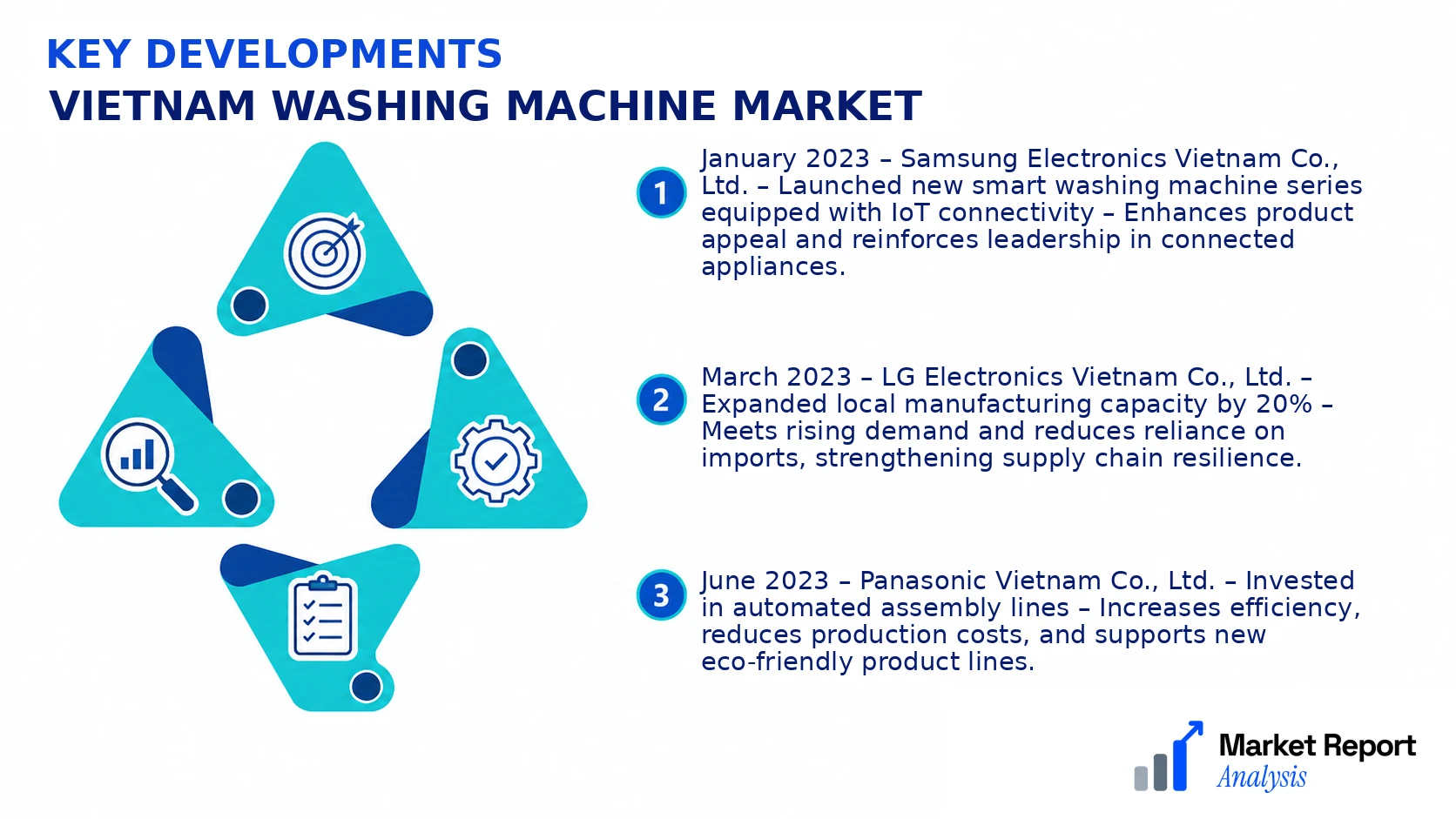
- January 2023 – Samsung Electronics Vietnam Co., Ltd. – Launched new smart washing machine series equipped with IoT connectivity – Enhances product appeal and reinforces leadership in connected appliances.
- March 2023 – LG Electronics Vietnam Co., Ltd. – Expanded local manufacturing capacity by 20% – Meets rising demand and reduces reliance on imports, strengthening supply chain resilience.
- June 2023 – Panasonic Vietnam Co., Ltd. – Invested in automated assembly lines – Increases efficiency, reduces production costs, and supports new eco-friendly product lines.
- September 2023 – Hitachi Appliances Vietnam Co., Ltd. – Formed strategic alliance with local tech firms for digital transformation – Improves competitive edge through enhanced smart features and data analytics capabilities.
- November 2023 – Electrolux Vietnam Co., Ltd. – Announced new environmentally sustainable manufacturing plant – Focuses on energy-efficient processes and waste reduction, aligning with global sustainability goals.
Frequently Asked Questions
What is the Vietnam Washing Machine Market?
The Vietnam Washing Machine Market encompasses the production, consumption, and import/export activities related to washing machines within Vietnam. It reflects indigenous manufacturing growth and rising consumer demand driven by urbanization, rising income levels, and technological adoption.
What is the current market size of Vietnam Washing Machine Market?
As of 2026, the market is valued at approximately USD 2.2 Billion, driven by increased household appliance penetration and urban development projects. Steady growth is expected as consumer preferences shift towards energy-efficient, smart washing machines.
What factors are driving the Vietnam Washing Machine Market?
Market growth is propelled by rising disposable incomes, urbanization, government initiatives supporting manufacturing, and increased penetration of modern appliances in rural areas. Additionally, innovations such as smart features and energy efficiency are attracting consumers.
Which Vietnamese city leads the Vietnam Washing Machine Market?
Ho Chi Minh City stands out as the market leader, owing to its large population, higher income levels, and dense urban infrastructure that fosters demand for domestic appliances including washing machines.
Which segment is expected to grow the fastest?
The smart washing machine segment is projected to exhibit the fastest growth, owing to rising consumer preference for technologically advanced, energy-efficient appliances integrated with IoT features, especially in urban centers.
Who are the leading companies operating in the Vietnam Washing Machine Market?
Key players include Samsung, LG Electronics, Panasonic, and Sharp. These companies have established manufacturing facilities and extensive distribution channels across Vietnam, enhancing their market share and consumer reach.
Analyst Perspective
The Vietnam washing machine market exhibits a mature yet still evolving landscape, with steady long-term growth driven by urbanization, rising disposable incomes, and shifting consumer preferences towards smart, energy-efficient appliances. As technological innovation accelerates, brands are increasingly focusing on IoT-enabled models and eco-friendly features, positioning themselves to capitalize on consumer demand for convenience and sustainability. Investment priorities should target manufacturing capabilities that support local assembly and R&D, especially within Ho Chi Minh City and Hanoi, which continue to exhibit high buyer density and infrastructure growth. Competitive intensity is poised to intensify with an influx of domestic players and premium international brands vying for market share. City-level growth is notably promising in Ho Chi Minh City, thanks to its rapid urban sprawl, whereas Hanoi offers opportunities tied to infrastructural upgrades. Strategic positioning involves leveraging localized supply chains, enhancing after-sales services, and adopting innovative marketing to build loyalty, all crucial for sustaining long-term growth amidst increasing competition.
