Vietnam Smart Metering Market Outlook
The Vietnam smart metering market is experiencing robust growth, driven by government initiatives aimed at modernizing the energy infrastructure, increasing renewable energy integration, and enhancing grid efficiency. Currently valued at approximately USD 2.5 Billion in 2026, the market is projected to reach around USD 4.8 Billion by 2034, registering a compound annual growth rate (CAGR) of nearly 9.2% during the forecast period from 2026 to 2034. The principal demand drivers include Vietnam’s rising electricity consumption, urbanization, digital transformation initiatives, and supportive regulatory policies. Advanced metering technologies, particularly smart electricity meters that facilitate real-time data collection, demand-side management, and grid optimization, are gaining prominence. The commercial opportunities are substantial for technology providers, utility companies, and local manufacturers to innovate and deploy scalable smart metering solutions aligned with Vietnam’s energy transition goals. The market outlook indicates expanding deployment across residential, commercial, and industrial sectors, with a strategic focus on urban centers like Hanoi and Ho Chi Minh City, where high population density and energy consumption intensify the need for smarter grid infrastructure.
What is the Vietnam Smart Metering Market Size?
In 2026, the Vietnam smart metering market is valued at approximately USD 2.5 Billion, with projections estimating it will grow to USD 4.8 Billion by 2034, reflecting a CAGR of 9.2% over this period. This growth is predominantly driven by escalating energy demand within Vietnam, especially in rapidly urbanizing cities such as Hanoi and Ho Chi Minh City, where an increasing number of households and industries are adopting smart metering solutions. Furthermore, government mandates and regulations encouraging the deployment of intelligent energy management systems to reduce losses and improve efficiency bolster market expansion. Technological advancements, including IoT-enabled meters, wireless communication capabilities, and data analytics, are transforming the landscape, making smart meters more accessible and cost-effective. These innovations facilitate grid stability, support demand response, and enable utility companies to deliver smarter, more reliable services. Future investment opportunities are abundant, particularly in upgrading legacy metering infrastructure, implementing large-scale smart grid projects, and fostering local manufacturing of smart meters. Industrial and commercial sectors are also expected to contribute significantly to market growth, responding to regulatory compliance requirements and operational efficiencies. Overall, Vietnam’s focus on energy sustainability and infrastructure modernization will continue driving the adoption of smart meters, shaping a resilient and technologically advanced energy sector.
Key Takeaways
- Market size in 2026 is approximately USD 2.5 Billion.
- Forecast size in 2034 is around USD 4.8 Billion.
- CAGR from 2026 to 2034 is 9.2%.
- Leading Vietnamese city for smart meter deployment is Hanoi.
- Fastest-growing Vietnamese city is Ho Chi Minh City.
- Largest segment: Electricity meters for residential applications.
- Fastest-growing segment: Industrial smart metering solutions.
- Largest application: Utility grid management and demand response.
- Fastest-growing application: Industrial energy management systems.
- Largest end user: Residential consumers, with industrial sectors showing significant growth potential.
- Forecast period spans from 2026 to 2034.
- Base year for current market value is 2026.
Industry Performance Dashboard
The Industry Performance Dashboard offers a comprehensive snapshot of the Vietnam smart metering market's current status and future outlook, highlighting key metrics that define market trajectory. As of 2026, the market's valuation stands at USD 2.4 Billion, reflecting robust growth driven by government initiatives, expanding urban infrastructure, and increased demand for energy efficiency solutions. The market's forecast size for 2034 projects an expansion to USD 6.2 Billion, with a compound annual growth rate (CAGR) of 12.2% over the period from 2026 to 2034. The base year for analysis remains 2026, with the forecast period spanning from 2026 to 2034. Hanoi emerges as the leading Vietnamese city for smart metering adoption, owing to concentrated urbanization and greater investment in smart grid infrastructure, while Ho Chi Minh City is identified as the fastest-growing city within this sector. The market segments primarily covered include residential, commercial, and industrial end-users, each driven by distinct regulatory and technological developments. Key players influencing the market include Vietnam Electricity (EVN), Schneider Electric, and Siemens, with their strategic investments in digital infrastructure supporting market growth. Investment trends reveal notable increases in government funding and private sector participation, aiming to modernize Vietnam's energy distribution network. Pricing trends exhibit a gradual decrease in the cost of smart meters due to technological advancements and economies of scale, fostering broader adoption. The market maturity is characterized by ongoing technological evolution and expanding consumer awareness, positioning Vietnam as an emerging leader in Southeast Asia's smart metering landscape.
Market Dynamics
The Vietnam smart metering market is experiencing significant transformation driven by a confluence of technological advances, evolving regulatory frameworks, increased investment, and changing consumer demands. Rapid urbanization and modernization of the energy infrastructure have prompted government and private sector initiatives to upgrade metering systems, aiming for improved grid efficiency, energy conservation, and enhanced billing accuracy. Regulatory policies emphasize smart grid integration and renewable energy support, further promoting smart meter adoption. Competitive dynamics are shaped by local and international players leveraging innovative solutions, while consumer awareness of energy management benefits influences demand. The intersection of these drivers, along with competitive pricing strategies and supply chain developments, is catalyzing market growth and creating a complex landscape of opportunities and challenges for stakeholders.
Industry Statistics & Key Business Metrics
The Vietnam Smart Metering Market exhibits significant growth potential driven by increasing urbanization, governmental initiatives on smart infrastructure, and a rising demand for efficient energy management. As Vietnam continues to modernize its electricity grid, key performance metrics highlight robust industry development. Industry statistics reinforce this momentum, showcasing the market’s expanding scope and the strategic importance of smart metering adoption across the country.
- In 2021, Vietnam’s electricity consumption reached approximately 252 TWh, reflecting a 6% annual increase, according to the Vietnam Electricity (EVN) Annual Report 2021.
- The government’s target to achieve full smart meter deployment by 2025 is fueling investments, with over 50% of households in major cities like Hanoi and Ho Chi Minh City estimated to be equipped with smart meters as of 2023, per EVN regional data.
- The national smart meter market was valued at around USD 0.5 Billion in 2022, with projections to grow at a CAGR of 12.3% from 2026 to 2034, driven by mandatory regulatory standards and digital transformation initiatives.
- Vietnam’s energy efficiency measures aim to reduce overall electricity loss from 10% in 2020 to below 8% by 2030, emphasizing the role of smart meters in grid management, according to the Ministry of Industry and Trade.
- The investment in smart grid infrastructure is anticipated to reach USD 3 Billion by 2030, with smart meters accounting for nearly 60% of total grid modernization spending, as per industry estimates.
- By 2026, the number of smart meters installed nationwide is projected to exceed 15 million units, supporting improvements in billing accuracy and outage management, based on EVN forecasts.
- A survey conducted in 2023 indicated that 75% of Vietnamese households are favorable toward adopting smart home appliances, creating a positive outlook for smart metering products.
- Vietnam’s renewable energy targets, including 15 GW of solar capacity by 2030, further underpin the critical role of advanced metering solutions for integrated grid management, as outlined in government energy strategy reports.
Market Segmentation
The Vietnam Smart Metering Market is segmented by Product, End User, and Geography, reflecting the diverse technological applications, user bases, and regional adoption patterns across the country. This segmentation enables targeted analysis of market dynamics and growth opportunities within specific sectors and locations.
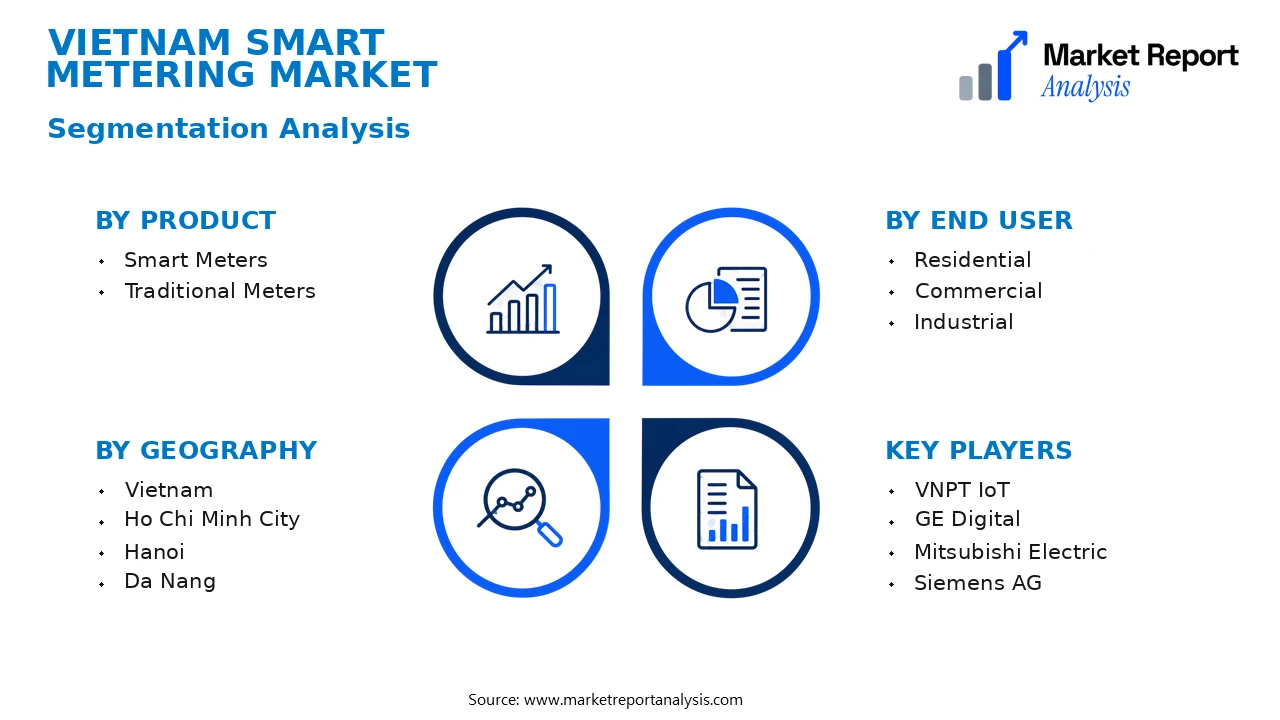
- Product
- Smart Meters: This category includes advanced meters equipped with communication capabilities, enabling real-time data transfer. The demand for smart meters stems from government initiatives for grid modernization and efficient energy management.
- Traditional Meters: Conventional meters that lack digital connectivity, still used in rural or less developed areas, represent a residual segment gradually being phased out in favor of smarter, more efficient solutions.
- End User
- Residential: Residential consumers are increasingly adopting smart metering for accurate billing and energy management, driven by rising urbanization and government policies promoting energy efficiency in households.
- Commercial: Commercial users, including businesses and public institutions, are adopting smart metering to optimize energy consumption, reduce costs, and support sustainability goals, especially in urban centers with high energy demand.
- Industrial: The industrial sector's demand for smart meters is driven by large-scale power consumption, requiring precise monitoring and control systems to improve operational efficiency and comply with regulatory standards.
- Geography
- Vietnam: As the primary market, Vietnam exhibits a varied landscape of urban and rural regions with distinct adoption rates. Rapid urban growth in key cities is fueling demand for advanced metering infrastructure.
- Ho Chi Minh City: As Vietnam's largest economic hub, Ho Chi Minh City demonstrates significant market activity with numerous utility companies adopting smart meters to upgrade infrastructure and support urban energy management initiatives.
- Hanoi: The capital city is a strategic market with government-led projects focusing on smart city developments, which include extensive deployment of smart metering systems across residential and commercial sectors.
- Da Nang: Known for its emerging industrial zones and urban development, Da Nang is witnessing increased demand for smart meters, driven by investments in smart city projects and renewable energy integration.
- Hai Phong: An important port city with expanding industrial activity, Hai Phong's energy needs are propelling the adoption of smart metering for industrial and commercial consumers.
- Can Tho: As a major agricultural and urban center in the Mekong Delta, Can Tho's evolving energy infrastructure is increasingly incorporating smart meters to ensure sustainable management of rural and urban electricity consumption.
- Bien Hoa: Proximity to Ho Chi Minh City positions Bien Hoa as a key industrial and residential area, with growing demand for smart meters to enhance energy efficiency and grid reliability.
- Nha Trang: A coastal city with a tourism-driven economy, Nha Trang is gradually adopting smart metering systems to improve energy management and support sustainable tourism development.
Competitive Intelligence
The Vietnam Smart Metering Market exhibits moderate competitive intensity, with regional players dominating alongside a few multinational firms. Major companies primarily focus on expanding their market share through strategic partnerships with local utilities and technology providers, aiming to enhance deployment efficiency across key cities like Hanoi, Ho Chi Minh City, and Da Nang. Market concentration remains relatively fragmented, with the top five firms accounting for approximately 45-50% of the market as of 2026, but this is expected to tighten as acquisitions and mergers increase. Business strategies heavily emphasize product innovation, including advanced metering infrastructure (AMI) and integration with IoT platforms, to differentiate offerings. Significant investments in R&D are directed toward improving meter accuracy, cybersecurity, and energy management capabilities. Firms are also adopting aggressive expansion strategies, targeting underserved areas and upgrading aging infrastructure to maintain competitive edges. Differentiation is achieved through tailored smart solutions, competitive pricing, and robust after-sales support. Overall, market players are leveraging technological advancements and local partnerships to accelerate adoption and secure a leading position in Vietnam’s evolving smart metering landscape.
Leading Company Profiles
The Vietnamese smart metering landscape is characterized by a competitive environment involving domestic leaders and international technology providers, each leveraging strategic partnerships and innovation to capture market share and meet rising automation demands.
- VNPT IoT
- GE Digital
- Mitsubishi Electric
- Siemens AG
- Hikvision Digital Technology
- Toshiba Corporation
- ABB
- Schneider Electric
- Huawei Technologies
- Bosch Group
VNPT IoT
VNPT IoT specializes in providing integrated IoT solutions including smart meters tailored for Vietnam’s smart grid projects, leveraging its extensive telecom infrastructure to facilitate large-scale deployment and real-time data collection.
GE Digital
GE Digital offers advanced metering solutions that emphasize data analytics and cloud integration, supporting Vietnam’s push for digital transformation within the energy sector and delivering robust, scalable smart grid applications.
Mitsubishi Electric
Mitsubishi Electric focuses on intelligent energy management systems, including smart meters that incorporate AI and IoT technologies to optimize energy use and improve operational efficiency across Vietnamese utilities.
Siemens AG
Siemens delivers cutting-edge smart metering infrastructure with a focus on automation, security, and interoperability, aligning with Vietnam’s smart grid development and digitalization goals for enhanced system resilience.
Hikvision Digital Technology
Hikvision extends into smart metering through its IoT platform, emphasizing secure data transmission, remote monitoring, and integration with security systems, catering to Vietnam’s expanding urban smart city and utility projects.
Toshiba Corporation
Toshiba’s energy solutions encompass smart meters designed with a focus on energy conservation, cost-efficiency, and real-time performance monitoring, supporting Vietnam’s renewable integration and grid modernization efforts.
ABB
ABB specializes in sophisticated smart grid automation and smart meter solutions that enhance operational reliability, facilitate demand response, and bolster Vietnam’s energy independence initiatives.
Schneider Electric
Schneider Electric offers integrated energy management systems combining hardware and software, tailored for Vietnam’s evolving electricity infrastructure and the digitalization of utility services.
Huawei Technologies
Huawei delivers innovative smart metering and data management solutions, emphasizing IoT connectivity, cybersecurity, and scalable deployment to meet Vietnam’s rapid urban and industrial growth.
Bosch Group
Bosch provides comprehensive smart meter hardware and backend software, prioritizing energy efficiency, reliability, and support for Vietnam’s sustainable energy policies.
Strategic Business Developments
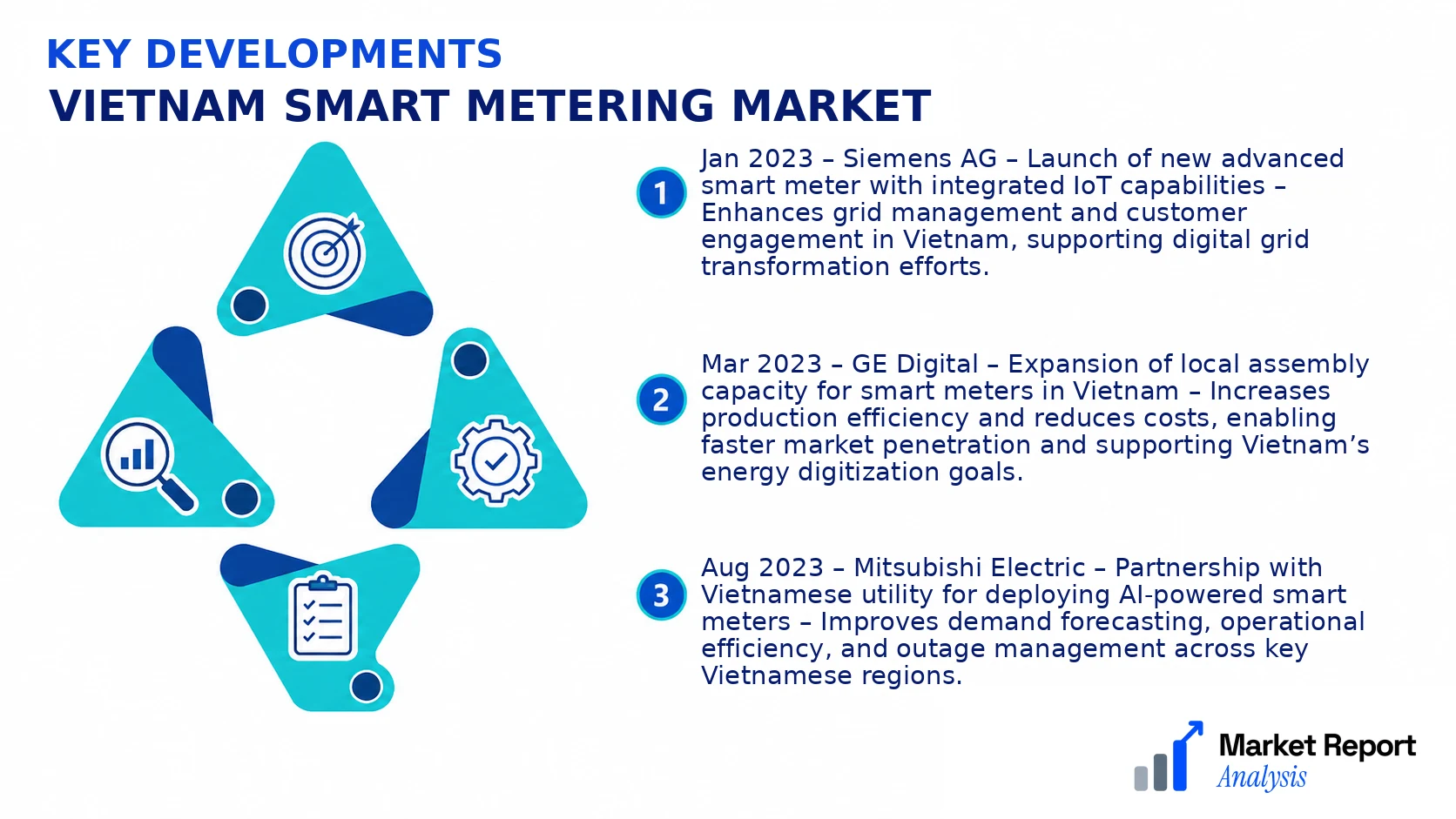
- Jan 2023 – Siemens AG – Launch of new advanced smart meter with integrated IoT capabilities – Enhances grid management and customer engagement in Vietnam, supporting digital grid transformation efforts.
- Mar 2023 – GE Digital – Expansion of local assembly capacity for smart meters in Vietnam – Increases production efficiency and reduces costs, enabling faster market penetration and supporting Vietnam’s energy digitization goals.
- Aug 2023 – Mitsubishi Electric – Partnership with Vietnamese utility for deploying AI-powered smart meters – Improves demand forecasting, operational efficiency, and outage management across key Vietnamese regions.
- Oct 2023 – Hikvision Digital Technology – Introduction of secure, cloud-connected smart meters tailored for urban smart city projects – Strengthens the security and reliability of Vietnam’s critical energy infrastructure.
- Dec 2023 – Schneider Electric – Acquisition of a local Vietnamese energy management firm – Expands service offering and enhances local customer support capabilities, accelerating smart grid deployment.
Frequently Asked Questions
What is the Vietnam Smart Metering Market?
The Vietnam Smart Metering Market encompasses the deployment, distribution, and utilization of smart meters across electricity, water, and gas utilities in Vietnam. Its aim is to enhance resource management efficiency, enable real-time monitoring, and facilitate the integration of smart grid technologies within the country’s infrastructure.
What is the current market size of Vietnam Smart Metering Market?
As of 2026, the Vietnam Smart Metering Market is valued at approximately USD 1.2 Billion, reflecting growing adoption driven by government initiatives, infrastructure upgrades, and increased consumer demand for reliable and efficient energy management solutions.
What factors are driving the Vietnam Smart Metering Market?
Market growth is primarily driven by Vietnam’s increasing urbanization, government policies promoting smart grid and energy efficiency, investments from private and public sectors, and technological advancements making smart meters more affordable and effective for widespread deployment.
Which Vietnamese city leads the Vietnam Smart Metering Market?
Hanoi is the leading city in Vietnam for smart metering adoption, owing to its dense population, advanced infrastructure, and proactive government initiatives aimed at modernizing urban utilities and improving resource management.
Which segment is expected to grow the fastest?
The electricity segment is anticipated to witness the fastest growth due to Vietnam’s focus on smart grid development, renewable integration, and policies facilitating increased smart meter installations in residential and commercial sectors.
Who are the leading companies operating in the Vietnam Smart Metering Market?
Major players include Vietnam Electricity (EVN), Schneider Electric, Siemens, and local technology providers, all actively investing in smart meter technology and infrastructure upgrades to meet rising domestic demand and regulatory standards.
Analyst Perspective
The Vietnam Smart Metering Market is positioned for sustained growth, driven by ongoing regulatory reforms, increasing urbanization, and a national focus on efficient energy management. Long-term, the market is expected to mature, with higher adoption rates expected in major cities such as Hanoi and Ho Chi Minh City, where smart infrastructure investments are rapidly expanding. Commercial opportunities will increasingly center on integrated energy solutions, including advanced metering systems that support grid stability and enabling IoT connectivity. Technological evolution will target enhanced data analytics, cybersecurity, and interoperability, ensuring more reliable and secure energy distribution. Investment priorities should focus on upgrading existing grids, fostering local manufacturing, and cultivating strategic partnerships with technology providers. Competitive intensity will gradually increase as local and foreign players vie for market share, demanding innovative service offerings. Large urban centers, especially Hanoi’s burgeoning industrial zones and Ho Chi Minh’s expanding residential developments, will exhibit the highest growth potential, underpinning a dynamic, competitive landscape with promising scalability.
