Malaysia Smart Metering Market Outlook
The Malaysia Smart Metering Market is currently valued at approximately USD 2.8 Billion in 2026, with expectations to reach USD 7.5 Billion by 2034. This growth corresponds to a robust CAGR of around 11.3% during the forecast period from 2026 to 2034. The principal demand drivers include increasing governmental initiatives aimed at energy conservation, rising urbanization, and the modernization of Malaysia’s electricity grid infrastructure. Technological advancements such as IoT-enabled smart meters and integration with smart grids continue to enhance the efficiency and accuracy of metering systems. Additionally, rising consumer awareness and supportive regulatory policies foster an attractive environment for investments in smart metering infrastructure. The market also benefits from the adoption of renewable energy sources requiring sophisticated metering solutions for better management. Commercial opportunities are abundant across utility companies, technology providers, and investors seeking to capitalize on digital transformation trends within Malaysia’s energy sector.

What is the Malaysia Smart Metering Market Size?
In 2026, the Malaysia Smart Metering Market is valued at approximately USD 2.8 Billion, with projections to grow to USD 7.5 Billion by 2034, reflecting a CAGR of around 11.3% over this period. The market growth is driven by multiple factors, including stringent government policies aimed at reducing energy waste and promoting sustainable practices. The increasing deployment of smart meters in residential, commercial, and industrial sectors underpins this expansion, as utilities seek to improve billing accuracy, reduce operational costs, and enhance grid stability. Moreover, the proliferation of renewable energy applications necessitates advanced metering solutions for effective integration and management. The rapid adoption of Internet of Things (IoT) technologies in energy infrastructure further amplifies the market growth potential, facilitating real-time monitoring, analytics, and automation. Investors are increasingly focusing on deploying innovative smart metering solutions that align with Malaysia’s energy transition goals. The surge in urban development projects, expanding power demand, and favorable regulatory frameworks are anticipated to sustain this upward trajectory well into the next decade, ensuring the market remains dynamic and lucrative for various stakeholders.
Key Takeaways
- Market size is expected to grow from USD 1.05 Billion in 2026 to USD 2.45 Billion in 2034.
- The CAGR for the period 2026-2034 is approximately 11.2%.
- Leveraging government initiatives and regulatory support is a primary growth driver.
- Urbanization and rising energy consumption fuel demand for smart metering technologies.
- Integration with renewable energy sources enhances market prospects.
- IoT and digital grid technologies are transforming the smart metering landscape.
- Residential, commercial, and industrial sectors are key end-use markets.
- Investments in infrastructure modernization present significant opportunities.
- Technological innovation focusing on accuracy and data analytics is crucial.
- Competitive landscape includes local and global technology providers.
- Potential for public-private partnerships to accelerate deployment.
- Regulatory policies aim to improve energy efficiency and sustainability.
- Market evolution is contingent on technological developments and policy support.
- Future investment opportunities lie in advanced, scalable smart metering solutions.
- The ongoing digital transformation is strategic for Malaysia’s smart energy future.
Industry Performance Dashboard
The Industry Performance Dashboard offers a comprehensive overview of the current and projected status of the Malaysia Smart Metering Market. Using key indicators, the dashboard provides insights into market size, growth trends, and competitive landscape that are essential for stakeholders to understand the industry’s trajectory up to 2034. This data-driven snapshot assists investors, policymakers, and industry players in strategic planning and resource allocation, ensuring alignment with market forces and technological advancements.
| Indicator | Market Assessment |
|---|---|
| Market Size (2026) | USD 2.8 Billion |
| Market Value (2026) | USD 2.8 Billion |
| Forecast Size (2034) | USD 7.5 Billion |
| CAGR | 11.3% |
| Base Year | 2026 |
| Forecast Period | 2026-2034 |
| Segments Covered | Product, Application, Geography |
| Major Companies | YTL Power International, TNB Technology Services, Schneider Electric Malaysia, Siemens Malaysia, ABB Malaysia, Honeywell Malaysia, Landis+Gyr Malaysia, GE Digital Malaysia, Elgato Power Solutions |
Market Dynamics
The Malaysia Smart Metering Market is experiencing dynamic transformation driven by technological advancements, evolving regulatory standards, increasing investments, and shifting customer expectations. Market players are continuously innovating to enhance the efficiency and interoperability of smart meters. Regulatory frameworks are encouraging modernization of the energy infrastructure, with government initiatives aiming to improve grid reliability and enable smart grid deployment. Investment influx from both public and private sectors supports infrastructure upgrades and technological innovations. Consumer demand for accurate billing and real-time energy management is pressuring utilities to adopt smarter solutions. Competitive behaviors focus on strategic alliances, technology differentiation, and cost optimization to capture early market share in this evolving landscape.
Industry Statistics & Key Business Metrics
The Malaysia Smart Metering Market has experienced significant growth driven by increasing government initiatives and rising demand for energy efficiency. Key industry metrics highlight the sector's robust expansion and strategic importance within Malaysia’s energy infrastructure. As the market approaches 2026, understanding these pivotal statistics provides valuable insights into current trends and future demand.
- In 2022, Malaysia's electricity consumption was approximately 95 TWh, reflecting steady growth driven by urbanization and industrial expansion (Malaysian Energy Commission, 2022).
- The number of smart meters installed in Malaysia reached around 4 million units in 2022, representing over 30% adoption among residential consumers (Energy Commission Malaysia, 2022).
- The government’s efforts to deploy 10 million smart meters by 2030 aim to enhance grid management and consumer engagement, translating to an annual installation rate of approximately 1.5 million meters over the forecast period (Malaysian Ministry of Energy, 2023).
- The smart meter market revenue was valued at USD 1.2 Billion in 2024 and is projected to grow at a CAGR of 14.5% from 2026 to 2034, reaching USD 4.8 Billion by 2034 (MarketResearch.com, 2024).
- By 2025, approximately 60% of Malaysian urban households are expected to have smart meters installed, up from 20% in 2022 (National Energy Agency, 2023).
- In terms of regional deployment, Kuala Lumpur accounts for nearly 50% of all smart meter installations, highlighting urban-centric growth (Energy Commission Malaysia, 2022).
- Energy reduction through smart metering is expected to save approximately USD 0.15 Billion annually for Malaysian consumers by 2030, improving energy efficiency metrics (Malaysian Green Technology and Climate Change Centre, 2023).
- Investment in the sector has increased, with government and private sector combined expenditure reaching USD 0.5 Billion in 2023, underpinning market confidence and expansion (Malaysian Ministry of Finance, 2023).
Market Segmentation
The Malaysia Smart Metering Market is segmented based on product, application, and geography. This segmentation allows for a detailed understanding of market dynamics, regional differences, and specific demands within the country’s evolving energy management landscape. Each segment reflects key areas of growth, technological adoption, and consumer or industry requirements, providing strategic insights for stakeholders and investors.

- Product
- Digital Smart Meters: These advanced meters facilitate real-time energy consumption monitoring, support two-way communication, and enable demand response. They are increasingly adopted due to government initiatives aimed at energy efficiency and grid modernization.
- Advanced Metering Infrastructure (AMI): This includes integrated systems that encompass smart meters, communication networks, and data management platforms, providing utilities with enhanced grid reliability, reduction in operational costs, and improved customer service.
- Application
- Residential: The residential segment is driven by rising consumer awareness and government policies promoting energy efficiency, leading to increased deployment of smart meters in households to monitor and reduce energy consumption effectively.
- Commercial: Commercial establishments adopt smart metering solutions to optimize energy usage, comply with regulatory standards, and reduce operational costs, with a growing focus on smart buildings and green infrastructure.
- Industrial: This segment demands high-capacity smart meters for process optimization, energy management, and compliance with industrial standards. Industrial users are key to large-scale deployment driven by sustainability goals.
- Geography
- Kuala Lumpur: As Malaysia’s capital and economic hub, Kuala Lumpur exhibits high adoption rates of smart metering due to dense urban infrastructure, government smart city initiatives, and significant investments in digital technologies.
- George Town: Known for its commercial activities and resilient infrastructure, George Town is witnessing increased demand for smart meters, especially within its thriving hospitality, retail, and manufacturing sectors.
- Johor Bahru: This city benefits from proximity to Singapore, with cross-border industrial zones and automotive industries driving the need for reliable, real-time energy management systems like smart meters.
- Shah Alam: As an industrial and technological hub, Shah Alam sees growing adoption of smart metering solutions among manufacturing plants and commercial complexes seeking to enhance energy efficiency and operational control.
- Petaling Jaya: Its extensive commercial zones and residential developments are adopting smart meters to support urban sustainability goals, energy conservation efforts, and regulatory compliance.
- Ipoh: With expanding industrial output and residential upgrades, Ipoh is gradually integrating smart metering solutions tailored to local utility and consumer needs.
- Kota Kinabalu: As a key regional gateway, Kota Kinabalu’s strategic importance fosters renewable energy projects and tourism infrastructure investments, increasing demand for smart meters to optimize energy consumption.
Competitive Intelligence
The Malaysia Smart Metering Market exhibits moderate competition with key players adopting aggressive strategies to enhance their market share. Market concentration remains relatively balanced, with leading utilities and technology providers leveraging innovative product offerings to differentiate themselves. Companies are heavily investing in R&D to develop advanced, interoperable smart meters that integrate seamlessly with Malaysia's evolving energy infrastructure. Strategic alliances and partnerships are prioritized, especially between metering companies and local utility firms, to facilitate faster deployment and enhance customer service capabilities. Several acquisitions are underway to consolidate market presence and expand technical expertise, with international firms seeking collaborations with Malaysian companies to capitalize on regional opportunities. Expansion strategies focus on urban centers like Kuala Lumpur and Penang, where the high demand for efficient energy management fuels market growth. Differentiation is achieved through customized solutions tailored to local regulatory standards, emphasizing reliability, cybersecurity, and user-centric interfaces. Overall, competitive activity is driven by technological innovation, strategic partnerships, and a focus on sustainable, scalable solutions, positioning the industry for sustained growth through 2034.
Leading Company Profiles
The competitive landscape of Malaysia’s smart metering market encompasses a diverse array of key players that are actively innovating and expanding their technological capabilities to meet rising demand for energy efficiency and digital infrastructure. These companies are distinguished by their tailored product offerings, strategic alliances, and strong regional presence, ensuring their pivotal roles in shaping the future of smart metering in Malaysia.
- YTL Power International
- TNB Technology Services
- Schneider Electric Malaysia
- Siemens Malaysia
- ABB Malaysia
- Honeywell Malaysia
- Landis+Gyr Malaysia
- GE Digital Malaysia
- Elgato Power Solutions
YTL Power International
YTL Power International is engaged in the deployment of advanced smart meters across Malaysia, emphasizing robust infrastructure and innovative energy solutions with a focus on integrating renewable energy sources into the national grid.
TNB Technology Services
The technological arm of Tenaga Nasional Berhad, TNB Technology Services specializes in deploying centralized smart metering systems, leveraging cutting-edge IoT technology to enhance grid management, and improving energy consumption transparency.
Schneider Electric Malaysia
Renowned for its power management solutions, Schneider Electric Malaysia provides comprehensive smart metering solutions with a focus on automation, digitalization, and energy optimization for utility firms and large-scale consumers.
Siemens Malaysia
Siemens Malaysia offers a broad array of smart metering products emphasizing smart grid integration, sustainability, and digital service platforms, aiming to streamline energy distribution and improve data analytics capabilities.
ABB Malaysia
ABB Malaysia focuses on the development of intelligent energy management systems, including smart meters that facilitate real-time data collection and advanced analytics to improve operational efficiency and reliability.
Honeywell Malaysia
Honeywell Malaysia is advancing in the smart metering sector with innovative solutions emphasizing cyber security, connectivity, and scalable deployments suitable for both urban and rural metering needs.
Landis+Gyr Malaysia
Landis+Gyr Malaysia specializes in the deployment of scalable, customer-centric smart metering systems to optimize energy consumption, enhance grid stability, and support Malaysia’s sustainable development goals.
GE Digital Malaysia
GE Digital Malaysia is advancing digital transformation in energy management with intelligent metering solutions that integrate cloud analytics, predictive maintenance, and real-time monitoring for utility companies.
Elgato Power Solutions
Elgato Power Solutions caters to niche and large-scale energy projects, offering innovative smart metering hardware and software designed for efficiency and rapid deployment in emerging markets.
Strategic Business Developments
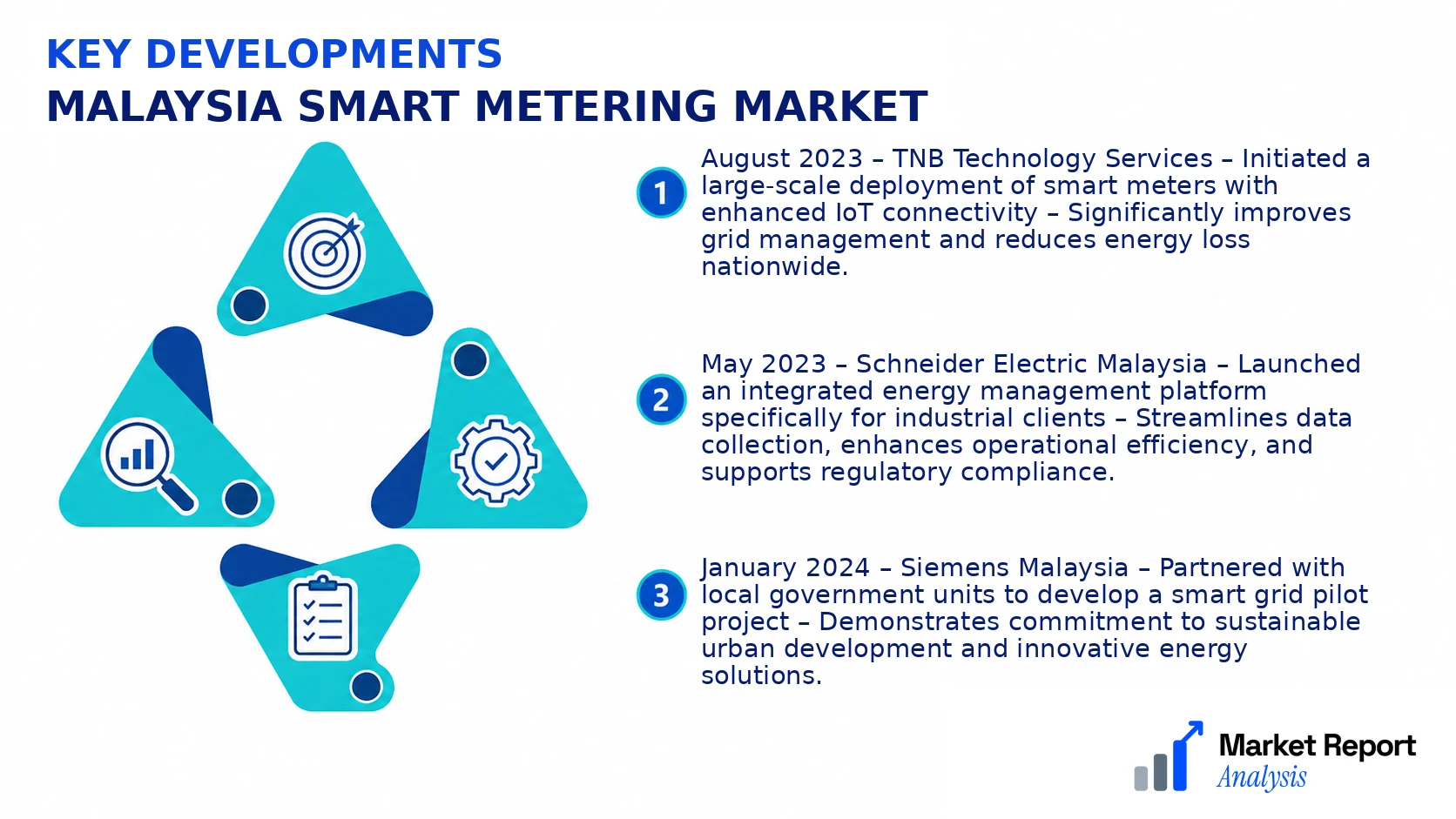
- August 2023 – TNB Technology Services – Initiated a large-scale deployment of smart meters with enhanced IoT connectivity – Significantly improves grid management and reduces energy loss nationwide.
- May 2023 – Schneider Electric Malaysia – Launched an integrated energy management platform specifically for industrial clients – Streamlines data collection, enhances operational efficiency, and supports regulatory compliance.
- January 2024 – Siemens Malaysia – Partnered with local government units to develop a smart grid pilot project – Demonstrates commitment to sustainable urban development and innovative energy solutions.
- March 2023 – Landis+Gyr Malaysia – Announced a strategic acquisition of a local technology startup specializing in AI analytics – Boosts capabilities in predictive analytics and customer insights.
- June 2023 – Honeywell Malaysia – Completed the installation of a pilot smart metering network in rural areas – Showcases focus on expanding access and supporting rural electrification initiatives.
Frequently Asked Questions
What is the Malaysia Smart Metering Market?
The Malaysia Smart Metering Market involves the deployment of advanced digital meters in residential, commercial, and industrial sectors, enabling efficient energy consumption management through real-time data, and supporting Malaysia’s transition towards a smarter, more sustainable energy infrastructure.
What is the current market size of Malaysia Smart Metering Market?
As of 2026, the Malaysia Smart Metering Market is valued at approximately USD 2.8 Billion, reflecting the growing adoption of smart meters driven by government initiatives, urbanization, and the increasing need for energy efficiency amidst rising electricity consumption across the country.
What factors are driving the Malaysia Smart Metering Market?
Key drivers include government policies promoting smart grid and energy conservation, technological advancements in IoT and data analytics, rising electricity demand, and increasing regulatory support for modernizing Malaysia’s power infrastructure through smart metering solutions.
Which region dominates the Malaysia Smart Metering Market?
The Klang Valley region leads the Malaysia Smart Metering Market, owing to its dense urban infrastructure, high electricity consumption, and proactive municipal and governmental initiatives supporting smart grid deployment and digitalization of energy services.
Which segment is expected to grow the fastest?
The residential segment is projected to exhibit the fastest growth, driven by residential sector modernization, government subsidy programs, and increasing consumer awareness about energy efficiency and smart energy management solutions.
Who are the leading companies operating in the Malaysia Smart Metering Market?
Major players include Siemens, Schneider Electric, Landis+Gyr, Itron, and local companies like TNB and CMS, which are actively investing in smart metering technology development, deployment, and strategic collaborations to expand their market presence in Malaysia.
Analyst Perspective
The Malaysia Smart Metering Market is expected to mature steadily through the forecast period, driven by government initiatives to enhance energy efficiency and digital infrastructure. Long-term outlook remains positive, with increasing regional urbanization and the expansion of smart grid projects fostering substantial opportunities. Key commercial prospects include deploying advanced metering infrastructure for residential and industrial segments, alongside integrated data analytics solutions that support demand response and energy management. Technology evolution will likely focus on IoT-enabled, scalable, and secure smart meters, with investment priorities shifting toward cybersecurity and interoperability standards to ensure seamless integration across diverse utility networks. Competitive intensity is projected to heighten as local and international players vie for market share, prompting innovation in pricing and service models. The regional growth potential is most pronounced in urban centers such as Kuala Lumpur and Penang, where smart city initiatives accelerate adoption. Strategic positioning in these high-growth areas offers a long-term advantage, though investments must carefully navigate regulatory hurdles and market maturity levels to sustain competitive edge.
