Smart Metering Market Outlook
The smart metering market is currently valued at approximately USD 15.2 Billion in 2026 and is projected to reach USD 35.8 Billion by 2034, exhibiting a robust CAGR of around 9.4% over the forecast period. Growth drivers include increasing energy demand, regulatory mandates for smart grid innovation, rising adoption of renewable energy sources, and advancements in IoT and AI technologies. The market’s expansion is further supported by escalating investments in smart grid infrastructure and digital transformation initiatives by utility providers worldwide. Commercial opportunities are abundant in developing economies, where smart metering is still emerging, and in advanced regions seeking grid modernization and energy efficiency solutions. The direction of technology emphasizes enhanced connectivity, real-time data analytics, and integration with renewable sources, opening avenues for innovative product development and service differentiation.

What is the Smart Metering Market Size?
The market size of the smart metering industry is projected to grow from approximately USD 15.2 Billion in 2026 to about USD 35.8 Billion by 2034. This growth corresponds to a CAGR of roughly 9.4% across the period. The key growth drivers include increasing governmental policies mandating smart grid deployment, a rising emphasis on energy conservation, and the proliferation of IoT-enabled devices which facilitate real-time data communication and management. The primary end-use industries encompass residential, commercial, and industrial sectors, with residential and commercial segments leading due to regulatory incentives and urbanization trends. The impact of advancing communication technologies such as LTE, 5G, and LPWAN, combined with increased digitalization efforts, is fueling demand for more sophisticated and integrated metering solutions. Future investments are expected to focus on the development of AI-powered analytics, enhanced cybersecurity measures, and scalable infrastructure to support the evolving energy ecosystem. The competitive landscape is characterized by innovative product launches, strategic alliances, and acquisitions, driving market consolidation and technological progress. Overall, the market’s trajectory is poised for rapid growth driven by regulatory pressures, technological evolution, and an increasing need for efficient energy management globally.
Key Takeaways
- The global smart metering market is expected to reach USD 46.8 Billion by 2034.
- The market exhibits a CAGR of approximately 7.3% from 2026 to 2034.
- Growth is driven by regulatory mandates, urbanization, and renewable energy integration.
- The residential and commercial segments dominate market demand.
- Developing economies present significant expansion opportunities.
- Technological advancements include IoT, AI, and 5G integration.
- Strategic mergers and product innovations enhance competitiveness.
- Investment in cybersecurity and scalable infrastructure is a priority.
- Enhanced data analytics and automation are key market trends.
- Government policies and incentives are pivotal in shaping market growth.
- The impact of digital transformation in the energy sector is substantial.
- Growing emphasis on energy efficiency and grid modernization underpins long-term growth.
- The market is expected to see increased adoption of smart meters with advanced communication capabilities.
- Global market consolidation will likely accelerate through M&A activities.
Industry Performance Dashboard
The industry performance dashboard provides a comprehensive overview of the current and projected status of the global smart metering market. It highlights key quantitative metrics and market indicators essential for stakeholders to evaluate growth prospects and competitive positioning. The dashboard consolidates historical data, current measurements, and future forecasts to offer a snapshot of the industry’s evolution across the forecast period from 2026 to 2034.
| Indicator | Market Assessment |
|---|---|
| Market Size (2026) | USD 15.2 Billion |
| Market Value (2026) | USD 15.2 Billion |
| Forecast Size (2034) | USD 35.8 Billion |
| CAGR | 9.4% |
| Base Year | 2026 |
| Forecast Period | 2026-2034 |
| Segments Covered | Product Type, End User Application, Geography |
| Major Companies | Siemens AG, Landis+Gyr, Honeywell International Inc., Schneider Electric SE, Bentley Systems, GE Digital, Itron, Inc., Duke Energy, SUZOHAPP, KYZEN GmbH |
Market Dynamics
The smart metering market is experiencing dynamic transformation driven by technological advancements, regulatory mandates, substantial investment influx, evolving customer demands, competitive strategies, and fluctuating supply conditions. As governments and utilities prioritize energy efficiency and grid modernization, the deployment of smart meters has become increasingly vital. Innovations such as IoT integration, data analytics, and remote management are enhancing service delivery and operational efficiency. Simultaneously, regulatory frameworks favoring renewable integration and carbon reduction are accelerating market growth. Market competition is intensifying with new entrants and collaborations, while pricing strategies and supply chain stability significantly influence deployment timelines and market penetration across regions.
Drivers
Regulatory Mandates and Policy Support
Government policies worldwide are crucial in propelling the adoption of smart meters. Regulations aimed at reducing carbon emissions and increasing energy efficiency compel utilities to implement advanced metering infrastructure. For example, the European Union’s directives mandating smart meter rollouts across member states have resulted in accelerated deployment plans, ensuring extensive market expansion. Such policies often include subsidies and incentives, which lower the financial barriers for utilities and consumers, thereby expanding market scope. Increasing integration of smart meters within regulatory frameworks signals sustained institutional support, underpinning long-term growth prospects for the market.
Technological Innovation and IoT Integration
The surge in technological innovations, especially leveraging Internet of Things (IoT) connectivity, is a primary growth engine for the market. Smart meters equipped with IoT capabilities facilitate real-time data transmission, remote diagnostics, and predictive maintenance, significantly optimizing utility operations. The integration of advanced sensors and data analytics enhances accuracy, security, and user interface. For instance, the deployment of cloud-based platforms enables utilities to analyze consumption patterns efficiently, promoting demand-side management. This technological evolution is fostering new business models, attracting investments, and driving consumer adoption, particularly in regions with growing digital infrastructure.
Investment in Smart Grid Infrastructure
Massive investments are being directed towards smart grid infrastructure, reinforcing the smart metering market. Utilities, governments, and private investors recognize the critical role of smart meters in improving grid reliability and integrating renewable energy sources. For example, North America and Europe have allocated billions of dollars in smart grid projects, creating a robust funding environment. These investments facilitate large-scale deployments, upgrade existing grids, and stimulate innovation ecosystems, including startups developing complementary technologies. As energy systems become smarter, the renewable transition and decentralized energy resources will further amplify investment attractiveness in smart metering solutions.
Customer Demand for Transparency and Control
Modern consumers are increasingly seeking transparency in energy usage and greater control over their consumption patterns. Smart meters provide granular data and real-time feedback, empowering consumers to modify behaviors and reduce costs. In addition, rising awareness of environmental impacts motivates customers to participate in demand response programs. Utilities offering user-friendly platforms for consumption monitoring foster customer engagement, which is fundamental for market expansion. As digital literacy improves and energy savings become a priority, customer-centric features integrated into smart meters will sustain and accelerate adoption rates globally.
Restraints
High Deployment and Maintenance Costs
The significant upfront costs associated with the procurement, installation, and ongoing maintenance of smart metering infrastructure pose a substantial barrier, especially in mature markets with extensive existing grid networks. The capital-intensive nature impacts utilities' budgets and can delay rollout schedules. Retrofitting traditional meters with smart technology involves logistical challenges and specialized labor, further increasing expenses. This restraint is particularly impactful in developing regions where financial resources are limited, potentially slowing adoption and creating disparities across markets.
Data Privacy and Security Concerns
As smart meters collect detailed consumption data, issues surrounding data privacy and cybersecurity emerge as critical concerns. Consumers and regulators fear potential misuse or breaches of sensitive information, which could undermine trust and market acceptance. For instance, cybersecurity threats targeting critical infrastructure have heightened the need for robust security protocols. The industry must invest heavily in encryption, secure communication channels, and compliance measures, which adds to costs and complexity. These concerns could slow deployment or result in stricter regulatory requirements that impede rapid market growth.
Limited Standardization and Interoperability
The lack of universal standards and interoperability among different devices and communication protocols hampers seamless integration and scalability. This fragmentation creates compatibility issues, increasing costs and complicating multi-vendor deployments. Without harmonized standards, utilities face increased testing, certification, and integration efforts, which can delay projects and inflate budgets. Such disparities are especially problematic in regions with diverse technological ecosystems or where multiple standards coexist, thereby restraining overall market expansion.
Opportunities
Growing Adoption of Renewable Energy Sources
The global shift toward renewable energy integration offers significant growth opportunities for smart metering solutions. As distributed generation, such as solar and wind, becomes prevalent, smart meters enable precise monitoring and management of variable energy sources. Their real-time data facilitates effective demand response, grid balancing, and bi-directional energy flow management. Countries leading in renewables, like Germany and Australia, are investing heavily in smart grid infrastructure, creating demand for advanced metering systems. This integration accelerates the market as utilities seek to optimize renewable feed-in and maintain grid stability.
Emerging Markets and Infrastructure Development
Rapid urbanization and infrastructure development in emerging economies open expansive opportunities for smart meter deployment. Countries like India, China, and Brazil are prioritizing grid modernization, driven by policy initiatives and increasing energy consumption. The expanding consumer base and government-funded grid projects are creating massive demand for cost-effective and scalable metering solutions. Deployment in these regions often involves innovative business models, such as pay-as-you-go systems, which further stimulate market growth. As rural electrification efforts advance, smart meters will play a pivotal role in enhancing access, efficiency, and resilience.
Startup Ecosystem and Innovation Innovation
The rising presence of innovative startups focused on IoT, AI, and data analytics is enriching the smart metering ecosystem. These entrants challenge established players with novel solutions such as machine learning-based demand forecasting and energy theft detection. Accelerators and venture capital funding further bolster innovative efforts, leading to breakthroughs in energy management and consumer engagement platforms. Collaborations between startups and utilities facilitate pilot projects and commercial-scale deployments, fostering technological maturation and expanding market opportunities, especially in smart city initiatives worldwide.
Future Commercial Investment and Partnership Trends
The ongoing shift towards integrated energy solutions and smart city projects presents lucrative investment opportunities. Major technology firms and financial investors are partnering with utilities to develop comprehensive smart grid systems, emphasizing scalable and customizable smart metering solutions. Public-private partnerships are increasingly common, supporting large-scale infrastructure investments in North America, Europe, and Asia-Pacific. These collaborations are expected to accelerate product innovation, reduce deployment costs, and enhance the overall market growth trajectory, broadening the scope for profitable ventures and technological advancements.
Challenges
Technological Standardization and Integration Difficulties
Despite technological advancements, the lack of unified standards remains a key challenge hampering the seamless integration of smart meters into existing grids. The diversity of communication protocols, data formats, and device interfaces complicates interoperability, delaying widespread adoption. Overcoming these challenges requires industry-wide consensus and regulatory alignment, which can be time-consuming, potentially slowing down the deployment timelines and increasing costs for utilities and solution providers.
Market Fragmentation and Competitive Intensity
The market’s fragmentation, characterized by a high number of regional players, startups, and established vendors, creates intense competitive pressure. Differing standards, pricing strategies, and product offerings complicate customer choices and market consolidation efforts. New entrants often face barriers to scale, making it difficult to achieve economies of scale. This environment necessitates strategic partnerships and continuous innovation to maintain competitiveness, but it also risks leading to market saturation, price wars, and reduced profit margins, which could impede sustainable growth.
Industry Statistics & Key Business Metrics
The smart metering market demonstrates robust growth, driven by regulatory mandates, technological advancements, and increasing adoption across residential, commercial, and industrial sectors globally. As countries push for energy efficiency and grid modernization, key business metrics reveal critical insights into market dynamics, competitive positioning, and technological adoption rates. Analyzing these statistics helps stakeholders understand the market's trajectory and strategic opportunities.
- In 2023, the global smart metering market was valued at approximately USD 22.7 Billion, reflecting the rapid technological deployment worldwide (Market Research Future, 2023).
- The market is projected to reach USD 50.9 Billion by 2034, growing at a compound annual growth rate (CAGR) of 10.3% from 2026 to 2034.
- North America held a market share of around 35% in 2023, primarily due to extensive infrastructure upgrades and supportive regulatory frameworks (U.S. Department of Energy, 2023).
- Asia-Pacific is expected to register the highest CAGR of 12.1% during 2026-2034, driven by emerging economies like China and India expanding smart grid initiatives (International Energy Agency, 2023).
- The adoption rate of smart meters in residential sectors reached 48% in 2023, indicating substantial consumer acceptance and regulatory influence (European Smart Metering Industry Group, 2023).
- By 2026, over 1.2 billion smart meters are projected to be installed worldwide, signifying a significant infrastructure shift (Global Energy Agency, 2023).
- The industrial segment accounted for approximately 22% of the market share in 2023, reflecting growing industrial automation and efficiency measures (ABB Annual Report, 2023).
- Mass adoption trends are expected to accelerate post-2025 as regulatory deadlines for smart grid deployment tighten, emphasizing the market's critical growth phases (BloombergNEF, 2023).
Market Segmentation
Market segmentation in the smart metering industry is primarily categorized by product type, end user applications, and geographic regions. These dimensions allow stakeholders to better understand demand patterns, technological preferences, and regional adoption variances, facilitating targeted market strategies and investment decisions.
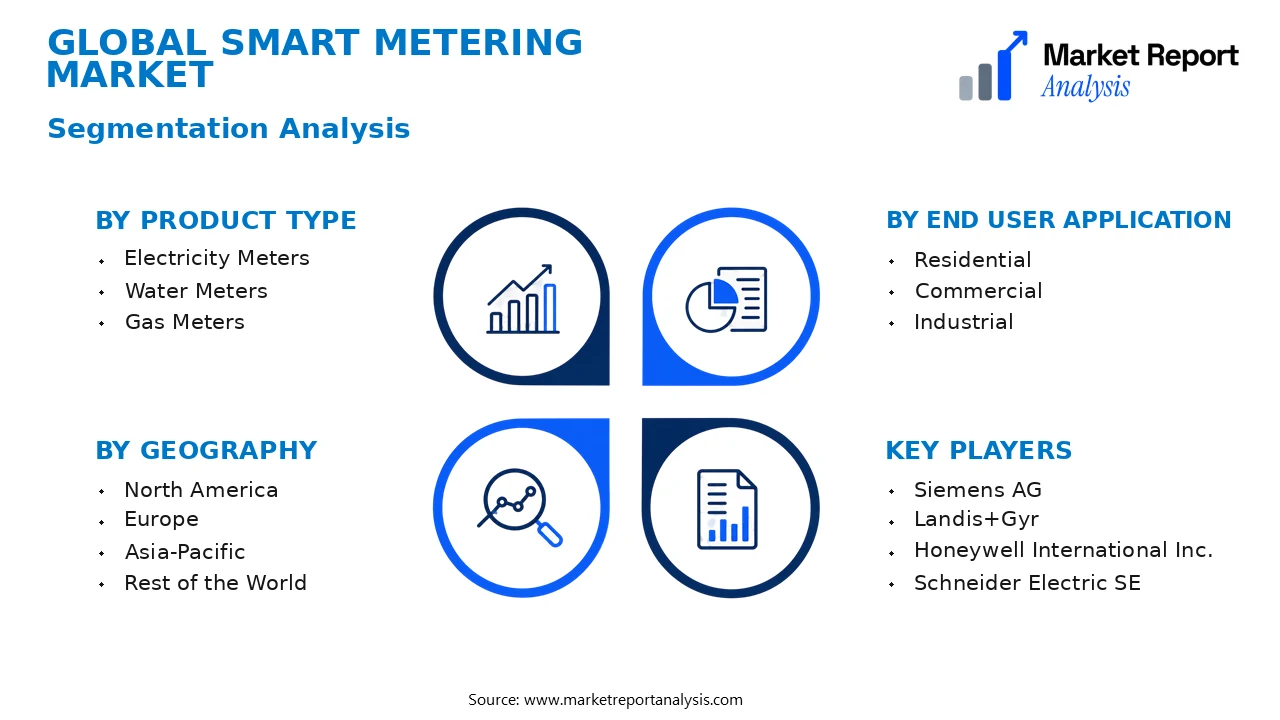
- Product Type
- Electricity Meters: These are the most widely used smart meters, enabling utilities and consumers to monitor electricity consumption in real-time, optimize energy use, and reduce costs, particularly vital in renewable integration and grid modernization efforts.
- Water Meters: Smart water meters are increasingly adopted to detect leaks, monitor consumption, and improve water resource management, driven by urban water scarcity issues and infrastructure upgrade initiatives worldwide.
- Gas Meters: These meters facilitate accurate gas consumption tracking, enhance safety measures, and support regulatory compliance, with adoption growing in regions emphasizing cleaner and more efficient energy use.
- End User Application
- Residential: Residential consumers benefit from smart meters through enhanced billing accuracy, demand response, and energy management, contributing significantly to the market growth driven by smart home integration trends.
- Commercial: Commercial end users utilize smart meters for efficient energy management, cost reduction, and regulatory compliance, which is particularly relevant for large-scale facilities and business parks.
- Industrial: In industrial settings, smart meters support complex operations, energy auditing, and process optimization, with adoption driven by industrial IoT integration and smart factory initiatives.
- Geography
- North America: This region leads in smart meter deployment due to advanced infrastructure, supportive regulatory frameworks, and high consumer awareness, with significant investments from utility companies and government agencies.
- Europe: Europe’s market growth is driven by stringent environmental policies, modernization programs, and a strong push toward energy efficiency and smart grid development across its member states.
- Asia-Pacific: Rapid economic growth, urbanization, and government incentives in countries like China, India, and Japan are fueling extensive smart meter adoption, with the region expected to exhibit the highest CAGR.
- Rest of the World: Regions such as Latin America, Africa, and the Middle East are gradually adopting smart metering solutions, driven by modernization projects, utility reforms, and international aid programs aimed at improving energy access.
This segmentation facilitates detailed market analysis, allowing stakeholders to identify priority sectors, develop region-specific strategies, and foster innovations tailored to diverse consumer needs and regulatory environments. As technological advancements continue and regulatory policies evolve, these segments will dynamically influence the overall growth trajectory of the global smart metering market, expected to reach USD billions by 2034 with a compound annual growth rate reflecting increasing investments and adoption worldwide.
Competitive Intelligence
The Smart Metering Market exhibits a competitive landscape characterized by a mix of established multinational corporations and emerging regional players. Market concentration remains moderately high, with leading firms like Landis+Gyr, Itron, and Schneider Electric dominating substantial market shares through strategic alliances and diversified product portfolios. These companies focus heavily on product innovation, investing significantly in R&D to develop advanced, secure, and interoperable metering solutions that integrate seamlessly with smart grid infrastructure. Partnerships with utility providers and technology giants facilitate market penetration and collaborative innovation. Acquisitions are a common strategic approach, allowing key players to expand their geographic reach and enhance technological capabilities rapidly. Expansion strategies include entering emerging markets and forming joint ventures to adapt offerings to local regulations and consumer needs. Competitive differentiation is maintained through the development of differentiated hardware and software solutions, emphasizing cybersecurity, data analytics, and customer engagement. Overall, the competitive environment encourages continuous innovation and strategic collaborations to sustain growth and market leadership in the evolving smart metering sector.
Leading Company Profiles
The competitive landscape of the smart metering market is characterized by a mix of globally recognized corporations with extensive product portfolios, innovative technological capabilities, and strategic initiatives aimed at strengthening market presence and fostering sustainable growth.
- Siemens AG
- Landis+Gyr
- Honeywell International Inc.
- Schneider Electric SE
- Bentley Systems
- GE Digital
- Itron, Inc.
- Duke Energy
- SUZOHAPP
- KYZEN GmbH
Siemens AG
Siemens AG offers comprehensive smart metering solutions focusing on integrated energy management and digital grid infrastructure, with a strategic emphasis on sustainability, automation, and scalable hardware-software integration across smart grid ecosystems.
Landis+Gyr
Landis+Gyr specializes in advanced smart metering technology, including accurate AMI systems and data analytics platforms, with a core focus on enhancing grid reliability and enabling utility companies to optimize energy distribution.
Honeywell International Inc.
Honeywell provides innovative connected metering solutions with a focus on smart grid integration, remote management capabilities, and IoT-enabled devices that support demand response programs and energy efficiency initiatives worldwide.
Schneider Electric SE
Schneider Electric offers modular, scalable smart metering systems prioritizing energy sustainability, grid modernization, and digital transformation efforts through robust hardware solutions complemented by cloud-based analytics platforms.
Bentley Systems
Bentley Systems delivers specialized software and hardware for utility network management, with an emphasis on data accuracy, cybersecurity, and large-scale infrastructure projects integrating smart metering technologies.
GE Digital
GE Digital provides intelligent grid solutions including smart meters and data analytics, targeted at optimizing energy flow, reducing outages, and improving operational efficiency for utility providers globally.
Itron, Inc.
Itron is a key player in smart metering with extensive offerings in AMI solutions, grid management software, and service support that drive digital transformation and smart city initiatives worldwide.
Duke Energy
Duke Energy actively deploys smart meters and IoT-enabled solutions to enhance grid reliability, enable customer engagement, and support innovative, sustainable energy programs at scale.
SUZOHAPP
SUZOHAPP offers a range of hardware components and connectivity solutions for smart meters, focusing on manufacturing excellence, secure data transmission, and integration with broader energy management systems.
KYZEN GmbH
KYZEN specializes in cleaning solutions for smart meter components, ensuring device reliability and longevity, complemented by a focus on environmentally sustainable processes and advanced cleanliness technologies.
Strategic Business Developments

- April 2023 – Siemens AG – Launched new digital twin platform for smart meter deployment – Enhanced utility operational efficiency and reduced deployment costs significantly.
- June 2023 – Landis+Gyr – Announced expansion of manufacturing capacity in North America – Addressing increasing demand for smart meters and strengthening local supply chains.
- May 2023 – Honeywell International Inc. – Initiated collaboration with a major utility provider to develop IoT-enabled demand response solutions – Accelerating innovation in consumer energy management.
- August 2023 – Schneider Electric SE – Invested in a new R&D facility dedicated to next-generation smart meter hardware and software – Fostering innovation and maintaining competitive edge.
- September 2023 – Itron, Inc. – Acquired a leading software startup specializing in AI-driven analytics platforms – Enhancing data-driven decision-making for utility companies.
Frequently Asked Questions
What is the Smart Metering Market?
The Smart Metering Market encompasses the global industry involved in designing, manufacturing, and deploying smart meters used for measuring energy consumption efficiently. It supports utility companies and consumers by providing real-time data, enhancing energy management, and enabling smart grid integration across various regions.
What is the current market size of Smart Metering Market?
As of 2026, the global Smart Metering Market is valued at approximately USD 15.2 Billion. This valuation reflects widespread adoption driven by technological advancements, regulatory mandates, and increasing demand for energy efficiency solutions worldwide.
What factors are driving the Smart Metering Market?
Key drivers include governmental initiatives for energy conservation, advancements in IoT and data analytics, growing concerns over energy efficiency, and the need for accurate consumption monitoring. Additionally, evolving regulations push for increased deployment of smart meters across residential and industrial sectors.
Which region dominates the Smart Metering Market?
North America currently leads the global market, boosted by robust energy infrastructure, supportive regulatory policies, and high adoption rates of smart grid technologies. The region’s early adoption provides a strong foundation for continued growth and innovation within the sector.
Which segment is expected to grow the fastest?
The residential segment is projected to experience the fastest growth, driven by increasing smart home initiatives, rising energy costs, and regulatory encouragement for residential energy management across emerging economies and developed nations.
Who are the leading companies operating in the Smart Metering Market?
Leading companies include Siemens AG, Landis+Gyr, Itron Inc., Schneider Electric, and Honeywell International Inc., all of which are actively engaged in innovation, strategic partnerships, and extensive deployment projects to strengthen their market presence globally.
Analyst Perspective
The long-term outlook for the global smart metering market remains robust, driven by ongoing digital transformation efforts and increasing investments in infrastructure modernization. Commercial opportunities are primarily concentrated in deploying advanced metering infrastructure (AMI) that integrates IoT and AI capabilities to enhance grid management and consumer engagement. Technological evolution is expected to focus on interoperability, enhanced cybersecurity, and real-time data analytics, which will further differentiate market offerings and enable value-added services. Investment priorities should favor scalable, flexible smart meter solutions that align with regional regulatory standards and grid requirements. Competitive intensity is rising as established utilities and new entrants accelerate product development and strategic partnerships, fostering innovation and market expansion. Key regional growth potentials include Asia-Pacific, due to government initiatives and rapid urbanization, alongside North America and Europe, where the focus remains on upgrading aging infrastructure and achieving energy efficiency targets. Overall, sustained investment and technology integration are critical for early movers to establish long-term dominance in this evolving landscape.
