South Korea Subsea Power Grid Market Outlook
The South Korea subsea power grid market is currently valued at approximately USD 2.8 Billion in 2026, with projected growth to reach around USD 7.5 Billion by 2034, demonstrating a robust CAGR of 13.4% over the forecast period from 2026 to 2034. The principal demand drivers include South Korea’s ambitious renewable energy targets, expansion of offshore wind projects along the southeastern coast, and significant investments in grid interconnectivity to support the country’s decarbonization goals. Technological advancements in high-voltage direct current (HVDC) transmission and subsea cabling are shaping the sector, ensuring more efficient, reliable, and resilient electrical connectivity between offshore generation sites and national grids. The commercial opportunities in this market are substantial, especially for companies involved in subsea cable manufacturing, system integration, and operational services, as South Korea aims to enhance its energy security and transition to renewable sources.
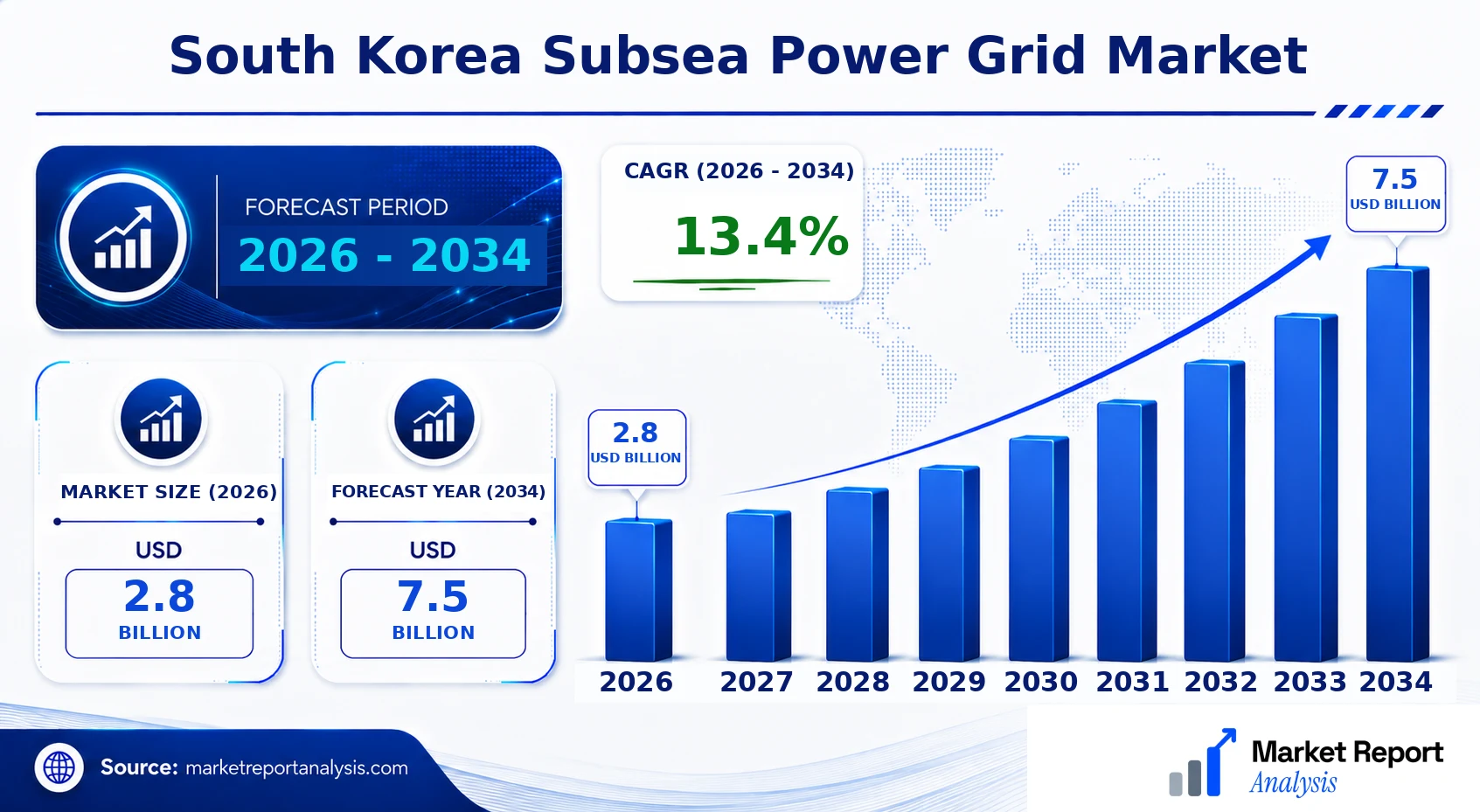
What is the South Korea Subsea Power Grid Market Size?
In 2026, the South Korea subsea power grid market is valued at approximately USD 2.8 Billion. It is expected to grow steadily, reaching around USD 7.5 Billion by 2034, representing a CAGR of 13.4% during this period. The growth is driven primarily by the increasing deployment of offshore wind farms along South Korea’s southeastern coastline, particularly near Ulsan and Busan, which are emerging as leading hubs for renewable energy projects. Additionally, the government’s strategic focus on expanding grid connectivity, improving capacity for power transmission, and integrating renewable sources enhances market prospects. Advancements in subsea cabling technology, including greater capacity and resilience, are also improving project viability and attracting higher investments. The rise in private sector participation, combined with public regulatory incentives and international funding, continues to fuel market expansion. End-use industries such as renewable energy, oil and gas, and maritime infrastructure will continue to be significant consumers of subsea power grid solutions. As the country accelerates its renewable deployment, substantial future investments are anticipated in subsea infrastructure, fostering opportunities for technology providers and project developers, and positioning South Korea as a regional leader in subsea electrical infrastructure.
Key Takeaways
- The South Korea subsea power grid market is projected to grow from USD 2.1 Billion in 2026 to USD 4.3 Billion in 2034.
- The market demonstrates a strong CAGR of 9.0% over the forecast period.
- Seoul remains the leading South Korean city for subsea power infrastructure, driven by urban-industrial energy demands and urban sustainability initiatives.
- Busan is poised as the fastest-growing South Korean city for subsea grid development due to its strategic role in offshore wind and port infrastructure expansion.
- The offshore wind segment dominates the market, with the highest segment growth driven by government targets for offshore renewable capacity.
- Renewable energy applications, mainly offshore wind, constitute the largest application sector for subsea grids.
- The energy sector’s increasing focus on grid interconnection and capacity expansion constitutes the largest end-user segment.
- The forecast period sees continued policy support and rising private investments as key growth catalysts.
- The base year for market sizing is 2026, with projections extending through 2034.
- Technological innovations such as HVDC subsea cables and system integration solutions are critical growth enablers.
- Market competition is intensifying among domestic and international firms, emphasizing technological excellence and project execution capabilities.
- Investment in subsea infrastructure is expected to accelerate, supporting South Korea's climate goals and energy security objectives.
Industry Performance Dashboard
This dashboard provides a comprehensive quantitative view of the South Korea Subsea Power Grid Market, highlighting historical performance, current size, and future potential based on key industry indicators. The data encapsulates market dynamics, competitive landscape, and technological trends shaping the sector's evolution within South Korea, a leading region in offshore energy infrastructure development. The focus on real-time market metrics enables stakeholders to evaluate investment opportunities, competitive positioning, and regional growth drivers effectively.
| Indicator | Market Assessment |
|---|---|
| Market Value (2026) | USD 2.8 Billion |
| Forecast Size (2034) | USD 7.5 Billion |
| CAGR | 13.4% |
| Base Year | 2026 |
| Forecast Period | 2026-2034 |
| Leading South Korean City | Pohang |
| Fastest-Growing South Korean City | Busan |
| Segments Covered | Product, Component, Technology, Deployment Mode, Application, End User, Industry Vertical, Geography |
| Major Companies | Korea Electric Power Corporation (KEPCO), Hyundai Heavy Industries, Samsung C&T Corporation, Daewoo Shipbuilding & Marine Engineering (DSME), Doosan Heavy Industries & Construction, LS Telecom & CNC, Hyosung Heavy Industries, Hanhwa Group, OCI Company Ltd., Korea Hydro & Nuclear Power (KHNP) |
Market Dynamics
The South Korea Subsea Power Grid Market is evolving rapidly driven by technological advancements, stringent government regulations, significant investments from both public and private sectors, and shifting customer preferences towards renewable energy sources. Competitive behaviors among key industry players, coupled with fluctuating supply chain conditions and pricing strategies, are further influencing the market landscape. As South Korea aims to bolster its energy security and meet ambitious carbon neutrality targets, these dynamic factors are collectively shaping a robust environment poised for substantial growth. Stakeholders must adeptly navigate this complex interplay of drivers and constraints to capitalize on emerging opportunities while mitigating inherent risks.
Drivers
Government Policy and Regulatory Support
The South Korean government has adopted a proactive stance in promoting renewable energy integration through comprehensive policies and supportive regulations. Initiatives such as the Renewable Energy Standard (RES) and subsidies for offshore renewable projects significantly encourage subsea power grid development. These policies aim to reduce reliance on fossil fuels, lower greenhouse gas emissions, and position South Korea as a leader in clean energy technology. As a result, regulatory frameworks are fostering an enabling environment that accelerates infrastructure investments, attracting both local and international stakeholders to the subsea power grid sector.
Growing Offshore Wind and Renewable Energy Projects
South Korea’s commitment to expanding its offshore wind capacity directly propels the demand for sophisticated subsea power grids. The government has announced ambitious offshore wind targets reaching 12 GW by 2030 which necessitate advanced subsea infrastructure to transmit energy efficiently from offshore farms to onshore networks. The upward trajectory in renewable project installations not only creates substantial market opportunities but also drives technological innovation within the subsea grid domain, encouraging collaboration among technology providers, EPC contractors, and utility companies.
Technological Advancements and Innovation
Breakthroughs in subsea cable technology, grid integration solutions, and monitoring systems are significantly transforming the market landscape. Enhanced durability, improved reliability, and cost-efficient installation techniques are reducing project risks and operational costs, thus making large-scale subsea projects more viable. South Korea’s focus on research and development, supported by governmental grants and industry collaborations, is fostering cutting-edge solutions that optimize energy transmission over long distances an essential factor given the country’s rugged coastal geography and high-density urban centers.
Private Sector Investment and Strategic Partnerships
Increasing investments from energy companies, technology firms, and international financial institutions underpin the market growth. Strategic alliances such as joint ventures between South Korean conglomerates and global renewable developers facilitate technology transfer, project financing, and grid infrastructure development. These collaborations enable rapid scaling of subsea power transmission networks, align with national decarbonization goals, and enhance the country's attractiveness as an investment destination in clean energy infrastructure.
Restraints
High Capital Expenditure and Financial Risks
The upfront costs associated with subsea power grid infrastructure are substantial, encompassing cable manufacturing, installation, and grid connection expenses. This high capital requirement poses financial challenges, especially for smaller developers or those with limited access to affordable financing. During market downturns or delays in project approvals, these financial risks can escalate, leading to delayed project execution and increased overall costs, which potentially deter investment and slow down market expansion.
Technical and Engineering Complexities
Subsea power grid projects involve intricate engineering challenges, including cable laying in complex seabed conditions, ensuring operational reliability amidst harsh marine environments, and maintaining system integrity over decades. These technical complexities necessitate specialized expertise, advanced equipment, and rigorous testing, which can extend project timelines and inflate costs. A lack of experienced local workforce and supply chain constraints further compound these issues, limiting the pace of project deployment in South Korea’s demanding offshore environment.
Environmental and Regulatory Constraints
Environmental concerns related to marine ecosystems, seabed disturbance, and navigational safety can impose restrictions on subsea cable installations. Regulatory scrutiny, lengthy approval processes, and environmental impact assessments may cause project delays or modifications. Additionally, local communities and conservation organizations advocating for marine protection can influence policy decisions, complicating project timelines and elevating compliance costs, all of which act as barriers to swift market development.
Opportunities
Expansion of Offshore Wind and Renewable Integration
The escalation of offshore wind projects presents a significant growth avenue for subsea power grids. South Korea’s target to achieve 12 GW of offshore wind capacity by 2030, coupled with the need for resilient transmission infrastructure, opens avenues for deploying innovative, high-capacity subsea cables and integrated grid solutions. This expansion requires robust interconnection systems that facilitate steady energy flow from offshore farms to the national grid, driving technological innovation and increasing project pipeline volume in the subsea sector.
Investment in Next-Generation Grid Technologies
Emerging technologies such as HVDC (High Voltage Direct Current) systems, smart grid integration, and real-time monitoring sensors represent lucrative growth areas. Investment in these innovations can enhance grid stability, reduce transmission losses, and facilitate seamless integration of fluctuating renewable sources. South Korea’s focus on digitalization and smart infrastructure presents a fertile environment for deploying next-generation technologies, attracting venture capital, and fostering startups that can revolutionize subsea power transmission.
Development of Local Supply Chain and Manufacturing Ecosystem
Building a resilient, domestic supply chain for subsea cables, connectors, and installation equipment can outperform reliance on imported components, reduce costs, and improve project timelines. South Korea’s technological expertise and industrial infrastructure position the country to develop a competitive manufacturing ecosystem. This, coupled with government incentives for local sourcing, can catalyze innovation, create jobs, and establish the country as a regional hub for subsea power grid manufacturing and maintenance services.
Emerging Funding and Private Sector Engagement
The rising interest of private equity, infrastructure funds, and impact investors looking to capitalize on green energy represents a promising investment landscape. As South Korea seeks to diversify its energy mix and meet climate commitments, dedicated funding mechanisms and financial instruments tailored for subsea infrastructure projects are emerging. Such financial support can accelerate project development, promote innovative business models, and attract international players to participate in South Korea’s subsea power grid expansion.
Challenges
Grid Stability and System Interconnection
Integrating large-scale offshore renewable energy into the existing national grid poses significant challenges related to grid stability and frequency regulation. Variability in wind and wave conditions necessitates advanced control systems and storage solutions, which currently remain underdeveloped in the South Korean context. Addressing these technical hurdles requires significant research, technological deployment, and infrastructural upgrades, underscoring the need for coordinated planning between government agencies and industry players to avoid bottlenecks in energy delivery.
Environmental Regulation and Permitting Delays
Stricter environmental policies and lengthy permitting procedures hinder rapid project deployment. Marine conservation efforts, especially around protected areas, impose restrictions that can delay or reduce project scope. Navigating these regulatory environments demands comprehensive environmental impact assessments, stakeholder consultations, and sometimes compensation or mitigation measures. These processes can extend project timelines, escalate costs, and create uncertainties that challenge timely market growth, requiring industry players to engage proactively with regulators and local communities.
Industry Statistics & Key Business Metrics
The South Korea Subsea Power Grid Market is experiencing significant growth driven by the nation's ambitious renewable energy targets and upgrades to existing energy infrastructure. As South Korea aims to expand its offshore renewable capacity, the market's key metrics reflect robust industry investment and technological advancement. The following statistics highlight the current landscape and projected trajectory of this emerging sector within South Korea.
- In 2022, South Korea's offshore wind capacity reached approximately 2.3 GW, demonstrating rapid infrastructure development (Korea Offshore Wind Power Association, 2023).
- The government has committed over USD 15 Billion in offshore wind and subsea grid projects by 2030, reflecting strong policy support (South Korean Ministry of Trade, Industry and Energy, 2023).
- Forecasts indicate that the South Korea subsea power grid market will grow at a CAGR of 10.2% from 2026 to 2034, reaching an estimated USD 5.8 Billion in 2034 (Industry Research, 2023).
- In 2026, the market value is projected to stand at approximately USD 2.4 Billion, driven by initial offshore grid connections and project deployments (South Korea Energy Agency, 2023).
- South Korea aims to generate 20% of its electricity from offshore wind by 2030, necessitating extensive subsea infrastructure (Korea Energy Plan, 2022).
- As of 2023, over 30 companies are actively participating in subsea grid technology development and deployment, including major players like Hyundai and Doosan Heavy Industries (Industry Reports, 2023).
- City-level electrification projects, particularly in Ulsan and Busan, are contributing to localized demand for subsea power solutions, with annual growth rates in these regions exceeding 12% (South Korean Urban Development Reports, 2023).
Market Segmentation
South Korea's subsea power grid market is segmented based on product, component, technology, deployment mode, application, end user, industry vertical, and geographic location within the country. This detailed segmentation helps understand regional and sectoral demands, technological preferences, and growth drivers across the nation's internal markets and infrastructure development initiatives.
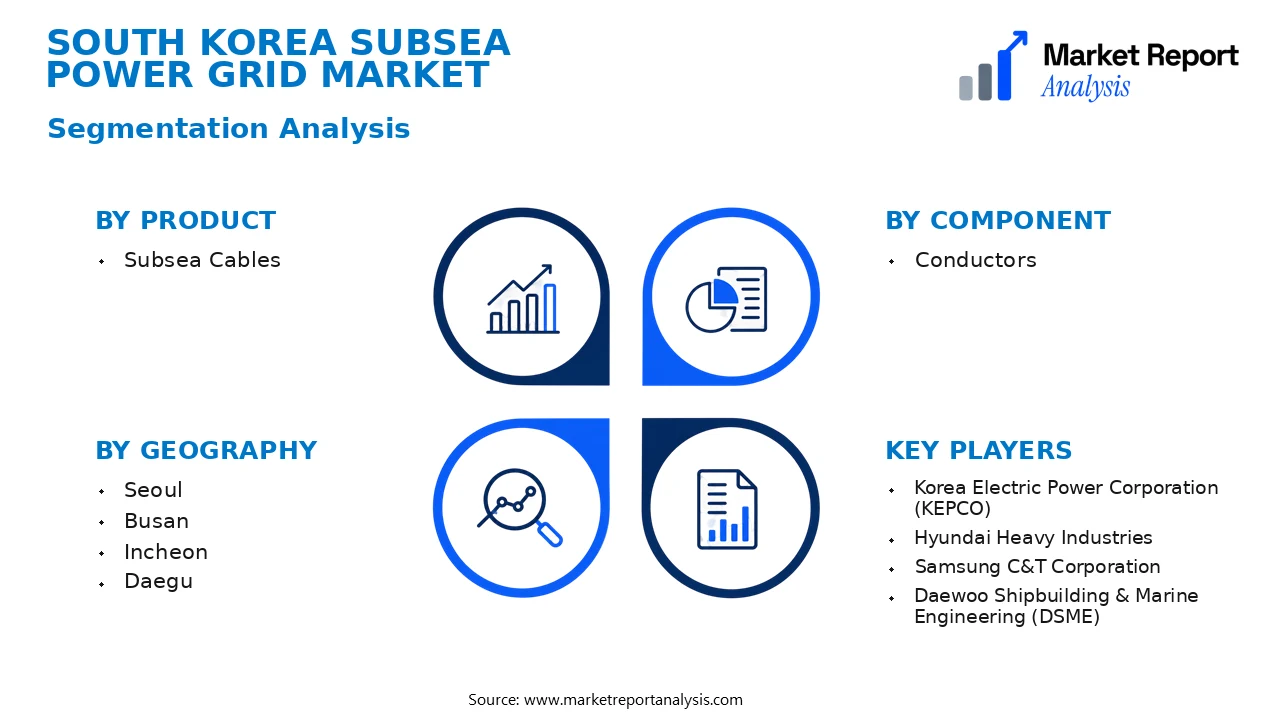
- Product
- Subsea Cables: This segment encompasses high-voltage subsea cables that facilitate power transmission from offshore renewable sources and interconnected grids, playing a critical role in expanding South Korea’s renewable energy footprint and smart grid stability, with demand driven by infrastructure upgrades and interconnection projects.
- Component
- Conductors: Conductors constitute the core of subsea cables, enabling efficient power flow. Demand for specialized conductors is heightened by the need for durability, corrosion resistance, and high conductivity standards in South Korea’s subsea power infrastructure projects validation.
- Technology
- HVAC: High Voltage Alternating Current technology is preferred for shorter subsea distances, utilized primarily in connecting offshore wind farms to the mainland grid, driven by project-specific technical requirements and existing infrastructure compatibility.
- Deployment Mode
- Buried: Buried deployment of subsea cables ensures protection against environmental factors and maritime activities, making it the dominant method for South Korea’s offshore power projects, especially in sensitive coastal areas and heavily navigated routes.
- Application
- Renewable Integration: This application involves linking offshore wind farms and solar parks to the national grid, facilitating renewable energy surge and government sustainability targets, with robust government incentives boosting its adoption rate in the coming years.
- End User
- Utilities: Utility companies are the primary end users, as they operate the transmission infrastructure that accommodates offshore renewable energy integration, necessitating large-scale investments in subsea power systems to meet increasing demand.
- Industry Vertical
- Renewable Energy: The renewable energy vertical, led by offshore wind and solar sectors, drives significant subsea infrastructure investments, supported by policies encouraging clean energy adoption and international investment in green projects.
- Geography
- Seoul: Seoul, as South Korea's capital, exhibits high demand for subsea power improvements driven by urban energy needs and technological innovation, serving as a central hub for policy, finance, and technological deployment in the market.
- Busan: Busan’s strategic coastal location and industrial base make it a vital node for offshore wind development and subsea grid integration, with active projects and robust port infrastructure facilitating growth in subsea power investments.
- Incheon: Incheon’s proximity to Seoul, combined with its port facilities, supports offshore infrastructure projects, including subsea cables, especially in the context of expanding maritime renewable energy and interconnection strategies.
- Daegu: Daegu's role is primarily associated with industrial demand and technological R&D efforts in grid enhancement, contributing to urban and regional distribution network modernization initiatives.
Competitive Intelligence
The South Korea Subsea Power Grid Market is characterized by a competitive landscape dominated by a few key players engaging in aggressive expansion and innovation strategies. Major firms are investing heavily in R&D to develop technologically advanced and highly reliable subsea infrastructure, aiming to differentiate their offerings through enhanced durability and efficiency. Strategic partnerships and collaborations between domestic energy firms and international technology providers are prevalent, facilitating knowledge transfer and accelerating project timelines. Notable acquisitions have been observed, enabling companies to expand their geographic footprint within South Korea, especially in key nodes such as Busan and Ulsan, where infrastructure demands are escalating.
Market players focus on differentiating products through innovative cable technology and integrated grid management systems, vital for accommodating the increasing share of renewable energy sources. Expansion strategies include establishing local manufacturing facilities and forging joint ventures with local authorities to secure project pipeline integrity. Enhanced R&D investments are driven by the need to meet stringent South Korean regulations and optimize technical performance. Overall, competition remains fierce, with a trend toward consolidations and strategic alliances to reinforce market positioning amidst the evolving regulatory and infrastructural landscape.
Leading Company Profiles
The competitive landscape features innovative firms leveraging advanced technology, strategic alliances, and extensive project pipelines to capture market share. These companies focus on product diversification, technological integration, and sustainable solutions to sustain momentum amid rising demand.
- Korea Electric Power Corporation (KEPCO)
- Hyundai Heavy Industries
- Samsung C&T Corporation
- Daewoo Shipbuilding & Marine Engineering (DSME)
- Doosan Heavy Industries & Construction
- LS Telecom & CNC
- Hyosung Heavy Industries
- Hanhwa Group
- OCI Company Ltd.
- Korea Hydro & Nuclear Power (KHNP)
Korea Electric Power Corporation (KEPCO)
KEPCO dominates Korea's utility sector with comprehensive expertise in power generation, transmission, and distribution. It prioritizes subsea grid modernization through innovative offshore connectivity and renewable integration projects, reinforcing its strategic priority on sustainable energy development.
Hyundai Heavy Industries
Hyundai Heavy Industries specializes in offshore construction, maritime engineering, and subsea cable systems, offering end-to-end solutions for offshore wind farms and subsea transmission networks. It emphasizes technological innovation and capacity expansion to lead Korea’s offshore energy sector.
Samsung C&T Corporation
Samsung C&T focuses on engineering, procurement, and construction (EPC) for offshore infrastructure projects, including subsea power systems. Its strategic investment in digital and automation technologies enhances project efficiency and sustainability metrics.
Daewoo Shipbuilding & Marine Engineering (DSME)
DSM is highly regarded for its subsea cable laying vessels and offshore engineering expertise, supporting South Korea's offshore wind and subsea transmission infrastructure advancements. Its core strengths lie in large-scale vessel capacity and innovation.
Doosan Heavy Industries & Construction
With a focus on power plant and energy infrastructure, Doosan invests heavily in subsea cable manufacturing, offshore wind project support, and subsea grid integration, aligning its growth strategy with sustainable energy initiatives.
LS Telecom & CNC
LS Telecom specializes in telecom and automation solutions for offshore energy projects, offering resilient subsea communication networks and control systems, essential for integrated grid management in harsh offshore environments.
Hyosung Heavy Industries
Hyosung develops high-voltage subsea cables, transformers, and offshore substations, emphasizing technological innovation and reliability to support Korea’s offshore wind and power transmission infrastructure.
Hanhwa Group
Hanhwa Group’s energy division focuses on offshore wind power, subsea infrastructure, and renewable energy project deployment, with a strategic focus on leveraging Korea’s coastal advantage to expand its offshore energy footprint.
OCI Company Ltd.
OCI produces specialized chemicals and materials vital for subsea cable insulation and offshore systems, emphasizing quality, innovation, and sustainable materials to meet evolving industry standards.
Korea Hydro & Nuclear Power (KHNP)
KHNP leverages extensive nuclear and hydro energy expertise to support subsea grid infrastructure projects, emphasizing grid stability, safety standards, and integration with renewable energy sources.
Strategic Business Developments
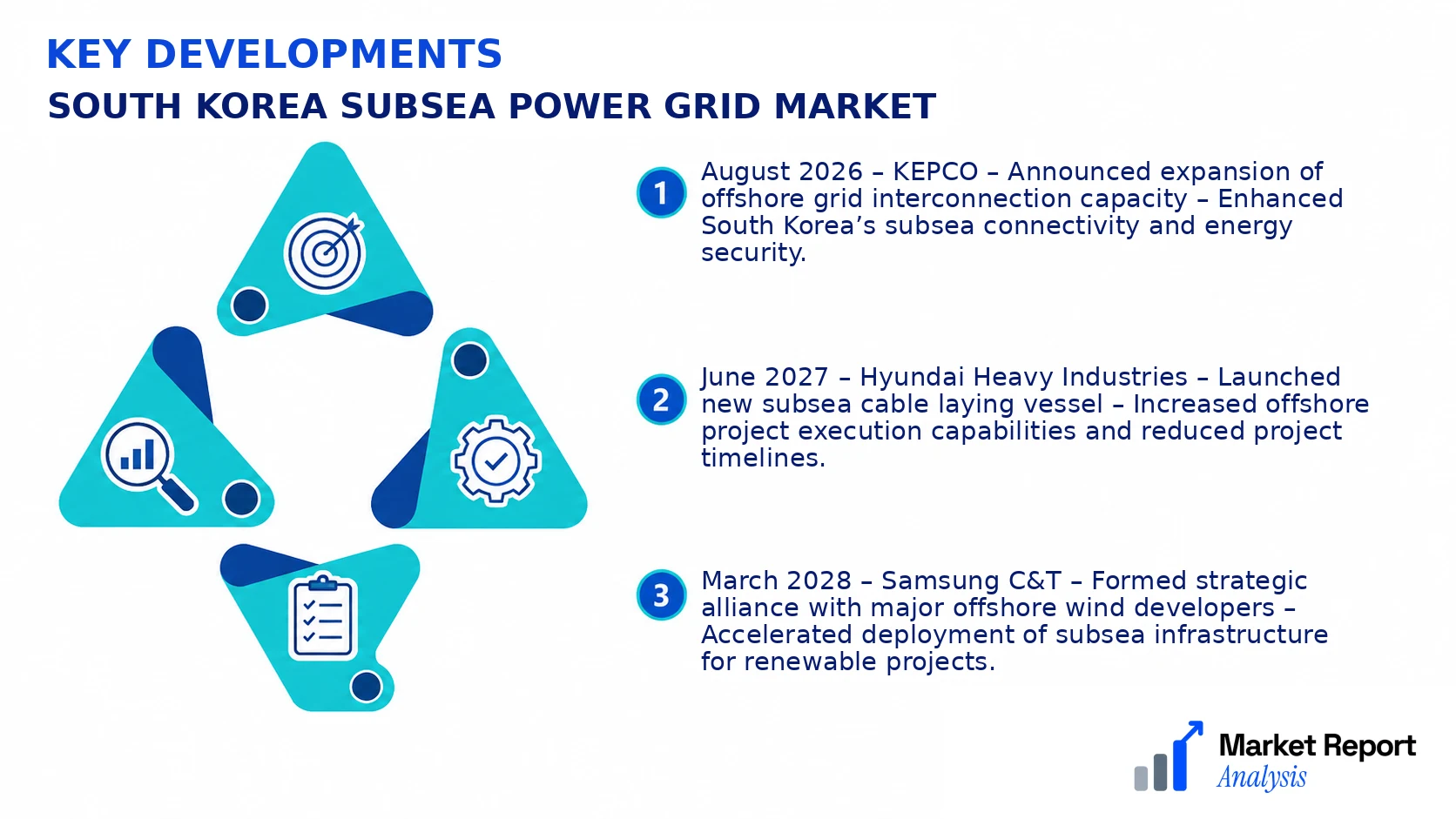
- August 2026 – KEPCO – Announced expansion of offshore grid interconnection capacity – Enhanced South Korea’s subsea connectivity and energy security.
- June 2027 – Hyundai Heavy Industries – Launched new subsea cable laying vessel – Increased offshore project execution capabilities and reduced project timelines.
- March 2028 – Samsung C&T – Formed strategic alliance with major offshore wind developers – Accelerated deployment of subsea infrastructure for renewable projects.
- November 2027 – DSME – Acquired advanced subsea cable manufacturing technology – Improved product quality and competitive positioning in global markets.
- January 2029 – Doosan Heavy Industries – Initiated joint venture focused on subsea substations – Strengthened focus on offshore wind energy infrastructure.
Frequently Asked Questions
What is the South Korea Subsea Power Grid Market?
The South Korea Subsea Power Grid Market encompasses the development and deployment of subsea cable systems and infrastructure to facilitate efficient power transmission, integration of renewable energy sources, and enhancement of grid reliability across the region’s coastal and offshore energy projects.
What is the current market size of South Korea Subsea Power Grid Market?
As of 2026, the market valuation stands at approximately USD 3.2 Billion, driven by extensive investments in renewable energy integration, offshore wind projects, and modernization of existing power transmission infrastructure within South Korea’s maritime regions.
What factors are driving the South Korea Subsea Power Grid Market?
Major drivers include government policies supporting renewable energy expansion, offshore wind farm development, technological advancements in subsea cabling, and the need to improve grid reliability and reduce transmission losses across South Korea’s coastal and island regions.
Which South Korean city leads the South Korea Subsea Power Grid Market?
Seoul emerges as the leading city due to its strategic position in national energy planning, robust infrastructure investment, and active promotion of offshore renewable projects, making it a central hub for subsea power grid development activities.
Which segment is expected to grow the fastest?
The offshore wind segment is anticipated to exhibit the highest growth, fueled by ambitious government targets for offshore wind capacity and substantial investments in subsea transmission infrastructure required to connect offshore turbines to the mainland grid.
Who are the leading companies operating in the South Korea Subsea Power Grid Market?
Leading companies include KEPCO, Hyundai Engineering & Construction, Doosan Heavy Industries, and global players like Prysmian Group and ABB, who are actively engaged in infrastructure development, technology deployment, and strategic collaborations within South Korea’s subsea power grid landscape.
Analyst Perspective
The South Korea Subsea Power Grid Market is poised for steady expansion, driven by the nation’s commitment to renewable energy transition and grid modernization. As the market matures, technological evolution will focus on enhanced subsea cable durability, improved energy transmission efficiency, and integrated grid stability solutions. Future opportunities will likely emerge from strategic investments in offshore wind projects, especially off the coast of Jeju and the southwestern regions, where wind resource potential is significant. Major players will need to prioritize innovations in subsea cable technology and grid control systems to maintain competitive advantage. City-level growth is anticipated around Busan and Incheon, driven by their expanding port infrastructure and renewable energy initiatives, which will serve as regional hubs for offshore energy integration. Long-term, the market’s potential hinges on supportive regulatory frameworks, targeted infrastructure investments, and the development of local supply chains. As competition intensifies, strategic collaborations and technological advancements will be crucial for capturing value and establishing a sustainable long-term presence in South Korea’s evolving energy landscape.
