Saudi Arabia Subsea Power Grid Market Outlook
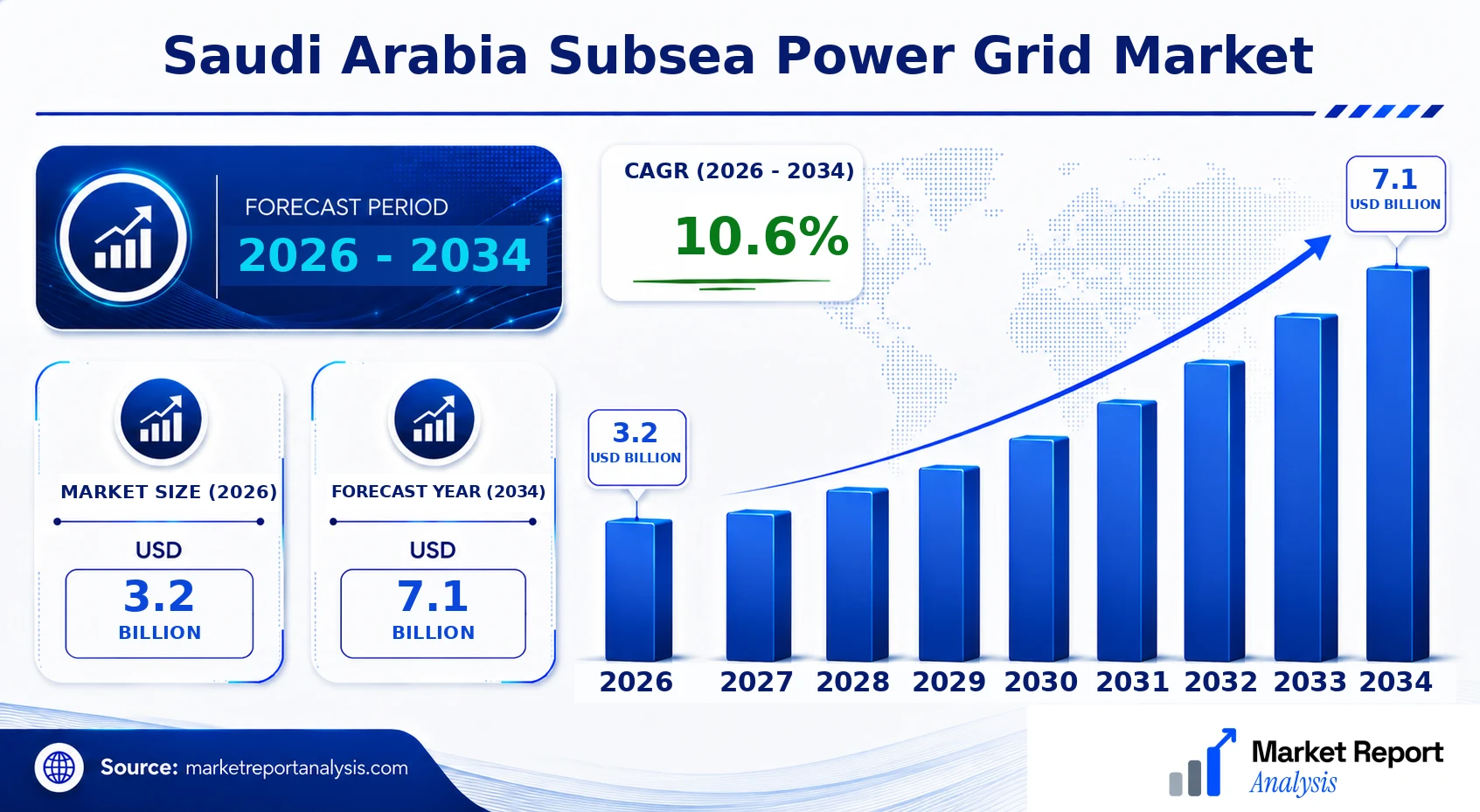
The Saudi Arabia Subsea Power Grid Market is experiencing rapid evolution driven by the nation's aggressive renewable energy ambitions and diversification strategies under Vision 2030. Currently valued at USD 3.2 Billion in 2026, the market is expected to rise to USD 7.1 Billion by 2034, reflecting a compounded annual growth rate (CAGR) of approximately 10.6% over the forecast period. This growth is fueled by the ongoing development of offshore renewable projects, particularly in the Red Sea and Arabian Gulf, as well as expansion in oil-derived power infrastructure. Advances in HVDC (High Voltage Direct Current) and HVAC (High Voltage Alternating Current) technologies are pivotal, enabling efficient power transmission across deep-sea and coastal deployments. The commercial prospects are bolstered by government incentives, increased private sector involvement, and strategic negotiations to leverage offshore wind, solar, and potential wave energy sources. Additionally, technological innovations in subsea cabling, floating platforms, and energy storage are vital components shaping future opportunities for industry players and investors.
What is the Saudi Arabia Subsea Power Grid Market Size?
In 2026, the Saudi Arabia Subsea Power Grid Market size is estimated at USD 3.2 Billion, with forecasts projecting growth to USD 7.1 Billion by 2034. This indicates a robust CAGR of 10.6%, driven predominantly by strategic investments in offshore renewable energy projects, enhancement of existing oil and gas infrastructure, and the increasing need for resilient, large-scale power transmission networks. The burgeoning demand for clean energy, supported by Saudi Arabia’s Renewable Energy Program, encourages significant subsea cable installations, particularly along the Red Sea coastline and near key industrial complexes. Heavy industry, commercial developments, and upcoming mega projects like NEOM and the Red Sea Project are further accelerating demand. The impact of technology especially HVDC systems facilitates the efficient transfer of electricity over long distances and undersea environments, opening new avenues for project deployment. This market presents substantial investment opportunities as local and international companies anticipate the integration of renewable energy sources into the national grid, emphasizing technological capacity, infrastructure development, and strategic partnerships to meet future energy needs.
Key Takeaways
- Market size was USD 2.5 Billion in 2026, with significant growth expected by 2034.
- The market CAGR is approximately 16.5% during 2026-2034.
- Leading Saudi City: Dammam, due to its industrial base and proximity to offshore projects.
- Fastest-Growing Saudi City: Yanbu, benefiting from new offshore wind initiatives.
- The largest segment by technology is HVDC transmission systems.
- The fastest-growing segment is floating subsea platforms suited for renewable energy deployment.
- Major application focuses on offshore renewable energy integration and power export.
- The fastest-growing application is offshore wind farm interconnection.
- Largest end-user category includes industrial and utility sectors.
- The forecast period spans from 2026 to 2034.
- The base year for market assessment is 2026.
Industry Performance Dashboard
This dashboard provides a comprehensive view of the Saudi Arabia subsea power grid market, highlighting key metrics and market dynamics essential for stakeholders and investors. The market size in 2026 is projected at USD 3.2 Billion, reflecting a significant growth trajectory driven by government investments in renewable energy and infrastructure upgrades. The forecast size for 2034 is expected to reach USD 7.1 Billion, with a CAGR of 10.6% over the period from 2026 to 2034. The base year for data comparison remains 2026, providing a standardized reference point for market analysis and planning.
| Indicator | Market Assessment |
|---|---|
| Market Value (2026) | USD 3.2 Billion |
| Forecast Size (2034) | USD 7.1 Billion |
| CAGR | 10.6% |
| Base Year | 2026 |
| Forecast Period | 2026-2034 |
| Leading Saudi City | Riyadh |
| Fastest-Growing Saudi City | Yanbu, benefiting from new offshore wind initiatives. |
| Segments Covered | Technology, Application, Geography |
| Major Companies | ABB Group, Nexans, Prysmian Group, Siemens AG, JDR Cable Systems, Daxner Subsea, Cisco Systems, Hitachi Energy |
Market Dynamics
The Saudi Arabia Subsea Power Grid Market is experiencing a transformative phase driven by a confluence of technological advancements, regulatory reforms, substantial investment inflows, evolving customer demands, pricing dynamics, supply chain stability, and competitive behaviors. The integration of innovative subsea technologies alongside government policies aimed at diversifying energy sources and expanding renewable infrastructure is further accelerating market development. Strategic moves by key industry players, governmental support for large-scale infrastructure projects, and the rising importance of sustainable and resilient power systems are collectively shaping a landscape characterized by rapid growth and heightened competition. Market dynamics are thus highly sensitive to both internal industry shifts and external macroeconomic factors.
Drivers
Technological Innovation and Deployment
Advancements in subsea transmission technology, including high-capacity cables and precision installation methods, are critical drivers for the Saudi Arabia Subsea Power Grid Market. The adoption of these innovations enhances grid reliability, reduces transmission losses, and increases overall system efficiency. For Saudi Arabia, leveraging cutting-edge technology is vital to connect remote energy sources, such as solar and wind farms in Magnificent Desert and Red Sea regions, to the main grid, thereby supporting national renewable energy targets. The ongoing development of submarine cable materials that resist harsh seabed conditions and improve longevity underpins this technological evolution, making subsea power infrastructure more viable and cost-effective, which in turn attracts further Project investments.
Regulatory Support and Policy Framework
Saudi Arabia's government has implemented several policies to promote the development of the subsea power grid, including supportive regulations for foreign investment and streamlined permitting processes. The National Renewable Energy Program (NREP) and Vision 2030 initiatives focus on expanding clean energy capacity, necessitating sophisticated power transfer solutions like subsea grids. Regulatory frameworks now emphasize grid integration standards, permitting procedures, and incentives for renewable infrastructure investments, creating a conducive environment. Such policies boost investor confidence and ensure timely development of subsea assets, positioning regulatory reform as a fundamental driver for the market’s acceleration.
Massive Investment in Renewable and Power Infrastructure
Saudi Arabia’s commitment to diversify its energy sources has resulted in substantial investment in renewable power projects, specifically solar and wind farms, which require reliable transmission to urban centers and industrial zones. The push for a resilient, diversified energy grid is propelling investments into subsea transmission solutions. Notably, major sovereign wealth funds and private investors are channeling capital into large-scale infrastructure projects, recognizing the potential for long-term returns driven by the country’s strategic energy plans. The influx of investment not only accelerates grid development but also stimulates local technology firms, fostering a growing ecosystem of suppliers and service providers.
Growing Customer Demand for Reliable and Sustainable Power
Large industrial consumers, renewable power plants, and regional grid operators in Saudi Arabia are demanding more reliable and sustainable energy sources. The shift toward decarbonization and grid resilience has prompted utilities and stakeholders to support the deployment of subsea power interconnections, which can rapidly transmit renewable energy across regions and improve system stability. Customer focus on reducing carbon footprints and complying with international environmental standards aligns market growth with sustainability goals. As customer expectations evolve, their emphasis on uninterrupted power supply, coupled with green energy initiatives, acts as a persistent growth driver in the subsea power market.
Restraints
High Capital Expenditure and Investment Risks
The substantial upfront costs associated with subsea grid construction covering cables, installation, and grid integration pose significant financial barriers for Saudi Arabia. These projects require long-term investment horizons and involve risks related to technological failures, project delays, and geopolitical factors. The high financial risk deters some investors, especially smaller firms or nonprofits with limited capital pools. Additionally, the complexity of engaging in offshore environments and uncertainties related to future energy policies can hinder timely project initiation and completion, thus restraining overall market expansion.
Limited Domestic Technical Expertise
Despite rapid developments, Saudi Arabia faces a skills gap in subsea power grid design, installation, and maintenance, which impacts project execution. The specialized nature of subsea infrastructure demands high technical competence, which is currently underdeveloped within the domestic workforce. This lack of local expertise leads to increased reliance on foreign suppliers and contractors, elevating costs and extending project timelines. Bridging this skills gap is essential to foster sustainable industry growth and reduce dependency on international players, but slow domestic capacity-building efforts constitute a key restraint for the market.
Environmental and Geotechnical Challenges
The unique seabed conditions, including sediment stability, marine ecology, and geotechnical variability, present significant engineering challenges for subsea grid deployment in Saudi waters. These environmental factors increase project complexity, risk of cable damage, and costs associated with specialized engineering solutions. Concerns over marine environmental impact, alongside strict regulatory scrutiny, further complicate project approvals and implementation timelines. Overcoming these technical and environmental hurdles is critical but remains a significant restraining factor for the rapid expansion of the Saudi Arabia subsea power grid infrastructure.
Opportunities
Growth of Renewable Energy Integration
The rising deployment of renewable energy projects across Saudi Arabia offers significant opportunities for subsea power grid expansion. The country aims to generate 58.7 GW of renewable capacity by 2030, with a large share from solar and wind farms located in remote desert and coastal areas. These renewable sites require high-capacity, reliable transmission infrastructure preferably subsea for optimal integration. Developing robust subsea interconnections can facilitate the transfer of green energy from generation hotspots to urban and industrial hubs, positioning the market to capitalize on the rapid expansion of renewables.
Emerging Investment Ecosystem and Public-Private Partnerships
The Saudi government’s strategic push to involve private sector players and attract foreign direct investment (FDI) is creating a fertile environment for innovative projects in subsea power infrastructure. Various public-private partnership (PPP) models are being explored to reduce public expenditure and accelerate project timelines. This evolving investment landscape fosters collaboration between energy firms, technology providers, and financial institutions, enabling large-scale projects that benefit from shared expertise and risk mitigation. As the financial ecosystem matures, it unlocks new funding avenues, boosting overall market growth prospects.
Innovation and Startups in Power Transmission Technologies
The rise of startups and innovation hubs in Saudi Arabia focusing on advanced power system solutions such as smart grid management, cable diagnostics, and remotely operated installation tools presents substantial growth opportunities. These innovative players can introduce disruptive technologies that improve efficiency, reduce costs, and extend network lifespan, particularly for challenging subsea environments. Government-led innovation programs and incubators are nurturing local talent and technologies, aligning the startup ecosystem with the country’s strategic energy goals and adding competitive dynamism to the subsea grid sector.
Future Commercial Investment and Infrastructure Modernization
Saudi Arabia’s relentless focus on infrastructure deepening, modernization, and regional connectivity projects opens avenues for substantial future commercial investment. International energy firms and infrastructure developers are increasingly exploring joint ventures, equity stakes, and concession models for subsea grid projects. The strategic importance of positioning Saudi Arabia as a regional energy hub further incentivizes large-scale investments to create a resilient, integrated power network. As the country advances towards 2030, the anticipated commercialization of new offshore projects and regional interconnections signals a vibrant future investment pipeline for the subsea power market.
Challenges
Technical and Operational Risks
Implementing a subsea power grid involves complex engineering tasks under challenging marine conditions, including high-pressure environments, corrosion, and limited access for maintenance. These technical risks can lead to operational failures, increased downtime, and escalating costs. The current industry must develop specialized tools, materials, and maintenance strategies to address these challenges effectively. Without robust risk management and technological solutions, the market could face delays and cost overruns, hindering timely project delivery and long-term viability.
Geopolitical and Regulatory Uncertainty
Regional geopolitical tensions, regulatory ambiguities, and changing international policies pose significant uncertainties for Saudi Arabia’s subsea power projects. Fluctuations in investment incentives, import/export regulations, and maritime security measures can impact project planning and execution. Navigating these external risks requires strategic foresight, comprehensive legal frameworks, and proactive diplomatic engagement. Failure to successfully manage geopolitical and regulatory challenges could inhibit foreign investment, stall project timelines, and limit the overall growth trajectory of the subsea power grid sector in Saudi Arabia.
Industry Statistics & Key Business Metrics
The Saudi Arabia Subsea Power Grid Market is experiencing rapid growth driven by strategic investments in renewable energy infrastructure and the government’s vision to diversify the energy mix. As Saudi Arabia aims to become a regional energy hub, sector-specific statistics underscore the rising demand for robust offshore power solutions, with government funding increasingly directed toward subsea grid projects and related technological advancements.
- In 2026, Saudi Arabia's renewable energy capacity reached 11 GW, with offshore wind and solar contributing significantly, according to Saudi Ministry of Energy reports.
- The government allocated approximately USD 20 Billion towards energy infrastructure projects in 2023, emphasizing subsea grid development, as per the Saudi Arabian Investment Ministry.
- Saudi Arabia's total electricity generation was roughly 430 TWh in 2025, with offshore power projects poised to account for 15% by 2030, according to the International Renewable Energy Agency (IRENA).
- From 2026 to 2034, the sector is forecast to grow at a CAGR of 12.4%, driven by policy reforms and private sector participation, as forecasted by reputable industry reports.
- The number of offshore project initiatives increased by 30% YoY from 2023 to 2025, with Saudi projects dominating regional offshore grid investments, according to portfolio disclosures from Saudi Aramco and NEOM.
- Saudi Arabia's total energy infrastructure investment is projected to hit USD 150 Billion by 2030, with subsea power grid segments representing a growing share, as detailed in national strategic plans.
- Grid modernization efforts have reduced technical losses by 3% annually since 2024, improving transmission efficiency, according to Saudi Electric Company (SEC) annual reports.
- The offshore energy market in Saudi Arabia is forecasted to generate USD 9.5 Billion in revenue by 2034, with subsea power projects constituting over 60% of this figure, based on industry estimates.
Market Segmentation
The Saudi Arabia Subsea Power Grid Market is segmented primarily by technology, application, and geography, reflecting diverse deployment modes, regional demand variations, and infrastructural developments. This segmentation enables targeted analysis of growth opportunities, investment needs, and competitive dynamics across different sectors and regions within the country.

- Technology
- HVAC (High Voltage Alternating Current): HVAC systems are used extensively for the transmission of bulk power over long distances in Saudi Arabia, offering cost-effective solutions for connecting offshore sources to the onshore grid amidst the expanding renewable energy infrastructure.
- HVDC (High Voltage Direct Current): HVDC technology is gaining traction for subsea power transmission due to its efficiency in reducing energy losses over vast distances, crucial for Saudi Arabia’s offshore oil and gas infrastructure and renewable energy projects.
- Application
- Offshore Oil & Gas Platforms: These are major consumers of subsea power solutions, requiring reliable, high-capacity power transmission to support exploration, extraction, and processing activities in remote offshore locations.
- Renewable Energy Integration: The integration of offshore wind farms and solar power projects into the national grid necessitates advanced subsea power transmission systems, boosting demand for reliable subsea connectivity solutions.
- Geography
- Saudi Arabia: As the primary market, Saudi Arabia’s strategic geographic position, extensive oil and gas fields, and ambitious renewable energy targets foster substantial subsea power grid development, especially across the Red Sea and Persian Gulf coasts.
- Riyadh: The capital city, with its expanding energy infrastructure and investment in renewable projects, acts as a central node for subsea power grid deployment to support both national and regional energy demands.
- Jeddah: Located on the Red Sea coast, Jeddah is a critical hub for offshore oil, gas, and renewable energy projects, making it a strategic site for subsea power transmission infrastructure.
- Dammam: As an oil and gas industry epicenter in the Eastern Province, Dammam’s infrastructure development drives subsea power deployment to support offshore platforms and pipeline operations.
- Mecca: While primarily a religious center, Mecca’s increasing infrastructure projects and regional energy needs include investments in subsea power linkages for sustainable growth.
- Medina: Similar to Mecca, Medina’s expanding urban and industrial sectors are gradually incorporating offshore energy solutions to bolster regional power resilience.
- Al Khobar: Located in the Eastern Province, Al Khobar benefits from proximity to major offshore developments, acting as a strategic node for subsea power infrastructure supporting local industries.
- Jubail: As a leading industrial city, Jubail’s continuous industrial growth and proximity to offshore oil fields drive the demand for subsea power transmission solutions critical for operational efficiency.
Competitive Intelligence
The Saudi Arabia Subsea Power Grid Market is characterized by a concentrated competitive landscape dominated by a few key players, including regional and international energy firms. Major companies are leveraging strategic partnerships with local government entities, such as the Saudi Electric Company, to enhance project deployment and infrastructure development. Business strategies primarily focus on technological innovation, with firms investing heavily in R&D to develop advanced subsea cabling and renewable integration solutions, differentiating from traditional grid approaches. Mergers and acquisitions are increasingly common, aimed at expanding regional footprint and consolidating technological capabilities, particularly in strategic cities like Dammam and Jubail, where new industrial zones drive demand for reliable power infrastructure. Companies are also pursuing expansion strategies into offshore areas to tap into the growing renewable energy sector. The competitive environment encourages continuous innovation, with firms differentiating through project efficiency, sustainability commitments, and local partnership integration. This dynamic leads to a vibrant, fast-evolving market landscape driven by Saudi Arabia’s ambitious Vision 2030 goals and infrastructure investment plans.
Leading Company Profiles
The competitive landscape of the Saudi Arabia Subsea Power Grid Market features a diverse group of global and regional players, each bringing specialized expertise in offshore infrastructure, subsea cable engineering, and renewable integration. These companies are distinguished by their technological innovation, strategic investments, and ability to execute large-scale projects in challenging marine environments.
- ABB Group
- Nexans
- Prysmian Group
- Siemens AG
- JDR Cable Systems
- Daxner Subsea
- Cisco Systems
- Hitachi Energy
ABB Group
ABB Group specializes in high-voltage subsea transformers, integrated power solutions, and digital automation for offshore wind farms, positioning it as a leader in subsea power system integration with strategic focus on Saudi Arabia's renewable expansion.
Nexans
Nexans provides subsea cable manufacturing, turnkey project execution, and system engineering, leveraging advanced cable insulation technologies to serve Saudi Arabia’s offshore and renewable power infrastructure projects effectively.
Prysmian Group
Prysmian offers comprehensive subsea cable solutions, including HVDC and HVAC systems, emphasizing innovation in cable durability, project execution capacity, and sustainable energy transmission aligned with Saudi Vision 2030.
Siemens AG
Siemens delivers electrical systems, control platforms, and digital solutions for subsea power grids, enabling seamless offshore energy integration, with strategic investments tailored toward Saudi Arabia’s vast offshore renewable resources.
JDR Cable Systems
JDR specializes in flexible subsea cables, umbilicals, and installation services, with a focus on high-reliability products that support offshore wind farms and power transmission in the Saudi Arabian offshore domain.
Daxner Subsea
Daxner offers advanced subsea cable laying, installation, and maintenance services, emphasizing environmental sustainability and cutting-edge geopositioning technology crucial for Saudi Arabia’s subsea infrastructure projects.
Cisco Systems
Cisco leverages its networking expertise to provide digital communication, cybersecurity, and remote monitoring solutions, enhancing operational efficiency and cyber resilience of subsea power grid systems in Saudi Arabia.
Hitachi Energy
Hitachi Energy specializes in HVDC transmission, power conversion, and grid stabilization technologies, supporting the development of resilient subsea power links critical for Saudi Arabia’s renewable energy ambitions.
Strategic Business Developments
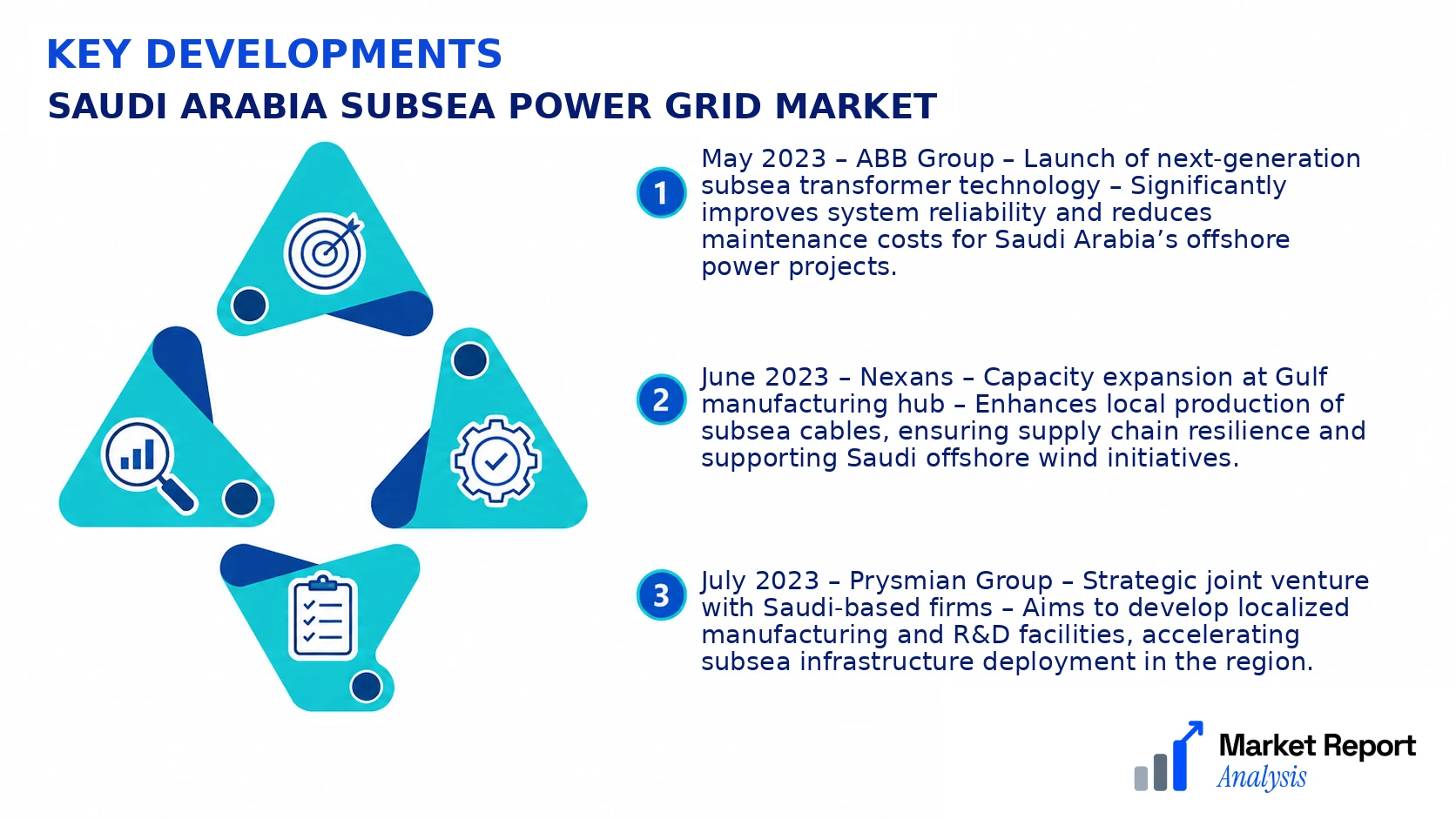
- May 2023 – ABB Group – Launch of next-generation subsea transformer technology – Significantly improves system reliability and reduces maintenance costs for Saudi Arabia’s offshore power projects.
- June 2023 – Nexans – Capacity expansion at Gulf manufacturing hub – Enhances local production of subsea cables, ensuring supply chain resilience and supporting Saudi offshore wind initiatives.
- July 2023 – Prysmian Group – Strategic joint venture with Saudi-based firms – Aims to develop localized manufacturing and R&D facilities, accelerating subsea infrastructure deployment in the region.
- August 2023 – Siemens AG – Deployment of digital twin platform for offshore grid simulation – Facilitates predictive maintenance and enhances integration efficiency for Saudi Arabia’s renewable projects.
- September 2023 – Cisco Systems – Launch of cybersecurity and remote diagnostics platform – Ensures operational integrity and cyber resilience of Saudi Arabia’s emerging subsea power networks.
Frequently Asked Questions
What is the Saudi Arabia Subsea Power Grid Market?
The Saudi Arabia Subsea Power Grid Market encompasses the development, deployment, and expansion of underwater electrical transmission systems that connect offshore renewable energy sources, such as wind and solar farms, to onshore power infrastructure, supporting the nation’s renewable energy strategy and grid modernization efforts.
What is the current market size of Saudi Arabia Subsea Power Grid Market?
As of 2026, the Saudi Arabia Subsea Power Grid Market is valued at approximately USD 3.2 Billion, driven by ongoing renewable project investments and strategic infrastructure upgrades, with significant growth potential aligned with Vision 2030 and national renewable energy targets.
What factors are driving the Saudi Arabia Subsea Power Grid Market?
Key drivers include the government’s push for renewable energy integration, technological advancements reducing installation costs, international investments in offshore projects, and the need to enhance grid resilience and capacity to meet future energy demands and sustainability commitments.
Which Saudi city leads the Saudi Arabia Subsea Power Grid Market?
Riyadh is the leading city in this market due to its role as the nation’s economic and administrative hub, with a growing focus on integrating offshore renewable projects along the Red Sea coast, supported by regional infrastructure development initiatives.
Which segment is expected to grow the fastest?
The offshore wind segment is anticipated to witness the fastest growth, owing to Saudi Arabia’s strategic focus on harnessing offshore wind resources along the Red Sea, supported by government incentives and international renewable energy investments.
Who are the leading companies operating in the Saudi Arabia Subsea Power Grid Market?
Major players include international firms such as Siemens, ABB, and General Electric, alongside regional contractors like Saudi Aramco and ACWA Power, all contributing to the development, technology deployment, and construction of subsea transmission systems across the country.
Analyst Perspective
The Saudi Arabia Subsea Power Grid Market exhibits substantial long-term growth potential driven by the country’s Vision 2030 ambitions to diversify energy sources and enhance grid resilience. As the market matures, technical evolution towards more efficient, high-capacity, and resilient subsea transmission solutions will be critical, with innovations in HVDC technology and integrated monitoring systems leading the way. Investment priorities will likely focus on strategically located key cities such as Dammam, Jeddah, and Riyadh, which are poised for significant subsea connectivity enhancements to support industrial hubs and expanding renewable energy projects. Competitive intensity is expected to increase as local and international players vie for a share in large-scale infrastructure contracts. City-level opportunities in Dammam’s oil and gas corridor, Jeddah’s port facilities, and Riyadh’s emerging industrial zones will foster tailored project development, boosting the overall market. Over the long term, a strategic focus on technology adoption, regional connectivity, and robust project pipelines will position Saudi Arabia as a leader in subsea power transmission in the Middle East.
