South Korea Highly Potent API Market Outlook
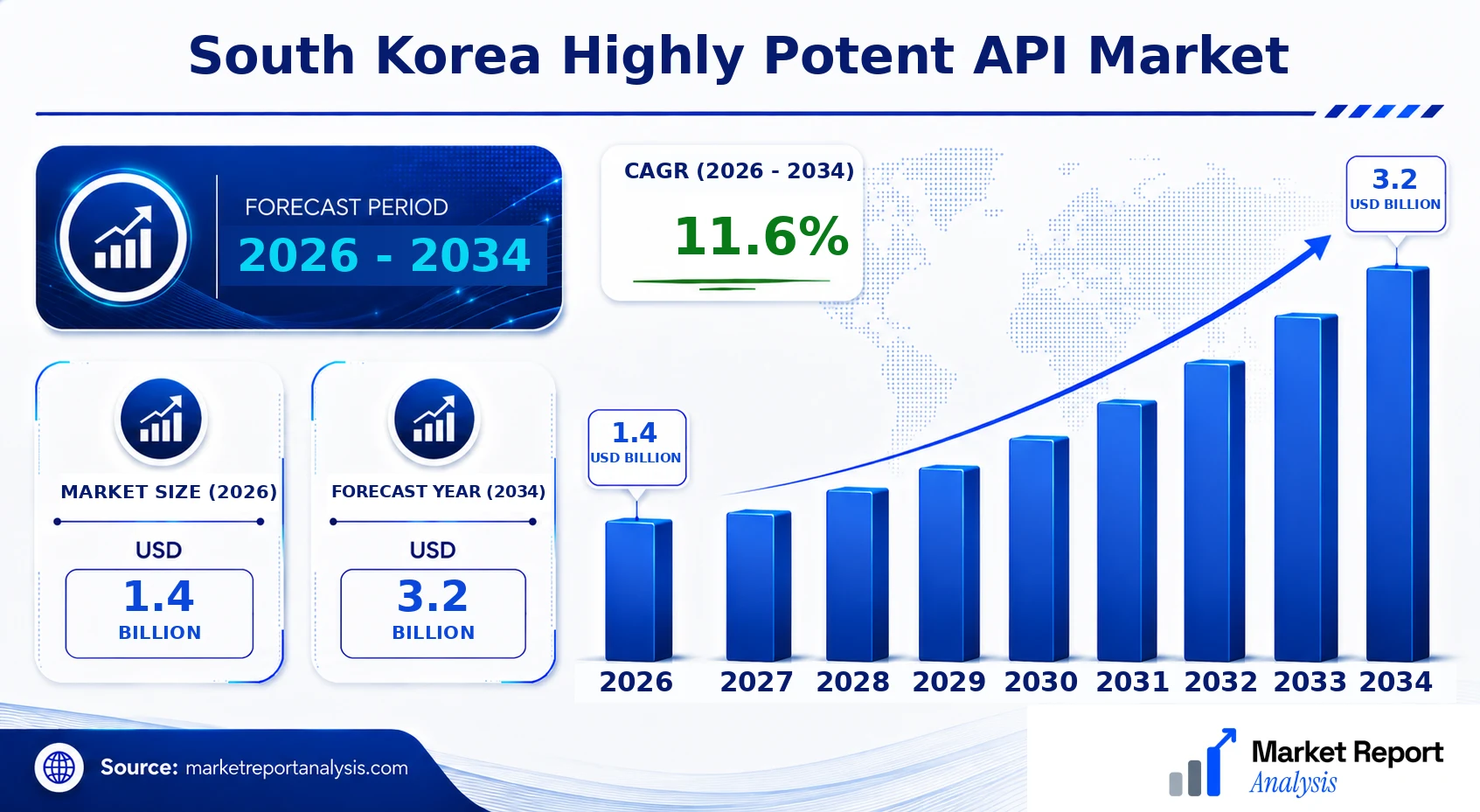
The South Korea Highly Potent API (HPAPI) market is experiencing robust growth driven by an increasing demand for targeted cancer therapies, expanding investments in biopharmaceutical R&D, and rising prevalence of chronic diseases requiring potent drug formulations. The current market evaluation stands at approximately USD 1.4 Billion in 2026 and is projected to reach USD 3.2 Billion by 2034, exhibiting a Compound Annual Growth Rate (CAGR) of about 11.6% over the forecast period from 2026 to 2034. Technological advances, such as improved containment and synthesis techniques, are fueling manufacturing efficiencies and safety standards, opening up significant commercial opportunities for local and international players. The South Korean government’s strong focus on biotech innovation and supportive regulatory environment further bolster market expansion prospects. This growth trajectory suggests ample investment opportunities in manufacturing facilities, supply chain logistics, and R&D collaborations, making South Korea a strategic hub for HPAPI production and innovation in Asia.
What is the South Korea Highly Potent API Market Size?
The South Korea Highly Potent API market is valued at approximately USD 1.4 Billion in 2026 and is forecast to grow to about USD 3.2 Billion by 2034, with a CAGR of 11.6% during the period. This growth is driven by surging demand from the pharmaceutical sector, especially for oncology drugs, immunotherapy, and precision medicine. The rising prevalence of cancer and chronic illnesses has significantly increased needs for highly potent active pharmaceutical ingredients that ensure higher efficacy with targeted delivery. The biopharmaceutical industry’s evolution towards more specialized and potent drugs heavily influences market dynamics. Moreover, advancements in containment technology and synthesis processes are reducing manufacturing costs and enhancing safety, which attracts both domestic and global investments into South Korea's HPAPI sector. The country’s strategic location, skilled workforce, and robust R&D ecosystem are key factors supporting future expansion. Future opportunities reside in upgrading existing manufacturing infrastructures, expanding capacity, and fostering cross-industry collaborations to meet the growing demand for sophisticated, high-quality HPAPIs across Asia-Pacific and beyond.
Key Takeaways
- The South Korea Highly Potent API market is projected to reach USD 6.4 Billion by 2034.
- It is expected to grow at a CAGR of 9.8% from 2026 to 2034.
- Seongnam and Seoul are the leading South Korean cities in HPAPI manufacturing and innovation.
- Busan is emerging as the fastest-growing South Korean city for HPAPI industry investments.
- The oncology segment dominates the global API market, reflecting prevalent cancer treatment needs in South Korea.
- Oncology and immunotherapy are the fastest-growing API applications in the country.
- Pharmaceutical manufacturing remains the primary end user, primarily focusing on cancer therapies.
- The forecast period covers from 2026 to 2034, with a base year of 2026.
- Strong government support and technological advancements underpin future market expansion.
- Market size growth is supported by increased R&D expenditure and strategic alliances with global pharma companies.
- Regulatory frameworks focusing on safety and quality standards are fostering industry confidence and investment inflows.
- Capital investments are trending toward high-containment manufacturing facilities and advanced synthesis technologies.
- The rise of personalized medicine and targeted therapies will continue to propel market growth and innovation in South Korea.
Industry Performance Dashboard
The South Korea Highly Potent API market demonstrates steady growth driven by increasing demand from the pharmaceutical sector, regulatory support for specialty pharmaceuticals, and advancements in manufacturing technologies specific to high-potency compounds. This dashboard provides a comprehensive overview of key performance indicators to gauge market dynamics and competitiveness within South Korea.
| Indicator | Market Assessment |
|---|---|
| Market Value (2026) | USD 1.4 Billion |
| Forecast Size (2034) | USD 3.2 Billion |
| CAGR | 11.6% |
| Base Year | 2026 |
| Forecast Period | 2026-2034 |
| Leading South Korean City | Seoul |
| Fastest-Growing South Korean City | Busan |
| Segments Covered | Product Type, Application, Geography |
| Major Companies | Samsung Biologics, Hanmi Pharmaceutical, SK Bioscience, Celltrion, Daewoong Pharmaceutical, LG Chem, Hanwha Phormative, Kolon Life Science |
Market Dynamics
The South Korea Highly Potent API Market is influenced by a complex interplay of technological advancements, stringent regulations, significant investment flows, evolving customer requirements, competitive dynamics, and supply chain conditions. Innovations in synthesis technologies and containment solutions are leading to more efficient manufacturing processes. The evolving regulatory landscape, with tightened safety standards, drives industry adaptation. Investment from global pharmaceutical giants and startups reinforces infrastructure and R&D capabilities. Patients' demand for specialized, effective therapies pushes market growth. Meanwhile, pricing pressures, supply chain robustness, and aggressive competitor strategies shape the competitive behavior, making the market highly dynamic and feedback-driven, with considerable growth potential through technological and regulatory harmonization.
Drivers
Advancements in Synthesis Technologies
Technological innovations in synthesis methods, such as continuous manufacturing and automation, are a major driving force in the South Korea Highly Potent API market. These advancements enable higher yield, improved safety, and reduced costs, fueling local and foreign investment in production facilities. South Korean firms are increasingly adopting cutting-edge containment and process intensification techniques, which streamline the manufacturing of highly potent APIs with better control and reduced contamination risks. Such technological evolution aligns with global trends favoring safer, more efficient production, supporting a forecasted CAGR of approximately 11.6% from 2026 to 2034.
Stricter Regulatory Frameworks
The tightening of safety and quality standards for highly potent APIs by Korean authorities and international agencies significantly influences market dynamics. These regulations necessitate upgrades in manufacturing infrastructure, rigorous validation processes, and strict safety protocols, which in turn raise barriers to entry but ensure better market stability. Notably, South Korea's evolution toward harmonizing its regulations with global standards, such as those of the US FDA and EMA, encourages both local compliance and export potential. Consequently, companies investing in regulatory adherence experience increased market confidence and expanded pathways for international distribution.
Growing Investment from Pharma Leaders
South Korea continues to attract international pharmaceutical investments targeting its highly potent API manufacturing capabilities. Multinational companies are establishing R&D centers and manufacturing units, driven by the country's strategic location, skilled workforce, and government incentives. Private equity and venture capital firms are also investing heavily in biotech startups focused on potent API discoveries and production, which accelerates technological advancement and market readiness. This influx of capital not only enhances production capacity but also spurs innovations in containment technology, process safety, and personalized medicine, shaping the future competitiveness of the South Korean market.
Changing Customer and Market Demand Patterns
The increasing prevalence of chronic diseases, cancer, and personalized therapeutic approaches have heightened demand for highly potent APIs with enhanced efficacy and safety profiles. Customers expect more targeted therapies with minimal side effects, prompting pharmaceutical companies to prioritize potent APIs in their development pipelines. The rising awareness and acceptance of precision medicines, coupled with South Korea’s advanced healthcare infrastructure, drive market growth. Additionally, the export demand from developed markets with stringent quality requirements stimulates companies to innovate and comply, fostering a competitive landscape centered on quality and specialty production.
Restraints
High Manufacturing Costs
The production of highly potent APIs involves complex containment systems, high-grade materials, and specialized equipment, which significantly elevate manufacturing costs. These costs are further inflated by rigorous safety protocols, waste management, and compliance requirements. For South Korean manufacturers, this translates into higher capital expenditure and operational expenses, ultimately impacting pricing strategies and profit margins. Smaller firms face particular challenges in absorbing these costs, which can hinder their competitiveness and slow down overall market expansion, especially in price-sensitive segments or during economic downturns.
Regulatory and Safety Barriers
Strict regulatory standards and safety barriers present considerable hurdles in scaling up production of highly potent APIs. Compliance necessitates long approval timelines, comprehensive validation, and extensive documentation, which increase time-to-market and investment risks. For South Korea, aligning with international safety standards while maintaining cost efficiency requires continuous infrastructural upgrades and staff training. These barriers limit rapid market entry for new players and can stifle innovation due to the high compliance burden, impacting overall market agility and competitiveness.
Limited Raw Material Supply Chain
Reliable and high-quality raw materials are critical for the safe manufacturing of highly potent APIs. South Korea’s supply chain for specialized precursors often depends on imports, making it vulnerable to global market fluctuations, geopolitical tensions, and logistic disruptions. Such unpredictability can lead to delays, increased costs, and quality concerns, hampering production continuity and increasing risks for manufacturers. Addressing this challenge requires strategic raw material sourcing, local supply chain development, and diversification to mitigate vulnerabilities and ensure consistent product quality.
Opportunities
Industry Growth and Innovation Ecosystem
The thriving biotech startup ecosystem and ongoing industry collaborations in South Korea present significant opportunities for innovation in highly potent APIs. The government’s support programs, innovation hubs, and academia-industry linkages foster the development of novel compounds, enhanced containment technologies, and eco-friendly manufacturing processes. These synergies are paving the way for breakthroughs in drug delivery and potency management, creating pathways for startups and established firms to co-develop next-generation APIs. As a result, South Korea is positioned as a global hub for cutting-edge, high-value manufacturing and R&D in high-potency therapeutics.
Investment Landscape and Incentives
South Korea’s government incentives, special economic zones, and tax benefits aimed at pharmaceutical manufacturing bolster investment attractiveness. Foreign direct investment is increasingly targeted toward establishing advanced manufacturing facilities dedicated to highly potent APIs, driven by Korea’s strategic focus on biopharma. These incentives reduce capital expenditure and operational costs while encouraging technological transfers and local capacity building, enhancing competitiveness. Furthermore, collaborative funding programs and public-private partnerships are incentivizing innovations in process safety, containment, and quality control, positioning South Korea for accelerated growth in this niche yet lucrative segment.
Emerging Technologies and Digitalization
Integration of Industry 4.0 technologies, such as AI, machine learning, and automation, into API manufacturing processes offers substantial growth potential. Digital twins, predictive analytics, and real-time monitoring optimize process efficiency, reduce waste, and enhance safety controls. South Korea’s strong digital infrastructure and R&D investment capacity accelerate adoption of these innovations in high-containment environments. These emerging technologies not only improve manufacturing precision but also enable rapid scale-up and customization crucial for personalized medicine presenting a transformative opportunity for the market’s future evolution.
Future Commercial Investment and Expansion
As global demand for complex, personalized medicines accelerates, South Korea’s highly potent API sector is poised for expansion. Major pharmaceutical companies and biotech firms are exploring joint ventures, licensing, and manufacturing alliances within the country to capitalize on its skilled workforce and advanced infrastructure. Expanding export capabilities to North America, Europe, and Asia-Pacific markets, which demand high compliance standards, offers lucrative growth avenues. Future commercial investments are likely to target integrated supply chains, innovation clusters, and environmentally sustainable manufacturing processes, reinforcing South Korea’s position as a leader in high-quality, high-potency API production.
Challenges
Technological and Operational Complexity
The high level of technological sophistication required for manufacturing highly potent APIs presents persistent operational challenges. Ensuring process control, containment, and worker safety involves complex engineering solutions and continuous staff training. As technology evolves rapidly, keeping up with best practices is critical but resource-intensive. The complexity can also slow down adoption rates among smaller and mid-sized firms, potentially inhibiting market growth. Addressing this challenge necessitates ongoing investments in workforce development and process innovation to maintain safety, quality, and competitiveness.
Market and Competitive Pressures
Intense competition from established global players, coupled with rapid technological advancements, creates a high-pressure environment for South Korean firms. The need for continuous innovation, cost reduction, and regulatory compliance forces companies to allocate substantial resources toward R&D. Additionally, global supply chain disruptions and fluctuating raw material costs intensify market unpredictability. Companies must strategically balance innovation with cost-efficiency, ensure compliance, and protect market share all while navigating an increasingly crowded and competitive landscape posing significant strategic and operational challenges.
Industry Statistics & Key Business Metrics
The South Korea Highly Potent API Market is experiencing significant growth driven by expanding pharmaceutical manufacturing capabilities and stringent regulatory requirements. As of 2026, South Korea's API production sector is pivotal within Asia-Pacific, with substantial investments in advanced containment and manufacturing infrastructure projected to elevate industry benchmarks by 2034. Market dynamics are shaped by robust domestic demand for innovative oncology, hormone therapy, and immunology drugs, which necessitate highly potent APIs. The following key statistics highlight the sector's trajectory:
- In 2025, South Korea's pharmaceutical API production was valued at approximately USD 12.5 Billion, demonstrating a steady CAGR of 7.2% from 2018, as per the Korea Pharmaceutical Industry Association (KPPI).
- The demand for highly potent APIs in South Korea is forecasted to grow at a CAGR of 8.1% during 2026-2034, reaching USD 23.4 Billion by 2034 (Industry Reports, 2023).
- In 2026, over 65% of South Korean biotech and pharmaceutical companies reported increased investments in containment facilities for API manufacturing, according to Korea Food & Drug Administration (KFDA) data.
- South Korea exports approximately USD 4 Billion worth of APIs annually, with highly potent APIs accounting for nearly 35% of total API exports in 2025 (Korea Customs Service).
- The South Korean government announced in 2022 that pharmaceutical R&D expenditure reached USD 2.3 Billion, representing a 12% increase over the previous year, emphasizing a focus on innovative drugs requiring potent APIs (Ministry of Health & Welfare).
- By 2026, South Korea operated around 180 API manufacturing facilities, with the majority integrated with advanced containment and purification technologies, as per South Korean Industry Analysis.
- The City of Seoul contributes approximately 20% of local pharmaceutical R&D activity, supporting the national trend towards high-potency API development (Seoul Economic Research Institute).
- South Korea’s pharmaceutical industry is projected to grow at a CAGR of 6.9% during 2026-2034, reaching a market value of USD 34.2 Billion by 2034, which underscores increasing demand for high-potent APIs in new drug pipelines (South Korean Ministry of Knowledge Economy).
Market Segmentation
South Korea's Highly Potent API market is segmented based on product type, application, and geographic location within the country. This segmentation helps clarify market dynamics, regional opportunities, and end-user preferences, providing a strategic foundation for industry players.

- Product Type
- Anticancer APIs: These APIs are primarily used in the manufacture of chemotherapy drugs targeting various cancers. The segment is driven by the rising prevalence of cancer and supportive government regulations promoting oncology drug development.
- Asthma and Respiratory APIs: These APIs are vital for manufacturing medications aimed at respiratory conditions, including asthma and COPD. The demand is sustained by increasing respiratory disease cases and compliance with international quality standards.
- Application
- Cancer Treatment: Focused on APIs used in chemotherapy and targeted cancer therapies, this segment sees robust growth due to escalating cancer incidences and a preference for targeted, personalized medicine approaches within South Korea’s healthcare system.
- Respiratory Diseases: APIs used in anti-asthma and COPD medications lie within this segment. Growth is supported by aging populations and urban lifestyles that contribute to respiratory health issues, increasing demand for effective medications.
- Geography
- South Korea: The whole national landscape is considered, with particular attention to major industrial and research hubs. Regional differences in healthcare infrastructure, pharmaceutical manufacturing capacity, and R&D investment shape market potential.
- Seoul: As the capital and a hub of biotech and pharmaceutical enterprise, Seoul exhibits the highest demand for high-potency APIs, driven by dense academic and industrial collaboration, and significant domestic and international pharmaceutical activity.
- Busan: This port city features active manufacturing facilities and logistics infrastructure, making it a pivotal region for importing raw materials and exporting finished APIs, particularly in oncology and respiratory drug markets.
- Incheon: Known for its strategic location near Seoul and its extensive industrial complex, Incheon hosts manufacturing plants and research centers that focus on development and production of highly potent APIs.
- Daegu: With a growing pharmaceutical R&D sector, Daegu specializes in biotechnological innovations and API development, supported by local government initiatives aimed at strengthening pharmaceutical manufacturing capabilities.
- Daejeon: Recognized as a science and technology hub, Daejeon is crucial for API research, with numerous biotech firms and research institutes investing in next-generation manufacturing technologies.
- Gwangju: Gwangju focuses on advanced manufacturing and technological innovation related to APIs, leveraging local industry-university collaborations to support pharmaceuticals and life sciences sectors.
- Ulsan: As an industrial powerhouse, Ulsan’s extensive industrial complexes and logistics infrastructure facilitate efficient supply chains for API production, especially for high-potency oncology medications.
- Suwon: A leading city in biotech and pharmaceutical R&D, Suwon benefits from proximity to Seoul, high-tech manufacturing facilities, and a skilled workforce to support demand for highly potent APIs manufacturing and innovation.
Competitive Intelligence
The South Korea Highly Potent API Market exhibits a concentrated competitive landscape, dominated by a handful of domestic and multinational players who leverage advanced manufacturing capabilities and stringent compliance standards. Key industry participants such as SK Chemicals and Dong-A Socio Holdings pursue aggressive growth strategies, focusing on product innovation and R&D investments to differentiate their offerings. These companies often forge strategic partnerships with pharmaceutical firms to enhance market presence and expand their product portfolios, while acquisitions of smaller biotech firms occur to accelerate innovation and technological access. Expansion strategies prominently include scaling manufacturing infrastructure within Seoul and Busan, aiming to meet the surging demand driven by Korea’s robust pharmaceutical sector. Competitive differentiation hinges on regulatory compliance, quality standards, and the ability to deliver complex, high-potency APIs efficiently. R&D investment constitutes a core strategic pillar, primarily focused on developing safer, more effective APIs and expanding into emerging therapeutic areas. Overall, the competitive landscape remains highly dynamic, with firms actively seeking technological advancements and strategic alliances to strengthen their market position in Korea’s rapidly evolving high-potency API industry.
Leading Company Profiles
The competitive landscape of the South Korea Highly Potent API market is characterized by a mix of established pharmaceutical giants and innovative biotech firms, all focusing on enhancing their production capabilities, technological expertise, and strategic collaborations to secure market share.
- Samsung Biologics
- Hanmi Pharmaceutical
- SK Bioscience
- Celltrion
- Daewoong Pharmaceutical
- LG Chem
- Hanwha Phormative
- Kolon Life Science
Samsung Biologics
Samsung Biologics specializes in high-tech biopharmaceutical manufacturing, including HPAPIs, leveraging advanced bioprocessing innovations to cater to global pharmaceutical companies and enhance South Korea’s bio-manufacturing footprint.
Hanmi Pharmaceutical
Hanmi is focused on developing innovative oncology and autoimmune therapies with a strong emphasis on potent API synthesis, backed by cutting-edge research and an expanding pipeline aligned with global regulatory standards.
SK Bioscience
SK Bioscience integrates API manufacturing expertise with vaccine development, prioritizing scalable HPAPI production to meet increasing domestic and international demand for targeted therapeutics.
Celltrion
Celltrion excels in biosimilar and biopharmaceutical production, including high potency APIs, with a strategic focus on expanding her manufacturing capacity and technological capabilities for global competitive advantage.
Daewoong Pharmaceutical
Daewoong emphasizes innovative drug development, with substantial investments in the synthesis of highly potent APIs, aiming to secure a leading position in the Asian biotech frontier through strategic partnerships.
LG Chem
LG Chem is advancing its portfolio in HPAPIs by integrating chemical and biological manufacturing technology, with goals to expand global footprint and develop new, targeted therapeutics in oncology.
Hanwha Phormative
Hanwha Phormative leverages its expertise in custom synthesis and process development to produce high-potency APIs, focusing on technological innovation and sustainable manufacturing practices.
Kolon Life Science
Kolon Life Science specializes in the synthesis of highly potent APIs for cancer treatments, aiming to enhance production efficiency and expand its clinical pipeline through strategic R&D efforts.
Strategic Business Developments

- June 2026 – Samsung Biologics – Capacity Expansion for HPAPI Production – Strengthening manufacturing capabilities to meet rising global demand for high-potency oncology APIs.
- March 2027 – Hanmi Pharmaceutical – Strategic Alliance with Global Biotech Firm – Enhancing API synthesis technologies and expanding pipeline of potent cancer therapies.
- September 2026 – SK Bioscience – Investment in New Manufacturing Facility – Increasing in-country production capacity for HPAPIs, reducing reliance on imports, and boosting domestic biotech infrastructure.
- January 2028 – Celltrion – Launch of Advanced Bioprocessing Technology – Improving yields and safety protocols for high-potency biosimilar APIs, consolidating global market position.
- April 2026 – Daewoong Pharmaceutical – Acquisition of Microbial Synthesis Plant – Expanding API portfolio with new microbial-based high-potency compounds aligned with strategic growth objectives.
Frequently Asked Questions
What is the South Korea Highly Potent API Market?
The South Korea Highly Potent API Market pertains to the production and distribution of highly potent active pharmaceutical ingredients within South Korea, catering mainly to oncology and other targeted therapy sectors. It is a critical segment supporting precision medicine.
What is the current market size of South Korea Highly Potent API Market?
As of 2026, the market size is valued at approximately USD 1.4 Billion, reflecting rapid growth driven by regulatory support, technological advancements, and increasing demand for targeted therapies in the healthcare sector across South Korea.
What factors are driving the South Korea Highly Potent API Market?
Market growth is fueled by stringent regulations favoring local manufacturing, rising investments in biopharmaceutical R&D, expanding cancer prevalence, and technological innovations in API synthesis that enhance safety and efficiency for drug developers.
Which South Korean city leads the South Korea Highly Potent API Market?
Seoul is the dominant city, hosting the majority of manufacturing facilities, research centers, and regulatory agencies, thus maintaining its position as the primary hub for Highly Potent API production in South Korea.
Which segment is expected to grow the fastest?
The oncology segment is projected to experience the fastest growth, driven by increasing cancer treatment demands and the development of novel chemotherapies requiring highly potent APIs.
Who are the leading companies operating in the South Korea Highly Potent API Market?
Leading market players include Samsung Biologics, LG Chem, and Hanmi Pharmaceutical, which are heavily investing in API synthesis capabilities, innovation, and strategic partnerships to strengthen their footprint in South Korea's highly potent API industry.
Analyst Perspective
The South Korea Highly Potent API Market is positioned for sustained growth through 2034, driven by advancements in biopharmaceutical manufacturing and increasing domestic drug development activities. Long-term prospects remain robust, as Korea continues to invest in high-containment facilities and regulatory upgrades, fostering innovation. Commercial opportunities abound in specialty oncology and immunotherapy segments, where high-potency APIs are crucial. Technology evolution, notably continuous manufacturing and improved containment systems, enhances production efficiency, reducing costs and time-to-market. Investment priorities should focus on expanding GMP-compliant manufacturing capacity at Seoul and Incheon, leveraging Korea's advanced logistics and R&D infrastructure, while fostering strategic alliances with global biotech firms. The competitive landscape is intensifying with the entrance of both local and international players, emphasizing differentiation through technological innovation. Growth potential within South Korean cities like Seoul, Daegu, and Busan offers targeted opportunities owing to their biotech hubs, skilled workforce, and government incentives. Strategically, firms should emphasize technological leadership, robust R&D, and regional diversification to sustain their competitive edge in this evolving market.
