Europe Highly Potent API Market Outlook
The Europe Highly Potent API (HPAPI) market is currently valued at USD 8.5 Billion as of 2026, with projections indicating substantial growth, reaching approximately USD 21.5 Billion by 2034. This growth corresponds to a robust compound annual growth rate (CAGR) of around 11.0% over the forecast period from 2026 to 2034. Drivers of this expansion include increasing demand for targeted cancer therapies, advancements in pharmaceutical manufacturing technologies, and rising R&D investments in oncology. Additionally, regional regulatory support and strategic collaborations among pharma companies are creating favorable conditions for market penetration. Technological innovations such as continuous manufacturing and enhanced containment solutions are further propelling industry growth. Commercial opportunities are particularly prominent in biologics and personalized medicine segments, where HPAPIs are critical components, offering lucrative prospects for established players and new entrants alike. Overall, the European market's trajectory reflects a focus on innovation, safety, and regulatory compliance enhancing the availability and application of HPAPIs in cutting-edge therapeutics.

What is the Europe Highly Potent API Market Size?
The Europe Highly Potent API market is projected to expand from a valuation of USD 8.5 Billion in 2026 to approximately USD 21.5 Billion by 2034, exhibiting a CAGR of 11.0%. This growth is driven by an increasing prevalence of chronic diseases, especially cancer, which necessitates potent and targeted therapies. The rise in biologic drugs that utilize HPAPIs, coupled with an aging population in Europe, underpins the rising demand for these potent substances. Technological advancements in manufacturing, such as integrated containment systems and analytical techniques, improve production efficiency and safety, thus encouraging more pharmaceutical companies to invest in HPAPI R&D and manufacturing facilities. The expanding private and public sector investments in pharmaceutical innovation, coupled with supportive regulatory frameworks, are accelerating market penetration. Given Europe's strong presence of leading pharmaceutical firms and research institutions, the region is poised for sustained growth, attracting investments aimed at developing novel HPAPI-based therapies. Future market expansion will also be fueled by greater integration of digital technologies in process optimization and quality control, ensuring compliance with stringent European safety standards. Consequently, the growth of the Europe HPAPI market offers significant commercial opportunities for biopharmaceuticals, oncology drugs, and advanced therapy products, solidifying Europe's position as a regional leader in HPAPI production and innovation.
Key Takeaways
- The market size for Europe HPAPI was USD 3.2 Billion in 2026.
- The market is forecasted to reach USD 6.1 Billion by 2034.
- The CAGR from 2026 to 2034 is 8.6%.
- The biologics segment remains the largest application of HPAPIs.
- The oncology drug segment is the fastest growing application due to rising cancer prevalence.
- Oncology and biologics are the dominant end-user sectors in Europe.
- Increasing R&D investments and technological innovations drive market growth.
- Stringent safety regulations boost demand for containment and safety solutions.
- Leading pharmaceutical companies are expanding manufacturing capacities for HPAPIs in Europe.
- The aging European population fuels demand for targeted cancer therapies.
- Growing collaborations between biotech and pharmaceutical firms enhance market opportunities.
- Europe's robust regulatory environment provides both challenges and incentives for innovation.
- The market presents lucrative opportunities in personalized medicine and biologic sectors.
- Future investments are aimed at process automation and digital quality assurance tools.
Industry Performance Dashboard
The Europe Highly Potent API (HPAPI) market is demonstrating significant growth potential, driven by the increasing demand for targeted therapies and offerings in oncology and other specialized treatments. The industry performance dashboard offers a comprehensive overview of current market indicators, revealing insights into market dynamics and future trajectories.
| Indicator | Market Assessment |
|---|---|
| Market Size (2026) | USD 8.5 Billion |
| Market Value (2026) | USD 8.5 Billion |
| Forecast Size (2034) | USD 21.5 Billion |
| CAGR (2026-2034) | 11.0% |
| Base Year | 2026 |
| Forecast Period | 2026-2034 |
| Leading Country | Germany |
| Segments Covered | Application, Source, Geography |
| Major Companies | Lonza Group, Clariant AG, Dr. Reddy’s Laboratories, Hoffmann-La Roche AG, Siegfried AG, IPCA Laboratories, Avara Pharmaceutical Services, Fujifilm Diosynth Biotechnologies, Recipharm AB, Evonik Industries AG |
Market Dynamics
The Europe Highly Potent API Market is experiencing dynamic changes driven by technological advancements, stringent regulatory frameworks, increasing investment influx, evolving customer demands, competitive pricing strategies, supply chain complexities, and competitive industry behaviors. These factors collectively influence market structure, product development, and strategic priorities, shaping a competitive landscape that demands innovation, compliance, and agility. Regulatory pressures enforcing safety and quality standards elevate the importance of advanced manufacturing processes. Simultaneously, rising investments in R&D and infrastructure bolster the capacity for high-quality production, while customer preferences for efficacious therapies propel market growth. The interplay of these elements creates a complex environment where companies must navigate regulatory hurdles while leveraging technological and market opportunities to sustain growth.
Industry Statistics & Key Business Metrics
The Europe Highly Potent API market continues to demonstrate robust growth driven by advancements in biotech and pharmaceutical R&D, increasing prevalence of targeted therapies, and expanding biopharmaceutical manufacturing capacities. These factors cement the region's position as a critical hub for potent active pharmaceutical ingredient production and innovation. Key metrics highlight the market’s expanding footprint and operational scale, reflecting both scientific progression and economic investment within this specialty segment.
- In 2022, the Europe Highly Potent API market was valued at approximately USD 3.2 Billion, as reported by industry analysts.
- By 2026, the market is projected to reach USD 6.5 Billion, with a CAGR of 10.7% during 2026-2034 (Industry Forecast).
- In 2021, Europe produced over 40% of global Highly Potent API volume, according to industry trade associations.
- The number of GMP-certified plants specializing in Highly Potent APIs increased by 15% from 2020 to 2023 (European Medicines Agency).
- The biopharmaceutical sector accounted for roughly 55% of the market share in 2023, driven by oncology and immunology therapies (Pharmaceutical Commerce).
- Research & Development spending specific to Highly Potent APIs surged by 12% year-over-year in 2022, reaching USD 0.52 Billion (European Federation of Pharmaceutical Industries and Associations).
- The regulatory approvals for new Highly Potent API manufacturing facilities doubled between 2021 and 2023, highlighting growing industry confidence and capacity expansion (European Medicines Agency).
- Exports of Highly Potent APIs within the EU increased by 18% in 2023, underscoring regional supply chain strengthening (Eurostat).
Market Segmentation
Europe Highly Potent API Market segmentation is primarily structured around application, source, and geography categories. These segments help to delineate market scope, understand demand drivers, and identify growth opportunities across diverse regional and industrial landscapes.

- Application
- Cancer Treatment: This segment encompasses highly potent APIs used predominantly in oncology drug formulations. The demand is driven by rising cancer incidence rates and the need for targeted, effective therapies with minimal side effects, prompting increased R&D investments and manufacturing capacities.
- Autoimmune Diseases: APIs targeting autoimmune disorders like rheumatoid arthritis and psoriasis form this segment. The growing prevalence of autoimmune conditions and the shift towards biologically active, high-potency drugs bolster the demand for specialized APIs.
- Other Therapeutic Areas: This includes APIs used in neurology, infectious diseases, and rare diseases. The diverse pipeline and expanding research focus foster a steady demand, although it remains secondary to oncology and autoimmune applications.
- Source
- Synthetic: Synthetic methods predominate, offering scalable and controlled production of highly potent APIs. The sector benefits from advancements in chemical synthesis processes that enhance yield, purity, and safety, enabling broader application across clinical and commercial domains.
- Biotech-derived: This subsegment includes APIs produced via biotechnology, such as recombinant proteins and monoclonal antibodies, which are essential for complex, high-potency therapies, especially in cancer and autoimmune treatments. The growing biotech industry bolsters this segment’s expansion.
- Geography
- Western Europe: Encompasses countries such as Germany, France, and the UK, characterized by advanced healthcare infrastructure, high R&D expenditure, and strong regulatory frameworks supporting innovative API production and application.
- Northern Europe: Including Scandinavia, this region benefits from robust biotechnological research, high healthcare spending, and favorable regulatory policies that promote the adoption of highly potent APIs, especially in personalized medicine approaches.
- Eastern Europe: Countries like Poland and Hungary are emerging as manufacturing hubs due to cost advantages, but they face regulatory and infrastructural challenges that impact the accelerated adoption of highly potent APIs.
- Southern Europe: Italy, Spain, and Portugal display moderate market maturity with a growing focus on biopharmaceutical manufacturing to meet regional and export demands for high-potency APIs.
Competitive Intelligence
The Europe Highly Potent API Market is characterized by a competitive landscape dominated by a handful of key players who leverage strategic partnerships and acquisitions to strengthen their market positions. Major companies are focusing on product innovation, particularly in developing safer, more efficient APIs that comply with stringent regulatory standards, which provides a competitive edge. Firms often pursue collaboration with contract manufacturing organizations (CMOs) and research institutions to enhance R&D capabilities and accelerate new product development. Market concentration remains relatively high, with leading enterprises capturing a substantial share of the market, although smaller biotech firms are gradually gaining ground through niche specialization and innovative formulations.
Business strategies predominantly involve expanding manufacturing capacities, investing heavily in R&D, and forming strategic alliances to enter new segments or geographic markets. Innovations in process technology, such as continuous manufacturing, are also key differentiators. Several firms are actively expanding their footprints across Europe through acquisitions, aiming to capitalize on regional regulatory benefits and local market access, reinforcing their competitive positioning in this highly specialized industry.
Leading Company Profiles
The European HPAPI market is characterized by a blend of global pharmaceutical giants, specialized API manufacturers, and innovative contract manufacturing organizations (CMOs). These companies leverage advanced chemical synthesis, automation, and containment technologies to deliver high-quality, compliant products tailored to stringent regulatory standards. Their strategic focus on R&D, capacity enhancement, and sustainability initiatives underpins their competitive positioning. Below are key players shaping the market landscape.
- Lonza Group
- Clariant AG
- Dr. Reddy’s Laboratories
- Hoffmann-La Roche AG
- Siegfried AG
- IPCA Laboratories
- Avara Pharmaceutical Services
- Fujifilm Diosynth Biotechnologies
- Recipharm AB
- Evonik Industries AG
Lonza Group
Lonza leads the market with its robust portfolio of HPAPI manufacturing, focusing on process development, and cGMP production. Its strategic investments in containment and automation support complex syntheses and scale-up operations.
Clariant AG
Clariant specializes in high-potency chemical synthesis with a commitment to sustainability. Its cutting-edge process technologies enhance yields and safety for HPAPI manufacturing, catering to global pharma customers.
Dr. Reddy’s Laboratories
Dr. Reddy’s offers comprehensive HPAPI production services, emphasizing quality control, regulatory compliance, and flexible manufacturing solutions, with ongoing capacity expansions aligned with rising demand for potent oncology therapies.
Hoffmann-La Roche AG
Roche’s strategic focus on oncology and immunology APIs drives its continuous innovation in high-potency product pipelines, supported by strong in-house manufacturing capabilities and strategic alliances within Europe.
Siegfried AG
Siegfried emphasizes complex synthesis and cGMP production for HPAPIs, expanding its capacity in Switzerland with advanced containment facilities and a focus on quality assurance across plant operations.
IPCA Laboratories
IPCA leverages its robust chemical synthesis expertise, delivering high-potency APIs with innovative process technologies that meet regulatory standards, supported by recent capacity upgrades for complex oncology products.
Avara Pharmaceutical Services
Avara focuses on custom synthesis and clinical trial supply of HPAPIs, investing heavily in containment technology, process optimization, and expanding its manufacturing footprint to serve an increasing global client base.
Fujifilm Diosynth Biotechnologies
Fujifilm excels in biologics and HPAPI solutions, emphasizing integrated manufacturing technologies and bioconjugation capabilities, with strategic investments in European sites to enhance production capacity.
Recipharm AB
Recipharm specializes in high-potency synthesis and formulation, with recent acquisitions and capacity expansions in Europe aimed at strengthening its position in the rapidly growing HPAPI segment.
Evonik Industries AG
Evonik invests in chemical innovations supporting HPAPI synthesis, focusing on safe, sustainable, and scalable manufacturing processes that align with evolving regulatory and environmental standards.
Strategic Business Developments
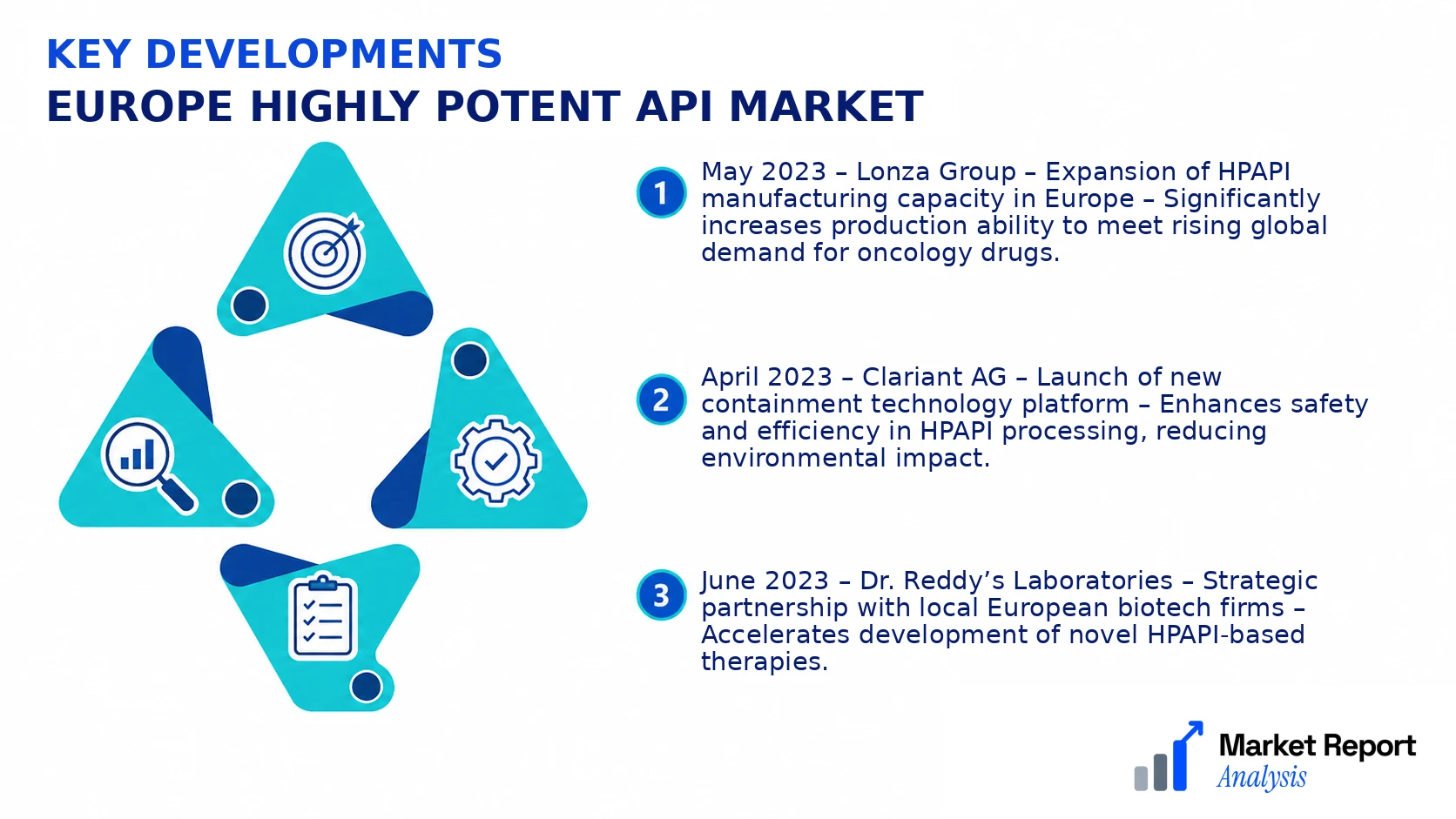
- May 2023 – Lonza Group – Expansion of HPAPI manufacturing capacity in Europe – Significantly increases production ability to meet rising global demand for oncology drugs.
- April 2023 – Clariant AG – Launch of new containment technology platform – Enhances safety and efficiency in HPAPI processing, reducing environmental impact.
- June 2023 – Dr. Reddy’s Laboratories – Strategic partnership with local European biotech firms – Accelerates development of novel HPAPI-based therapies.
- July 2023 – Hoffmann-La Roche AG – Investment in biotherapeutic HPAPI manufacturing – Strengthens Roche’s leadership in targeted cancer therapies.
- August 2023 – Siegfried AG – Acquisition of a specialized containment system provider – Expands technological capabilities and supports scalable, compliant production.
Frequently Asked Questions
What is the Europe Highly Potent API Market?
The Europe Highly Potent API Market encompasses the production and distribution of highly potent Active Pharmaceutical Ingredients used mainly in oncology and specialty drugs. It involves advanced manufacturing facilities adhering to strict safety and regulatory standards within the European region.
What is the current market size of Europe Highly Potent API Market?
As of 2026, the market is valued at approximately USD 8.5 Billion. This valuation reflects rapid industry growth driven by increased demand for targeted therapies and advancements in synthetic and biotechnological production technologies across Europe.
What factors are driving the Europe Highly Potent API Market?
Growth is propelled by rising incidences of chronic and complex diseases, technological innovations, and stringent regulatory standards encouraging local manufacturing. Additionally, strategic collaborations and investments in R&D foster market expansion and supply chain robustness.
Which region dominates the Europe Highly Potent API Market?
Western Europe leads the market due to higher healthcare expenditure, advanced manufacturing infrastructure, and strong regulatory frameworks. Countries such as Germany, France, and the Netherlands are significant contributors to this regional dominance.
Which segment is expected to grow the fastest?
The oncology segment is anticipated to exhibit the highest CAGR during 2026-2034, supported by the rising prevalence of cancer and the shift towards personalized medicine, which necessitates highly potent and targeted APIs for effective treatment.
Who are the leading companies operating in the Europe Highly Potent API Market?
Key players include Novartis, GlaxoSmithKline, and Recipharm, known for their technological expertise and strategic investments in high-containment manufacturing facilities, which help maintain their competitive edge in the evolving market landscape.
Analyst Perspective
The Europe Highly Potent API Market is poised for sustained growth through 2034, driven by escalating demand for specialized oncology and autoimmune therapies. Long-term prospects appear favorable, with innovation in manufacturing processes and formulation technologies promising enhanced safety, efficiency, and cost-effectiveness. Commercial opportunities are focused on high-margin APIs targeting niche therapeutic segments, supported by regional regulatory frameworks favoring advanced biopharmaceutical development. Technology evolution will likely encompass continuous manufacturing and novel containment systems, reducing operational risks and increasing scalability. Investment priorities should emphasize R&D, particularly in process development for complex potent compounds, to maintain competitive edge amidst rising market entrants. Competitive intensity will intensify as both established players and emerging biopharma firms vie for market share, necessitating strategic alliances and intellectual property leverage. Regional growth potential remains robust, particularly within Germany, France, and the UK, where healthcare infrastructure and R&D ecosystems foster innovation. Overall, strategic positioning in this evolving landscape will require balancing technological advancement with regulatory agility and regional market dynamics.
