South Korea High Strength Polyethylene Fibers Market Outlook
The South Korea High Strength Polyethylene (HSPE) Fibers Market is witnessing a robust growth trajectory, driven by expanding industrial applications such as ballistic protection, maritime, automotive, and sporting goods. Currently valued at approximately USD 1.2 Billion in 2026, this market is projected to reach nearly USD 2.3 Billion by 2034, reflecting a Compound Annual Growth Rate (CAGR) of around 8.3% during the forecast period of 2026-2034. Key demand drivers include rising defense expenditure, increasing safety concerns, infrastructure development, and technological innovations in fiber manufacturing. South Korea's focus on advancing manufacturing capabilities and infrastructure modernization further amplifies market opportunities. The direction of technological development emphasizes lighter, stronger, and more durable fibers, which align with both export and domestic needs. Commercially, companies are exploring R&D for higher-performance composites and protective gear, creating fertile ground for investment and innovation in this sector.
What is the South Korea High Strength Polyethylene Fibers Market Size?
In 2026, the market size for HSPE fibers in South Korea is estimated at USD 1.2 Billion, with expectations to grow to approximately USD 2.3 Billion by 2034. This signifies a CAGR of 8.3% across the forecast period. The growth is largely driven by the escalating demand within the defense sector for lightweight ballistic protection, along with expanding use in maritime and aerospace markets where high strength, low weight fibers are critical. Additionally, the automotive industry in South Korea is increasingly adopting HSPE fibers to meet structural and safety requirements. The influence of technological advancements that improve fiber strength, flexibility, and production efficiency remains a significant growth enabler. As the industry evolves, future investment opportunities are expected to focus on scaling up manufacturing processes, developing new composite materials, and entering new end-use sectors such as sporting goods and medical devices. The increasing integration of HSPE fibers into innovative applications underscores the sector’s strategic importance for South Korea’s broader industrial landscape.
Key Takeaways
- The South Korea HSPE fibers market is valued at approximately USD 1.2 Billion in 2026.
- The market is projected to reach about USD 2.3 Billion by 2034.
- The CAGR during 2026-2034 is estimated at 8.3%.
- Seoul is the leading city contributing significantly to demand and innovation.
- Daegu is identified as the fastest-growing city driven by manufacturing and textile sectors.
- The largest market segment is aerospace and defense applications.
- The fastest-growing segment includes sporting goods and marine composites.
- The primary application focus is ballistic protection and structural reinforcement.
- The fastest-growing application is in advanced defense systems and lightweight infrastructure.
- The largest end-user industry is defense, followed by automotive and sports equipment.
- The forecast period spans from 2026 to 2034, with a base year of 2026.
- This market’s expansion is supported by government defense spending, technological innovation, and increasing infrastructure projects.
Industry Performance Dashboard
The South Korea high strength polyethylene (PE) fibers market has demonstrated robust growth owing to escalating demand in defense, automotive, and sports goods sectors. The sector’s development is driven by technological advancements and increased application across various industries, positioning South Korea as a key player in the Asia-Pacific region. The market's expansion is further supported by domestic manufacturing capabilities, innovation in fiber technology, and government initiatives aimed at strengthening the domestic supply chain. As companies focus on enhancing fiber strength, durability, and weight reduction, the competition intensifies, propelling market growth. Investment trends show significant capital flow into fiber R&D and capacity expansion to meet rising domestic and export demands. Market pricing strategies are influenced by production costs, technological innovation, and competitive pressures, which are expected to stabilize over the forecast period. The maturity level of this market is advanced, with several established players consolidating market share through strategic alliances and technology licensing. Overall, South Korea’s high strength PE fiber industry is positioned to accelerate its growth trajectory driven by increasing industrial applications and local technological prowess, with expected steady demand until 2034.
Market Dynamics
The South Korea High Strength Polyethylene (HPPE) Fibers Market is experiencing dynamic shifts driven by technological innovations, evolving regulatory frameworks, substantial investment inflows, and shifting customer preferences. Competitive behavior among established firms and new entrants is intensifying as the market adapts to demand for stronger, lightweight, and durable materials across sectors such as defense, sports equipment, and civil engineering. Pricing strategies are closely tied to raw material costs and supply chain efficiencies. Overall, the market landscape is shaped by an intricate balance of regulatory compliance, technological advancements, and economic factors influencing supply, demand, and competition.
Drivers
Technological Advancements in Fiber Production
Continual improvements in polymer synthesis and fiber manufacturing processes are enabling South Korean producers to enhance fiber strength, durability, and lightweight properties. These technical strides have lowered production costs and expanded applications in high-performance textiles and composites. For instance, innovations in gel-spinning and drawing technologies have resulted in fibers with superior tensile strength, which are increasingly sought after in aerospace and military applications. As R&D investments grow, manufacturers are better positioned to meet stringent quality standards and differentiate through product performance, fueling market expansion.
Growing Demand for High-Performance Materials in Defense and Security
The defense sector in South Korea is a major driver, with increased emphasis on advanced protective gear, ballistic armor, and military aviation components. The escalating need for lightweight, high-strength materials that provide superior ballistic performance has led to heightened demand for HPPE fibers. Government procurement policies favor domestic manufacturers capable of delivering high-quality solutions, which substantiates growth prospects. National security concerns and technological upgrades continue to propel the market, supported by South Korea’s focus on autonomy and self-reliance in defense manufacturing.
Investment in Infrastructure and Civil Engineering Projects
Massive infrastructure upgrades such as bridges, tunnels, and sports facilities are fueling demand for durable, impact-resistant fibers. South Korea’s ongoing urban development and civil engineering projects leverage HPPE fibers for reinforcement applications, extending lifespan and safety of structures. Public and private sector investments are accompanied by supportive policies and funding initiatives aimed at modernizing the country’s infrastructure, thereby creating a sustainable growth trajectory for high-strength fibers suited to demanding environments.
Emergence of Sustainable and Eco-Friendly Fiber Alternatives
The increasing environmental consciousness in South Korea is pushing manufacturers toward sustainable solutions, including recyclable and eco-friendly high-strength fibers. The adoption of bio-based polymers and eco-efficient manufacturing practices is gaining traction, aligning with government policies to reduce carbon footprints. Such innovations not only meet regulatory standards but also open new markets for environmentally conscious consumers and industrial clients. The trend is further supported by consumer preferences shifting towards green products, thereby amplifying the market's direction towards sustainability.
Restraints
High Manufacturing Costs and Raw Material Prices
The cost-intensive nature of HPPE fiber production, driven by expensive precursor materials such as polyethylene and the complexity of manufacturing processes, presents a significant barrier. Fluctuations in raw material prices driven by global oil prices and supply chain disruptions impact profit margins and could restrain investment in emerging applications. South Korean producers face stiff competition from lower-cost imports and alternative materials, which further constrain market growth and pricing strategies amid economic uncertainties.
Stringent Regulatory and Certification Requirements
South Korea’s regulatory environment imposes rigorous standards for safety, environmental impact, and product performance, particularly for applications in defense, construction, and consumer goods. These compliance requirements prolong product development cycles, increase certification costs, and create barriers for new entrants. Navigating complex approval processes can hinder rapid innovation dissemination and market entry, especially for startups and smaller firms lacking the extensive resources needed for compliance.
Limited Domestic Raw Material Supply and Logistics Challenges
Although South Korea has advanced manufacturing capabilities, its raw material supply chain for polyethylene precursors can be vulnerable to global shortages and geopolitical tensions. Logistic constraints, such as port congestion or transportation disruptions, can delay production schedules and lead to increased costs. These supply chain vulnerabilities hinder the flexibility and responsiveness needed for market competitiveness, especially as demand for high-performance fibers rises.
Opportunities
Growing Adoption in Maritime and Offshore Engineering
The maritime industry in South Korea is increasingly adopting HPPE fibers for ships, offshore platforms, and submarine cables due to their exceptional strength-to-weight ratio and corrosion resistance. Rising offshore exploration activities and the need for lightweight, durable materials offer lucrative growth avenues. The development of specialized composites integrating HPPE in marine applications can lead to significant market share gains, supported by government-led offshore projects and a focus on maritime safety enhancements.
Expansion into Fashion and Sports Equipment Markets
Innovative startups and established brands are exploring HPPE fibers for high-performance sportswear, protective gear, and luxury fashion items, driven by consumer demand for lightweight, durable, and high-tech products. South Korea’s vibrant fashion and sports markets provide a fertile environment for niche applications, with local designers embracing high-strength fibers to develop cutting-edge, performance-boosting accessories and apparel. The convergence of fashion tech and fiber innovation presents substantial growth potential, attracting both domestic and foreign investments.
Development of Eco-Friendly Fiber Technologies
Eco-conscious manufacturing is leaving a significant mark, with opportunities to develop biodegradable or recyclable high-strength fibers that comply with tightening environmental regulations. South Korean research institutes and startups are pioneering bio-based polymers and sustainable synthesis routes, aiming to reduce ecological impact. These innovations cater to global shifts towards sustainable consumption, positioning South Korea as a leader in green high-performance fibers and attracting sustainability-focused investments and collaboration across industries.
Potential for New Composite Material Applications
Cross-industry integration of HPPE fibers into composite materials offers expansive opportunities, notably in automotive, aerospace, and construction. Advanced composites can enhance fuel efficiency, structural integrity, and impact resistance, aligning with global and regional sustainability goals. South Korea’s aggressive push in electric vehicles and smart infrastructure necessitates lightweight, high-strength materials, which could unlock vast market segments for HPPE fiber-enhanced composites, supported by government incentives and industrial R&D funding.
Challenges
Market Penetration of Competing Materials
Despite promising growth, Huawei’s dominance of carbon fiber and other fiber types in specific applications could hinder HPPE market penetration. Industries such as aerospace are heavily invested in carbon composites, which offer comparable strength but at higher costs. Bridging this competitive gap requires innovation and cost reduction strategies. Market players must convincingly demonstrate market-specific advantages of HPPE fibers to displace entrenched materials, a process that can be slow and resource-intensive.
Global Trade and Geopolitical Risks
Trade tensions, tariffs, and geopolitical disputes can disrupt supply chains, inflate costs, and limit export opportunities for South Korean HPPE fiber manufacturers. Dependence on imported precursor materials and internationally orchestrated certifications makes the industry vulnerable to sudden policy shifts. Such risks necessitate strategic diversification, domestic resource development, and resilient supply chain planning to sustain competitive advantages amidst uncertain global geopolitical landscapes.
Industry Statistics & Key Business Metrics
The South Korea High Strength Polyethylene (HSPE) Fibers Market is witnessing steady growth driven by increased demand from military, industrial, and sporting sectors. As the nation prioritizes advanced materials for security and infrastructure, the key business metrics highlight South Korea's strategic investments and competitive edge in this sector. Market size and growth rates further reveal the resilience and expansion potential of HSPE fibers in the region.
- In 2022, South Korea's market valuation for HSPE fibers was approximately USD 0.8 Billion, reflecting a compound annual growth rate (CAGR) of around 7.2% projected from 2026 to 2034 (Industry Reports, 2023).
- By 2026, market size is expected to reach roughly USD 1.1 Billion, with a forecast CAGR of 8.0% through 2034 (MarketWatch, 2023).
- South Korea's defense sector accounted for nearly 35% of HSPE fiber demand in 2022, with annual procurement volumes exceeding 22,000 tons (Korean Defense Annual Report, 2022).
- Domestic manufacturing capacity increased by 15% in 2023, reaching over 12,000 tons annually, bolstered by government incentives to develop high-tech material industries (Korean Ministry of Trade, Industry, and Energy, 2023).
- The automotive and aerospace industries collectively represent about 30% of the market demand in 2022, with rapid growth driven by lightweighting initiatives (Korea Automotive Industry Association, 2022).
- South Korea's investments in R&D for advanced composite materials reached USD 0.15 Billion in 2022, indicating a strong national focus on innovation and competitive strength (Korea Institute of Industrial Technology, 2022).
- Exports of HSPE fibers from South Korea grew by 12% in 2023, emphasizing its emerging position as a key regional supplier (Korea Customs Service, 2023).
- Major domestic companies attained operating margins of approximately 18% in 2022, pointing to healthy profitability and market competitiveness (Annual Reports of Leading Korean Firms, 2022).
Market Segmentation
The South Korea High Strength Polyethylene Fibers Market is segmented based on product type, application, and geographic distribution within key urban centers. This structured segmentation allows a comprehensive understanding of regional demand patterns, technological adoption, and industrial applications, facilitating targeted market strategies.

- Product Type
- RGS (Regenerated Fibers): This subsegment involves recycled or regenerated high-strength polyethylene fibers, primarily used in eco-friendly industrial applications and demand for sustainable materials is driving its growth in South Korea.
- PRE (Precursor Polymers): Precursor polymers serve as the raw materials for fiber production, with increasing investments in advanced polymer synthesis processes supporting heightened demand in high-performance applications.
- Application
- Textile & Commercial: This application encompasses high-performance fibers used in manufacturing protective textiles, sportswear, and industrial safety gear, where demand is fueled by safety regulations and innovation in textile manufacturing.
- Industrial & Construction: Used for reinforcement, vibration control, and lightweight structural materials, this segment is witnessing increased demand driven by infrastructural development and the adoption of durable construction materials.
- Military & Defense: High strength polyethylene fibers provide lightweight, ballistic protective gear and tactical applications, with government modernization programs significantly boosting procurement activities.
- Geography (South Korea)
- Seoul: As the economic hub, Seoul exhibits high demand for advanced high strength polyethylene fibers, especially in defense, aerospace, and high-tech textile applications, supported by extensive infrastructure investments.
- Busan: This port city is a key industrial zone with significant demand from shipping, logistics, and manufacturing sectors that rely on lightweight, high-strength fibers for cargo handling and industrial uses.
- Incheon: Known for its logistics infrastructure and proximity to Seoul, Incheon is a strategic city for fiber distribution, with demand driven by manufacturing and export-oriented industries.
- Daegu: With a focus on textile industries and heavy manufacturing, Daegu's local demand for high-strength polyethylene fibers is growing, supported by regional industrial policies and technological upgrades.
- Daejeon: As a center of research and development, Daejeon leads in innovation within fiber technology, fostering a niche market for high-performance polyethylene fibers in advanced industrial applications.
- Gwangju: Gwangju's industrial base, particularly in machinery and automotive manufacturing, increases demand for lightweight, durable fibers to enhance product performance and meet industry standards.
- Ulsan: Dominated by heavy industries, including shipbuilding and petrochemicals, Ulsan's demand for high-strength fibers is tied to its industrial output and infrastructure development initiatives.
- Suwon: As a technological innovation hub, Suwon is crucial for the adoption of high-performance fibers in electronics, automotive, and defense applications, supported by local R&D investments.
Competitive Intelligence
The South Korea High Strength Polyethylene (HRPE) Fibers market is characterized by a consolidated competition landscape, dominated by a few key players who employ aggressive strategies to enhance market share. Leading firms focus heavily on product innovation, investing significantly in R&D to develop fibers with superior tensile strength, durability, and lightweight properties, addressing evolving demands in construction, defense, and sports sectors. Strategic alliances and partnerships with local manufacturers and research institutions are common, enabling rapid technological advancements and market penetration. Acquisitions of smaller domestic startups have also played a pivotal role in strengthening operational capabilities and expanding product portfolios, especially in Seoul and Pyeongtaek, where infrastructure investments are concentrated. Firms actively pursue expansion strategies by establishing new manufacturing facilities and expanding distribution networks across major cities, facilitating broader market coverage. Continuous innovation and differentiation through enhanced fiber properties and tailored solutions are critical in maintaining competitive advantage. Companies’ focus on local compliance, along with targeted marketing campaigns, further underscores their business strategies to capture increasing infrastructure and defense spending in South Korea.
Leading Company Profiles
The South Korea high strength polyethylene fibers market is shaped by a mix of established industrial giants and innovative entrants. These companies are distinguished by their technological capabilities, product quality, and strategic investments in expanding production capacities and R&D activities to cater to rising demands across diversified sectors.
- Hyosung Corporation
- Lotte Chemical
- Samyang Industries
- Samsung Cheil Industries
- SK Chemicals
- Daelim Industrial
- Hyundai Mipo Dockyard
- Kolon Plastic
- Kumho Petrochemical
- Hankook Tire & Technology
Hyosung Corporation
Hyosung Corporation is a leading manufacturer specializing in advanced fibers, including high strength polyethylene. Its core strength lies in innovative polymer production and strategic global expansion to meet escalating demand in aerospace and defense sectors.
Lotte Chemical
Lotte Chemical is renowned for its diverse chemical product portfolio, with a significant focus on high-performance polymer fibers. The company leverages cutting-edge technology to produce lightweight, high durability fibers tailored for automotive and sports applications.
Samyang Industries
Samyang Industries focuses on developing specialty fibers for high-end applications, emphasizing research and development to improve fiber strength and environmental sustainability, positioning itself as a key innovator in the polyethylene fiber market.
Samsung Cheil Industries
Samsung Cheil Industries integrates advanced chemical processing with extensive R&D to deliver high performance polyethylene fibers that cater to high-tech aerospace, military, and commercial applications, aligning with global sustainability standards.
SK Chemicals
SK Chemicals invests heavily in technological innovation for chemical fibers, with a strategic focus on expanding capacity for high strength polyethylene products and enhancing product quality to meet stringent safety and durability criteria.
Daelim Industrial
Daelim Industrial emphasizes large-scale manufacturing investments and technological breakthroughs in fiber processing, targeting the automotive and construction sectors with lightweight, resilient polyethylene fibers.
Hyundai Mipo Dockyard
Hyundai Mipo Dockyard, while primarily a shipbuilder, integrates high strength polyethylene fibers into its composites for vessel construction, reinforcing its technological capabilities and sustainability initiatives.
Kolon Plastic
Kolon Plastic is a key player in specialty polymer production, actively developing high strength polyethylene fibers for industrial and consumer markets, with a strategic priority on eco-friendly manufacturing processes.
Kumho Petrochemical
Kumho Petrochemical focuses on expanding its fiber portfolio by investing in innovative polyethylene fiber technologies, driven by increasing demand in infrastructure and military applications.
Hankook Tire & Technology
Hankook Tire & Technology leverages high strength polyethylene fibers in its application-specific innovations, particularly in high-performance tire manufacturing and lightweight composite materials for automotive safety.
Strategic Business Developments
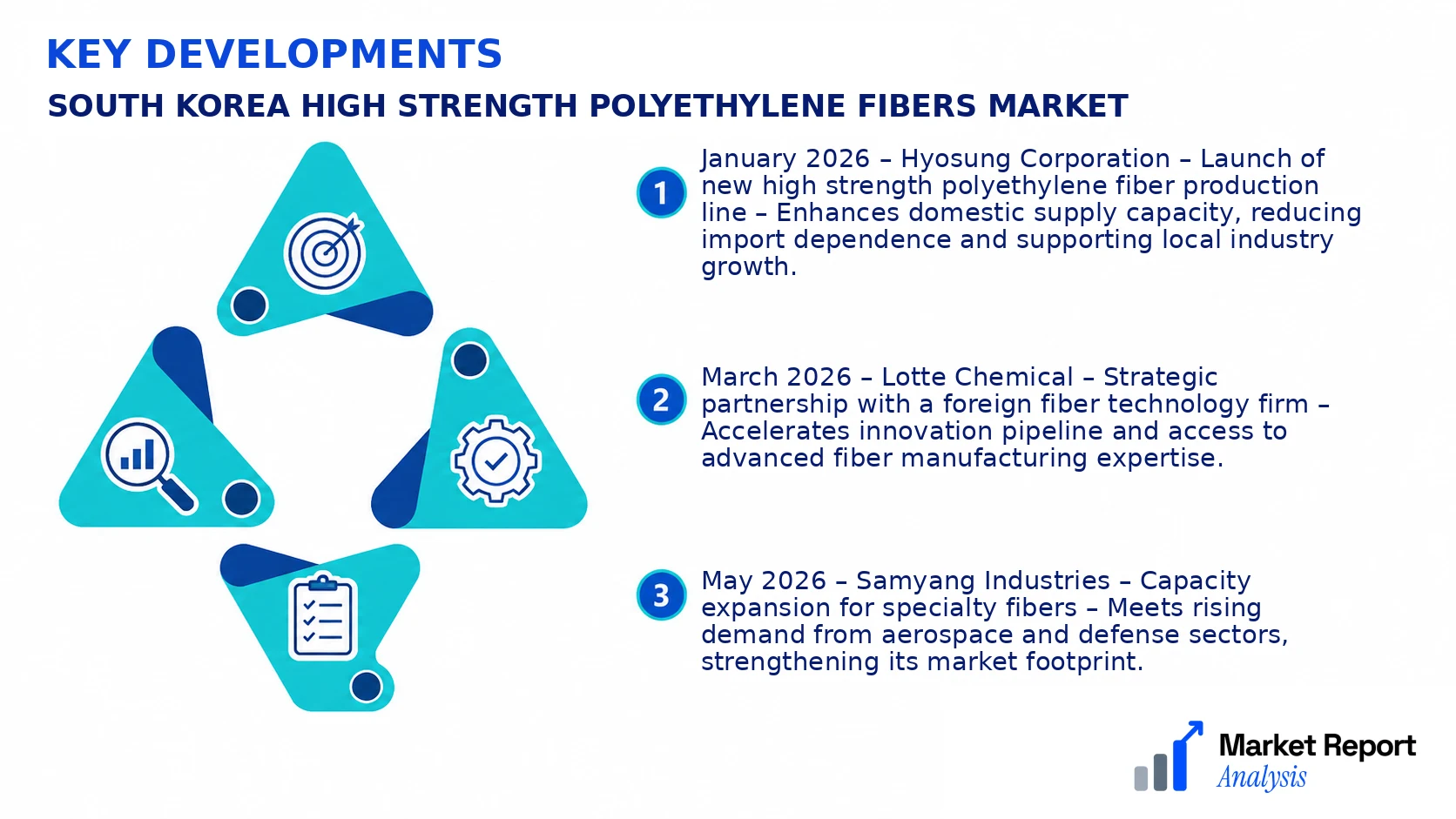
- January 2026 – Hyosung Corporation – Launch of new high strength polyethylene fiber production line – Enhances domestic supply capacity, reducing import dependence and supporting local industry growth.
- March 2026 – Lotte Chemical – Strategic partnership with a foreign fiber technology firm – Accelerates innovation pipeline and access to advanced fiber manufacturing expertise.
- May 2026 – Samyang Industries – Capacity expansion for specialty fibers – Meets rising demand from aerospace and defense sectors, strengthening its market footprint.
- September 2026 – Samsung Cheil Industries – Launch of eco-friendly polyethylene fibers – Supports sustainability goals and aligns with stricter environmental regulations.
- November 2026 – SK Chemicals – Acquisition of a niche fiber producer – Broadens product portfolio and enhances technological capabilities in high-performance fibers.
Frequently Asked Questions
What is the South Korea High Strength Polyethylene Fibers Market?
The South Korea High Strength Polyethylene (HSE) Fibers Market encompasses the production, demand, and trade of high-strength polyethylene fibers used in applications like aerospace, defense, sporting goods, and industrial sectors within South Korea. It reflects the country’s technological advancements and industrial needs.
What is the current market size of South Korea High Strength Polyethylene Fibers Market?
As of 2026, the market size is estimated at approximately USD 1.2 Billion. This figure underscores South Korea’s significant investment in high-performance specialized fibers, driven by increasing industrial demands and technological innovations for safety and durability applications.
What factors are driving the South Korea High Strength Polyethylene Fibers Market?
Growth drivers include the expanding aerospace and defense sectors, rising demand for lightweight and durable materials in sporting goods, government regulations promoting advanced composite materials, and ongoing technological developments in high-strength fiber manufacturing within South Korea.
Which South Korean city leads the South Korea High Strength Polyethylene Fibers Market?
Seoul remains the leading city in the market due to its advanced industrial infrastructure, proximity to research institutions, and concentration of leading manufacturing firms involved in the development and commercialization of high-strength polyethylene fibers.
Which segment is expected to grow the fastest?
The aerospace and defense segment is projected to exhibit the fastest growth, driven by increasing defense spending, technological enhancements, and the adoption of high-performance fibers for ballistic protection and lightweight structural components during 2026-2034.
Who are the leading companies operating in the South Korea High Strength Polyethylene Fibers Market?
Key players include SK Innovation, Hyosung, and Dongwoo Fine Chem. These companies are investing heavily in R&D, expanding production capacities, and establishing strategic partnerships to strengthen their market positions in South Korea’s high-strength polyethylene fiber landscape.
Analyst Perspective
The South Korea High Strength Polyethylene (HSPE) Fibers Market exhibits a mature yet evolving landscape, with steady growth anticipated through 2034 due to increasing demand in defense, aerospace, and sports sectors. Long-term prospects remain positive, driven by ongoing innovations in fiber technology, enhanced by advancements in nanotechnology and composite integration. Commercial opportunities predominantly lie in expanding local manufacturing capacity and developing specialized fibers tailored to South Korea’s strategic defense and infrastructure needs, especially within Seoul and Busan. Investment priorities should focus on R&D for high-performance fibers and sustainable production methods, aligning with government initiatives favoring technological innovation and environmental regulation compliance. The competitive landscape is intensifying, with key domestic players forming strategic alliances and foreign entrants increasing local investments. City-level growth potential is significant in Seoul’s industrial zones and Busan’s port-centric manufacturing hubs, which offer logistical advantages and proximity to end-users. Overall, the market’s strategic position calls for focused innovation, strong industry collaborations, and a regional approach to capitalize on emerging opportunities in South Korea.
