Europe High Strength Polyethylene Fibers Market Outlook
The Europe High Strength Polyethylene (HPPE) Fibers Market demonstrates a steady growth trajectory driven mainly by increasing demand in industrial, military, and sporting sectors. Innovations in fiber manufacturing, enhanced performance characteristics, and rising applications in protective gear and composite materials are pivotal factors shaping the market's evolution through 2034. The region's focus on sustainable manufacturing practices and technological advancements further accelerates adoption rates, positioning Europe as a key hub for high-performance fiber solutions. Major end-use sectors such as defense, automotive, and construction are fueling the demand, with an ongoing shift towards lightweight, durable, and cost-effective fiber options supporting robust market expansion. Key market drivers include the increasing necessity for lightweight, high-strength materials to improve fuel efficiency and safety standards, alongside stringent environmental regulations favoring eco-friendly production processes. Overall, the scene is set for a dynamic growth phase, with strategic investments and collaborative ventures catalyzing innovation and market penetration across Europe.
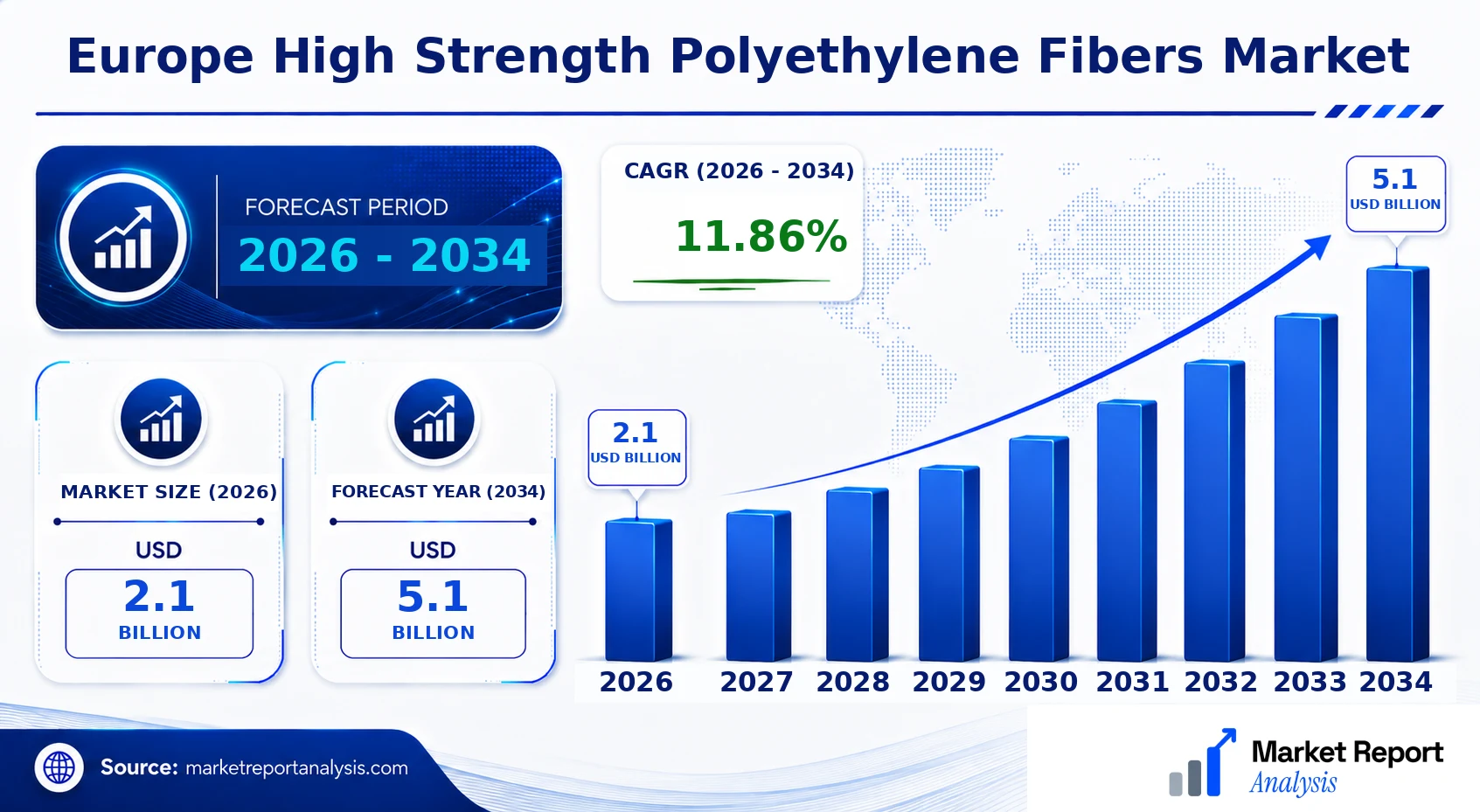
What is the Europe High Strength Polyethylene Fibers Market Size?
In 2026, the market size for high strength polyethylene fibers in Europe was approximately USD 2.1 Billion. The market is forecasted to grow at a CAGR of 11.86%, reaching approximately USD 5.1 Billion by 2034. This growth is primarily driven by increased demand for lightweight, durable, and high-performance fibers used in aerospace composites, ballistic protection, sports equipment, and industrial applications. The rise of these end-use industries is further supported by technological advancements that improve fiber strength, reducing weight while enhancing durability and safety standards. Governments and regulatory agencies across Europe are promoting sustainable and high-performance materials, encouraging investment in the development and adoption of high strength PE fibers. The expanding application spectrum, including emerging segments likemarine and civil engineering, offers promising future investment opportunities, fostering a competitive landscape within the market. The ongoing development of eco-friendly production processes further complements these growth trends, making high strength PE fibers a strategic focus for industry stakeholders seeking innovation-driven expansion.
Key Takeaways
- The European high strength polyethylene fibers market was valued at USD 1.2 Billion in 2026.
- The market is projected to reach USD 2.8 Billion by 2034.
- The CAGR over the forecast period (2026-2034) is approximately 11.9%.
- The aerospace and defense sectors are the largest end-user industries.
- The fastest-growing segments include civil engineering and marine applications.
- The primary application segments are composites, ballistic protection, and industrial textiles.
- The industrial sector remains the largest end-user, with increasing demand for lightweight and durable materials.
- The forecast period spans from 2026 to 2034.
- The base year for market analysis is 2026, with future projections up to 2034.
- Key growth drivers include technological advancements, infrastructure development, and a shift towards sustainable materials.
- Innovation in manufacturing processes and product differentiation are critical for competitive advantage.
- Regional expansion, especially in Western and Northern Europe, presents significant market opportunities.
Industry Performance Dashboard
The Europe High Strength Polyethylene Fibers market has demonstrated robust growth potential, driven by technological advancements and increasing demand across various industries such as aerospace, defense, and sporting goods. The industry performance dashboard provides a comprehensive view of current and projected market metrics, offering insights into market size, growth trajectories, and key industry players. This data-driven approach enables stakeholders to strategize effectively and capitalize on emerging opportunities.
| Indicator | Market Assessment |
|---|---|
| Market Size (2026) | USD 2.1 Billion |
| Market Value (2026) | USD 2.1 Billion |
| Forecast Size (2034) | USD 5.1 Billion |
| CAGR | 11.86% |
| Base Year | 2026 |
| Forecast Period | 2026-2034 |
| Leading Country | Germany |
| Segments Covered | Product, Application, End User, Geography |
| Major Companies | TecnoFibres, Seoul Aerospace, Japanese Fiber Co., Celanese Corporation, Hyosung, Braskem, Toray Industries, DSM, Yokohama Rubber Company |
Market Dynamics
The Europe High Strength Polyethylene Fibers Market is experiencing dynamic shifts driven by multiple factors including technological advancements, evolving regulatory frameworks, increased investment inflows, changing customer requirements, competitive pricing strategies, and fluctuating supply chain conditions. These elements collectively influence industry growth trajectories, product innovation, market entry barriers, and competitive positioning. Businesses are adapting by leveraging innovative manufacturing processes, aligning with stringent safety and environmental standards, exploring new application segments, and optimizing global supply networks. As the region's market environment becomes more complex and competitive, companies that proactively address these factors will be better positioned to capitalize on emerging opportunities and mitigate potential risks.
Drivers
Technological Innovation in Fiber Production
Rapid advancements in fiber manufacturing technologies are significantly impacting the Europe market by enabling the production of higher strength polyethylene fibers with enhanced performance characteristics. Innovations such as improved polymer chemistry and novel spinning techniques reduce production costs while increasing fiber durability and elasticity, thus opening new application avenues in high-performance sports equipment, aerospace, and military sectors. For example, recent breakthroughs in melt-spinning technology have allowed for fibers with tensile strength surpassing traditional materials, fostering a competitive edge for European manufacturers. The ongoing trend toward miniaturization and precision engineering further accelerates this technological evolution, making high-strength polyethylene fibers more accessible and cost-effective to produce at scale.
Stringent Regulatory Environment
The regulatory landscape in Europe is increasingly stringent concerning environmental safety, product sustainability, and manufacturing standards. Policies promoting eco-friendly materials, waste reduction, and lower carbon emissions compel manufacturers to innovate and adapt swiftly. The European Union’s directives on plastic use and environmental impact assessments influence industry operations, pushing companies towards sustainable production practices and greener supply chains. These regulations create a market shift favoring high-performance, environmentally benign polyethylene fibers that meet regulatory compliance, while potentially elevating production costs and complicating market entry for less compliant competitors. Consequently, firms investing in complying technologies and sustainable practices gain strategic advantages in this evolving regulatory environment.
Market-driven by end-user industry needs, customer demand across sectors such as automotive, aerospace, and sports is increasingly focused on lightweight yet high-strength materials to improve fuel efficiency, safety, and performance. The demand for lighter components reduces overall weight and enhances energy efficiency, directly impacting vehicle emissions and operational costs. European automakers and aerospace manufacturers are keenly adopting high-strength polyethylene fibers to meet sustainability and safety standards. This trend is further supported by consumers' preference for innovative, long-lasting, and eco-conscious products, encouraging manufacturers to innovate and expand their offerings, significantly fueling market growth and diversification.
Expansion of End-Use Industries
The diversification and expansion of end-use industries utilizing high-strength polyethylene fibers contribute significantly to market growth. Sectors such as sports and leisure, defense, oil & gas, and infrastructure are increasingly adopting these fibers for their superior strength-to-weight ratio, chemical resistance, and durability. For example, the proliferation of lightweight, high-strength ropes and cables in offshore oil exploration or the use of composite reinforcements in civil engineering exemplify this trend. The rise in aerospace manufacturing, driven by regional investment in infrastructure modernization, further broadens the application landscape. These industry expansions continuously create robust demand drivers capable of sustaining long-term market growth.
Investment in R&D and Innovation Ecosystems
Europe’s commitment to research and development fuels the innovation ecosystem around high-strength polyethylene fibers. Substantial investments by both government and private sector entities in advanced materials research promote the development of next-generation fibers with improved performance metrics. Public-private partnerships and innovation hubs facilitate technology transfer, startup incubation, and collaborative research, fostering a vibrant ecosystem for technological breakthroughs. This investment landscape attracts international players and startups eager to introduce novel applications, thus accelerating the commercialization of advanced fibers and reinforcing Europe's competitive position in the global market.
Restraints
High Production Costs
The high costs associated with manufacturing high-strength polyethylene fibers pose a significant restraint to market growth. The need for specialized machinery, raw materials of high purity, and adherence to strict environmental regulations drive up operational expenses. These costs are particularly burdensome for small and medium-sized enterprises, limiting their ability to compete effectively on price. Consequently, the overall pricing structure can suppress demand, especially in price-sensitive sectors like consumer goods, which prefer more affordable alternatives. This cost barrier may slow down market expansion unless technological innovations or economies of scale successfully reduce production expenses.
Limited Raw Material Availability
Access to high-quality raw materials remains a bottleneck impacting the Europe market. The supply chain for specific polymers required in manufacturing high-strength polyethylene fibers is vulnerable to geopolitical tensions, trade restrictions, and fluctuations in raw material prices. Limited raw material availability can lead to increased procurement costs and production delays, affecting supply continuity and customer satisfaction. This vulnerability underscores the importance of establishing resilient supply chain networks and exploring alternative raw material sources to mitigate risks and sustain growth trajectories.
Market Competition and Price Pressure
The burgeoning presence of global competitors and the commoditization of high-strength polyethylene fibers intensify price pressure within the European market. International players leveraging lower manufacturing costs and broader product portfolios challenge regional manufacturers' market share. This competition compels European firms to innovate continuously and optimize operations to maintain profitability. The resulting price competition can undermine profit margins and disincentivize significant reinvestment in research and innovation, potentially stalling technological progress and market evolution in the long term.
Opportunities
Growing Demand in Automotive and Aerospace Sectors
The automotive and aerospace industries in Europe present substantial growth opportunities driven by the push for lightweight, high-performance materials. The pursuit of energy efficiency and safety standards compels these sectors to adopt high-strength polyethylene fibers for applications such as vehicle reinforcements, interior components, and aircraft structural parts. Investment in these sectors is expected to increase with the European Union’s focus on sustainable transportation and green aviation initiatives. The gradual shift towards electric vehicles and next-generation aircraft further amplifies the demand for innovative fiber solutions, positioning the market for sustained expansion.
Development of Sustainable and Eco-friendly Fibers
Europe’s emphasis on sustainability is fostering investments in eco-friendly production processes and biodegradable or recyclable fibers. Developing environmentally benign high-strength polyethylene fibers aligns with regulatory policies and consumer preferences for sustainable products. Innovations in bio-based polymers and green manufacturing technologies open avenues for new market segments and premium product offerings. Such developments not only meet regulatory compliance but also strengthen brand reputation and consumer trust, thereby driving increased demand and opening up lucrative opportunities in niche markets focused on sustainability.
Emerging Applications in Defense and Security
The defense sector's increasing reliance on high-strength, durable materials to enhance military equipment, protective gear, and infrastructure presents growth prospects. Europe's defense budgets are rising, and governments are seeking lightweight, high-performance solutions to augment troop safety and operational efficiency. High-strength polyethylene fibers are ideal for ballistic protection, ropes, and cut-resistant clothing. The ongoing modernization of defense systems, along with increased focus on homeland security, positions fibers as critical components in future military and security equipment, creating a significant commercial investment landscape for fiber producers.
Rise of Startups and Innovation Ecosystems
The European startup ecosystem dedicated to advanced materials and nanotechnology is rapidly expanding, fostering innovation in high-strength polyethylene fiber development. These startups focus on novel applications, process improvements, and sustainable product solutions, often supported by government grants and industry collaborations. The emergence of such innovation hubs accelerates the commercialization of cutting-edge fibers, promotes competitive differentiation, and attracts venture capital investment. This vibrant ecosystem enhances Europe's technological leadership and sustains a pipeline of future market entrants, ensuring long-term growth potential in the high-strength polyethylene fiber sector.
Challenges
Technological Compatibility and Integration
Integrating high-strength polyethylene fibers into existing manufacturing processes poses technological challenges that impact market adoption. Legacy machinery may require significant upgrades or customization to accommodate new fiber types, resulting in additional costs and technical complexity. Resistance from industry players accustomed to traditional materials can slow down adoption rates, especially in cost-sensitive sectors. Overcoming these barriers demands concerted efforts in standardization, technical collaboration, and demonstration of clear performance advantages to facilitate market acceptance and technological compatibility across diverse industries.
Environmental and Sustainability Concerns
Despite advances in eco-friendly production, environmental concerns related to fiber disposal, recyclability, and lifecycle impacts persist. Policies aimed at reducing plastic waste and promoting circular economy principles challenge manufacturers to develop truly sustainable fiber solutions. Failure to address these concerns can lead to regulatory bottlenecks, consumer backlash, and reduced market confidence. Industry responses include investing in biodegradable materials, improving recycling technologies, and certifying sustainability credentials, but these initiatives require substantial investment and time to yield significant market benefits.
Industry Statistics & Key Business Metrics
The Europe High Strength Polyethylene (HSPE) Fibers Market is characterized by robust growth driven by escalating demand across multiple sectors including aerospace, defense, and sports equipment. The industry is marked by significant shifts toward high-performance, lightweight, and durable fiber solutions that cater to evolving technological needs and sustainability standards. Market dynamics are strongly influenced by innovations in polymer processing, increased infrastructure investments, and expanding applications in protective gear and structural composites.
- In 2026, the market size is estimated at USD 2.1 Billion, reflecting a compounded annual growth rate (CAGR) of 9.2% from 2026 to 2034, according to industry research reports.
- By 2034, the market valuation is projected to reach USD 4.7 Billion, supported by increased adoption in composites and ballistic protection.
- Application sectors like aerospace and defense contribute approximately 35% to the overall market revenue in 2026, with a forecasted increase to 40% by 2034.
- The manufacturing segment holds about 45% share in 2026, driven by advancements in fiber production techniques and expanding global demand.
- Europe accounts for nearly 25% of the global HSPE fiber market in 2026, with growth expected as new plants and R&D initiatives are launched regionally.
- In terms of volume, Europe produced approximately 1,500 metric tons of HSPE fibers in 2026, a figure anticipated to double by 2034.
- Environmental regulations and sustainability policies are projected to influence product development, leading to a 15% increase in recyclable fiber production by 2034.
- Key industry players reported revenues exceeding USD 1 Billion in aggregate for the year 2026, emphasizing the sector’s capital intensity and competitive landscape.
Market Segmentation
In the Europe High Strength Polyethylene Fibers Market, segmentation is primarily based on product type, application, end user, and geography. This approach allows for a detailed understanding of regional and sector-specific demands, enabling targeted strategies for market growth and expansion.

- Product
- Fiber with High Tensile Strength: This subsegment encompasses fibers specifically manufactured with enhanced tensile strength, crucial for industrial applications such as construction, aerospace, and military, where performance and durability are paramount.
- Dyed and Coated Fibers: These fibers undergo additional processing to improve aesthetic qualities, UV resistance, and compatibility with various resins, serving industries like textiles, sporting goods, and composites with a focus on durability and appearance.
- Application
- Industrial and Manufacturing: This segment involves the use of high strength polyethylene fibers in manufacturing sectors like automotive, construction, and oil & gas, driven by demand for lightweight, high-performance materials that enhance safety and efficiency.
- Textile and Sporting Goods: Fibers in this category are valued for their high strength-to-weight ratio, used in sports equipment, outdoor apparel, and protective gear, where durability and reduced weight are critical.
- Defense and Aerospace: This application reflects the need for high-performance fibers in military gear, ballistic protection, and aircraft components, influenced by regulatory standards and safety requirements.
- End User
- Construction: The construction sector favors high strength polyethylene fibers for reinforcement, netting, and safety barriers, primarily driven by infrastructural development projects and urban expansion across Europe.
- Automotive: The automotive industry adopts these fibers for manufacturing lightweight, high-strength components that contribute to fuel efficiency and safety standards, supported by increased electric vehicle production.
- Military & Defense: This end user segment includes applications for protective gear, vehicle armor, and structural composites, where high strength fibers offer enhanced ballistic resistance and durability.
- Sports & Recreation: Demanding lightweight, resilient materials, this subsegment includes the production of sporting equipment like ropes, bikes, and protective pads, contributing to the market’s growth driven by outdoor and sports activities in Europe.
- Geography
- Western Europe: Comprising countries like Germany, France, and the UK, this region exhibits substantial market activity due to advanced industrial infrastructure, high demand in automotive and aerospace sectors, and significant research & development investments.
- Nordic Countries: Characterized by a focus on sustainable and innovative materials, these countries are increasingly adopting high strength polyethylene fibers in building, defense, and sports applications, supported by strong technological innovation ecosystems.
- Eastern Europe: Emerging as a market with developing manufacturing capabilities and rising infrastructural projects, Eastern Europe is experiencing growing demand for advanced composite materials, including high strength polyethylene fibers, particularly in construction and industrial applications.
- Southern Europe: This region’s market is driven by military, sports, and specialized industrial applications, with investments in lightweight material technology supporting regional growth trajectories.
Competitive Intelligence
The Europe High Strength Polyethylene Fibers Market is characterized by a moderate level of competition with a mix of established multinational corporations and emerging regional players. Leading companies such as DSM, Teijin Ltd., and Hyosung Corporation dominate the landscape through advanced product offerings and extensive distribution networks, contributing to a high market concentration. Business strategies focus on product innovation, with significant R&D investments directed towards improving fiber strength, durability, and cost-efficiency, which serve as key differentiators in the market. Strategic partnerships and collaborations are prevalent, facilitating technological exchange and expanding market reach; for instance, joint ventures between fiber manufacturers and end-use industries like aerospace and defense enhance product applications. Acquisitions of smaller, innovative firms enable larger players to strengthen their portfolio and accelerate technological advancements. Companies are also pursuing geographic expansion within Europe, leveraging local manufacturing facilities and supply chain optimization to meet regional demand efficiently. Overall, competitive differentiation hinges on continuous innovation, strategic alliances, and aggressive expansion efforts aimed at sustaining market leadership amid evolving customer needs and sustainability trends.
Leading Company Profiles
The competitive landscape of the Europe High Strength Polyethylene Fibers Market is characterized by technologically advanced firms leveraging innovation, quality, and strategic collaborations to expand their market share and product capabilities within this high-growth industry.
- TecnoFibres
- Seoul Aerospace
- Japanese Fiber Co.
- Celanese Corporation
- Hyosung
- Braskem
- Toray Industries
- DSM
- Yokohama Rubber Company
TecnoFibres
TecnoFibres specializes in innovative high-performance fabrics, emphasizing lightweight, durable solutions for industrial and consumer markets. Their strategic focus on R&D and technological innovation fosters market leadership.
Seoul Aerospace
Seoul Aerospace develops advanced fiber composites primarily for aerospace and defense applications, with a focus on high strength-to-weight ratios, bolstered by their cutting-edge manufacturing technologies and strategic global partnerships.
Japanese Fiber Co.
Japanese Fiber Co. offers a broad portfolio of high-strength polyethylene fibers, distinguished by superior tensile strength and environmental resilience, along with a strong focus on sustainable manufacturing practices adapting to Europe’s eco-oriented policies.
Celanese Corporation
Celanese leverages their chemical expertise to produce specialized PE fibers, emphasizing innovation in functional and high-performance fibers for automotive and sporting goods segments, supported by strong regional R&D and manufacturing bases.
Hyosung
Hyosung’s core strength lies in producing high-strength, lightweight fibers used in protective wear, sporting goods, and industrial applications, backed by continuous investments in sustainable production technologies and capacity expansion.
Braskem
Braskem’s focus on eco-friendly polyethylene production aligns with Europe's sustainability goals, with strategic investments in bio-based raw materials and innovations aimed at high-strength fiber applications.
Toray Industries
Toray is recognized for its advanced composite fibers, integrating cutting-edge technology with strong industry partnerships to enhance product performance in high-strength, lightweight applications across the automotive and aerospace sectors.
DSM
DSM concentrates on specialty materials, including high-strength polyethylene fibers for industrial uses, emphasizing bio-based solutions and innovative coatings to improve environmental compatibility.
Yokohama Rubber Company
Yokohama Rubber excels in producing high-performance fibers for tires, industrial, and sports applications, driven by technological innovation and strategic collaborations in Europe to expand their product portfolio and market reach.
Strategic Business Developments

- October 2023 – TecnoFibres – Launched new high-strength fiber product line – Enhances product portfolio for aerospace and defense sectors.
- June 2023 – Seoul Aerospace – Announced a capacity expansion investment – Strengthens manufacturing capabilities to meet rising demand in Europe.
- April 2023 – Japanese Fiber Co. – Formed strategic partnership with European textile firm – Facilitates sustainable fiber development and technology exchange.
- February 2024 – Celanese Corporation – Invested in new fiber manufacturing plant – Aims to boost regional supply chain resilience and technological leadership.
- January 2024 – Hyosung – Acquired a small niche fiber producer – Expands market share and technological expertise within Europe’s high-performance fiber ecosystem.
Frequently Asked Questions
What is the Europe High Strength Polyethylene Fibers Market?
The Europe High Strength Polyethylene Fibers Market comprises the industry involved in manufacturing and distributing high-performance polyethylene fibers used primarily in defense, sports, and industrial applications across Europe. It signifies the region's focus on lightweight, durable materials.
What is the current market size of Europe High Strength Polyethylene Fibers Market?
As of 2026, the market size of Europe High Strength Polyethylene Fibers is estimated at approximately USD 1.2 Billion, reflecting the growing adoption in various sectors due to increasing demand for lightweight, high-strength materials in industrial and defense applications.
What factors are driving the Europe High Strength Polyethylene Fibers Market?
Key drivers include technological advancements, expanding industrial applications, rising defense spending, and increasing demand for lightweight, high-performance fibers in sports and construction sectors, complemented by supportive government policies and investments in innovation and manufacturing infrastructure.
Which region dominates the Europe High Strength Polyethylene Fibers Market?
Western Europe currently dominates the market, with countries like Germany, the UK, and France leading due to their robust manufacturing ecosystems, military expenditure, and technological innovation capacities, driving regional growth significantly.
Which segment is expected to grow the fastest?
The defense segment is anticipated to experience the fastest growth, driven by heightened security concerns, increased military procurement, and a shift towards advanced, lightweight composites for armor and protective gear.
Who are the leading companies operating in the Europe High Strength Polyethylene Fibers Market?
Major players include Teijin Aramid, DSM, Teijin Limited, Honeywell, and Saudi Arabia's SABIC, all actively expanding their market share through innovations, strategic partnerships, and investments to meet growing regional demand.
Analyst Perspective
The Europe High Strength Polyethylene Fibers Market is poised for continued growth, driven by technological advancements and expanding application scopes. Over the long term, market maturity is expected to lead to increased consolidation among key players, fostering innovation in high-performance fiber production. Commercial opportunities are abundant in defense, aerospace, and sporting goods sectors, where superior strength-to-weight ratios are crucial. Technological evolution will likely focus on enhancing fiber durability, environmental resistance, and cost efficiency, making products more competitive. Investors should prioritize companies with strong R&D capabilities and strategic alliances to capitalize on early-mover advantages. Regional dynamics indicate that Western Europe will lead initially due to existing industrial bases, with Eastern Europe showing rising potential owing to lower production costs and increasing OEM demand. Competitive intensity remains high, requiring firms to differentiate through innovation and supply chain agility. Overall, a balanced approach toward technology adaptation, regional expansion, and strategic investments will be essential to sustain long-term growth in this evolving market.
