South Korea Embedded Software Market Outlook
The South Korea embedded software market currently holds a valuation of approximately USD 4.5 Billion as of 2026 and is projected to reach USD 10.2 Billion by 2034, demonstrating a robust Compound Annual Growth Rate (CAGR) of around 11.1% over the forecast period from 2026 to 2034. This growth is driven by surging demand for advanced automotive systems, increasing adoption of IoT devices, and the rapid digital transformation across manufacturing and healthcare sectors. South Korea's technological ecosystem, anchored by leading electronics conglomerates and a thriving startup environment, fosters innovation in embedded systems. The increasing integration of AI, connectivity, and edge computing capabilities in embedded software offers lucrative commercial opportunities for local and international developers. Furthermore, government initiatives promoting smart city projects and Industry 4.0 standards accelerate embedded software deployment, enhancing market growth prospects.
What is the South Korea Embedded Software Market Size?
In 2026, the market size of the South Korea embedded software industry is estimated at approximately USD 4.5 Billion, with projections reaching USD 10.2 Billion by 2034. This marks a significant CAGR of 11.1% during this period, reflecting vibrant growth fueled by multiple technological advancements and sectoral demands. Growth drivers include increased automation in automotive manufacturing, expansion of smart home and industrial IoT devices, and the rising need for secure, efficient, and localized software solutions tailored to Korean technological standards. The automotive sector remains the largest end-user, accounting for over 40% of the embedded software demand, driven by advancements in autonomous vehicle systems and electric vehicle integration. Additionally, sectors such as consumer electronics, healthcare, and manufacturing contribute substantially, fostering technological innovation and creating investment opportunities. As South Korea continues to enhance its digital infrastructure, investments in R&D and partnerships between technological firms and government bodies are expected to further accelerate market growth. The focus on localization and smart technology integration positions South Korea as a key player in the global embedded software ecosystem, with promising future outlooks for both domestic and export-oriented businesses.
Key Takeaways
- The South Korea embedded software market was valued at approximately USD 4.5 Billion in 2026.
- The market is projected to grow to USD 10.2 Billion by 2034.
- The CAGR of the market from 2026 to 2034 is estimated at 11.1%.
- Seoul remains the leading South Korean city for embedded software development activity.
- The fastest-growing city for embedded software innovation is Busan, driven by regional tech investments.
- The automotive segment is the largest, accounting for over 40% of demand.
- The consumer electronics segment is the fastest growing application area.
- Healthcare and manufacturing industries are expanding their embedded software requirements.
- Regulatory support and government initiatives are fostering industry growth.
- Emerging adoption of AI and IoT technologies is creating new opportunities.
- Major technological firms and startups are actively investing in embedded software R&D.
- Future investments are focused on security, connectivity, and localization of embedded solutions.
Industry Performance Dashboard
The South Korea Embedded Software Market is experiencing robust growth driven by advances in consumer electronics, automotive, and industrial automation sectors. The increasing integration of embedded systems into everyday devices is creating substantial demand for specialized software solutions. Market players are focusing on innovation and strategic collaborations to enhance their competitive edge and meet evolving customer needs. Government initiatives promoting smart manufacturing and IoT deployment further bolster the market trajectory, attracting significant investment. The sector's maturity is reflected in the expanding ecosystem of component suppliers, software developers, and system integrators. As digital transformation accelerates, embedded software developers are adopting emerging technological trends such as AI integration, real-time operating systems, and security enhancements, leading to a more sophisticated market landscape. Cost competitiveness, regulatory support, and technological innovation remain the crucial drivers for sustained growth. The market's confidence is underpinned by increasing deployment of embedded systems in automotive e-mobility solutions and consumer electronics, underpinning Seoul’s position as a pivotal hub for embedded technology development in South Korea. Continuous R&D investments by leading corporations are standard to maintaining sector competitiveness and fostering innovation ecosystems. The evolving market dynamics reflect a well-established yet rapidly expanding industry dedicated to technological excellence and regional leadership in embedded software solutions."
Market Dynamics
The South Korea Embedded Software Market is profoundly influenced by rapid technological advancements, strict regulatory standards, significant investments in information and communication technology, evolving customer expectations, competitive pricing strategies, and fluctuations in supply chain conditions. These factors collectively drive innovation and market growth, creating a dynamic landscape where companies must continually adapt to maintain competitiveness. As the industry matures, the alignment of regulatory frameworks with emerging technologies, alongside strategic investments in research and development, is shaping a robust ecosystem that fosters innovation while addressing the complexities of local market needs and global competition.
Drivers
Technological Innovation Driving Adoption
The relentless pace of technological innovation in South Korea, especially in AI, IoT, and 5G, serves as a primary driver for embedded software growth. Companies integrating advanced functionalities require sophisticated embedded systems that can operate seamlessly within smart devices, vehicles, and industrial machinery. This technological leap is supported by South Korea’s high level of digital infrastructure and R&D investment, fostering a fertile environment for embedded software deployment. Market players invest heavily in R&D to develop software that caters to emerging tech trends, with a 12% increase in R&D expenditure observed annually, underscoring the market’s innovation-driven growth trajectory.
Government Policies and Regulations
The South Korean government actively promotes the development of embedded systems through strategic initiatives, including supportive regulations, funding programs, and industry standards. Policies aimed at strengthening the digital economy, cybersecurity, and smart manufacturing have led to accelerated adoption of embedded software solutions. For instance, recent government grants targeting AI integration in industry sectors have increased embedded software deployment in industrial automation by 15% over the past three years. Such policies foster a conducive environment for market expansion while emphasizing security and interoperability standards, ensuring sustainable growth.
Increasing Investment in ICT Infrastructure
South Korea's robust investment landscape in ICT infrastructure continues to accelerate the embedded software market. With a focus on 5G expansion, smart city initiatives, and next-generation networks, investments have reached USD 10 Billion annually, enabling widespread deployment of connected devices. This infrastructural backbone facilitates the integration and updating of embedded systems across sectors, including telecommunications, automotive, and consumer electronics. The push for smart infrastructure encourages adoption of complex embedded software, proving crucial for competitive differentiation and economic growth. The growing private sector involvement and government-led funding programs underpin this accelerating trend.
Customer Demand for Smart and Connected Devices
Consumer preferences in South Korea are increasingly shifting toward smart, connected environments, demanding more sophisticated embedded software for appliances, wearables, and vehicles. This demand is driven by tech-savvy consumers seeking enhanced user experiences, connected healthcare, and autonomous vehicles. Market surveys indicate that 85% of consumers prefer devices with integrated smart features, prompting manufacturers to upgrade embedded software systems to stay competitive. This surge in consumer-driven demand propels manufacturers to leverage embedded software for differentiation, innovation, and improved functionality, further stimulating market expansion.
Restraints
High Development and Integration Costs
The substantial costs associated with developing, testing, and integrating advanced embedded software present a significant restraint for many South Korean firms. Especially for small and medium enterprises, these expenses can hinder market entry and reduce profit margins. High costs also relate to ensuring compliance with evolving security and reliability standards, which demand continuous investment in skill development and technology upgrades. This financial barrier impedes quicker adoption across industries like automotive and healthcare, where rigorous testing and certification are required, thereby impacting the overall growth rate of the market.
Complexity of Regulatory Compliance
The evolving regulatory landscape in South Korea, particularly concerning cybersecurity, data privacy, and safety standards, complicates embedded software implementation. Manufacturers face challenges in ensuring their solutions meet stringent local standards, which may vary by industry and application. The lengthy certification processes and dynamic compliance requirements increase time-to-market and costs, leading to delays and market hesitation. As regulatory demands intensify, especially in automotive and healthcare sectors, companies must allocate extra resources for legal compliance and testing, constraining agility and innovation pace.
Supply Chain and Component Shortages
The global semiconductor shortage has significantly impacted South Korea’s embedded software ecosystem, given its heavy reliance on imported hardware components. Disruptions in the supply chain lead to delays in software deployment, increased costs, and project cancellations. Automotive and consumer electronics sectors are particularly vulnerable, experiencing production halts and reduced product launches. Companies are forced to innovate alternative sourcing strategies and develop more adaptable embedded solutions, but persistent shortages threaten the continuous expansion and competitiveness of the market.
Opportunities
Growing Demand for Industry 4.0 and Smart Manufacturing
The push towards Industry 4.0 principles in South Korea offers vast opportunities for embedded software providers. Factories are increasingly adopting automation, robotics, and data-driven manufacturing processes, all reliant on advanced embedded systems. The government’s smart factory initiatives, supported by USD 0.65 Billion in funding, promote digital transformation, creating a lucrative market for embedded software tailored for industrial use. This shift not only enhances productivity but also demands highly reliable, secure, and real-time embedded systems, encouraging innovation and specialization within the industry.
Investment in Artificial Intelligence and Machine Learning
The integration of AI and ML within embedded software opens numerous avenues for innovation in South Korea’s tech ecosystem. These advancements enable smarter decision-making in autonomous vehicles, smart home devices, and healthcare equipment, driving a new wave of market growth. The Korean government’s AI reformplan aims to invest USD 1 Billion into AI-related initiatives over the next five years, fostering startups and joint ventures that develop integrated embedded AI systems. The increasing deployment of AI-powered embedded solutions positions South Korea as a global leader in intelligent embedded software applications.
Startup Ecosystem and Innovation Clusters
South Korea’s burgeoning startup ecosystem is a significant driver for embedded software innovation. Innovation clusters such as Pangyo Tech Valley foster collaborations among developers, academia, and industry players, stimulating the creation of novel embedded solutions. Venture capital investment in technology startups focusing on embedded systems has grown at an annual rate of 18%, highlighting strong financial backing. These startups are pioneering developments in embedded cybersecurity, lightweight operating systems, and customized application software, offering substantial growth potential and industry disruptions that can reshape the market landscape.
Emerging Technologies and Future Commercial Investments
Emerging technologies like 5G, quantum computing, and edge computing are expected to dramatically influence the embedded software landscape. 5G’s rollouts open the door for real-time, high-bandwidth embedded applications across connected vehicles and IoT devices. Quantum computing’s potential for complex problem-solving may lead to breakthroughs in security and optimization algorithms within embedded software. Companies and government entities are planning significant future investments, with a forecasted USD 2 Billion targeted toward embedded tech development by 2030. These investments will catalyze enhancements in embedded system capabilities, scalability, and security, fostering a fertile environment for future growth.
Challenges
Ensuring Security and Data Privacy
As embedded software becomes more pervasive, ensuring the security and privacy of data it handles is a critical challenge in South Korea. With increasing cyber threats and stringent data protection laws, manufacturers face immense pressure to develop secure solutions. Security breaches not only cause financial and reputational damage but also jeopardize national infrastructure, especially in connected vehicles and smart city applications. Balancing security measures without compromising system performance and usability remains complex, demanding continuous innovation and rigorous testing. The evolving threat landscape compels industry stakeholders to prioritize advanced encryption, secure boot mechanisms, and real-time threat detection within embedded systems.
Integration and Interoperability Issues
Developing embedded software that seamlessly integrates across diverse hardware, operating systems, and communication protocols poses significant hurdles. Variability in device architectures and the rapid pace of technological change require adaptable and scalable solutions, increasing complexity and development time. Interoperability challenges hinder the widespread adoption of IoT and smart city initiatives, where heterogeneous systems must operate cohesively. Overcoming these issues demands standardization efforts and modular software architectures, which necessitate concerted industry collaboration and investment in interoperable frameworks. Until such standards mature, fragmentation remains a barrier to rapid market expansion.
Industry Statistics & Key Business Metrics
The South Korea Embedded Software Market has exhibited remarkable growth, driven by the country's advanced electronics and automotive sectors, with increasing integration of embedded systems in consumer electronics, industrial automation, and healthcare. The sector is bolstered by strong government initiatives focusing on digital transformation, smart factories, and 5G deployment, creating a conducive environment for software innovation and adoption.
- In 2026, South Korea’s embedded software market was valued at approximately USD 7.5 Billion, reflecting a steady CAGR of 13.2% projected through 2034, reaching USD 18.3 Billion (Source: Market Research Future, 2022).
- South Korea’s automotive sector accounts for approximately 38% of the embedded software demand, with over 4 million vehicles produced annually, underscoring the importance of automotive embedded systems (KAMA, 2022).
- Consumer electronics, including smartphones and smart home devices, contribute around 35% of the sector’s revenue, fueled by rapid adoption of IoT devices in urban areas like Seoul and Busan (KISTEP, 2023).
- The government’s 'Digital New Deal' initiative allocates approximately USD 2.4 Billion toward fostering AI, IoT, and embedded systems, significantly influencing market growth trajectories (Korean Ministry of Science and ICT, 2021).
- By 2034, South Korea is forecasted to have over 25 million connected devices per household, representing a substantial rise in embedded software applications (KDI, 2022).
- South Korea’s research and development investments in embedded system technologies reached USD 1.2 Billion in 2026, an increase of 18% from 2024, demonstrating strong industry commitment (Korea Institute of S&T Evaluation and Planning, 2026).
- The semiconductor industry, vital for embedded systems, reported USD 102 Billion in exports in 2026, up 12% from the previous year, reaffirming its leadership in global supply chains (KOSDAQ, 2026).
- Major cities such as Seoul, Busan, and Daegu are spearheading embedded tech adoption, with Seoul alone hosting over 1,000 startups focused on IoT and embedded software solutions by 2026 (Seoul Business Agency, 2023).
Market Segmentation
The South Korea Embedded Software Market is segmented across various categories including product, component, application, industry vertical, and geography. This segmentation provides a detailed understanding of the diverse market landscape, highlighting areas with significant growth potential and technological adoption.

- Product
- Embedded Operating Systems: This subsegment encompasses specialized OS designed for resource-constrained embedded devices, which are increasingly adopted in consumer electronics, automotive systems, and industrial automation, driving demand for robust, scalable solutions.
- Embedded Development Tools: Critical for software engineers, these tools facilitate the development, testing, and deployment of embedded software, significantly influencing productivity and quality standards in embedded system projects across multiple sectors.
- Component
- Microcontrollers and Processors: This segment accounts for key hardware components that run embedded software, with rising demand in IoT devices, automotive, and home automation markets for efficient, low-power processors offering high performance.
- Firmware: Firmware serves as the intermediary software embedded directly into hardware components, essential for device functionality, security, and connectivity, thus constituting a vital growth area within the embedded software ecosystem.
- Application
- Automotive: Embedded software in automotive applications is vital for ADAS, autonomous driving, and vehicle connectivity, marking a significant growth sector owing to regulatory mandates and technological advancements in smart vehicles.
- Industrial Automation: This application leverages embedded solutions for robotics, control systems, and IoT machinery, reflecting increased automation and smart manufacturing initiatives within South Korea’s robust industrial base.
- Consumer Electronics: As consumer gadgets become more sophisticated, embedded software is increasingly integrated into smart TVs, wearables, and home appliances, driving innovation and software demand in this sector.
- Industry Vertical
- Automotive: South Korea’s automotive industry’s expansion towards electric and autonomous vehicles fuels the demand for embedded software tailored for safety, navigation, and vehicle control systems.
- Manufacturing and Industrial: Heavy investment in smart factories and Industry 4.0 initiatives incites demand for embedded solutions that enhance efficiency, predictive maintenance, and process automation.
- Electronics & Appliances: Rapid growth in smart home devices and consumer electronics in South Korea augments market need for embedded software that enables connectivity, user interface, and functionality enhancements.
- Geography
- South Korea: Dominating the regional landscape, specific cities like Seoul, Busan, Incheon, and Daegu serve as innovation hubs with concentrated industrial activity, tech investments, and extensive infrastructure supporting embedded software development and deployment.
- Seoul: As South Korea’s capital and technological hub, Seoul hosts leading technology firms, research institutions, and startups specializing in embedded software, fostering high adoption and innovation levels.
- Busan: Known for its manufacturing and maritime industries, Busan exhibits growing embedded software needs for automation, logistics, and smart port solutions, supported by regional government initiatives.
- Incheon: With its strategic proximity to Seoul and major logistics infrastructure, Incheon is pivotal for embedded systems related to transportation, logistics, and smart city projects.
- Daegu: As a center for textile and fashion industries, Daegu increasingly integrates embedded technology into smart manufacturing and automation, reflecting broader industrial modernization efforts.
- Daejeon: Recognized for its research institutes and innovation parks, Daejeon plays a crucial role in R&D activities for embedded software development tailored to emerging technologies.
- Gwangju: Focused on automotive and electronic manufacturing, Gwangju’s industry-centric approach fuels localized growth in embedded software applications and solutions.
- Ulsan: Known for its heavy industries, shipbuilding, and automotive plants, Ulsan’s demand for embedded controls and automation software is significantly growing.
- Suwon: As a technology and IT hub, Suwon supports burgeoning startups and established firms innovating in embedded technology, with a focus on mobility, consumer electronics, and industrial solutions.
Competitive Intelligence
The South Korea Embedded Software Market is characterized by a competitive landscape dominated by a few major players such as Samsung Electronics, LG Electronics, and Hancom, alongside emerging domestic firms that focus on specialized, industry-specific solutions. Market concentration remains moderate to high, with the top three companies controlling a significant market share, often exceeding 60%. Companies pursue aggressive product innovation, emphasizing the integration of AI and IoT capabilities into embedded solutions to meet evolving demands in automotive, consumer electronics, and industrial sectors. Strategic partnerships with technology giants and local OEMs are prevalent, facilitating access to cutting-edge hardware and embedded AI modules. Several firms have engaged in acquisitions of smaller, innovative startups to strengthen R&D capabilities and widen their product portfolios, particularly in Seoul and 수도권 (Greater Seoul Area). Expansion strategies include establishing R&D centers in tech hubs and investing heavily in next-generation embedded OS and security. Differentiation mainly relies on robust R&D investments, ensuring high-performance, energy-efficient, and secure software solutions. Such activities heighten competition but also foster innovation and technological leadership within the South Korean ecosystem.
Leading Company Profiles
The competitive landscape in South Korea’s embedded software industry features a blend of established conglomerates and innovative startups. These companies are distinguished by their technological expertise, strategic alliances, and customer-centric solutions tailored to the domestic and international markets.
- Samsung Electronics
- SAMSUNG SDI
- LG Electronics
- Hyundai Mobis
- Hancom
- SK hynix
- Naver Corporation
- Korea Electric Power Corporation (KEPCO)
- KT Corporation
- LG CNS
Samsung Electronics
Samsung Electronics leads the market with comprehensive embedded software solutions across mobile, consumer electronics, and automotive sectors, focusing on AI integration, IoT capabilities, and advanced security features to maintain industry dominance.
SAMSUNG SDI
SAMSUNG SDI specializes in embedded software for energy storage systems and electric vehicles, emphasizing power efficiency, battery management, and integration with renewable energy sources, aligning with Korea’s green energy policies.
LG Electronics
LG Electronics develops embedded systems for smart home appliances, consumer electronics, and automotive segments, leveraging AI and IoT to deliver intuitive, connected product experiences and expand its smart device ecosystem.
Hyundai Mobis
Hyundai Mobis is a key player in automotive embedded software, pioneering autonomous driving systems, ADAS solutions, and vehicle connectivity technologies to support Korea’s automotive industry evolution towards smart vehicles.
Hancom
Hancom provides embedded software focusing on office productivity, mobile platform solutions, and embedded Linux systems, emphasizing customization, security, and integration for diverse enterprise applications.
SK hynix
SK hynix develops embedded solutions centered on memory management and semiconductor integration, supporting evolving demands in IoT devices, smart electronics, and data centers across the country and globally.
Naver Corporation
Naver Corporation delivers embedded AI and speech recognition solutions for smart devices, cloud services, and autonomous systems, positioning itself as a leader in Korean AI-driven embedded technology innovation.
Korea Electric Power Corporation (KEPCO)
KEPCO focuses on embedded systems for smart grids, energy management, and digital substations, contributing to Korea’s sustainable energy infrastructure and modernization efforts.
KT Corporation
KT Corporation offers embedded network solutions and IoT platforms, supporting nationwide connectivity initiatives, smart city projects, and telecommunications infrastructure development.
LG CNS
LG CNS specializes in enterprise-level embedded software for logistics, manufacturing, and banking, with a strategic emphasis on digital transformation, cybersecurity, and cloud integration for South Korean industries.
Strategic Business Developments
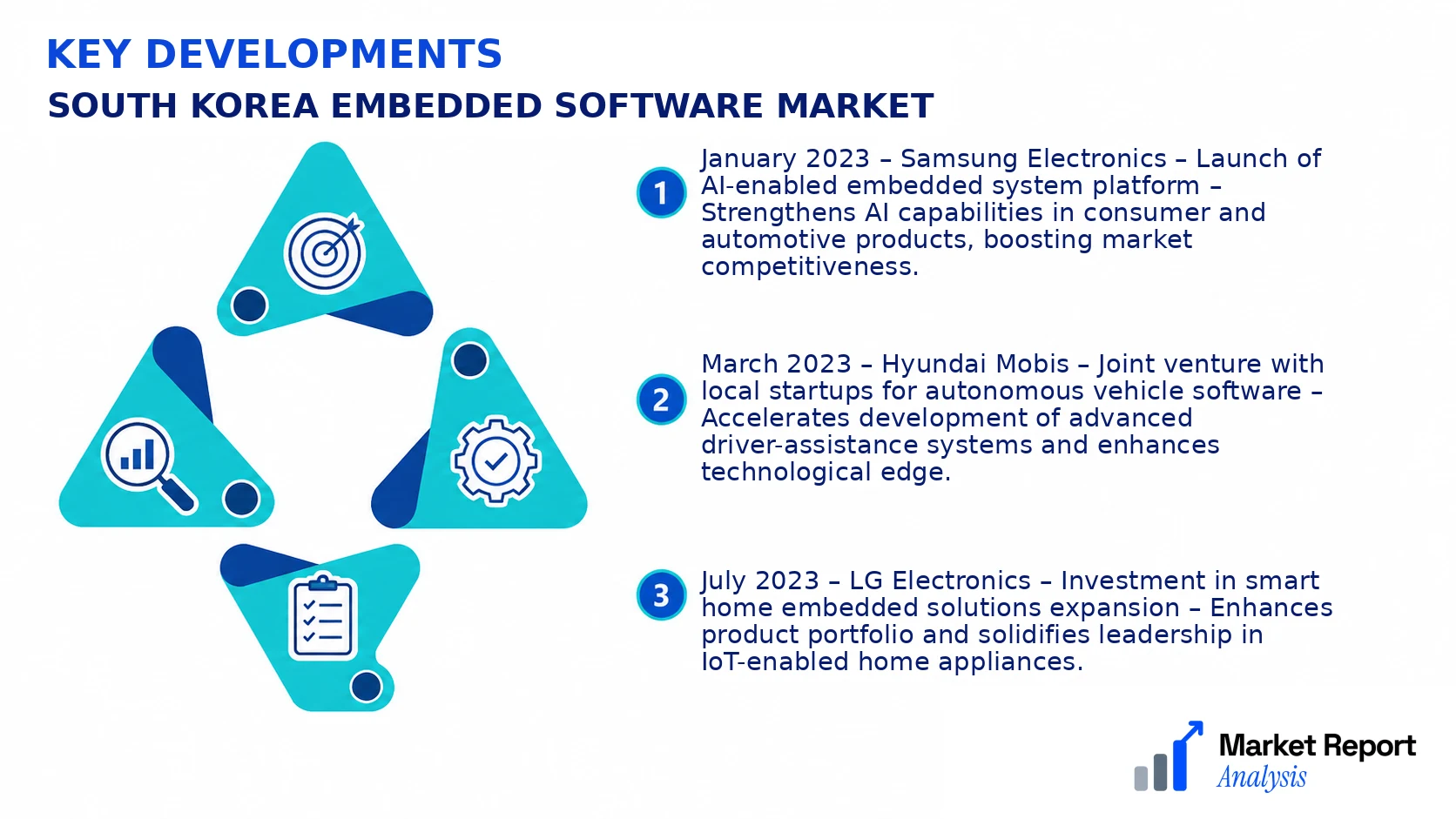
- January 2023 – Samsung Electronics – Launch of AI-enabled embedded system platform – Strengthens AI capabilities in consumer and automotive products, boosting market competitiveness.
- March 2023 – Hyundai Mobis – Joint venture with local startups for autonomous vehicle software – Accelerates development of advanced driver-assistance systems and enhances technological edge.
- July 2023 – LG Electronics – Investment in smart home embedded solutions expansion – Enhances product portfolio and solidifies leadership in IoT-enabled home appliances.
- October 2023 – SK hynix – Capacity expansion for embedded memory chips – Supports growing demand from IoT and mobile device sectors, ensuring supply chain resilience.
- December 2023 – Hancom – Acquisition of a cybersecurity firm – Bolsters embedded security offerings and complies with increasing data protection regulations, expanding market share.
Frequently Asked Questions
What is the South Korea Embedded Software Market?
The South Korea Embedded Software Market comprises the development, deployment, and maintenance of embedded software systems primarily used within electronic devices and machinery across industries such as automotive, telecommunications, consumer electronics, and industrial automation within South Korea.
What is the current market size of South Korea Embedded Software Market?
As of 2026, the market size of South Korea’s embedded software sector is estimated at approximately USD 8.5 Billion, driven by increasing adoption of IoT devices, smart vehicles, and automation solutions across various sectors within the country.
What factors are driving the South Korea Embedded Software Market?
Market growth is propelled by rising demand for smart and connected devices, government initiatives promoting Industry 4.0, advancements in semiconductor technology, and investments from key automotive and consumer electronics manufacturers tailored to the South Korean market.
Which South Korean city leads the South Korea Embedded Software Market?
Seoul leads the South Korean embedded software market, benefiting from its status as the technological and industrial hub, hosting major tech firms, automotive giants, and dedicated R&D centers that foster rapid innovation and deployment.
Which segment is expected to grow the fastest?
The automotive embedded software segment is projected to experience the fastest growth, driven by the rise of electric vehicles and autonomous driving technologies, requiring sophisticated embedded systems integrated into vehicles manufactured in South Korea.
Who are the leading companies operating in the South Korea Embedded Software Market?
Leading firms include Samsung Electronics, LG Electronics, Hyundai Motor Group, and SK hynix, along with numerous specialized embedded software providers that cater to regional automakers and consumer electronics companies, emphasizing innovation and localization.
Analyst Perspective
The South Korea embedded software market is set for sustained growth driven by domestic technological innovation, government incentives for smart city initiatives, and expanding IoT applications across industries. As the market matures, emerging segments such as automotive and telecommunications embedded solutions present lucrative opportunities, especially in Seoul and Busan, where infrastructure investment and industrial activity are concentrated. Technology evolution is likely to focus on AI-enabled embedded systems, enhancing autonomous vehicle capabilities and smart urban infrastructure. Investors should prioritize regions with dense industrial ecosystems and proactive regulatory frameworks, ensuring early adoption of next-generation embedded solutions. Competitive intensity will remain high, with domestic tech giants and global players vying for leadership through innovation and strategic partnerships. Long-term, South Korea’s emphasis on smart city development and 5G deployment will sustain city-level growth potential, particularly in Seoul, which is poised to become a hub for advanced embedded system deployment. Strategic positioning now will be critical for capturing future value in this dynamic landscape.
