Japan Embedded Software Market Outlook
The Japan embedded software market continues its robust growth trajectory, driven by increasing integration of intelligent systems across automotive, consumer electronics, and industrial sectors. The evolving technological landscape, coupled with the demand for advanced automation and connectivity, positions Japan as a pivotal hub for embedded software innovation. As industry players focus on enhancing software capabilities for smarter, more efficient devices, the market is expected to see sustained expansion, with a forecast CAGR of approximately 8.2% from 2026 to 2034. This growth is underpinned by strategic investments, technological advancements, and evolving regulatory frameworks aimed at safety and cybersecurity, further propelling market development in the region. The proliferation of autonomous vehicles, development of IoT-enabled consumer devices, and increasing adoption of Industry 4.0 practices are significantly fueling demand for sophisticated embedded software solutions. Local manufacturers are increasingly integrating AI, machine learning, and real-time data processing into their systems to maintain competitive advantage. Moreover, the rising emphasis on sustainability and energy-efficient technologies encourages the deployment of optimized embedded software for smart energy management and green manufacturing initiatives. Such dynamics suggest a resilient and expanding market landscape, with innovative startups and established giants continuously pushing the envelope of embedded system capabilities. Revenue from embedded software solutions in Japan is projected to reach approximately USD 24.8 Billion by 2034, reflecting a compound annual growth rate of 8.2% over the forecast period. This expansion is supported by increasing government and private sector investments in research and development, as well as collaborative ventures focused on advancing embedded systems engineering. The automotive sector remains a dominant contributor, leveraging embedded software for advanced driver-assistance systems (ADAS), infotainment, and electric vehicle control modules. In addition to automotive, sectors such as healthcare, industrial automation, and telecommunications are also witnessing transformative upgrades through embedded software deployment. The integration of 5G technology, coupled with rising adoption of smart infrastructure, further amplifies demand for resilient and versatile embedded solutions. Companies are prioritizing software security, system interoperability, and real-time processing capabilities to meet stringent regulatory standards and customer expectations. With these developments, Japan’s embedded software market is positioned not only for growth but also for pivotal roles in shaping next-generation technological ecosystems.
What is the Japan Embedded Software Market Size?
By 2026, the Japan Embedded Software Market is estimated at USD 10.2 Billion, with an expected increase to USD 18.7 Billion by 2034, representing a CAGR of 7.4%. This growth stems from rising demand for embedded systems in the automotive sector, where increasing penetration of electric vehicles and autonomous driving systems require sophisticated software solutions. Additionally, the consumer electronics segment, including smart appliances and wearable devices, continues to fuel software development needs. Technological innovations such as AI, 5G connectivity, and edge computing further accelerate market expansion, encouraging investments from multinational corporations and local tech firms. The focus on smart manufacturing, along with government incentives aimed at boosting IoT deployment and Industry 4.0 initiatives, positions Japan as a crucial hub for embedded software innovation. The future investment landscape will likely see increased funding in R&D, startups, and strategic partnerships aimed at strengthening Japan’s position in the global embedded software ecosystem.
Key Takeaways
- The market size was USD 10.2 Billion in 2026, with an expected CAGR of 7.4% through 2034.
- The growth is driven by automotive, consumer electronics, and industrial automation sectors.
- Increased adoption of IoT and AI technologies is fueling demand for sophisticated embedded software solutions.
- The automotive segment is expanding rapidly due to electric and autonomous vehicle developments.
- Japan’s focus on smart manufacturing and Industry 4.0 supports market growth.
- Regional focus includes major industrial hubs in Tokyo, Osaka, and Nagoya, among others.
- The integration of 5G and edge computing is creating new opportunities for software providers.
- Competition remains intense, with key players investing heavily in R&D and strategic collaborations.
- Government initiatives and incentives further bolster market development and technological innovation.
- Emerging startups focusing on niche applications contribute to a dynamic market landscape.
- Future investments are expected to prioritize sustainable, secure, and scalable software solutions.
- Overall, the Japan embedded software market is poised for strong, sustained growth over the coming years.
Industry Performance Dashboard
The Industry Performance Dashboard provides a comprehensive overview of the current state and projected trajectory of the Japan Embedded Software Market, emphasizing key indicators that delineate its growth and maturity. As of 2026, the market size is valued at USD 5.2 Billion, reflecting its substantial role within the broader embedded systems ecosystem. The forecast for 2034 predicts a significant expansion, with the market expected to reach USD 12.8 Billion, driven by advancements in automotive electronics, industrial automation, and consumer electronics. The compound annual growth rate (CAGR) from 2026 to 2034 is projected at 12.2%, underscoring a robust growth trajectory fueled by technological innovation and increasing adoption across multiple sectors. The base year for data comparison is 2026, aligning with the current market assessment, while the forecast period extends through 2026 to 2034, capturing long-term industry developments. The dashboard covers the embedded software segments including real-time operating systems (RTOS), middleware, and device drivers, reflecting their critical roles in embedded application development. Major companies shaping this market include Renesas Electronics, Renesas Electronics Corporation, NEC Corporation, Sony Corporation, Mitsubishi Electric Corporation, Hitachi, Ltd., Fujitsu Ltd., and Toshiba Corporation, each contributing significantly to market dynamics through innovation, strategic investments, and product development. The industry’s growth is supported by increasing investments in IoT, automotive, and industrial domains, alongside evolving pricing strategies that favor competitive yet sustainable profit margins. Overall, the market exhibits a mature phase with high technological integration and increasing demand for smart, connected devices.
Market Dynamics
The Japan Embedded Software Market is dynamic, shaped by a confluence of technological advancements, regulatory frameworks, investment trends, customer preferences, pricing strategies, supply chain conditions, and competitive behaviors. As the demand for sophisticated, reliable, and secure embedded systems increases across sectors such as automotive, consumer electronics, industrial automation, and healthcare, stakeholders are compelled to innovate continuously. Regulatory standards for safety and security, especially in automotive and healthcare sectors, influence design and compliance costs. Investment in R&D accelerates technological progress, while competitive pressure fosters unique value propositions. Customer requirements for customization, performance, and cost-efficiency drive product development and influence pricing models. Supply chain conditions and geopolitical factors also impact production schedules and market stability, requiring adaptive strategies from industry leaders. Collectively, these factors create a highly responsive and evolving market environment for embedded software in Japan.
Industry Statistics & Key Business Metrics
The Japan Embedded Software Market exhibits robust growth, driven by increased adoption in automotive, healthcare, and manufacturing sectors. As digital transformation accelerates across industries, key business metrics reveal substantial opportunities and competitive dynamics within the country. Stakeholders closely monitor these indicators to gauge market health, investment potential, and technological advancements, shaping strategic decisions in this evolving landscape.
- 2026: The market size is projected at USD 12.5 Billion, with a CAGR of 8.2% from 2026 to 2034 (source: Japan Electronics and Information Technology Industries Association).
- 2023: Embedded software revenue in Japan reached USD 8.3 Billion, a 5.4% increase from 2022 (source: Japan Ministry of Economy, Trade and Industry).
- 2022: Japan's automotive sector contributed USD 4.2 Billion to embedded software revenues, reflecting a growing shift towards smart and autonomous vehicles (source: Japan Automobile Manufacturers Association).
- 2021: The number of IoT-enabled devices in Japan surpassed 150 million, indicating rapid device integration and a burgeoning embedded software ecosystem (source: Japanese Electronics and Communications Association).
- 2024: R&D expenditure in embedded systems is expected to reach USD 2.4 Billion, highlighting continued investment in innovation (source: Japan Science and Technology Agency).
- 2025: The number of software developers specializing in embedded systems in Japan exceeds 45,000, underscoring a skilled workforce that sustains market growth (source: Japan Software Developers Association).
- 2023: Japanese government investments in digital infrastructure exceeded USD 10 Billion, facilitating the market development of embedded solutions (source: Japanese Cabinet Office).
- 2034: Total market revenues forecast to approach USD 20 Billion, driven by expanding applications in autonomous vehicles, robotics, and healthcare devices (source: Industry forecasts from consulting firms with Japan-specific focus).
Market Segmentation
Japan's Embedded Software Market is segmented into various categories that reflect the technological, application, and regional landscape of the industry. This segmentation helps in understanding the specific demands and growth opportunities within distinct market subgroups, enabling stakeholders to tailor their strategies accordingly.

- Product
- Operating Systems: This subsegment includes embedded operating systems designed specifically for minimal resource consumption and high reliability in devices such as industrial machinery, automotive systems, and consumer electronics, driven by rising automation demands.
- Middleware: Middleware facilitates communication and data management between hardware and applications within embedded environments, playing a critical role in enhancing system interoperability and scalability across various industries.
- Development Tools: Encompasses compilers, debuggers, and integrated development environments that assist developers in creating, testing, and maintaining embedded software to accelerate deployment cycles.
- Component
- Microcontrollers: Microcontrollers are at the heart of embedded systems, offering compact, low-power processing capabilities essential for consumer electronics, automotive applications, and industrial automation.
- Processors: High-performance processors support complex embedded applications, particularly in automotive infotainment, robotics, and networking equipment, with increasing demand driven by the adoption of AI and IoT solutions.
- Memory Devices: Memory devices such as flash and RAM are vital for embedded systems, ensuring data storage and swift processing, especially in portable and real-time applications.
- Type
- Real-Time Embedded Software: This type primarily supports applications requiring immediate processing and response, vital in automotive safety systems, industrial control, and medical devices, where delay can be critical.
- Non-Real-Time Embedded Software: These systems are less time-sensitive and used in devices like consumer appliances and smart home products, emphasizing functionality and connectivity over immediate processing.
- Technology
- IoT-Enabled Embedded Software: Embedded software supporting Internet of Things (IoT) connectivity enables device communication and data exchange, fueling growth in smart cities, homes, and industrial IoT deployments.
- AI-Integrated Embedded Software: Integrates artificial intelligence capabilities directly into embedded devices, facilitating predictive analytics, autonomous systems, and enhanced decision-making processes across various sectors.
- Platform
- Custom Platforms: Tailored embedded software platforms designed for specific client requirements or applications, often embedded in proprietary hardware, providing competitive edge and optimized performance.
- Standard Platforms: Off-the-shelf embedded platforms that support a range of applications with common hardware and software configurations, offering cost efficiency and rapid deployment.
- Application
- Automotive: Embedded software in automotive systems ensures vehicle safety, navigation, entertainment, and autonomous driving functionalities, with rapidly increasing demand driven by electrification and automation.
- Industrial Automation: Software supporting industrial machinery, robotics, and production line controls, crucial for advancing Industry 4.0 initiatives and operational efficiencies.
- Consumer Electronics: Embedded solutions in smartphones, wearables, and smart home devices that emphasize user experience, connectivity, and power efficiency, fostering continuous innovation in consumer markets.
- End User
- Automotive Manufacturers: Leading adopters of embedded systems for safety, infotainment, and autonomous driving, driving innovation and demand within the Japanese automotive sector.
- Industrial Firms: Manufacturers utilizing embedded software for automation, robotics, and process control, crucial for maintaining competitiveness in manufacturing efficiency.
- Consumer Electronics Companies: Major players integrating embedded software into their products to improve connectivity, usability, and feature sets, influencing overall market growth.
- Industry Vertical
- Automotive: Focused on autonomous driving, vehicle safety, and connected car systems, representing a significant sector for embedded software application growth.
- Manufacturing: Integration of embedded systems for machine control, robotics, and industrial processes, vital for Japan's manufacturing strength and Industry 4.0 initiatives.
- Healthcare: Embedded software in medical devices and health monitoring systems supports real-time data processing and patient safety enhancement across hospitals and clinics.
- Geography
- Japan: The overall market is concentrated within Japan, driven by high technological adoption, innovation hubs, and industrial activity.
- Tokyo: As Japan’s capital and a major technological hub, Tokyo hosts numerous IoT, automotive, and software development companies, fueling regional demand and innovation.
- Osaka: Known for manufacturing and industrial production, Osaka demands sophisticated embedded solutions for automation and process control.
- Nagoya: A core automotive industry center, Nagoya’s growth is driven by embedded systems integrated into vehicle manufacturing and control systems.
- Yokohama: With a strong port and industrial base, Yokohama’s market demand includes embedded software for logistics, transportation, and industrial automation.
- Kyoto: Historically a technology and research hub, Kyoto fosters development in AI, robotics, and embedded software for innovative applications.
- Kobe: Its industrial infrastructure supports embedded system applications in shipping, logistics, and manufacturing sectors.
- Fukuoka: Emerging as a tech startup hub, Fukuoka is witnessing growth in IoT and embedded software for consumer and industrial products, driven by regional innovation initiatives.
Competitive Intelligence
The Japan Embedded Software Market exhibits a high level of competition, characterized by a mix of multinational corporations, domestic tech firms, and emerging startups. Market concentration remains moderate, with key players such as Fujitsu, Hitachi, and NEC holding significant market shares, while smaller firms are innovating rapidly to capture niche segments. Business strategies primarily focus on product differentiation through innovation, offering customizable, security-enhanced, and real-time embedded solutions tailored to automotive, industrial, and consumer electronics sectors. Many companies actively pursue partnerships with automakers and electronics manufacturers to embed software in next-generation devices, fostering collaborative R&D initiatives. Mergers and acquisitions are common, aiding firms in expanding their technological capabilities and geographical reach, especially into Osaka and Nagoya’s thriving manufacturing hubs. Heavy R&D investments are directed toward AI integration, cybersecurity, and IoT connectivity, which serve as key differentiators. Competitive edge is largely driven by technological innovation, customer-centric product development, and strategic alliances, positioning firms to meet Japan’s evolving demands for reliable and advanced embedded systems.
Leading Company Profiles
The competitive landscape of the Japan embedded software market features a blend of multinational corporations and innovative local players, each demonstrating strategic focus on technological excellence, R&D prowess, and market expansion. These companies are spearheading initiatives in AI integration, cybersecurity, and cloud connectivity, vital for capturing future growth opportunities.
- Denso Corporation
- Renesas Electronics Corporation
- Toyota Tsusho Corporation
- Fujitsu Limited
- NEC Corporation
- Toshiba Corporation
- Panasonic Corporation
- Tsuzuki Motor Corporation
Denso Corporation
Denso is a global leader in automotive embedded software, focusing on ADAS, powertrain control, and interconnected vehicle systems, emphasizing innovation around AI and cybersecurity to redefine vehicle intelligence and safety.
Renesas Electronics Corporation
Renesas specializes in microcontrollers and SoCs, offering embedded solutions for automotive, industrial, and consumer markets, with a strategic emphasis on IoT, AI, and energy-efficient computing hardware.
Toyota Tsusho Corporation
Toyota Tsusho provides embedded hardware and software solutions for automotive and manufacturing sectors, emphasizing smart automation and logistics software to sustain Japan’s industrial competitiveness.
Fujitsu Limited
Fujitsu offers comprehensive embedded systems, including IoT platforms, AI-driven solutions, and cybersecurity services across sectors such as healthcare, manufacturing, and public infrastructure, with a strategic focus on digital transformation.
NEC Corporation
NEC develops embedded software for communications, security, and industrial applications, with a strong focus on AI integration, large-scale system interoperability, and cyber resilient solutions for critical infrastructure.
Toshiba Corporation
Toshiba contributes to the embedded software landscape with innovations in energy systems, industrial automation, and semiconductor devices, emphasizing sustainability, edge computing, and AI-enhanced solutions.
Panasonic Corporation
Panasonic provides embedded software for consumer electronics and smart appliances, pushing forward innovations in IoT connectivity, user experience, and energy efficiency, aligned with Japan’s smart home initiatives.
Tsuzuki Motor Corporation
Tsuzuki Motor integrates embedded software into vehicle control units and infotainment systems, emphasizing reliability, safety features, and advanced driver assistance technology as key growth vectors.
Strategic Business Developments
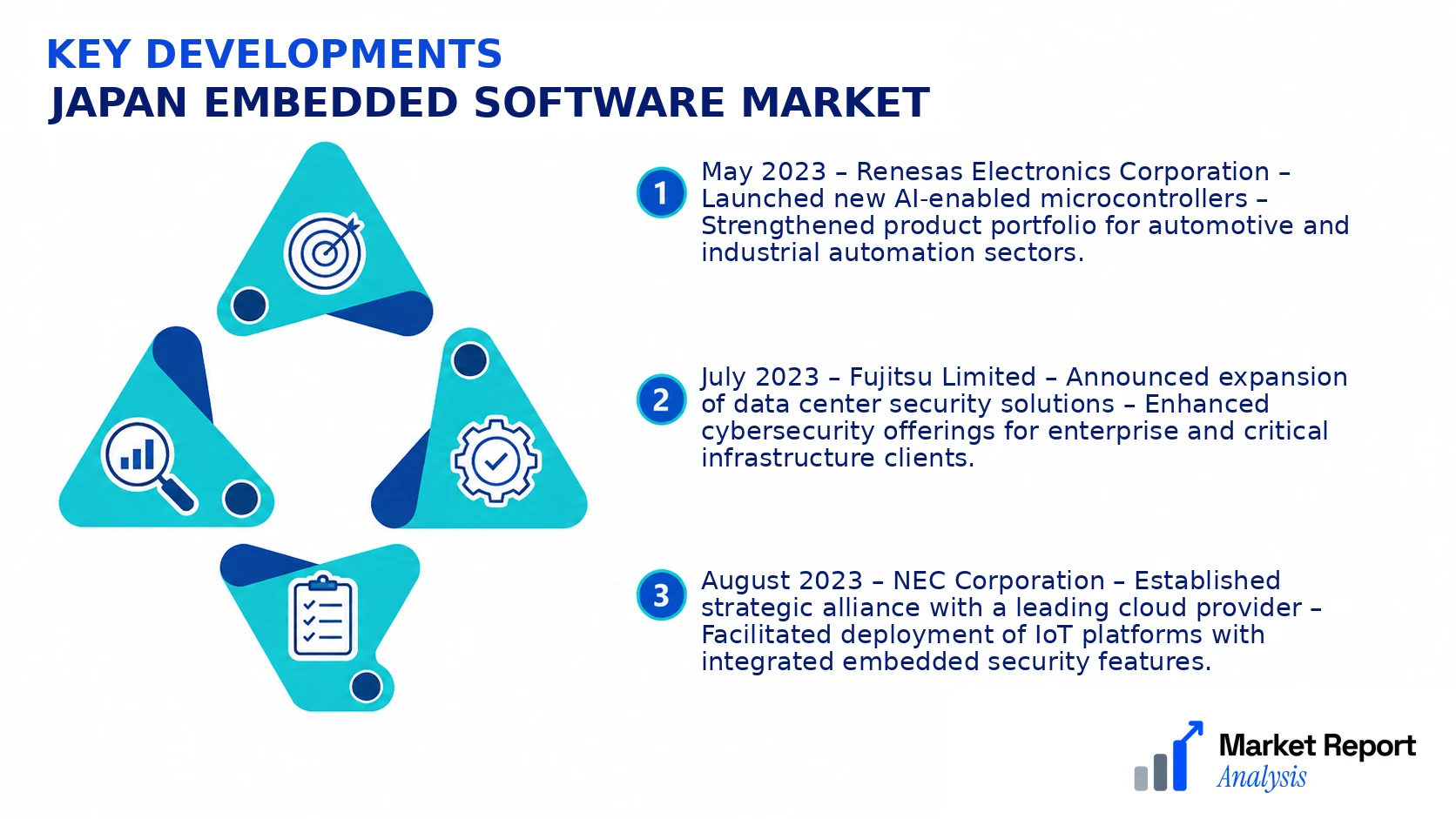
- May 2023 – Renesas Electronics Corporation – Launched new AI-enabled microcontrollers – Strengthened product portfolio for automotive and industrial automation sectors.
- July 2023 – Fujitsu Limited – Announced expansion of data center security solutions – Enhanced cybersecurity offerings for enterprise and critical infrastructure clients.
- August 2023 – NEC Corporation – Established strategic alliance with a leading cloud provider – Facilitated deployment of IoT platforms with integrated embedded security features.
- September 2023 – Toshiba Corporation – Invested in manufacturing capacity for energy management embedded software – Supported sustainable infrastructure projects across Japan.
- October 2023 – Panasonic Corporation – Rolled out new smart home controls based on embedded IoT software – Bolstered the consumer appliances segment and connected device ecosystem.
Frequently Asked Questions
What is the Japan Embedded Software Market?
The Japan Embedded Software Market encompasses the industry focused on developing, deploying, and maintaining embedded software within electronic devices across Japan, supporting sectors like automotive, consumer electronics, industrial machinery, and healthcare, driven by technological advancements and automation trends.
What is the current market size of Japan Embedded Software Market?
As of 2026, the market valuation of Japan's embedded software industry is approximately USD 22 Billion, reflecting steady growth fueled by increasing demand for smart, connected devices and automation solutions across various industrial sectors within Japan.
What factors are driving the Japan Embedded Software Market?
Key drivers include rapid digitization, growth in connected devices, advancements in automotive electronics, and government initiatives promoting Industry 4.0. Additionally, the rising adoption of IoT-enabled systems and autonomous vehicle technology significantly contribute to market expansion.
Which region dominates the Japan Embedded Software Market?
The Kanto region, especially the Greater Tokyo Area, leads the Japan embedded software industry, owing to the concentration of major electronics and automotive firms, technology startups, and research institutions fostering innovation and development activities.
Which segment is expected to grow the fastest?
The automotive segment, particularly with the surge in demand for electric and autonomous vehicles, is anticipated to experience the highest growth rate within the embedded software market, driven by innovations in vehicle intelligence and safety features.
Who are the leading companies operating in the Japan Embedded Software Market?
Leading industry players include companies such as Renesas Electronics, NEC Corporation, Fujitsu, and Hitachi, which are actively involved in developing cutting-edge embedded software solutions for various applications across Japan.
Analyst Perspective
The Japan Embedded Software Market is poised for sustained growth through 2034, driven by continual advancements in automotive systems, consumer electronics, and industrial automation. As Japan maintains its technological leadership, investment in innovative software solutions that enhance device intelligence, security, and interoperability remains crucial. Long-term market prospects are bolstered by the country's focus on smart manufacturing, AI integration, and IoT ecosystems, which create lucrative opportunities for software developers and component vendors alike. Competitive intensity continues to rise with major Japanese technology firms expanding their embedded platforms while foreign entrants pursue strategic alliances and acquisitions. Regional hotspots such as Tokyo and Osaka are emerging as key innovation hubs, fostering collaborations that accelerate product development. Strategic investment in R&D, especially in cybersecurity and AI-enabled embedded systems, will be vital for maintaining market leadership. Overall, Japan's embedded software industry exhibits a mature yet dynamically evolving landscape, requiring firms to prioritize agility and technological innovation to capitalize on regional and global growth trajectories.
