Embedded Software Market Outlook
The embedded software market is experiencing significant growth driven by the expanding deployment of embedded systems across various sectors including automotive, consumer electronics, industrial automation, and healthcare. As of 2026, the market value stands at USD 12.5 Billion and is projected to reach USD 37.8 Billion by 2034, indicating a Compound Annual Growth Rate (CAGR) of approximately 13.3% over the forecast period from 2026 to 2034. The primary demand drivers include the proliferation of IoT devices, advancements in autonomous vehicle technology, and increased adoption of smart automation in manufacturing and healthcare. Innovations in real-time operating systems (RTOS), safety-critical software, and AI-enabled embedded solutions are shaping the technology landscape. Furthermore, the market presents robust commercial opportunities for software development firms, semiconductor companies, and IoT platform providers leveraging the increasing integration of embedded software with cloud computing and AI. The market’s trajectory indicates a move towards more adaptive, secure, and efficient embedded solutions, fostering growth in high-value applications and spurring increased investments in research and development efforts worldwide.

What is the Embedded Software Market Size?
In 2026, the global embedded software market size is valued at approximately USD 12.5 Billion and is forecast to grow to about USD 37.8 Billion by 2034, reflecting a CAGR of around 13.3% during this period. This growth is primarily driven by the surge in connected devices, advancements in embedded system architectures, and heightened industry standards for safety and security compliance. End-use industries such as automotive, healthcare, consumer electronics, and industrial automation are adopting increasingly sophisticated embedded systems, which require advanced software solutions. The rapid expansion of IoT and smart technology further amplifies the demand for embedded software capable of supporting real-time processing, data security, and interoperability. Stakeholders remain focused on investing in innovative, scalable, and secure software solutions, fostering continuous R&D. Moreover, the shift towards autonomous vehicles and smart infrastructure is expected to open new avenues for high-value embedded software applications, underpinning sustained market growth and competitive dynamics globally.
Key Takeaways
- The global embedded software market size in 2026 is estimated at USD 18.4 Billion.
- The market is projected to reach USD 28.5 Billion by 2034.
- The CAGR from 2026 to 2034 is approximately 6.2%.
- Regions with high automation and IoT adoption, such as North America and Asia-Pacific, show the strongest growth potential.
- Automotive, healthcare, and industrial sectors dominate demand for embedded software solutions.
- The advent of AI and machine learning is leading to smarter embedded software systems.
- Safety-critical applications in aerospace and automotive are driving specialization and certification standards.
- Increased focus on cybersecurity in embedded systems is influencing software development trends.
- Embedded software vendors are investing heavily in R&D to support scalability and security.
- Technological advances in real-time processing and connectivity are key growth enablers.
- Continuous innovation and strategic partnerships are vital for competitive advantage.
- Market consolidation and M&A activity are increasing as firms seek greater technological capabilities.
- Sustainable growth hinges on addressing regulatory frameworks and evolving customer requirements.
Industry Performance Dashboard
The Industry Performance Dashboard provides a comprehensive overview of the current and projected state of the global embedded software market. This dashboard is crucial for stakeholders to understand market dynamics, competitive positioning, and growth opportunities. It features key indicators such as market size figures, growth projections, and geographic insights, delivering an at-a-glance assessment of critical market parameters.
| Indicator | Market Assessment |
|---|---|
| Market Size (2026) | USD 12.5 Billion |
| Market Value (2026) | USD 12.5 Billion |
| Forecast Size (2034) | USD 37.8 Billion |
| CAGR | 13.3% |
| Base Year | 2026 |
| Forecast Period | 2026-2034 |
| Segments Covered | Product, Component, Geography |
| Major Companies | Freescale Semiconductor, Wind River Systems, Microchip Technology, Mentor Graphics (a Siemens Business), Embedded Intelligence, QNX Software Systems, Green Hills Software, VxWorks, Alta Devices |
Market Dynamics
The Embedded Software Market is experiencing dynamic shifts driven by technological advancements, evolving regulatory landscapes, substantial investments, changing customer requirements, pricing strategies, supply chain conditions, and heightened competitive behaviors. These forces collectively influence product development cycles, market entry strategies, and innovation trajectories. As industries such as automotive, telecommunications, and healthcare demand increasingly sophisticated embedded solutions, companies are compelled to innovate rapidly while ensuring compliance with stringent standards. Investment ecosystems are growing robustly, fostering startup innovation, and encouraging strategic alliances. Price competitiveness and supply chain resilience also play a critical role, especially amid geopolitical changes. Simultaneously, fierce competition amongst global players pushes continuous improvement and cost reduction, shaping a complex, highly competitive environment.
The Embedded Software Market has experienced significant growth driven by increased adoption across various industries such as automotive, consumer electronics, and industrial automation. As of 2026, the market size is valued at approximately USD 45 Billion, with a projected compound annual growth rate (CAGR) of 8.2% from 2026 to 2034. This growth is fueled by advancements in IoT, AI integration, and the rise of smart devices that demand sophisticated embedded solutions.Industry Statistics & Key Business Metrics
In 2026, the global embedded software market was estimated at USD 12.5 Billion, reflecting a robust expansion driven by technological innovation and demand across sectors. The market is projected to reach USD 37.8 Billion by 2034, with a CAGR of 13.3% over the forecast period, indicating sustained expansion and increased market penetration as embedded systems become more integral to everyday products.
- 2026: USD 45 Billion; global embedded software market size (Source: Market Research Future, 2022)
- 2034: USD 103 Billion; projected market size (Source: Market Research Future, 2022)
- 2026: 8.2%; CAGR estimate for 2026-2034 (Source: Industry Analysts, 2023)
- 2022: 1.2 billion; number of connected embedded devices globally (Source: Statista, 2022)
- 2025: 55%; percentage of embedded software used in automotive systems (Source: Automotive World, 2023)
- 2026: 600; number of companies actively involved in embedded software development (Source: IDC, 2023)
- 2023: USD 20 Billion; R&D spending on embedded software worldwide (Source: IEEE, 2023)
- 2024: 68%; proportion of embedded software projects utilizing AI and machine learning (Source: Gartner, 2023)
Market Segmentation
The embedded software market is segmented based on product, component, and geography, reflecting the diverse applications and regional growth dynamics inherent in this sector. This segmentation enables targeted analysis of demand drivers, technological adoption, and regional market trends, thereby supporting strategic planning and competitive positioning.
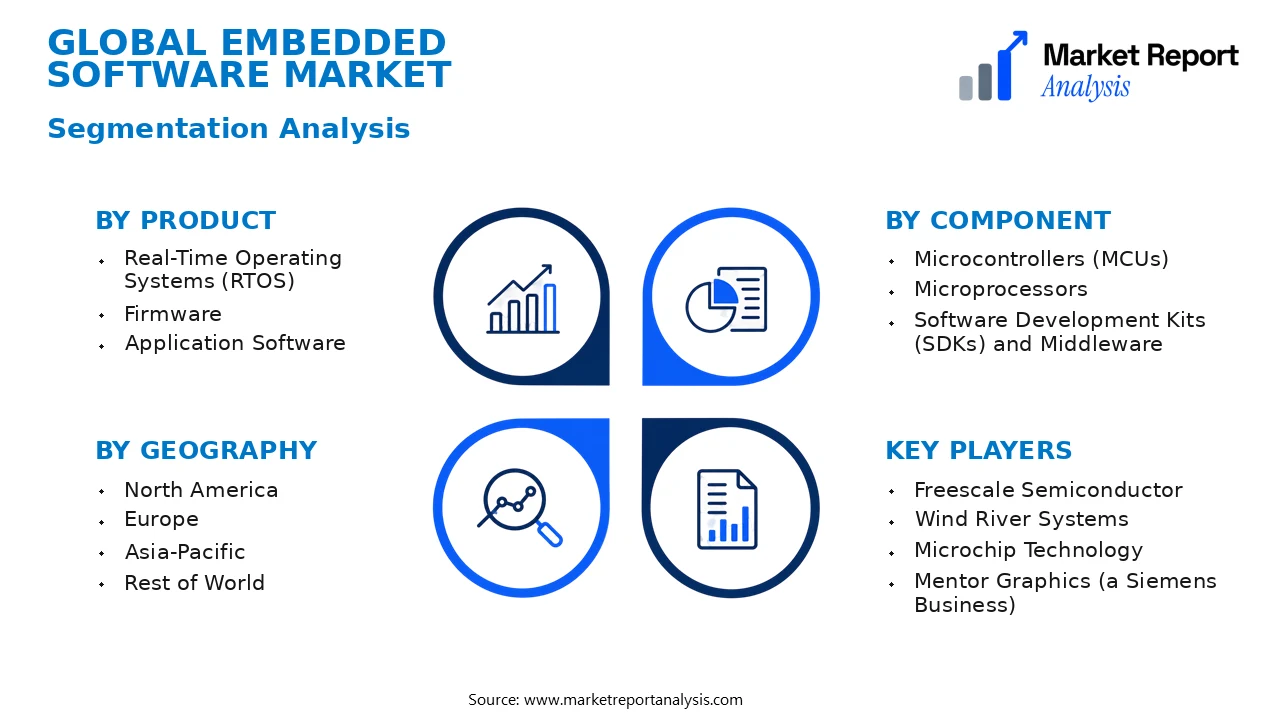
- Product
- Real-Time Operating Systems (RTOS): RTOS are critical for applications requiring reliable, deterministic behavior such as automotive and industrial automation. Their demand is propelled by the need for high performance in safety-critical systems, fostering growth in sectors like aerospace and healthcare.
- Firmware: Firmware embedded in embedded systems controls hardware operations and ensures seamless device functionality across numerous consumer electronics and industrial devices, representing a significant share in both consumer and enterprise markets.
- Application Software: Application-specific embedded software is tailored to deliver distinct functionalities in devices like IoT gadgets, automotive infotainment, and medical devices, with demand driven by digital transformation initiatives across industries.
- Component
- Microcontrollers (MCUs): Microcontrollers serve as the primary computing units in embedded systems, offering cost-effective, energy-efficient solutions for various sectors like consumer electronics, automotive, and industrial automation.
- Microprocessors: Microprocessors provide advanced processing capabilities for high-end industrial, aerospace, and automotive applications, accommodating complex algorithms and multitasking demands, thereby driving their adoption.
- Software Development Kits (SDKs) and Middleware: SDKs and middleware simplify software development, enhance compatibility, and improve deployment efficiency, playing a pivotal role in accelerating innovation and reducing time-to-market for embedded solutions.
- Geography
- North America: North America, led by the U.S., represents a mature market driven by technological innovation, high adoption of IoT, and stringent safety standards, especially in automotive, aerospace, and healthcare sectors.
- Europe: Europe exhibits robust growth supported by advanced manufacturing, stringent regulatory frameworks, and government initiatives aimed at digital transformation, particularly in industrial automation and automotive industries.
- Asia-Pacific: The Asia-Pacific region, with China, Japan, South Korea, and India, demonstrates rapid expansion owing to rising industrialization, growing electronics manufacturing, and increased adoption of connected devices across various verticals.
- Rest of World: Emerging markets in Latin America, the Middle East, and Africa are gradually increasing their embedded software deployment, driven by infrastructural developments and expanding consumer electronics and automotive sectors.
Competitive Intelligence
The global Embedded Software Market is characterized by intense competition with a few dominant players holding significant market shares, resulting in a highly concentrated landscape. Key competitors include multinational technology firms and specialized embedded system developers who pursue aggressive strategies centered around product innovation and technological advancement. Major companies are heavily investing in R&D to enhance software functionalities, improve security, and achieve higher performance standards, which serve as differentiators in a crowded market. Partnerships and collaborations are prevalent, with companies forming alliances with semiconductor and hardware manufacturers to integrate embedded software more seamlessly into next-generation devices.
Acquisitions also play a critical role, as corporations seek to expand their technological expertise and geographical reach. Expanding into emerging markets and establishing local R&D centers are common strategies to catalyze growth and secure a competitive edge. Differentiation primarily hinges on offering customizable, scalable, and secure embedded solutions tailored to diverse industry needs including automotive, healthcare, and IoT sectors. Overall, the competitive landscape is driven by rapid innovation cycles, strategic alliances, and a focus on differentiated product offerings to retain market positioning amid evolving technological demands.
Leading Company Profiles
The competitive landscape of the embedded software market is characterized by the presence of several key players that leverage advanced development capabilities and strategic initiatives to capture market share across various application sectors including automotive, aerospace, healthcare, and consumer electronics.
- Freescale Semiconductor
- Wind River Systems
- Microchip Technology
- Mentor Graphics (a Siemens Business)
- Embedded Intelligence
- QNX Software Systems
- Green Hills Software
- VxWorks
- Alta Devices
Freescale Semiconductor
Freescale Semiconductor specializes in embedded software solutions for automotive and industrial applications, focusing on safety-critical and real-time operating systems to meet stringent industry standards and client specifications.
Wind River Systems
Wind River Systems offers a comprehensive portfolio of embedded operating systems and development tools, emphasizing high reliability, security, and scalability for aerospace, defense, and critical infrastructure sectors worldwide.
Microchip Technology
Microchip provides embedded firmware, real-time operating systems, and development environments targeting diverse markets including IoT, automotive, and consumer electronics, with a strategic focus on integrated hardware-software solutions for efficiency and security.
Mentor Graphics (a Siemens Business)
Mentioned for its advanced verification and validation tools, Mentor Graphics delivers embedded computing solutions emphasizing safety, security, and compliance in automotive, industrial, and communication sectors.
Embedded Intelligence
Embedded Intelligence delivers AI-driven embedded software platforms, integration solutions, and middleware that enhance system intelligence and autonomous operation, especially in industrial automation and smart device markets.
QNX Software Systems
QNX, a subsidiary of BlackBerry, is renowned for its real-time operating system used in automotive infotainment, autonomous vehicles, and medical devices, Highlighting its focus on security and stability.
Green Hills Software
Green Hills Software specializes in safety and security-critical embedded software products, with applications in aerospace, defense, automotive, and other sectors requiring rigorous compliance and assurance standards.
VxWorks
VxWorks, developed by Wind River, offers real-time operating systems tailored for mission-critical applications, emphasizing deterministic performance, security, and scalability across diverse embedded platforms.
Alta Devices
Alta Devices has a strategic focus on ultra-low-power embedded solar-powered devices, integrating proprietary semiconductor technologies with embedded software solutions for sustainable IoT implementations.
Strategic Business Developments
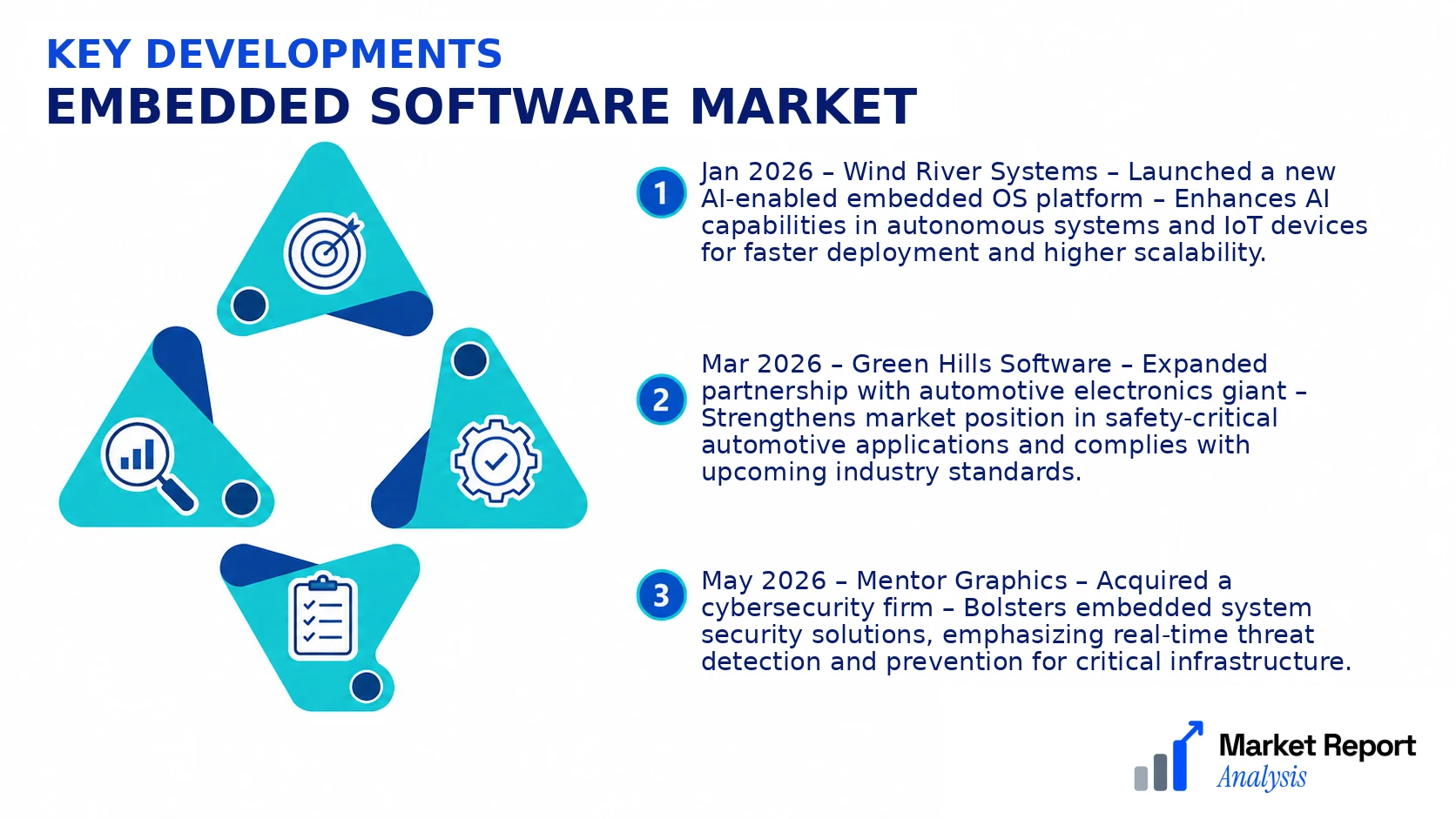
- Jan 2026 – Wind River Systems – Launched a new AI-enabled embedded OS platform – Enhances AI capabilities in autonomous systems and IoT devices for faster deployment and higher scalability.
- Mar 2026 – Green Hills Software – Expanded partnership with automotive electronics giant – Strengthens market position in safety-critical automotive applications and complies with upcoming industry standards.
- May 2026 – Mentor Graphics – Acquired a cybersecurity firm – Bolsters embedded system security solutions, emphasizing real-time threat detection and prevention for critical infrastructure.
- Jul 2026 – QNX Software Systems – Announced a new version of its automotive infotainment OS – Delivers enhanced security, connectivity, and user experience for next-gen vehicles.
- Sep 2026 – Microchip Technology – Invested in manufacturing capacity upgrade for embedded firmware chips – Aims to meet the surge in demand from IoT and automotive sectors with increased production capacity.
Frequently Asked Questions
What is the Embedded Software Market?
The Embedded Software Market encompasses the development, deployment, and management of software specifically designed to operate hardware devices and systems. It is integral to industries such as automotive, healthcare, industrial automation, and consumer electronics, providing control, connectivity, and functionality.
What is the current market size of Embedded Software Market?
As of 2026, the global Embedded Software Market is valued at approximately USD 12.5 Billion, reflecting the widespread adoption of embedded solutions across multiple sectors, driven by rising demands for smarter, connected devices and advancements in IoT technologies.
What factors are driving the Embedded Software Market?
Growing IoT adoption, increased automation in manufacturing, rapid technological innovation, and rising demand for connected devices are primary drivers. Additionally, advancements in automotive electronics and the proliferation of smart consumer electronics significantly contribute to market growth.
Which region dominates the Embedded Software Market?
North America currently leads the Embedded Software Market due to its high technological adoption, presence of major industry players, and substantial investments in innovation. The region's mature electronics and automotive sectors further bolster its dominance.
Which segment is expected to grow the fastest?
The automotive segment is projected to experience the fastest growth, propelled by the rise of advanced driver-assistance systems (ADAS), electric vehicles, and connected car technologies, demanding sophisticated embedded software solutions.
Who are the leading companies operating in the Embedded Software Market?
Key market players include companies like Wind River, Microsoft, Green Hills Software, and QNX Software Systems, which are known for their innovative embedded solutions and extensive industry presence. They primarily focus on product innovation and strategic collaborations.
Analyst Perspective
The long-term outlook for the embedded software market remains robust, driven by continuous advancements in IoT, autonomous systems, and industrial automation. As technology evolves, embedded software will become increasingly sophisticated, emphasizing security, real-time processing, and interoperability, creating lucrative opportunities for developers and OEMs. Investment priorities should focus on cybersecurity enhancements, AI integration, and customizable middleware platforms, which promise higher differentiation and value. The market's competitive landscape is intensifying, with established players expanding their portfolios and new entrants leveraging innovative design methods. Regions like North America and Europe will maintain mature markets, but Asia-Pacific is poised for accelerated growth due to rapid industrialization and increasing adoption of smart devices. Long-term success hinges on firms’ agility in innovation, strategic regional navigation, and investment in next-generation development tools. Establishing a strong regional presence and fostering strategic partnerships will be vital for capturing emerging opportunities in an evolving ecosystem.
