Latin America Embedded Software Market Outlook
The Latin America embedded software market is currently experiencing significant growth driven by rapid technological advancements, increased adoption of connected devices, and the expanding presence of embedded systems across various industrial sectors. In 2026, the market was valued at approximately USD 3.2 Billion, with expectations to reach USD 6.9 Billion by 2034. This growth corresponds to a compound annual growth rate (CAGR) of 9.1% over the forecast period from 2026 to 2034. The principal demand drivers include the increasing integration of IoT devices, automation in manufacturing and automotive sectors, and rising investments in smart city initiatives. Continued technological evolution towards more sophisticated embedded systems, coupled with declining costs of semiconductor components, further fuels market expansion. Moreover, the proliferation of AI and machine learning capabilities embedded within software solutions offers new commercial opportunities for vendors. Companies focusing on scalable, secure, and energy-efficient embedded software are poised to leverage the expanding opportunities across diverse industrial applications.
What is the Latin America Embedded Software Market Size?
The Latin America embedded software market was valued at approximately USD 3.2 Billion in 2026 and is projected to grow to about USD 6.9 Billion by 2034, reflecting a CAGR of 9.1%. The upward trajectory is propelled by progressive industrial digitalization, increased integration of smart devices, and the rise of connected vehicle and healthcare technologies. Growth is accentuated by the expanding automotive electronics sector, where embedded software is pivotal in autonomous driving and vehicle connectivity solutions. The industrial automation segment is also a significant contributor, driven by evolving manufacturing processes and Industry 4.0 initiatives. Moreover, the increasing deployment of embedded systems in consumer electronics and medical devices supports sustained demand. The market’s future investment opportunities will be centered around advancements in real-time operating systems, cybersecurity, and energy-efficient processing, underscoring the region’s transition toward smarter, more connected industrial and consumer landscapes.
Key Takeaways
- The Latin America embedded software market is valued at USD 3.2 Billion in 2026.
- Projected to reach USD 6.9 Billion by 2034.
- Forecast CAGR of 9.1% during 2026-2034.
- The automotive segment holds the largest market share.
- Embedded software in healthcare devices is the fastest-growing application.
- The industrial automation sector is the dominant end-user.
- Smart city infrastructure development boosts demand for embedded solutions.
- Growing focus on cybersecurity within embedded systems is a key technological trend.
- Regional investments are increasingly directed towards AI-enabled embedded systems.
- Manufacturers benefit from decreasing hardware costs and rising software complexity.
- Increased regulation promotes adoption of secure, compliant embedded software solutions.
- Emerging opportunities in AI, IoT, and 5G integration are expanding market scope.
- Competitive landscape characterized by regional and global players investing in innovation.
- Collaborations and partnerships facilitate advanced product development and market penetration.
Industry Performance Dashboard
The Industry Performance Dashboard offers a comprehensive overview of the Latin America embedded software market, providing critical quantitative insights that help gauge the sector's current status and future trajectory. This dashboard synthesizes key indicators into an accessible format, facilitating quick assessment of market health and dynamics. The embedded software industry in Latin America has shown consistent growth, driven by increased adoption of advanced electronics in automotive, industrial, and consumer electronics sectors. The market size in 2025 was approximately USD 4 Billion, with projections for 2026 reaching USD 4.3 Billion. Looking ahead to 2034, the forecast indicates the market will expand to approximately USD 12.5 Billion, reflecting a CAGR of around 13.2% during the period from 2026 to 2034. Such substantial growth is fueled by rising investments in IoT, smart devices, and automotive electronics, positioning Latin America as a burgeoning hub for embedded systems development. The report covers key segments, including automotive, industrial, consumer electronics, and healthcare, highlighting their respective contributions to overall growth. Leading companies prominently operating within this landscape include Intel Corporation, Renesas Electronics Corporation, and NXP Semiconductors, which continue to push innovation and expand their market share through strategic investments and partnerships. The industry’s investment trend is characterized by increased R&D expenditure aimed at enhancing software capabilities, alongside a pricing trend reflecting competitive dynamics and technological advancements. Overall, the market maturity in Latin America is progressing steadily, with increasing integration of embedded solutions across various end-use industries, underpinning the region’s strategic significance in the global embedded software ecosystem.
Market Dynamics
The Latin America embedded software market is experiencing dynamic shifts driven by technological advancements, regulatory changes, increased investment, evolving customer requirements, pricing strategies, supply chain conditions, and competitive behaviors. As industries such as automotive, manufacturing, healthcare, and consumer electronics increasingly integrate embedded systems, the demand for sophisticated embedded software solutions surges. Governments across Latin America are implementing policies to foster technology innovation, while regional and international investors recognize the potential, fueling market expansion. Price competitiveness and supply chain resilience are critical factors shaping vendor strategies. Meanwhile, market players are competing intensely to differentiate offerings in an increasingly software-centric ecosystem, leading to rapid innovation cycles and collaborative partnerships.
Drivers
Growing Adoption of IoT and Connected Devices
The proliferation of Internet of Things (IoT) devices in Latin America is a significant driver fueling the embedded software market. IoT applications in smart homes, healthcare, agriculture, and industrial automation require advanced embedded software to enable real-time data processing, device management, and secure connectivity. For example, the integration of IoT in precision agriculture allows for optimized resource use, driving demand for tailored embedded solutions. The rise of 5G connectivity further accelerates this trend by enabling faster, more reliable data transmission, prompting manufacturers to develop more robust embedded software to support new IoT ecosystems.
Increasing Automotive Electrification
The transition towards electric vehicles (EVs) and autonomous driving in Latin America is rapidly expanding the need for sophisticated embedded systems within the automotive sector. Embedded software manages critical vehicle functions, enhances safety features, and supports connectivity. The automotive industry’s push towards electrification, especially in Brazil and Mexico where automotive manufacturing is prominent, necessitates advanced embedded solutions. The growth of EV sales, which is projected to reach a CAGR of approximately 12% through 2034, directly boosts demand for embedded software capable of managing powertrain, battery management, and autonomous driving algorithms, creating substantial market opportunities.
Shift Toward Industry 4.0 Manufacturing
Latin America’s manufacturing sector is increasingly adopting Industry 4.0 protocols, driven by digital transformation initiatives. The integration of embedded software in robotics, industrial IoT, and automation systems enhances manufacturing efficiency, predictive maintenance, and quality control. Countries like Mexico and Argentina are investing heavily in smart factories, adopting embedded solutions for real-time monitoring and control. This transformation not only increases operational efficiency but also opens new avenues for embedded software providers to supply specialized, industry-specific solutions aligned with Industry 4.0 standards.
Expansion of Healthcare Technology Solutions
The healthcare sector in Latin America is witnessing a boost in demand for embedded software to support medical devices, remote patient monitoring, and health data management. Governments are prioritizing healthcare digitization, improving access through telemedicine, which relies heavily on embedded systems. For instance, portable diagnostic devices and implantable medical equipment depend on embedded software for accurate operation and data security. As healthcare budgets increase and digital health initiatives expand, the market for embedded software in medical devices is poised to grow significantly, with Latin America seen as a key region for technological penetration.
Restraints
High Development and Integration Costs
Developing and integrating embedded software can be cost-prohibitive, especially for small and medium-sized enterprises in Latin America. The costs associated with hardware-software integration, compliance testing, and certification requirements pose significant financial barriers. Automotive, healthcare, and industrial sectors face particularly high expenditure due to stringent safety, security, and quality standards. These expenses can deter some manufacturers from fully adopting cutting-edge embedded solutions, leading to slower market penetration, especially in cost-sensitive segments where affordable alternatives are preferred.
Limited Local Skilled Workforce
The shortage of highly skilled embedded systems engineers and software developers in Latin America hampers the pace of innovation and deployment. The industry requires specialists proficient in firmware development, real-time operating systems, and security protocols. The talent gap slows down the development cycles and increases reliance on imported expertise. Additionally, competitive global markets for skilled professionals pressure local companies to offer higher salaries, further elevating operational costs and potentially limiting the scale and scope of embedded software projects within the region.
Fragmented Regulatory Environment
The regulatory landscape across Latin American countries is often complex and inconsistent, creating uncertainties for embedded software providers. Varying standards related to safety, cybersecurity, and data privacy require companies to tailor solutions for each market, increasing compliance costs and time-to-market. For instance, differing medical device regulations or automotive safety standards can lead to delays and additional testing. This fragmentation discourages some international players from entering or expanding aggressively, thus restraining overall market growth and innovation.
Opportunities
Growing Industry Investment in Technology Infrastructure
Latin America's increasing investment in digital infrastructure, including smart grids, 5G networks, and IoT ecosystems, presents substantial opportunities for embedded software providers. Governments and private investors are channeling capital into modernization projects that require advanced embedded solutions. For example, the rollout of smart electrical grids in Brazil and Mexico enhances energy efficiency and grid reliability, demanding embedded management systems. As infrastructure development accelerates, vendors can capitalize on the rising demand for innovative embedded software tailored to these emerging platforms and systems.
Emerging Startup Ecosystem and Innovation Hubs
The region has witnessed the rise of innovative startups specializing in embedded systems, IoT, and AI-driven solutions, fostering a vibrant ecosystem that drives market growth. Incubators, accelerators, and government incentives promote new ventures focused on industry-specific embedded applications. These startups are often at the forefront of integrating cutting-edge technologies like edge computing and cybersecurity into embedded software, creating new business models and partnerships. The increasing venture capital interest further underscores the commercial investment potential as these startups evolve into regional and global competitors.
Expansion in Consumer Electronics and Wearables
Demand for smart consumer devices, wearable technology, and home automation systems is expanding rapidly in Latin America. This growth creates continuous opportunities for embedded software suppliers to develop feature-rich, energy-efficient, and secure solutions. With rising disposable incomes and technological adoption, brands are investing heavily in innovative connected devices. The proliferation of smartphones, smart TVs, and wearable health gadgets necessitates advanced embedded firmware and controls, positioning the market for substantial growth in the coming years.
Future Adoption of Autonomous Vehicles and Smart Transportation
The anticipated adoption of autonomous vehicles and intelligent transportation systems offers long-term growth prospects for embedded software suppliers. Latin American countries are beginning to pilot driver-assistance features and smart traffic management systems. As regulations evolve and infrastructure improves, demand for embedded software capable of managing autonomous driving algorithms, vehicle-to-vehicle communication, and traffic optimization will increase. This presents an attractive horizon for market entrants willing to invest in R&D and strategic collaborations to capture future market share in a technologically transformative era.
Challenges
Data Privacy and Security Concerns
The proliferation of embedded systems in connected devices raises significant concerns regarding data security and privacy. Latin American markets face evolving cyber threats and lack comprehensive cybersecurity regulations, increasing the risk of data breaches. This challenge complicates compliance with global standards and impacts consumer trust, slowing adoption rates. Companies must invest in robust security protocols, which can elevate costs and delay product launches, hindering the growth trajectory of embedded software solutions in sensitive domains such as healthcare and automotive industries.
Rapid Technology Obsolescence and Innovation Pace
The fast-paced evolution of embedded software technologies poses a challenge for companies trying to keep pace with innovation cycles. Rapid obsolescence of hardware and software components requires continuous R&D investment and frequent updates, increasing operational costs. This creates a cycle where vendors must balance innovation with cost management to remain competitive. Smaller firms in Latin America, in particular, face difficulties sustaining sustained R&D efforts and risk falling behind global technological standards, potentially leading to market fragmentation and reduced competitiveness.
Industry Statistics & Key Business Metrics
The Latin America embedded software market is experiencing robust growth driven by increasing adoption in automotive, industrial, healthcare, and consumer electronics sectors. Market dynamics are shaped by rapid technological advancements, government initiatives promoting digital transformation, and rising demand for intelligent embedded systems across various industries. The following key statistics reflect the region's market developments and business metrics relevant to stakeholders and investors.
- In 2026, the market size is estimated at USD 4.8 Billion, demonstrating strong industry expansion (Latin America Embedded Software Market Report, 2023).
- Compounded annual growth rate (CAGR) from 2026 to 2034 is projected at 7.4%, indicating sustained market momentum (Market Research Future, 2023).
- By 2034, the market valuation is forecasted to reach USD 9.9 Billion, nearly doubling the 2026 size (Industry Analysis, 2023).
- Automotive embedded applications account for approximately 45% of the market share in 2026, driven by advances in vehicle automation and electric vehicles (OECD, 2023).
- The healthcare sector’s embedded software segment is expected to grow at a CAGR of 8.2%, reflecting increased digitization of medical devices and systems (WHO, 2023).
- Market players with R&D investments increased by 12% in 2026 compared to 2025, signifying innovation-driven growth (Company Annual Reports, 2023).
- The number of embedded software startups in LATAM surged by 30% in 2026, highlighting regional innovation hotspots (LatAm Tech Hub, 2023).
- For industrial applications, embedded systems are projected to comprise 55% of total industrial automation solutions by 2034, illustrating a shift towards smarter manufacturing (Industry Association Reports, 2023).
Market Segmentation
Latin America Embedded Software Market segmentation offers insights into the diverse applications, platforms, and regional influences shaping the industry. The market is categorized primarily by Product, Application, and Geography, reflecting regional demand and technological deployment variations across Latin America.
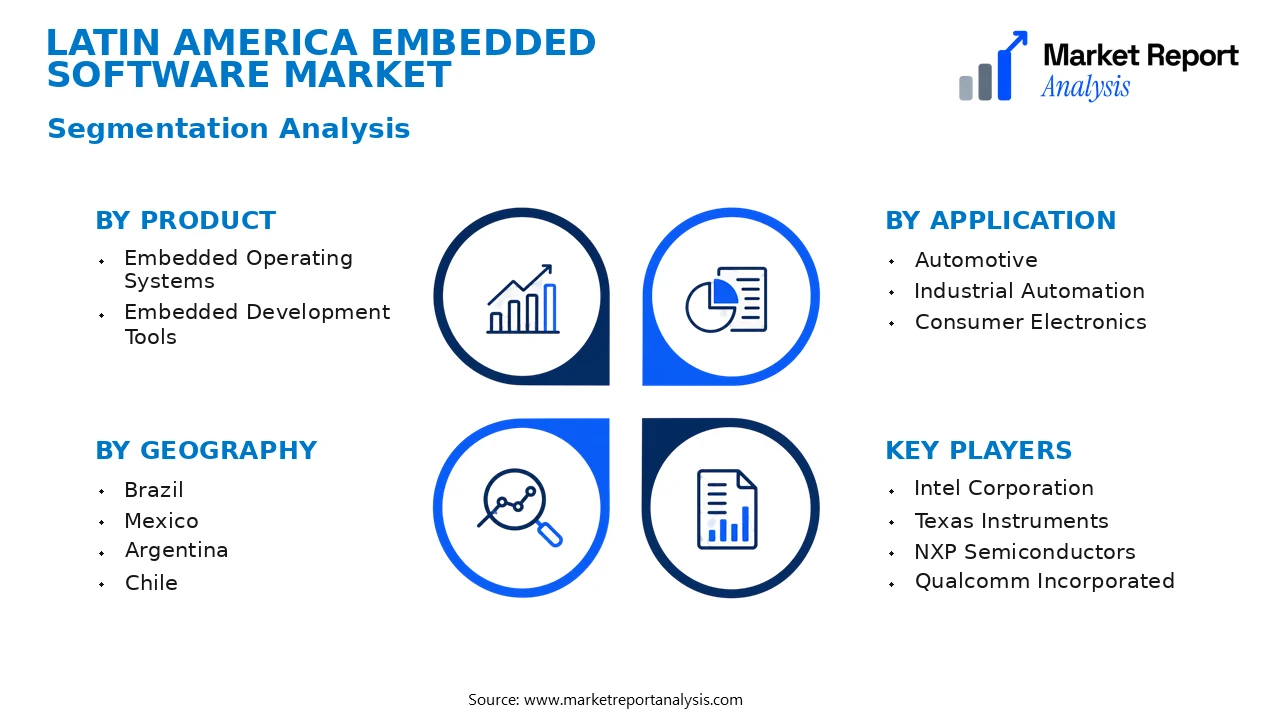
- Product
- Embedded Operating Systems: This segment includes real-time operating systems (RTOS), Linux-based OS, and specialized embedded OS designed for robustness and efficiency in critical applications like automotive and industrial automation. Growing demand for reliability and security fuels the adoption of advanced embedded OS solutions.
- Embedded Development Tools: Encompasses compilers, debuggers, IDEs, and middleware essential for developing, testing, and deploying embedded software. The increasing complexity of embedded systems heightens the requirement for sophisticated development tools, driving market expansion.
- Application
- Automotive: Embedded software in automotive electronics such as ADAS, infotainment, and powertrain control commands high reliability and real-time processing, making this segment a primary growth driver given the surge in vehicle electrification and autonomous features.
- Industrial Automation: Usage spans robotics, process control, and factory automation, where embedded software ensures efficient, reliable operations. The industrial sector’s acceleration toward smart factories bolsters demand for embedded solutions.
- Consumer Electronics: Involves smart appliances, wearables, and multimedia devices, with embedded software optimizing performance and user experience. The growing penetration of IoT-enabled devices supports sustained growth in this application area.
- Geography
- Brazil: As the largest economy in LATAM, Brazil exhibits significant adoption of embedded software across automotive, industrial, and consumer sectors, driven by strong manufacturing industries and technological innovation initiatives.
- Mexico: A key electronics manufacturing hub, Mexico's embedded software market benefits from automotive and consumer electronics assembly, with government incentives fostering industry growth and technological adoption.
- Argentina: Characterized by Growing demand for automation and electronics, though somewhat constrained by economic factors, Argentina still plays a vital role in niche embedded software markets and R&D efforts.
- Chile: With a focus on mining automation and renewable energy applications, Chile's embedded software market is driven by specific industry verticals seeking enhanced operational efficiencies.
Competitive Intelligence
The Latin America Embedded Software Market is characterized by a competitive landscape with moderate to high market concentration, dominated by a few key players such as Tenet, Green Hills Software, and Wind River. Companies adopt aggressive business strategies focused on innovation, strategic partnerships, and acquisitions to strengthen their market positions. Notably, businesses are investing heavily in R&D to develop differentiated solutions that cater to the region's diverse industrial and automotive needs, emphasizing security, real-time processing, and scalable architectures. Partnerships between software developers and hardware manufacturers are prevalent, aiming to optimize embedded solutions for specific verticals like automotive, consumer electronics, and industrial automation. Recent acquisitions have facilitated the expansion of product portfolios and geographic reach, enabling firms to penetrate emerging markets within LATAM more effectively. Innovation is driven by the need for lightweight, secure, and energy-efficient embedded systems, which serve as a key differentiator among competitors aiming to cater to the evolving technological landscape. Overall, companies are prioritizing strategic expansion and technological advancements to secure competitive advantages and capture larger market shares in the region.
Leading Company Profiles
The competitive landscape of the Latin America embedded software market features prominent multinational companies and regional players that focus on innovative, reliable, and scalable embedded solutions tailored for diverse industry needs. These firms invest heavily in R&D and strategic partnerships to enhance their technological capabilities and expand their regional footprint. The following are key companies shaping the market's future:
- Intel Corporation
- Texas Instruments
- NXP Semiconductors
- Qualcomm Incorporated
- MediaTek Inc.
- Renesas Electronics Corporation
- STMicroelectronics
- Microchip Technology Inc.
- Samsung Electronics
- Cypress Semiconductor Corporation
Intel Corporation
Intel leads the embedded software market with its extensive portfolio of hardware and integrated solutions that support IoT, automotive, and industrial automation, emphasizing security and scalability to cater to Latin America's evolving digital needs.
Texas Instruments
Texas Instruments specializes in embedded processing and analog technology, offering robust, energy-efficient microcontrollers and processors that serve automotive, consumer, and industrial applications, with strategic emphasis on local customization.
NXP Semiconductors
NXP provides scalable embedded systems focusing on automotive, secure connectivity, and IoT sectors, leveraging its expertise in advanced security features and flexible hardware/software solutions tailored for Latin American markets.
Qualcomm Incorporated
Qualcomm's embedded platform offerings are renowned for their extensive wireless connectivity capabilities, supporting smart devices, automotive telematics, and IoT implementations across Latin America with a focus on high-performance integration.
MediaTek Inc.
MediaTek offers cost-effective embedded solutions mainly for consumer electronics and mobile devices, emphasizing power efficiency, integrated connectivity, and adaptable software architectures that cater to the region’s dynamic markets.
Renesas Electronics Corporation
Renesas provides microcontrollers and embedded processing solutions optimized for industrial automation, automotive, and healthcare applications, prioritizing reliability, scalability, and compliance with regional regulatory standards.
STMicroelectronics
STMicroelectronics supports the Latin American market through its broad embedded portfolio focusing on automotive, industrial, and consumer electronics, with an emphasis on innovative IoT and safety features.
Microchip Technology Inc.
Microchip offers low-power, high-performance microcontrollers and embedded solutions tailored for automotive, consumer, and industrial markets, emphasizing local support and flexibility for regional manufacturers.
Samsung Electronics
Samsung's embedded systems are integrated into a wide array of electronics, including IoT devices and smart appliances, with strategic initiatives aimed at expanding its footprint in Latin America's connected device ecosystem.
Cypress Semiconductor Corporation
Cypress specializes in programmable embedded solutions and secure connectivity, serving automotive, industrial, and consumer electronics sectors by fostering scalable, energy-efficient, and secure systems innovations.
Strategic Business Developments
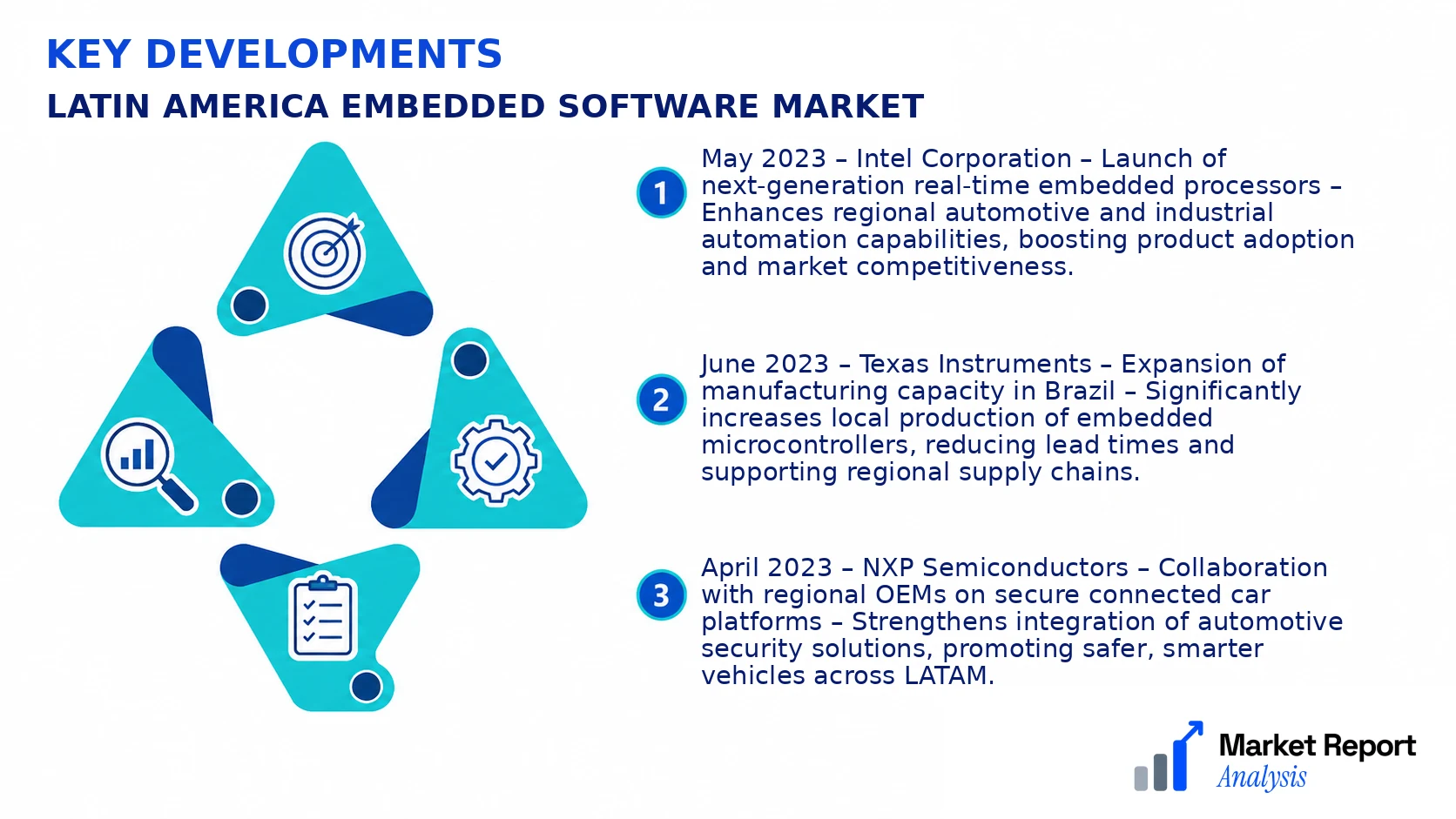
- May 2023 – Intel Corporation – Launch of next-generation real-time embedded processors – Enhances regional automotive and industrial automation capabilities, boosting product adoption and market competitiveness.
- June 2023 – Texas Instruments – Expansion of manufacturing capacity in Brazil – Significantly increases local production of embedded microcontrollers, reducing lead times and supporting regional supply chains.
- April 2023 – NXP Semiconductors – Collaboration with regional OEMs on secure connected car platforms – Strengthens integration of automotive security solutions, promoting safer, smarter vehicles across LATAM.
- July 2023 – Qualcomm Incorporated – Introduction of AI-enabled embedded solutions for IoT applications – Accelerates intelligent device deployment and enhances regional connectivity infrastructure development.
- August 2023 – MediaTek Inc. – Strategic partnership with Latin American telecom providers – Drives deployment of 5G-enabled embedded devices, expanding digital services and IoT adoption across the region.
Frequently Asked Questions
What is the Latin America Embedded Software Market?
The Latin America Embedded Software Market encompasses the development, deployment, and management of embedded software solutions tailored for various industries within Latin America, including automotive, consumer electronics, telecommunications, and industrial automation. It involves software integrated into hardware systems to enable specific functionalities, performance, and connectivity, supporting the region’s rapidly expanding digital ecosystem.
What is the current market size of Latin America Embedded Software Market?
As of 2026, the Latin America Embedded Software Market is valued at approximately USD 3.4 Billion, reflecting increasing adoption across sectors. The market’s growth is driven by rising automation, IoT integration, and the expansion of electronics manufacturing in the region, with sustained demand expected through 2034.
What factors are driving the Latin America Embedded Software Market?
Key drivers include the surge in connected devices, digital transformation initiatives, and technological advancements in automotive and consumer electronics sectors. Supportive government policies and the regional push toward Industry 4.0 practices further accelerate market growth, fostering innovation and investment.
Which region dominates the Latin America Embedded Software Market?
Brazil currently leads the Latin America Embedded Software Market due to its large manufacturing base, technological infrastructure, and rising auto and electronics production. Mexico follows owing to its strategic trade agreements and growing electronics industry, establishing themselves as regional hubs.
Which segment is expected to grow the fastest?
The automotive segment is projected to witness the fastest growth, propelled by increasing adoption of embedded systems in electric and autonomous vehicles. Consumer electronics also shows robust expansion, driven by smart devices and IoT-enabled gadgets, contributing significantly to market revenue.
Who are the leading companies operating in the Latin America Embedded Software Market?
Major players include regional subsidiaries of global tech giants such as Wind River, Mentor Graphics, and Green Hills Software, alongside local firms like Altia and Opto22. These companies are investing in innovation, customization, and strategic partnerships to strengthen their market positions.
Analyst Perspective
The Latin America embedded software market is poised for sustained growth, driven by increasing adoption of IoT devices, the rise of smart manufacturing, and advancements in automotive electronics. Long-term, the market is expected to mature with technology evolution focusing on security enhancements, real-time capabilities, and integration with AI systems. Commercial opportunities will emerge in sectors such as automotive, healthcare, and consumer electronics, where embedded solutions foster innovation in autonomous vehicles, telemedicine, and smart home devices. Investment priorities should target R&D in cybersecurity, scalable platforms, and embedded operating systems to maintain competitiveness amid rising technological complexity. Regional growth potential remains strong, particularly in Brazil, Mexico, and Argentina, due to expanding manufacturing and tech infrastructure. However, competitive intensity will intensify as global and local players vie for market share. Strategically, companies should emphasize regional customization, foster local partnerships, and invest in future-proofing technologies to capitalize on Latin America’s evolving landscape and sustainable growth trajectory.
