South Korea Cloud Intrusion Detection and Prevention Market Outlook
The South Korea cloud intrusion detection and prevention market is being significantly molded by a confluence of technological advances, regulatory mandates, and evolving customer security requirements. As enterprises increasingly migrate to cloud environments, there is a heightened demand for sophisticated security solutions that can seamlessly integrate with dynamic cloud infrastructures. Competitive pricing, supply chain conditions for hardware and software components, and aggressive innovation by top cybersecurity firms are further shaping the landscape. Regulatory frameworks, such as amendments to the Personal Information Protection Act (PIPA), emphasize data security, prompting enterprises to invest heavily in robust intrusion detection and prevention systems (IDPS). This synergy of market forces is driving rapid growth, digital confidence, and technological transformation within South Korea’s cyber defense ecosystem.
Drivers
Increasing Cloud Adoption by Enterprises
The exponential growth in cloud services adoption by South Korean corporations fuels the demand for advanced intrusion detection and prevention solutions. As businesses shift operational workloads to cloud platforms like AWS, Azure, and domestic providers such as Naver Cloud, there is a pressing need to safeguard sensitive data from cyber threats. The widespread adoption of SaaS, IaaS, and PaaS models necessitates tailored security measures capable of real-time threat detection and response. Growing digital transformation initiatives in sectors such as finance, healthcare, and manufacturing have heightened the reliance on cloud infrastructures, directly correlating to a surge in the deployment of security solutions aimed at protecting these virtual environments.
Stringent Data Privacy Regulations
South Korea’s tightening of data privacy laws, including updates to the Personal Information Protection Act (PIPA), mandates organizations to implement advanced security controls to prevent data breaches and unauthorized access. These regulations impose strict penalties for non-compliance, compelling companies to proactively adopt intrusion detection and prevention systems that meet regulatory standards. Financial institutions, with large volumes of personally identifiable information (PII), are especially motivated to upgrade their security frameworks. Regulatory pressure not only acts as a compliance driver but also influences market participants to innovate more sophisticated security solutions tailored specifically for cloud environments under legal oversight.
Proliferation of Cyber Threats and Attacks
The increasing sophistication and volume of cyber threats targeting South Korean organizations significantly boost the demand for intrusion detection and prevention solutions. Cybercriminals frequently launch ransomware, phishing, and supply chain attacks, exploiting vulnerabilities in cloud-based infrastructures. The 2022 surge in attacks on Korean financial institutions and government agencies underscores the critical need for real-time threat monitoring and rapid response capabilities. This threat landscape compels enterprises to invest heavily in advanced security systems that can identify malicious activities early and block potential breaches before significant damage occurs, thus reinforcing the market’s growth trajectory.
Emerging Cloud Security Standards and Certifications
The development of new industry standards and certifications for cloud security is catalyzing the adoption of intrusion detection and prevention solutions across South Korea. Local standards bodies and government agencies are establishing comprehensive benchmarks to ensure cloud security resilience. Certification requirements, such as the Korea Internet & Security Agency’s (KISA) evaluations, provide assurance of system effectiveness, driving vendors to develop compliant solutions. These standards create a competitive market environment, foster innovation, and encourage enterprises to favor solutions that meet or exceed regulatory and industry benchmarks, hence contributing directly to market growth.
Restraints
High Implementation and Maintenance Costs
The deployment of advanced intrusion detection and prevention systems involves substantial initial investment and ongoing operational expenses, which can be prohibitive for small and medium-sized enterprises in South Korea. These costs encompass hardware, software licensing, customization, staff training, and continuous updates to respond to evolving threats. As a result, budget-constrained organizations may delay or limit their adoption of comprehensive security solutions, thereby restraining overall market growth. The cost sensitivity is particularly acute in sectors with tight margins like retail and SMEs, which may prefer less sophisticated, more affordable security measures, affecting market penetration and expansion.
Complexity of Cloud Security Integration
Integrating intrusion detection and prevention systems into existing cloud environments poses technical challenges that hinder widespread adoption. Enterprises face difficulties in ensuring interoperability between legacy security infrastructure and new cloud-native solutions. Compatibility issues, configuration complexities, and a shortage of skilled cybersecurity professionals impede smooth integration. Companies also worry about potential disruptions to their operations during implementation. These factors slow down the adoption rate of cutting-edge IDPS solutions, particularly among organizations lacking in-house expertise or facing urgent time-to-market pressures, thus acting as a restrictive barrier to growth.
Limited Awareness and Skill Gaps
A significant restraint to the South Korean market’s expansion is the limited awareness of advanced cloud security measures among some organizations, particularly SMEs and smaller government agencies. A lack of trained cybersecurity personnel to manage, operate, and respond to sophisticated intrusion detection systems exacerbates the challenge. This skills gap often results in underutilization of existing security investments, increased risk exposure, and hesitancy to upgrade or adopt new solutions. Accelerating workforce training and awareness campaigns are necessary to fully leverage the potential of IDPS technologies, but these efforts require time and investment which temporarily restrain market growth.
Opportunities
Growth in Cloud Security Market and Investment Ecosystem
The expanding demand for comprehensive cloud security solutions presents a significant opportunity for growth in South Korea’s cloud intrusion detection and prevention market. Increased investments from domestic and multinational firms aim to capture this emerging sector, with government-backed initiatives supporting cybersecurity innovation. As cloud adoption skyrockets, leading vendors are strategically expanding their portfolios to include integrated IDPS solutions. The rapid development of cloud security startups, coupled with venture capital interest, underpins future innovation and deployment. This vibrant investment ecosystem creates fertile ground for new product launches, strategic alliances, and collaboration opportunities that can accelerate market expansion.
Emergence of AI and Machine Learning Technologies
Artificial intelligence (AI) and machine learning (ML) are transforming intrusion detection and prevention by enabling systems to analyze vast amounts of data for anomaly detection with greater accuracy and speed. South Korean security vendors and startups are increasingly integrating AI/ML techniques to develop predictive threat models, automate incident response, and reduce false positives. The integration of AI-driven security solutions into cloud environments enhances proactive threat management, providing a competitive edge. The government’s push for AI innovation, coupled with industry R&D investments, positions AI-powered IDPS as a key growth segment, unlocking new avenues for commercial deployment and technological leadership in the market.
Expansion of Industry Vertical-Specific Solutions
As industries such as finance, healthcare, and government sectors expand their cloud infrastructure, there is a growing need for vertical-specific IDPS solutions tailored to sector-specific compliance, data types, and threat profiles. Vendors are developing tailored offerings that address unique security challenges faced by these industries, such as patient data protection or financial transaction security. This sector specialization creates tailored go-to-market strategies and unlocks new customer segments. The increasing digitalization and regulatory compliance requirements in these sectors, coupled with growing cloud footprints, lead to sustained demand for tailored intrusion detection and prevention solutions, bolstering market growth potential.
Future Investment in Smart City and IoT Security
South Korea’s ambitious smart city projects and IoT (Internet of Things) expansion provide substantial future opportunities for the intrusion detection and prevention market. Securing interconnected devices, urban infrastructure, and transport systems demands robust, scalable cloud security solutions imbued with advanced threat detection capabilities. Market players are investing heavily in developing specialized security tools for smart city applications, reflecting an understanding of the strategic importance of IoT security in national infrastructure. As these initiatives scale, the demand for integrated, cloud-native IDPS solutions will grow substantially, offering long-term growth prospects in the evolving IoT ecosystem and urban security landscape.
Challenges
Rapidly Evolving Threat Landscape
The fast-changing nature of cyber threats, especially within cloud environments, presents a formidable challenge for South Korea’s security vendors. Attack vectors such as zero-day exploits, polymorphic malware, and supply chain infiltrations evolve rapidly, requiring constant updates and innovation in detection techniques. Maintaining an effective and adaptive IDPS system necessitates significant R&D investments and agile threat intelligence capabilities. Keeping pace with threat actors demands continuous technological evolution, which can strain resources, increase costs, and complicate deployment for organizations lacking in advanced security infrastructure and expertise.
Difficulty in Balancing Security and User Experience
Implementing robust intrusion detection and prevention measures often impacts user experience, as security protocols may introduce latency or false alarms that disrupt normal operations. Striking an optimal balance between comprehensive security and seamless user interaction remains a challenge, especially in high-demand sectors like finance and telecommunications. Excessively stringent security measures risk alienating users and reducing productivity, while lax controls expose organizations to breaches. Developing adaptive, context-aware solutions that minimize operational disruptions while maintaining high security standards is an ongoing challenge for developers and deployers in the South Korean market.
Industry Performance Dashboard
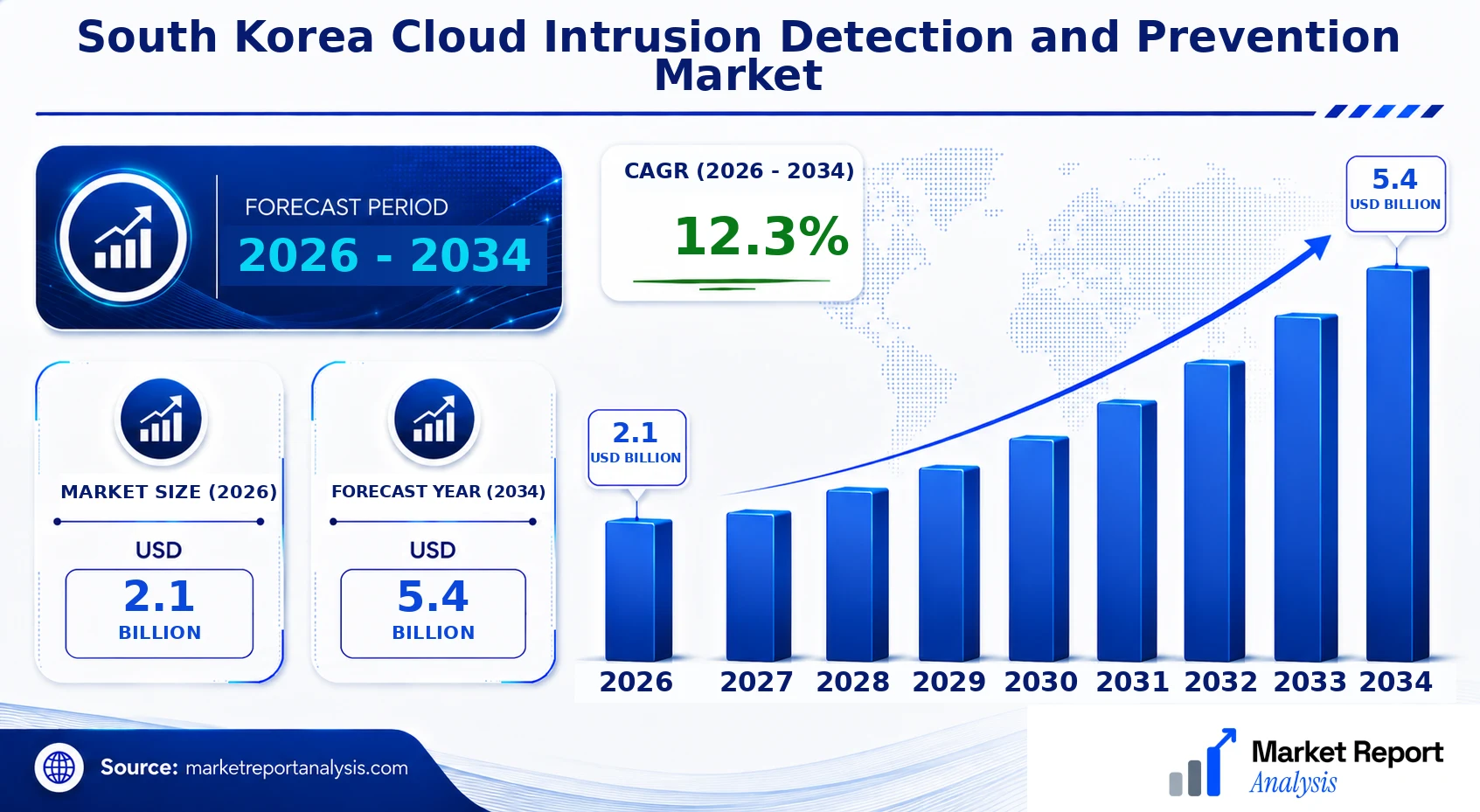
The South Korea Cloud Intrusion Detection and Prevention Market has demonstrated significant growth potential driven by increasing cybersecurity threats and the rapid digital transformation across various sectors. Market players are focusing on innovative solutions tailored to address regulatory requirements and sophisticated cyberattack techniques. The dashboard below summarizes key market indicators, reflecting the current status and future outlook of this evolving landscape.
| Indicator | Market Assessment |
|---|---|
| Market Value (2026) | USD 2.1 Billion |
| Forecast Size (2034) | USD 5.4 Billion |
| CAGR (2026-2034) | 12.3% |
| Base Year | 2026 |
| Forecast Period | 2026-2034 |
| Leading South Korean City | Seoul |
| Fastest-Growing South Korean City | Pusan |
| Segments Covered | Product, Deployment Mode, Geography |
| Major Companies | Samsung SDS, Korea Telecom (KT), LG CNS, Hancom Secure, SK Infosec, The11, Lotte Data Communication Company, Naver Cloud, Security & Signals |
Industry Statistics & Key Business Metrics
The South Korea Cloud Intrusion Detection and Prevention Market has seen significant growth driven by increasing digital transformation initiatives, rising cyber threats, and stringent government regulations emphasizing cybersecurity. With a rapidly expanding digital infrastructure, South Korea's demand for advanced cloud security solutions is expanding, positioning the market for robust future growth. Market participants are actively investing in innovative detection and prevention technologies to safeguard sensitive data and maintain trust.
- In 2026, South Korea’s cybersecurity expenditure was valued at approximately USD 8.2 Billion, with an annual growth rate of 12% as reported by the Korea Internet & Security Agency (KISA).
- The cloud security market in South Korea is projected to reach USD 4.5 Billion by 2030, growing at a CAGR of 14% during 2026-2034 (Industry analysts).
- South Korean enterprises are increasingly adopting cloud platforms, with over 68% utilizing cloud services in 2026, according to the Ministry of Science and ICT.
- The number of cloud breaches reported in South Korea increased by 23% in 2025, emphasizing the urgency of deploying intrusion detection and prevention solutions (KISA, 2025).
- By 2034, the South Korean government aims to allocate over USD 1.2 Billion specifically towards national cybersecurity initiatives, including cloud security enhancements (South Korean Government Digital Strategy Report).
- Major South Korean cities such as Seoul, Busan, and Incheon contribute over 55% of the country’s overall cybersecurity investments, driven by urban digital infrastructure expansion (South Korea Cybersecurity Council, 2026).
- The market share of local vs. international cybersecurity providers in South Korea stood at approximately 60% to 40% in 2026, with local vendors expanding rapidly (IDC, 2026).
- The regional CAGR for the South Korean cloud intrusion detection and prevention market is forecasted at 13.8% between 2026 and 2034, reflecting strong growth potential in the domestic cybersecurity sector.
Market Segmentation
The South Korea Cloud Intrusion Detection and Prevention Market is segmented based on several key categories that influence market dynamics, including product, deployment mode, and geographical distribution within major urban centers. This segmentation helps in understanding distinct demand drivers and adoption patterns across different sectors and regions in South Korea.

- Product
- Solution-based: This subsegment encompasses comprehensive intrusion detection and prevention systems tailored for cloud environments, focusing on real-time threat monitoring, automated response capabilities, and integration with existing security frameworks, crucial for enterprises aiming to enhance their cybersecurity posture.
- Service-based: Includes managed security services and consultancy offerings that assist organizations in deploying, managing, and optimizing cloud security solutions, reflecting the growing trend towards outsourced cybersecurity expertise among South Korean businesses.
- Deployment Mode
- Public Cloud: Cloud intrusion detection and prevention solutions designed for public cloud environments are in increasing demand, driven by the rapid cloud adoption among startups and SMEs seeking scalable and flexible security options.
- Private Cloud: Organizations in sensitive industries such as finance and government prefer private cloud deployments for enhanced security, making this a vital segment within the South Korean market for tailored intrusion prevention solutions.
- Hybrid Cloud: Combining public and private cloud environments, hybrid deployment models are gaining prominence as they offer a balance of scalability and enhanced security controls, appealing to large enterprises with complex operational requirements.
- Geography
- Seoul: As the capital and major technology hub, Seoul hosts a dense concentration of enterprise headquarters, government agencies, and tech innovators, making it a focal point for cloud security investments and advanced intrusion detection infrastructure.
- Busan: This port city is expanding its digital infrastructure and industrial activities, leading to increased adoption of cloud security solutions among logistics, manufacturing, and shipping sectors for safeguarding sensitive data flows.
- Incheon: With its extensive logistics hubs and proximity to Seoul, Incheon is a strategic location for cloud service providers and enterprises emphasizing data security, particularly in transport and trade logistics sectors.
- Daegu, Daejeon, Gwangju, Ulsan, Suwon: These cities are witnessing regional growth in industry-specific cloud deployments, including manufacturing, research institutions, and local government initiatives, fostering targeted demand for intrusion detection and prevention solutions.
Competitive Intelligence
The South Korea Cloud Intrusion Detection and Prevention Market exhibits a concentrated competitive landscape with key players such as AhnLab, SK Infosec, and LG CNS dominating the space. These companies leverage advanced AI and machine learning technologies to enhance product offerings, focusing on predictive analytics and real-time threat detection. Business strategies are predominantly centered around strategic partnerships with domestic cloud service providers, such as Naver Cloud and Kakao Enterprise, to deepen market penetration and foster integrated cybersecurity solutions. R&D investment remains robust, with companies aiming to differentiate through innovative feature sets, including automated response capabilities and compliance management tailored to South Korea’s strict regulatory environment. Recent acquisitions, notably LG CNS’s acquisition of smaller cybersecurity startups, have bolstered their technological capabilities and expansion prospects. While Seoul remains the primary hub for R&D and innovation, firms are increasingly targeting other metropolitan areas like Busan and Incheon to capture regional demand, employing localized solutions and expanding regional sales channels. This dynamic, competitive environment continually pushes firms to innovate and forge strategic alliances to sustain market growth.
Leading Company Profiles
The competitive landscape in South Korea features a blend of domestic technology giants and international cybersecurity players, all vying for market dominance through innovation, strategic alliances, and tailored local solutions. These companies are leveraging advanced AI, machine learning, and behavior analytics to enhance cloud security offerings amid the rising threat landscape.
- Samsung SDS
- Korea Telecom (KT)
- LG CNS
- Hancom Secure
- SK Infosec
- The11
- Lotte Data Communication Company
- Naver Cloud
- Security & Signals
Samsung SDS
Samsung SDS specializes in integrated cloud security solutions, utilizing advanced AI and predictive analytics to pre-empt threats, catering to large enterprises and public sector clients looking for scalable, resilient security frameworks.
Korea Telecom (KT)
Korea Telecom applies its extensive telecommunications infrastructure to offer comprehensive cloud security services, including intrusion detection, DDoS prevention, and secure cloud connectivity for diverse industry verticals.
LG CNS
LG CNS combines its expertise in IT solutions with innovative cybersecurity services, focusing on cloud security automation, threat intelligence, and real-time intrusion prevention tailored to South Korea's compliance standards.
Hancom Secure
Hancom Secure develops specialized security software and hardware, emphasizing AI-based intrusion detection systems designed for cloud environments, with a strategic emphasis on government and financial sector deployment.
SK Infosec
SK Infosec offers a broad spectrum of cybersecurity solutions, including cloud-specific intrusion detection/prevention, leveraging its cloud-native architecture and strong local compliance knowledge to serve South Korean enterprises.
The11
The11 integrates cloud security with AI innovations to deliver real-time threat monitoring and prevention, focusing heavily on scalable solutions for SMEs and rapidly digitalizing sectors within the country.
Lotte Data Communication Company
Lotte Data advocates for cloud security innovation through AI-enhanced intrusion detection, emphasizing operational efficiency, threat mitigation, and secure multi-cloud environments for large enterprise clients.
Naver Cloud
Naver Cloud leverages its AI and machine learning capabilities to develop proactive intrusion detection systems, focusing on flexible, high-performance solutions for Korea’s burgeoning startup and tech ecosystem.
Security & Signals
Security & Signals specializes in managed security services with a strong emphasis on cloud intrusion detection, providing strategic threat intelligence and incident response tailored to South Korea's dynamic cyber threat landscape.
Strategic Business Developments
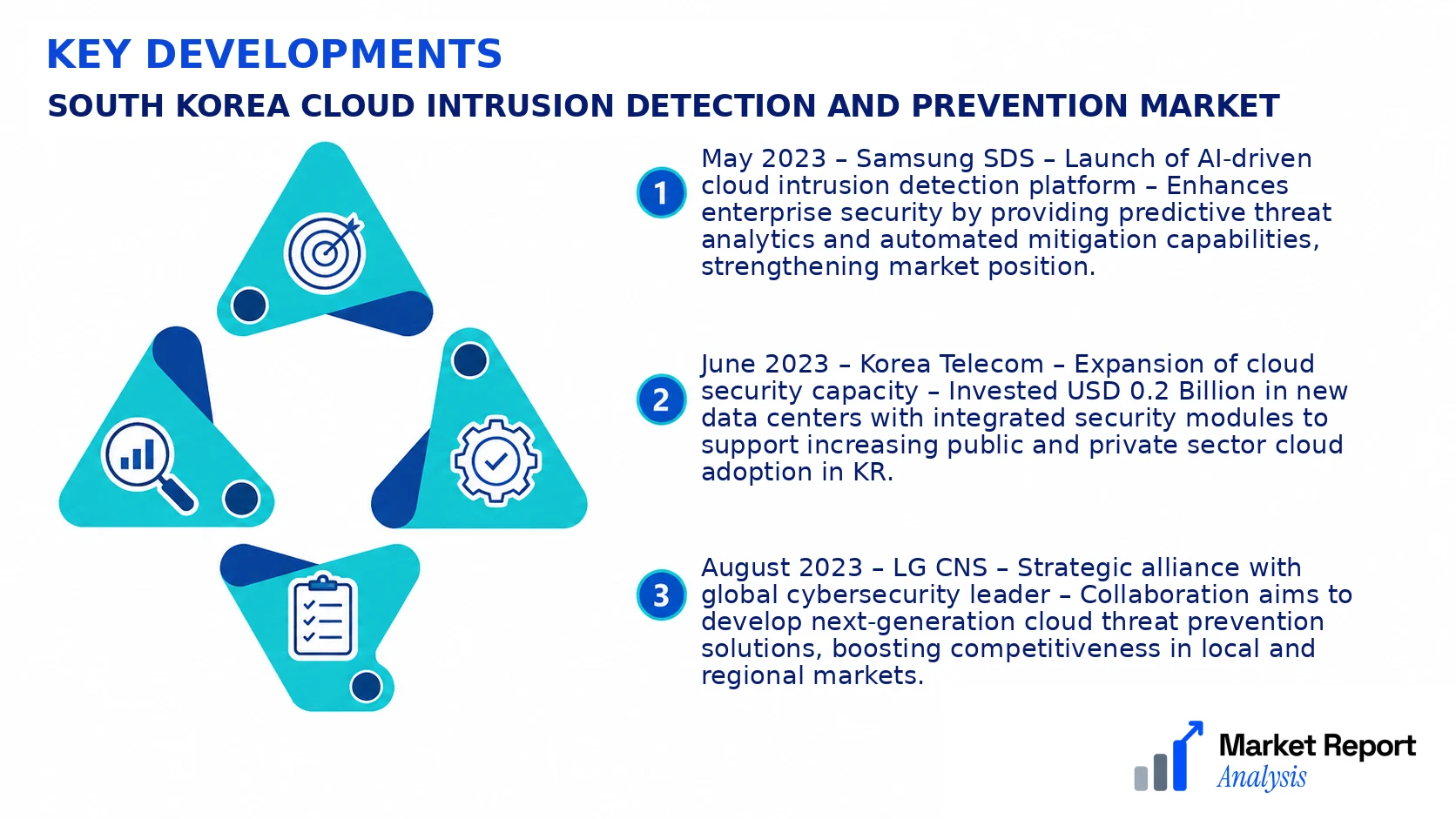
- May 2023 – Samsung SDS – Launch of AI-driven cloud intrusion detection platform – Enhances enterprise security by providing predictive threat analytics and automated mitigation capabilities, strengthening market position.
- June 2023 – Korea Telecom – Expansion of cloud security capacity – Invested USD 0.2 Billion in new data centers with integrated security modules to support increasing public and private sector cloud adoption in KR.
- August 2023 – LG CNS – Strategic alliance with global cybersecurity leader – Collaboration aims to develop next-generation cloud threat prevention solutions, boosting competitiveness in local and regional markets.
- September 2023 – Hancom Secure – Acquisition of a leading AI threat intelligence startup – Focuses on integrating cutting-edge AI detection algorithms into existing cloud security products, enhancing threat response effectiveness.
- October 2023 – SK Infosec – Launch of managed cloud intrusion prevention service – Targets mid-sized enterprises, offering a plug-and-play, compliant security solution optimized for South Korean regulatory standards.
Frequently Asked Questions
What is the South Korea Cloud Intrusion Detection and Prevention Market?
The South Korea Cloud Intrusion Detection and Prevention Market encompasses software solutions designed to detect and prevent unauthorized access and threats in cloud environments. It integrates advanced analytics, AI, and machine learning to ensure data security specifically within South Korean enterprise and government cloud infrastructures.
What is the current market size of South Korea Cloud Intrusion Detection and Prevention Market?
As of 2026, the market is valued at approximately USD 2.1 Billion, reflecting increasing adoption driven by rising cyber threats, cloud migration, and regulatory compliance demands. The market continues to expand rapidly as more organizations prioritize cybersecurity investments.
What factors are driving the South Korea Cloud Intrusion Detection and Prevention Market?
Key drivers include the escalation in cyber threats targeting sensitive data, governmental mandates enforcing cybersecurity standards, growth of cloud adoption among enterprises, and technological advancements in detection systems. Additionally, digital transformation initiatives foster demand for robust security solutions.
Which South Korean city leads the South Korea Cloud Intrusion Detection and Prevention Market?
Seoul leads the South Korean market, driven by its status as the economic and technological hub of the country. The city hosts the majority of domestic and multinational corporations’ headquarters, making it the primary market for advanced cybersecurity solutions.
Which segment is expected to grow the fastest?
The managed services segment is projected to witness the fastest growth, owing to increasing demand for outsourcing complex security operations and a shortage of skilled cybersecurity professionals in South Korea. This allows organizations to leverage expert solutions efficiently.
Who are the leading companies operating in the South Korea Cloud Intrusion Detection and Prevention Market?
Leading companies include global giants like Cisco, Palo Alto Networks, and Fortinet, complemented by local firms such as AhnLab and SK Infosec. These firms deliver innovative, localized security solutions tailored to South Korea’s compliance and operational needs.
Analyst Perspective
The South Korea Cloud Intrusion Detection and Prevention Market is poised for sustained growth, driven by escalating cyber threats and the country's digital transformation initiatives. Over the long term, a combination of stringent regulatory environments and increasing adoption of cloud services will underpin market expansion, with a projected CAGR of approximately 12.3% from 2026 to 2034. Strategic opportunities are significant in sectors such as finance, healthcare, and public infrastructure, where data security is paramount. Technological evolution will focus on integrating AI and machine learning for real-time threat detection and adaptive security responses. Investment priorities should target scalable cloud security platforms and innovations in threat intelligence. Competitive intensity remains high with global and local players vying for market share, emphasizing differentiation through advanced analytics. At the city level, Seoul, Busan, and Incheon are anticipated to lead growth, owing to their robust digital infrastructure and high enterprise concentration. Overall, the market presents lucrative prospects for vendors with technological agility and deep local expertise, while risk mitigation and regulatory compliance will shape strategic positioning.
