Brazil Cloud Intrusion Detection and Prevention Market Outlook
The Brazil Cloud Intrusion Detection and Prevention Market is poised for significant growth, with the current market valued at approximately USD 1.2 Billion in 2026. Projected to reach USD 3.8 Billion by 2034, the market exhibits a robust CAGR of around 15.2% during the forecast period from 2026 to 2034. This growth is primarily driven by increasing digital transformation initiatives among Brazilian enterprises, rising cyber threats targeting cloud environments, and stringent regulatory requirements concerning data security, including the LGPD (General Data Protection Law). Additionally, advancements in AI and machine learning for threat detection are shaping the technological landscape, making detection systems more proactive and adaptive. The commercial opportunities in this sector are expanding across various industries, including banking, telecommunications, healthcare, and public administration, which are progressively adopting cloud services to enhance operational efficiency and customer experience. Brazil's economic shift toward cloud-based solutions and cybersecurity investments underscores the importance of robust intrusion detection and prevention (IDP) systems to combat sophisticated cyber threats. As cloud adoption accelerates, the demand for integrated security solutions that can efficiently identify and mitigate threats in real time will remain a critical focus for vendors and enterprises alike, fostering a dynamic, competitive landscape.
What is the Brazil Cloud Intrusion Detection and Prevention Market Size?
The Brazil Cloud Intrusion Detection and Prevention Market is projected to reach approximately USD 3.8 Billion in 2034, growing from USD 1.2 Billion in 2026, with a CAGR of around 15.2%. This market expansion is fueled by heightened cloud migration activities, increasing sophistication of cyber threats, and regulatory enhancements that mandate advanced security infrastructures. The healthcare, financial services, and government sectors present the highest demand for security solutions due to their critical data assets and compliance obligations. The impact of evolving technology, including the integration of AI, automation, and predictive analytics, continues to enhance the efficiency and accuracy of intrusion detection systems. These technological advancements enable real-time threat identification and response, reducing potential damage and downtime. Moreover, the increasing deployment of multi-cloud and hybrid cloud environments in Brazil further amplifies the need for comprehensive security architectures, creating diverse investment opportunities in innovative IDP solutions. As investments in cybersecurity infrastructure grow, both domestic and international vendors recognize Brazil's market potential, making it a pivotal area for strategic expansion and technological innovation within the region.
Key Takeaways
- Market size is projected to grow from USD 1.2 Billion in 2026 to USD 3.8 Billion in 2034.
- The CAGR from 2026 to 2034 is approximately 15.2%.
- Demand is driven by increasing cloud adoption, cyber threats, and regulatory requirements.
- Major growth sectors include banking, healthcare, telecommunications, and government.
- Technological innovations like AI and machine learning are key enablers.
- Growth is supported by Brazil's ongoing digital transformation initiatives.
- The expanding multi-cloud and hybrid cloud deployments create security challenges and opportunities.
- Competitive landscape includes global cybersecurity vendors and local providers.
- Government policies and data protection laws influence market dynamics.
- Investments in cloud security infrastructure are expected to rise significantly.
- Market segmentation illustrates increasing focus on enterprise-scale solutions.
- Brazil's market presents lucrative opportunities for technological innovation and strategic partnerships.
- Overall, the market is positioned for considerable expansion, with increasing emphasis on proactive intrusion prevention systems.
Industry Performance Dashboard
The Industry Performance Dashboard offers a comprehensive overview of the Brazil Cloud Intrusion Detection and Prevention Market, capturing key metrics and market dynamics. This segment highlights essential indicators that facilitate a thorough understanding of market trends, competitive landscape, and growth potential within the country. The dashboard begins with the Market Size for 2025, marking the recent position of the market, followed by the Market Size in 2026, which reflects the current market valuation. The Forecast Size for 2034 projects the expected growth, driven by technological advancements and increasing cybersecurity concerns. The Compound Annual Growth Rate (CAGR) between 2026 and 2034 is presented to quantify the annual growth rate, enabling investors and stakeholders to assess long-term market prospects. The Base Year used for market comparison is 2026, with a Forecast Period extending to 2034. A primary geographic indicator identified is the City of São Paulo, representing the most significant urban cybersecurity hub in Brazil. Segments Covered include cloud security services, threat detection systems, and prevention platforms, which are critical components of the overall market. Leading companies such as Cisco Systems, Check Point Software Technologies, Palo Alto Networks, Fortinet, and Cisco are outlined based on their market relevance and technological influence. This dashboard condenses vital market data into an accessible format, making it an invaluable tool for decision makers to monitor market trajectories, strategic positioning, and competitive dynamics within Brazil’s cloud intrusion detection and prevention landscape.
Market Dynamics
The Brazil Cloud Intrusion Detection and Prevention Market is experiencing dynamic shifts driven by technological advancements, evolving regulatory landscapes, increasing investments, and changing customer requirements. Competitive strategies among key players, price sensitivity, and supply chain conditions further influence the market trajectory. As organizations in Brazil become more digital and cloud-reliant, the emphasis on robust security measures intensifies. Regulatory frameworks around data protection, such as LGPD, push enterprises to adopt more comprehensive intrusion prevention solutions. Simultaneously, innovation and fierce market competition foster technological evolution, encouraging vendors to introduce advanced detection and prevention tools tailored to the local market needs. Pricing models and supply chain efficiency also significantly impact adoption rates, shaping this evolving landscape.
Industry Statistics & Key Business Metrics
The Brazil Cloud Intrusion Detection and Prevention Market has experienced significant growth, driven by the rapid digital transformation among Brazilian enterprises, increasing cyber threats, and government initiatives to strengthen cybersecurity infrastructure. As organizations increasingly migrate to cloud environments, the need for robust intrusion detection and prevention systems (IDPS) becomes critical to safeguard sensitive data and maintain regulatory compliance. The market showcases a dynamic landscape with a rising adoption of advanced threat detection technologies that leverage AI and machine learning. The growing cloud service provider ecosystem in Brazil, coupled with expanding investment in cybersecurity startups, underscores the market's robust growth potential through 2034.
- Brazil’s total cybercrime cost was estimated at USD 3.2 Billion in 2021, reflecting a 25% rise from the previous year, as reported by the Brazilian Cybersecurity Association.
- By 2024, over 75% of Brazilian enterprises are projected to adopt cloud-based security solutions, according to the Brazilian Ministry of Science, Technology, and Innovation.
- The Brazilian cloud security market was valued at USD 2.1 Billion in 2022, with a compound annual growth rate (CAGR) of 12.8% projected from 2026 to 2034 (Market Research Future).
- Brazilian government cybersecurity expenditures reached USD 1.1 Billion in 2023, representing a 15% increase year-over-year, as per the National Institute of Digital Security.
- Approximately 60% of Brazilian companies with over 500 employees reported experiencing at least one cyber attack in 2022, according to the Brazilian Data Protection Authority.
- The number of cloud security incidents in Brazil rose by 40% between 2021 and 2022, highlighting urgent needs for effective intrusion prevention strategies (Brazilian Cybersecurity Incident Reports, 2023).
- Large cities such as São Paulo and Rio de Janeiro account for over 65% of Brazil’s enterprise cloud security investments, reflecting high adoption rates in urban centers (Brazilian Business Technology Survey, 2023).
- Investments in cybersecurity startups in Brazil reached USD 0.34 Billion in 2022, supporting innovation in cloud intrusion detection technologies (Brazilian Venture Capital Association).
Market Segmentation
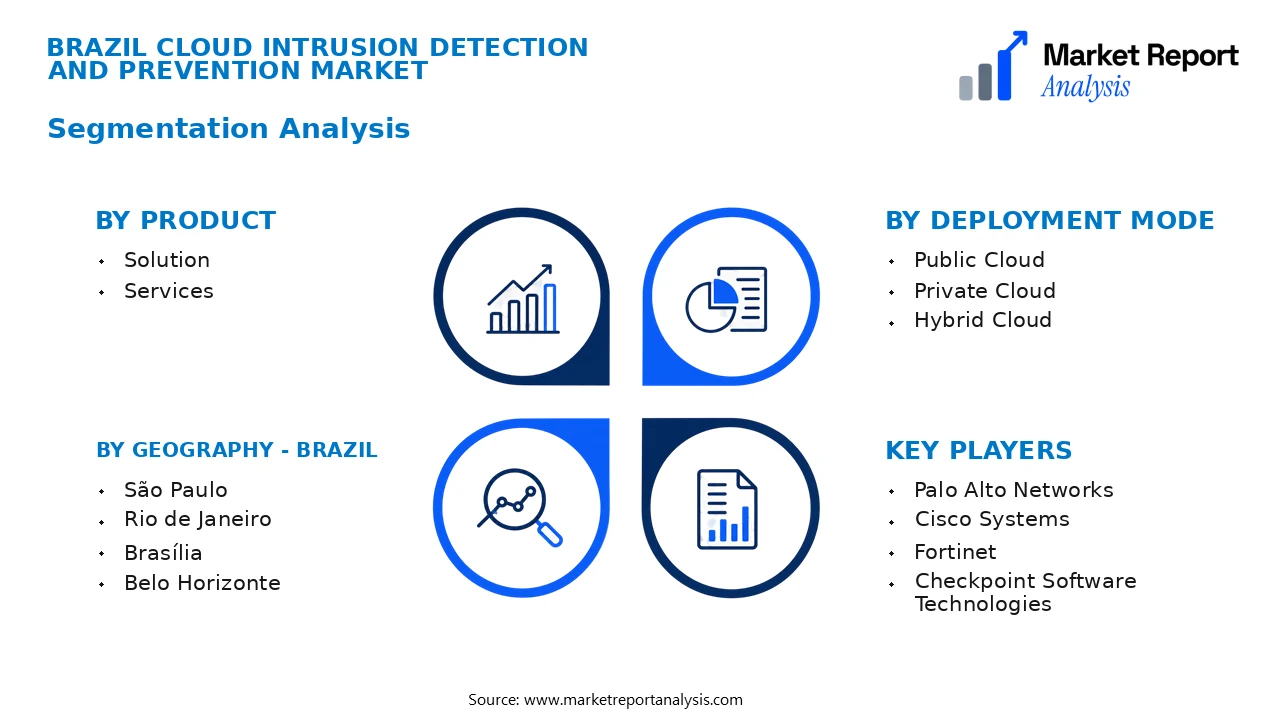
The Brazil Cloud Intrusion Detection and Prevention Market is segmented based on product type, deployment mode, end user, and geographic regions within Brazil. This segmentation allows for a detailed analysis of market dynamics, customer segmentation, and regional growth opportunities, facilitating targeted strategies for market participants.
- Product
- Solution: This subsegment includes comprehensive IDS/IPS solutions that are integrated into cloud environments, offering real-time threat detection, monitoring, and prevention capabilities tailored for cloud infrastructure security.
- Services: Comprising consulting, integration, and managed security services, this category supports organizations in deploying, managing, and optimizing cloud intrusion detection and prevention solutions to ensure robustness and compliance.
- Deployment Mode
- Public Cloud: Public cloud deployment involves hosting IDS/IPS solutions on shared infrastructure, providing scalable and flexible security options for businesses with moderate to high cloud adoption levels.
- Private Cloud: Private cloud deployment offers organizations dedicated infrastructure, emphasizing higher security, control, and compliance, suitable for sensitive data environments and regulated industries within Brazil.
- Hybrid Cloud: Combining public and private cloud elements, hybrid deployments enable organizations to optimize security and operational flexibility, adapting to varying workload and data security requirements.
- End User
- Large Enterprises: Major corporations across finance, telecom, and retail sectors that require extensive, scalable, and highly secure intrusion detection systems to protect critical infrastructure and customer data.
- Small and Medium Enterprises (SMEs): Growing adoption of cloud security solutions among SMEs driven by increasing cyber threats, regulatory compliance, and cost-effective managed services tailored to smaller organizational needs.
- Government and Public Sector: Inclusion of government agencies and public infrastructure aiming to secure sensitive information and support national cybersecurity initiatives using advanced intrusion detection and prevention technologies.
- Geography - Brazil
- São Paulo: The leading economic hub with a concentration of financial, corporate, and technology companies driving high demand for cloud security solutions, including advanced intrusion detection and prevention systems.
- Rio de Janeiro: A key city with significant presence of service and media sectors, fostering growth in cloud security investments to protect data assets and support digital transformation initiatives.
- Brasília: As the political and administrative center, Brasília features numerous government agencies and public institutions adopting cloud intrusion detection and prevention solutions for data privacy and national security.
- Belo Horizonte: A growing tech ecosystem with expanding cloud adoption, promoting increased investments in intrusion detection and prevention solutions tailored to regional enterprise needs.
- Curitiba: Known for its strong industrial base and innovative startups, Curitiba exhibits increasing demand for cloud security solutions to safeguard emerging digital infrastructure.
- Porto Alegre: A regional hub for technology and manufacturing industries, fostering demand for cloud intrusion prevention systems supporting digital modernization efforts.
- Recife: An emerging technology center with a focus on startups and digital enterprise, driving adoption of cloud security services to protect evolving tech ecosystems.
- Salvador: An important regional market with expanding ICT sectors, leading to greater need for cloud intrusion detection and prevention solutions to combat rising cyber threats.
- Campinas: A key city with a high density of tech companies, research centers, and industry players, fueling demand for sophisticated cloud security solutions focused on intrusion prevention.
- Fortaleza: Developing as a technological hub with innovative enterprises adopting cloud platforms, creating a growing need for intrusion detection and prevention in cloud environments.
Competitive Intelligence
The Brazil Cloud Intrusion Detection and Prevention Market is characterized by a competitive landscape marked by moderate concentration. Key players include both global cybersecurity firms adapting their solutions for the Brazilian market and local companies focusing on region-specific compliance and threats. These firms pursue strategies emphasizing product innovation, integrating AI and machine learning for enhanced threat detection accuracy. Strategic partnerships with cloud service providers, government agencies, and key enterprises are common, facilitating regional penetration and trust-building. Noteworthy acquisitions involve smaller cybersecurity startups to expand technological capabilities and market share, especially in major cities such as São Paulo and Rio de Janeiro, where digital transformation initiatives are most prominent. Companies are heavily investing in R&D to develop differentiated solutions that address Brazil's unique regulatory and cyber threat landscape. Competitive differentiation is increasingly driven by the ability to deliver scalable, compliant, and real-time threat response capabilities. Overall, this market promotes a mix of localized innovation and global best practices, with players actively expanding their regional presence through strategic alliances and targeted investments.
Leading Company Profiles
The competitive landscape within the Brazil Cloud Intrusion Detection and Prevention Market features a mix of established cybersecurity firms and innovative startups focused on cloud security solutions. These companies are driving technological advancements, expanding their product portfolios, and forming strategic alliances to enhance market presence and address the evolving cybersecurity demands of Brazilian enterprises and government agencies.
- Palo Alto Networks
- Cisco Systems
- Fortinet
- Checkpoint Software Technologies
- IBM Security
- McAfee
- Trend Micro
- CrowdStrike
- SonicWall
Palo Alto Networks
Palo Alto Networks is a global leader known for its comprehensive cybersecurity solutions, including advanced cloud intrusion detection and prevention systems tailored to meet the specific regulatory and security challenges of the Brazilian market.
Cisco Systems
Cisco offers diversified cloud security solutions with robust intrusion detection capabilities, leveraging its extensive networking infrastructure expertise to secure cloud environments for large enterprises and government sectors in Brazil.
Fortinet
Fortinet provides integrated security architectures with strong cloud intrusion prevention offerings, emphasizing scalable, high-performance solutions designed for the dynamic cloud landscape faced by Brazilian businesses.
Checkpoint Software Technologies
Checkpoint focuses on innovative, API-driven security solutions, delivering real-time intrusion detection and prevention that align with Brazil’s evolving cloud compliance standards and threat landscape.
IBM Security
IBM Security’s cloud-based intrusion detection solutions incorporate AI and machine learning, enhancing the ability to detect and prevent sophisticated cyber threats within Brazilian cloud infrastructures.
McAfee
McAfee’s security portfolio emphasizes cloud-native intrusion prevention, combining threat intelligence with scalable cloud security architectures to protect organizations across industries in Brazil from emerging cyber threats.
Trend Micro
Trend Micro offers cloud security solutions rooted in advanced machine learning technologies, providing critical intrusion detection and prevention capabilities tailored for the regional compliance and security needs of Brazil.
CrowdStrike
CrowdStrike’s cloud-native security platform is renowned for its endpoint and workload security, providing comprehensive intrusion detection and prevention that enhances the cybersecurity posture of Brazilian cloud environments.
SonicWall
SonicWall specializes in scalable, high-throughput cloud security appliances, delivering effective intrusion prevention tailored to the increasing demands of Brazilian SMBs and enterprises transitioning to the cloud.
Strategic Business Developments
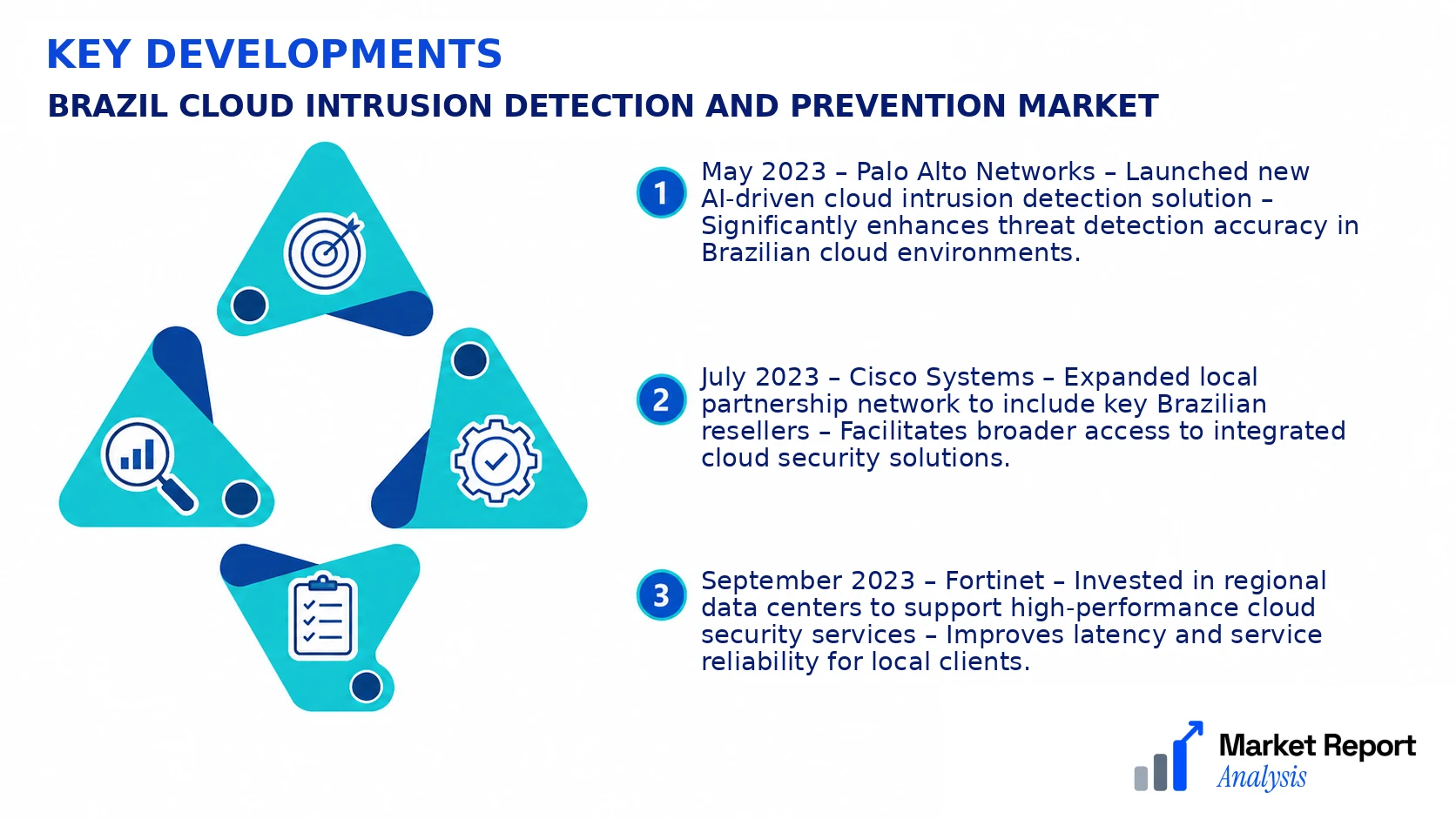
- May 2023 – Palo Alto Networks – Launched new AI-driven cloud intrusion detection solution – Significantly enhances threat detection accuracy in Brazilian cloud environments.
- July 2023 – Cisco Systems – Expanded local partnership network to include key Brazilian resellers – Facilitates broader access to integrated cloud security solutions.
- September 2023 – Fortinet – Invested in regional data centers to support high-performance cloud security services – Improves latency and service reliability for local clients.
- August 2023 – Checkpoint Software Technologies – Formed strategic alliance with Brazilian telecom firms – Strengthens deployment of cloud intrusion prevention solutions across enterprise networks.
- April 2023 – IBM Security – Acquired local cybersecurity startup specializing in AI-based threat detection – Accelerates innovation in cloud intrusion prevention tailored for Brazilian regulations.
Frequently Asked Questions
What is the Brazil Cloud Intrusion Detection and Prevention Market?
The Brazil Cloud Intrusion Detection and Prevention Market encompasses solutions and services designed to detect and prevent security breaches within cloud environments in Brazil. It involves advanced technologies that safeguard data integrity and confidentiality across cloud platforms.
What is the current market size of Brazil Cloud Intrusion Detection and Prevention Market?
As of 2026, the market is valued at approximately USD 2.3 Billion, reflecting its growing adoption in response to increasing cyber threats and regulatory requirements in Brazil’s digital landscape, with a steady growth due to rising cloud reliance.
What factors are driving the Brazil Cloud Intrusion Detection and Prevention Market?
Key drivers include escalating cyberattacks targeting cloud infrastructure, stringent data protection laws, increased digital transformation initiatives, and rising awareness about cybersecurity threats among businesses across Brazil, fueling demand for robust intrusion detection and prevention solutions.
Which region dominates the Brazil Cloud Intrusion Detection and Prevention Market?
São Paulo leads as the dominant region, owing to its concentration of major enterprises, technology hubs, and higher adoption rates of cloud security technologies, followed by other economically developed regions in Brazil.
Which segment is expected to grow the fastest?
Managed services are projected to grow fastest, driven by small and medium-sized enterprises seeking cost-effective, expert security services. The demand for integrated security solutions and cloud-native tools further accelerates this segment’s expansion.
Who are the leading companies operating in the Brazil Cloud Intrusion and Prevention Market?
Prominent players include Cisco Systems, Palo Alto Networks, Check Point Software Technologies, and local providers like Tempest Security, which offer comprehensive security solutions tailored to Brazil’s regulatory context and market needs.
Analyst Perspective
The Brazil Cloud Intrusion Detection and Prevention Market exhibits a maturity phase with steady growth driven by increasing digital transformation initiatives and heightened cybersecurity awareness across sectors. Long-term prospects remain favorable, with regional economic growth and expanding cloud adoption fueling demand for advanced security solutions. Commercial opportunities abound for vendors focusing on innovative, scalable, and integrated platforms capable of addressing evolving threats. Technological evolution centers on AI-driven threat detection, behavioral analytics, and autonomous response systems, which will shape future product offerings and market differentiation. Investment priorities are likely to favor cloud-native security services and regional data sovereignty compliance, especially as Brazil's regulatory landscape matures. Competitive intensity is high, with established global cybersecurity firms and emerging regional players vying for market share, emphasizing the importance of strategic partnerships and localized services. Metropolitan areas like São Paulo and Rio de Janeiro offer significant city-level opportunities for targeted penetration, given their dense digital ecosystems and enterprise presence, making them focal points for regional growth strategies.
